Last Night by James Salter: “Eyes of the Stars”

It is hard not to read this story as an invitation to compare-and-contrast its female characters. Like “Comet”, “Eyes of the Stars” opens with a vivisection of its primary protagonist:

She was short with short legs and her body had lost its shape. It began at her neck and continued down, and her arms were like a cook’s. In her sixties Teddy had looked the same for a decade and would probably go on looking the same, where was not that much to change. She had pouches under her eyes and a chin, slightly receding when she was a girl, that was lost now in several others, but she was dressed neatly and people liked her.

There’s a surprising amount of cruelty and laziness about this description. Teddy’s obesity is characterised as a loss of shape and begins at her neck in a way that invites us to think of her pretty face, which is always the first thing people try to compliment in fat women. Drenched in vinegar, such compliments invariably take the form “…but you have such a pretty face!” as though obesity were a body’s act of betrayal against an innocent and undeserving face. Equally uncomfortable is Salter’s decision to append the description with the rejoinder that “she was dressed neatly and people liked her” so as to assure us that Teddy is not one of those slovenly fat people who are deserving of our unreasoning hatred. The mention of the cook’s arms also gives this passage an edge of snobbery as though Teddy’s weight made her look like a member of the working class.

Uncharitably viewed, this is Salter weaving a character from raw social prejudice. Charitably viewed, this is a deliberate act of cruelty designed to make us think of Teddy as someone who has long been the victim of other people’s unkindness. When I refer to Teddy as the story’s primary protagonist, what I mean is that she is the character with whom we are meant to sympathise. She is the ‘goodie’ for want of a better word.


Continue reading →

REVIEW — Drone (2014)

FilmJuice have my review of Tonje Hessen Shei’s Drone, a shortish documentary about the use of drones in the American War on Terror.

As a long-time science fiction fan who once studied war in an academic setting, I must admit that I find the rise of drone warfare to be an endlessly fascinating subject. Much of what we think of as the modern nation state has been shaped not only by the waging of war but also by the administrative requirements associated with the on-going maintenance of a sizeable security apparatus. Now… imagine what governments might become if that security apparatus were to be entirely automated. Suddenly, there would be no need for a standing military aside from a (largely administrative) officer class and a few special forces types for unusual situations. Given that most Western politicians have abandoned the idea of administering their own country’s infrastructures and economies, would they cling on to the idea of national military forces or would they simply cut a cheque to a military contractor who promised to deliver victory for significantly less than their competition? Given that Western governments have abandoned most administrative duties beyond throwing people in jail and waging wars, would there really be a need for national governments if standing armies became a thing of the past? If a government doesn’t provide healthcare, run schools, repair roads or fight wars then what’s the point of having one at all? Drones aren’t just another piece of military tech, they’re the thin end of the wedge we call tomorrow.  Many academics have realised the significance of this technology and thrown themselves into the study of drones, Tonje Hessen Shei’s Drone is a film that tries to join that conversation but winds up trying to cover way too much ground in way too little space:

Schei’s greatest sin is the failure to corral her ideas and feelings into a single coherent train of thought. Rather than presenting us with arguments or linking up data-points in a manner that encourages further reflection, Schei moves almost at random from complex analysis to footage of angry Peshawaris and then onto footage that could just as easily have been defence industry PR as images culled from the latest generation of video games. The frustrating thing about this documentary is that while it says many interesting things about an absolutely fascinating subject, it feels less like a sustained piece of cinematic argument than a load of raw documentary footage cut together at random.

Drone is a documentary that touches on a number of really interesting questions but rather than looking into the question of why the Pakistani airforce don’t shoot down American drones or how America’s criminally loose definitions of ‘terrorist’ came to form the basis of a rolling campaign of mechanised murder, the film merely touches base with a number of different issues before moving on to the next idea. The weirdest thing about Shei’s decision to cover a lot of ground in so little depth is the fact that the film is only a little over an hour long. Even an extra 20 minutes would have made the difference between ‘incoherent mess’ and ‘structured trains of thought’. Frustrating stuff really.

REVIEW — The Strange Case of Dr. Jekyll and Miss Osbourne (1981)

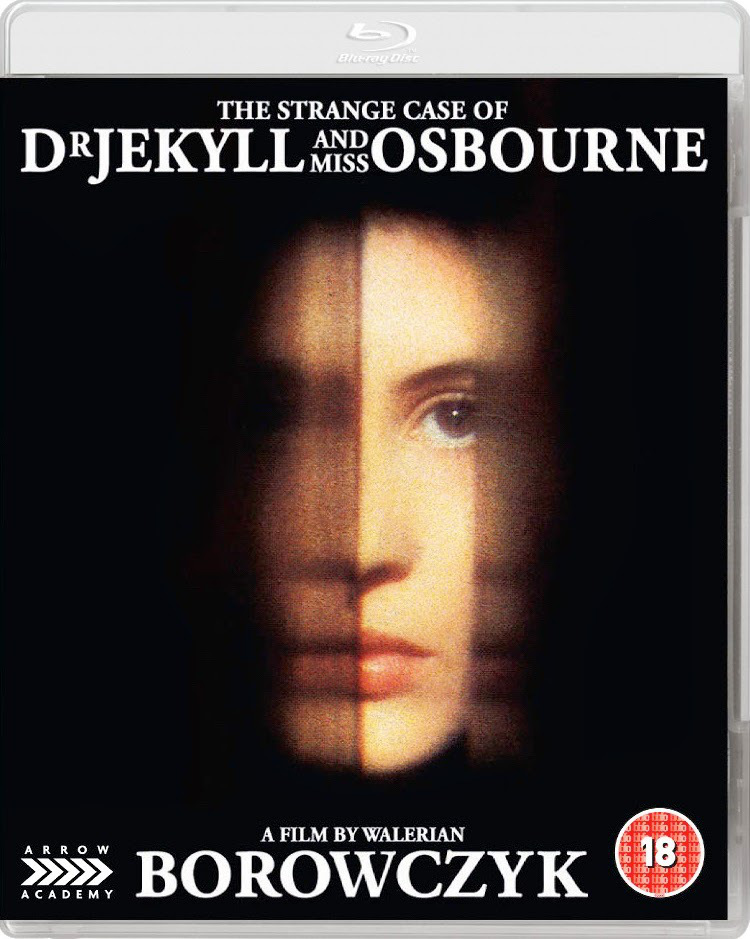
FilmJuice have my review of Walerian Borowczyk’s The Strange Case of Dr. Jekyll and Miss Osbourne, also known as Blood of Doctor Jekyll, Docteur Jekyll et les Femmes and (somewhat generically) Bloodlust. Borowczyk is a director who has grown on me considerably since I reviewed a collection of his films back in September 2014. While I must admit that Borowczyk’s obsession with the transgressive and emancipatory nature of sex leaves me rather cold, I am still drawn to his work by virtue of its sheer uniqueness. These days, art house film is all too often a narrow and generic exercise in pandering to middle-class mores using an ever-shrinking collection of tools inherited from the Golden Age of European art house film. Reminiscent of Pasolini and Von Trier in his more expansive moments, Borowczyk’s work is strange, arresting and completely mental in a way that few contemporary directors even bother trying to emulate.

Less singular but more accessible than Blanche (Borowczyk’s best film), I describe The Strange Case of Dr. Jekyll and Miss Osbourne as:

Gloriously amoral and more than slightly bonkers, this is a film in which parents, society, art, science, and God are all brought low before the terrifying power of the orgasm.

As the title suggests, the film is a re-working of Robert Louis Stevenson’s The Strange Case of Dr. Jekyll and Mr. Hyde that focuses on the journey undertaken by Jekyll’s fiancee Fanny Osbourne (named for Stevenson’s real-life partner). Borowczyk views Stevenson’s novella as a meditation on Victorian sexuality and the tendency of certain men to keep their vices private even from their own wives. In the world of the Borowczyk’s film, Jekyll is a repressed Victorian scientist who assumes the Hyde persona in order to satisfy a variety of transgressive urges which, if known, would completely undermine Jekyll’s social standing. The film finds Jekyll trapped between his two personae as he struggles to choose between a life of violent debauchery as Hyde and a life of privilege and power as Jekyll. Psychologically unstable, Jekyll moves back and forth between the two personae until his fiancee works out what is going on and solves his dilemma by choosing to take the potion herself and join her husband in a state of complete indifference to bourgeois morality.

Arrow films scanned the film themselves (working from an original negative with the help of Borowczyk’s original cinematographer) and it looks fantastic. Also wonderful is Michael Brooke’s discussion of the film in which he talks about seeing it for the first time in one of London’s long-lost and much-missed flea-pit cinemas. I found this discussion particularly evocative as while I grew up in London and got into film at quite a young age, those types of cinemas had completely disappeared by the time I was old enough to visit them. In fact, by the time I started visiting the West End on my own, the ‘re-development’ of Soho and Tottenham Court Road were already well under way and thinking about a Leicester Square filled with cinemas showing soft-core porn and horror is very much like thinking of some mad parallel universe… only with less airships and more films about Swedish au pairs.

I remember once reading a story about someone going to see Stalker in a cinema near Victoria station. The film started but the person sharing the story kept on being distracted by loud slurping noises coming from the row behind him. Hoping to tell whoever it was to pipe down, they turned around in their seat only to find themselves face-to-face with a man who was eating a plum whilst tossing off the bloke sitting next to him. Funny how our patterns of media consumption change… nowadays they bloke with the plum would probably be watching Avengers.


REVIEW — Paper Moon (1973)

FilmJuice have my review of Peter Bogdanovitch’s Paper Moon, a film I did not expect to like but wound up absolutely adoring.

The Coen Brothers’ O Brother, Where Art Thou? left me with what I consider to be a healthy scepticism of American films set during the great depression. Though many a director has set out with a head full of social realism and the urgent need to capture what things can be like for capitalism’s victims, most of them wind up getting distracted by the slang, the hats, the music and the endlessly photogenic poverty. Add a few fast-talking grifters to the mix and what you have is a recipe for self-mythologising nostalgia: Sure the excesses of capitalism can destroy communities and drive people from their homes but these are also moments of opportunity for the kind of lovable rogues who not only benefit from other people’s misery but actively legitimise the capitalist system by proving that America is still a land of opportunity for those who are smart, lucky and charming! I approached Paper Moon expecting another lesson in America’s capacity for economic re-invention but what I found was a beautiful and genuinely funny character study of one fucked up little girl:

Aside from the film’s gritty look, what keeps the film on the right side of sentimentality is its willingness to share Addie’s profound distrust of human relations. Only child of a woman who made her living as a bar room honey, Addie’s skinny frame, ugly clothes and fondness for cigarettes display all the signs of historic neglect. Before Addie even opens her mouth, we are shown the ‘warm-hearted’ Christian neighbours who are so desperate to get rid of her that they literally dump her on the first stranger who passes through town. Addie is desperate for family but rightly wary of people who would proclaim their righteousness only to reveal their hypocrisy in secret, she warms to Moses precisely because his displays of piety are understood to be nothing but an act.

And when I say ‘beautiful’, I mean genuinely jaw-dropping. This Masters of Cinema release is dual-format but the screener I received was DVD-only, which genuinely surprised me as I can’t remember the last time I saw a DVD look this perfect.


Consider, for example, this shot of a factory from early in the film, it’s not just that the buildings themselves look amazing, it’s also the composition and the attention to detail as Ryan O’Neal gestu8res to his daughter while workers toil in the background:


PM1


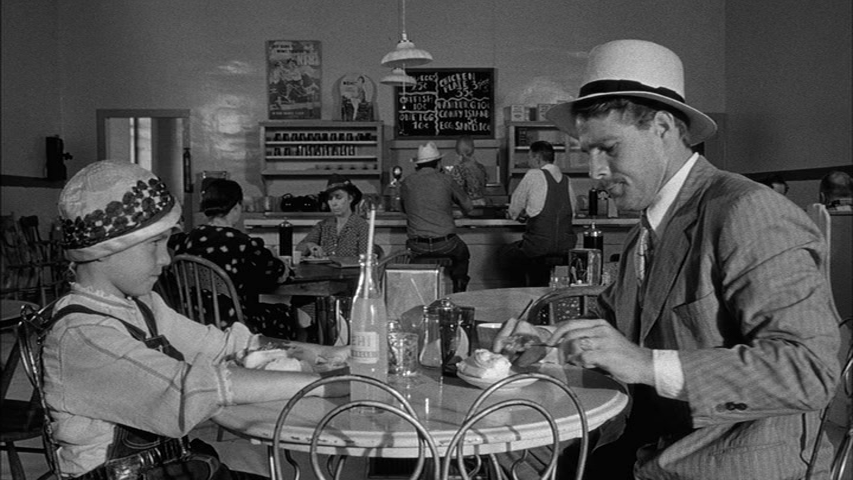
Despite producing three back-to-back hits that made a shit-ton of money and won people armfuls of awards, Bogdanovitch’s place in the canon of American filmmaking is far from guaranteed. It’s not just that the quality of his films seemed to decline as his career progressed, it’s that his ability to produce great films seemed to evaporate the second he parted company with his wife and production designer Polly Platt. Both Peter Biskind and David Thomson float the possibility that Platt was the real talent behind Bogdanovitch’s directorial throne and the complexity of Paper Moon‘s art direction certainly supports this theory. For example, look at how much detail is crammed into this image from a short scene in a diner… It’s not just the composition and how the straw in the bottle of Nehi seems to split the screen, it’s also the positioning of extras so that the men are clustered on one side of the screen while women are mostly clustered on the other:


PM2


The Masters of Cinema release comes with some interesting discussions of the film and one of the point that people make is that Paper Moon is a film in which everything is always in focus and how the positioning of background details not only aid the composition but also help to create the impression of a real world. The extras point to this exquisite combination of shots from when Moses tries to get rid of Addie by sticking her on a train:
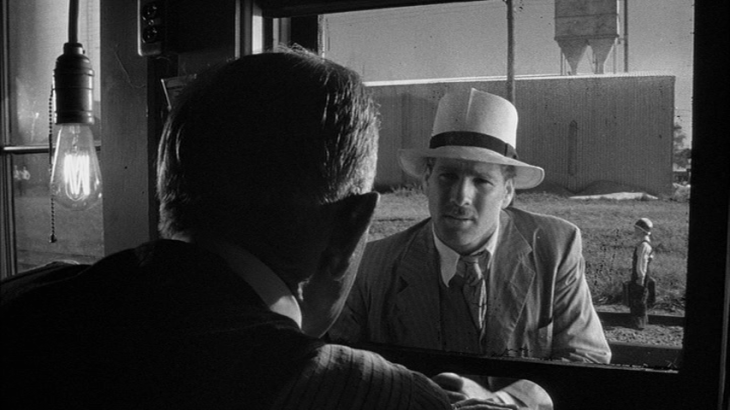
 

PM3a


Note Addie looking sad in the background and compare it to the shot that immediately follows it:


PM3b


Look over the ticket-seller’s shoulder and you’ll see kids playing with a ball.  This not only echoes the shot of Addie looking sad, it also foreshadows the questions posed in the final act about whether Addie is actually in a position to make her own decisions and whether she is right to stick with Moses. In the context of these two shots you have a sad-looking Addie standing next to Moses and a pair of kids playing happily on the other side of the rail road buildings.


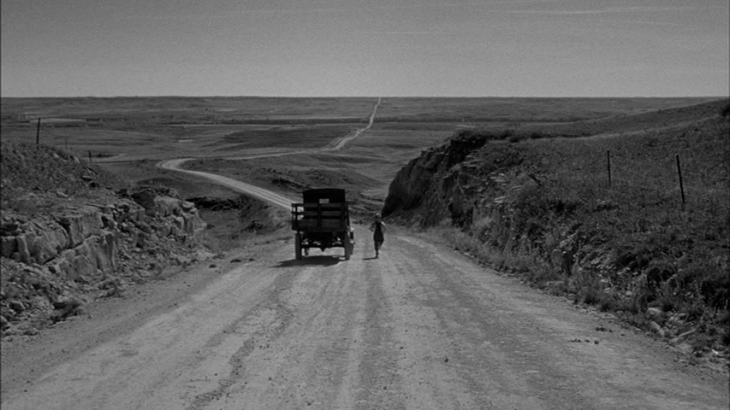
Another thing the extras reveal is that Platt not only convinced Bogdanovitch to work on Paper Moon and dressed the sets, she also served as a location scout meaning that all of the film’s evocative scenery was chosen by Platt rather than Bogdanovitch. Bogdanovitch started his career as an actor before falling into film criticism and many people seem to associate him with the rise of auteur theory in American film-writing. The auteur theory would certainly struggle to account for a production designer with the capacity to pick up on locations that are literally idiot-proof:

 

PM5

PM6

Last Night by James Salter: “Comet”

It occurs to me that a gap has emerged between the types of film that I enjoy and the types of book that I tend to read.

As the contents of this blog suggest, I am generally drawn to small, intimate and psychological films that ask a lot of their audiences. Made with a painter’s eye and a jeweller’s hand, these films demand not just a familiarity with the language of cinema but also a capacity to sift the debris of fictional lives for traces of raw humanity. If forced to choose a film that most captured my current mood, I would happily point to Francois Ozon’s 5×2 as it strikes the major chords of a modern marriage only to then invite the audience to speculate as to nature of the tune that once united them.

Given that the books I read generally keep humanity at arm’s length, I thought it might be fun to seek out some literary short fiction that adopted a similar relationship to its readers as the works of Claude Chabrol and Francois Ozon. Hell…. Reading something a bit different might also help to improve my reading skills, which have atrophied considerably since I stopped regularly reviewing books.

I wanted a work that would present me with beautiful human puzzles and my search eventually lead me to James Salter’s Last Night. It is my intention to write a little something about each of the book’s ten stories, starting with “Comet”.

As I write, I have not yet finished Last Night but I have read a few stories ahead in an effort to familiarise myself with Salter’s techniques and spot any recurring themes. The first theme to emerge from my reading is an interest in older sexualities and the emotional lives surrounding them. “Comet” is a story that invites us to consider the differences between a freshly-married bride and groom.

Continue reading →

Gaea Girls (2000) — Those Aren’t Real Tears

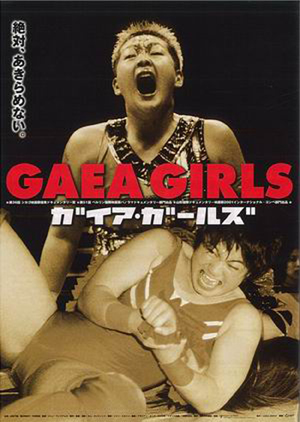
Back in the early 1980s, Chigusa Nagayo and Lioness Asuka formed a professional wrestling tag-team known as The Crush Girls. Part of the second generation of Japanese professional wrestlers, the Crush Girls proved so impossibly popular that they changed the face of professional women’s wrestling and raised the bar for female wrestlers all over the world. Despite their immense popularity, the Crush Girls split up in 1989 when they reached the then-mandatory retirement age of 27. Six years later, Chigusa Nagayo came out of retirement to found Gaea Japan, an entirely new wrestling promotion in which she would also play out a long-standing grudge with her one-time partner Lioness Asuka. Kim Longinotto and Jano Williams’ Gaea Girls is a documentary filmed in and around the training facilities of Gaea Japan that looks at how aspiring female wrestlers cope not only with the traditionally male-dominated world of professional wrestling but also with Chigusa Nagayo’s ideas about parenting.

Continue reading →

Shinjuku Boys (1995) — Even When Words Fail

The Austrian philosopher Ludwig Wittgenstein once wrote that “The limits of my language mean the limits of my world”. What Wittgenstein actually meant remains a subject of philosophical debate but we can read his comment as a reflection upon the two-way relationship between our perception of the world and the ways in which we talk about it.

Intuitively, facts should always take precedence over language and whenever we encounter a fact that does not fit with our use of language, we should simply update our vocabulary to better reflect the facts on the ground. While there are certainly institutions and groups who try to educate people about ‘correct’ language use, the meaning of a word is always determined by the way it is most commonly used by a given population. What this means in practice is that while experts may be forever inventing language that is a better fit with current thinking about a particular phenomenon, having those new terms filter down into general usage is subject to the same structural biases as any other attempt at changing the way that people think.

The problem with the rigidity of our spoken language is that the vernacular often contains concepts and assumptions that are not only out of date but actively harmful. For example, if we define masculinity in terms of having a penis then someone who identifies as male despite not having a penis must simply be wrong about their gender. While there was a time when our culture was quite happy to make this type of judgement, our understanding of gender has now evolved to the point where terms like ‘male’ and ‘female’ are becoming increasingly hard to pin down.

The language of gender and sexuality has evolved with almost unprecedented speed over the last few decades and new conceptual iterations seems to generate more and more political heat as words are fought over by people with different needs and ideas. If the limits of our shared language mean the limits of our world then the battle to control the conceptual underpinnings of our language is also the battle to control our world.

Directed by Kim Longinotto and Jano Williams, Shinjuku Boys is a documentary about a group of people who were assigned female at birth but identify more closely with the male gender than the female. Made all the way back in 1995, I am sure that many of the terms used in this documentary are horrendously outdated but while Shinjuku Boys may struggle with its pronouns, it does show how people will continue to perform and negotiate their genders even when words fails them.


Continue reading →