REVIEW – Colossal Youth (2006)

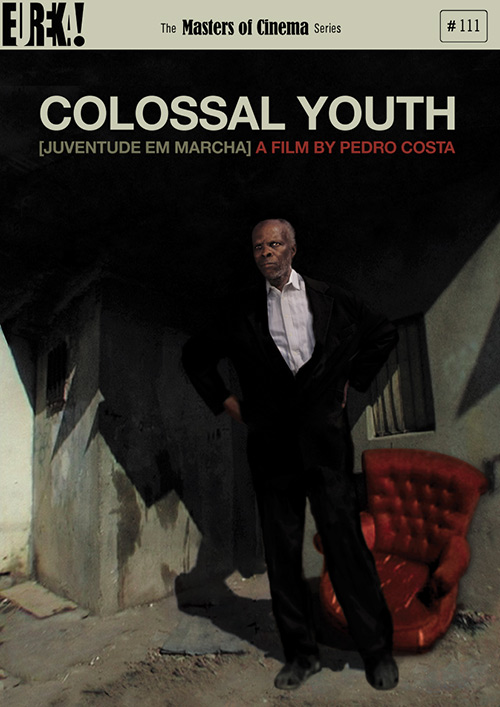
Videovista have my review of Pedro Costa’s Juventude em Marcha, which has been released by the always excellent boutique DVD and Blu-ray label Masters of Cinema.

While Colossal Youth is not the first Pedro Costa I have seen, my familiarity with the filmmaker’s work in no way made it either an easier or a more appealing watch.  The film is beautiful, intelligent and is inspired by the same singular vision that pervades all of Costa’s work but it is also cataclysmically boring and inaccessible. This is art house film making without compromise or concession, either you accept the film on its own terms or you don’t bother:

While Costa’s films are almost completely unwatchable, there is clearly a coherent vision behind the impenetrable boredom that dominates his films. Because this coherent vision exists, Costa has found an audience for his decidedly singular and experimental approach to filmmaking. Indeed, while I suspect that Costa has few followers outside of academic film studies and film schools, the substance that exists in his work means that his films contribute to the evolution of the cinematic form. While the films that Costa makes may be boring and unwatchable, they will be influential and it would not surprise me if Costa’s devotees can find echoes of his work in that of the filmmakers who have come after him. As boring as his work may be to me, I cannot deny that Costa is an important figure and that his films constitute a boon to the on-going evolution of the cinematic form.

Going by the recent output of Colin Marshall’s excellent podcast Marketplace of Ideas, I get the impression that certain elements of the lit-blogosphere are attempting to re-claim boredom as a position of spiritual strength and a reaction against the media-saturation and sensationalism of much of Western culture. It seems to me that Costa’s work would probably make a good case-study for people sympathetic to that position.

Amer (2009) – Faceless Wordless Passion

In 1963, the Swedish director Ingmar Bergman concluded what has become known as the Trilogy of Faith.  Prior to this trilogy, many of Bergman’s films tended to revolve around questions of religion and faith as their characters struggled to find meaning in the meaningless void of life.  Paradoxically, the Trilogy of Faith marked a departure in Bergman’s filmmaking as it displayed an interest not in God but in people. In Through a Glass Darkly (1961) and Winter Light (1962), Bergman explored the roots of religious faith and how that faith might be lost.  In The Silence (1963), Bergman examined a world characterised only by absence; absence of God, absence of faith and absence of speech.  As Bergman himself put it:

“These three films deal with reduction. Through a Glass Darkly – conquered certainty. Winter Light – penetrated certainty. The Silence – God’s silence – the negative imprint. Therefore, they constitute a trilogy.”

What Bergman found when he stripped away God and faith was a world of passion and turmoil, a world in which nobody speaks but everyone yearns.  The Silence is a remarkable film in that it manages to be both intensely psychological and almost entirely free of dialogue. Helene Cattet and Bruno Forzani’s Amer marks a return to Bergman’s silent realm of desire, passion, alienation and horror.

Continue reading →

Final Destination 5 (2011) – The Last Laugh is On Us

The literary critic Paul Bleton argues that the difference between genre and non-genre pieces is that genre pieces have a structure resembling that of a string of pearls.  What Bleton means is that genre (whether erotic, sensational or criminal) is all about big dramatic set pieces.  These dazzling moments of spectacle attract the eyes, stimulate the brain and distract you from the fact that the plots and characters they involve frequently serve no purpose other than to tie the set-pieces together into something broadly resembling a story.

Interesting though it may be, Bleton’s conception of genre is now seriously out of date.  Firstly, a generation of writers and directors with interests in character and subtext have worked at reclaiming genre devices so as to blur the distinction between pearl and string.  Secondly, a generation of directors including Michael Bay (Transformers), Gore Verbinsky (Pirates of the Caribbean), and Mark Neveldene and Brian Taylor (Crank) have stripped away the fig leaf of plot and character to produce films that are nothing more than series of set-pieces held together by implication and the fact that they are packaged and sold as a single artistic unit.

With the difference between genre and non-genre under continuous assault on multiple sides, there is something pure and elegant in a film that is unapologetic in its string of pearls-like structure.  The Final Destination series has never been anything other than a series of lavish set-pieces held together by weak plots and terrible characters but in that terrible predictability lies real profundity.

Continue reading →

REVIEW – Attenberg (2010)

FilmJuice have my review of Athina Rachel Tsangari’s Attenberg.

Much like last year’s Dogtooth (whose director both produced and acted in this film), Attenberg is an account of young people struggling to escape the surreal worlds constructed by their parents. The parent in question is an unnamed engineer who produced factories and housing estates so soul-crushingly mundane, it is hardly surprising that he dragged his daughter into a weirdly skewed parallel world.  With the engineer now struggling against a terminal illness, his isolated only daughter is forced to grow up fast:

Much like Dogtooth, Attenberg is ultimately a film about the transfer of power from one generation to the next.  Both films present the post-War Baby Boomers as a generation of addle-brained fantasists and control freaks. Flattered by decades of economic growth into an all-consuming sense of entitlement, the Baby Boomers nurtured a vision of the world that bore very little resemblance to reality.  As the post-War generation grows older and their children reach adulthood and middle-age, the Baby Boomers try their best to protect their vision of the world despite the terrible economic and psychological consequences of their delusions.

I was somewhat conflicted over Dogtooth but Attenberg, it seems to me, hits all of the same notes in far more resonant a fashion.  Singular and utterly entrancing.

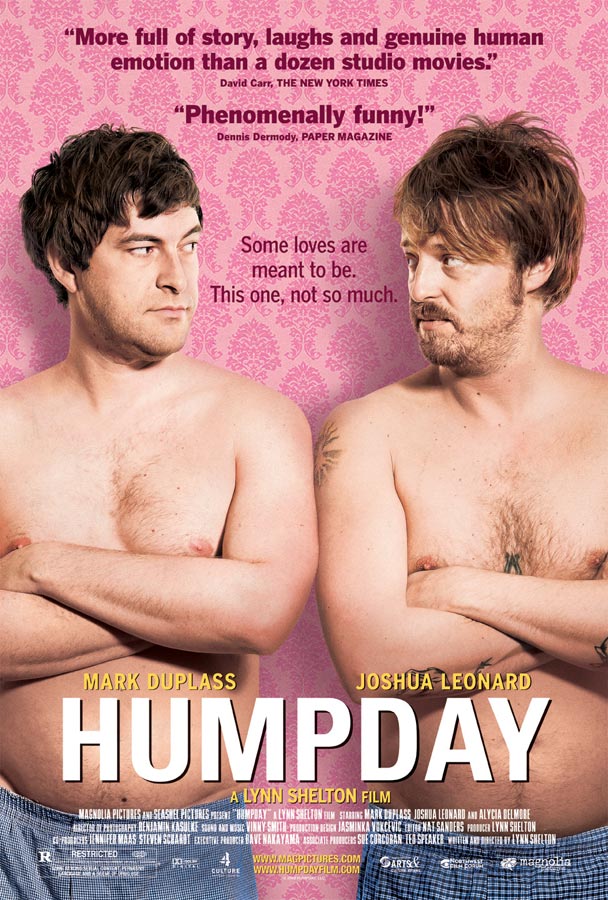
Humpday (2009) – No Pretty, No Mercy

While I am happy to join the chorus of disapproval surrounding the state of British universities, I cannot help but feel that there was something inevitable about the current wave of cuts and restructurings.  The problem is that, while there has been a massive expansion in higher and post-graduate education, much of this expansion was founded on a lie, the lie that you can teach someone to be insightful. Universities are brilliant at immersing you in a subject and teaching you to produce papers that look like the sort of things that academics should produce, but they cannot teach you to look at a phenomenon and say something truly original.  You cannot teach originality because you cannot teach creativity and you cannot teach creativity because you cannot teach insight.  Nowhere are the products of this lie more obvious than in contemporary film.

As Peter Biskind points out in the excellent Easy Riders, Raging Bulls (1998), people seldom attended film school in the 1970s.  Film schools existed but they held no status, carried no cachet and (most importantly) provided no guarantee whatsoever that any of their students would ever get to sit behind a camera and shout ‘Action’. Forty years later and film schools not only provide universities with a welcome source of income, they also provide the creative industries with a steady supply of competent individuals who are more than ready to step behind a camera and produce adverts, music videos and films on demand. Film schools train aspiring directors by helping them to deconstruct and replicate the techniques that made great films what they are. Because film schools are so popular and because they are so well attended, contemporary film boasts levels of technical sophistication that would humble the filmmakers of previous generations. Unfortunately, while film schools do a brilliant job of teaching people how to make a film, they cannot teach them how to make good and insightful art.  Because of this, the explosion of film school students has lead not to a generation of great directors but to a generation of skilled imitators.

In Narration in the Fiction Film (1985), David Bordwell masterfully deconstructs the techniques used in what he calls ‘Art-Cinema Narration’.  This form of narration involves the use of extended silences, gaps in narration and expressionistic visual composition that shed light on the characters’ inner states.  While these techniques may once have been radical and ‘difficult’, they are now as familiar to cinema-going audiences as the strictures of any populist genre.  Because these techniques are familiar, they can be adopted in order to lend a work an ‘art house sensibility’.  The textbook example of this sort of affection is Matthew Weiner’s period TV drama Mad Men.  As Daniel Mendelsohn points out in his piece in the New York Review of Books, Mad Men is effectively a soap opera.  However, because the series adopts many of the narrative tropes and techniques common to art house film, we assume that it is as intelligent and insightful as the art house films that pioneered these sorts of narrative techniques.  Because Mad Men’s plotlines are never resolved, we think the series is as smart as L’Avventura. Because Don Draper’s internal state is only ever alluded to in an elliptical fashion, we think the series is as smart as Last Year in Marienbad.  Films such as Samuel Maoz’s Lebanon (2009) and Mike Mills’ Beginners are also excellent examples of works that look intellectually substantial but in fact have very little to say. Clearly, techniques developed in order to help filmmakers shed light on a new set of issues are now used to evade the responsibilities of coherent thought and genuine insight. What was shocking is now familiar.  What was revolutionary is now consolatory. When technical expertise carries more weight than genuine insight mere competence becomes downright heroic.  Mumblecore is a cinematic movement that finds virtue  and strength in technical mediocrity.

Mumblecore films such as Andrew Bujalski’s Funny Ha Ha (2005) and Aaron Katz’s Cold Weather (2010) are made on ultra-low budgets with minimal production values, largely non-professional actors and scripts that allow for a good deal of on-set improvisation.  Stripped of complex camera movements, lighting effects and art-house narrative techniques, Mumblecore films stress relationships over plot in such a way that the emotional and psychological meat of the film has no place to hide.  Mumblecore films are all about character and relationships and their power derives from a complete commitment to exploring these things in forensic detail. No handwaving. No distractions. No bullshit.  Lynn Shelton’s Humpday is brilliant in its unflinching commitment to the weakness and complexity of its characters.

Continue reading →

Robinson in Ruins (2010) – Mould on a Dystopian Corpse

Back in the 1990s, the filmmaker and architectural scholar Patrick Keiller made a pair of films about Britain. As much video essays as they were documentary films, London (1994) and Robinson in Space (1997) were concerted attempts to find the true spirit of Britain that had been buried by a decade and a half of Thatcherite rule.  Sensing that the wheels were coming off the Tory juggernaut and that a fresh start would soon be required, Keiller used the eccentric academic Robinson and a wryly-comic unnamed narrator to sift the wreckage in search of gold.  Unfortunately, despite the best efforts of Keiller’s intrepid explorers, the project was a political failure: Britain, much like its capital city, was a place devoid of any truth that could not be measured in pounds, euros, dollars or units of industrial measurement.  London and Robinson in Space are films about the defeat of the romantic spirit and the absolute victory of neoliberalism.

Over a decade later, Keiller returns with Robinson in Ruins, an unexpected addendum to the Robinson duology.  With the narrator dead and Robinson gone, the narration has fallen to an equally unnamed female public sector worker (voiced by Vanessa Redgrave) who discovers Robinson’s footage and notes in an old caravan on a site destined for re-development. Made at the height of the credit crunch, when the towers of Capitalism tottered and nearly fell, Robinson in Ruins is far less pessimistic than either London or Robinson in Space.  Eerily apocalyptic and as visually arresting as all of Keiller’s work, Robinson in Ruins suggests that humanity’s salvation may lie in communion with non-human intelligences.

Continue reading →

Some Thoughts On… Project Nim (2011)

Last year, the French documentarian Nicolas Philibert produced Nenette (2010), a film that used footage of an orang-utan and recordings taken in a zoo to demonstrate the human tendency to project human emotions onto animals. Nenette also demonstrated that human speculations about the inner lives of apes tend to tell us a lot more about the humans than they do about the apes. James Marsh’s latest documentary Project Nim ploughs much the same furrow by exploring the attempt by a group of 1970s scientists to teach a chimp to sign.

Project Nim focuses upon the story of Nim Chimpsky, a chimpanzee who was removed from his mother and brought up by humans in an attempt to see if treating a chimp like a human might encourage him to think and communicate like one.   Initially, Nim is entrusted to the care of a wealthy hippy family whose laid-back approach to parenting results in Nim effectively taking control of the house.  Concerned that the chimp is getting what he wants through social dominance rather than by acquiring language skills, the project director Herbert S. Terrace removes Nim from his surrogate family and places him in the care of a group of specialised teachers.  While these teachers manage to imbue Nim with an incredibly rich vocabulary, the older Nim becomes, the harder it is to control him. When Nim bites his teacher’s face, Terrace decides to end the project and place the chimp in a research facility where his life gets progressively worse.

The foreground of the documentary is devoted to a somewhat uneven engagement with the project’s ethical standards. Terrace is depicted as a shameless opportunist who uses both his students and Nim to build an academic career before cutting both adrift without a moment’s hesitation or regret.  While this foreground narrative produces a number of touching moments, it is fatally undermined by Marsh’s bizarre insistence upon reminding us that Nim is a wild animal who should not be thought of in human terms.  The result is a film that coaxes its audience into empathising with a chimp before slapping them down for doing precisely this.  Mercifully, the film’s background proves far more rewarding.

Stepping back from the details of Nim’s life, Project Nim does an absolutely brilliant job of conveying the weirdness of 1970s academic culture. For example, Nim’s original foster family included a woman who breast-fed Nim and then allowed the chimp to ‘explore her body’ as part of her informal personal research into the Oedipus complex. Predictably enough, once Nim is transferred to the care of a group of scientists, they follow the original foster mother in using Nim as a vehicle for their own desires and ambitions. One ambitious graduate student wrestled control of Nim’s education from the foster family as a means of acquiring Terrace’s attention, this lead to a brief affair that resulted in one dumped graduate student and one chimp deprived of a mother-figure. The more figures from Nim’s life the film introduces, the more obvious it becomes that while everyone was eager to do what was best for Nim, their assessments of what was ‘best’ usually depended upon what was convenient for them.  This is particularly obvious in the case of Terrace whose termination of the project results in Nim being sold for medical research.  His charge cast into the outer darkness, Terrace promptly produced a book in which he argues that Nim was nothing more than a hugely accomplished beggar who never really understood the language he was using. Unsurprisingly, the humans who come across as most sympathetic are the ones whose visions of Nim emphasise his human characteristics.  Particularly sympathetic is the Dead Head primate handler who treats Nim as just another pot-smoking fellow traveller.

The fact that our sympathies tend to lie with those who treat Nim like a person rather than an animal says a lot about our own empathic tendencies and the film’s capacity for inviting us to fall into the same trap as Nim’s original handlers.  However, as clever as this manipulation may be, the film’s refusal to engage with empathic projection head-on results in frustratingly lightweight fare. Yes, we extend empathy to a chimp because the chimp behaves like a human but so what? What does this say about us? What does it mean for our relationships to animals as a whole? Are we wrong to treat animals as humans or are those who treat chimps like animals unethical monsters? Project Nim tries to address some of these questions without getting bogged down in the sort of heavy philosophical speculation that might alienate audiences but by raising questions in such an oblique fashion and then failing to develop them in any meaningful way, Project Nim only manages to remind us of quite how much can be achieved with footage of an orang-utan and the sound of zoo visitors wildly projecting their own worries onto the indifferent figure of an ape.
Rise of the Planet of the Apes (2011) – Arrested Arrested Development

Reboots are predicated upon the idea that franchises have natural lifespans. The cycle begins with a single luminous idea that is transformed into a film, a book, a game or a TV series.  The brilliance of the idea is such that its chosen media vehicle becomes a huge success.  Desperate to cash-in on the success of that idea, its owners will then sanction the creation of sequels, prequels, spin-offs and media tie-ins that make them a lot of money whilst devaluing the original idea thanks to over-exploitation, over-familiarity and the corrosive inertia of too many bad decisions.  Down on its luck, the franchise then lies dormant until people either forget the bad decisions or a new idea reinvigorates the old one allowing the franchise to be re-launched, re-imagined or re-booted.

In 1968, Pierre Boulle’s 1963 science fiction novel gave birth to a surprisingly thoughtful and visually striking film directed by Franklin J. Schaffner. Planet of the Apes was such a success that it went on to spawn four cinematic sequels and a short-lived TV series, by which time the idea was well and truly played out (for a great overview of the original films, check out Matt Singer’s piece here).  Mindful that TV repeats and home video cinephilia had transformed these old films into objects of cult veneration, studio executives hired Tim Burton to helm a ‘re-imagining’ of the original franchise.  However, far from re-invigorating the franchise, Burton’s under-written chase picture only served to bury it beneath an avalanche of sneers and titters rendered all the more toxic by that Simpsons episode. Planet of the Apes!  What a stupid idea for a movie!

Fast-forward ten years and trailers for a new Planet of the Apes movie began to appear in theatres and websites.  The trailers for Rupert Wyatt’s Rise of the Planet of the Apes featured lots of CGI and a gorilla attacking a helicopter. When I first saw this trailer in a cinema, people laughed. However, far from being risible, Wyatt’s finished film is nothing short of a triumph. A delicious surprise given its recent cinematic antecedents, Rise of the Planet of the Apes is one of the most effective and thought-provoking Hollywood films to appear this year.

Continue reading →

Drive Angry (2011) – And Hungry… And Horny…

Half an hour into Patrick Lussier’s uneven but ultimately likeable neo-grindhouse pseudo-exploitation film Drive Angry, there is a scene that manages to perfectly encapsulate what it is about this film that makes it both intensely silly and surprisingly interesting. In this scene, Nicolas Cage’s character John Milton is having sex with a waitress he picked up in an Oklahoma roadhouse. As the naked woman groans in pleasure and writhes around on the end of his (presumably massive) penis, Cage’s character stares impassively into space from behind a large pair of wrap-around shades. Despite being in mid coitus, Milton is fully dressed and smoking a (noticeably massive) cigar. He also has a bottle of Jack Daniels in one hand. When a bunch of Satanists come crashing through the door hoping to kill Cage’s character, Cage calmly scoops up the waitress and proceeds to shoot them all dead without either spilling his drink or pulling out of the waitress. Drive Angry is a film about humanity’s unquenchable desire for pleasure. It is not enough for these characters to have sex, they also have to smoke cigars and drink hard liquor while they are doing it.  Nor is it enough for them to have exciting shoot-outs, they also have to have sex at the same time. Drive Angry is filled with characters that go to extraordinary lengths in order to satisfy their desires, but no matter how much fun, sex and excitement they have, there is always something more that needs doing.

Continue reading →

Captain America (2011) – A Star-Spangled Slave?

0. A Capsule Review

Despite concerns about both the character and the decidedly uneven quality of Marvel’s cinematic output, Joe Johnston’s Captain America: The First Avenger reveals it to be one of the most engaging superhero films to grace the silver screen since Sam Raimi’s masterful and genre-defining Spider-Man 2 (2004).  Aside from engaging central performances from Chris Evans and Hugo Weaving as Captain America and his nemesis the Red Skull and a perfectly serviceable script by Narnia alumni Stephen McFeely and Christopher Markus, the film benefits hugely from an impressive directorial turn by Johnston himself.

Johnston began his career as concept artist and special effects technician George Lucas’ Star Wars (1977) before going on to win an Oscar for his effects work on Steven Spielberg’s Raiders of the Lost Ark (1981).  From there, Johnston graduated to direction but while none of his previous films stand-out as particularly worthy of praise, his work on period superhero flick The Rocketeer (1991) clearly stood him in good stead when Marvel went looking for a director to deliver Captain America from the depths of comics obscurity and into the centre of the media frenzy that will be Joss Whedon’s 2012 Avengers film.

As might be expected from a director who worked on both The Rocketeer and Raiders of the Lost Ark, Johnston delivers a film that walks an elegant line between rich period detail and fantastical anachronism. Unlike the Wagnerian belle époque of Branagh’s Thor (2011) or the muscular modernism and Gee-whizz Californian cool of Favreau’s Iron Man (2008), Johnston’s Captain America fails to break new ground but is all the more visually engaging for it.  We have seen these sorts of gizmos and sets a dozen times before but Johnston does it better and more beautifully than most.

Aside from its impressive visuals, Captain America also benefits from a well-paced plot buttressed by some well-shot action sequences that help the film’s somewhat excessive 124 minutes slip by almost unnoticed. In an age where every Summer blockbuster feels the urge to edge further and further past the 120 minute-mark, Johnston delivers a film that wears its extended run-time like a well-fitted demob suit.

While all of these ingredients contributed to my enjoyment of the film, what really won me over was Captain America himself. Prior to the film, my experience of the character was limited to (a) the old animated series,  (b) a few issues of Cap’s collaboration with the Falcon and (c) Ed Brubaker’s entirely over-rated run on the comic. Taken together, these created the impression of a character completely ill-suited to the modern world. Indeed, Brubaker uses Captain America’s origin story as a means of re-inventing the character as an isolated figure whose memories of the past alienate him from the people around him.  However, returned to his original timeframe, Captain America’s old fashioned heroism somehow seems strikingly original and fresh.

Indeed, Captain America: The First Avenger features an origin story whose complete absence of angst is nothing short of revolutionary. Indeed, Captain America is the first cinematic Superhero to not be a slave.

Continue reading →