REVIEW – Julia’s Eyes (2010)

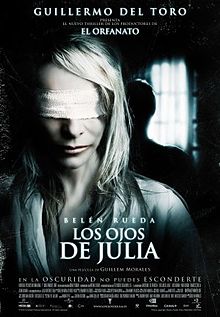
THE ZONE has my review of Guillem Morales’ disappointing Los Ojos de Julia.

The difference between the critical reaction to Julia’s Eyes and the critical reaction to James Wan’s Insidious sheds some interesting light on the extent to which our reactions to things are determined by the ways in which they are marketed and packaged. Indeed, boasting a cinematic heritage including such films as Saw and Paranormal Activity, Insidious was dismissed by many critics as stupid, childish and derivative.  Or, as Nigel Floyd puts it in his review for Time Out:

From the co-creators of ‘Saw’ (James Wan and Leigh Whannell, here director and writer) and the director of ‘Paranormal Activity’ (Oren Peli, producing) comes a project featuring nothing that was original, distinctive or scary about either earlier film.

Floyd then concludes his piece with a flourish of scorn:

Not so much insidious as inexcusable.

Compare this level of dismissive hostility with many of the reviews of Julia’s Eyes and you find a very different reaction to what is, ultimately, a film operating in very much the same genre and with very much the same set of concerns and interests.  Consider, for example, Nigel Floyd’s review for Time Out:

Guillem Morales’s thriller aims for intricate, Hitchcockian suspense, embellished with ornate visual flourishes that recall Dario Argento’s early giallo movies.

In fairness to Floyd, he does go on to suggest that Morales doesn’t quite manage to achieve these aims but the difference between the two reviews is quite striking.  Neither film is a classic of the genre but because Julia’s Eyes reminds Floyd of Hitchcock and Argento while Insidious reminds Floyd of Saw and Paranormal Activity, Julia’s Eyes is judged with a good deal more charity.  However, as I argue in my review, Julia’s Eyes fails precisely because of its direction. Morales is not only less visually imaginative than Wan but also less technically able when it comes to creating the sort of tension required to sustain a horror film and when Wan reaches for humour he connects whereas when Morales reaches for sentiment he comes away only with a handful of slush:

The chief problem with Morales’ direction is that he allows his scenes to drag on for far too long without ever really developing beyond their initial conditions. Time and again, Morales makes effective use of sound-effects and lighting cues to create an unsettling atmosphere only for this atmosphere to dissipate as audiences are allowed to grow accustomed their cinematic surroundings.

The technical failings of Julia’s Eyes are so obvious to me that I find myself wondering whether the film’s positive critical reaction might not have been due more to the way in which the film was marketed than to its inherent qualities.  Indeed, while Insidious was marketed as a stupid Horror film, Julia’s Eyes was marketed as an art house thriller of precisely the sort produced by Hitchcock and Argento. While the fact that the film was in a foreign language may have hurt it at the box office, I think that its foreign language dialogue may have served to bolster its art house credentials and so helped to solicit a more positive reaction from critics.

The more I review and the more I attempt to deconstruct my own evaluative thought processes, the more it occurs to me that my reaction to films and books is determined as much by the context of discovery as by the works themselves.  If a work comes to me warmly recommended by a trusted source then I am more disposed to be charitable.  If a book has a cover adorned with dark imagery then I am likely to read it as Horror but if the same book comes with a cover with more neutral colours then I am more likely to see it as fantasy.  The conflict between precept (my reaction as dictated by non-textual factors) and concept (my reaction to the content of the work itself) also determines the strength of my reaction.  If I go into something expecting it to be awful only to discover that it is quite good then I am more likely to give it a really positive review.  Similarly, if I go into something expecting it to be one of the books of the year only to discover that it is merely okay then I am less likely to be charitable in my evaluation.

Humans are such complex beasts and I suspect all of this explains why so many ‘serious’ academic critics tend to steer clear of evaluation…
REVIEW – Insidious (2011)

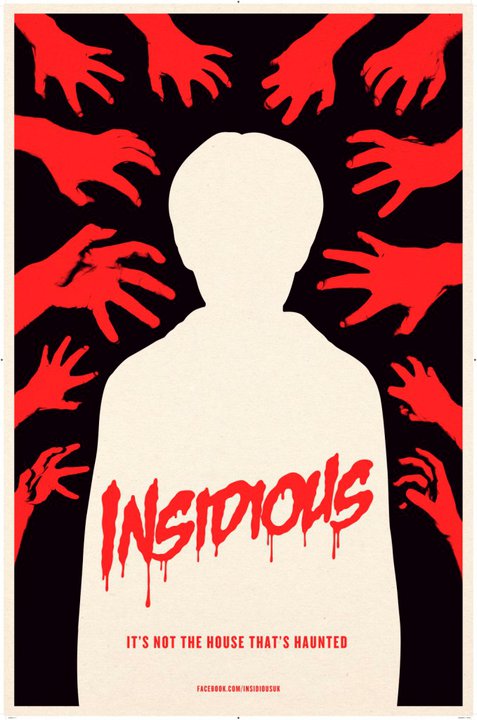
THE ZONE have my review of James Wan’s deliciously camp and thoroughly ridiculous Horror film Insidious.

Insidious is in some ways a remake of Oren Peli’s low-budget cult hit Paranormal Activity (2007) in that it is a story about a bunch of ghosts turning up and haunting an individual rather than a place.  As in Paranormal Activity, the hapless victims of the haunting contact some ‘experts’ only to discover that the situation is in fact far worse than they had imagined.  However, while Paranormal Activity made clever use of fixed cameras to make it look as though it had been shot by the victims themselves (an effect fatally undermined by the various special effects ‘added’ to the film for its UK cinematic release), Insidious moves right on past minimalist realism and into the realms of full bore gonzo:

Insidious is proof that Horror still has the power to entertain and to thrill without the need for 3D gimmickry, pointless nostalgia or needless deconstruction and that all you need to deliver a really effective work of cinematic Horror is a good crew and a talented director to guide them. You don’t even need a script. Or actors. Or ideas…

Warmly recommended for anyone who likes their Horror well-made but also a little bit silly. See also Jaume Collet-Serra’s Orphan a film that brings the awesome with devastating grace and efficiency.

Ikigami: The Ultimate Limit… Stripp’d

Gestalt Mash have my column on Matoro Mase’s manga serial Ikigami: The Ultimate Limit.

My column draws on the first six volumes of what will be an eight volume run if Viz Media do actually translate the entire series.  Set in an alternate version of contemporary Japan, the series is about a society that has decided to force its population to make the most of life by killing one citizen in every thousand at random.  The series examines this ideas from two different perspectives; on the one hand, it examines the psychological impact of the death sentences on the victims and their families while, on the other hand, exploring what the effects of this policy are on the Japanese body politic.  The result is a series of graphic novels that paint exquisitely detailed pictures of human grief and suffering whilst also slowly creating the impression that such a society is monstrous and must be overthrown:

Death has the power not just to end lives, but also to change them. It can change them for the better by prompting people to make changes, and it can change things for the worse by fostering a crippling sense of futility and loss. Ikigami: The Ultimate Limit is an exploration of the tension between these two reactions to the revelation that we too shall someday be no more.

The series has also spawned a film adaptation, which I also wrote about a little while ago for Videovista.

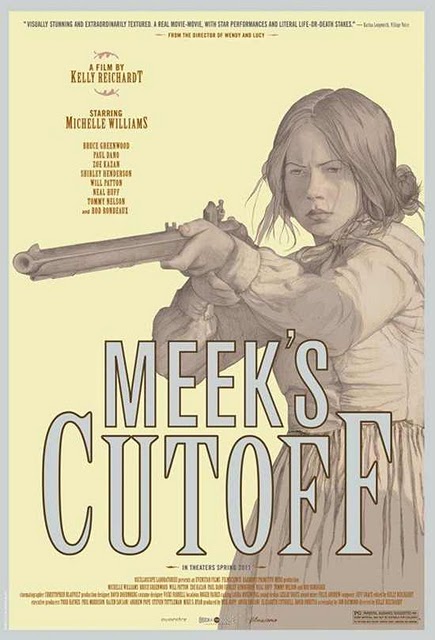
Meek’s Cutoff (2010) – Sous le Sable… les Femmes

Let me begin with a bit of history: until the arrival of the locomotive, the western half of the American continent was criss-crossed by a number of emigrant trails designed to help Americans immigrate to such emerging western territories as California. Arguably the most famous of these trails was the Oregon Trail, a 2000-mile route that linked the Missouri River to valleys in what we now think of as the state of Oregon. In its heyday between 1846 and the completion of the first transcontinental railroad in 1869, the Oregon Trail conducted over 400,000 Americans to the west of the continent. It was through this steady flow of farmers, miners, ranchers and normal people that the West was truly won.

Kelly Reichardt’s film Meek’s Cutoff tells the (reportedly true) story of what happened when one group of settlers – lead by the famous explorer Stephen Meek – attempted to find a safer route to Oregon that might bypass some dangerous Indian land. Slow-paced and enigmatically shot, Reichardt’s film reveals both an emptiness at the heart of the American dream and the dangers of what can happen when being a man is mistaken for being a leader.

Continue reading →

REVIEW – Monk: Season 7

  Videovista have my review of season seven on Monk.

Given that Monk (in the UK at least) is a daytime TV detective series that appeals mostly to old people, I think it is fair enough to say that it is somewhat off the beaten path in terms of stuff I normally think and write about.  Hell… it’s not the type of thing I normally watch let alone review!  However, despite it being quite formulaic, quite repetitive and really not particularly intelligent, I rapidly found myself warming to the way in which the writers were able to take a small number of ideas and themes and keep returning to them again and again without those ideas ever coming across as in anyway tired.  Given that most of my genre-related reading and watching tends to focus upon works that transcend and question genre boundaries, I found it fascinating to watch a TV series that is quite content to play within the boundaries of the genre:

While Murder, She Wrote, The Father Dowling Mysteries and Diagnosis Murder may all feature crime-fighting pensioners; only Monk tells the story of a character whose life genuinely resembles that of an older person. Weighed down by fears, doubts and a variety of weird mental compulsions that make it difficult for him to deal with the realities of 21st Century life, Monk lives the sort of awkward and fragile existence common to older people.  He even has a carer and struggles with ‘new-fangled’ technology such as the Internet. While Monk may ultimately be little more than lightweight fluff that shamelessly panders to a demographic of which I am not a part, I cannot deny that I enjoyed watching it.  You simply have to marvel at a series that does so much with so little!

REVIEW – Confessions (2010)

  Videovista have my review of Tetsuya Nakashima’s Confessions.

Based on a novel by Kanae Minato Confessions (a.k.a. Kokuhaku) is a brilliantly conceived psychological thriller involving an elaborate scheme to take revenge for the murder of a child. Powerful and astonishingly mean, the film is sadly let down by some over-cooked but nonetheless well executed music video-style visual flourishes:

As the ghastly constellation of neuroses that lead to the murder is carefully illuminated, Confessions flirts with forgiveness, bats its eyelashes at reconciliation but ultimately ends in an act of vengeance so beautifully composed and ambiguous in its meaning that it rivals anything found in the work of such divinities of the form as Claude Chabrol, Alfred Hitchcock, Ruth Rendell or Patricia Highsmith.

My review also contains an extended complaint about the difference between material shot in order to encourage people to buy a film and material shot in order to help people make the most of a film they have already bought.  The second category makes for excellent DVD extras.  The first… not so much.

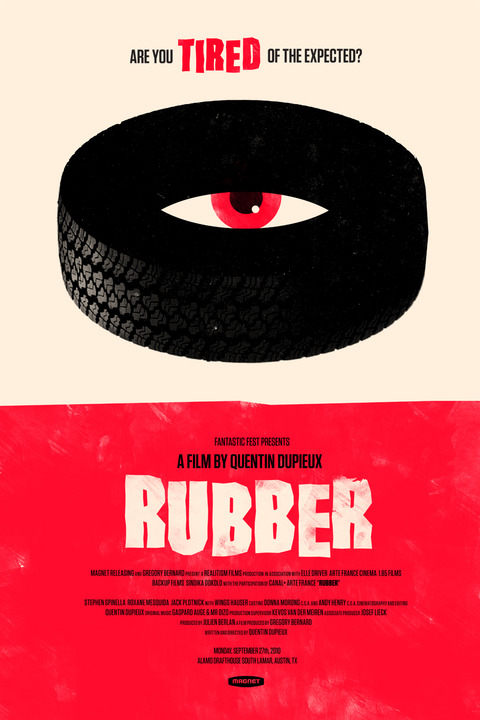
REVIEW – Rubber (2010)

  Videovista have my review of Quentin Dupieux’s postmodern exploitation film Rubber.  A film that features a sentient tyre, exploding heads and a cinema audience that is force-fed poisoned turkey after spending a night alone in the desert while a tyre sits in a motel room watching TV.

While I’m not convinced that the film is entirely successful in what it sets out to do (the joke ultimately fails to sustain the film despite its short running time), this is still a hugely imaginative and ambitious piece of film-making that is unlike anything you will see in the cinema or on DVD this year:

By confronting us with the absurdity of audiences speculating about the emotional lives of apes and tires, Philibert and Dupieux are drawing our attention to the inherent absurdity of the cinematic medium: Why do we care about the characters in films? They do not exist! They are not real!


My review also points out a number of similarities between Rubber and Nicolas Philibert’s ape-based documentary Nenette (2010), which I wrote about on this very blog.

REVIEW – Rabbit Hole (2010)

  Videovista have my review of John Cameron Mitchell’s Oscar-nominated drama Rabbit Hole.

While there is no doubting that the film has its moments and that many of these moments involve incredibly well observed and subtly performed recreations of humans going through the grieving process, Rabbit Hole strikes me as one of a growing number of films that seem less concerned with their subject matter and more concerned with winning awards for their actors.  I call this evolving sub-genre Oscar Bait:

Films such as Stephen Daldry’s The Reader (2008), John Patrick Shanley’s Doubt (2008), Bennett Miller’s Capote (2005) and Tom Hooper’s The King’s Speech (2010) tell very different stories about very different characters and explore very different sets of issues but they also share certain clear similarities.  For example, while all of these films touch upon quite substantial themes and ideas such as religious doubt, the role of the monarchy, involvement in the Holocaust and the media’s enabling relationship with criminals, none of the films really have anything to say about any of these topics. Indeed, while Rabbit Hole is about a couple experiencing grief over the loss of a child, Lindsay-Abaire’s script does not contain anything that is new or surprising. In fact, the plot of Rabbit Hole could be summarised as ‘unhappy people are unhappy’. However, while Rabbit Hole does not genuinely engage with human grief in any meaningful way, the fact that it alludes to these sorts of issues is sufficient for critics and audiences alike to consider it a ‘serious film’ that is worth a) going to see and b) taking seriously. Having convinced us to take them seriously, Oscar Baits then immerse us in a world full of acting-based set pieces.

BG 39 – Don’t Take It Personally, Babe, It Just Ain’t Your Story: High School, Privacy and Blended Identity

Futurismic have my latest Blasphemous Geometries column.

This month’s column is about Christina Love’s latest indie game Don’t Take it Personally, Babe, It Just Ain’t Your Story, which can be downloaded for free on a variety of platforms.

Set in a weirdly Japan-ised American Highschool in 2027, the game explores issues of identity and social media.  As I suggest in the column, the game is best played as a companion piece to Love’s previous game, the equally excellent Digital: A Love Story, which I wrote about a little while ago. Together, the two games tackle the process of putting oneself online and interacting with other online souls from quite starkly diffing perspectives.

PS: In the article, I mention a paper by Andrea Baker called “Mick or Keith: blended identity of online rock fans”, it can be downloaded (for free) HERE.

13 Assassins (2010) – Modernity Ain’t What It Used To Be

Ever since John Sturges remade Akira Kurosawa’s Seven Samurai (1954) as The Magnificent Seven (1960) and Sergio Leone ‘borrowed’ the plot of Kurosawa’s Yojimbo (1961) to make A Fistful of Dollars (1964), there has been a profound sense of kinship between the American Western and the Japanese Chanbara.

This connection can be explained in purely historical terms. For example, one of the side effects of America’s post-War occupation of Japan was a flush of Americanophilia amongst young Japanese people. Young Japanese people who would grow up to be filmmakers, filmmakers who might have been tempted to interrogate their own history using the iconography and genre conventions of American popular cinema. Alternately, we could point to the fact that Japanese cinema began to reach an international audience just as the Western entered its revisionist phase, prompting Western filmmakers to look at the Western with a sensibility informed by a newfound awareness of the tragic character of many Japanese films. However, while one could argue that the link between the Western and the Chanbara Samurai film is due to the winds of cultural history and political chance, this is not the story that people want to hear…

The popular (and somewhat more poetic) view of the link between the Chanbara and the Western makes use of the idea of the creation myth. Indeed, while both America and Japan reached the height of their historical powers in the 20th Century, both cultures like to see themselves as products of an anterior historical period characterised by violence and conflict. According to this view, contemporary America was forged in the ashes of the Wild West just as modern Japan can trace its cultural roots to the Edo period in which a warlord known as the Shogun ruled over a feudal order controlled by a class of sword-wielding nobles known as Samurai. While the reinvention of an anterior historical period into a sort of mythic creative age is common in both Japanese and American cultures, contemporary attitudes towards these mythic ages are varied enough that neither the Chanbara nor the Western could ever be accused of simple-minded nostalgia. Indeed, for every scene in which an ersatz Butch and Sundance romantically throw themselves beneath the mechanised wheels of modernity knowing well that there is no place for them in the new world, there is a scene in which a more-or-less ‘wild bunch’ show us that the only thing to have changed between now and then is the efficiency of the weapons that we use to murder each other.

Steeped in traditional iconography and fully intent upon revisiting this same set of ambivalent attitudes towards modernity, Jusan-nin No Shikaku resembles much of Takashi Miike’s recent output in so far as it combines a strict adherence to genre conventions with an eye for human perversity and a desire to celebrate that perversity in as horrific a manner as possible.

Continue reading →