REVIEW – Secret Behind The Door (1947)

THE ZONE have my review of Fritz Lang’s classic psychological thriller Secret Behind the Door starring Joan Bennett and Michael Redgrave.

Based upon Charles Perrault’s fable Bluebeard, Secret Behind the Door explores the process through which a couple get to know each other.  After a whirlwind romance, Bennett’s character marries Redgrave’s secretive and intense architect.  After a rudely interrupted honeymoon, Bennett’s character arrives at the architect’s home and finds him sharing it with two other women and a son from a previous marriage. As in the fable, Bennett’s character begins poking around in her husband’s background until she discovers something sinister.

Bluebeard is perhaps better known in its native France than it is in the Anglo-Saxon world. One reason for this is that it is one of those stories that paints women as a race of incessant and toxic meddlers whose refusal to follow simple male instructions result in the destruction of everything.  Think of Else to Lohengrin. Think of Eve to Adam. Because of the story’s misogynistic roots, generations of feminist authors have been quick to reclaim the role of interfering spouse and cast it in a more positive and transformative light such as the one that bathes Jane Eyre in Charlotte Bronte’s novel. Neither misogynistic nor feminist, Lang’s adaptation of Silvia Richards’ screenplay presents Bennett’s character as a wonderfully ambiguous figure who ‘fixes’ her husband for reasons all of her own. However, while the characters are engaging and the plot is fascinating, what really grabbed me was Lang’s decision to use a voice over as the primary means of communicating inner states:

Watching Secret Beyond The Door and noticing Lang’s tendency to simply pause the action and linger on his actor’s faces while their voiceovers are delivered, I was struck by how little has changed in the way that directors communicate interiority. Indeed, while directors of Lang’s generation paused so that voiceovers can be delivered, contemporary directors simply pause and allow audiences to fill in their own voiceovers. Doubtless many art house films could be transformed by using these little pauses and gazings into the middle distance to deliver short voiceovers in which characters speak directly to the audience. Clearly the basic grammar of cinema has not evolved that much since the days of Lang, it is just that nowadays art house directors tend to outsource exposition to audience speculation.

Secret Behind the Door is a flawed gem and its arrival on region-free DVD is long overdue. This is a must for anyone who enjoys psychological thrillers and an absolute necessity for anyone who loves Fritz Lang’s film noirs.

Wuthering Heights (2011) – Outside Looking In

Andrea Arnold is a director renowned for her unrelenting modernity. Set on council estates, Arnold’s first two films are about being on the outside, looking in and trying to find cracks in those protective walls that we call alienation and indifference.  In her directorial debut Red Road (2006), Arnold tells the story of a CCTV operator who finds herself becoming obsessed with observing a man she happens to recognise. Now used to experiencing life through a lens, the operator follows her target into a party and dances with him. Horrified by the intense colours, sounds and sensations of reality, the operator runs from the party and vomits in a lift. Seemingly, real life was just too much for her. A similar withdrawal from the world features in Arnold’s follow-up picture Fish Tank (2009) where a teenaged girl observes her mother’s relationship with a local lothario. Initially treating this interloper as a potential father figure, the girl soon finds herself being lured into the waters of adult sexuality by waves of unexpected kindness and discrete flirting. Believing she is in control of the situation, the girl pushes harder and harder at the limits of her childhood before the complexities and inequalities of adult life threaten to overwhelm her, forcing her to withdraw to a state of adolescent seclusion where everything makes sense and lessons can be learned in relative safety.

While there is no denying that Arnold’s adaptation of Emile Bronte’s Wuthering Heights (1847) constitutes something of a departure for the director, the film’s novelty lies not in its period setting but in the refusal of its characters to back down when confronted by a world they do not really understand. Arnold’s Wuthering Heights is a film in which madness and obsession confront reality and reality loses.


Continue reading →

BG45 – Demon’s Souls and the Meaning and Import of Virtual Death

Futurismic have my forty-fifth Blasphemous Geometries column about From Software’s Demon’s Souls and its place in the history of video game attitudes towards death.

Following on from some of my thoughts on Deus Ex: Human Revolutions, the column argues that rather than trying to downplay virtual death by re-packaging it as with Assassin’s Creed and Prince of Persia‘s talk of death-as-flawed-memory, video game designers ought to follow From Software in embracing the cataclysmic number of deaths that feature in their games. Indeed, what makes Demon’s Souls such a fascinating game is its relentless downbeat tone and its recognition of the fact that characters will die and players will give up in disgust. Clearly, if Demon’s Souls had been a film, it would have been directed by Ingmar Bergman. The column also draws the reader’s attention to Algis Budrys’ Rogue Moon, a book all about the psychological impact of experiencing a futile death over and over again…

Nowhere is the need for unpleasantness greater than in video gaming’s attitude to death.  What was once a means of rationing the time people spent hogging a particular arcade machine has now ossified into a set of linguistic tics that are now completely disconnected from both their real-world and in-game significances. Video games ask us to die over and over again but rather than acknowledging this fact, many game designers seek to minimise the impact of these sacrifices by explaining them away as lapses in memory. By trivialising death, game designers have not only cheapened the lives of our characters, they have also deprived themselves of one of the most powerful thematic motifs in all of art and literature.

Games like Demon’s Souls recognise that they are dealing in death and this recognition is genuinely disconcerting. Like death itself, Demon’s Souls is utterly indifferent to both our presence in the game and our attempts at engaging with it. Demon’s Souls is a game of misery tempered by frustration, and its unapologetic recognition of this fact is what makes it both different and great. While I appreciate Walker’s point, I cannot help but feel that he is looking at the problem in entirely the wrong way: Let us not repackage death, but rather celebrate it as the core of the video game experience.

Having spent a good deal of time playing carefully-packaged AAA-rated titles for this column, one of the continuing joys of Demon’s Souls remains its complete indifference to my presence.  Forty hours in and I’m still not completely clear on how many basic aspects of the game actually work. One of the game’s major mechanics involves shifting between different forms and you begin to pick up magical items helping with that transition a long time before you actually realise what it means. Similarly, it took me about 20 hours to realise that the game had a magic system. In a video game culture full of shallow joys and craven player-pandering, there is something truly wonderful in From Software’s complete indifference to whether or not we ever get the hang of the game.

REVIEW – Don’t Look Now (1973)

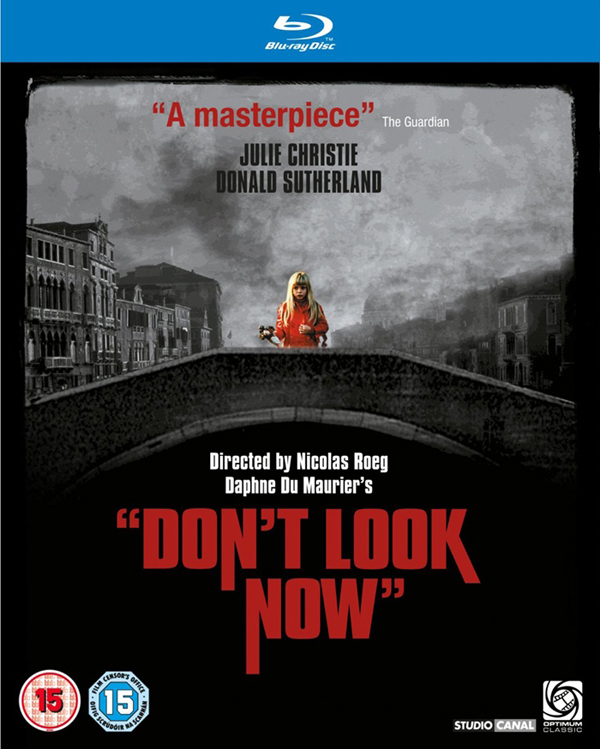
I recently noticed a pattern in my choice of films to write about.  I tend to really enjoy the films I write about but the films I truly love tend to go unprocessed and un-deconstructed.  I did not write about Luca Guadagnino’s I Am Love (2009) and I did not write about Nicolas Winding-Refn’s Drive (2011) despite loving both of these films to pieces. In an bid to force myself out of this unfortunate habit, I decided to take on the recent Blu-ray release of one of my favourite films: Nicolas Roeg’s Don’t Look NowTHE ZONE has my review.

The common thread binding these three films together is their unapologetic devotion to the grammar of film. Indeed, rather than relying upon such theatrical devices as three act structures or novelistic devices such as expositionary dialogue, Don’t Look Now, Driver and I Am Love tell their stories using mostly pictures and sounds. Don’t Look Now is particularly cinematic as Roeg uses cinematic grammar for force us into the head of Donald Sutherland’s reluctant psychic: Sutherland’s character is assailed by images and sounds that he struggles to comprehend and Roeg shares these fragments with us, placing us next to Sutherland’s character. Struggling to comprehend:

The opening scene of Don’t Look Now introduces us to a series of memorable images that Roeg returns to throughout the film. Everywhere the Baxters go, they encounter water, red hoods and shards of light. As people trained in the basic grammar of art house cinema, we know how to recognise recurring motifs and know that we are supposed to treat them as clues to the film’s hidden subtext. However, rather than allowing these clues to sit in the mind of the audience, Roeg uses the possibility of psychic powers to drag these clues into the foreground of the film.

Suddenly, those motifs and images that are normally just hints at hidden artistic meaning become evidence of hidden patterns in the life of John Baxter. Baxter’s hostility to the sisters betrays a deeper hostility to the idea that he too may be psychic and that the recurring images that plague his life might be evidence of future unpleasantness. Baxter foresaw the death of his daughter and now he sees signs that point to his own death. Everywhere he turns, Baxter is haunted by water, shards of light and the colour red. Everywhere he turns, Baxter sees proof that he too will soon be dead.

To suggest that John Baxter may be psychic is, somewhat predictably, to do Roeg a disservice as talk of mediums and psychic powers inevitably conjures up images of third eyes and supernatural powers. However, much of the power of Don’t Look Now resides in the fact that Baxter’s psychic gift is only a slight exaggeration of that very human addiction to pattern recognition, an addiction that forces the audience to hunt for subtexts and clues in Roeg’s repeated use of water, shards of light and the colour red. Indeed, Don’t Look Now is a deeply unsettling film as it forces the audience into the same position as the film’s protagonist: just like John Baxter, we know that something is coming; we know that it is not going to be good but we are powerless to avoid it. The audience are powerless to avoid it because Don’t Look Now is a film. John Baxter is powerless to avoid it because his life is like a film; it is pre-scripted with a beginning, middle and an inevitably grizzly end.

Don’t Look Now is not just a film of towering cinematic brilliance it is also, in its own way, a film about the process of taking a series of disconnected images and forcing them into a cohesive and comprehensible whole.

This review is based upon the Blu-ray special edition that was released in summer 2011.  Billed as a “Special Edition”, this Blu-ray release is pretty much indistinguishable from the 2006 DVD “Special Edition” release.  The extras are exactly the same.  According to the sticker on the cover of the box, the colour restoration was supervised by Roeg himself but, while there is no denying that the colours are crisp and the pictures are clean, I genuinely struggle to tell the difference between this and the DVD special edition. This begs the question as to the purpose and future of Blu-ray releases.

The UK benefits from a growing second hand market for DVDs that has the effect that DVDs lose most of their value within a few weeks of release. In fact, if you are paying full price for a DVD that is more than a week old then you are nothing more than a sucker.  Though Blu-ray has not yet supplanted DVD, the market for Blu-ray disks is pretty much the same as that for DVDs only with Blu-ray discs starting and remaining ever so slightly more expensive. The reason for this is that, UK consumers have largely accepted the idea that Blu-ray is a meaningful step up from DVD. Using this perception, Blu-ray distributors are re-releasing older films hoping that those of us with Blu-ray players (i.e. people who own a PS3) will replace our old DVDs with more expensive and ‘better quality’ Blu-ray editions. However, despite Blu-ray being touted as better quality, it is notable that hardly any Blu-ray releases come with any more extras than their equivalent DVD release. In short, the only difference between Blu-ray and DVD is that Blu-ray discs support HD playback meaning that if you do not possess an HD screen then there is absolutely no reason whatsoever for buying a film on Blu-ray. I bought the special edition DVD of Don’t Look Now when it was originally released and, despite clearly adoring the film, I cannot think why you would choose to replace the DVD with a Blu-ray.

The fate of Blu-ray is made all the more tenuous by changes in the US market.  In the US, the online video streaming service Netflix has not just popularised watching films online it has pretty much killed both DVD and Blu-ray stone dead with the latter-most nails in physical media’s coffin being provided by iTunes and the video-on-demand capacities of cable TV, Xbox Live and the PlayStation Network. Blu-ray was only ever supposed to be a stopgap measure between the latter days of DVD and the early days on online streaming that might allow technology companies to sell one final generation of media players before everyone started watching stuff through their home computer. This gap in the market has now effectively closed in the US and the UK is not that far behind.

Despite chaotically shuffling between business models in a way that has seen its share price plunge, Netflix recently announced that it is planning on bringing its subscription-based video-on-demand service to the UK. In short, Blu-ray is history in the US and the same will soon be true in the UK. If Netflix and Lovefilm do not kill UK DVD sales then Amazon, iTunes and cable TV will.

Of course, physical copies of films will continue to retain some value as people will always to want to ‘own’ the films they love rather than simply retain the capacity to access them online.  Similarly, AV nuts who invested small fortunes in home cinema installations will probably not be the first in line to start watching films on their laptops. I mention this not because I have anything in particular against either Blu-ray or DVD (I own loads myself) but simply as a warning: In a year’s time, Blu-rays and DVDs will be just as worthless as CDs meaning that you will be able to buy films like Don’t Look Now on Blu-ray for next to nothing.  So, instead of splashing out on one great Blu-ray, either save your money and stick with the DVD or wait a year and buy five films for the price of one. And thus the wheel doth turn…


REVIEW – Angels of Evil (2009)

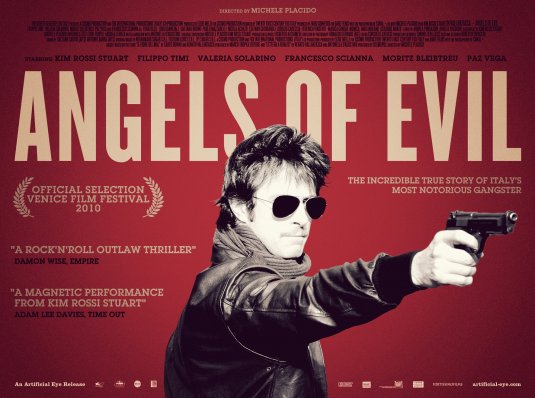
Videovista have changed their format.  Rather than spewing a torrent of reviews at you once a month, the site has moved towards a more selective approach to publishing in which they devote attention solely to a few note-worthy films.  My first shot at the DVD of the month is a piece about Michele Placido’s Angels of Evil (a.k.a. Valanzasca – Gli Angeli del Male), the follow-up to Placido’s 2005 crime bio-pic Romanzo Criminale. While I ultimately found the film a good deal less engaging than the politically thoughtful Romanzo Criminale, Angels of Evil remains a beautifully shot and stylishly produced crime thriller that sheds an intriguing light on the challenges facing the crime bio-pic genre. My review is HERE.

Though undeniably well made, Angels Of Evil suffers terribly from an overabundance of familiar elements: it is a film entirely composed of stock characters. Vallanzasca’s first wife Consuelo (Valeria Solerino) is a beautiful woman who doesn’t take any shit from anyone right up until the moment she meets Vallanzasca and promptly transforms into a long-suffering doormat with a sensible haircut. Similarly, the members of Vallanzasca’s gang are differentiated solely through their facial hair and their professional characteristics including the capacity to ride a motorcycle at 125 mph, and make good use of a sub-machinegun. Even Turatello is something of a cliché as his charismatic public persona masks a psychopathic fondness for violence and a rather predictable obsession with his hair that has him visiting women’s salons and sleeping in a hair-net. Anyone who has seen Goodfellas will recognise these sorts of characters and Goodfellas’ influence means that they have spent the last 20 years appearing and re-appearing in every crime thriller you care to mention. Aside from being faintly depressing, Placido’s refusal to depart from traditional genre stereotypes also serves to weaken his treatment of Vallanzasca himself.

Having damned the film for its generic nature, I then ponder whether the generic nature of the film’s characters might not be the result of deeper sociological forces. Indeed, if you watch The Sopranos, it is obvious that the characters have all partly modelled themselves on figures from the Godfather. This begs the following question: does the film’s depiction of Vallanzasca and his gang seem generic because of lazy script-writing or does the script capture the basic truths about a group of characters who modelled themselves on figures out of crime fiction and film?

Abbas Kiarostami to direct Paranormal Activity 4?

Almost certainly not… but you never know.

Aside from confounding search engines and the countless websites that survive by publishing idle film industry gossip, the title of this post does actually have a point. Namely that I see a number of similarities between the films of Iranian director Abbas Kiarostami and the latest iteration in the Paranormal Activity series directed by Ariel Schulman and Henry Joost.  In short, these cameras are all about forcing us to dwell on that which we do not see.

Continue reading →

DC: The New Frontier… Stripp’d

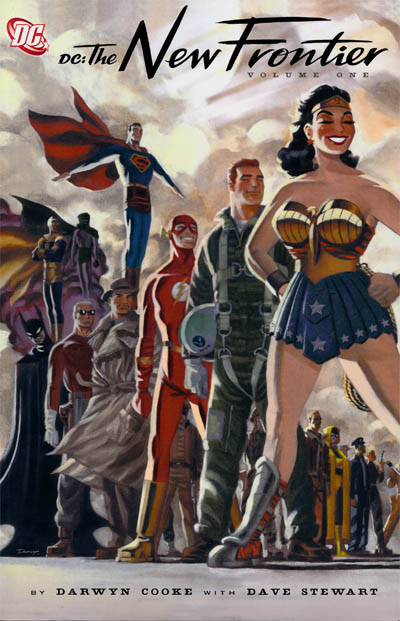
Boomtron have my latest comics column on Darwyn Cooke’s DC: The New Frontier.

New Frontier is an ‘elseworld’ that takes the superheroes of the DC Comics Universe and transposes them into the late 1940s in much the same way as Neil Gaiman transposed the Marvel Universe into Elizabethan England in 1602 (2003). However, while 1602 is really nothing more than an extended exercise in fan service that wanders around Elizabethan London going “Oooh… I wonder what Daredevil would look like if he was an Irish bard!”, DC: The New Frontier is an attempt to liberate mainstream superhero comics from the cynicism of the post-Watchmen era by finding a way of reconciling psychological depth with the values of old-fashioned Gold and Silver Age heroism. While I do not think that Cooke is ultimately successful in his endeavour, I do think that the result is one of the most fascination mainstream superhero comics ever produced.  It is fascinating because it is a comic that clearly realises the challenge that faces large generation-spanning mythological systems.  As I pointed out in my review of Dick Maas’ horror film Saint (2010), myths must reinvent themselves in order to stay alive and DC: The New Frontier is clearly designed as a mutation that might help superhero comics adapt to the culture of today:

The last thirty years has seen a drive to re-invent traditional heroes as darker and more realistic figures. Moore’s reinvention of the superhero as a vigilante mired in psychological trauma and political compromise is no different to the re-invention of King Arthur as a Roman Centurion or an Iron-age Chieftain. The world has changed and though we can no longer believe in a campy middle-aged Batman, we can believe in a tortured psychopath who acts upon his own flawed sense of justice. Humans have always and will always yearn for escape from the prison of their lives but the vehicle they choose for that escape is determined by the nature of the lives they are escaping. Because of this, stories must be retold and heroes must be reborn. Even modern day myths are subject to these evolutionary pressures, in order to survive stories must change to suit the demands of their audience.

Despite its failures, DC: The New Frontier is still a fascinating read and a great place to start if you are looking to get a handle on the tendency of superhero comics to keep re-launching and re-inventing themselves.

Some Thoughts On… The Debt (2010)

Best known as the director responsible for such safe, middle brow, award-bothering prestige productions such as Mrs Brown (1997), Shakespeare in Love (1998) and Captain Correlli’s Mandolin (2001), John Madden returns with a thriller written by Jane Goldman and Matthew Vaughn. As might be expected from the writing team behind X-Men: First Class (2011) and Kick-Ass (2010), The Debt is a kinetic thriller that is forever promising to erupt into something a good deal more complex. However, much like both Kick-Ass and First Class, The Debt is a film that works best when it is in movement as its quiet character moments are under-written and under-powered despite some decent performances by two eye-catching casts.

Split between two timelines, The Debt tells the story of a group of 1960s Mossad agents who are sent into Soviet-controlled East Germany to kidnap a Nazi war criminal. Forced to live together, the three agents quickly stumble into a love triangle that finds the quietly intense Rachel (Jessica Chastain) having to choose between the introverted idealist David (Sam Worthington) and the arrogantly ambitious Stephan (Marton Csokas). When the kidnapping goes wrong, the three young people find themselves having to babysit an aging but fiercely intelligent Nazi who relentless probes their weaknesses and tries to set them against each other. Bookending this middle section is the film’s second timeline. Set in the 1990s, this timeframe explores the psychological consequences of the events of the film’s middle section. Still physically and psychologically scarred by her ordeal, Older Rachel (Helen Mirren) shifts uncomfortably as her daughter pays public tribute to her heroism. Meanwhile, Older David (Ciaran Hinds) is crippled by the burden of guilt and secrecy while Older Stephan’s (Tom Wilkinson) arrogant bluster has turned into tyrannical will-to-power.

The Debt features some excellent action direction and powerful sound-design that lends its fight sequences a brutal clarity that is terrifying when compared to expanses of quiet emotional desolation that dominate the rest of the film.  The scenes in which a manipulative Nazi confronts the agents are similarly impressive even though Quentin Tarantino did the same thing only better in Inglorious Basterds (2009).  Unfortunately, once the film moves beyond such genre staples, the limits to both the script and Madden’s direction start to become painfully evident.

Much of the film’s drama rests upon the tension of the plot colliding with both the characters’ back-stories and the bonds of affection that tie them together. While this occasionally works quite well (in particular the scene where Stephan seduces Rachel at the piano while the introverted David flinches in pain with every note they play), the film does not manage to pull off the bulk of its dramatic moves and because many of the film’s emotional beats fall short of the mark, many of the film’s sequences seem overly long and hopelessly flabby. Indeed, there were huge expanses of this film where time seemed to stand still as characters pouted and bemoaned some inner turmoil that never managed to feel real let alone seem particularly compelling.

The problem is that while The Debt had the potential to be an interesting genre film, the filmmakers clearly want it to be quite a bit more. Having secured a good deal of top-notch acting talent, you can sense their desire to make the most of it and maybe push for a few awards but, at the end of the day, both the script and the direction of The Debt fail to support these lofty ambitions and so a promising espionage thriller finds itself transformed into an over-long and dramatically dysfunctional exercise in thespian posturing. This film has nothing much to say about the human condition and its insistence on trying to say it for close to two hours is both depressingly and frustratingly tedious.

Some Thoughts On… Hunky Dory (2011)

Set in a Welsh comprehensive during the long hot summer of 1976, Marc Evans’ Hunky Dory tells of a bohemian drama teacher (Minnie Driver) who returns home after the death of her father and the collapse of her long-strived for career. Hoping to inject a bit of sunshine into the lives of her pupils Viv starts to pull together a version of The Tempest filled with musical numbers culled from the albums of David Bowie, Beach Boys and The Byrds. Faced with institutional hostility on the one hand and student indifference on the other, Viv strives to convince everyone of the importance of expressing oneself even when one’s life is falling apart.

Marc Evans is very much a journeyman director whose work in film (1998’s Resurrection Man and 2002’s My Little Eye) and television (2009’s Collision) has elicited some praise but not enough to make him a director with much of a following. Despite Evans’ somewhat patchy track record, Hunky Dory finds him on fine form as every shot screams ‘Long Hot Summer’ through sweat-glazed sepia tones while the film’s pacing never once slows or drags. Indeed, despite the fact that I did not think very much of this film, there is no denying that Evans perfectly understands the ‘string of pearls’ nature of genre plotting and so we are never more than a few minutes from a song or a big dramatic scene. On a purely structural and cinematic level, Hunky Dory is a very effective piece of filmmaking.  Which is strange given that pretty much every other aspect of this film fails to deliver.

The biggest problem affecting Hunky Dory is Laurence Coriat’s script. As one might expect from a coming-of-age teen musical, Hunky Dory is littered with Big Dramatic Scenes where characters learn about themselves and about life. Unfortunately, despite these scenes popping up quite frequently, Hunky Dory lacks the requisite amount of characterisation to lend these scenes the dramatic substance to which they so obviously aspire. For example, there is one scene in which the school hall burns down and Driver’s Viv rounds on her fellow teachers in order to challenge their hostility to the play. But because neither the sports teacher nor the social studies teacher are properly fleshed out, Viv’s grand exit from the room feels like a laughably childish flounce. Like most of Hunky Dory’s Big Dramatic Scenes, this was the pay-off to a dramatic arc that simply does not exist. Another example of this is the scene in which Viv finds an engraving of her dead father’s motto ‘Don’t Let The Bastards Grind You Down’. This discovery is clearly supposed to rekindle Viv’s faith in the stalled project but because neither Coriat’s script nor Evans’ direction bother to flesh out Viv’s relationship with her father, the scene feels like nothing more than a dishonest and undeserved emotional contrivance. By repeatedly trying to milk the pay-off to dramatic arcs that simply do not exist, Hunky Dory comes close to achieving the levels of hysteria found in Michael Bay’s Transformers 3 as Everyone! Is! Very! Upset! All! The! Fucking! Time! For! No! Apparent! Reason!

The weakness of Hunky Dory’s characterisation also carries across into much of its plotting as the film is littered with tensions and conflicts which, though useful in terms of moving the narrative forward, lack anything approaching psychological verisimilitude or emotional resonance. For example, when the school hall burns down the police decide to question Darren Evans’ ‘troubled’ skinhead Kenny. Discussing the fact that Kenny could not have done it, a couple of kids are confronted by Kenny’s skinhead brother who asks whether they shopped him to the police. Rather than simply saying No and going on their way, the pair decides to run off and a pointless chase ensues. Well… I say pointless but this race across town does serve to set up one of the kids discovering that his best friend is dating his sister. Because this is deemed unacceptable (for reasons that are largely glossed over), people get upset and this causes a Big Dramatic Scene with running and shouting. A scene that, again, feels utterly contrived and dramatically undeserved.

Aside from its weak characterisation and clunky plotting, Hunky Dory is also weighted down by some of the ugliest line-by-line writing that I have ever encountered. Coriat’s script is a wasteland of flaccid zingers and awkward exchanges littered with dull expletives in a desperate attempt to make it all seem a bit more real and a bit more urgent. Also deeply problematic is the film’s use of words such as “poof” and “paki”. While there is no denying that people in the mid-70s did use those terms, Hunky Dory not only strips them of their context but also fails to hold the people who use them to account. For example, one of the main characters becomes a skinhead but unlike Shane Meadows’ This is England (2006), Hunky Dory never explains what this means or why it might be a bad thing. Instead, the film presents racism and homophobia as mere local colour no different to a love of rugby or the quaintness of growing up without a telephone. Similarly, while I realise that Julia Perez’s Sylvie is supposed to be a comic character, her character’s comic impact lies in its stereotypical nature: French people have sex all the time and smoke! Ha Ha Ha! Period setting is no excuse for that kind of lazy and xenophobic writing. It simply has no place in a modern British film.

Of course, Hunky Dory is ultimately a genre piece and while it fails as both a comedy and a musical, the film might have been redeemed had its musical elements been successful. Unfortunately, they are not. Much of Hunky Dory’s marketing bumf stresses the fact that the film features classic works of 60s and 70s pop. While this may conjure up images of High School Musical (2006) meets Mama Mia (2008), the truth is that Hunky Dory’s songs are mostly quite obscure. Indeed, despite being in my mid-30s, I only recognised one of the tunes and even then it was because the tune was covered by Nirvana. Equally unimpressive are the performances of the mostly youthful cast who both lack charisma and display a terrifying tendency to wander off the note. Though some of the musical numbers are okay, none are particularly memorable and a few are faintly embarrassing. A lot of the singing in Hunky Dory is so flat that it could be Holland.

Clearly, I am not the target audience for Hunky Dory but I do see what it is that the film is trying to achieve. Inspired by the massive success of High School Musical and the TV series Glee, Hunky Dory is an attempt to do something a bit similar but set in Wales and with a slightly cooler soundtrack. Hunky Dory should have been about the power of music and performance to guide and transform teenaged lives, to find those that are lost and fix those that are broken. Hunky Dory should have been, as Driver’s character says, about the heroism of self-expression in a time and place where everybody wants you to shut up and knuckle down. Sadly, because of its weak performances, unimpressive musical numbers and astonishingly weak script, Hunky Dory is none of these things. All it is is a mess.

REVIEW – Saint (2010)

THE ZONE has my review of Dick Maas’ Evil Santa horror movie Saint (a.k.a. Sint).

Well… I say that this is another addition to the growing sub-genre of Evil Santa movies but in truth, the film works best if you don’t see it as a deconstruction of Santa Claus.  Let me explain what I mean: Saint is an Evil Santa film but rather than deconstructing the American figure of Santa Claus, Maas focuses instead upon the North European figure of Saint Nicholas, a mythological being whose relationship with our Santa is tenuous at best.  As I explain in my review, Saint works best if, instead of seeing it as the story of an evil Santa Claus, you see it as the story of a medieval Bishop who terrorises modern-day Amsterdam. In effect, this interpretation of Saint positions it as a deconstruction of Catholicism rather than Father Christmas:

Who the fuck are these withered old bastards and where do they get off telling us what to do? The idea that the Catholic Church is now nothing more than a morally putrescent corpse imbues Saint with a strong satirical edge. Indeed, the modern Catholic Church behaves very much like the film’s Saint Nicholas, a hideous and antiquated authority figure that ‘hates everyone’ and routinely abducts children in order to force them into servitude. Indeed, the power of Maas’ surreal confrontations between myth and reality owes quite a bit to the absurdity of a medieval institution operating in the modern world. We all know that the world was not created in six days, we all know that there is nothing wrong with homosexuality, and we all know that women should have the absolute right to choose… so why do we listen to a cadre of elderly men in skirts and hats who tell us that we are not only wrong but damned?

Regardless of whether or not you buy into my anti-clerical reading of the film, Saint is one of the most entertaining high-concept horror films out there.