Meek’s Cutoff (2010) – Sous le Sable… les Femmes

Let me begin with a bit of history: until the arrival of the locomotive, the western half of the American continent was criss-crossed by a number of emigrant trails designed to help Americans immigrate to such emerging western territories as California. Arguably the most famous of these trails was the Oregon Trail, a 2000-mile route that linked the Missouri River to valleys in what we now think of as the state of Oregon. In its heyday between 1846 and the completion of the first transcontinental railroad in 1869, the Oregon Trail conducted over 400,000 Americans to the west of the continent. It was through this steady flow of farmers, miners, ranchers and normal people that the West was truly won.

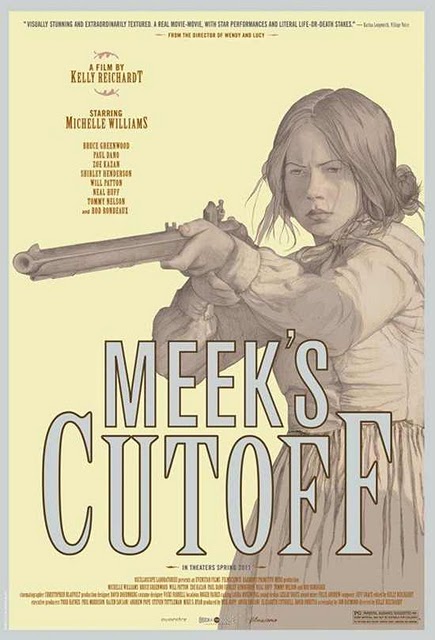
Kelly Reichardt’s film Meek’s Cutoff tells the (reportedly true) story of what happened when one group of settlers – lead by the famous explorer Stephen Meek – attempted to find a safer route to Oregon that might bypass some dangerous Indian land. Slow-paced and enigmatically shot, Reichardt’s film reveals both an emptiness at the heart of the American dream and the dangers of what can happen when being a man is mistaken for being a leader.

Continue reading →

REVIEW – Confessions (2010)

  Videovista have my review of Tetsuya Nakashima’s Confessions.

Based on a novel by Kanae Minato Confessions (a.k.a. Kokuhaku) is a brilliantly conceived psychological thriller involving an elaborate scheme to take revenge for the murder of a child. Powerful and astonishingly mean, the film is sadly let down by some over-cooked but nonetheless well executed music video-style visual flourishes:

As the ghastly constellation of neuroses that lead to the murder is carefully illuminated, Confessions flirts with forgiveness, bats its eyelashes at reconciliation but ultimately ends in an act of vengeance so beautifully composed and ambiguous in its meaning that it rivals anything found in the work of such divinities of the form as Claude Chabrol, Alfred Hitchcock, Ruth Rendell or Patricia Highsmith.

My review also contains an extended complaint about the difference between material shot in order to encourage people to buy a film and material shot in order to help people make the most of a film they have already bought.  The second category makes for excellent DVD extras.  The first… not so much.

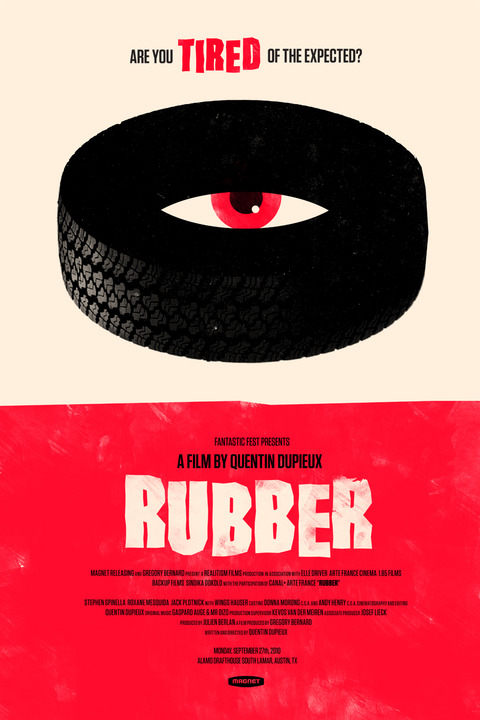
REVIEW – Rubber (2010)

  Videovista have my review of Quentin Dupieux’s postmodern exploitation film Rubber.  A film that features a sentient tyre, exploding heads and a cinema audience that is force-fed poisoned turkey after spending a night alone in the desert while a tyre sits in a motel room watching TV.

While I’m not convinced that the film is entirely successful in what it sets out to do (the joke ultimately fails to sustain the film despite its short running time), this is still a hugely imaginative and ambitious piece of film-making that is unlike anything you will see in the cinema or on DVD this year:

By confronting us with the absurdity of audiences speculating about the emotional lives of apes and tires, Philibert and Dupieux are drawing our attention to the inherent absurdity of the cinematic medium: Why do we care about the characters in films? They do not exist! They are not real!


My review also points out a number of similarities between Rubber and Nicolas Philibert’s ape-based documentary Nenette (2010), which I wrote about on this very blog.

REVIEW – Rabbit Hole (2010)

  Videovista have my review of John Cameron Mitchell’s Oscar-nominated drama Rabbit Hole.

While there is no doubting that the film has its moments and that many of these moments involve incredibly well observed and subtly performed recreations of humans going through the grieving process, Rabbit Hole strikes me as one of a growing number of films that seem less concerned with their subject matter and more concerned with winning awards for their actors.  I call this evolving sub-genre Oscar Bait:

Films such as Stephen Daldry’s The Reader (2008), John Patrick Shanley’s Doubt (2008), Bennett Miller’s Capote (2005) and Tom Hooper’s The King’s Speech (2010) tell very different stories about very different characters and explore very different sets of issues but they also share certain clear similarities.  For example, while all of these films touch upon quite substantial themes and ideas such as religious doubt, the role of the monarchy, involvement in the Holocaust and the media’s enabling relationship with criminals, none of the films really have anything to say about any of these topics. Indeed, while Rabbit Hole is about a couple experiencing grief over the loss of a child, Lindsay-Abaire’s script does not contain anything that is new or surprising. In fact, the plot of Rabbit Hole could be summarised as ‘unhappy people are unhappy’. However, while Rabbit Hole does not genuinely engage with human grief in any meaningful way, the fact that it alludes to these sorts of issues is sufficient for critics and audiences alike to consider it a ‘serious film’ that is worth a) going to see and b) taking seriously. Having convinced us to take them seriously, Oscar Baits then immerse us in a world full of acting-based set pieces.

13 Assassins (2010) – Modernity Ain’t What It Used To Be

Ever since John Sturges remade Akira Kurosawa’s Seven Samurai (1954) as The Magnificent Seven (1960) and Sergio Leone ‘borrowed’ the plot of Kurosawa’s Yojimbo (1961) to make A Fistful of Dollars (1964), there has been a profound sense of kinship between the American Western and the Japanese Chanbara.

This connection can be explained in purely historical terms. For example, one of the side effects of America’s post-War occupation of Japan was a flush of Americanophilia amongst young Japanese people. Young Japanese people who would grow up to be filmmakers, filmmakers who might have been tempted to interrogate their own history using the iconography and genre conventions of American popular cinema. Alternately, we could point to the fact that Japanese cinema began to reach an international audience just as the Western entered its revisionist phase, prompting Western filmmakers to look at the Western with a sensibility informed by a newfound awareness of the tragic character of many Japanese films. However, while one could argue that the link between the Western and the Chanbara Samurai film is due to the winds of cultural history and political chance, this is not the story that people want to hear…

The popular (and somewhat more poetic) view of the link between the Chanbara and the Western makes use of the idea of the creation myth. Indeed, while both America and Japan reached the height of their historical powers in the 20th Century, both cultures like to see themselves as products of an anterior historical period characterised by violence and conflict. According to this view, contemporary America was forged in the ashes of the Wild West just as modern Japan can trace its cultural roots to the Edo period in which a warlord known as the Shogun ruled over a feudal order controlled by a class of sword-wielding nobles known as Samurai. While the reinvention of an anterior historical period into a sort of mythic creative age is common in both Japanese and American cultures, contemporary attitudes towards these mythic ages are varied enough that neither the Chanbara nor the Western could ever be accused of simple-minded nostalgia. Indeed, for every scene in which an ersatz Butch and Sundance romantically throw themselves beneath the mechanised wheels of modernity knowing well that there is no place for them in the new world, there is a scene in which a more-or-less ‘wild bunch’ show us that the only thing to have changed between now and then is the efficiency of the weapons that we use to murder each other.

Steeped in traditional iconography and fully intent upon revisiting this same set of ambivalent attitudes towards modernity, Jusan-nin No Shikaku resembles much of Takashi Miike’s recent output in so far as it combines a strict adherence to genre conventions with an eye for human perversity and a desire to celebrate that perversity in as horrific a manner as possible.

Continue reading →
Love Like Poison (2010) – No Escaping Christ’s Lustful Gaze

Perhaps the most depressing things about the financial crisis is that as banks collapsed, governments groaned and the wheels of global capitalism ground momentarily to a halt, nobody stepped forward with an alternative to the current system. For a moment there, the world might have changed and a new system might have been built but instead of forging a new world, governments took money away from poor people and threw it at the rich in the hope that they would return to doing whatever it is that they were doing before the global economy went tits up. This was a failure of the imagination not only on the part of governments but also on the part of political activists and theorists the world over. As global capitalism teetered, stumbled and nearly fell, Margaret Thatcher was proved right: There Is No Alternative.

The idea that there is simply no viable alternative to market capitalism and (more or less) liberal democracy is the most potent defence of the status quo imaginable. Thanks to thinkers such as Francis Fukuyama arguing that we have reached the end of history, alternatives to neoliberalism are strangled at birth. As citizens of liberal democracies, we have certain political options open to us but none of these options are radical because radical options are not viable alternatives.  And thus we are free and yet everywhere in chains…

Un Poison Violent, the first feature film by Breton director Katell Quillévéré, is an exploration of the nature of female self-determination in a world where men impose their own limits on what is and is not an acceptable mode of being. Whether in Church or a teenaged bedroom, nowhere can women escape the merciless glare of the male gaze.

Continue reading →

The Veteran (2011) – The Consolations of War and its Theories

Humans are a curious species in so far as our desire to understand the world frequently outstrips both our analytical skill and our willingness to accept the truth. Nowhere is this tension better expressed than in the explosion of conspiracy theories that invariably follow the unexpected death of a celebrity.

As JG Ballard correctly diagnosed in The Atrocity Exhibition (1970), celebrities are not merely people but symbols and signs. These signs and symbols bind culture together in such a way that, when the celebrity attached to them suddenly dies, the symbol continues to exist simply because of the structural role they play. Dimly aware of the undead symbolic status of these celebrities, humans attempt to account for the cognitive dissonance by either denying that they are dead or by seeking to transform their deaths into important historical moments: Osama bin Laden is simply too important to be shot dead in some Pakistani suburb.

Our desire to see the world in terms that make sense to us is also evident in our attempts to build theories that account for such random and chaotic events as war. Matthew Hope’s The Veteran explores the idea that, far from being a violent and random convulsion of the body politic, war might actually be a force of nature.

Continue reading →

Hanna (2011) – The Cinema of Fraying Worlds

To be human is to live with the assumption that, somewhere out there, other people are having more fun than you. These other people sit in VIP lounges enjoying better food, better sex, better clothes, better conversation and better access to all the fun stuff that the world has to offer. This assumption underpins literature’s obsession with what has come to be known as the demimonde (literally the ‘half-world’).

In the 19th Century, operas such as Verdi’s La Traviata (1853) and novels such as Dumas’s La Dame aux Camelias (1848) and Le Demi-Monde (1855) described a sub-culture where the bourgeois values of respectability were flouted in favour of a lifestyle based upon decadent self-indulgence, pleasure and self-destructive hedonism. The success of these operas and novels reflect the fear amidst the European middle classes that all of their wealth and their social status came at the cost of being locked out of a world that was much more fun than the world they knew and created around them. The demimonde is as much a fantasy as it is a paranoid delusion; the tendency of the demimondaines to reach a sticky end represents the profound ambivalence that the middle classes felt about their own fantasies of hedonism and rebellion.

This ambivalence continued to hold true as 19th demimondes devoted to sensual indulgence transformed into demimondes based upon fantasies of power and influence. The 20th Century demimondaines were not consumptive courtesans but criminals, business leaders, Soviet officials and intelligence operatives. These were the people who were thought to be the true leaders of the world, those who dwell behind the velvet ropes and who get to have all the fun.

Joe Wright’s Hanna is an espionage thriller that draws extensively upon the idea of the demimonde as part of an exploration of the coming-of-age process. For Wright and his teenaged protagonist Hanna, the world is but a series of partly overlapping demimondes: the world of childhood is the world of the forest and the world of adulthood is the world of espionage. Each of these worlds has its own inhabitants and the viewpoints of these inhabitants are not only perfectly adapted to those worlds, they also help define the character of that world and the beliefs required to survive within it. However, as Hanna attempts to escape childhood and become an adult, the artificial nature of these demimondes becomes increasingly clear and ‘growing up’ becomes not so much a rite of passage as a choice between different – but equally flawed – ways of seeing the world.

Continue reading →

Home (2008) – Images of the Post-Post-Nuclear Family

Civilisation, much like society, is always someone else. Wherever we live and whatever it is we do, it is easy to come to think of civilisation and society as being external forces that we must protect ourselves against lest they impinge upon our autonomy and deny us our Purity of Essence. But the truth is that while civilisation is always someone else, we are just as much ‘someone else’ as the next person and the ills of civilisation follow us because they are the ills of the human condition.

Ursula Meier’s drama Home tells the story of a family that live by the side of a motorway. Though their home is small, the family enjoy an idyllic life by virtue of the fact that the motorway was never finished and so, despite living cheek by jowl with a million tons of concrete, the family lives as though they are the last people on earth: All the joys of civilisation, none of the downfalls. Then, their stretch of motorway is hooked up to the rest of the grid and the beautiful post-apocalyptic silence is brutally replaced with a wall of engine noise, pollution and honking car horns. Home is the story of the family’s attempts to get used to the motorway and how the motorway changes them both an individuals and a family.

Continue reading →

REVIEW – Death Notice: Ikigami (2008)

Videovista have my review of Deah Notice: Ikigami, Tomoyuki Takimoto’s adaptation of Motoro Mase’s manga Ikigami: The Ultimate Limit:

There is something profoundly refreshing about Death Notice because not only does it seek to tug the heart-strings rather than quicken the pace, it also tugs the heart-strings in a way that displays a real depth of insight into the human condition and the different ways in which we face death. Each of Death Notice‘s episodes functions as a delicious and perfectly contained capsule of loss, grief and hope in the face of death.

In fact, I enjoyed the film so much that I went out and purchased a few volumes of the manga.