REVIEW – The Ides of March (2011)

FilmJuice have my review of George Clooney’s much-hyped political thriller The Ides of March starring Clooney, Ryan Gosling, Philip Seymour Hoffman and Paul Giamatti.

As my review suggests, this is an entirely decent piece of filmmaking.  The story is a fundamentally interesting one, the direction is competent, the performances are entrancing and the whole thing looks and feels very much like an episode of The West Wing featuring some of the best thought-of actors in modern-day Hollywood. The problem is that, while The Ides of March is entirely decent, it is not particular exciting. Indeed, when I say that it looks and feels like an episode of The West Wing, I mean exactly that and while I liked The West Wing quite a bit at the time, I do think that a serious political film has to do a little bit more than ape a decade-old TV programme:

Whether on a visual or narrative level, Clooney and co-screenwriter Grant Heslov really do not show us anything that we have not seen before. The tale of idealism crushed beneath the boots of political expediency is an old political saw and while the themes of fear and loyalty are interesting, Clooney’s direction fails to elevate them above the level of a subtle motif. Perhaps if Clooney had been less plodding in his direction and the film’s accusation had been more concrete and impassioned then Ides of March might have been a truly memorable piece of political filmmaking. Instead, Clooney’s latest is nothing more than an entertaining and competently directed romp featuring great performances from some of Hollywood’s most potent (and promising) acting talents.  Some Friday nights, that is more than enough.

I didn’t dislike the film and I would warmly recommend it to West Wing fans but no film this derivative should have this amount of buzz surrounding it.  That’s all I’m saying…

Red State (2011) – Nothing to Say and No Idea of How to Say it

It seems difficult to talk about a Kevin Smith film without also talking about Kevin Smith.  Since his debut Clerks (1994), Smith has excelled in the art of bundling himself up with his artistic output: When Smith made Clerks, he was making a film about himself, when Smith made Chasing Amy (1997), he was making a film about something that happened to him and when Smith made Dogma (1999), he was making a very personal statement about his own religious beliefs. Aside from a habit of making very personal and autobiographical films, Smith has also been very open about the experience of making films and the experience of… well… being Kevin Smith. When Peter Biskind wanted to write a book about the dark side of Miramax, Smith was there to provide him with quotes. When the critics sharpened their knives and leapt on Jersey Girl (2004) and Cop Out (2010), Smith made it quite clear what he thought about film critics and the industry as a whole. Smith is the logical consequence of the cult of the auteur: the director who makes every detail of his life available in the hope that this might somehow make his films seem more interesting. A habitual over-sharer, tantrum-thrower and general emotional incontinent, Smith is a wonderful figure to write about and when he announced that he would fund, make and distribute Red State alone, writers could not help but write about Smith’s latest project.  Which is somewhat odd given that this is arguably Smith’s least personal film to date. Red State finds Smith attempting to reboot his directorial career by moving into the thriller genre.

I adore thriller and horror films because, in my view, they come very close to being what Alfred Hitchcock once described as ‘pure cinema’. Thrillers are all about drawing upon plot, actors, dialogue, theme and cinematography to enclose the audience in a bubble of pure cinematic affect.  A good thriller drags you halfway out of your seat and keeps you crouching in the darkness, because of this, thrillers frequently demand a high standard of technical filmmaking. A thriller cannot hide behind lavish special effects, celebrated performances or noble themes… it has to work as a piece of art.  Despite containing some brilliantly realised elements, Red State is one of the most technically dysfunctional films that I have ever had the misfortune of seeing.

Continue reading →

REVIEW – Vanishing on 7th Street (2010)

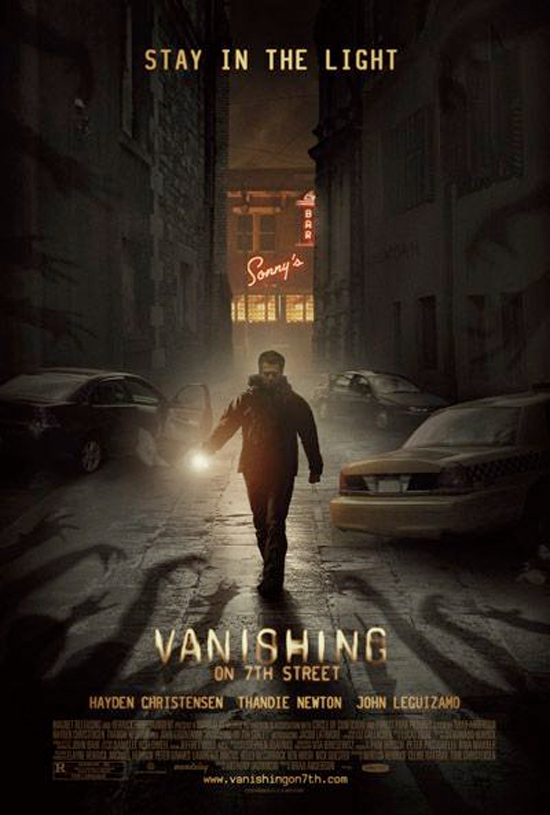
THE ZONE have my review of Brad Anderson’s urban horror film Vanishing on 7th Street.

I say “urban” as the film takes place in the rapidly depopulating city of Detroit but it strikes me that a more accurate description of the film might be something like ‘marshy’. Vanishing on 7th Street is about a group of people struggling to survive in the ruins of a city plunged into darkness by a powercut. What makes their existence something of a struggle is the fact that, out in the darkness, people keep disappearing meaning that, in order to stay alive, you have to keep the lights on. Unfortunately, with the main power out, the survivors are forced to rely upon mysteriously dwindling supplies of fuel and batteries.  These situation is made even worse by the tendency of the survivors to get lost in their own memories and wander off into the darkness. As you can probably tell, this is a film that is full of interesting thematic hooks but Anderson somehow manages to avoid getting caught on any of them resulting in a film that is neither scary nor dramatic and neither tense nor thought-provoking.  Vanishing on 7th Street is a marsh of ideas and Anderson made the terrible mistake of stepping off the path…

Vanishing On 7th Street could have been a brilliant horror film, an intelligent allegory for urban collapse or a thoughtful character study, but its refusal to pick a dramatic register and stick with it means that the resulting film is nothing but a series of pretty but ultimately pointless exercises in low-budget atmospheric cinematography. This is a brilliant idea waiting for a competently written script.

Whatever happened to the man who directed such brilliantly off-beat psychological thrillers as Session 9 (2001) and The Machinist (2004)? Come home Brad Anderson!  All is forgiven!

Fright Night (2011) – Even The Straight Boys are Queer

There are some things that female directors do better than male directors and one of them is acknowledging the moral and psychological ambiguities inherent in the loss of sexual innocence.

Consider such mainstream accounts of adolescent sexuality as the Porky’s and American Pie series and you will find teenaged boys that are monuments to frustrated worldliness.  Endless fonts of libidinal energy, these teenagers know all the moves and all the rules but cannot find anyone with whom to put them into practice. In most films, males are either guileless children or frenetic satyrs, there is no middle ground and there is no real sense of psychological transition. Films that should describe a coming of age all too often opt for depicting an age of cumming. By contrast, films such as Lucille Hadzhihalilovic’s Innocence (2004), Katell Quillevere’s Love Like Poison (2010) and Celine Sciamma’s Water Lillies (2007) depict the loss of female innocence as a profoundly ambiguous process, a fall from grace into desire and a movement from protected freedom to vulnerable responsibility.

Cinema’s lack of engagement with the subtleties of male sexuality is also evident in a lot of gay independent cinema. ‘Coming out’ dramas such as The String (2009), Shank (2009) and even Tropical Malady (2004) focus less upon the emergence of homosexual desire than they do upon the process through which apparently straight men come to terms with the social pressures keeping them in the closet. One notable exception to this rule is Tom Holland’s sadly overlooked vampire film Fright Night (1985), in which a teenaged boy finds himself trapped between the sexual demands of his increasingly frustrated girlfriend and the siren’s call of the sexually ambiguous man-next-door. Nowadays, the equation of male sexuality with vampirism is a largely unquestioned part of the genre landscape given that both Buffy the Vampire Slayer and the Twilight books present adolescent males as dangerously libidinal creatures whose desires must be kept in check lest all hell break loose. This metaphorical Othering of male sexuality is particularly evident in Meyer’s Twilight series as the books feature a male vampire who effectively castrates himself in order to assume the role of an ersatz gay best friend. Once feared and desired in equal measure, the vampiric sexuality of adolescent boys is now house-broken for the purposes of romance, teenaged boys are now expected to sigh and to speak of love but never to demand a hand-job.

Half an hour into Craig Gillespie’s remake of Fright Night, a character expresses absolute outrage at the suggestion that he reads Twilight novels. This fragment of dialogue constitutes a statement of intent: Fright Night is not about dickless pretty-boys; it is about a male sexuality that is red in tooth and claw. A sexuality so terrifying in its primal nature that it even frightens the men afflicted by it.  Far more than a vampire movie or a horror-comedy, Gillespie’s Fright Night attempts to follow in the footsteps of Innocence and Love Like Poison by confronting received wisdom about the adolescent sexual experience. However, the more the movie deconstructs traditional depictions of adolescent male sexuality, the more it struggles to find an alternative to the frustrated satyrs of American Pie thereby begging the question: What is it like to be a teenaged boy?

Continue reading →

REVIEW – Spread (2009)

Videovista have my review of David Mackenzie’s Spread (a.k.a. Toy Boy).

Trapped somewhere between romantic comedy and a warts-and-all indictment of life on the Hollywood fringe, Mackenzie’s film garnered a good deal of festival buzz thanks to the presence of Ashton Kutcher and the insider-y nature of the subject matter.  Kutcher — whose career received a sizeable boost as a result of his relationship with the older Demi Moore — plays a pretty young man who lives off of older women.  On paper, this film promised a lot and initial reviews were strong but once the collective hysteria of festival season faded, so too did the film’s buzz and reality soon reasserted itself.  A reality of muddled tone, indifferent scripting and lack of sociological bite:

I suspect that these variations on the traditional romantic comedy theme are intentional and that, by breaking with generic tradition, the film is trying to make some wider point about the way in which we think our lives are going to follow these grand romantic arcs but, while Spread hints at this sort of deconstructive agenda, it ultimately fails to explore any of these themes meaning that the film comes across as broken rather than deconstructed.

All in all: Not nearly clever enough.

REVIEW – Hatchet II (2010)

Videovista have my review of Adam Green’s latter-day slasher film Hatchet II.

I requested Hatchet II because I had heard great things coming out of the film’s US screenings. Having enjoyed Hatchet’s ironic humour, I was hoping that Hatchet II might push the boat out that little bit further and be maybe just a little bit sillier, a little bit gorier and a little bit funnier.  Instead, I discovered a film that caused me to reconsider my view of the original film.  Suddenly I was reminded of that scene in The Simpsons episode where Moe builds a tunnel from the fashionable waterfront district to his bar in the slums in order to lure in yuppies. “Hey, this isn’t faux dive… this is a dive”.  Upon watching Hatchet II, I thought of Hatchet and exclaimed “Hey, this isn’t faux schlock… this is schlock!”:

Unfortunately, because Green struggles with both the campier elements and the more serious moments, Hatchet II never manages to find that sweet spot between postmodern irony and absolute sincerity. Because it is impossible to know when the film is being intentionally awful and when it is merely being awful, Hatchet II‘s moments of intentional self-parody feel more like defence mechanisms designed to allow the filmmakers to cry ‘irony’ whenever their attempts at tension and human drama fall wide of the mark. This makes for an uncomfortably defensive cinematic experience, like sharing a drink with someone who keeps putting himself down in the hope that you’ll tell him how wonderful he is.

Avoid it like the proverbial.

Final Destination 5 (2011) – The Last Laugh is On Us

The literary critic Paul Bleton argues that the difference between genre and non-genre pieces is that genre pieces have a structure resembling that of a string of pearls.  What Bleton means is that genre (whether erotic, sensational or criminal) is all about big dramatic set pieces.  These dazzling moments of spectacle attract the eyes, stimulate the brain and distract you from the fact that the plots and characters they involve frequently serve no purpose other than to tie the set-pieces together into something broadly resembling a story.

Interesting though it may be, Bleton’s conception of genre is now seriously out of date.  Firstly, a generation of writers and directors with interests in character and subtext have worked at reclaiming genre devices so as to blur the distinction between pearl and string.  Secondly, a generation of directors including Michael Bay (Transformers), Gore Verbinsky (Pirates of the Caribbean), and Mark Neveldene and Brian Taylor (Crank) have stripped away the fig leaf of plot and character to produce films that are nothing more than series of set-pieces held together by implication and the fact that they are packaged and sold as a single artistic unit.

With the difference between genre and non-genre under continuous assault on multiple sides, there is something pure and elegant in a film that is unapologetic in its string of pearls-like structure.  The Final Destination series has never been anything other than a series of lavish set-pieces held together by weak plots and terrible characters but in that terrible predictability lies real profundity.

Continue reading →

Humpday (2009) – No Pretty, No Mercy

While I am happy to join the chorus of disapproval surrounding the state of British universities, I cannot help but feel that there was something inevitable about the current wave of cuts and restructurings.  The problem is that, while there has been a massive expansion in higher and post-graduate education, much of this expansion was founded on a lie, the lie that you can teach someone to be insightful. Universities are brilliant at immersing you in a subject and teaching you to produce papers that look like the sort of things that academics should produce, but they cannot teach you to look at a phenomenon and say something truly original.  You cannot teach originality because you cannot teach creativity and you cannot teach creativity because you cannot teach insight.  Nowhere are the products of this lie more obvious than in contemporary film.

As Peter Biskind points out in the excellent Easy Riders, Raging Bulls (1998), people seldom attended film school in the 1970s.  Film schools existed but they held no status, carried no cachet and (most importantly) provided no guarantee whatsoever that any of their students would ever get to sit behind a camera and shout ‘Action’. Forty years later and film schools not only provide universities with a welcome source of income, they also provide the creative industries with a steady supply of competent individuals who are more than ready to step behind a camera and produce adverts, music videos and films on demand. Film schools train aspiring directors by helping them to deconstruct and replicate the techniques that made great films what they are. Because film schools are so popular and because they are so well attended, contemporary film boasts levels of technical sophistication that would humble the filmmakers of previous generations. Unfortunately, while film schools do a brilliant job of teaching people how to make a film, they cannot teach them how to make good and insightful art.  Because of this, the explosion of film school students has lead not to a generation of great directors but to a generation of skilled imitators.

In Narration in the Fiction Film (1985), David Bordwell masterfully deconstructs the techniques used in what he calls ‘Art-Cinema Narration’.  This form of narration involves the use of extended silences, gaps in narration and expressionistic visual composition that shed light on the characters’ inner states.  While these techniques may once have been radical and ‘difficult’, they are now as familiar to cinema-going audiences as the strictures of any populist genre.  Because these techniques are familiar, they can be adopted in order to lend a work an ‘art house sensibility’.  The textbook example of this sort of affection is Matthew Weiner’s period TV drama Mad Men.  As Daniel Mendelsohn points out in his piece in the New York Review of Books, Mad Men is effectively a soap opera.  However, because the series adopts many of the narrative tropes and techniques common to art house film, we assume that it is as intelligent and insightful as the art house films that pioneered these sorts of narrative techniques.  Because Mad Men’s plotlines are never resolved, we think the series is as smart as L’Avventura. Because Don Draper’s internal state is only ever alluded to in an elliptical fashion, we think the series is as smart as Last Year in Marienbad.  Films such as Samuel Maoz’s Lebanon (2009) and Mike Mills’ Beginners are also excellent examples of works that look intellectually substantial but in fact have very little to say. Clearly, techniques developed in order to help filmmakers shed light on a new set of issues are now used to evade the responsibilities of coherent thought and genuine insight. What was shocking is now familiar.  What was revolutionary is now consolatory. When technical expertise carries more weight than genuine insight mere competence becomes downright heroic.  Mumblecore is a cinematic movement that finds virtue  and strength in technical mediocrity.

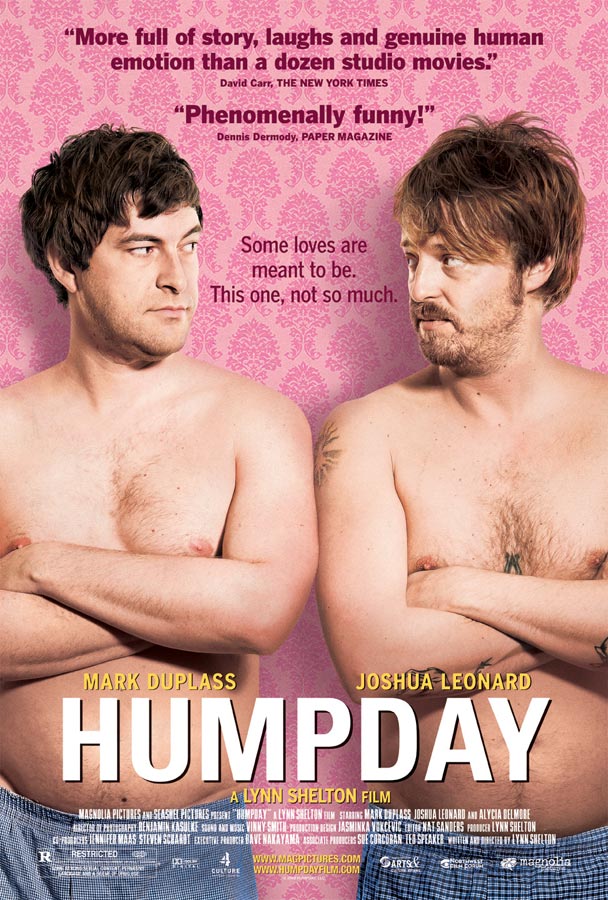
Mumblecore films such as Andrew Bujalski’s Funny Ha Ha (2005) and Aaron Katz’s Cold Weather (2010) are made on ultra-low budgets with minimal production values, largely non-professional actors and scripts that allow for a good deal of on-set improvisation.  Stripped of complex camera movements, lighting effects and art-house narrative techniques, Mumblecore films stress relationships over plot in such a way that the emotional and psychological meat of the film has no place to hide.  Mumblecore films are all about character and relationships and their power derives from a complete commitment to exploring these things in forensic detail. No handwaving. No distractions. No bullshit.  Lynn Shelton’s Humpday is brilliant in its unflinching commitment to the weakness and complexity of its characters.

Continue reading →

Some Thoughts On… Project Nim (2011)

Last year, the French documentarian Nicolas Philibert produced Nenette (2010), a film that used footage of an orang-utan and recordings taken in a zoo to demonstrate the human tendency to project human emotions onto animals. Nenette also demonstrated that human speculations about the inner lives of apes tend to tell us a lot more about the humans than they do about the apes. James Marsh’s latest documentary Project Nim ploughs much the same furrow by exploring the attempt by a group of 1970s scientists to teach a chimp to sign.

Project Nim focuses upon the story of Nim Chimpsky, a chimpanzee who was removed from his mother and brought up by humans in an attempt to see if treating a chimp like a human might encourage him to think and communicate like one.   Initially, Nim is entrusted to the care of a wealthy hippy family whose laid-back approach to parenting results in Nim effectively taking control of the house.  Concerned that the chimp is getting what he wants through social dominance rather than by acquiring language skills, the project director Herbert S. Terrace removes Nim from his surrogate family and places him in the care of a group of specialised teachers.  While these teachers manage to imbue Nim with an incredibly rich vocabulary, the older Nim becomes, the harder it is to control him. When Nim bites his teacher’s face, Terrace decides to end the project and place the chimp in a research facility where his life gets progressively worse.

The foreground of the documentary is devoted to a somewhat uneven engagement with the project’s ethical standards. Terrace is depicted as a shameless opportunist who uses both his students and Nim to build an academic career before cutting both adrift without a moment’s hesitation or regret.  While this foreground narrative produces a number of touching moments, it is fatally undermined by Marsh’s bizarre insistence upon reminding us that Nim is a wild animal who should not be thought of in human terms.  The result is a film that coaxes its audience into empathising with a chimp before slapping them down for doing precisely this.  Mercifully, the film’s background proves far more rewarding.

Stepping back from the details of Nim’s life, Project Nim does an absolutely brilliant job of conveying the weirdness of 1970s academic culture. For example, Nim’s original foster family included a woman who breast-fed Nim and then allowed the chimp to ‘explore her body’ as part of her informal personal research into the Oedipus complex. Predictably enough, once Nim is transferred to the care of a group of scientists, they follow the original foster mother in using Nim as a vehicle for their own desires and ambitions. One ambitious graduate student wrestled control of Nim’s education from the foster family as a means of acquiring Terrace’s attention, this lead to a brief affair that resulted in one dumped graduate student and one chimp deprived of a mother-figure. The more figures from Nim’s life the film introduces, the more obvious it becomes that while everyone was eager to do what was best for Nim, their assessments of what was ‘best’ usually depended upon what was convenient for them.  This is particularly obvious in the case of Terrace whose termination of the project results in Nim being sold for medical research.  His charge cast into the outer darkness, Terrace promptly produced a book in which he argues that Nim was nothing more than a hugely accomplished beggar who never really understood the language he was using. Unsurprisingly, the humans who come across as most sympathetic are the ones whose visions of Nim emphasise his human characteristics.  Particularly sympathetic is the Dead Head primate handler who treats Nim as just another pot-smoking fellow traveller.

The fact that our sympathies tend to lie with those who treat Nim like a person rather than an animal says a lot about our own empathic tendencies and the film’s capacity for inviting us to fall into the same trap as Nim’s original handlers.  However, as clever as this manipulation may be, the film’s refusal to engage with empathic projection head-on results in frustratingly lightweight fare. Yes, we extend empathy to a chimp because the chimp behaves like a human but so what? What does this say about us? What does it mean for our relationships to animals as a whole? Are we wrong to treat animals as humans or are those who treat chimps like animals unethical monsters? Project Nim tries to address some of these questions without getting bogged down in the sort of heavy philosophical speculation that might alienate audiences but by raising questions in such an oblique fashion and then failing to develop them in any meaningful way, Project Nim only manages to remind us of quite how much can be achieved with footage of an orang-utan and the sound of zoo visitors wildly projecting their own worries onto the indifferent figure of an ape.

Rise of the Planet of the Apes (2011) – Arrested Arrested Development

Reboots are predicated upon the idea that franchises have natural lifespans. The cycle begins with a single luminous idea that is transformed into a film, a book, a game or a TV series.  The brilliance of the idea is such that its chosen media vehicle becomes a huge success.  Desperate to cash-in on the success of that idea, its owners will then sanction the creation of sequels, prequels, spin-offs and media tie-ins that make them a lot of money whilst devaluing the original idea thanks to over-exploitation, over-familiarity and the corrosive inertia of too many bad decisions.  Down on its luck, the franchise then lies dormant until people either forget the bad decisions or a new idea reinvigorates the old one allowing the franchise to be re-launched, re-imagined or re-booted.

In 1968, Pierre Boulle’s 1963 science fiction novel gave birth to a surprisingly thoughtful and visually striking film directed by Franklin J. Schaffner. Planet of the Apes was such a success that it went on to spawn four cinematic sequels and a short-lived TV series, by which time the idea was well and truly played out (for a great overview of the original films, check out Matt Singer’s piece here).  Mindful that TV repeats and home video cinephilia had transformed these old films into objects of cult veneration, studio executives hired Tim Burton to helm a ‘re-imagining’ of the original franchise.  However, far from re-invigorating the franchise, Burton’s under-written chase picture only served to bury it beneath an avalanche of sneers and titters rendered all the more toxic by that Simpsons episode. Planet of the Apes!  What a stupid idea for a movie!

Fast-forward ten years and trailers for a new Planet of the Apes movie began to appear in theatres and websites.  The trailers for Rupert Wyatt’s Rise of the Planet of the Apes featured lots of CGI and a gorilla attacking a helicopter. When I first saw this trailer in a cinema, people laughed. However, far from being risible, Wyatt’s finished film is nothing short of a triumph. A delicious surprise given its recent cinematic antecedents, Rise of the Planet of the Apes is one of the most effective and thought-provoking Hollywood films to appear this year.

Continue reading →