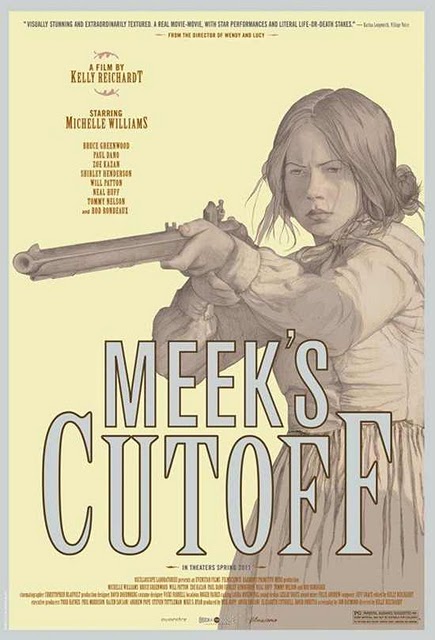
Meek’s Cutoff (2010) – Sous le Sable… les Femmes

Let me begin with a bit of history: until the arrival of the locomotive, the western half of the American continent was criss-crossed by a number of emigrant trails designed to help Americans immigrate to such emerging western territories as California. Arguably the most famous of these trails was the Oregon Trail, a 2000-mile route that linked the Missouri River to valleys in what we now think of as the state of Oregon. In its heyday between 1846 and the completion of the first transcontinental railroad in 1869, the Oregon Trail conducted over 400,000 Americans to the west of the continent. It was through this steady flow of farmers, miners, ranchers and normal people that the West was truly won.

Kelly Reichardt’s film Meek’s Cutoff tells the (reportedly true) story of what happened when one group of settlers – lead by the famous explorer Stephen Meek – attempted to find a safer route to Oregon that might bypass some dangerous Indian land. Slow-paced and enigmatically shot, Reichardt’s film reveals both an emptiness at the heart of the American dream and the dangers of what can happen when being a man is mistaken for being a leader.

Continue reading →

Cold Weather (2010) – The Eyes of the Sensitive Observer

Cold Weather is an experiment that does not quite work but which is all the more beautiful for its failure.

Aaron Katz is one of several young American filmmakers to be tarred with the Mumblecore brush. Neither a genre nor a movement, ‘Mumblecore’ refers to one of those rare and beautiful moments when a group of creative artists with similar tastes and interests come together and begin to learn from each other’s methods and respond to each other’s ideas thereby creating a series of works with a similar set of aesthetic priorities. While these aesthetics are still evolving, it is possible to see in the work of such directors as Andrew Bujalsky (2002’s Funny Ha Ha), Lynn Shelton (2009’s Humpday) and the Duplass brothers (2008’s Baghead) the development of a cinematic style that has been heavily influenced by the films of John Cassavetes, Mike Leigh and Maurice Pialat.

Mumblecore films tend to be made with small budgets, small crews and small casts composed of largely non-professional actors working from and improvising around a more or less pre-written script. The non-professional nature of the actors and the improvisational aspects of the dialogue along with the tendency to frame character development in such a way that the audience has to draw its own inferences about the characters means that Mumblecore films frequently feel remarkably rough, realistic, unpolished and spontaneous. Mumblecore films invariably feel as though they simply ‘happen’; a stylistic tic also that owes quite a lot to the tendency to use 20-something actors and unglamorous settings that make it look as though the films might have been made in the director’s spare time.

 Cold Weather is an attempt to move Mumblecore outside of its comfort zone by taking the aesthetics of spontaneous authenticity and fusing them with those of a cinematic genre that is defined by its careful plotting and its use of directorial technique to create a sense of tension. While this Mumblecore thriller never feels like more than the sum of its parts, it is difficult not to love a film that so perfectly understands the allure of a good mystery.

Continue reading →

Limitless (2011) – Mega Mega White Thing

They say that cocaine can make a good man great.

The also say that it can make him into a tedious jabbering fool.

These things are not necessarily mutually exclusive.

One of the more intriguing sequences in Charles Ferguson’s Oscar-winning documentary about the credit crunch Inside Job (2010) reveals that, prior to the crash, a number of New York brokerage houses and management consultancies allowed their employees to pay for sex on their company credit cards. Ferguson uses this revelation to add a tinge of decadence to his depiction of Wall Street institutions but it also raises the question of a degree of kinship between betting large amounts of other people’s money and a lifestyle littered with cocaine and high-class escorts. Ferguson hand-waves this association with some waffling about pleasure centres in the brain but what if the link is not neurology but a question of peer groups? Are the sort of people who tend to do well in banking also the sort of people who tend to enjoy coke and hookers? Does a fondness for coke and hookers mark financial executives out as ‘our sort of chap’?

Neil Burger’s Limitless is a science fiction film about a man who discovers a drug that unlocks the untapped potential of his brain. Initially a struggling science fiction writer, the film’s protagonist soon morphs into the sort of arrogant, swaggering, bollock-talking bell-end that seem to dominate the world’s financial institutions and, as long as he keeps taking the pills, there’s a good chance that this particular bell-end will wind up President.

Continue reading →

REVIEW – The Long Hot Summer (1958)

More and more, I find myself attracted to character.  Character not so much as a focus for empathy or even sympathy but character as an examination of human psychology and of the human condition as it is projected into the world. One way of exploring the evolution of human nature is by taking an extremely long view of the matters and looking at how the quirks of one generation can blossom into the crippling psychological ailments of another.  This style of writing and approach to character underpins Zola’s Rougon-Macquart series as well as William Faulkner’s Snopes family series of books and short-stories.

The Long Hot Summer is an attempt to capture some of that psychological depth and complexity and communicate it through the medium of film.  Based mostly upon the first of Faulkner’s Snopes novels, The Long Hot Summer features the great Orson Welles as an overbearing paterfamilias whose psychological quirks are strangling both him and his children.  In order to escape from this impasse, Welles’ character needs a catalyst but what of the ethics of using someone else to solve your own problems?  Paul Newman plays a catalyst by the name of Ben Quick.  A catalyst who, it transpires, has issues of his own.

Videovista has my review.

REVIEW – Buried (2010)

Late last year, Rodrigo Cortes’s film about a man buried alive in Iraq was released to a good deal of serious critical attention.  Ostensibly an experimental work primarily concerned with trying to inject textured tension and atmosphere without ever leaving the confines of a small wooden box.  Though successful in this regard, the film’s use of the word ‘Iraq’ lead some overly eager critics to jump to the conclusion that the film is some grand allegory for American foreign policy.  It isn’t.  It’s a very silly film about a man trapped in a box which, despite glimmers of intelligence, is ultimately let-down by a decidedly lackluster script.

Videovista has my review.

In the review, I also mention Stuart Gordon’s film Stuck (2007), which I reviewed on this very site a couple of years ago.  That’s a much better film, go and watch that one instead.

REVIEW – The Lost Patrol (1934)

One of the more depressing cinematic experiences I had last year was going to see Matt Reeves’ timid remake of Tomas Alfredson’s superlative Let The Right One In.  I was lured into the cinema on the promise that the American version teased certain elements out of the original text that Alfredson’s film missed but what I got was pretty much a shot-for-shot remake.  Pointless hack-work aimed at culturally insular Americans.  Some might say that this was inevitable and that there is no point in remakes, but I do not think that this is necessarily true.  Some films positively overflow with great ideas but somehow manage to fuck up the implementation.

As my review of John Ford’s largely overlooked The Lost Patrol makes, clear, I think that it is a film that is absolutely ripe for a re-make.  Set in the Mesopotamian desert during the first world war, the film tells of a group of British soldiers who lose their officer and their way in the middle of the desert.  Under attack from unseen assailants, the soldiers hole-up in an abandoned mosque and slowly go mad.  Boasting Boris Karloff, the film is rushed and has too many characters to ever settle down into the psychological register the subject requires but there are some lovely ideas hidden in this film.  They just need someone to unleash them.

REVIEW – The Fallen Sparrow (1943)

“To shoot people, sweetheart!”

And with those words… my heart soared with joy.

Richard Wallace’s The Fallen Sparrow is very much an overlooked gem.  One of a series of novels by Dorothy B. Hughes that were adapted for the screen during the hey-day of the film noir, The Fallen Sparrow is a demented psychological thriller in which a tortured veteran of the Spanish Civil War cuts a swathe through New York high society as he attempts to solve the (possible) murder of the man who helped him escape the clutches of the Gestapo.  As the veteran moves from reconnecting with his old friends and into a world of sinister academics and crusading noblemen, the lines between reality and delusion blur and then finally disappear.  Boasting a fantastic script and some rather surprising performances, The Fallen Sparrow deserves its place in cinema history.

Videovista have my review.

REVIEW – The Seven-Ups (1973)

Did you enjoy Steve McQueen in Bullitt?  How about Gene Hackman in The French Connection?  Well… believe it or not the producer of both of those films went on to direct a film of his own.  A film with many of the same advisors and technical assistants.  The result?  A Big Dumb Stylish 1970s Car Chase Movie but, unlike Bullitt and The French Connection, The Seven-Ups is nothing else than a Big Dumb Stylish 1970s Car Chase Movie.

Videovista have my review.

REVIEW – Sealed Cargo (1951)

Anyone who grew up in Britain in the 1980s will remember a time when TV schedules were bulked out with lesser-known black and white films.  Films which, as a kid, you would seldom find yourself watching.  There is a definite rainy-saturday-afternoon feel to Alfred L. Walker’s Sealed Cargo.  A war-time drama dealing with U-boats and the paranoia surrounding Nazi infiltration of the Danish merchant navy, Sealed Cargo features both some sublimely atmospheric moments of tension and some frankly demented action sequences.

Videovista have my review.

The Kids Are All Right (2010) – It’s a Woman’s World… Thanks to Men.

In September I wrote a piece about Debra Granik’s excellent Winter’s Bone (2010) examining the film through the prism of what the theologian Elisabeth Schüssler Fiorenza calls ‘Kyriarchy’.  Kyriarchy is a concept designed to move discussions of prejudice and social dominance beyond the kind of simplistic oppositional dynamics that have for too long dominated this area of political discourse.  According to Kyriarchy, dominance is not a question of GLBT vs. Straight, Black vs. White, Male vs. Female or Catholic vs. Protestant but rather a patchwork of ever-changing power relations between all kinds of different groups.  According to Elisabeth Schüssler Fiorenza, the face of human oppression takes myriad forms.  It is always changing and yet always present.  Winter’s Bone demonstrates not only that women can be complicit in the oppression of other women but that men can also find themselves forced into a particular social role that they may personally find oppressive and intolerable.  In Granik’s Ozark mountains, men are violent and psychotic because that is what they are expected to be.  If you are not violent and psychotic then you are not a real man and if you are not a real man then you might as well spend your time playing the banjo.

As it deals with the poorest of the poor, it is easy to characterise Winter’s Bone as a depiction of a life that is particularly and unusually hard and so to conclude that the patterns of social dominance represented in the film are somehow an exception to the more normal and healthy gender relations that characterise the rest of society.  This is simply not the case.  The Ozark mountains may well make social dominance a matter of life and death but the same patterns of social dominance present on those bleak mountainsides play out all across our society.  Right up to the top.  The universality of Kyriarchal rule is elegantly demonstrated by the sexual politics of Lisa Cholodenko’s The Kids Are All Right.

Continue reading →