The Book of Human Insects (1970) By Osamu Tezuka – The Horror of Limitless Potential and Unfettered Change

It is impossible to dangle one’s toes into the waters of Japanese sequential art without, sooner or later, encountering the name of Osamu Tezuka. Aside from being a hugely prolific and influential artist who inspired generations of authors, Tezuka was also one of the first Japanese comics artists to enjoy commercial success in the West with series including Astro Boy and Kimba the White Lion. However, despite the child-friendliness of Tezuka’s greatest successes, many of his finest works are decidedly darker and a good deal more complex. An excellent example of this is Tezuka’s recently translated The Book of Human Insects. Set in 1970s Tokyo, the novel offers a darkly compelling portrait of a woman with a remarkable capacity for re-invention. Ostensibly a psychological thriller about a Mr Ripley-like femme fatale who feeds upon Japan’s predominantly male intelligentsia, The Book of Human Insects resonates most when read as a critique of post-War Japanese society.


Continue reading →

Incendies (2010) – The Viscera of History

There are many metaphors applied to humanity’s study of the past. In the opening lines of The Go-Between (1953), L.P. Hartley opines that “the past is a foreign country: they do things different there”. In The Aetiology of Hysteria (1896), Freud likens the role of the psychoanalyst to that of a conquistador or antiquarian:

Imagine that an explorer arrives in a little-known region where his interest is aroused by an expanse of ruins, with remains of walls, fragments of columns, and tablets with half-effaced and unreadable inscriptions… He may have brought picks, shovels and spades with him, and he may set the inhabitants to work with these implements. Together with them he may start upon the ruins, clear away the rubbish, and, beginning from the visible remains, uncover what is buried.

Both metaphors present the process of historical detection as a voyage into territories unknown. Today, these metaphors ring hollow through a combination of over-use and changing attitudes to the wider world. These days, the world is a village and no two parts of the village are ever more than a plane-flight away. However, in the days of Hartley and Freud, the world was a much larger and scarier place. Were one to update Hartley’s dictum for contemporary usage one would most likely say something like “the past is an oceanic trench: who knows what lies buried in the dark?”

Nowhere is the past’s peculiar edge more evident than when it protrudes from the wreckage of a life recently concluded. When a parent dies, the children move in and sort through their things. This process of sorting generally uncovers all kinds of facts from the actively forgotten to the merely mislaid. People lead complicated lives and these lives are seldom fully encapsulated by the short amount of time that people know each other. To look into a loved-one’s past is to uncover things about them that we would rather not know, things that force us to confront unpleasant truths about ourselves. Denis Villeneuve’s Incendies is a film about a voyage into the past and the changes that such a voyage can bring to otherwise blissfully ignorant lives.

Continue reading →

REVIEW – Secret Behind The Door (1947)

THE ZONE have my review of Fritz Lang’s classic psychological thriller Secret Behind the Door starring Joan Bennett and Michael Redgrave.

Based upon Charles Perrault’s fable Bluebeard, Secret Behind the Door explores the process through which a couple get to know each other.  After a whirlwind romance, Bennett’s character marries Redgrave’s secretive and intense architect.  After a rudely interrupted honeymoon, Bennett’s character arrives at the architect’s home and finds him sharing it with two other women and a son from a previous marriage. As in the fable, Bennett’s character begins poking around in her husband’s background until she discovers something sinister.

Bluebeard is perhaps better known in its native France than it is in the Anglo-Saxon world. One reason for this is that it is one of those stories that paints women as a race of incessant and toxic meddlers whose refusal to follow simple male instructions result in the destruction of everything.  Think of Else to Lohengrin. Think of Eve to Adam. Because of the story’s misogynistic roots, generations of feminist authors have been quick to reclaim the role of interfering spouse and cast it in a more positive and transformative light such as the one that bathes Jane Eyre in Charlotte Bronte’s novel. Neither misogynistic nor feminist, Lang’s adaptation of Silvia Richards’ screenplay presents Bennett’s character as a wonderfully ambiguous figure who ‘fixes’ her husband for reasons all of her own. However, while the characters are engaging and the plot is fascinating, what really grabbed me was Lang’s decision to use a voice over as the primary means of communicating inner states:

Watching Secret Beyond The Door and noticing Lang’s tendency to simply pause the action and linger on his actor’s faces while their voiceovers are delivered, I was struck by how little has changed in the way that directors communicate interiority. Indeed, while directors of Lang’s generation paused so that voiceovers can be delivered, contemporary directors simply pause and allow audiences to fill in their own voiceovers. Doubtless many art house films could be transformed by using these little pauses and gazings into the middle distance to deliver short voiceovers in which characters speak directly to the audience. Clearly the basic grammar of cinema has not evolved that much since the days of Lang, it is just that nowadays art house directors tend to outsource exposition to audience speculation.

Secret Behind the Door is a flawed gem and its arrival on region-free DVD is long overdue. This is a must for anyone who enjoys psychological thrillers and an absolute necessity for anyone who loves Fritz Lang’s film noirs.

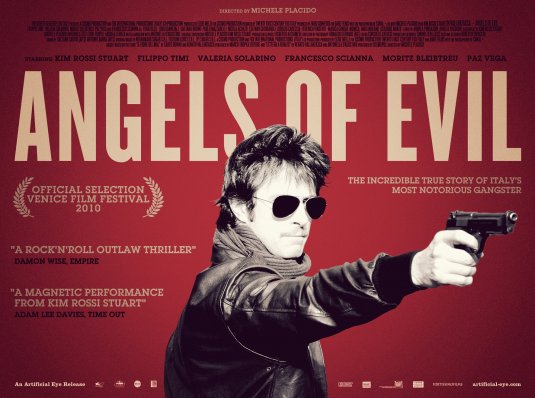
REVIEW – Angels of Evil (2009)

Videovista have changed their format.  Rather than spewing a torrent of reviews at you once a month, the site has moved towards a more selective approach to publishing in which they devote attention solely to a few note-worthy films.  My first shot at the DVD of the month is a piece about Michele Placido’s Angels of Evil (a.k.a. Valanzasca – Gli Angeli del Male), the follow-up to Placido’s 2005 crime bio-pic Romanzo Criminale. While I ultimately found the film a good deal less engaging than the politically thoughtful Romanzo Criminale, Angels of Evil remains a beautifully shot and stylishly produced crime thriller that sheds an intriguing light on the challenges facing the crime bio-pic genre. My review is HERE.

Though undeniably well made, Angels Of Evil suffers terribly from an overabundance of familiar elements: it is a film entirely composed of stock characters. Vallanzasca’s first wife Consuelo (Valeria Solerino) is a beautiful woman who doesn’t take any shit from anyone right up until the moment she meets Vallanzasca and promptly transforms into a long-suffering doormat with a sensible haircut. Similarly, the members of Vallanzasca’s gang are differentiated solely through their facial hair and their professional characteristics including the capacity to ride a motorcycle at 125 mph, and make good use of a sub-machinegun. Even Turatello is something of a cliché as his charismatic public persona masks a psychopathic fondness for violence and a rather predictable obsession with his hair that has him visiting women’s salons and sleeping in a hair-net. Anyone who has seen Goodfellas will recognise these sorts of characters and Goodfellas’ influence means that they have spent the last 20 years appearing and re-appearing in every crime thriller you care to mention. Aside from being faintly depressing, Placido’s refusal to depart from traditional genre stereotypes also serves to weaken his treatment of Vallanzasca himself.

Having damned the film for its generic nature, I then ponder whether the generic nature of the film’s characters might not be the result of deeper sociological forces. Indeed, if you watch The Sopranos, it is obvious that the characters have all partly modelled themselves on figures from the Godfather. This begs the following question: does the film’s depiction of Vallanzasca and his gang seem generic because of lazy script-writing or does the script capture the basic truths about a group of characters who modelled themselves on figures out of crime fiction and film?

Some Thoughts On… The Debt (2010)

Best known as the director responsible for such safe, middle brow, award-bothering prestige productions such as Mrs Brown (1997), Shakespeare in Love (1998) and Captain Correlli’s Mandolin (2001), John Madden returns with a thriller written by Jane Goldman and Matthew Vaughn. As might be expected from the writing team behind X-Men: First Class (2011) and Kick-Ass (2010), The Debt is a kinetic thriller that is forever promising to erupt into something a good deal more complex. However, much like both Kick-Ass and First Class, The Debt is a film that works best when it is in movement as its quiet character moments are under-written and under-powered despite some decent performances by two eye-catching casts.

Split between two timelines, The Debt tells the story of a group of 1960s Mossad agents who are sent into Soviet-controlled East Germany to kidnap a Nazi war criminal. Forced to live together, the three agents quickly stumble into a love triangle that finds the quietly intense Rachel (Jessica Chastain) having to choose between the introverted idealist David (Sam Worthington) and the arrogantly ambitious Stephan (Marton Csokas). When the kidnapping goes wrong, the three young people find themselves having to babysit an aging but fiercely intelligent Nazi who relentless probes their weaknesses and tries to set them against each other. Bookending this middle section is the film’s second timeline. Set in the 1990s, this timeframe explores the psychological consequences of the events of the film’s middle section. Still physically and psychologically scarred by her ordeal, Older Rachel (Helen Mirren) shifts uncomfortably as her daughter pays public tribute to her heroism. Meanwhile, Older David (Ciaran Hinds) is crippled by the burden of guilt and secrecy while Older Stephan’s (Tom Wilkinson) arrogant bluster has turned into tyrannical will-to-power.

The Debt features some excellent action direction and powerful sound-design that lends its fight sequences a brutal clarity that is terrifying when compared to expanses of quiet emotional desolation that dominate the rest of the film.  The scenes in which a manipulative Nazi confronts the agents are similarly impressive even though Quentin Tarantino did the same thing only better in Inglorious Basterds (2009).  Unfortunately, once the film moves beyond such genre staples, the limits to both the script and Madden’s direction start to become painfully evident.

Much of the film’s drama rests upon the tension of the plot colliding with both the characters’ back-stories and the bonds of affection that tie them together. While this occasionally works quite well (in particular the scene where Stephan seduces Rachel at the piano while the introverted David flinches in pain with every note they play), the film does not manage to pull off the bulk of its dramatic moves and because many of the film’s emotional beats fall short of the mark, many of the film’s sequences seem overly long and hopelessly flabby. Indeed, there were huge expanses of this film where time seemed to stand still as characters pouted and bemoaned some inner turmoil that never managed to feel real let alone seem particularly compelling.

The problem is that while The Debt had the potential to be an interesting genre film, the filmmakers clearly want it to be quite a bit more. Having secured a good deal of top-notch acting talent, you can sense their desire to make the most of it and maybe push for a few awards but, at the end of the day, both the script and the direction of The Debt fail to support these lofty ambitions and so a promising espionage thriller finds itself transformed into an over-long and dramatically dysfunctional exercise in thespian posturing. This film has nothing much to say about the human condition and its insistence on trying to say it for close to two hours is both depressingly and frustratingly tedious.

Cutter’s Way (1981) – The Complete Hero

When the golden age of 1970s Hollywood came to an end and the studios reasserted their control there were many unworthy casualties. The great tide of the American New Wave had surged up the beach and rolled back to a sea of spiralling budgets, slumping revenues and bottomless self-indulgence. One of these casualties was Ivan Passer’s adaptation of Newton Thornburg’s novel Cutter and Bone (1976).

Buried in a corporate shake-up and largely forgotten until its DVD re-release, Cutter’s Way is very much a product of the American New Wave. Ostensibly about a pair of misfits investigating a conspiracy to protect a wealthy industrialist, the film taps into the same cultural anxieties as Alan J. Pakula’s political paranoia trilogy comprising Klute (1971), The Parallax View (1974) and All the President’s Men (1976). However, rather than pandering to the audience’s belief that someone is out to get them, Passer’s film presents its conspiracy in a deeply ambiguous manner. Indeed, Cutter’s Way is a film that asks whether the tendency to see conspiracies everywhere might not in fact be a reflection of a deeper psychological need to be appreciated and desired. After all… if people are out to get you then that must mean that they consider you worth getting. Far more than a simple conspiracy thriller, Cutter’s Way is an exploration of the comfort that can be had in being a victim.

Continue reading →

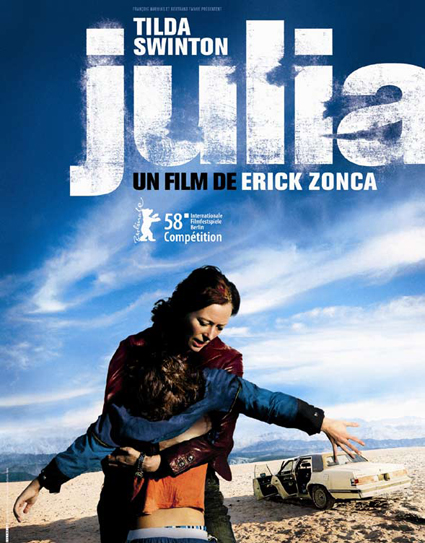
Julia (2008) – An Experiment in Unsympathetic Empathy

What can I say? I understand Lars von Trier. He did some wrong things, absolutely, but I can see him sitting there at the Cannes film festival… I sympathise with him, yes, a little bit.

When von Trier announced that he felt sympathy for Hitler, the grandees of the Cannes film festival responded by declaring him persona non grata. While much can be said of von Trier’s history of provocation, I believe that von Trier’s real mistake lay in expressing sympathy for Hitler rather than empathy. Indeed, while empathy involves understanding why someone does what they do and ‘feeling their pain’, sympathy means also seeing that person in a positive light. The slipperiness of these two concepts and their tendency to bleed into one another poses something of a challenge for writers because empathy and sympathy are quite different concepts. We should be able to understand why someone did something without seeing those actions as in any way acceptable.

Humans can be a surprisingly forgiving bunch and the more we understand another person, the more likely we are to see their actions as justified even if we do not necessarily agree with them. Because of this quirk in human nature, there is a tendency for unlikeable characters to wither beneath the glare of sustained psychological scrutiny, meaning that the more you explore a character’s back story and explain their motivations, the more likely it is that an unsympathetic bastard will turn into a big misunderstood puppy.  One could even argue that our tendency to automatically feel sympathy for the characters with whom we empathise accounts for the rise of psychopaths as anti-heroes. Indeed, by labelling a character as a psychopath, writers are making it clear that we ought not to feel much sympathy for them. Consider, for example the difference between character such as Dexter Morgan from Dexter and Vic Mackey from the Shield: Both are stone-cold killers who do not flinch from using horrific violence when it suits them. However, because Dexter has the label ‘psychopath’ attached to him, the character can never be completely sympathetic and so maintains his edge. Conversely, Vic Mackey is just a corrupt cop and, over the series, his actions take on a logic of their own that shifts the character from morally dysfunctional anti-hero to Dirty Harry-style crusader with a private sense of morality. Tellingly, when The Shield ended, Mackey’s future as an office drone was played for its pathos… we were supposed to feel sorry for a man denied access to the streets.

Based upon John Cassavetes’ Gloria (1980), Erick Zonca’s Julia can be seen as an attempt to solve this unintentional drift from empathy to sympathy. Telling the story of a selfish, unpleasant and manipulative alcoholic who kidnaps a child, the film works very hard at humanising its protagonist whilst retaining the opinion that she is a wretched human who is undeserving of either our sympathy or forgiveness. While the experiment is not entirely successful and the film does eventually collapse into something approaching sympathy for its protagonist, the move towards a more sympathetic portrayal is marked by a parallel drift away from character-based drama and towards a more genre-friendly approach to storytelling, thus begging the question as to whether we are more forgiving of genre characters than we are of real people.


Continue reading →

Some Thought On… Kill List (2011)

A little while ago, I was lucky enough to attend a British film festival designed to find foreign distributors for British films. While only a few of the festival’s films showed any promise, what they all demonstrated was the relative ease with which British thrillers were able to secure funding. Jean-luc Goddard once said that all you needed to make a film is a girl and a gun and low-budget British filmmakers seemed to be proving exactly that. Over the last couple of years, this financial trend has blossomed into a full-scale British genre revival including such works of psychological tension as J Blakeson’s The Disappearance of Alice Creed (2009), Matthew Hope’s The Veteran (2011) and Lynne Ramsay’s We Need To Talk About Kevin (2011). All of these films speak to the darkness of the human soul with a style and grace that elevate them above predictable exploitation narratives into something altogether more interesting.  Ben Wheatley’s Kill List is yet further proof of the intellectual vibrancy of the British thriller, it is one of the most effective films I have seen this year.

Wheatley began his feature-length directorial career with the micro-budgeted crime film Down Terrace (2009).  Grounded in dysfunctional human psychology, Down Terrace blurred the line between genre and traditional drama by embedding its narrative in a seemingly banal working-class environment. Wheatley’s desire to ground his films in the mundane details of everyday life continues with Kill List. Kill List opens by introducing us to Jay (Neil Maskell), a working-class man enjoying a comfortable middle-class life with his son and beautiful Swedish wife Shel (MyAnna Buring). Claiming to be suffering from back pain, Jay has not worked for eight months and the couple are now running in to the sorts of financial difficulties that put strains on even the most loving of marriages. Aware that Jay may not be completely ‘ready’ to go back to work, Shel invites Jay’s old partner Gal (Michael Smiley) over for dinner in the hope of luring her husband from retirement.

Having painted a scene of mundane domesticity in beautifully vibrant colour, Wheatley then sets about filling in the shadows. When Gal’s date for the evening pops to the loo, she turns the mirror over and carves a strange rune into the back of it.  Meanwhile, Gal and Jay chat about the old days in evasive terms until one of them pulls out an assault rifle.  Clearly, Jay and Gal’s mundane lower-middle class existence is supported thanks to a decidedly unusual career. The oddness of the boys’ day job is made all the more clear in an extraordinary sequence that transforms a mundane business meeting into an occult rite by having the boys sign their acceptance of the contract in blood. From there, the film becomes progressively more and more weird, and more and more disturbing.

As in Down Terrace, Wheatley breaks the action down into chapters by filling the screen with text.  Thus, the first hit on the kill list is ‘The Priest’ and then we move on to ‘The Librarian’ and ‘The M.P.’ before concluding with ‘The Hunchback’.  Ostensibly quite a crude piece of meta-narration, these inter-titles serve not only to anchor the narrative as the film’s narrative structures begin to fray, they also serve to heighten the sense of unreality surrounding Jay’s working life. What kind of professional to-do list features hunchbacks, priests and members of parliament? The further the film progresses, the more the fantastical encroaches upon the lives of the characters and the more the characters begin to crack under pressure with cinematography, sound-design and narrative working in unison to present a powerful and psychotropic voyage into the outer darkness.

Looking at the critical coverage this film has received, it is clear that critics have struggled to pin down the argument behind Kill List. Though beautifully realised and almost insanely tense, the film’s profligate use of familiar themes and images make interpreting it something of an uphill battle.  Is the film about Jay’s nervous breakdown (fore-shadowed by early trips to the supermarket and the doctor)? Is it a tale of morality set against an ink-black British underworld filled with mercurial figures?  Or is it simply a beautifully made thriller that borrows from the crime and horror genres to produce a cinematic experience that pushes all of the audience’s buttons at once? Obviously, Kill List is all of these things (and none) but my impression was of a film that ventures onto the same territory as the work of Thomas Ligotti.

Thomas Ligotti is one of the finest American horror writers of the last fifty years. Unfairly overshadowed by ancestors such as Lovecraft and more commercial contemporaries such as Stephen King, Ligotti’s collections of short fiction are seldom in print and seldom easy to write about. However, one of the recurring motifs in Ligotti’s work is the horror of the workplace. Short stories such as “The Town Manager” and “Our Temporary Supervisor” as well as longer pieces such as the novella My Work is Not Yet Done, reflect upon the surreal brutality of an institution that consumes most of your waking life whilst humiliating and dehumanising you from dawn till dusk. Kill List vocalises the same sense of surreal disconnection as the work of Ligotti; Jay is called upon to carry out tasks that he does not comprehend (his employer calls him “a cog”) and these tasks carry a heavy psychological burden.  Ideally, Jay would not have to work at all but in order to feed his family and keep them in the style to which they have become accustomed, Jay must return to work and do what it is that he has to do. Even when Jay wants to quit and go home, work follows him to his door.  There is simply no escaping the workplace. The film’s final denouement offers Jay the possibility of escape but makes it abundantly clear what price he will be expected to pay for his freedom.

Kill List’s denouement encompasses all of the strengths and weaknesses of Wheatley’s film: beautifully shot and powerfully scored, Kill List’s final scenes are a master class in pure cinematic tension. However, the impressionistic quality of the direction and the embarrassment of symbolic riches also create a distinct sense of directorial profligacy. Rather than restrain himself and pin Jay’s experiences down to a singular precise meaning, Wheatley ends his film in the broadest way imaginable: we know that Jay is unhappy, we know that his unhappiness is linked to issues of sanity, morality and family but beyond that the film’s emotional and psychological content is vague and elusive. Kill List makes its point with considerable style and power but as the smoke clears and the credits roll, it is by no means clear that that point might have been.


Amer (2009) – Faceless Wordless Passion

In 1963, the Swedish director Ingmar Bergman concluded what has become known as the Trilogy of Faith.  Prior to this trilogy, many of Bergman’s films tended to revolve around questions of religion and faith as their characters struggled to find meaning in the meaningless void of life.  Paradoxically, the Trilogy of Faith marked a departure in Bergman’s filmmaking as it displayed an interest not in God but in people. In Through a Glass Darkly (1961) and Winter Light (1962), Bergman explored the roots of religious faith and how that faith might be lost.  In The Silence (1963), Bergman examined a world characterised only by absence; absence of God, absence of faith and absence of speech.  As Bergman himself put it:

“These three films deal with reduction. Through a Glass Darkly – conquered certainty. Winter Light – penetrated certainty. The Silence – God’s silence – the negative imprint. Therefore, they constitute a trilogy.”

What Bergman found when he stripped away God and faith was a world of passion and turmoil, a world in which nobody speaks but everyone yearns.  The Silence is a remarkable film in that it manages to be both intensely psychological and almost entirely free of dialogue. Helene Cattet and Bruno Forzani’s Amer marks a return to Bergman’s silent realm of desire, passion, alienation and horror.

Continue reading →

Some Thoughts On… Cell 211 (2009)

Based on a novel by Francisco Pérez Gandul, Daniel Monzon’s prison drama Celda 211 hits the ground running.  Without wasting a single shot or line of dialogue, Monzon introduces us to the film’s setting and many of its principle characters: Juan (Alberto Ammann) is the new guard at a prison where violent offenders are kept separated from the general population. Malamadre (Luis Tosar) is one of these violent offenders, a violent offender who orchestrates a riot in order to bring attention to the failures of the current prison regime.  As alarms sound and roofs collapse, Juan finds himself abandoned in an empty cell by his new colleagues.  Aware that the rioting inmates will kill him if they find out that he is a guard, Juan decides to pass himself off as a newly arrived prisoner.

Boasting some of the most elegantly simple and unadorned storytelling I have ever seen, Cell 211 starts by building up an incredible amount of tension in very little time. Not only does Juan have to convince Malamadre’s gang that he is a prisoner, he also has to guide Malamadre’s actions so as to both minimise bloodshed and maximise his own chances of getting out alive. While tensions build inside the prison, they also begin to build outside as prison administrators find themselves trapped between the desire to cover up Juan’s capture and the desire to get him out safely. In what slowly emerges as one of the film’s recurring visual motifs, black-clad SWAT teams swarm over roof-tops and stand poised to storm the building before a compromise is reached and mass slaughter is averted.

Half an hour into this film, I was convinced that I was seeing a work of real vision. Aside from building tension like a master, Monzon also reveals himself to be a dab hand at actor wrangling as Juan emerges as an intriguing character with an intense relationship with both his wife and the charismatic sociopath Malamadre. However, having introduced us to all of these fascinating balls and thrown them gracefully up into the air, Monzon promptly forgets how to juggle and they all come crashing down on the ground.  Indeed, the first act complete, Cell 211 loses focus horribly as plot lines unravel in all directions, spilling tension as they go. Needless to say, my heart sank.

Then Monzon begins the process all over again as something dreadful happens on the outside and Juan decides to throw his lot in with the prisoners.  Suddenly aware both that Juan may not be in his right mind and that he might be a guard, Malamadre finds himself trapped between his loyalty to Juan, his convict’s hatred of guards and his suspicion that Juan is right when he says that all this is going to end badly.  Again, Monzon does a brilliant job of stoking up the tension and again, he allows it all to slip away as the film resolves in an ugly and unsatisfying mess.

The problem is that, while Monzon knows how to build tension, his commitment to the film’s characters is such that he is unwilling to simplify their arcs for the sake of the over-arching narrative.  As a result, tension builds and builds until denouement at which point the film switches to a melodramatic register in which characters respond in great depth to everything that has just happened and, like a river flowing into a vast set of swamps, all urgency is lost forever in the murky heat of soap-operatic swampland.  Of course, this is not to say that the melodrama is boring to watch… far from it.  Luis Tosar’s Malamadre is a wonderful combination of outer toughness and inner softness mediated by a keen mind.  Similarly, Alberto Ammann does a great job of presenting a character so skilled at thinking on his feet that he cannot stop plotting even when his world starts to come apart. With so many conflicting agendas and competing factions at work, Cell 211 also works as a commentary upon the Spanish prison system and public attitudes to prisoners.  However, while there is no denying that this film is smart and possesses some brilliant moments of tension and character-based drama, I cannot help but feel that co-writers Daniel Monzon and Jorge Guerricaechevarria failed to make the sorts of tough decisions you need to make in order to adapt a novel for the screen. I suspect that Cell 211’s changes of pace and register work quite nicely in a novelistic context as the increased time of consumption means that characters have more space to bloom and changes in register are less sudden and jarring.  However, reduced to a 113 minute running time, Cell 211 needed to be either a character-based melodrama or a thriller set in a prison as, while Monzon handles both elements with equal panache, his attempts to force the two together are distracting to say the least.