Only Lovers Left Alive (2013) – Deathless Capital

Jim Jarmusch is one of those directors who attract a lot of critical attention despite few critics being fans of their work. You can always identify these directors from the way that reviews of their work often include sentences like ‘a return to form’ or ‘his best film since x’ where x stands for some previously well-received but not necessarily successful film.

Exemplified by the likes of Woody Allen, Tim Burton, and Spike Lee, this type of director invariably has a strong and immediately identifiable vision that seldom seems to translate into great films. We all know what we think of when we talk about the films of Woody Allen and Tim Burton but pointing to a really good Woody Allen or Tim Burton film is quite a lot harder than you’d think given the way that these directors have been allowed to pursue and perfect their cinematic visions. Critics like the idea of this type of director as perfecting a vision is what directors are supposed to do and yet the ability to articulate and explore a personal vision is no guarantee that you will produce interesting films. Some people just have boring visions.

Jarmusch’s vision is as singular as it is identifiable in that many of his films feel like attempts to produce American genre film using the themes and techniques of European art house. For example, 1995’s Dead Man is an ironic deconstruction of the western that dwells on feelings of cultural isolation while the more recent The Limits of Control strips the espionage thriller down to its component parts resulting in a film about beautifully-dressed people wandering around exotic locations in response to some inarticulate conspiracy. Only Lovers Left Alive is neither as minimalist as Limits of Control nor as tongue-in-cheek as Dead Man but it is excellent and precisely what you would expect from a Jim Jarmusch vampire movie.


Continue reading →

45 Years (2015) — Forever Tainted

Andrew Haigh’s Weekend is about as good a film as Britain has managed to produce fifteen years into the twenty-first century. Set in a London of run-down flats and bleak nights out, it follows a pair of men as they talk their way from a one night stand to the brink of something more meaningful. A powerful response to the growing factionalism of the online world, Weekend’s characters have radically different attitudes towards society and sexuality and yet they still manage to sense something of value in each other. Despite being a very talky film, Weekend is all about those moments of silence in which emotional energies shift and life is made anew. Haigh’s ability to capture what happens in the intimate spaces surrounding conversation is what made Weekend great and what has made 45 Years one of the great unexpected cinematic successes of the summer (despite being released on VOD at the same time and being largely ignored by multiplexes).

Continue reading →

REVIEW — Les Combattants (2014)

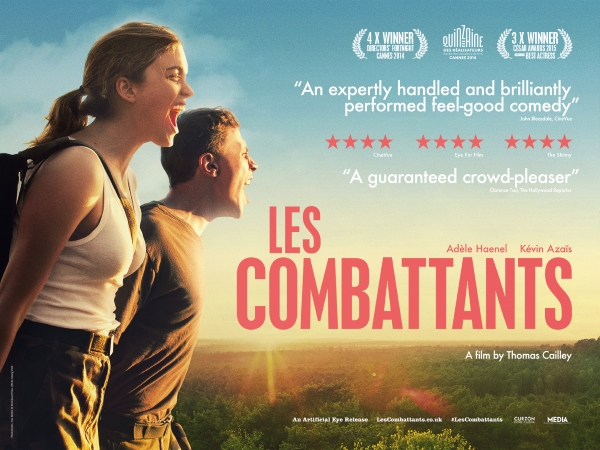
FilmJuice have my review of Thomas Cailley’s hugely engaging teen drama Les Combattants (a.k.a. Love at First Fight). Having received a standing ovation at Cannes, Cailley’s debut film went on to secure nine nominations and three wins at the French equivalent of the Oscars. Celebrated by French critics as nothing less than the future of French cinema, Les Combattants limped onto Anglo-American screens where it was marketed and reviewed as a romantic comedy (hence the stupid English-language title). Given that it is short on jokes and long on the kind of evocative, hands-off storytelling that is common in European drama and absent from the history of romantic comedy, the film received middling reviews from critics who seemed more interested in engaging with the press release than the nature of the film itself. According to Gary Goldstein at the LA Times:

There’s a better movie floating around the edges of the French import “Love at First Fight” than first-time feature director Thomas Cailley has allowed to surface. Though it’s billed as a romantic comedy, this quirky tale takes too many narrative U-turns that seem to dodge the genre’s more traditional (read: satisfying) tropes and dynamics.

There’s misprision and then there’s critical laziness. This is an example of the latter as Les Combattants is actually a fantastic meditation on Young Adult fiction and contemporary gender roles. You just need to make a bit of an effort in order to see it.

Les Combattants is built around two young adult protagonists: Kévin Azaïs‘ Arnaud whose lack of ambition and focus in no way seems to prevent his integration into a French society that is always pleased to see him. Everywhere he goes, Arnaud is offered jobs and opportunities for advancement despite the fact that the French economy is evidently still in tatters. Adèle Haenel plays Mathilde, a fiercely intelligent and incredibly driven young woman whose every attempt to secure an education or job is met with dismissive scorn. The fact that Arnaud’s white male privilege protects him from economic deprivation means that he is far better disposed to people and society than Mathilde, who spends the entire film having doors slammed in her face:

When Mathilde joins Arnaud’s family for dinner, the conversation naturally turns to the lack of jobs for young people and we see how the inequalities in French society have nurtured two very different reactions to the economic crisis: Embittered and unappreciated, Mathilde reaches the conclusion that society has nothing to offer her and so sets about preparing for its imminent demise; Pampered and protected, Arnaud has the luxury to consider a number of different career paths and so admits that he has never really thought about the collapse of Western civilisation.

Arnaud slowly falls in love with Mathilde and so decides to join her at a boot camp designed to help young adults preparing to join a parachute regiment. While Arnaud’s easy charm and happiness going with the flow mean that he fits right into a military environment, Mathilde solitary nature and intense disposition mean that the army falls out of love with Mathilde almost as quickly as Mathilde loses interest in the army. Eventually, things get so bad that Arnaud decides to abandon his shot at a military career and simply wanders off into the wilderness with Mathilde in tow.

As I explain in my review, I think that Cailley was wrong to have Arnaud discover his agency at the end of the film. I think that having Arnaud lead the pair out of danger undermines Mathilde’s character and turns Les Combattants from a film about a couple into a film about a young man. This misstep aside, I think this film has a lot of interesting things to say about gender. Particularly when you realise the similarities between Haenel’s intense survivalist Mathilde and the intensely self-reliant young women who feature in books like Suzanne Collins’ The Hunger Games, Veronica Roth’s Divergent series, and Kristin Cashore’s Graceling.

Les Combattants suggests that women have it considerably harder than men in the current economic climate. What makes Cailley’s analysis interesting is the suggestion that these inequalities might well have a knock-on effect of how the different genders perceive society. For example, Mathilde has grown intensely self-reliant because she no longer trusts society whereas Arnaud is happy to trust society and go with the flow because his experience is of people and institutions falling over themselves to offer him jobs and opportunities for advancement. The film’s ending strikes a false note because allowing Arnaud to save the day sends the message that Arnaud’s vision of society is somehow correct whereas Mathilde’s is paranoid and self-destructive. I disagree… I think Mathilde’s wariness is a rational response to an irrational world and I can’t help but wonder whether the immense popularity of YA among women might not be a direct response to their unequal treatment at the hands of society.

Interesting stuff aside, Les Combattants is one of the better looking films I have reviewed recently, so I thought I would share a few screen grabs:


Continue reading →

Killer of Sheep (1978) — The Neorealist Equivalent of Conan’s Hat

One of the most enduring creation myths to emerge from late-20th Century popular culture is that of Los Angeles as a city built on bones. Robert Towne and Roman Polanski’s Chinatown tells of an incestuous white man who engineers water shortages in order to force poor farmers off their land and build new homes for middle-class families. Set a number of years later, James Ellroy’s LA Quartet provides Capital with an even more corrupt figurehead in the person of Dudley Smith, an OSS spymaster turned anti-Communist and White supremacist who uses his institutional power as chief of detectives to corner the local drugs trade in an effort to keep the city’s non-White population under control and away from the classy White neighbourhoods that Chinatown’s Noah Cross famously described as “the future”.

While American popular culture is often willing to recognise the racial character of the oppressive forces it seeks to catalogue, its viewpoint is invariably that of the White liberal onlooker rather than that of the explicitly oppressed. This is particularly evident in Robert Zemeckis’ Who Framed Roger Rabbit, a polymorphously problematic remake of Chinatown where California’s marginalised population is represented by a ghetto filled with a diverse population of cartoon characters who eke out a living on the margins of Hollywood and eagerly distance themselves from a villainous Judge Doom who acquired considerable power and money by passing himself off as a respectable White man. The film ends with the ‘toons bickering about whether Doom was actually a duck, a dog or a mouse because obviously no White man would ever stoop so low as to use institutional power to brutalise and immiserate the poor and dispossessed. Even Chinatown’s most famous line resonates with the privilege of being born White in a White supremacist state; Jake may be able to ‘forget it’ because it is Chinatown but the actual residents of Chinatown are forced to live with ‘it’ every day of their lives.

As Thom Andersen suggests in his peerless video essay Los Angeles Plays Itself, the American film industry has long proven reluctant to engage with the city of Los Angeles on its own terms and turn the camera over to the real victims of its emerging creation myth. Charles Burnett’s Killer of Sheep is one of only a few films to consider what it means to live in the town of Noah Cross and Dudley Smith.


Continue reading →

REVIEW — 3 Women (1977)

FilmJuice have my review of Robert Altman’s arthouse drama 3 Women. Set in a small desert town, the film tells of a teenage girl who arrives in town and attaches herself to a slightly older woman with a similar background. Initially, the teenage girl behave likes little more than an enraptured child, hanging on the older woman’s every word as she spins lies and revels in her narrow consumerist ideas about the good life. This relationship lasts until the young woman’s naivete and the older woman’s dishonesty run afoul each other resulting in one of them being hospitalise, at which point the film gets weird:

3 Women is divided into three increasingly-short sections that are topped and tailed by these beautifully composed surrealist interludes that linger in the mind and imbue the film with a distinctly dreamlike quality. When Milly and Pinky’s first relationship falls to pieces, a dream sequence triggers a re-ordering of their friendship and a transfer of personality traits: Once childlike and naïve, Pinky now emerges as manipulative and sexually confident while the deluded and selfish Milly is replaced by a more nurturing and principled figure who tries to look after Pinky only to wind up apologising for her failings until their unhealthy relationship intersects with another woman.

The elevator pitch for this film could easily be: A Feminist Lost Highway as the exchange of personality traits and the radical reworkings of reality are very similar to those deployed by Lynch. The film was evidently quite poorly reviewed at the time and Altman himself admitted that he wasn’t entirely clear what message he was trying to get across but I was reminded quite a lot of the work of Joanna Russ in so far as the film builds towards a future without men and many of the weirder shifts are triggered by a need to find a new way to co-exist with men who are either distracted and indifferent or crude stereotypical representations of a masculinity so toxic that it borders on the absurd.

I remembered Robert Altman chiefly from the grown-up satires he produced towards the end of his career, but while The Player, Short Cuts and Pret-a-Porter always struck me as very similar to Altman’s breakthrough film MASH, they did absolutely nothing to endear him to me. 3 Women has completely changed my opinion of Robert Altman and while I suspect that it’s probably not worth my while investigating the rest of his back catalogue in search of films like 3 Women, I do now wonder to what extent I was simply not ready for his sensibility.


REVIEW — A Pigeon Sat on a Branch Reflecting Upon Existence (2014)

FilmJuice have my review of Roy Andersson’s deadpan existentialist comedy A Pigeon Sat on a Branch Reflecting Upon Existence.

I must admit that this film caught me completely by surprise.  Prior to this review, I was only really familiar with Andersson’s first film, the wonderfully moving teenage love story entitled — aptly enough — A Swedish Love Story. Having now seen a couple more of his films and read a few interviews, I now realise that A Swedish Love Story is completely unrepresentative of the talent that emerged after a long depression-linked hiatus. Andersson may have gone to work in advertising as a successful maker of sentimental films but he returned as a bleakly existentialist comic who produces what can only be described as the cinematic equivalent of Chris Morris’s Jam.

A Pigeon Sat on a Branch Reflecting Upon Existence takes place in a darkly surreal version of the Swedish city of Gothenburg where the futility of everyday life is periodically interrupted by eruptions of surrealist energy that allow the residents fleeting moments of happiness or sadness before returning them to their anhedonic stupor:

Characters flirt outrageously in one scene only to wind up being unceremoniously dumped in the background of another while complete strangers lambast each other for having the temerity to suggest that a Wednesday might feel like a Thursday. The only things that seem to keep the utterly defeated population from outright madness are moments when the past unexpectedly erupts into the present and sends Napoleonic armies marching through the streets while bawdy barkeeps sing about exchanging drinks for kisses while their patrons cheer them on.

The release of this film coincides with the release of a box set including not only A Pigeon and A Swedish Love Story but also Songs from the Second Floor and You, The Living. I recommend it to anyone capable of finding humour in the pointlessness of existence.


Summer Hours (2008) — On the Meanings of Stuff

Earlier this week, I wrote a piece in which I commented upon the extent to which our impressions of films are coloured by a lifetime’s worth of experiences. While all critical responses may be anchored in a shared humanity, there is no such thing as a clean or dispassionate read and what you think of a text is likely to be as much a product of your bullshit as it is of the inherent qualities of the text itself.

I wrote that piece and immediately sat down to watch Summer Hours by Olivier Assayas, a film that so closely matches my own personal experiences that it is at times quite uncanny.

A number of years ago, my mother died leaving quite a complicated estate. While I had been serving as my mother’s carer for a number of years, her death put me in a situation where I was legally involved with my much older half-siblings. While these siblings had always been a presence in my life, they had all left home by the time I was about 10 and their subsequent visits became increasingly sporadic and tense as my mother’s emotional stability declined. By the time I was legally manacled to them by my mother’s estate, I was effectively a complete stranger who had been parachuted into their existing group dynamic. While the stress of the situation meant that we all found a way to more-or-less cooperate, it rapidly became quite clear that my siblings and I had very different attitudes towards my mother’s possessions.

As someone who had been in the firing line of my mother’s emotional instability for my entire life, I viewed my mother’s things as a burden in need of lifting… I wanted to be rid of the stuff because I wanted to be rid of my mother and every item that went out the door brought a tangible sense of relief. Though my siblings expressed a number of different attitudes towards my mother’s stuff, one prevailing attitude seemed to be that the stuff was almost sacred in that it allowed one of my siblings in particular to reconnect with his (seemingly far more pleasant) childhood without the person my mother became getting in the way and spoiling his feelings of nostalgia. To this day, I could not tell you which of these two attitudes was the more ‘sane’ or ‘rational’ but we not only saw the objects in very different lights, we were also using them as props in what turned out to be very different psychodramas, which is precisely the theme of Summer Hours.


Continue reading →

Leviathan (2014) — Dismay Goes Before Him

We would like to believe that our critical faculties are impartial and that our impressions of the media we consume are a direct result of its inherent quality. We would like to believe that we can sense aesthetic excellence in the same way as we smell burning or taste strawberries but the truth is a good deal more complex. While our culture and neurological make-up certainly train us to expect certain aesthetic benchmarks, much of our reaction comes not from the text but the stuff around it.

At a very basic physiological level, it is quite hard to enjoy a 3D film when you arrive at the cinema with a head-ache only to discover that the cinema’s sound-system is malfunctioning along with its air-conditioning. As we progress past childhood, we learn to make allowances for things likely to affect our moods but it is still incredibly easy to sit through a bad screening of a film and conclude that the film itself is to blame. Conversely, go to see a stupid movie with a bunch of friends who respond to every beat with gales of laughter and you are just as likely to praise the film for that evening’s entertainment as you are your friends.

At a more psychological level, we seldom enter a cinema without baggage. We carry with us a lifetime’s worth of ideas and learned emotional responses that cannot help but influence how we respond to depictions of fictional events. Indeed, the very concept of a Trigger Warning assumes that exposure to images and situations will produce similar emotional responses regardless of whether those situations are real or fictional. We often talk about children becoming ‘desensitised’ to media portrayals of violence and a normal suite of emotional reactions does include the capacity to distinguish between real and fictional contexts but lines are often blurry, slopes are often slippery and the emotions we choose to police are largely a question of cultural norms and individual tastes. For example, while we may learn to endure the unpleasant imagery of horror films in the same way as we learn to endure the sting of spicy food, we are not generally in the habit of distancing ourselves from the emotional payload of comedies or conventional dramas. In fact, some of our most enjoyable artistic experiences happen when an author whose experiences resemble our own manages to connect to the emotional baggage we carry around with us by virtue of being human. Some art is well made, and some just happens to speak directly to us.

It is hardly controversial to suggest that our emotional reaction to a work of art is likely to be coloured by factors external to the text but the same could also be said of more complex critical judgements and the formation of our own interpretations. An excellent (fictional) example of this process can be found in an early episode of The Sopranos when Tony visits his therapist only to accuse her of deliberately planting a picture of a rotting tree. Of course, there is nothing in the painting that would lead us to conclude that the tree is rotten and so we are invited to conclude that it is Tony’s emotional baggage that is encouraging him to ‘see’ a generic painting as somehow inherently bleak. The bleed between our own personal experiences and our interpretation of texts is one of the reasons why I see criticism as a creative rather than a reactive form but the process of interpretation can be ‘gamed’ or deliberately influenced.

The great French director Claude Chabrol began his career as a film critic and so stepped behind the camera with an excellent idea of how critics formed judgements about the films they reviewed. This insight encouraged Chabrol to ‘embellish’ the text of his film by including references to other books and works of art. As Chabrol would later admit, these references were rarely thought-through but Chabrol realised that if he allowed the camera to linger on the cover of a book then some bright critic would invariably take the bait, assume a link between the two texts, and produce a more involved (and flattering) interpretation of his film. This anecdote may paint Chabrol as something of a rogue, but priming audiences for particular interpretations is now absolutely central to the PR process and Hollywood blockbusters will often contain under-developed references to important events (such as 9/11 in the case of J.J. Abrams’ Cloverfield, the Occupy movement in the case of Nolan’s The Dark Knight Rises and Afghanistan in the case of Favreau’s Iron Man) in an effort to create the illusion of thematic depth.

Where you stand on these types of interpretative games will, in part, be a function on where you stand on issues such as a the Death of the Author and whether you see works as the sole responsibility of an auteur or something that artist and audience create together as part of a symbiotic relationship. Personally, I tend to shuffle back and forth between the two extremes but I generally think that if a director and a film are to be credited with a particular set of ideas then considerable effort needs to go into developing those ideas within the text of the film. This brings us to Andrey Zvyagintsev’s Leviathan, a Golden Globe-winning Russian film whose title contains almost the entirety of its thematic substance.

Continue reading →

REVIEW — The Turning (2013)

FilmJuice have my review of the Australian short film collection The Turning, based on Tim Winton’s short fiction collection of the same name.

Short films as undeniably a good thing: Their reduced run time means that they are not only cheaper to make, they’re also less thematically demanding in that it is easier to come up with an interesting idea that will sustain a ten minute short film than it is to come up with an idea that will support a 90-minute feature film. The fact that short films are considerably shorter than feature films also means that they are a lot cheaper to make and so ambitious filmmakers can experiment with short films in a way that they simply cannot do at feature lengths. The problem with short films is that they are incredibly difficult to sell… indeed, no stable market for short films exists outside of a Horror genre that has somehow managed to maintain its fondness for anthology formats. The Turning is an attempt to rekindle the market for art house short film by getting 18 different directors to make short films based on stories taken from an award-winning short fiction collection in which some of the stories share characters, themes and recurring motifs. As I point out in my review, the idea of using the motifs in a short fiction collection to bind together a set of short film does not really work as:

while Winton’s short stories connect using recurring characters, themes, and motifs, the production’s failure to create a sense of visual continuity means that almost none of the recurring motifs or re-used characters survive the transition from book to film. What this leaves is a series of short films that only inter-connect in so far as they often share a fascination with regret or alcoholism, and frankly those types of themes pop up so often in art house film that they seem accidental.

In fairness, I can see why the producers chose the path they did as making the connections in Winton’s fiction work on film would have required not only the imposition of particular actors for particular parts but also a shared visual palette that would have seriously hampered the vision of the individual directors. This reminded me quite a bit of the Marvel Cinematic Universe as creating a sense of visual continuity between the films has robbed individual directors not only of the power to cast for themselves but also to shape the look of their own films. In the case of the MCU, the need for visual continuity has resulted in films that look depressingly similar but, in the case of The Turning, the lack of visual continuity means that a curated collection of short films comes across as almost completely unconnected. Swings and roundabouts I guess…

Another thing that really struck home when watching The Turning was quite how male-gazey the films directed by men turned out to be compared to those directed by women. One of the recurring saws of this blog is that art house film has ossified around a set of visual shortcuts that contain sexist assumptions but seeing similar characters and themes tackled by both men and women really drives home the extent to which female directors are more willing to question those shortcuts than their male counterparts. Having said that, the single most objectifying film in the entire collection is directed by a woman so it’s evidently not just men who fail to unpack their own cinematic vocabularies.


REVIEW — The Grandmaster (2013)

FilmJuice have my review of Wong Kar-wai’s The Grandmaster, an art house kung fu film based on the life of Bruce Lee’s trainer Ip Man.

I think I like the idea of kung fu films a lot more than I like actual kung fu films… In my early teens, I worked my way through much of Jackie Chan’s back catalogue but I have always struggled with films that did not recreate that particular style. Well… I say ‘style’ when what I actually mean is ‘competence level’ as being able to direct extended scenes of hand-to-hand combat requires a constellation of skills that surprisingly few directors manage to acquire. Every Frame A Painting has a truly excellent video about Chan’s directorial style but what has always drawn me to Chan’s direction are his clarity and his spatial awareness. Chan is first and foremost a performer and he directs in a way that emphasises the grace and skill of the performer rather than trying to compensate for it in post production as has become the norm in Hollywood where it is always much easier to add a bit of CGI or do a bit of extra editing than it is to keep re-shooting the scene in the hope of getting it just right. While action films are generally considered a lot less ‘worthy’ than the films I tend to write about on this blog, a good action director will have just as much skill, vision and sensitivity as the most celebrated Cannes winners. Hollywood may have created a generation of action directors whose logistical expertise outweighs their technical competence but that is a failing of the contemporary Hollywood machine… not the action genre.

I was intrigued to see The Grandmaster as Wong Kar-wai is undoubtedly one of the most highly skilled visual directors in world cinema. David Thomson’s Biographical Dictionary of Film dismisses Wong’s films as cold but this is the result of focusing on the actors rather than everything that Wong chooses to put on the screen. When I think of Wong Kar-wai’s films I think of characters whose muted emotional tones are radically and deliberately at odds with the colourful complexity of the worlds they inhabit. Wong’s foregrounds are always cold, still and immaculately controlled but his backgrounds are rich and almost overwhelmingly evocative. Somewhat unsurprisingly, this means that Wong is an absolute natural when it comes to shooting kung fu as his characters are the cold, controlled centre to a world that is filled with beauty and movement:

Like many of Wong Kar-Wai’s films, The Grandmaster sets up a tension between the stillness of the characters and the churning chaos of the world that surrounds them. Unable or unwilling to acknowledge their own feelings, Wong’s characters feel deliberately out of place as every set and every shot hints at the passions they keep chained up inside them. While the tension between Ip’s physical mastery and emotional backwardness is beautifully realised thanks to a cast and crew at the absolute peak of their respective games, you cannot help but feel a bit frustrated by the shallowness of Wong’s character study. Ip was a fascinating man who lived at a fascinating time and while action directors like Winston Yip and Herman Yau have been content to present the man as little more than a generic action hero, Wong breaks with this tradition only to strip his subject back to the equally simplistic lines of a generic romantic lead who struggles with feelings that would not overly bother a teenager.

In hindsight, this is almost certainly unfair to the romance genre as I suspect most characters in romance novels have a good deal more emotional complexity than Wong’s Ip and Gong. As I point out in the review, this cut of the film is significantly shorter than the version that was released in China and I suspect that much of the film’s connective tissue was left on the cutting room floor by Western distributors with one eye on the action market. This perhaps is the problematic legacy of Crouching Tiger, Hidden Dragon as you can also see it in the Western release of John Woo’s Red Cliff: The Chinese action genre is desperate to grow up and to use bigger budgets and action sequences to draw big audiences to weighty themes but the West has little time or interest in 3 hour action epics that contain 2 hours of mood-setting and characterisation. Not for the first time, our debased palette seems to have prevented us from sampling the dishes served by cultures that have not followed the same reductive cinematic path.