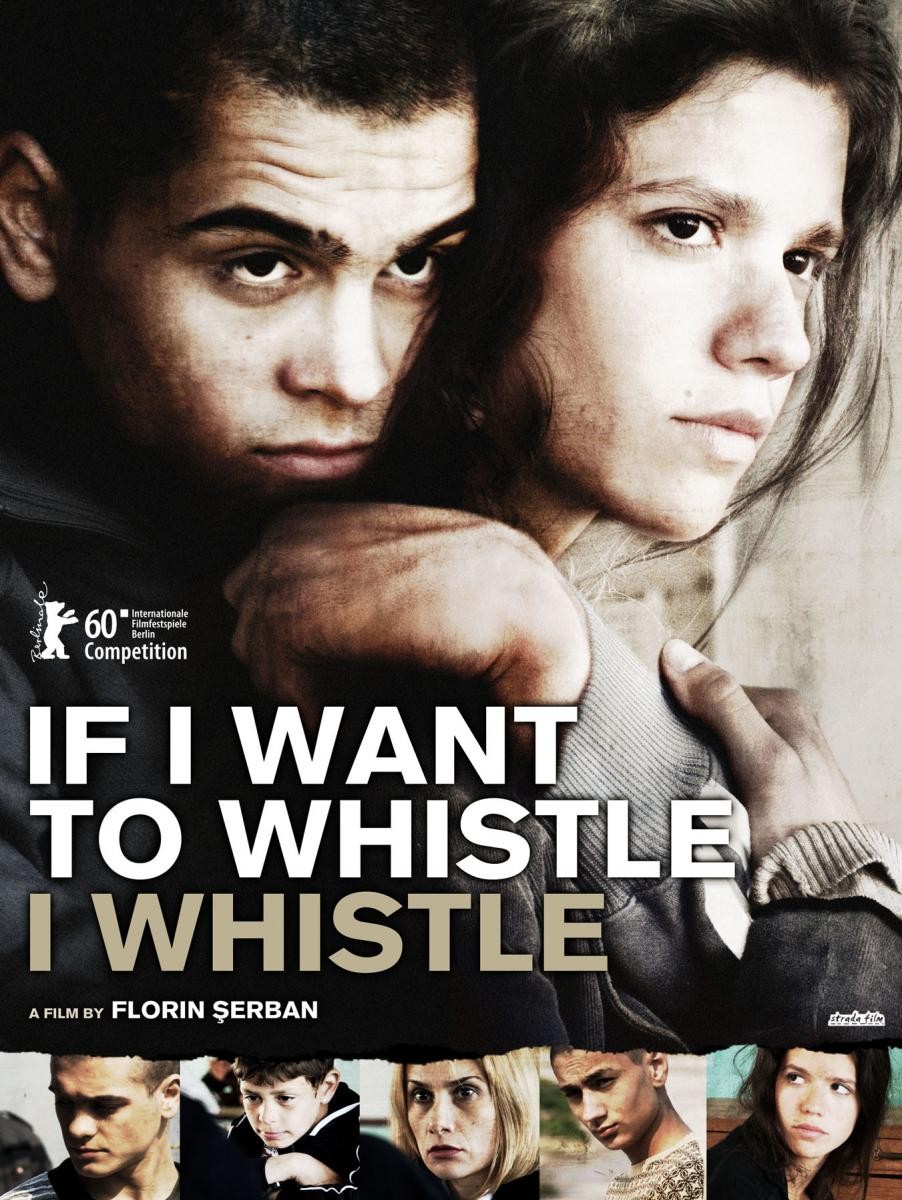
REVIEW – If I Want to Whistle, I Whistle (2010)

FilmJuice have my review of Florin Serban’s debut feature If I Want to Whistle, I Whistle. Nominated for the Berlin Golden Bear and winner of the Jury Prize Silver Bear, Serban’s film is being marketed as the latest opus to emerge from the fecund soil of the Romanian New Wave. High praise indeed given that that particular wave produced not only Cristi Poiu’s The Death of Mr Lazarescu and Corneliu Porumboiu’s Police, Adjective but also Cristian Mungiu’s Cannes-winning 4 Months, 3 Weeks, 2 Days. Unfortunately, while Serban’s film does an excellent job of re-creating the corridorpunk aesthetic that has thus-far dominated the Romanian New Wave, the film itself is really nothing more than a generic prison thriller:

The problem is that while films like Police, Adjective and The Death of Mr Lazarescu used a very specific set of Romanian problems to explore what it is like to be a contemporary Romanian, Serban’s film is really nothing more than the sort of generic prison movie that could have been made anywhere. Generic in plot and unoriginal in aesthetic sensibility, Serban’s debut is a largely pointless addition to an increasingly over-loaded bandwagon. Indeed, while the film’s gritty visuals and social realism may have helped to secure international distribution, they do absolutely nothing for the film’s message or emotional impact.

Some critics have suggested that If I Want to Whistle, I Whistle is proof that we are close to reaching the bottom of the Romanian New Wave barrel and that all the talent in that particular scene has now been discovered leaving only the hacks and the wannabes. Though I have a certain amount of sympathy for this viewpoint, I think the decision to load If I Want to Whistle, I Whistle onto the Romanian New Wave bandwagon speaks of a more profound malaise with world cinema.

Consider the following hypothetical situation: You are a young Romanian who has just graduated from film school at a time when critics all over the world are singing hosannas to your national cinema. All over the world, people are paying to see Romanian film and you know that, as a young Romanian film director, chances are that you can score a breakthrough hit. However, in order to produce a breakthrough hit and launch your career, you need to attach yourself to this national cinema that everyone is raving about. Q: What is the best way of accomplishing this? A: By making the film you want to make and combining it with familiar tropes. Result: A thriller with a corridorpunk aesthetic.

If I Want to Whistle, I Whistle is best understood as a professional calling card. A demonstration of technical prowess and aesthetic pragmatism that showcases Serban’s ability to adopt popular styles in order to get a film made. Much like Tom Waller’s Soi Cowboy, it is proof that Serban can be a good cultural citizen and produce the type of film expected of young Romanian film directors. I suspect his next film will be not only better but also a good deal more personal. Florin Serban is clearly one to watch.
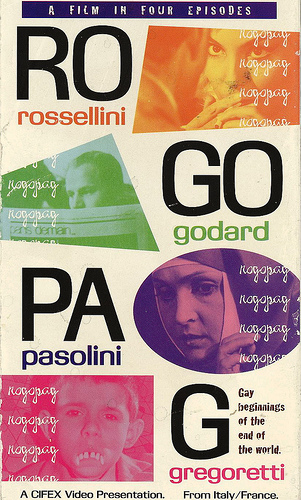
REVIEW – RoGoPaG (1963)

FilmJuice have my review of the really rather wonderful 1960s Italian anthology film RoGoPaG. Comprising three short films directed by Roberto Rossellini, Jean-Luc Godard, Pier Paolo Pasolini and Ugo Gregoretti, RoGoPaG is funny, satirical, gnomic and misogynistic in equal parts but the satire and humour of Passolini and Goretti more than make up for the pretentiousness and misogyny of Godard and Rossellini.

The film begins poorly with a well made but ultimately insipid morality tale by Roberto Rossellini in which an innocent and matronly airhostess (Rosanna Schiaffino) reinvents herself as a ‘whore’ in order to escape the attentions of a horny businessman. Schiaffino is undoubtedly charismatic but her charms simply cannot make up for the grinding misogyny of the film’s themes and plot.

Much like Pigsty and Hawks and Sparrows, Pasolini’s short film “La Ricotta” is a joyous avalanche of images and symbols that communicate mood far more effectively than they communicate ideas. The film revolves around an attempt to make a film about the Crucifixion that ends with one of the bit players dying on the cross as a result of eating too much cheese. Pasolini was evidently sent to prison for making the film and, to be honest, I can see why as the anger and hostility to organised religion are clear even though the exact nature of that anger is much harder to discern. The best short film in the collection is also the product of the least well-known director. Ugo Gregoretti’s “Il Polo Ruspante” is a well-observed and viciously delivered critique of Italian post-War consumerism in which a small family travel across the country while being fleeced by everyone they enter into contact with.

REVIEW – The Night Porter (1974)

FilmJuice have my review of Liliana Cavani’s arthouse nazisploitation flick The Night Porter.

The Night Porter tells of a former Nazi who is attempting to evade prosecution and disappear into the shadows of post-War Europe. However, this flight into shadow is arrested when the Nazi encounters a young Jewish woman who survived the War by serving as his personal sex slave. Concerned that this young woman might turn him in to the authorities, the Nazi sets out to murder her but the second the pair are face to face they tumble back into the same sadomasochistic patterns that had seen them through the War. At the time of its release, the film’s suggestion that some Jewish people might have enjoyed or benefited from their time in a concentration camp was taken as an almost impossibly transgressive thing to say as Europe was in the process of turning Holocaust survivors into a class of living saints. However, as time has passed and the moral certitudes of the Second World War have begun to evaporate, the political elements of The Night Porter are not as shocking as they were meaning that all that remains is a film is which a topless Jewish girl sings for a bunch of Nazis. As I pointed out in the review, these scenes are astonishing:

If cinematic history has been kind to The Night Porter it is chiefly due to the series of dream-like vignettes that Cavani scatters across the face of the narrative. Almost entirely dialogue-free, these vignettes chart Rampling’s transformation from a terrified child to a sexually empowered woman who fearlessly performs a topless cabaret before a group of leering Nazis. Shot with a combination of elegant eroticism and low-key surrealism, these scenes are not just amazing to look at, they are also a highly evolved exercise in visual storytelling. Indeed, the more we learn about the behaviour of the ‘little girl’ in the camp, the more we realise that there was a good deal more to the sexual relationship than a desire to survive.

The problem is that, once you move beyond the beauty of those dream-like scenes, the film begins to fall apart.

While there is no denying either the beauty of the power of these transgressive dreamscapes, it is frustrating to note that while the storytelling inside the vignettes is arresting, Cavani fails to root them in either the wider narrative or basic principles of human psychology. As with Max’s feelings of guilt and his desire to withdraw from the world and live ‘like a church mouse’, the true desires and motivations of the ‘little girl’ are never explored and so Cavani never actually engages with any of the Big Ideas that litter the foreground of the film.

With nothing to say and nearly two hours in which to say it, The Night Porter shambles along with neither point nor purpose. Lacking proper characterisation, the film struggles to engage our sympathies meaning that the descent into thriller territory towards the end of the film feels forced, fraudulent and entirely unexciting.

Released on Blu-ray with neither bells or whistles, The Night Porter does contain a few legitimately wonderful cinematic moments but aside from dancing Nazis, there is little here to explain why it is that this film has endured while other works of artful Nazisploitation such as Tinto BrassSalon Kitty have largely disappeared from view. Neither as transgressive as Pier Paolo Pasolini’s Salo or as politically engaged as Marcel OphulsThe Sorrow and The Pity, Cavani’s Night Porter sheds little light on the human truths lost in the moral rubble of the Second World War.

REVIEW – Hawks and Sparrows (1966)

FilmJuice have my review of Pier Paolo Pasolini’s postmodern/religious fable Hawks and Sparrows (a.k.a. Uccellacci e Uccellini).

Much like Pasolini’s Pigsty, Hawks and Sparrows comes across as an intensely weird and inaccessible piece of film making. Filled with portentous images as well as characters and narratives that make very little in the way of sense, both films are products of a time when the fundamental grammar of film was in the process of revision/ The works of Pier Paolo Pasolini feel far stranger than contemporary works such as Alain Resnais’s Last Year at Marienbad or Michelangelo Antonioni’s L’Avventura because Pasolini has proved to be a far less influential filmmaker than either Resnais or Antonioni. Contemporary audiences can easily decode L’Avventura because L’Avventura contains a number of techniques which, though radical at the time, have since entered the mainstream of film and TV. Conversely, the works of Pasolini contain ideas and techniques that are seldom used in contemporary art house film and so they seem as radically odd now as they did when they first appeared in the 1960s. As I put it in the actual review:

Once you accept that Hawks and Sparrows is little more than a cavalcade of images and references, the film becomes a good deal more enjoyable. Freed from the need to present an argument or tell a coherent story, Pasolini plays with the fabric of our dreams to present a succession of memorable cinematic images including dark-eyed girls with angelic wings, rampaging monks and an aging clown who is suddenly gripped by a lust for life in all its pulchritudinous glory. Hawks and Sparrows is neither particularly entertaining, nor particularly profound. However, despite the film’s decidedly experimental and disposable feel, it remains a timely reminder of quite how brave and innovative art house filmmaking can be when it decides to start rattling cages. At a time when every art house cinema seems filled with beautifully hollow dramas about beautifully hollow upper-class people, Masters of Cinema have allowed us the opportunity to (re) discover the work of a legitimately artistic and legitimately challenging filmmaker.

REVIEW – Pigsty (1969)

FilmJuice have my review of the recent Masters of Cinema release of Pier Paolo Pasolini’s uncanny masterpiece Pigsty.

Comprising two narrative strands, the film explores the way in which cultural elites undermine dissenting opinions by subsuming traditional vocabularies of dissent. In one strand, a young man wanders wordlessly around a volcanic landscape until he comes across a dead body which he promptly consumes. This act of consumption classifies the young man as an outcast and this outcast status allows him to acquire a following that eventually forces the local authorities to intervene. When the young man is finally given the opportunity to express himself in words, all he has to say for himself is:

I killed my father, I have eaten human flesh, and I quiver with joy.

The film’s second strand is set in the 1960s where another young man finds himself crushed between the capitalistic radicalism of his father and the logorrheic gibberrish of his leftist fiancee.  Denied the means with which to express himself as an individual, the boy retreats into a comatose state before finding some form of fulfillment in the act of fucking a pig.

Pigsty is an attempt to address the relationship between the generations and how difficult it can be for the young to express themselves when they are not the ones in control of society. Particularly striking is the way that Pasolini presents post-War German prosperity as little more than a repackaged version of the pre-War economic boom engineered by the Nazi government of the 1930s. With all of culture safely commoditised and filed away, what are today’s rebels to do but seek sanctuary in the most heinous acts imaginable? Windy, difficult and decidedly ‘of its time’ Pigsty remains a ceaseless beautiful and thought-provoking film by one of the great provocateurs and stylists of the European art house tradition.

The idea that cultural elites pull the ladder up behind them to ensure that nobody can rebel against them in the same way that they rebelled against previous generations will be familiar to those of you who have read Thomas Frank’s wonderful essay “Why Johnny Can’t Dissent”.

REVIEW: Giorgio Moroder Presents Metropolis (1984)

FilmJuice have my review of Giorgio Moroder’s eighties remix of Fritz Lang’s immortal Metropolis.

Lang’s Metropolis is a science fiction fairy tale dealing in class warfare, economic collapse and the power of compromise and understanding to deliver a world that is at the very least tolerable to all. Grounded in the cinematic techniques developed by German Expressionism to increase the bandwidth of silent film and unlock new depths of emotional complexity, the film is two and a half hours of directorial brilliance. However, though the original cut of the film has now been recovered, there were decades during which people believed it would never be seen again. Given that Metropolis is not only a beautiful but also an intensely important film, it was perhaps unavoidable that attempts to restore it would stir up strong feelings. In fact, the debate over what should be done with the Metropolis fragments rapidly coalesced into a bitter confrontation between those who wanted the original film left as it was and those who wanted the meddle with the footage in the hopes of recapturing some dim afterglow of Lang’s genius. Giorgio Moroder’s Metropolis is not only the best known and most interventionist of the alternate edits of Metropolis, it was also the most widely seen version of the film as the ‘hip’ scoring by eighties pop stars combined with the short running time ensured that copies of the film flew in and out of video rental stores throughout the eighties and nineties. Now that the original cut of the film has been recovered, it is tempting to simply consign Moroder’s edit to the bin and move on but this cut has historical merit on its own.

Moroder’s Metropolis is a short and punchy affair that feels very much like an extended trailer for original version of the film. Moroder solves the narrative problems of the various re-cuts by stripping out much of the dialogue and drama in order to focus upon the big cinematic set pieces and emotional moments. Somewhat unsurprisingly, this results in a film that bubbles with the same hysterical energy and visual spectacle as the Michael Bay Transformers movies. However, rather than leaving his characters to scream and flail about like Shia LaBoeuf, Moroder attempts to fill in the emotional gaps by scoring the film with a series of somewhat heavy-handed eighties power ballads performed by the likes of Bonnie Tyler, Freddy Mercury and Pat Benatar. Moroder also colourises the film in an attempt to convey changes of mood which, though obvious from the context of Lang’s longer film, struggle to emerge from the mangled cinematic vocabulary of the truncated versions.

Watching this film, I couldn’t help but wonder what other alternate edits of classic films are out there… the film is being re-released today by Masters of Cinema in a limited edition steel shell thingy. Release of the standard edition is coming later this year according to the Brazilian river place.

REVIEW – Total Recall (1990)

FilmJuice have my review of Paul Verhoeven’s Total Recall. The review is of the freshly released and genuinely fantastic Blu-ray release of the film and it ties in quite nicely with this recent piece I also wrote for FilmJuice about the films of Paul Verhoeven.

The first thing that struck me about this film was how violent and sexually explicit it is by the standards of contemporary big budget filmmaking. Indeed, the likes of Michael Bay will frequently include women draped decoratively across motorbikes or ascending stairs but the actual sexual content of their films is practically non-existent. The reason for this is two-fold: A) These big budget films have absolutely immense budgets and in order to maximise their profitability, they need to be accessible to as wide an audience as possible. Hence the death of the ’18’ rated action film that dominated much of my childhood. B) The target demographic for most contemporary action films is teenaged boys whose sexual experience is usually limited to ogling and giggling… so whenever Bay has an actress bend over but not actually have sex with anyone, he is attempting to position his film in the sexual universe of horny teenaged boys. Compared to contemporary action films, Total Recall comes across as not only quite explicit but also quite surprisingly adult… particularly strange is the weird sexual energy that fizzes between the characters of Schwarzenegger and Stone as they beat each other up and pretend to be married:

One particularly wonderful element of the film is the relationship between Schwarzenegger’s violently bulging everyman and Sharon Stone’s pouting secret agent. Indeed, Stone plays the roll of a woman who is either a loving wife to Schwarzenegger or deep-cover operative assigned to keep him under surveillance lest his secret identity as a Martian freedom fighter begin to reassert itself. Rather than pitting these two personae against each other and musing as to which is the ‘real’ one, Verhoeven simply runs them together meaning that Stone’s character comes across as a lovingly traitorous wife who wants to kill her husband and have sex with him, quite possibly at the same time. Victims of actual domestic abuse might squirm as Schwarzenegger and Stone flit between flirting and kicking each other across the room but Verhoeven fully embraces the tension and presents it almost as a form of sadomasochistic play. Tellingly, when Schwarzenegger decides that he can no longer trust his wife, Stone’s character makes one last attempt to win him over by offering to let him tie her up. Verhoeven’s bizarre sexualisation of domestic abuse is both intensely unsettling and utterly compelling.

Total Recall is an excellent film and this Blu-ray edition does it proud.  Definitely worth revisiting and re-appraising.

The Films of Paul Verhoeven

FilmJuice have just uploaded a piece I wrote for them about the films of Paul Verhoeven, director of Robocop, Total Recall, Showgirls and Basic Instinct.

Regular readers of this site will know that I have a marked fondness for unpopular blockbuster directors like Neveldine/Taylor, Michael Bay and Zac Snyder. Part of what drives my fondness for these directors is their willingness to set aside human values in pursuit of absolute spectacle. All of these directors use violence and action to entertain their audiences but they also use sexuality and fascistic imagery in a way that many directors are reluctant to do. My view on these directors is that one cannot defend Big Dumb Blockbusters like Avengers or Spiderman whilst turning one’s nose up at films like Transformers 3. Summer blockbusters are in the business of pushing buttons and to have your buttons pushed is an inherently dehumanising process. The difference between directors like Bay and directors like Spielberg is that Bay is completely unapologetic about what it is that he does. He makes films for the sweaty masturbating homunculus in all of us:

When people talk about blockbuster action movies, their minds naturally gravitate to the works of sexless man-children such as Peter Jackson, Stephen Spielberg and George Lucas. The reason for this strange cognitive bias is that most people feel ashamed about watching big dumb action movies and so they need their violence to be not only bloodless but also presented in terms of absolute moral simplicity. Spielberg always cuts to the heroic working-class dad because cinema audiences need to know that their yearning for cinematic carnage does not make them a bad person. Similarly, George Lucas can neither shoot nor write a love scene because you can’t have people falling in love and then shooting each other in the face. That simply would not do.

My take on Paul Verhoeven is that he is a transitional figure in the history of blockbuster filmmaking as he spent the late 80s and early 90s building up mainstream audiences’ tolerance for sex. Without Verhoeven, people would never have gone to see Snyder’s Watchmen or Bay’s Transformers.

REVIEW – Howl’s Moving Castle (2004)

FilmJuice have my review of Hayao Miyazaki’s adaptation of Diana Wynne Jones’s Howl’s Moving Castle. Re-watching the film for the first time since it first appeared in a UK cinema, I was struck by the extent to which it is a microcosm for all the strengths and weaknesses of Miyazaki’s direction:  On the plus side, the animation is spectacular, the mood is uplifting without ever seeming false and the design is a profound expression of nostalgia for a sophisticated, metropolitan Europe that may never have existed in the first place. On the down side, the plotting is frequently nonsensical and the characters have so little depth that they struggle to command our interest, let alone our sympathies. As I put it in the review:

If you are one of those upper middle-class parents that have latched onto Miyazaki as a reliable source of non-violent and morally uplifting children’s entertainment then Howl’s Moving Castle is definitely the film for you. The animation, artwork and pacing are more than enough to keep the little ones amused while their parents sit in open-plan kitchens drawing up plans to take over a Tuscan bean farm or a gite in the Dordogne. However, if you are a grown-up looking for grown-up ideas and characters then Howl’s Moving Castle is a touch more problematic.

A couple of years ago, I wrote a piece about Miyazaki’s Ponyo (2008) in which I suggested that Miyazaki’s attitudes towards humanity moved back and forth between flesh-rending misanthropy and warm-hearted sentimentality. In that piece, I concluded that Miyazaki tended to ‘do’ warm-hearted sentimentality a lot better than he did complex adult morality. Having recently re-watched both Ponyo and Howl’s Moving Castle, I now realise that my earlier diagnosis was entirely off base. The problem is not that Miyazaki struggles with adult morality, it is that he struggles with human psychology but that these struggles are less evident when they are presented as part of a film aimed directly at children. Indeed, both Ponyo and Howl’s Moving Castle suffer from the fact that they are films that revolve around entirely unconvincing love stories but because Ponyo presents itself as child-friendly, we are more inclined to forgive its lack of psychological foundation while Howl’s Moving Castle seems much more grown-up and so the lack of real characterisation is both obvious and grating.

REVIEW – The Rafi Pitts Collection (2012)

Back in April 2011, I reviewed Rafi Pitts’ The Hunter, a superb insertion of 1970s American paranoid cinema tropes into a depiction of contemporary Iranian society. Evidently quite successful, the cinematic release of The Hunter has prompted the good folks at Artificial Eye to put out a box set of Pitts’ films including The Hunter but also the exquisitely moving It’s Winter (2006) and Pitts’ far more conventional early feature Sanam (2000). FilmJuice have my review of The Rafi Pitts Collection.

One of the pleasures of this box sex is that it allows you to survey the development of a creative talent. Though beautiful to look at and entirely decent, Pitts’ Sanam is a highly generic exercise in wrangling world cinema tropes. Indeed, the colourful photography and plot featuring a young boy struggling to get over the death of his father could have been made by any world cinema director in any country in the world. Having mastered the world cinema genre, Pitts then begins to process of developing his own sensibility. Intensely poetic and filled with chilly urban alienation, It’s Winter is demonstrably a far better film than Sanam and a far better film than we have come to expect from most world cinema directors who seem mostly content with toeing the line and giving western art house audiences exactly what they expect of a particular country. This cold and urban sensibility finds its ultimate fruition in the paranoia and repressed violence of The Hunter, which is easily Pitts’ best film to date:

The Hunter tells of a reformed criminal struggling to find salvation in the role of husband and father. The problem is that, while the film’s protagonist is quite content to go straight as long as he can spend time with his family, his employers use his criminal past as an excuse to make him work nights thereby ensuring that he rarely gets to see his family. When something terrible happens and the man’s family disappears, the man understandably goes nuts and begins hunting Iranian policemen. At this point, the film transitions from being an account of social injustice to being a tense paranoid thriller in the style of Taxi Driver and The Parallax View. Just as beautifully shot as Pitts’ earlier films, The Hunter juxtaposes the cold urban landscapes of It’s Winter with the warm naturalism of Sanam only to find that the Iranian police will chase you down through both sets of landscapes. Intriguingly, the film’s ending obliquely hints at the possibility of future uprisings. How much mistreatment will the Iranian people endure before, much like the hunter, they snap?

Also fantastic is the interview with Pitts that is included on the second disk in the collection. Many creatives, though clearly intelligent, lack either the self-awareness or the personal openness required to shed much light on their working processes, Pitts is clearly not one of those types of creatives. Witty, insightful and astonishingly candid about the choices he made during the shooting of It’s Winter, the interview is a timely reminder of quite how much a good DVD extra can add to the experience of watching a film.