Transformers: Age of Extinction (2014) – A Counter-Productive Relationship with Thought

Transformers: Age of Extinction is something of a paradox. Compared to Transformers: Dark Side of the Moon, Transformers: Revenge of the Fallen and the original Transformers, the film is better acted, better written and better made. Rather than the usual barrage of ill-connecting set-pieces, Age of Extinction’s plot has a beginning, middle and end constructed around a cast of characters who not only speak in complete sentences but also behave in a manner suggesting the presence of recognisable human emotions and comprehensible motives. The comedy (though still irritatingly broad) is somewhat less offensive and better integrated into the beats of the film while the action sequences are much easier to follow thanks to digital effects technology having now reached a point where Michael Bay can finally stage and shoot a fight between two giant robots without having to keep dipping the camera behind obstacles whenever the bit-rate sinks below the photo-realistic. Transformers: Age of Extinction is a real paradox as while it is unquestionably the best made film in the series, it is also the most excruciatingly shit.

Continue reading →

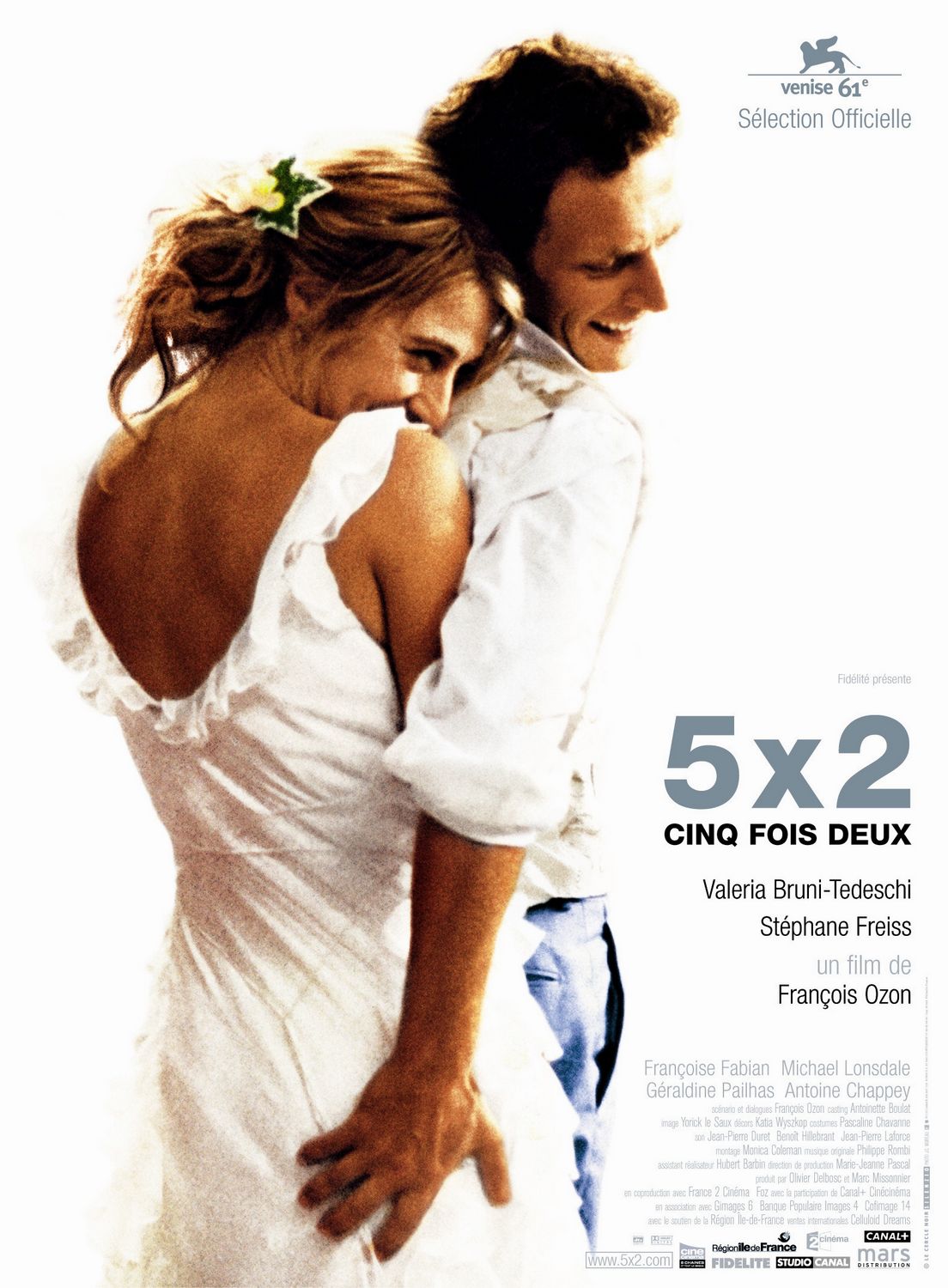
5×2 (2004) – The Space around Love

Characterisation is a funny thing. Characters obviously have no inner lives and no existence beyond the indentations they leave on a text and yet a well-drawn character can seem human enough to warrant an emotional response from the audience. Characterisation works by tapping into the various short-cuts humans use in social interaction; As humans, we can never know what another person is thinking or feeling but we can infer their emotional state by considering their behaviour and comparing it to what feelings we think might prompt us to act in a similar fashion. Characterisation can thus be thought of as the art of building an evocative human shape from a series of descriptive passages. Strike the right poses at the right moments and a character will leap off the page but fail to make a character’s poses recognisable or fail to make those poses coherent and you will be left with a character that seems lifeless and inhuman.

Different cinematic traditions have different standards of characterisation. For example, travel back to 1930s Hollywood and it was still quite common for directors to use voice-overs and have their characters tell the audience what they were thinking. Fast-forward to contemporary Hollywood blockbusters and you find directors relying quite heavily on audience-recognisable character types whose inner lives are made accessible through a combination of unambiguous musical cues and absurd theatrical gestures including sinking to their knees and bellowing ‘Nooo’ into a rain-filled sky. Thankfully, not all cinematic traditions are as heavy-handed; Cinema originating in cultures with low-levels of emotional disclosure is far more subtle in its emotional topography and so audiences are forced to pay closer attention and approach scenes in different ways in order to catch the poses that might allow them to infer the presence of an internal state or collective vibe. The subtlety of character beats in Japanese film also explains its long-standing relationship with a European art house tradition in which directors seek to deliberately attenuate their characterisation in a bid to create characters that seem more complex and ambiguous. However, despite European film’s desire to keep its characters aloof, the last fifty years have still seen the emergence of not just stock characters but stock poses that serve as short-cuts in films that should not be about the easy answers. How many times have you seen art house films in which characters stare into the middle-distance impassively? How many times have you seen art house films in which a character fails to react to some devastating event and yet winds up over-reacting to some seemingly unrelated incident? As a general rule of thumb, if you are an art house director and your characterisation techniques are showing up on Mad Men then it is time to get yourself some new techniques… which is where François Ozon’s 5×2 comes in.


Continue reading →

REVIEW – The Overnighters (2013)

FilmJuice have my review of Jesse Moss’s rather frustrating documentary The Overnighters.

The documentary is set against the backdrop of the North Dakota oil boom, which saw a massive expansion in the North Dakota oil industry at a time when many Americans were losing their jobs and their homes in the Great Recession. However, while North Dakota now has the lowest unemployment rate of any state in the Union, the job market expanded so quickly and generated so much money that the state’s rental sector simply could not keep up meaning that many Americans travelled thousands of miles to get a job in the oil industry only to realise that their new job didn’t pay enough to allow them to cover rent. The film revolves around a Lutheran pastor who set up a programme that would allow the working poor to sleep on the floor of his church.

The documentary is at its absolute best when it shows the inhumanity and indifference of American institutions:

The most striking thing about this documentary is how little support Reinke gets from… well… anyone. The oil industry in North Dakota is going through a period of historic expansion and yet despite record profits rolling in to corporate coffers, none of the oil companies seems to provide food or shelter for the thousands of people they employ. The oil boom has reportedly given the under-populated state of North Dakota a billion-dollar budget surplus and yet the state would rather shut down the church and ban people from living in caravans than find a way to house and feed the thousands of people who helped to create that surplus. Even more shocking is the way that Reinke is forced to battle his own church as parishioners file into his office and trumpet their Christian values in the same breath as they complain about poor people making the place look untidy.

However, rather than expanding this critique into something more systematic, Moss takes the disastrous decision to focus upon the human element and the experiences of the men who are running and relying on the Overnighters programme. This approach is quite traditional in American documentaries as human interest stories sell better than analytical pieces but you can only make that kind of film when the humans are interested in telling their stories and the men who feature in The Overnighters keep their emotional cards very close to their chests. As I point out in my review, Herzog’s Into the Abyss is a great example of how to use human stories to build a social critique but Herzog’s interviews help his subject to develop their own thoughts whereas Moss seemed reluctant to ask any questions whatsoever. For example, one of the subjects spends his time spouting vitriol after being asked to leave the church and Moss neither challenges his vitriolic remarks or tries to determine what actually happened. Similarly, the film seems to imply that one of the subjects might well have been sexually involved with a man staying in the church who then blackmailed him but Moss never bothers to ask questions that might have allowed him to share the real story of what happens at the end of the film. The Overnighters had the potential to be a great little documentary about the plight of America’s working poor but rather than making that film, Moss tried to make a film about people’s feelings when nobody wanted to discuss them.

Another issue the film brought to light is the role of charity in perpetuating systemic inequality. According to the film, the oil industry did not pay its workers a living wage in the sense that their salaries did not allow them to make rent and feed themselves, forcing hundreds of people to sleep in their cars. It does not seem unreasonable to suggest that, allowed to continue unchecked, these working practices would have resulted in hundreds of deaths and people fleeing the cold of North Dakota in order to return home. The resulting humanitarian disaster and shrinking of the labour pool would presumably have resulted in either the state stepping in or employers raising wages and building dormitories to arrest declining production. While charities like the Overnighters might prevent humanitarian disasters and save hundreds of lives, they do provide both the state and the public sector with an excuse for not changing their practices.  After all, why would an oil company build dormitories when a church down the road provides one at no cost to them? Watching The Overnighters, I was struck by the fact that the only way of addressing systemic inequality is at a systematic level: Workers can’t make rent? raise the minimum wage. Rents too high? Cap them. People forced to sleep in their cars because their wages are too low? raise corporate taxes and use the money to provide cheap social housing. There is something faintly obscene about the fact that the oil boom gave the state of North Dakota a seven-figure budget surplus and yet the only time we hear from the state in the film is when they are trying to shut down the church or ban people from sleeping in caravans.


REVIEW – The Killing (1956) and Killer’s Kiss (1955)

FilmJuice have my twin review of Stanley Kubrick’s second and third films Killer’s Kiss and The Killing, which are getting an all-singing and all-dancing re-release next week at the hands of Arrow Films.

It was interesting to discover these films after reviewing the Masters of Cinema release of Kubrick’s first film Fear and Desire (apologies for nerfed formatting) as, like most people, my memories of Kubrick’s work are shaped by the classics he started churning out from the late-50s onwards. Of Kubrick’s first three films, The Killing is almost certainly the most accomplished and accessible.

However, while the heist is beautifully handled and provides the film with a strong narrative spine, the film’s real beauty lies in the character beats that provide the film’s real sources of tension. Based on a novel by Lionel White but scripted by the legendary crime novelist Jim Thompson, the film benefits from a cast of old B-movie hands who slot effortlessly into their assigned character types and go to town on the dialogue:

Marie Windsor plays Sherry as this wonderfully cynical drunk with a young lover and a hunger for money. Every inch the Femme Fatale dominatrix, she showers her husband with sarcasm and distain only to show him just enough attention to secure his continued loyalty and affection.

As I point out in my review, I felt that the film’s ending failed to live up to the promise of the film’s opening act but I have since learned that the film’s leading man Sterling Hayden was not a popular choice with the film’s studio backers and I wonder if Kubrick might not have left a few of his character beats on the cutting room floor. Either way, the film makes the mistake of driving home the idea that the character is a no-nonsense hard case only to try to elicit sympathy for him in the final scene. You can see how the film might have played out as Kubrick does soften the character in the opening scene but his failure to re-visit that softening and underline that duality results in a film that feels more bleakly nihilistic than it clearly yearns to be. Having said that, I compare the film to pictures like The Big Sleep and The Maltese Falcon and I stand by that comparison as this still a really fucking good film.

As well as some awesome extras (including an interview with a bearded, shirtless and resentful Hayden), the disc also includes Kubrick’s lesser-known second film Killer’s Kiss. Seldom revived during Kubrick’s lifetime, Killer’s Kiss is just as trippy and arty as his first film Fear and Desire but rather than deploying those tricks in the context of a war movie, Kubrick decides to deploy them in the context of an hour-long film about a second-rate boxer who falls in love with a woman in trouble. The narrative isn’t that interesting and the bloke playing the boxer is not what you would call charismatic but the film looks sensational, a bit like Billy Wilder’s The Lost Weekend complete with blurring of boundary between real and imagined:

However, look beyond the simple narrative and the desperately uneven acting and you will see a young director experimenting with a wide array of cinematic techniques. For example, whereas most Hollywood films of the period shot dialogue scenes with fixed cameras, Kubrick has his cameras move in and around the actors while they deliver their lines resulting in an odd, queasy feeling that feels a lot more subjective than realistic. Also interesting is the way that Kubrick makes the walls of the boxer’s kitchen pitch black except for a window looking onto his neighbour’s apartment creating the impression that the window functions almost like a comic book thought bubble in which the boxer visualises sounds overheard through the walls.

It is also quite interesting to see these two films get a release from Arrow films. Arrow have always been a damn fine home-release outfit but I have always associated them with the cult and horror titles they release under the Arrow Video label. I’m not entirely sure how long Arrow Academy has been around as a label but releases like this one and last year’s amazing Walerian Borowczyk box set would certainly position them as the emerging power in Britain’s premium home-video market. Masters of Cinema had better watch themselves!

Nobody Knows (2004) – Left Luggage

Art house film is a really shitty cultural milieu. Back in the 1960s, when European directors began to chafe against the studio system and competition from an ever-expanding Hollywood machine, they looked to the East for legitimacy and proof that cinema didn’t need to be about three act structures and infantilising melodrama. The history of European film may be dominated by European names but those early Japanese victories in Berlin served to remind the world that Hollywood is not the default option when it comes to film. Half a century later and Japanese film is treated in the same cavalier fashion as every other piece of non-English language cinema: Invisible until someone has a breakthrough at which point the floodgates open until everyone gets bored and moves on to the next big thing. Don’t believe me? When was the last time you saw a Spanish horror film or French thriller at your local cinema? Was it after one Spanish horror film or French thriller had a breakthrough success? I thought so.

It is now a long time since a Japanese film was embraced by European audiences and so the lines of communication with the Japanese cinema scene are growing increasingly faint. Fancy watching a cartoon series about World War II battleships that are anthropomorphised as sexualised pre-pubescent girls? No problem! There’s a massive website that will sub-title that shit and stream it so that you can see it at the same time as Japanese people! Fancy watching a Japanese live-action film that peels back the surface of Japanese social problems and exposes the embattled spirit that all humans share regardless of their race, gender or sexuality? Yeah… that might appear on DVD eventually but only if it does well at Cannes. Clearly, Japanese directors are missing a trick by not having their intricately-drawn characters be semen-drinking demons that look like 10 year-old girls.

Hirokazu Koreeda is one of only a handful of Japanese directors who retain some visibility in the West. Over the past twenty years, his films have charted the emotional landscape of contemporary Japan with a degree of humanity that nearly justifies Koreeda’s reputation as heir to the cinematic tradition of Yasujiro Ozu. Released in 2004 and winner of the Best Actor award at the 2004 Cannes Film Festival, Nobody Knows finds Koreeda using one of his favoured narrative techniques: Taking inspiration from a contemporary news story and producing a film that unpacks the emotions underpinning not only the story but its relationship to Japanese society.

Continue reading →

REVIEW – Thief (1981)

FilmJuice have my review of Michael Mann’s cinematic debut Thief. Despite having seen Mann’s first feature-length film (a TV movie called Jericho Mile), I had somehow evaded seeing his first cinematic feature. This means that I have just had one of my best cinematic experiences in years as Michael Mann’s Thief is a stone cold classic!

The film revolves around a highly organised and professional thief played by James Caan in full 70s tough guy mode. Despite having his life completely squared away and stripped of all unwelcome and unnecessary emotional entanglements, the character feels a yearning for normality when a face-to-face meeting with an old mentor gives him a Ghost-of-Future-Present moment in which he imagines himself dying alone in jail. However, despite wanting to live a normal middle-class life, the character approaches his desire for normality with the same level of aggression and control-freakery that he approaches his job as a cat burglar resulting in an absolutely amazing sequence in which Caan’s character almost pulls a gun on a woman as a means of declaring his love and desire to start a family. Unfortunately, the character soon realises that his chequered past and lack of social skills mean that a proper middle-class existence is out of bounds (he cannot adopt or secure a mortgage to buy a house) and so he enters into a relationship with a crime boss who is looking to start a family.

The conventional reading of this film emphasises the humanity of Caan’s character and see a desire for emotional openness in his pursuit of a middle-class lifestyle. However, I don’t believe that Thief is a film about someone who has a middle-class life stripped away from him, this is a film about a man who was never suited to middle-class life to begin with!

Hardboiled crime thrillers love the idea of emotionally isolated men discovering reasons to live: In Nicolas Winding Refn’s Drive, Ryan Gosling’s highly-professional simpleton goes on a couple of nice dates with the woman next door and sacrifices himself for the sake of her family. In Brian Helgeland’s Payback, Mel Gibson’s highly-professional blank slate murders his way through an entire criminal syndicate for the sake of a few thousand dollars until he spends time with an old flame whose presence transforms the money from a stupid reason to risk your life into a chance for a new beginning. Directors and writers love these transformative moments as it softens one male power fantasy (the highly-professional hard case) into a slightly different male power fantasy (the highly-professional hard case who turns out to be a sensitive soul after all). Part of what makes Thief so fascinating is that while Mann literally walks Caan’s Frank up the garden path to an ordinary life, Frank abandons that life at the very first set-back. In fact, Frank doesn’t just walk away from his life… he abandons his family and burns his house to the ground because he cannot cope with the emotional entanglements that characterise a normal life.

Michael Mann’s Thief can be read as a hardboiled version of Jean Renoir’s classic Boudu Saved From Drowning except rather than being about an eccentric homeless person who is taken under the wing of a nice middle-class man only to walk away from middle-class bliss, Thief reskins Boudu as an emotionally isolated cat burglar and the lovely middle-class book salesman as a patriarchal crime boss. Both films critique the idea that everyone is suited to a normal middle-class existence and both films suggest that there is something faintly intimidating about the middle-class urge to uplift and civilise the lower orders.


Continue reading →

REVIEW – The Keeper of Lost Causes (2013)

FilmJuice have my review of Mikkel Nørgaard‘s Scandinavian police procedural The Keeper of Lost Causes. Based on the novel Mercy by Jussi Adler-Olssen, The Keeper of Lost Causes is an entirely predictable and by-the-numbers Scandinavian police procedural. Its plot is entirely linear and generic, its characters are generic, one-dimensional stereotypes and nothing introduced by either the director or the writer complicates matters in any way. This is a solidly entertaining slice of Scandinavian noir that offers no surprised whatsoever:

The Keeper of Lost Causes is the Tesco Everyday Mild Cheddar of Scandinavian noir: Competently made and entirely free of anything in the least bit new or different, it gets the job done but leaves you yearning for something with a little more flavour.

I quite enjoyed The Keeper of Lost Causes but, as I point out in my review, I can’t help but wonder how much more Scandinavian noir the British market can endure before people start getting sick of it. How many more series of The Bridge can sit through before we start shouting ‘Oh for fuck’s sake get some colour on those walls and go and have a shave!’? The Keeper of Lost Causes is based on the first novel in a series meaning that the film feels a lot like a pilot. In fact, there is already an adaptation of the second book in the series by the same director and with the same actors. Will it be released in the UK? Almost certainly but Scandinavian noir is definitely starting to feel a little bit long in the tooth… time for someone to adapt Jean-Claude Izzo’s Marseilles trilogy and move us away from grizzled beardy Scandinavian men and towards grizzled beardy Mediterranean men instead! The Keeper of Lost Causes actually raises an interesting critical question as while the film does absolutely nothing even remotely new or different, it does it in a very competent and enjoyable manner. For as long as I have been paying attention to it, the conversation surrounding science fiction has portrayed genre boundaries and conventional narrative forms as something to be overcome but I think there is probably a case to be made for innovation being a somewhat over-rated quality. A lot has been made of the way that the gender of critics and gatekeepers tends to skew the conversation around a cultural scene but I think the same is probably true of scenes where the conversation is lead by creators and experienced critics. I suspect that a reader-focused conversation about books or an audience-focused conversation about film would see formal and narrative innovation as much less important than the competent deployment of established forms and story-types. The Keeper of Lost Causes is a solid piece of genre cinema, it does precisely what it says on the tin and absolutely nothing more.

REVIEW – Hockney (2014)

FilmJuice have my review of Randall Wright’s documentary Hockney.

I approached the film without knowing a huge amount about the work of David Hockney and I left in pretty much the exact same condition. Like a lot of documentaries produced these days, Hockney tries to convince us that its subject matter is worthy of our attention without engaging either with the subject matter itself or with the cultural context that allowed the creation of said subject matter. The result is a film content to display the work of David Hockney without really bothering to say anything about it. In lieu of commentary, the film provides a string of anecdotes that are intended to be amusing but actually come across as intensely patronising:

Wright tries to establish Hockney as someone who was considered eccentric even by the lofty standards of the 1960s London art scene. Allergic to anything that might resemble a broader context, the film draws on anecdotes that all seem to revolve around the fact that Hockney is a gay northerner who happens to dye his hair. Far from establishing Hockney as a rebellious artist, this suggests that the 1960s London art scene was full of patronising snobs who are still patting themselves on the back for giving house room to people from Bradford. Oh darlings… it was all so mad in the 1960s! We all had long hair and pretended to be friends with ghastly northern yobbos who dyed their hair!

On reflection, the film reminds me quite a bit of Sophie Fiennes’ film about Anselm Kiefer Over Your Cities Grass Will Grow as both films are content to let the art speak for itself. The problem is that whereas Kiefer’s art is a huge installation that has transformed an old silk factory into a mad alien landscape, Hockney’s art is a series of twee and colourful paintings of his friends. On a very basic level, Hockney’s art is not as well served by the cinematic medium as Kiefer’s and, on a more critical level, Fiennes’ wordless approach to Kiefer’s art emphasises its opaque and inscrutable nature whereas Wright’s attempt to juxtapose Hockney’s paintings with anecdotes about the artist only serves to make his work seem insubstantial and whimsical.


The Trip to Italy (2014) – Poo and Broken Glass

The longer a drama is allowed to run, the closer it comes to resembling a soap opera. The difference between these two forms is that while both are made from the relationships between fictional characters, dramas use those relationships as a means of articulating some deeper truth about the human condition. Soap operas are dramas that have been robbed of significance; they treat the relationships between fictional characters as ends in themselves.

As someone who has never entirely understood why I am supposed to become emotionally invested in the lives of people who do not exist, I am very sensitive to the difference between drama and soap opera and I am always wary of films and series that move from one form to another. An excellent example of the slide from drama to soap is the French procedural Spiral. When Spiral first aired in 2005, it was a tightly-written drama exploring how various aspects of the French legal system interact as part of an investigation and how incompetence, mendacity and institutional dysfunction can get in the way of justice. At the time, many people compared Spiral and to The Wire but where the two programmes part company is that while The Wire used its additional seasons to expand its critique of American society, Spiral lost interest in the real world: By the third season, the writers of Spiral had shifted their interest away from the French legal system towards the emotional lives of their characters. By the fourth season, the procedural elements were serving as little more than an excuse for characters to bicker, plot and occasionally jump into bed with each other. A fifth season of the programme has been produced and has begun to air and I see no reason why it shouldn’t continue indefinitely. Spiral’s viewers may have been drawn in by the critique of French society but it is their emotional investment in the characters that keeps them coming back. In the nine years since it first aired, Spiral has transitioned from a drama about the French legal system to a soap opera set in courthouses and police stations.

This process is also beginning to affect the on-going collaboration between director Michael Winterbottom and the comic actors Steve Coogan and Rob Brydon; a creative partnership that began by producing thought-provoking drama now traffics in smug, middle-class soap opera.

Continue reading →

REVIEW – The Congress (2013)

Videovista has my review of Ari Folman’s second feature film The Congress. Set in the immediate future, the film revolves around a fictionalised version of the actress Robin Wright who decides to sell all of her image rights to Hollywood and retire from public life for a period of no less than twenty years. In return for the paying the actress a generous pension, Hollywood will be able to use the image and name of Robin Wright to make all of the films and adverts they deem appropriate for her brand. With no awkward human actress to wrangle, the studios turn Robin Wright into a global superstar but the next contract pushes much further… twenty years from now, people won’t be wanting to watch Robin Wright, they will be wanting to be Robin Wright.

Loosely based on a Stanislaw Lem novel called The Futurological Congress, The Congress is best understood as a cinematic critique of contemporary cinema. Less a film than an extended visual essay designed to critique cinema itself, The Congress is a collage of carefully assembled cinematic references designed to draw our attention to the fact that contemporary Hollywood is in the business of wholesale emotional manipulation in which film is never anything more than a means to an end:

The Congress is a difficult film to evaluate as it is a cynical and manipulative film designed to draw our attention to the fact that Hollywood films are incredibly cynical and manipulative. The sheer density of the text draws us up and away from the drama and encourages us to engage with the film on a purely intellectual level as Robin is never more than ballast in a film that feels more like an animated meta-textual essay than a conventional cinematic narrative. Readers of science fiction who have encountered the work of Adam Roberts will be familiar with this effect as both Roberts and Folman produce beautifully constructed and achingly clever works filled with neat little ideas and interesting things to say that really make you think but rarely make you feel.

There is nothing new in films suggesting that corporations want to take over reality but Folman’s critique is surprisingly explicit. Rather than attacking a faceless multinational corporation, Folman aims his guns directly at contemporary Hollywood.  Particularly surprising is his willingness to critique actors who sell their image rights to corporations who then go on to use those image rights as a means of putting a human face on their exploitative business practices.  Consider this quote from a Variety article about the sponsorship deals built around Iron Man 2:

“This was not a hugely recognized superhero character,” Bob Sabouni, senior VP of business development and promotions for Marvel Entertainment told Daily Variety . “These partners got the mystique of the Marvel brand the first time around and took their faith in that. They were pretty well rewarded and are now stepping up their game and creating even better programs.”

Which partners are we talking about?

Marvel’s “Iron Man 2,” which rockets into megaplexes May 7, has brought back most of the promotional partners — including Audi, LG Mobile, 7-Eleven, Dr. Pepper, Oracle and Burger King — that spent considerable coin to help launch the first film in 2008.[…] The Hershey Co.’ Reese’s brand, Royal Purple motor oil and Symantec’s Norton software are also partners.

It is something of a misnomer to refer to the likes of Disney and Marvel Entertainment as film companies as the artefacts they produce behave more like malware than conventional films. Once introduced into a cultural space, cultural malware sucks up all available resources to the point where it is almost impossible to get away from said product let alone start a conversation about anything else. Everywhere you look, there will be articles about what the product is like and what it tells us about other products that will be released in years to come. Anyone who happens to be plugged into a cultural space that has become infected by cultural malware will most likely become infected too meaning that smart, principled commentators will soon devote all of their time to writing about stupid, regressive cultural artefacts while completely ignoring films, books and TV series that are not themselves disease vectors. Once established in a cultural system, the malware will use the system to undertake tasks that are harmful to the components of said system such as encouraging them to buy over-priced status objects and foodstuffs that make them significantly more likely to develop a serious health problem. Fully aware that these harmful tasks might cause the system to react against the infection, the cultural malware also seeks to replicate itself by encouraging people to get excited about the next generation of cultural pathogens.

I was not entirely convinced by The Congress in much the same way as I was not entirely convinced by his first film Waltz with Bashir.

When I reviewed Waltz with Bashir back in 2008, I expressed my frustration with Folman’s apparent lack of focus.  Having now re-watched the film, it occurs to me that what I originally took to be a lack of intellectual focus was actually an intelligent man flinching from the truth and attempting to derail his own line of thought. The reason Folman sabotaged his own film is that the process of therapeutic self-analysis documented by the film lead him to a door that he refused to open, a door marked ‘What Ari Folman did during the 1982 Lebanon War’.  In fact, you could very well argue that Waltz with Bashir is all about a man being offered the chance to learn the truth about who he really is only for that man to decide that he is better off not knowing.


waltz


My review of The Congress calls it a less personal project than Waltz with Bashir but one could argue that The Congress is actually Folman’s attempt to confront the tissue of lies he has assembled around his involvement in the 1982 Lebanon War. In the film, Robin Wright is presented with a choice between returning to the misery of the real world in order to maybe track down her children and remaining in the chemically-induced corporate virtual reality with a man she loves. Wright chooses the first option but Folman’s explanation as to why she would make such a decision feels just as evasive as the conclusion to Waltz with Bashir where he pointedly refuses to ask the questions that would help him connect with his past and discover how involved he really was in the Sabra and Shatila massacre. If Folman can’t convince himself about the virtues of the real world, how can he possibly hope to convince us? The philosopher Robert Nozick asked a similar question in his book Anarchy, State, and Utopia but the argument he presented for refusing to plug yourself into a bliss machine was just as unconvincing as Folman’s. Folman’s The Congress is engaging, frustrating and at least too clever by half but it remains that rarest and most previous of breeds: a work of cinematic science fiction that encourages us to think rather than gorge on hydrogenated vegetable fat while thinking about Robert Downey Jr.

 

thecongress1