The Decline of Western Civilization (1981-1998) – Ancestor Worship

I grew up within gobbing distance of the Kings Road and can still remember teenaged punks charging tourists for photos and shitting in doorways opposite what is now an enormous McDonalds. I remember when postcards of London still featured punks and I remember when rising property prices finally rid Chelsea of its art school pretensions and replaced them with the cosmopolitan brutality of a first class airport lounge. I remember the aftermath of the British punk scene but I was too young to appreciate it… all I have to go on is what history has taught me.

Anyone who grew up in Britain during the 1990s will be familiar with the broad narrative beats of British punk history as laid down by the Sex Pistol–Media–Industrial-Complex: From the poorly attended gig at the Manchester Lesser Free Trade Hall to their expletive-laden appearance on the Bill Grundy Show and on to mocking the Queen’s silver jubilee from the top of a chartered boat. We are familiar with these narratives because they are the origin stories of people who would later become very popular and very successful. The truth about the British punk scene might have endured the deliberate revisionism of Julien Temple’s The Great Rock n’ Roll Swindle but it was never going to survive Alan fucking Partridge:


Narratives are easy to steal, history is easy to re-write and the truth will always be closer to the unformed opinions of people who were there than the polished anecdotes of those exact same people twenty years down the line. The truth about British punk may lie buried in interviews and half-forgotten fanzines but part of the truth about one corner of the LA music scene recently returned to DVD in the form of a swanky box set.

Continue reading →

REVIEW — The Connection (2014)

FilmJuice have my review of Cedric Jimenez’s The Connection (a.k.a. La French), a stylish crime thriller that could be described as the French side of The French Connection.

Setting aside the fact that this is a really well-made cat-and-mouse thriller set in an impeccably realised and beautifully shot vision of 1970s Marseilles, there are two really interesting things going on in this film that elevate it above your standard crime drama and into the intellectual stratosphere occupied by the likes of David Simon’s The Wire and Jacques Audiard’s A Prophet.


First, the film is grounded in the character study of a local magistrate who is lured into an ineffectual War on Drugs by a combination of excitement and fame. Cleverly, the film portrays the magistrate’s early ‘successes’ as fantastic nights out in which everyone drinks champagne and gets laid. This is then related back to the fact that the magistrate in question (Jean Dujardin’s Pierre Michel) has a gambling problem, thereby raising the possibility that his commitment to the job might have less to do with results and more to do with addiction:

The film suggests that Michel’s pursuit of Zampa and the insane risks he takes as part of that pursuit are just an expression of his addictive personality: Where once Michel risked everything on a turn of the card, now he risks everything by playing hunches and violating civil rights. What is the War on Drugs if not an institutionalised addiction to headlines and excitement? Maybe the reason we continue to treat addicts like criminals is that you don’t build careers in law enforcement and politics by tending to the sick.

What I really liked about this film is that while it may start off as yet another right-wing law-enforcement fantasy about a rogue magistrate trying to take down a gang by cracking balls and bending laws, the film gradually segues into a brutal critique of the assumptions underpinning this very myth. Do car-chases and fist-fights actually keep the streets clean or do they merely serve as a distraction from the intractability of major social problems and the combination of corruption and neglect that feeds them?

Second, while the film is a fictionalised account of the real-world French Connection that supplied the American drugs trade with most of its illegal heroin throughout the 1960s and ’70s, the writer and director use these fictional elements as a springboard for naming names and pointing fingers at a French establishment that allowed organised crime to flourish in the hope that it would keep French ports free from communist elements:

Jimenez’s desire to confront France’s recent political past is reminiscent of Matthieu Kassovitz’s thoroughly excellent Rebellion, a film about how Jacques Chirac allowed police to massacre protesters in an effort to win over hard-right voters in a tightly-run election. Both films are powerful, necessary and a reminder that no comparable tradition exists in British film.

When British films critique British governments, it’s usually as part of a broader social realist tradition that shows the consequences of government action rather than the combination of incompetence and indifference that informed those decisions in the first place. I also wonder whether British film’s reluctance to go after the British establishment might not be a function of the fact that many British films are made with American audiences in mind using money handed out by British institutions.

I also wonder whether British directors might not see these types of stories as more televisual than cinematic based upon the fact that Britain used to have a tradition of producing one-off dramas and plays that criticised both British society and its government.The problem is that while British TV used to have a tradition of producing politicised plays and one-off dramas, the amount of drama on British TV has now declined to the point where there’s really not much room for unpopular opinions. Of course, the excellent Red Riding trilogy was produced for TV but that came out in 2009 and I struggle to think of anything even remotely like it that has appeared since.

Greek Pete (2009) — British Rituals of Displacement and Avoidance

Andrew Haigh’s debut film Greek Pete is neither particularly novel nor particular striking. Set in the world of London’s gay escort scene, the film is a scripted drama inspired by the lives of its non-professional actors and shot in a pseudo-documentary style. In other words, it’s a hybrid piece similar to Jersey Shore and The Only Way is Essex albeit with somewhat less theatricality and spray-on tan.

Having watched Greek Pete, I almost decided not to write about it but it occurs to me that while the film’s themes and characters are never quite as interesting as they needed to be, the film actually reveals quite a lot about Haigh’s interests, methods, and the quintessentially British way in which he approaches drama. This makes Greek Pete almost a textbook example of an immature work that is only of historical interest given the quality of the work that would follow it.

Continue reading →

Boyhood (2014) – Kids Sure can be a Disappointment

Richard Linklater’s Boyhood is a film defined by its own logistics. The project began back in 2002 when Linklater decided to bring together a group of actors to portray a family that would age and change with the natural passage of time. Clearly very conscious of the logistical difficulties inherent in keeping a cast together for over a decade, Linklater designed a production schedule that would minimise production time while giving him as much narrative wiggle-room as possible. Thus, rather than working from a fixed script, Linklater would shoot for a couple of weeks every year, re-watch all of the available footage and come up with just enough narrative and scripting to generate another year’s worth of footage. While it is easy to understand why Linklater would choose to approach the project in this fashion, his decision to emphasise flexibility at the expense of focus has resulted in a film that manages to lack both the complexities of real life and the resonance of fictional artifice. Stranded somewhere between the desert of the real and the palace of dreams, Boyhood is little more than a collection of haircuts and games consoles.

Continue reading →

Far From Heaven (2002) – Melodrama, Irony, and What Lies Beneath

By the end of the 1950s, British cultural production had fallen out of step with the realities of British life. Still in thrall to the drawing room comedies of Noel Coward and the well-made plays of Terrence Rattigan, British theatre was about to undergo a paradigm shift that would banish romanticism and replace it with a commitment to unflinching social realism. Though usually associated with the establishment of the National Theatre, the rise of Kenneth Tynan, and the emergence of the so-called Angry Young Men, Britain’s realist turn was also evident in cinemas as producers fell over themselves to turn realist plays and novels into films that held a mirror up to the realities of life in modern Britain.

Films like The Loneliness of the Long Distance Runner, Saturday Night and Sunday Morning, This Sporting Life and A Taste of Honey took inspiration from Robert Hamer’s It Always Rains on Sundays and focused their attentions on the hardships and tragedies of working class life. Confrontational and unapologetically left-wing, they critiqued a society in which the poor were left to rot while the rich enjoyed all the benefits of economic renewal. While this vogue for social realism manifestly did very little to slow the rising tide of social inequality, the belief that drama should project us into the world rather than help us escape it endured for generations. Even once the revolutionary energy began to drain from the British film industry, a commitment to ‘kitchen sink’ realism survived in TV strands such as Armchair Theatre, the Wednesday Play and Play for Today. Traces of it can even be detected in that very British tendency to produce dramas and soap operas about the lives of the working class rather than the upper-middle class families favoured by American TV dramas.

Hollywood has never shared Britain’s interest in chronicling the lives of the poor and desperate. Up until the Second World War, the studios made it their business to provide audiences with glimpses of lives more glamorous than their own. In fact, the 1930s actress Kay Francis was explicitly marketed as the best-dressed woman in the world and many of her films feel like little more than excuses for her to change into a series of expensive-looking outfits. However, while the studios may have been reluctant to shine a light on the lives of America’s dispossessed, they did regularly produce films that were critical of the status quo… you just needed to look beyond the big houses and glamorous wardrobes.

From the silent era all the way till the 1960s, Hollywood produced films with female audiences in mind. Usually built around a bankable female star, these so-called women’s films focused on the emotional realities of women’s lives including love-triangles, affairs, spousal estrangement, parenting problems and mental illness. For example films like Curtis Bernhardt’s Possessed and Otto Preminger’s Whirlpool feature women who are driven insane by uncaring husbands and manipulative lovers. Many of these films are now quite difficult to find as the term ‘women’s film’ is itself somewhat problematic. Though still in use until the 1960s, many critics consider the genre to be little more than an expression of institutionalised sexism as saying that certain films are ‘for women’ seems to imply that men are the cinema’s natural audience. As a result of these problems, many women’s films are today referred to as melodramas.

Melodramas are often criticised for their political conservatism in that they introduce us to people whose lives are literally torn apart by the injustices of American society only for said people to either die or return to the roles allotted to them by virtue of their gender and social class. For example, George Stevens’ A Place in the Sun features a working class Montgomery Clift who falls in love with wealthy society girl Elizabeth Taylor only to have his shot at social mobility destroyed by a combination of jealousy and unwanted pregnancy. Viewed in a certain light, the film is all about a man being brought down by his own hubris but, seen in a different light, it is also about social class and the difficulty of finding happiness in a capitalist society. Though ostensibly conservative, many melodramas and women’s films can be read as subtle critiques of an American society that would rather kill, immiserate and drive people insane than allow them to find happiness on their own terms.

While many great directors made films in the melodramatic style, the idea of the melodrama as subtle social criticism is most closely associated with the films of Douglas Sirk. Born in Germany in the late 19th Century, Sirk abandoned a successful theatrical and cinematic career in 1937 when his political convictions and Jewish wife forced him to leave Germany. Initially dismissed as a purveyor of commercially successful fluff who made films that were unimportant, dull and ludicrously over-stylised, Sirk is now understood to have been a fiercely principled intellectual who moved to America with a plan to make films that hid their social criticism beneath a veil of irony. The re-discovery of Sirk is said to have begun in the late 1950s when the fiercely leftist Cahiers du Cinema began defending his work but the use of irony in films like All That Heaven Allows and Imitation of Life continue to pose something of a critical challenge. As the late Roger Ebert once put it:

To appreciate a film likeWritten on the Wind probably takes more sophistication than to understand one of Ingmar Bergman’s masterpieces, because Bergman’s themes are visible and underlined, while with Sirk the style conceals the message.

Todd Haynes’ Far from Heaven is a loving tribute to the films of Douglas Sirk. Shot in a style similar to Sirk’s using similar colour schemes, similar camera angles, similar compositions and similar sound-recording techniques that litter the soundtrack with echoing footsteps and rustling crinoline, Far from Heaven is a traditional Hollywood melodrama, right down to its brutal critique of American culture.


Continue reading →

Nightcrawler (2014) – We All Get the Media We Deserve

I am still not entirely clear how Nightcrawler managed to get seen, let alone made… Yes, it had a relatively slim $8.5 Million budget and yes, it appears to have received some money from a Californian tax credit scheme but how did a viciously left-wing film about a profoundly unsympathetic character manage to pick its way through the gears of a Hollywood machine that has grown disinterested in anything other than Summer money and Winter respectability? This film neither provides multinational corporations with a means of advertising to children nor aging sex symbols a chance to relaunch their careers by playing someone ugly, disabled, or mad.

I can imagine this film being made by Fritz Lang in the 1940s or Martin Scorsese in the 1970s but from a first time writer/director in the same year that the Academy nominated American Sniper for Best Picture? No. Not now. Never.

Nightcrawler is a film that is completely out of step with the cowardice, mendacity and incompetence of contemporary Hollywood. It is the cinematic equivalent of a black panther spotted diving into an English hedgerow or an enormous footprint discovered in the forests of the Pacific Northwest. It is a cryptid, evidence of a cinematic Golden Age that exists nowhere other than our desire for something bigger, better and different to what we actually have.

Described as a “neo-noir crime thriller”, Nightcrawler is best understood as a film that critiques American cultural values in a way that echoes the visual panache of Nicolas Winding-Refn’s Drive albeit with none of that film’s faith in the retributive powers of heteronormative masculinity.


Continue reading →

Stranger By The Lake (2013) — Places Made of People

It is now quite common to speak of a need for greater diversity in the media that we produce and consume, but where does this ‘diversity’ reside? Are we calling for a more representative creative class or media that speaks to the desires and interests of a more diverse population? Clearly, taking a monolithically straight, white and American cultural form such as the contemporary Superhero film and adding a few token non-whites and non-straights would do little to improve the situation. One diversity-container that frequently gets overlooked is the idea of ‘spaces’ and how those spaces help to shape experiences and build cultures. This is something of a pity as LGBT cinema does spaces better than almost any other form.

The unrivalled king of gay spaces is the French director Jacques Nolot. One-time lover of Roland Barthes and protégé of Andre Techine, Nolot has devoted his cinematic career to the marginal spaces around gay culture. His second film Glowing Eyes is set in a porn cinema and explores not only the fluid nature of the identities and relationships created by the space, but also the importance of such spaces as venues for experimentation and self-expression. While Glowing Eyes is all about a space that allows entrance to different forms of sexuality, his third film Before I Forget examines the end game and the almost post-apocalyptic spaces opened up by disease, death and the end of gay men’s lives. These is a lovely scene in Before I Forget where Nolot’s character lets himself into an old boyfriend’s house in order to secure something of value for all those years of companionship. What he finds is that the dead man’s family have swooped in to pick the place clean forming an unspoken case for gay marriage at least as powerful as the one buried in the subtext of Steven Soderbergh’s Behind the Candelabra. Structured like a thriller, Alain Guiraudie’s Stranger by the lake is perhaps not quite as brave as Nolot’s thunderously un-commercial works but his desire to recreate and explore a gay space is no less fascinating.


Continue reading →

REVIEW — Colors (1988)

FilmJuice have my review of Dennis Hopper’s decidedly uneven crime drama Colors, starring Sean Penn and Robert Duvall.

Colors is one of those films that I never got round to seeing, despite remembering its release and the fact that it was a really big deal at the time. You can sort of see why the film was such a big deal back in the 1980s… Dennis Hopper had left his compound, sobered up and returned to the director’s chair a new man. His first film back in charge was a hard-hitting crime drama starring a Hollywood veteran in the form of Duvall and an up-and-comer in the form of Penn. Colors was taken seriously at the time of its release as it was one of the first mainstream Hollywood films to engage with gang-culture in a somewhat nuanced fashion. Since then, the film has dipped from view because a) it’s not actually very good and b) the early 1990s saw a number of African American directors (including John Singleton and Mario Van Peebles) rising to prominence and making much better and more ‘authentic’ films about the exact same themes and subject matter.

The frustrating thing about Colors is that it clearly contains some very interesting ideas. For example, rather than having the two cops face off against a whole gang and bring them to justice, the film does recognise that two white cops aren’t going to make much of a difference and so it has the police nibble ineffectually at what is quite obviously a much larger social problem. Indeed, while the film does follow a particular Crip set, you never get the impression that killing any member of the set or bringing the set to justice would make a blind bit of difference. The leader of the set is played by a very young Don Cheadle who rarely says a word and so gives the impression that he’s simply a vehicle for much larger social forces. Kill him and another guy would rise up to lead the set. Bring down the set and another would rise up to take its place. The problem is that while Colors does this type of stuff really well, it also wants to hit the beats of a traditional Hollywood genre film and so you need goodies, baddies, pathos and action scenes. A braver director would have seen these elements in the script and downplayed them but this was Hopper’s first mainstream directorial gig in a long time and he was clearly desperate not to deliver a sprawling art movie:

This is why we have a film with a non-linear plot structure that feeds unconvincingly into a moment of pathos that would have been better served by a traditional three act structure, a film about the horrors of gang violence that includes a number of ridiculously over-the-top action sequences, and a socially conscious message film that side-lines its own message in order to focus on the poorly developed man-pain of two White cops. The Dennis Hopper of Easy Rider might have been able to turn this sprawling mess into something coherent but the Hopper of the late 1980s was simply not up to the task and the films that followed in the wake of Colors were similarly uninspired and unimpressive.

Colors is being re-released on Blu-ray alongside State of Grace as part of an informal Sean Penn double-bill. Neither film is really that good but they do serve as a reminder of the types of films that used to be Hollywood’s mainstay before the beginning of the perpetual summer in which we all currently roast.

REVIEW — State of Grace (1990)

FilmJuice have my review of Phil Joanou’s State of Grace, which is due to be re-released as part of a weird actor-focused box set alongside Colors. The film’s wikipedia entry describes it as a “neo-noir crime film” but I find it more helpful to think of the film as a bloated rock opera set amidst the gangs of New York. I use that phrase deliberately as State of Grace is a film about the last surviving remnants of the criminal underworld described by Scorsese in the film Gangs of New York. State of Grace is about a gang of working-class Irish-Americans who are struggling to hold onto territory that is in the process of being gentrified. Trapped between the legal connections of developers and the muscle of the Italian families, the once-plentiful Irish-American criminal fraternity has shrunk down to a single gang of drunks, cowards and nostalgic fuck-ups. As a snapshot of a particular point in the history of NYC, the film is really fascinating as many of the empty buildings the gang hang-out in are now home to high-end designer boutiques and luxury apartments. Basically… if you want to know what Hell’s Kitchen looked like before a wave of gentrification turned it into ‘Midtown West’ then this is the film for you.  Just don’t watch it for the story… or the acting.

The film’s plot is sort of similar to that of Mike Newell’s Donnie Brasco in that it involves a cop infiltrating a criminal gang only to wind up identifying with the gang so much that he struggles to do his job. Only, the cop’s job is a lot harder here as the gang he is ordered to infiltrate is mostly composed of his childhood friends. The names attached to this project were always first class: Sean Penn, Gary Oldman, Ed Harris and Robin Wright. The problem is that the director seems to have provided his actors almost no direction resulting in a film that is completely overwhelmed and unbalanced by one of the worst performances of Gary Oldman’s career:

The film’s primary problem is that Gary Oldman starts off shouting and flailing only to become increasingly hysterical as the film progresses. Come the final act, he is literally stamping his feet and rolling around on the ground like an over-tired toddler. Oldman’s performance is so ludicrously over the top that it completely destabilises the rest of the film: Ed Harris’ muted and conflicted performance as the gang-leader comes across as flat while Robin Wright undermines an otherwise delicate job with one scene in which she suddenly abandons all of her character’s emotional toughness in order to rend her clothes and tear at her hair. Penn is arguably the best thing in this film as his double-dealing character gives him an excuse to ‘act crazy’ around Jackie and assume a more muted demeanour when dealing with Frankie, Kathleen or his police handler. Had Joanou decided to have a quiet word with Oldman then the film might easily have been salvaged but rather than reining his actors in, the director lavishes attention on them allowing even minor scenes to balloon into absurd melodramatic arias that rapidly overstay their welcome.

Three things occurred to me after writing this review:

Firstly, the only thing I really knew about Hell’s Kitchen before watching this film is that it’s home to the Marvel comics character Daredevil. Given that Hell’s Kitchen has now been gentrified and filled with up-scale apartments, does Daredevil still protect that neighbourhood and if so, doesn’t that change the dynamic of the comic? The masked protector of a shit-hole might have a bit of nobility but a lawyer who spends his evenings beating up door-to-door duster salesmen? Sounds even worse than Batman!

Secondly, it occurs to me that Gary Oldman’s Jackie may well have been the inspiration for the character of Ziggy Sabotka as played by James Ransone in season two of The Wire: They’re both remnants of a working-class culture that is about to disappear, they’re both temperamentally unsuited to their chosen life of crime and they’re both annoying histrionic tits who stick out like sore thumbs in an otherwise realistic and well-drawn setting.

Thirdly, Hollywood doesn’t really make these sort of mid-budget dramas any more and it occurred to me to look into how much money the film actually made upon first release.  Unsurprisingly, it wasn’t much and Roger Ebert (who thought more of the film and Oldman’s performance than I did) explains why:

There’s another problem. This movie, intended as a gritty slice-of-life about gangsters in New York City, is being released at about the same time as Martin Scorsese’s “GoodFellas,” which deals with the same subject and is a film so strong and graceful that few others can stand comparison to it.

Yeah… tough luck that.


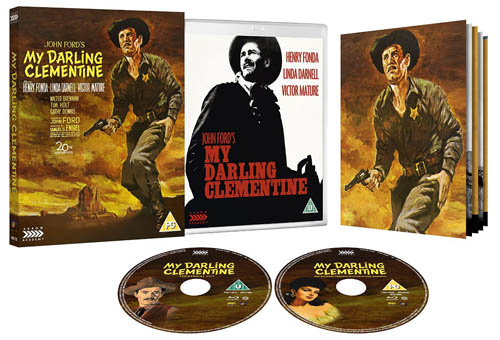
REVIEW — My Darling Clementine (1946)

FilmJuice have my review of the high-end Arrow Academy release of John Ford’s classic western My Darling Clementine.

I knew that John Ford was a great director the second I saw ‘that shot‘ in Stagecoach when John Wayne makes his entrance and the camera seems to scamper towards him like an over-eager puppy. Since then, I’ve seen a few more of his films and even written about one of them in less than flattering terms but while I haven’t been all that aggressive about seeking our Ford’s work, he has been sitting at the back of my head with a ‘Genius?’ post-it note stuck on his forehead. Reviewing My Darling Clementine was a great chance to peel off the post-it and remind myself why I instinctively hold Ford in such high esteem. This is a stone cold classic in which every shot is a painting and every line is a poem.

The thing that took me completely by surprise was the depth at which Ford seems to be operating. What depresses me about a lot of the films coming out of contemporary Hollywood is that rather than operating on several different levels at the same time (e.g. telling a story, exploring some characters, elaborating a theme, providing a spectacle) they often struggle to do even a couple of these without collapsing in a heap. The Marvel Cinematic Universe films are an excellent example as while they more or less tell stories, have characters, and provide spectacle, they never do any of these things particularly well. John Ford, on the other hand, does all of these things in a way that allows them to flow into one another in a completely organic fashion. For example, the main plot of My Darling Clementine is this deeply symbolic meditation on moral grace that brings Henry Fonda’s morally up-standing cowboy to the morally decadent town of Tombstone and watches as the goodness seems to seep out of his boots as he wander about the place. This conflict between the grace humans can create and the moral decadence that is native to this world plays out in every image and every character including Victor Mature’s Doc Holliday who arrived in Tombstone as a good man only to wind up getting infected by the animal selfishness of the town:

Ford explores Holliday’s dilemma by positioning him between two women: On the one hand is Linda Darnell’s Chihuahua, a white woman named for a Mexican dog and wearing Mexican clothes despite frequent references to her being some sort of Native American. As in many films of this era, racial otherness combines with moral and sexual otherness to create an image of everything that Holliday is yearning to become. Chihuahua is like the household god of Tombstone; she’s beautiful, treacherous, promiscuous and a ravening Id that is unchecked by anything even approaching a conscience. On the other hand is Cathy Downs’ Clementine, a Boston school teacher who fell in love with the man Holliday used to be and who came out west in order to lure him back to civilisation. Clementine is not exactly successful as her presence shames Holliday into a bender and plans to move to Mexico with Chihuahua by his side. However, Clementine’s journey turns out not to have been wasted as her simple goodness turns out to be a perfect match for that of Wyatt Earp.

Very symbolic and character-focused, this plot strand stands in stark contrast to a secondary strand dealing with the burgeoning relationship between Wyatt and Holliday’s ex-lover Clementine. Ford presents both Earp and Clementine as restrained and upstanding and so, rather than having them talk about their feelings, he allows the relationship to unfold with virtually no dialogue at all. These sections of the film could have been culled from a film by Carl Theodor Dryer, such is the faith that Ford displays in his audience’s capacity to read emotions straight off the actors’ faces.

It’s always nice to encounter a canonical film that doesn’t disappoint and My Darling Clementine is entirely deserving of its canonical status.