REVIEW – Arrietty (2010)

FilmJuice have my review of Hiromasa Yonebayashi’s Arrietty. A Studio Ghibli adaptatation of Mary Norton’s Borrowers books.

As one might expect of a film directed by one of Ghibli’s finest animators, Arrietty is visually very impressive indeed. The characters are well-designed, the sets are elegant and the re-use of mundane items — de rigueur in all wainscot fantasies — is both imaginatively conceived and brilliantly executed.  However, beyond such shallow set-dressing, Yonebayashi displays a skill for visual storytelling that shows an astonishing amount of promise:

However, while the film repeatedly shows us how alien a world can be when it is not built with you in mind, it also whispers of conciliation and companionship and of what beauties might be achieved if only humans and borrowers could learn to live together. This yearning is symbolised by a dollhouse built by Sho’s family as a place for borrowers to live. A place of glittering chandeliers and tiny silver kettles, the dollhouse is nothing short of a holy land for a group of small people that are very afraid and very alone in a world full of humans.

Unfortunately, while Yonebayashi’s direction is flawless, many of his visual motifs work against Miyazaki’s characteristically slap-dash plot.  Indeed, while Yonebayashi is hinting at what might be if humans and borrowers could live together, the film ends with the borrowers leaving the world of humans completely.  The disconnect between the story told by the film’s visuals and the story told by the film’s script gives the impression that Arrietty is filled with unresolved plot lines resulting in a film that feels more like the opening of a trilogy than a self-contained world.

REVIEW – Sarah’s Key (2010)

FilmJuice have my review of Gilles Paquet-Brenner’s Sarah’s Key.

Starring Kristin Scott Thomas, the film tell the twin stories of a young Jewish girl who was sent to a deportation camp as part of the French government’s infamous War-time Vel D’Hiv Roundup and an American journalist who becomes obsessed with the fact that her husband’s family may have benefited from the roundup:

As these two plot strands slowly unfurl and the connections between the two stories become more and more apparent, Sarah’s Key not only shows us the extent of French complicity in the Holocaust, it also presents us with an explanation of why it is that the events at the Vel D’Hiv were so swiftly forgotten.

While I thought that Paquet-Brenner handed the period elements of the film very well, I felt that he really struggled with the part of the film that tried to make a case for a sort of universal human guilt whereby even the children of people who indirectly benefited from the Holocaust bear a distinct burden of guilt. While this idea neither baffles nor repulses me, I think that it is something of a hard-sell and Sarah’s Key never manages to approach a convincing argument despite an increasingly melodramatic tone. Disappointing but fairly enjoyable up until the 90 minute mark.

Transformers: Dark of the Moon (2011) – The Ambivalence of the Metallic Sublime

Michael Bay is a director whose career can best be described as a heroic fall from competence.

Bay cut his directorial teeth by producing the sort of ‘documentaries’ that allow bands and soft-core pornographers alike to bootstrap unconnected short-form material (such as music videos and photo shoots) into something that can be sold either as a DVD or a VHS. Having learned how to please the eye and how to link together completely unrelated sequences, Bay naturally made the step up to producing action movies.

While Bad Boys (1995) and The Rock (1996) were never going to win Cannes, they do stand as incontrovertible proof that Michael Bay knows how to make a film. Both films are well paced and feature some memorable dialogue delivered by casts only too aware that they are present only as human ballast designed to humanise what would otherwise be nothing more than a succession of fire-fights, chase sequences and expensive-looking explosions. Looking back over Bad Boys and The Rock, Bay’s talent for spectacle is only too evident: abandoned prisons and airfields are shot with the same impossible glamour that you find in the photo-shoots of glossy magazines. Characters in Bay’s early films do not walk, they glide and their cars do not so much accelerate as explode into the world with energy so absurd as to be joyous. There are some who would have Bay return to these sorts of films and it is easy to see why… much of what we think of when we sneer the words ‘a Michael Bay’ film are not present in either The Rock or Bad Boys, but the potential is there. Oh such potential…

Continue reading →

BG 41 – Last Tuesday: How to Make an Art House Video Game

Futurismic have my latest Blasphemous Geometries Column.

The column arose from the fact that, instead of playing a new game like a good columnist, I instead devoted all of my video game time over the last month to replaying Oblivion and Europa Universalis III. By the way, Oblivion is so much more fun if you play it as a warrior instead of a sneaky bloke with a bow. As the deadline loomed, I realised that I had better start looking around for a slightly shorter game to play and I stumbled across Jake Elliott’s indie game Last Tuesday, which can be downloaded for free HERE. Elliott’s game so closely adhered to the template of art house cinema that the column pretty much wrote itself:

Many of the earliest writings on film are psychological in nature because filmmakers were desperate to understand how it was that the human brain took a series of stills photographs and constructed it into not just a moving image but also an entire narrative. Indeed, it is said that when the Lumiere brothers first showed moving images of an approaching train to Parisian audiences, members of the audience fled in panic because they had not yet learned to distinguish between a large moving image of an oncoming train and an actual oncoming train. In order to ‘make sense’ of what it was they were seeing, audiences had to acquire the correct interpretative strategy.  A hundred years later and art house audiences are expected to be able to draw not only on the skills required to make sense of moving images but also upon a veritable arsenal of interpretative techniques used to shed light on narratives filled with the sorts of intentional ambiguities, inconsistencies and plot holes that would be decried as incompetence were it not for the fact that they were evidence of genius.

While I’m particularly proud of how my analysis of the art-house sensibility turned out, I’m also quite happy with my analysis of Elliott’s game. Go play it!

Some Thoughts On… The Princess of Montpensier (2010)

Based on a novel by Madame de la Fayette, Bertrand Tavernier’s The Princess of Montpensier tells a story of love, betrayal, jealousy and intrigue set against a vicious 16th Century French civil war that saw Protestants square off against Catholics.

On initial viewing, there is little to distinguish The Princess of Montpensier from the growing backlog of pleasingly cynical romances that have come to dominate French period drama over the last couple of decades. For example, if you liked the swashbuckling aspects of Philippe de Broca’s Le Bossu (1997) or the acute social commentary of Patrice Leconte’s Ridicule (1997) then you will find in Tavernier’s film elements of both. However, look beyond the masked balls and the buckled swashes and you will also find a film that is refreshingly literary in its approach to storytelling.

Many films are formulaic creations content to tell and retell the same stories that people have been telling to each other since fire met side and beer met lips.  In these ancient narratives, character only ever serves as ballast as the issue is never what a particular character will do but which of his character traits will force him down the rabbit hole of conventional narrative form: is the young hero motivated by passion or by a desire to prove himself? Is his quest for truth, for himself or for love? An approach to narrative that prizes effectiveness of plot over respect for character and complexity is a fixture of genre and there’s a genre for everything these days.  Thankfully, some works take a different approach in so far as they place the impetus not upon the plot but upon the characters.  The plot, in such forms of writing, comes from the characters and not from some procrustean notion of what constitutes a story.  This approach to plotting is particularly evident in the televisual writings of David Milch, whose Deadwood and John from Cincinatti both featured narratives that emerged organically as a result of having a bunch of well-drawn characters shoved into a confined space in which they are forced to interact.

The Princess of Montpensier is a film that is written very much in the Milchian tradition.  It begins by introducing us to a series of characters and then waits patiently as these characters’ personality traits force them into conflict with each other.  The characters in question are:

  • Marie (Melanie Thierry): The beautiful and intelligent daughter of a wealthy but guileless nobleman.
  • De Chabannes (Lambert Wilson): The accomplished scholar, courtier and warrior whose disaffection with violence has resulted in banishment from court and a job as Marie’s tutor in the courtly arts.
  • Philippe (Gregoire Leprince-Ringuet): The son of an ambitious nobleman whose character and skills never quite live up to his aspirations.
  • De Guise (Gaspard Ulliel): The impossibly skilled and glamorous scion of the wealthiest family in the realm.
  • Anjou (Raphael Personnaz): Son of the Queen and General of the Catholic armies.

For nearly two and a half hours, The Princess of Montpensier shows us what happens when some of the most accomplished, powerful and greedy men in France fall in love with the same woman. Some love her because others love her, some love her for who she is and some love her because she is theirs by right or by love.  Regardless of their motivations and Marie’s attitude towards them, these men are all willing to stake everything they have in order to get what they want. The film’s plot flows naturally from the ensuing conflicts as disagreements, jealousies and insecurities pile on top of each other as irrational desires surge and spiral out of control. This treatment of irrational passion makes the film an interesting companion piece to Patrice Chereau’s Dumas-inspired La Reine Margot (1994), which features many of the same historical characters and settings.

La Reine Margot explains the French Wars of Religion by presenting Early Modern France as a bubbling cauldron of sexual, religious and political passions, passions that inevitably bubbled over into mass hysteria resulting in the demented carnage of the St. Bartholomew’s Day Massacre.  Chereau depicts Paris as a sweltering, flea-infested place that is so overcrowded and full of drink and hatred that the massacre could just as easily have been caused by a fight over a barmaid as by the desire to control the spiritual fate of the nation. Religious violence, for Chereau, is just an expression of humanity’s inherent psychological instability.

Tavernier’s The Princess of Montpensier opts for a slightly different approach by presenting 16th Century France as an eminently reasonable place in which people go about their business without being overly worried by matters of religion or love. Indeed, given that the plot involves only Catholic nobles, the Huguenots are absent from the bulk of the film excepting one brilliant scene in which their black-clad countenances are warped and rendered monstrous and ethereal by an imperfect pane of glass. By presenting the irrational conflict over Marie as an uncharacteristic moment of madness, Tavernier is presenting Marie as a sort of thematic placeholder for the high ground of French political life, whether it is secular or religious. By showing us how a number of powerful and accomplished men can destroy themselves for the sake of a woman, Tavernier is suggesting how the Wars of Religion might have come to pass, namely that it is a small step from a life of sanity to an orgy of blood and self-destructive violence.

Grounded in some beautifully drawn and wonderfully performed characters and boasting some neat sword-fights and battle sequences, The Princess of Montpensier is a timely reminder not only of the cynical wonders of French period drama but also of the astonishing richness of French history. The French Wars of Religion saw the French body politic tear itself to shreds as the desire for compromise and peace was driven out by a murderous need for purity and blood. By setting a tragic romance against this backdrop, Tavernier is warning us that human nature is so unstable that there is no telling when such moments of madness might grip us again.

Three Colours: Blue (1993) – Tightrope Walker

We are, according to existentialism, hopelessly free. Jean-Paul Sartre argued that, in the absence of God and the sort of meaningful meta-narratives that give life an objective meaning and purpose, we are free to define our own natures:  ‘To Do is To Be’ because ‘Existence Precedes Essence’. The problem is that freedom is a double-edged sword and while the death of God may well have done away with all limitations on our freedom, it has also served to render all of our choices meaningless.  Indeed, if all paths are open to us and equally inviting then there is no correct path to take and so every decision we do make is tainted by the knowledge that all of our choices are effectively meaningless and arbitrary.

Freedom’s double edge so concerned Sartre that he wrote a short pamphlet entitled Existentialism is a Humanism (1946) addressing the charge that existentialism is a gloomy credo.  The pamphlet ends with a barnstorming rant against Christianity:

 This is humanism, because we remind man that there is no legislator but himself; that he himself, thus abandoned, must decide for himself; also because we show that it is not by turning back upon himself, but always by seeking, beyond himself, an aim which is one of liberation or of some particular realisation, that man can realise himself as truly human (…) In this sense, existentialism is optimistic, it is a doctrine of action, and it is only by self-deception, by confusing their own despair with ours that Christians can describe us as without hope.

Barnstorming though it may be, this rant is hardly convincing as the vision of human nature that Sartre describes is one of perpetual vertigo and while ridding ourselves of the tyrannical sky-pixie is no bad thing, Sartre seems to have saddled us with another form of tyranny: The tyranny of responsibility for ourselves and the tyranny of endless choice.

This tension within the concept of freedom is beautifully demonstrated by Krzysztof Kieslowski in Three Colours: Blue, the first of a trilogy of films interrogating the values of the French Revolution (Liberte, Egalite, Fraternite).

Continue reading →

We Need To Talk About Kevin (2011) – Fear and Loathing in Thebes

Back in 2003, Lionel Shriver published the Orange award-winning novel We Need to Talk About Kevin. Taking the form of a series of letters, the book chronicles a mother’s attempt to come to terms with the extent of her responsibility in the creation of a monster. The novel’s epistolary structure means that adapting it for the cinema was always going to horrify the book’s ever-growing legion of fans but a ripple of excitement passed through cinephilia when the news began to spread that a film had been produced and that it marked the long-overdue return of Scotland’s Lynne Ramsay, a director whose earlier films Morvern Callar (2002) and Ratcatcher (1998) demonstrated a real gift for tackling darker themes with a decidedly poetic sensibility. We Need to Talk About Kevin is not only a successful adaptation of a great novel, it also heralds the return of a director who has been absent from our screens for far too long.  We Need to Talk About Kevin is nothing short of breath taking.


Continue reading →

REVIEW – The Kremlin Letter (1970)

Videovista have my review of John Huston’s spectacularly misanthropic espionage thriller The Kremlin Letter.

Aside from its fantastically icy cinematography and its twisted multiculturalism, The Kremlin Letter is an extraordinary film in that it uses the noir idiom to call into question the utility and the morality of the Cold War cottage industry that was international espionage.  Again and again, Huston returns us to the idea that while there is something heroic in fighting and dying to protect one’s country, there is absolutely nothing heroic about destroying someone’s life in order to force them to give up a few useless secrets:

It is telling that Huston neither shows us the letter at the centre of the plot, nor spells out what the letter means. The letter, like any mcguffin, exists purely in order to drive the plot but, can the same not also be said for the ‘information’ sought by real spies? How can a letter ever hope to justify the racism, misogyny, homophobia and outright savagery of the spies? In truth, the letter is but a fig leaf allowing the spies to pursue old professional rivalries and line their pockets at government expense. There is no justifying what spies do… no ‘information’ is worth such savagery, particularly when this is a war in which no shots are ever fired and where military muscle is only ever for show.

Despite the failure of the post-WWII intelligence apparatus to predict either the fall of the Berlin War or the attacks of 9/11, it is still largely unheard of for someone to call into question the need for an intelligence service.  For Huston to do the same at the height of the Cold War shows not only remarkable character but also a rare amount of political and historical insight.  As unpleasant as it is, The Kremlin Letter remains an astonishing film that deserves to be considered alongside Huston’s greatest cinematic achievements.

REVIEW – Stranger on the 3rd Floor (1940)

Videovista have my review of Boris Ingster’s Stranger on the 3rd Floor, which was co-written by Nathanael West of Day of the Locust fame.

Another slice of film noir goodness, Stranger on the 3rd Floor is one of a number of films from that era that flirted ideas of madness and surrealism before eventually surrendering to the strictures of the genre. The root of the madness, in this case, is guilt.  Guilt for participating in an unjust system and guilt over feelings of hatred so intense that it is easy to imagine why someone would stoop to murder:

Mike’s guilt is so intense that it seems to take on a physical form as Mike stumbles across a strange man leaving the neighbour’s apartment. Was the man there? Is the neighbour actually dead? Did Mike murder the old man while drunk? Mike’s guilt and self-doubt are so intense that, without actually checking to see whether the old man is dead, Mike is already dreaming about the possibility of being rightly executed for being a murderer.

Part of what makes this surprisingly short film so satisfying is the fact that despite the film ending in such a way as to dispel the possibility of projection, the resolution is ambiguous and strange enough that we are left with more than enough critical space in which to dream.

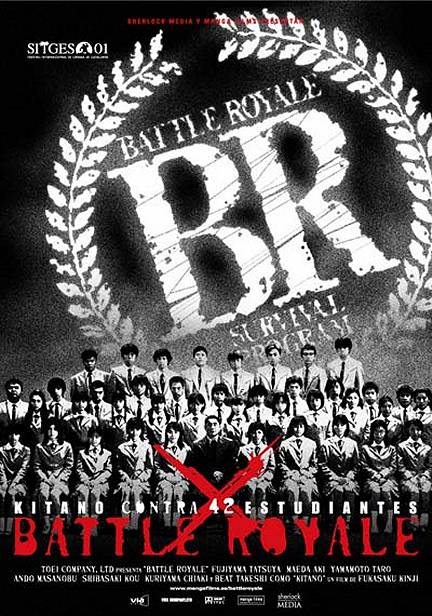
REVIEW – Battle Royale (2001)

THE ZONE has my review of  Kinji Fukasaku’s Battle Royale: Director’s Cut, which has recently been re-released on DVD.

My review attempts to localise Battle Royale within a dystopian tradition which, it seems to me, is peculiarly Japanese. What distinguishes Battle Royale from many dystopian fictions starring plucky teenagers is that the film uses every possible opportunity to mock and ridicule the suffering of its teenaged scapegoats. Indeed, while writers in this tradition are quick to point the finger at governments that blame the young for social problems, works in this tradition also pour scorn on the youth that allow themselves to be victimised:

Again and again, Japanese genre writers depict modern Japan as a hellish place where the old lash out against the youth in ignorance, fear and hatred but the youth refuse to organise and refuse to do anything about their treatment thereby suggesting that no matter how immoral these old people might be, they are not entirely wrong about Japan’s passive, consumerist youth.

The ways in which Fukasaku mocks and trivialises his teenaged characters feeds directly into my one serious complaint about this re-edition: Was a Director’s Cut really necessary?