Last Night by James Salter: “Palm Grove”

This is a story that left me somewhat unconvinced. What drew me to Salter in the first place, was the promise of unfamiliar psychological vistas: As a reader, I wanted to encounter something new. As a critic, I wanted stories that would ask more from me than the ability to recognise stock characters and the relationships that traditionally bind them together. This is a very well-crafted story but it also rests upon a dynamic that is both ancient and toxic, namely that of men viewing women as objects and psychological props rather than living, breathing people. Salter handles his charges with considerable sympathy but it is noticeable that Noreen never quite manages to come together as anything more than Arthur’s perceptions of her. I knew coming into Last Night that Salter was an older writer whose worldview was not likely to be particularly progressive but it is still disappointing to run into lazy thought patterns in the work of someone who is manifestly capable of real empathy and understanding. “Palm Court” is what theatre people would call a two-hander: Two characters drawn are together after a long time apart, their unexpected closeness compelling them to consider both why they parted and why they cannot remain together. Continue reading →

REVIEW — Stalag 17 (1953)

FilmJuice have my review of Billy Wilder’s misleading P.O.W. comedy Stalag 17. I say “misleading” as while the film was initially marketed as a tribute to America’s brave prisoners of war, the film’s depiction of life in a World War II prison camp is actually far from flattering.

Originally a hugely-successful Broadway play, Stalag 17 revolves around a group of American POWs who are trying to escape the camp. Using all of their initiative and sneakiness, the men dig tunnels, fashion civilian clothes and scout for weaknesses in German security only to wind up delivering their escapees into the waiting arms of German machine-gun fire. Shocked but reticent to engage in any form of concerted self-criticism, the group’s frustrations wind up being unleashed on William Holden’s Sefton, a cynical individualist who would rather profit from the group’s desires than aid in their fulfilment. What makes this film “misleading” is the fact that, rather than conforming to genre expectations and producing a film all about a bunch of POWs coming together to outwit the Germans, Wilder has produced a film that portrays American POWs as boorish, overbearing idiots. In fact, Sefton’s rugged individualist is quite obviously intended to be the film’s point-of-view character:

Stalag 17 is not exactly the easiest film to get into. In fact, the film is almost completely unwatchable for most of its opening hour. The problem is that the film ostensibly plays lip service to the idea of the Good War by presenting many of the POWs as happy-go-lucky scamps. Stalag 17 is often described as an iconic film as it was one of the first films about the Second World War to present the Germans as figures of fun rather than menace. Just as this vision of the Nazis as effeminate, strutting nincompoops would later inform British comedies like ‘Allo ‘Allo, the idea that prisoners of war could pull off elaborate schemes under the noses of their German captors would later inspire 168 episodes of the American sitcom Hogan’s Heroes. What makes the film very nearly unwatchable is the fact that virtually all of its jokes are embarrassingly unfunny: First we have the incessant torrent of anti-German comments that are really little more than crude xenophobic sniping dressed up as banter. Then we have about a dozen different jokes involving an over-weight man falling over and finally we have a scene in which hundreds of well-fed American POWs scream and gesture lewdly at a bunch of terrified female prisoners. This type of humour might well have passed muster amidst the jingoism and sexism of 1950s America but it actually makes the POWs come across as a bunch of boorish idiots… and therein lays the point.

My review places Stalag 17 in the broader context of Wilder’s career and his tendency to view American society in very cynical terms but it also occurs to me that films like Stalag 17 could very well mark the point at which war-time solidarity left the American cultural bloodstream, taking any and all faith in collective action with it. Sefton’s rugged individualism provides the film with its moral centre precisely because America was entering an age where it became the individual’s moral duty to look to their own advancement whilst questioning any and all conceptions of the public good that were not grounded in material largesse.


Last Night by James Salter: “Platinum”

Now this is a bit more fucking like it! “Give” and “Such Fun” have their moments but both stories rely rather too heavily on grand reveals to do their work. The grand reveal that forces one to re-evaluate the entire story is a very heavy-handed technique and I think that Salter’s stories work better when his touch is lighter and readers are left to come to their own conclusions. I don’t know whether I am getting better at deciphering Salter but “Platinum” felt completely transparent to me… I read it once and then read it again but I was never left scratching my head in the way I did with those earlier stories. Despite being quite accessible, “Platinum” contains some of my favourite writing in the collection to date.

The story opens with a description of a magnificent apartment overlooking Central Park. The apartment was bought for a small fortune a number of years ago and now it is almost the almost priceless home of a true patriarch, a man who has made a fortune helping the poor and the innocent only to them spend that money making life better for the people around him:

He was a figure of decency and honor, like the old men described by Cicero who planted orchards they would not live to see fruit from, but did it out of a sense of responsibility and respect for the gods, he had a desire to bequeath the best of what was known to his descendants.

This pillar of the community is married to a woman who is intelligent, has no interest in cooking but for whom grace, generosity and good manners are as natural as breathing. When she first met the patriarch Brule’s children she seduced them with a promise of unquestioning love and loyalty:

— Look, she had said to his daughters when she and Brule were married, I’m not your mother and I never can be, but I hope that we’ll be friends. If we are, good, and if not, you can count on me for anything.

Reading this, I am reminded of how consistently brilliant Salter is with this type of emotional engineering. These are good people, they do good things and you cannot help but fall in love with them and their little eccentricities; Brule’s insistence upon walking to work, Pascale’s refusal to cook on the grounds that she cannot talk at the same time. This is a family you desperately want to belong to… how could you not? And if that line about being able to count on Pascale for anything weren’t enough, check this out:

You belonged to the family, not as someone who happened to be married to a daughter, but entirely. You were one of them, one for all and all for one. The oldest daughter, Grace, had told her husband,

— You have to really get used to the plural of things now.

“The plural of things”… The remedy to fear, isolation and existential loneliness condensed down to four words and delivered with all the lethal accuracy of a shot to the head. This is not a family that demands loyalty or makes you work for its trust… it simply takes your ‘I’ and turns it into ‘We’.

Continue reading →

The Organization Geek

I sometimes think that my generation got the wrong end of the stick when it came to the question of conformity. My first encounter with conformity as a theoretical concept came in my early teens when some pre-cursor to GCSE psychology mentioned Solomon Asch’s conformity experiments in which a subject was confronted with a room full of people giving the wrong answer to a simple perception test. Supposedly overwhelmed by peer pressure, over a third of Asch’s subjects chose to follow the group and give the wrong answer.

I say “supposedly” as while a lot has since been written about Asch’s experiments, most of it has been reductive, simplistic and wrong. The problem lies not in the work itself but rather in the tendency to package it up with Stanley Milgram’s experiments on obedience and Philip Zimbardo’s Stanford Prison Experiment as part of a broad cultural narrative about the hazards of conformity.

By the time I was first encountering experimental psychology in the early 1990s, conformity was being presented as a Bad, Bad Thing that caused you to speak untruths, torture people to death and generally behave like a German prison camp guard. Indeed, a lot of the research into obedience and conformity that took place in the middle decades of the 20th Century is best understood as trying to understand the rise of Nazi Germany and thereby prevent it from ever happening again. The work of Asch, Milgram and Zimbardo may have been lousy and misunderstood science but it was great propaganda as it sold us a vision of humanity as a species wired for obedience and moral cowardice.

Continue reading →

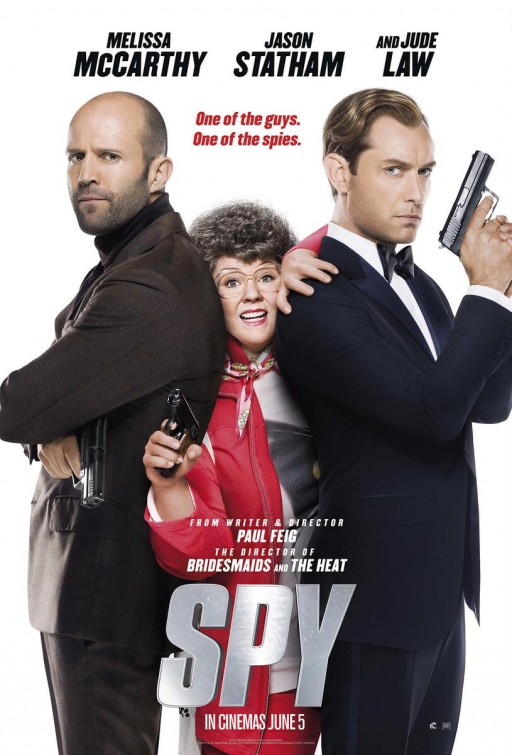
Spy (2015) — Wanting to Fuck Someone Does Not Mean that they are Good at their Job

People have been making spy film parodies for almost as long as they have been making spy films. As early as 1951, Paramount cast Bob Hope in My Favourite Spy as both a sophisticated international spy and the bumbling stand-up comedian who happened to resemble him. Right from the start, this cinematic formula proved so incredibly successful that it began to have an influence on the source material and so many conventional spy films and TV series of the 1960s went out of their way to incorporate the kinds of sight gags and deconstructive energies that had once been used to mock the genre from the outside. Indeed, the only tangible difference between The Man from U.N.C.L.E. and Get Smart is that Don Adams seemed to realise that his character was a self-important fool while Robert Vaughn did not. By the 1980s, the conventional spy film was so far beyond parody that Roger Moore was allowed to turn James Bond into the straight middle-aged equivalent of high camp while films such as Spies Like Us and True Lies functioned as both conventional action films and satirical comedies without even a trace of tonal dissonance.

The public’s growing inability to tell the difference between films about spies and films taking the piss out of spies also served to deprive espionage satires of their political edge. Despite realising that it was impossible to satirise a genre that had progressed beyond parody some twenty-five years previously, many filmmakers went down the path of producing broader and broader satires of a genre that no longer existed as anything other than a comic punching bag for hacks like Mike Myers or the Jason Friedberg and Aaron Seltzer partnership that would eventually wind up creating such cinematic monstrosities as Scary Movie and Meet the Spartans.

Though it is hard to think of a more degraded cinematic genre, the spy movie parody has nonetheless managed to produce a number of truly classic and devastatingly pointed films: Often imitated but rarely understood, Yves Robert’s The Tall Blond Man with One Black Shoe depicts the intelligence services as a bunch of self-important and unaccountable bureaucrats who spend all their time chasing their own tails in an effort to commandeer more power and funding from a political class that lacks the courage to recognise their pointlessness. Equally brutal is Michel Hazanavicius’ OSS 117: Cairo, Nest of Spies, which depicts the French secret service as a bunch of racist thugs who use the trappings of state power to legitimise a playboy lifestyle that takes them from one sun-drenched swimming pool to another as women and members of marginalised groups look on in anger and disgust. Though Paul Feig’s Spy does not approach the savagery of either of these two films, it is an action/comedy that does action very well and a comedy with real satirical bite. Ostensibly a satire of Bourne-era spy films, Spy is best understood as an exploration of the Halo Effect and the idea that physically attractive people are anything other than a bunch of incompetent narcissists benefiting from society’s libidinous good will.


Continue reading →

Last Night by James Salter: “Give”

A story that gave me little joy and left behind it only impertinent questions: – When was this story written relative to the others in the book? Just as composers will often re-use musical phrases and directors can often be found re-using particular motifs, “Give” is a story that seems to draw on images and themes that are also present in the other stories. Is this story’s lusty poet a dry run for that of “My Lord You” or did that image stick so firmly in Salter’s mind that he could not help but return to it? – Does Salter work better at certain lengths than others? The more space he affords himself, the more elegantly he describes to space around his moods and characters. “Give” is nearly the shortest story in the collection and while it does manage to gain some traction, the emotions and images it shuffles around are more simplistic than they are in other stories. Much like “Such Fun”, “Give” is a story with a distracting twist in the tale. I say “distracting” as the drama arising from the male narrator’s affair with another man is most definitely not the point of the story. This is not a story about lost love or a marriage strained by infidelity, it is a story about a world woven from lies and enforced with all the passive-aggression that the middle-classes can muster. Continue reading →

REVIEW — 3 Women (1977)

FilmJuice have my review of Robert Altman’s arthouse drama 3 Women. Set in a small desert town, the film tells of a teenage girl who arrives in town and attaches herself to a slightly older woman with a similar background. Initially, the teenage girl behave likes little more than an enraptured child, hanging on the older woman’s every word as she spins lies and revels in her narrow consumerist ideas about the good life. This relationship lasts until the young woman’s naivete and the older woman’s dishonesty run afoul each other resulting in one of them being hospitalise, at which point the film gets weird:

3 Women is divided into three increasingly-short sections that are topped and tailed by these beautifully composed surrealist interludes that linger in the mind and imbue the film with a distinctly dreamlike quality. When Milly and Pinky’s first relationship falls to pieces, a dream sequence triggers a re-ordering of their friendship and a transfer of personality traits: Once childlike and naïve, Pinky now emerges as manipulative and sexually confident while the deluded and selfish Milly is replaced by a more nurturing and principled figure who tries to look after Pinky only to wind up apologising for her failings until their unhealthy relationship intersects with another woman.

The elevator pitch for this film could easily be: A Feminist Lost Highway as the exchange of personality traits and the radical reworkings of reality are very similar to those deployed by Lynch. The film was evidently quite poorly reviewed at the time and Altman himself admitted that he wasn’t entirely clear what message he was trying to get across but I was reminded quite a lot of the work of Joanna Russ in so far as the film builds towards a future without men and many of the weirder shifts are triggered by a need to find a new way to co-exist with men who are either distracted and indifferent or crude stereotypical representations of a masculinity so toxic that it borders on the absurd.

I remembered Robert Altman chiefly from the grown-up satires he produced towards the end of his career, but while The Player, Short Cuts and Pret-a-Porter always struck me as very similar to Altman’s breakthrough film MASH, they did absolutely nothing to endear him to me. 3 Women has completely changed my opinion of Robert Altman and while I suspect that it’s probably not worth my while investigating the rest of his back catalogue in search of films like 3 Women, I do now wonder to what extent I was simply not ready for his sensibility.


REVIEW — A Pigeon Sat on a Branch Reflecting Upon Existence (2014)

FilmJuice have my review of Roy Andersson’s deadpan existentialist comedy A Pigeon Sat on a Branch Reflecting Upon Existence.

I must admit that this film caught me completely by surprise.  Prior to this review, I was only really familiar with Andersson’s first film, the wonderfully moving teenage love story entitled — aptly enough — A Swedish Love Story. Having now seen a couple more of his films and read a few interviews, I now realise that A Swedish Love Story is completely unrepresentative of the talent that emerged after a long depression-linked hiatus. Andersson may have gone to work in advertising as a successful maker of sentimental films but he returned as a bleakly existentialist comic who produces what can only be described as the cinematic equivalent of Chris Morris’s Jam.

A Pigeon Sat on a Branch Reflecting Upon Existence takes place in a darkly surreal version of the Swedish city of Gothenburg where the futility of everyday life is periodically interrupted by eruptions of surrealist energy that allow the residents fleeting moments of happiness or sadness before returning them to their anhedonic stupor:

Characters flirt outrageously in one scene only to wind up being unceremoniously dumped in the background of another while complete strangers lambast each other for having the temerity to suggest that a Wednesday might feel like a Thursday. The only things that seem to keep the utterly defeated population from outright madness are moments when the past unexpectedly erupts into the present and sends Napoleonic armies marching through the streets while bawdy barkeeps sing about exchanging drinks for kisses while their patrons cheer them on.

The release of this film coincides with the release of a box set including not only A Pigeon and A Swedish Love Story but also Songs from the Second Floor and You, The Living. I recommend it to anyone capable of finding humour in the pointlessness of existence.


Sisters in Law (2005) – Part of the Solution, Not Part of the Problem

Kim Longinotto and Florence Ayisi’s documentary Sisters in Law is best understood in terms of its relationship with Longinotto’s earlier films Divorce Iranian Style and Runaway. Divorce Iranian Style put Longinotto’s camera into an Iranian family court where Women tried to use their country’s sexist legal infrastructure to protect them from their abusive and manipulative husbands. Eye-opening in its depiction of Iranian female agency and moving in its uncompromising commitment to women’s stories, Divorce Italian Style is a powerful film made even more powerful by Runaway, a film about what happens when the system fails and women are forced to flee their family homes. Formally very similar to Divorce Iranian Style, Sisters in Law finds the British documentarian Kim Longinotto filming various legal proceedings in the Cameroonian town of Kumba where it has been seventeen long years since the last conviction for spousal abuse.

Continue reading →

Last Night by James Salter: “Such Fun”

Looking back over the pieces I have written about this collection I am struck by the fact that I’ve effectively been dancing around an idea first put forward by the German poet, playwright and theatre director Bertolt Brecht.

Brecht was a life-long committed Marxist at a time when that meant something other than being an academic. As a Marxist, Brecht was concerned about the purpose of the theatre and people’s tendency to use it as a source of escapism and/or moral complacency: Turn up at a show, identify with one of the characters, experience their moral gyrations at one step removed, go back to your life without even pausing for self-reflection. Brecht’s response to this tendency was to develop a form known as ‘epic theatre’ that encouraged the audience to engage critically with his plays rather than relying on more traditional forms of engagement such as searching for strong characters with which to identify.

Brecht would pursue this end by deploying what he called Verfremdungseffekt, which is often translated as ‘distancing effect’, ‘estrangement effect’ or simply ‘the V-effekt’. The best known distancing effects are those that draw attention to the play’s status as a fictional conceit by breaking down the fourth wall, anything to prevent the audience from relaxing into a passive state and treating the text of the play as some sort of inviolable entity. Given the universality of postmodernism and the frequent use of meta-fictional conceits in popular culture, I suspect that today’s writers have to work considerably harder to force their audience onto a critical footing but the basic principle of the verfremdungseffekt remains intact: You cannot encourage your audience both to suspend their disbelief and to treat your text as an intriguing fiction. An audience that is engaging critically with a text is not surrendering to your attempts at emotional manipulation and an audience that has submitted to a series of carefully curated emotional experiences will be either unwilling or incapable of engaging with a text in a dispassionate fashion. Audiences can, of course, move from one footing to another but they can’t do both things at once.

The reason I mention the verfremdungseffekt is that I think something similar is going on in this collection. Every story thus far uses literary techniques to encourage us to identify with a character and their needs only for Salter to hide much of his real intent in little details that only become apparent when you step back from the stories and survey them not as the journeys of particular characters but as the interaction of different ideas and themes. This effect is definitely at work in “Such Fun”, one of the shorter stories included in this collection.


Continue reading →