Treme: Season 1 (2010) – Questioning the Value of Community

One of the enduring themes of David Simon’s award-winning series The Wire is the idea of the quiet apocalypse and of a society that is drifting into terminal decline not because of war or disease or alien invasion but because of stupidity, selfishness and the fundamental short-sighted perversity of human nature. After an uneven attempt at tackling the War in Iraq with Generation Kill (2008), Treme sees Simon teaming up with fellow Wire alumnus Eric Overmyer to take another look at America’s inevitable end.  However, unlike The Wire, there is nothing quiet about Treme’s apocalypse as the end of this particular world was caused by Hurricane Katrina and the collapse of the New Orleans levees that flooded the city leaving thousands of New Orleans residents, dead, disenfranchised and scattered to the four corners of a nation that simply did not care about the destruction of one of its most historical and culturally vibrant cities.  Treme is about the on-going attempts by the residents of New Orleans to rebuild their lives and their city. Treme is a story about community and returning home but, as you might expect from a series helmed by David Simon, the picture of community it paints is far from idyllic.

If I had to compare Treme to any other TV series of recent times, my choice would be to compare it to David Milch’s gritty western drama Deadwood in that both series are character-based dramas and both series are ultimately about the evolution of the community that these characters are a part of. However, while Milch’s series allowed the characters to dictate the action by effectively having them to walk out their door and interact with whoever happened to be walking past, Simon’s series is far more traditionally structured. Treme is built around a series of more or less discrete emotional communities composed of characters who interact chiefly with each other.


Continue reading →

Book Log for the First Half of 2011

It’s that time again… the year has turned and the first six months of 2011 have given way to the second tranche of annual decay and entropy.

As in previous years, I am listing all of the books that I have read in the last six months with links to where I have reviewed them.  Sadly, as one of the sites I review for regularly is undergoing problems, I will be unable to link to a lot of the reviews I have produced.  However, once the site is back up again, I shall return and fill in the links for anyone foolish enough to be curious.


Continue reading →

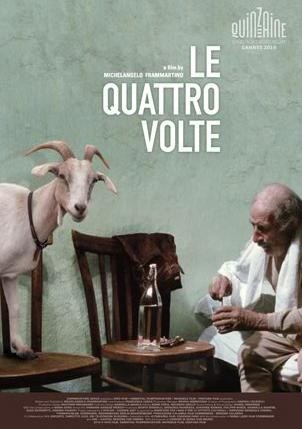
Le Quattro Volte (2010) – Pay No Attention To The Goat Behind The Ocean

Film critics sometimes talk about films having a ‘Malick Aesthetic’.  What they generally mean by this is that the film features lots of nature photography such as the fields of long grass rippling in the wind from The Thin Red Line (1998), the sunlight in the trees from The New World (2005) or the desert sunsets from Badlands (1973). The ‘Malick Aesthetic’ is created by inserting this sort of footage in between more eventful scenes both as a way of allowing the audience to reflect upon what they have just seen and as a way of creating an impression of the numinous that both surrounds and consumes the characters. Michelangelo Frammartino’s Le Quattro Volte is a film that makes extensive use of this technique to create a film that is both free of dialogue and positively overflowing with the same sense of grace that infuses many of Malick’s most enduring films. However, unlike films such as Carlos Reygadas’ Silent Light (2007), Frammartino is not content with presenting us a world imbued with the divine. Instead, much like Malick himself, Frammartino interrogates the divine resulting in a film filled with wit, warmth and wonder, but also profound scepticism about the divine spark that supposedly surrounds us.

Continue reading →

Some Thoughts On… A Lonely Place To Die (2011)

Back in 2007, Julian Gilbey co-wrote and directed a film entitled Rise of the Footsoldier.  Boasting some execrable cockney dialogue, vast amounts of violence and an intent to glamorise football hooliganism that was as morally repugnant as it was artistically derivative, Rise of the Footsoldier sank rapidly, leaving behind it only a greasy slick of DVDs that clogged up the ‘3 for £10’ aisle for months on end. Four years later and Julian Gilbey returns with his co-writer Will Gilbey to offer us a film that is just as violent and unpleasant as Rise of the Footsoldier but which somehow manages to work.  A Lonely Place to Die is a lean and misanthropic action thriller that warns middle-class thrill seekers to be careful what they wish for.

Dateline Scotland where Eagles soar over rocky mountainsides of almost unbearable beauty.  As the camera swoops past outcrops and peaks, we suddenly see a series of coloured fleeces picked out against the barren greyness of the Scottish peaks.  These fleeces belong to three friends on a climbing holiday.  Well… I say friends but the tensions within the group are obvious from the get-go as Alison (Melissa George) scolds Ed (Ed Speleers) for his lack of focus while experienced climber Rob (Alec Newman) rolls his eyes at the couple’s bickering.  A potentially fatal fall narrowly averted, the group trudge back to a nearby cottage where they meet up with another couple and spend the evening getting drunk.  Unlike many films that attempt to stress the camaraderie of the protagonists, A Lonely Place To Die makes it abundantly clear that these people hate each other.  They not only hate each other but they tease and antagonise each other to the point of nearly coming to blows.  “I’d rather eat my own shit” harrumphs Ed when he is handed a fish-based sarnie after a morning’s hiking. This is a group that is tired, bored and spoiling for a bit of adventure.  Needless to say, their wish is granted.

As the group make their way through a forest, a noise is carried to them on the wind.  Is it an animal in pain? Is it a human voice? Spreading out to search, the group soon discover a pipe sticking out of the ground leading to a box that contains a young girl. Clearly, she has been buried alive… but by whom? Squabbling as they go, the group split up with the more experienced climbers taking the direct route to civilisation while the others move more slowly across country with the girl.

Forced out of comfort zone, the climbers are forced to climb fast and hard.  Gilbey’s camera spins around and plays up the sense of vertigo as Alison and Ed hang on for dear life.  However, after a nasty fall and an inexplicable rockslide, it soon becomes clear that the pair are not alone.  Someone out there is after them.

In a slick move, Gilbey holds off introducing us to the villains of the piece, choosing instead to play up the sense of oppressive paranoia gripping both sets of climbers as they move across the brutal Scottish hillside. With the identities and motivations of the kidnappers still unclear, Gilbey introduces us first to a pair of hunters and then a carload of heavies who both seem to be involved in the kidnapping in some way.  However, in the first of a series of reversals, Gilbey rapidly pulls the rug from beneath our understanding of the situation as people slowly reveal not only their true motivations but also their true character. People you would expect to be immoral speak of the need for trust while people that seem good and upstanding are revealed to be cold and calculating mercenaries.

By the time the group has made it back to civilisation, there are three different groups in play.  All of them desperate and all of them ready to kill in order to get whatever they want.  Here, the film transitions from paranoid thriller to all-out action as the three groups go to war in a small Scottish town in the midst of a spectacular street carnival populated by flame-wielding demons and strange naked figures.  As flames belch into the sky and fireworks detonate above the village, the three groups go to war, filling the streets of the Scottish town with blood and bullets in a series of well-conceived and exquisitely directed gun-fights that easily rival the climbing set-pieces from earlier in the film.

In his book The Whole Equation: A History of Hollywood (2004), the film critic David Thomson speaks of the role of Californian light in helping to establish the American film industry.  Indeed, by building their studios in Los Angeles, executives were able to tap into a free natural resource that would have cost them an absolute fortune to artificially replicate.  Because of the climate and because of the environment, films made in Hollywood just flat out looked better than films made elsewhere. While there is previous light to be had in the Scottish Highlands, Gilbey’s film benefits hugely from the awe-inspiring natural beauty of its mountain backdrop.  From the opening frames, A Lonely Place to Die is a film that looks absolutely stunning.  Even when the action moves to the town, Gilbey makes brilliant use of a Scottish Winter Fire Festival to create a bizarre world of flickering firelight and sinister figures.  Add to this some beautifully devised set-pieces, some neat structural tricks, some clever use of camera filters and an absolutely flawless feel for pacing and what you have is one of the best-directed action thrillers I have seen in a long time.  Based upon A Lonely Place to Die, I would put Gilbey in the same bracket as the Frenchman Fred Cavaye whose Anything for Her (2008) recently received a Hollywood remake and whose Point Blank (2010) confirmed his status as one of the best thriller directors working at the moment.

For all of its technical accomplishment, A Lonely Place to Die does suffer from a regrettable lack of interiority.  Gilbey introduces us to characters and plays games with our attitudes towards them but at no point does any of this game-playing really result in anything that I would call a dramatic arc; the story is that there’s a group of climbers and a kidnapped girl and people are chasing them… there is no sub-text, there is no emotional core, there are no character arcs… there’s just lots of chasing, lots of excitement, lots of people falling off of things, getting shot and being blown up but nothing really beyond that.  Were A Lonely Place to Die any less technically impressive as a piece of action cinema, this lack of dramatic interiority would be a terrible problem but with pacing this good and spectacle this well constructed, I am inclined to forgive Gilbey and Gilbey their somewhat lightweight plot, particularly as the characters are well-defined and well served for dialogue despite their lack of dramatic ‘movement’. Had maybe a scene or two been devoted to giving this film some sort of ‘message’ then I would be hailing A Lonely Place to Die as one of the best films I have seen so far this year but, because of the lack of substance, I am reduced to saying that this is one of the best thrillers I have seen this year and that is still something.  A Lonely Place to Die has appeared at a couple of festivals and is slated (according to IMDb) for an autumn release, this release may be theatrical or it may be on DVD but either way, it is a film that deserves to find an audience. I would be intrigued to know what Gilbey could accomplish with a really good script behind him.


On Why I Hate Those Orange Film Adverts

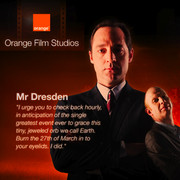
Way back in the mists of time, the British mobile phone carrier Orange came up with quite a neat idea for an advertising campaign that reacted to a genuine public sentiment in a way that was not only funny but also a really intelligent piece of marketing.

In Britain, adverts for products typically appear prior to the trailers thereby forming a kind of de facto ‘buffer zone’ between the film’s advertised screening time and the point at which the film actually begins.  Because nobody wants to watch adverts when they’ve just paid over £10 for the use of a chair for a couple of hours.  Reacting to a sudden epidemic of texting and people talking on their phones during cinema screenings, Orange pitched a series of adverts to cinema chains that effectively allowed them to place an advert for phones in-between the trailers and the actual film, thereby reaching all of the people possessing the sense to not pay for the privilege of watching adverts.

The original idea was simple and effective: A series of actors and filmmakers approach the fictional ‘Orange Film Board’ in an effort to secure funding for their pet project.  However, rather than funding the projects, the good people at Orange start to suggest ways in which adverts for phones could be crudely squeezed into the film.  The moral? Don’t let mobile phones spoil your film and turn off your phone.  Boasting a very funny regular cast, some decent scripts and some great cameos, the adverts were a success and they made Orange look good for being willing to make fun of themselves whilst making a point about anti-social use of mobile phones.

Fast forward a few years and the original chairman of the board drops out of the adverts only to be replaced by a markedly less funny doppelganger.  Gradually, as the campaign grew longer in the tooth, the quality of the scripts started to decline as the adverts stopped being about great potential films ruined and started to be about terrible made-up films built around mobile phone gadgets.  It wasn’t long before the campaign changed again and the Orange Film Board was replaced by actors from real upcoming films fighting fictional battles with Orange to protect the integrity of their films.  This poses a number of problems that were not present in the original campaign:


Firstly, there is a world of difference between casting oneself as the villain who wants to spoil a potentially great fictional film and the villain who is trying to spoil a real film.  Once the film actually exists, you’re not laughing at the movie business, you’re laughing with it and that makes you smug rather than satirical.

 Secondly, there is a world of difference between casting oneself as the villain who wants to spoil a potentially great fictional film and the villain who has spoiled an incredibly shit real film.  I care about the late Roy Scheider trying to make a black-and-white noir thriller; I don’t care about whether or not someone spoils The A-Team or Gulliver’s Travels.  Those films are shit anyway.

 Thirdly, there is a world of difference between casting oneself as the villain who wants to spoil a potentially great fictional film and the villain who is spoiling a real film, as, by including a real film, you are actually engaging in a form of product placement, something that actually does harm films. It is difficult to sell the message that you shouldn’t let a mobile phone ruin your film when your advert is an example of mobile phones ruining a film through crass product placement and the co-opting of characters, actors and filmmakers for commercial ends.

In conclusion? I hate the Orange film adverts and wish with all of my heart that they would fuck off and die.

Yes, this problem is exacerbated by the fact that I habitually go to the cinema two or three times a week but I never used to hate the Orange adverts and now every time I see them, part of me wants to die but only after I have stabbed the idiots who continue to laugh at the fucking things.

I understand that these adverts help Orange shovel money at films and so help films to be made and distributed but the films that Orange uses in its adverts were (by and large) never going to struggle to get distribution anyway.  The A-Team is not some tiny indie film but a multi-million dollar Blockbuster that gets released on hundreds of screens and so, by featuring them in the adverts, Orange are just selling phones and helping Hollywood to line its already bulging pockets.  So, again, I say that these Orange adverts need to fuck off.  I hate the Orange mobile phone adverts and I wish that they would stop.

‘Ah,’ you say ‘but if Orange were to pull their campaign… how would punters get the message that they shouldn’t use their phones during the screening?’ Simple… you get your ushers to kick people out when they do and, if they complain, you do what the Alamo Drafthouse does: Take their not particularly articulate complaints and turn them into a meme.

I watch this advert and I want to give my money to the Alamo Drafthouse (who are reportedly a rather splendid chain of rep cinemas that do all kinds of seasons and interesting one-off screenings) and when I watch the Orange phone adverts, I want to firebomb their smug corporate offices. Fuck Orange, Remember the Alamo and long live the Magnited States of America!

Some Thoughts On… Retreat (2011)

Kate (Thandie Newton) and Martin (Cillian Murphy) are in trouble.  Married for a number of years, the couple’s relationship has been soured by the loss of a child resulting in them visiting an isolated island retreat in the hope of forcing themselves to have a proper conversation. Unfortunately, once the pair arrive on the island things go from bad to worse as instead of forcing them to communicate, the isolation offers up a myriad of displacement activities including fishing, running and the writing of incredibly bitter articles about why their marriage is doomed.

Slowly retreating into paranoia and mutual resentment, Kate and Martin are jolted out of their bitterness by the arrival of a wounded soldier.  Jack (Jamie Bell) informs the couple that a terrible pandemic is sweeping the world and that their only hope is to barricade themselves into their house and seal all the windows. Understandably sceptical, the couple play along on the grounds that even if Jack is lying, he is clearly a dangerous man who needs to be handled with care.

As he boards up the windows, Jack sets about playing on the couple’s fears and desires.  Initially, he plays upon Martin’s presumed masculine desire to protect Kate and to wear the trousers.  He then moves on to attempting to seduce Kate by suggesting that she resembles his late wife thereby tapping into both Kate’s frustration and her presumed feminine attraction to tough guys with a softer side.  While the couple remain sceptical about Jack’s claims of a pandemic, Jack’s ability to play Martin and Kate off each other does allow him to gain the upper hand, a position he begins to use quite skilfully once he finds Kate’s laptop and reads all about the couple’s marital difficulties.

Retreat is a film all about a relationship struggling with the cancer of distrust.  For a while, Jack’s ability to tap into the couple’s fears seems so uncanny that one begins to think that he might be some phantom either supernatural or psychological in nature and while the film regrettably down-plays this aspect of Jack’s character, there is a very clear evolution in the nature of the fears he uses in his attempts to manipulate the couple. For example, initially knowing nothing of the couple, Jack draws on quite widespread fears such as disease as well as a husband’s fear that he cannot protect his wife.  However, as Jack gets to know more about the couple, his lies become a whole lot more specific.  While I regret the fact that the script did not allow us more of a peak behind Jack’s thought-processes, I would still argue that Jack is the best thing about this film.  In fact, Bell’s performance is spell-binding and constitutes a timely reminder of why his name continues to carry a good deal of buzz despite its tendency to be attached to terrible films. Sadly, while Retreat offers Bell the opportunity to shine, the same cannot be said of Newton and Murphy who are forced to contend not only with a tangible lack of chemistry but also a tragically under-written script.

Retreat’s suffers for the fact that Martin and Kate’s relationship never feels unique enough to be real. This is somewhat odd given that the film takes a long time to settle into ‘thriller’ mode allowing oceans of space for the development of its central relationship. However, despite ample time and some real acting talent to draw upon, first-time director and co-writer Carl Tibbetts never quite manages to make the relationship progress beyond the merely generic. The problem is that while the idea of a couple struggling to stay together after the loss of a child is a firm grounding for a film about trust, it is not a particularly original idea.  In fact, the idea has featured in so many films that by the time Tibbetts and his co-writer Janice Hallett get round to it, it feels dated and generic.  This means that, in order to make the relationship seem real, the script and the actors needed to personalise it to the point where we feel that Martin and Kate are more than genre figures. Sadly, because neither Murphy and Newton’s performances nor the script bring that specificity to the table, Retreat’s central relationship fails to engage meaning that the film’s primary dramatic arc is as dead as Martin and Kate’s un-named child. The failure of this central relationship has a knock-on effect on the rest of the film.

The lack of emotional substance to Kate and Martin’s relationship means that Jack’s attempts to play on the couple’s mutual distrust is more interesting than it is emotionally compelling and because we are forced to engage with this unevenly paced thriller on intellectual rather than emotional terms, the film’s fundamental lack of depth becomes increasingly problematic as time goes on.

Retreat is, at root, a psychological thriller and as such it is part of a genre that thrives on the new.  Script-lead, these films typically rely for their effectiveness upon their capacity to surprise audiences through narrative innovation. This means that each new psychological thriller needs to work that little bit harder to break through to an audience raised on Basic Instinct, The Tenant and Memento. In fact, these three films demonstrate quite how much pressure there is on writers to generate something new.  Basic Instinct shocked mainstream audiences with its explicit sexuality, The Tenant shocked audiences with its inherited surrealism and Memento shocked audiences with its bizarre structure and psychological quirkiness.  One could argue that there is a screen-writing arms race raging in the psychological thriller genre and that this arms race has forced screenwriters to skew the genre away from the psychological and towards the fantastical.

As humans, we are trapped in a prison of pure subjectivity.  We know how we feel and we know how we see the world but we are forever separated from our fellow humans and we can never really know how they feel, what they see or what they think.  Because of this gap between minds, humans have developed an incredibly sophisticated of the human mind that we use to attempt to infer what it is that other people are thinking.  This model in referred to by philosophers as Folk Psychology.  The folk psychological model that we draw on as individuals is determined both by our individual experience and by our cultural history.  Indeed, one reason why the characters in classical plays frequently appear stilted and weird is because authors wrote them with radically different folk psychological models to our own.  Because our need to interact with other humans has forced us all to become amateur psychologists, we humans tend to have a pretty good nose for bullshit when it comes to characterisation.  In fact, one could argue that the challenge of characterisation is that of walking a tightrope between writing characters that we recognise as human and characters who act in individual enough ways that our folk psychological model is forced to adapt and encompass these new artistic insights into the human condition.  Unfortunately, our innate capacity to smell bad characterisation is something of a problem for writers operating within a genre that thrives on novelty and the unexpected.  Memento works as a psychological thriller because its central character feels real despite suffering from a condition that is genuinely novel from an artistic point of view but there are not that many psychological conditions that satisfy these twin demands.  As a result, many recent psychological thrillers have tended to rely upon a narrative twist grounded not in human psychology but in either fantasy or the madness of the main protagonist.

By anchoring a plot in magic and madness, a screenwriter is effectively admitting to throwing the rules of drama out the window. Once magic and madness have been invoked, audiences can never quibble about plot as all quibbles can be defused with a terse ‘of course it doesn’t make sense… it’s magic’.

Retreat attempts to double bluff its audience by raising the possibility of the fantastical only to resolve to a set of rules that are ultimately purely psychological; Jack is neither a phantom nor a delusion, he is just a desperate man with a knack for playing on people’s fears. Tibbetts and Hallett’s decision to forego madness and magic in favour of an old school Cape Fear-style psychopath is refreshing but it does show quite how sophisticated our folk psychological model has become, particularly in the light of numerous films that have set out quite explicitly to fuck with our capacity to read people.  Despite some neat ideas, Retreat never feels smart enough to scratch that genre itch.  It never surprises, it never wrong-foots, it never moves us out of our psychological or emotional comfort zones and it never for even an instant capitalises on its potential.  Perhaps if Martin and Kate had been better drawn then the film might have been more emotionally involving.  Perhaps if the script had explored Jack’s motivations a bit better then the film would have been more interesting but for a psychological thriller hoping to find an audience in this day and age, Retreat is nowhere near psychological enough.

Some thoughts On… Page One: Inside the New York Times (2011)

NB: Thoughts On… is new strand for this particular blog.  As I have been watching quite a few films recently, I have realised that while many films give me reason to ponder, not all pondering necessarily results in either a coherent opinion or enough substance for a full critical response.  So instead of keeping such thought to myself, I have decided to share my thoughts on the various films I see as well as producing more developed pieces.

***

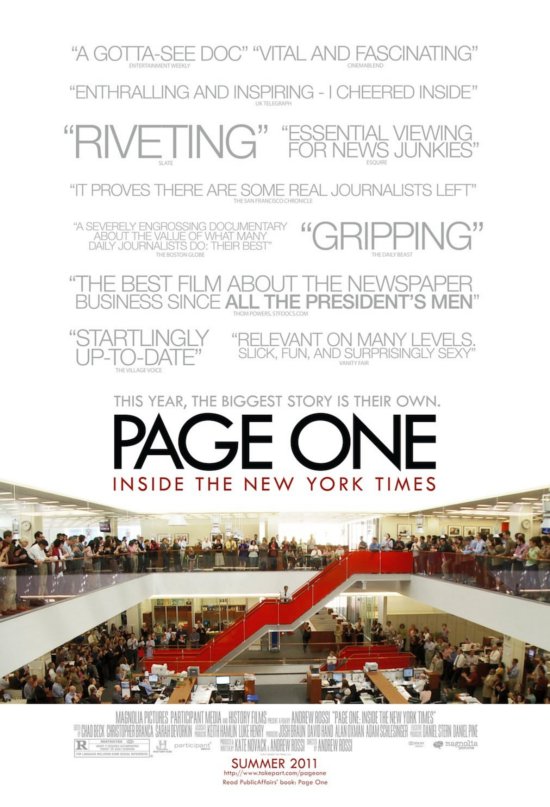
Currently on limited US release and in search of US distributors, Andrew Rossi’s Page One: Inside the New York Times primary concern is with the current economic state of the US newspaper industry and it asks whether there is still a place for an old media institution like the NYT.  Indeed, with advertising revenue drying up, classified ads moving online and more and more people getting their news online for free, the question of the Times’ continued existence needs to be asked if only so that we can work out why it is that newspapers should survive.  While Page One offers us an answer, I am not at all convinced that the answer it gives us is all that convincing.

Our guide through the issues surrounding the future of the newspaper industry is the NYT’s engaging media columnist David Carr.  The doc follows Carr about as he breaks stories, interviews new media tycoons, takes part in panel discussions and gives speeches at journalism conferences. A gruff scarecrow of a man whose odd physicality speaks to his past as a drug addict, Carr is absolutely savage in his defence of the New York Times in particular and print media in general.  In fact, Carr is so engaging a presence that it is difficult not to smile as he repeatedly swings a carefully sharpened and immaculately weighted hatchet at the reams of hyperbole generated by online mavens only too eager to dance on the grave of traditional print media. However, as engaging as Carr might be, I could not help but feel that Page One is only giving us half the story.

The problem is that Page One is a film that is utterly in love with its subject matter.  Rossi repeatedly stresses not only the NYT’s history but also its continuing role as a purveyor of truth and a guardian of natural justice.  Rather than giving equal time and equal weighting to both sides of the debate, the film portrays critics of old media as hyperbole-slinging crooks and straw men who take to the field of debate solely to provide the ferocious Carr with target practice.  So one-sided is the battle that one cannot help but begin to wonder why it is that Carr spends all his time grappling with paper tigers when the real beasts of the jungle are allowed to go about their business unmolested.  For example, in his book Flat Earth News (2008), Nick Davies points out that only 12% of the stories published in British newspapers come from actual reporters while 88% come either from recycling other papers’ stories or from cutting-and-pasting directly from press releases put out by pressure groups and business people. Once you realise that that 12% also includes stories generated through tabloid muckraking, the arguments put forward by Carr and his ilk begin to seem quite flimsy.  Indeed, there is no denying that newspapers such as the New York Times do fantastic work in breaking important stories and unveiling hidden truths, but what of the remaining 88% of the stories that grace their website?

The question of whether newspapers are a public good that are worth protecting even as their business models crumble is an important one not only for the state of our public discourse but also for the future of democracy.  By failing to answer any of the tough questions that can be asked of old media, Page One has not so much argued the NYT’s corner as sung its praises in the form of a funeral dirge.  Nobody benefits from this sort of one-sided cheerleading, least of all an industry in dire need of waking up and smelling the coffee.

Page One is arguably at its best when it is not trying to help as its most cogent and powerful arguments for the continued existence of print media are not the ones that it explicitly makes but the ones that it makes by implication simply by showing the NYT’s journalists at work.  In one brilliant sequence, the media editor and the foreign affairs editor discuss whether or not to report on a so-called ‘final patrol’ by US combat troops in Iraq only for the pair to reach the conclusion that the only people who are actually announcing the withdrawal of combat troops are the TV journalists that feature in the report and, because NBC are not actually at war in the Middle East, the story has more to do with TV reporters wanting narrative closure than it does with any real-world events of changes in policy.  As the various editors toss ideas back and forth, it is easy to see quite how much thought goes into the honing of an editorial stance.  These sequences suggest that there is far more to reporting than dumping a load of diplomatic correspondence on a website and the fact that the construction of editorial stances involve such careful deliberation and expertise is a powerful argument for the continued existence of what Clay Shirky refers to in the film as a professional media class.

The irony of Page One is that, had Rossi followed his own advice and left reportage to the reporters, this documentary would have been far more powerful an argument in favour of print media.  However, instead of allowing the NYT’s reporters to speak for themselves through their entirely admirable actions, Rossi attempts to fashion a narrative and, in so doing, weakens his own case by producing a documentary, which, though undeniably enjoyable, feels stilted to the point of hagiography.

BG 40 – Pixel-Bitching: L.A. Noire and the Art of Conversation

Futurismic have my latest Blasphemous Geometries column.

The column is about the various attempts by game-designers to emulate the cut and thrust of human social interaction.  I begin by taking and in-depth look at L.A. Noire‘s attempts to climb out of the uncanny valley before widening the aperture a touch and taking a look at some of the theoretical challenges that need to be overcome before games become capable of modelling conversation as well as they model shooting people in the face and slicing them up with great big swords:

Phelps’ capacity to be inhuman to his fellow man helps him to understand his fellow humans better… thereby raising the possibility that Phelps is in fact a sort of autistic Colonel Kurtz whose willingness to commit acts of terrible violence is a form of spiritual strength. The road to Nirvana is easy to walk when you are wearing jack-boots.

However, in the interest of full disclosure I do feel obliged to make clear the fact that I did not come up with the term ‘pixel-bitching’ all by myself. The term used to be bandied about on the RPGnet forums as a means of referring to a mode of adventure design whereby games masters will not allow the game to progress until the players have uncovered a single specific (and usually well-hidden) clue.  I’ve also heard the phenomenon referred to as a ‘plot bottleneck’ but I think that term fails to capture how irritating it can be to find yourself hunting for a single pixel in a digital landscape.

Point Blank (2010) – The Love… The Love…

From Plato to Robert Louis Stevenson and Joseph Conrad to William Golding, one of the most enduring leitmotifs in the history of Western Culture has been the duality of man and how, beneath a civilised and housebroken exterior, lurks a creature with a truly terrifying capacity for debasement, savagery and chaos. One of the reasons for the popularity of this dualistic conception of human nature is that the idea of humanity being suspended between two points allows different cultures to position the points wherever they choose. For example, for the Platonists, these points were positioned in intellectual real of the Forms and the sensual world of the flesh allowing Platonists to talk about the need for humanity to aspire to the examined life of the mind. This denigration of the body proved convenient when Plato entered the Christian bloodstream through thr works of Plotinus and Augustine allowing the life of the mind to be replaced with the life of the spirit and the pursuit of Salvation. One of the peculiarities of dualism as a cultural trope is the tendency for people to present man’s duality as an essentially moral problem with one pole representing moral rectitude and the other pole representing all that is base and horrid about human nature.  It is telling that, when Golding’s schoolboys are freed from the fetters of civilisation, they immediately turn to killing each other and not to making great art, thinking great thoughts or just fucking the living shit out of each other.  The tension between the fundamental amorality of the dualist conception of human nature and our tendency to see this duality in strictly moral terms is one that is present in many adaptations of Robert Louis Stevenson’s Strange Case of Dr. Jekyll and Mr. Hyde (1886) as for every adaptation that has presented Hyde as an evil psychopath there is an adaptation that presents him as a free spirit to whom the laws of society (for good or ill) simply do not apply. This notion that man’s inner savage need not necessarily be evil is one that is emerging as absolutely central to the films of Fred Cavaye.

Cavaye’s First film Anything for Her (2008) (a.k.a. Tout Pour Elle) tells the story of a man whose wife is sent to prison for a crime she did not commit.  Rendered incapable of functioning by the loss of his wife, the film’s mild-mannered protagonist sets about reinventing a new identity for himself that will allow him to break his wife out of prison. Events rip away the character’s veneer of bourgeois rectitude, but while the inner savage allows the character to do some genuinely terrible things, the film never passes judgement on him because what he does he does out of love and because he is ultimately in the right.

Cavaye’s second film as writer/director Point Blank (a.k.a. A Bout Portant) sees him return to this same moral hypothesis: Men and women are born divided. On the one hand, we are civilised beings who love each other, hate violence and generally follow the rules.  On the other hand, we are uncivilised beings who will stop at nothing in order to defend what we have and get what we want. Because we live in a society that protects us and enforces ‘civilised’ values, we tend to keep our uncivilised natures in check: We do not murder, we do not steal and we do not fuck the living shit out of each other at the drop of a hat. However, should civilisation fail us then our animalistic character will come to the fore.  What makes animalistic actions morally reprehensible is not their violence, their destructiveness or their anti-social character but their motivation.  In Point Blank as in Anything for Her, Cavaye believes that there is nothing that is not permissible as long as it is done out of love.

Continue reading →

X-Men: First Class (2011) – Better Without The Class

Living in the second decade of the 21st Century, it is difficult for us to cast our minds back and to recall the shocking novelty of Bryan Singer’s X-Men (2000). Up until that point, super hero films tended not to take place in the real world. Tim Burton’s Gotham City was a gothic masterpiece unlike anything on Earth while Richard Donner’s Metropolis seemed resistant to any changes in political culture that might stem from having a super-powered alien enforcing city by-laws. Prior to the release of X-Men, the politics of super hero cinema tended to follow the politics of super hero comics in so far as they existed solely at the level of sub-text. Sure, Stan Lee and Jack Kirby’s original X-Men was about racism and prejudice but those themes only emerged over time and Lee never took the risk of embarking on the sort of direct social commentary that might come from confronting his mutants with real-world events.  This was, after all, the 60s…

By opening X-Men with a sequence involving a young mutant who uses his magnetic powers to bend the gates of a Nazi death camp, Singer elevated comic book politics from subtext to foreground. When American politicians planned to register all mutants, Singer was absolutely clear that this was a form of xenophobic fascism.  When the parents of a mutant asked if their son had tried not being a mutant, Singer was absolutely clear that anti-mutant prejudice was akin to homophobia, racism and anti-Semitism. Bryan Singer’s X-Men films were not mere fantasies… they were stories about our broken and distorted world.

By the time Brett Ratner directed X-Men: The Last Stand (2006), much of the politics of the original film had drained away leaving only hot babes in tight outfits and dull whirlwinds of CGI presented with the same blend of hollow psychobabble and Christian imagery that pervades most super hero films. Five years later, the franchise is resurrected under the creative control of Matthew Vaughn and Jane Goldman, the pairing who brought us the somewhat uneven Kick Ass (2010).  Moving from script to cinema in less than a year and with a creative partnership not known for either its creativity or its political engagement, X-Men: First Class had a steep slope to climb and while the finished product is far from flawless, the film does boast a level of intelligence and political thoughtfulness that is vanishingly rare in a genre whose recent successes include the dunderheaded Thor (2011) and the hyperactive Iron Man 2 (2010).

Continue reading →