REVIEW – Spread (2009)

Videovista have my review of David Mackenzie’s Spread (a.k.a. Toy Boy).

Trapped somewhere between romantic comedy and a warts-and-all indictment of life on the Hollywood fringe, Mackenzie’s film garnered a good deal of festival buzz thanks to the presence of Ashton Kutcher and the insider-y nature of the subject matter.  Kutcher — whose career received a sizeable boost as a result of his relationship with the older Demi Moore — plays a pretty young man who lives off of older women.  On paper, this film promised a lot and initial reviews were strong but once the collective hysteria of festival season faded, so too did the film’s buzz and reality soon reasserted itself.  A reality of muddled tone, indifferent scripting and lack of sociological bite:

I suspect that these variations on the traditional romantic comedy theme are intentional and that, by breaking with generic tradition, the film is trying to make some wider point about the way in which we think our lives are going to follow these grand romantic arcs but, while Spread hints at this sort of deconstructive agenda, it ultimately fails to explore any of these themes meaning that the film comes across as broken rather than deconstructed.

All in all: Not nearly clever enough.

Walking Hadrian’s Wall – Day Five: Saughy Rigg to Gilsland

Steps: 20,000

Distance: 11.7 km

Having done the crags the previous day, day five’s walking felt very much like a cop-out; too few steps and too little complaining to be altogether real. The morning began with a gentle stroll along the last large-scale remnants of the Wall.

Continue reading →

BG43 – QWOP, GIRP and the Construction of Video Game Realism

Futurismic have my forty-third Blasphemous Geometries column.

The column uses Bennett Foddy’s flash games QWOP and GIRP to investigate the concept of realism in a video game concept.  In a recent article in Wired magazine, Foddy was championed for his commitment to “soul-crushing, low-reward realism” in video games but are GIRP and QWOP really more realistic than Assassin’s Creed?

While there is definitely something ‘unrealistic’ about the ease of physical movement displayed by the characters in Assassin’s Creed, it does not follow that QWOP and GIRP are ‘realistic’ simply because they make physical activity seem a lot more difficult. Indeed, most gamers are in fact capable of walking a few steps and climbing over a wall without falling over or drowning. They can do these things because, for most people, walking and climbing are skills that are learned in infancy, skills that they have mastered to the point where using them no longer required conscious thought. By asking us to focus upon how the laws of physics interact with the movement of our muscles while walking, Foddy is asking us to take control of a character who has not yet mastered the art of walking. But such a character is no more representative of ‘real life’ than a character who can scale a building without breaking a sweat. Both Assassin’s Creed and QWOP present us with highly selective visions of reality, visions that instantly belie any claim to artistic realism suggesting that, yet again, claims or artistic realism are nothing more than rhetorical hot air.

A better way of looking at Foddy’s games is to consider them as an interrogation of the control mechanisms that gamers have come to take for granted.  Gamers pick up a game assuming that they will be able to run and jump and kill with effortless grace, Foddy’s games deny them that ease of access. His games make the most mundane tasks crushingly difficult and so draws our attention to the manufactured nature of gaming reality.

I conclude the column by pointing out that a lot of what we think of as ‘hardcore games’ are in fact nothing more than games that refuse to call into question the basic assumptions and conceits of gaming.  In order to play a hardcore game, you have to be familiar with the games that came before it. In truth, ‘Hardcore’ games are nothing more than unimaginative games that are content to echo the design decisions made in earlier games. ‘Hardcore gaming’ is nothing more than unadventurous and conservative gaming rebranded.

Walking Hadrian’s Wall – Day Four: Chollerford to Saughy Rigg

Steps: 28,000

Distance: 16.65 km

I’d like to begin this day’s entry with a few words on preparation.  In the bumph we received from Hadrian’s Wall Ltd, there were frequent allusions to the need for us to be both physically and psychologically prepared for the walk.  Reading this, we made fun of the idea that a few days’ walking in the countryside might require a rigorous regimen of fasting and meditation. Oh the folly of innocence!

Continue reading →

REVIEW – Hatchet II (2010)

Videovista have my review of Adam Green’s latter-day slasher film Hatchet II.

I requested Hatchet II because I had heard great things coming out of the film’s US screenings. Having enjoyed Hatchet’s ironic humour, I was hoping that Hatchet II might push the boat out that little bit further and be maybe just a little bit sillier, a little bit gorier and a little bit funnier.  Instead, I discovered a film that caused me to reconsider my view of the original film.  Suddenly I was reminded of that scene in The Simpsons episode where Moe builds a tunnel from the fashionable waterfront district to his bar in the slums in order to lure in yuppies. “Hey, this isn’t faux dive… this is a dive”.  Upon watching Hatchet II, I thought of Hatchet and exclaimed “Hey, this isn’t faux schlock… this is schlock!”:

Unfortunately, because Green struggles with both the campier elements and the more serious moments, Hatchet II never manages to find that sweet spot between postmodern irony and absolute sincerity. Because it is impossible to know when the film is being intentionally awful and when it is merely being awful, Hatchet II‘s moments of intentional self-parody feel more like defence mechanisms designed to allow the filmmakers to cry ‘irony’ whenever their attempts at tension and human drama fall wide of the mark. This makes for an uncomfortably defensive cinematic experience, like sharing a drink with someone who keeps putting himself down in the hope that you’ll tell him how wonderful he is.

Avoid it like the proverbial.

Walking Hadrian’s Wall – Day Three: Harlow Hill to Chollerford

Steps: 30,000

Distance: 18 km

Breakfast brought more culinary disappointments from The Keelman’s.  My eggs were unseasoned and came with only minimal toast.  Also, most B+Bs tend to give people a pot of coffee for the table. However, The Keelman’s serve you by the cup and so if, like me, you enjoy your coffee in the morning, you may find yourself having to pester the waitress a few times for more coffee. Given that we arrived at The Keelman’s completely knackered and starving hungry, my memories of the place may well have been etched by the twin (and not entirely disconnected) acids of bile and low blood sugar but, after two disappointing meals and a night spent on a bed that felt like a sack of flour, I was more than happy to leave Newburn behind and head out into the countryside.

Continue reading →

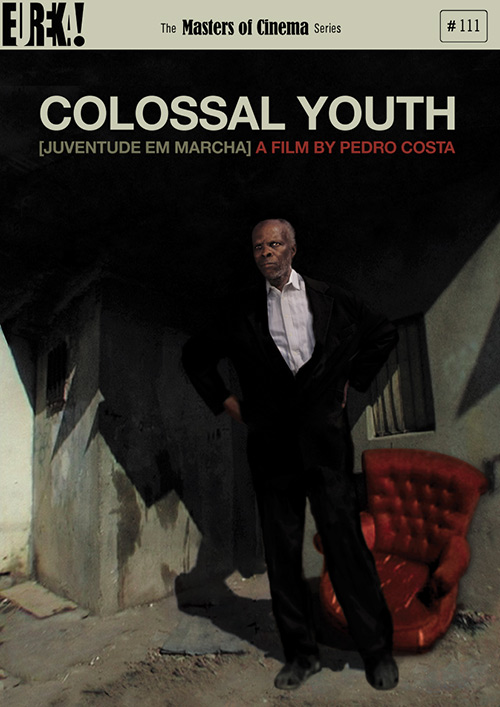
REVIEW – Colossal Youth (2006)

Videovista have my review of Pedro Costa’s Juventude em Marcha, which has been released by the always excellent boutique DVD and Blu-ray label Masters of Cinema.

While Colossal Youth is not the first Pedro Costa I have seen, my familiarity with the filmmaker’s work in no way made it either an easier or a more appealing watch.  The film is beautiful, intelligent and is inspired by the same singular vision that pervades all of Costa’s work but it is also cataclysmically boring and inaccessible. This is art house film making without compromise or concession, either you accept the film on its own terms or you don’t bother:

While Costa’s films are almost completely unwatchable, there is clearly a coherent vision behind the impenetrable boredom that dominates his films. Because this coherent vision exists, Costa has found an audience for his decidedly singular and experimental approach to filmmaking. Indeed, while I suspect that Costa has few followers outside of academic film studies and film schools, the substance that exists in his work means that his films contribute to the evolution of the cinematic form. While the films that Costa makes may be boring and unwatchable, they will be influential and it would not surprise me if Costa’s devotees can find echoes of his work in that of the filmmakers who have come after him. As boring as his work may be to me, I cannot deny that Costa is an important figure and that his films constitute a boon to the on-going evolution of the cinematic form.

Going by the recent output of Colin Marshall’s excellent podcast Marketplace of Ideas, I get the impression that certain elements of the lit-blogosphere are attempting to re-claim boredom as a position of spiritual strength and a reaction against the media-saturation and sensationalism of much of Western culture. It seems to me that Costa’s work would probably make a good case-study for people sympathetic to that position.

Walking Hadrian’s Wall – Day Two: Tynemouth to Harlow Hill

Steps: 50,000

Distance: 30 km

The day began with the sort of breakfast you might expect from a faded seaside hotel.  People sat at tables with white linen tablecloths looking out of a huge picture window at storm-ravaged British coastline.  Alongside the apple and orange juice sat a pitcher of tomato juice, some Tobasco sauce and a few sticks of celery.  Penance, no doubt, for a night on the Courvoisier. Breakfast was decent but no more.  Neither quantity nor quality was anything other than fine.

Bags packed, boots laced, stomachs filled, we headed off on our first day’s proper walking.  Gary had suggested the possibility of walking from Tynemouth to Wallsend in Newcastle but this prospect seemed to appall us both.  We were there to walk the Wall.  Tyneside’s cheap, clean and efficient Metro took us into town and deposited us at Wallsend, near Segedunum and the old Swan Hunter shipyards.

Continue reading →

REVIEW – Black Butler, Collection One (2008)

Videovista have my review of the first ‘collection’ (which may or may not be the same thing as a series) of Toshiya Shinohara’s anime adaptation of Yana Toboso’s Black Butler manga.

Black Butler is a not particularly intelligent, not particularly inventive and not particularly interesting series that sees a young man form a pact with a demon to help him find the person responsible for the death of his parents.  The demon takes the form of an uber-competent Jeeves-style butler who not only helps the young man to manage his business empire but also to battle underworld threats to Victorian Britain. The steampunk fantasia that makes up the series’ foreground is, quite frankly, utterly derivative but the series is made watchable by a yaoi-inspired subtext that introduces a strong erotic charge to the boy’s relationship with his butler:

All of these elements (including the weird top-bottom, master-slave relationship) will be instantly familiar to anyone who has ever encountered the Yaoi or Bishonen genres of manga but the fact that these elements are present in an ostensibly mainstream and youth-oriented series lends them a fresh and subversive feel that is undeniably attractive and engaging.

While the series just about held my interest, it did make me wonder why you would watch this rather than an actual work of Yaoi or Bishonen anime. Neither of these sub-genres is particularly marginal or all that subversive… why hide their influence in the closet of a mainstream anime series?

Walking Hadrian’s Wall 2011 – Day One: Tynemouth

Our first day’s travelling was limited to getting us from London to Tynemouth via Newcastle.

As with most fields of human endeavour, there is a good deal of discussion regarding the ‘best’ and ‘correct’ way to walk Hadrian’s Wall. Some attempt to do it in three days, others argue the importance of arriving a day early in order to begin the walk first thing in the morning and others argue that the Wall should be walked from West to East on account of the prevailing winds. As this was our first walking holiday, we decided to do the Wall in seven days and we decided to walk it from East to West because walking into Newcastle’s industrial landscape might prove more depressing than triumphal. Obviously, your mileage may vary but that of the Wall does not.

The trip up to Newcastle was smooth by the standards of British railways and the hours flew by as we read, dozed and chatted to the astonishingly outgoing couple sat next to us on the train. We arrived at Newcastle and got a taxi to Tynemouth driven by an insane control-freak Geordie who drove incredibly quickly and insisted upon getting out of the cab at the lights in order to give directions to other drivers. I was too terrified to ask how he knew where the other drivers were headed.

Continue reading →