REVIEW – Trevor Howard: Collection (2013)

trevor-howard-collectionFilmJuice have my review of a recently released collection of films starring the late great Trevor Howard.

The collection includes David Lean’s Brief Encounter, Herbert Wilcox’s Odette, George More O’Ferrall’s Heart of the Matter and a Carol Reed double-bill comprising The Third Man and Outcast of the Islands. While it is somewhat unfortunate that the collection doesn’t include Sons and Lovers (the film that netted Howard his only Oscar nomination), I feel that the films included here do an excellent job of showcasing precisely why it was that the odd-looking Howard rose to prominence as a leading man in post-War British cinema. The answer, in a word, is fallibility:

Instantly recognisable to anyone who grew up in the days when terrestrial TV channels still padded out their schedule with classic black and white films, Trevor Howard is one of the great screen presences of British post-War cinema. No matinee idol, Howard’s awkward looks and brittle manner made him the perfect choice for directors seeking a wounded British patriarch; a man of action who is forever tired, a romantic figure with just a hint of threat, a spy who gives away all his secrets and listens to no one. In fact, Howard was so effective in these sorts of roles that the end of his career saw him typecast as an impotent and dysfunctional authority figure: a symbol of broken imperial hubris to be mocked in Superman and denounced in Gandhi.

Howard is, in many ways, the antithesis to the unflappable patriarch played by Noel Coward in In Which We Serve, a fragile and selfish man who tries to assume the role expected of him by his society only to fail and fail again. Interestingly, Howard’s film career was boosted by his reputation for being something of a war hero who did ‘good work’ in the royal corps of signals during the Second World War. However, as Terence Pettigrew revealed Trevor Howard: A Personal Biography, Howard was actually kicked out of the army for having a “psychopathic personality”. I can think of no more fitting a life story for a man who would spend his career playing flawed patriarchs.

In terms of the films included in the collection, Brief Encounter, Odette and The Third Man are unimpeachable classics of post-War British cinema which more than justify picking up the collection. However, the other two films are somewhat less than brilliant.  I bounced quite hard off the hysterical racism of Outcast of the Islands but warmed to the odd narrative structures and atmospheric cinematography of O’Ferrall’s Heart of the Matter. However, I can completely understand people having the opposite reaction as in the case of Viv Wilby’s excellent write-up of the collection over at Mostly Film:

In his New Biographical Dictionary of Film, the critic David Thomson blames Trevor Howard’s second-league career on bad role choices and a reluctance to move to Hollywood. Maybe. Or maybe he was hidebound by a British film industry that struggled to see him in anything other than upper-middle class officer roles. Or perhaps he was just born too early. Were he in his prime in the 60s rather than the early 50s perhaps he would have had more interesting choices to make. One of his favourite roles was apparently the eccentric aristocrat in Vivian Stanshall’s 1980 film Sir Henry at Rawlinson End. That would have been a more interesting addition to a Trevor Howard boxset than, say. Odette. But even in this rather narrow selection of movies, Howard shows himself to be an actor of great versatility and sensitivity and there’s much to admire and enjoy.

While I can see the case for excluding Odette, I think it would be foolish to do so. Odette casts Howard as a deluded and privileged foil to Anna Neagle’s quietly heroic female spy who undergoes terrible hardship without breaking whilst Howard’s character enjoys a much softer treatment by virtue of his family connections to Churchill. Aside from being the originator of the immortal “we have ways of making you talk” line and the inspiration for the way that Allo Allo handled British people speaking in different languages by varying their accents, Odette can actually be classed as a feminist film. At a time when most big releases struggle to pass the Bechdel test, it is hard to imagine a lavishly produced studio picture about the quiet heroism of a middle-aged woman.

REVIEW – Citadel (2012)

Citadel_2FilmJuice have my review of Ciaran Foy’s debut horror movie Citadel.

Set on a council estate that might be in Ireland or possibly Scotland, Citadel revolves around a single father attempting to escape from a decaying council estate that is over-run with faceless hoodies. When the hoodies break into his council house in a bid to abduct his daughter, the young man turns to a psychotic Catholic priest who urges him to abandon all fear and compassion. Turns out the feral underclass are the inbred “dog children” of a pair of junkies and the only way to ‘save’ them is to murder them in an enormous gas explosion that will not only wipe the streets clear of impoverished scum but also allow the young man to become a real father.

The problem with Citadel is that, rather than seeking to examine middle class fears of a feral underclass, Foy treats these fears as entirely rational thanks to a backstory that deploys not only the language of class warfare as found in the pages of the Daily Mail but also fears of miscegenation, violence and unreasoning carnality that are common to pretty much every racial panic in recorded history. Much like Velt Harlan’s Jew Süss and D. W. Griffith’s The Birth of a Nation, Ciaran Foy’s Citadel uses crude stereotypes to dehumanise and degrade whilst equating personal fulfilment and moral clarity with an act of grotesque violence against the dehumanised group. This makes Citadel not just ugly and reactionary, but downright fascistic in both its imagery and argument. To produce a film like this at a time when poor people are disproportionately subject to government funding cuts is nothing short of reprehensible.

As distasteful as it may be to make a film that dehumanises the poor at a time when they are being disproportionately targeted by government cuts, Citadel somehow manages to be even more offensive by virtue of receiving funding from government bodies such as the Irish Film Board and Creative Scotland. What this means is that while the Scottish and Irish governments may well have cut back on the amount of money they use to help poor people, they still found money to help produce a film that demonises the poor and advocates killing them all in an enormous gas explosion. How’s that for a slice of class warfare?

REVIEW – Plein Soleil (1960)

pleinsoleil10A little while ago, I was planning on writing a book about psychological thrillers. I thought it might have been a good idea because I wanted to read a book about psychological thrillers but nobody appeared to have written one. While the project was eventually dissolved by the dawning realisation that nobody would publish a book about psychological thrillers written by me, my attempt to pull together a list of great psychological thrillers brought me into contact with Rene Clement’s Plein Soleil. Based on Patricia Highsmith’s classic existential novel The Talented Mr Ripley, Plein Soleil struck me as a fascinating misprision… a failure to comprehend the original intent of a work that nonetheless produced something of considerable beauty. FilmJuice have my review of Plein Soleil, which is now available in the UK for the first time in altogether too long.

Set in the strange demimonde created by wealthy American socialites slumming it in Italian hotels, Plein Soleil tells of a penniless young man who attaches himself to a much wealthier man with a far more forceful personality. In Highsmith’s original text, the relationship between Ripley and his prey is a sort of existential magnetism, a void that attempts to fill itself by consuming a much more substantial person. Intriguingly, Clement and Delon present Ripley not as an existential void but as a sort of unquenchable hunger… a man with nothing who wants everything and who will stop at nothing in order to get it. Indeed, even Anthony Minghella’s stylistically dull adaptation of the book presented Ripley as a sexless figure whereas Delon’s Ripley is all about Marie Laforet’s fragrant Marge:

Delon’s Ripley is an absolute masterpiece, a creature of malign and yet unfettered grace, the male libido chiselled into marble and made socially acceptable by the strategic use of smart haircuts and tailor-made suits. Think Bond unhitched from Queen and Country.

Another thing that struck me since filing the review is that Plein Soleil has a very similar setting and cast of characters to Antonioni’s now burdensomely-canonical L’Avventura; both are about beautiful people in a beautiful place and both films use that beauty to highlight the beautiful people’s complete lack of interiority. In L’Avventura, the mediterranean is a dull grey slate dotted with jet black protuberances while that of Clement is a washed-out nightmare where only the most brutal and beautiful fear to tread.

Re-visiting Plein Soleil was a real treat that only continues to confirm my feeling that Anthony Minghella’s Oscar-nominated and BAFTA-winning Talented Mr Ripley is actually the weakest of all the Ripley films while Clement’s adaptation and Liliana Cavani’s take on Ripley’s Game remain sadly under-rated.

REVIEW – Rebellion (2011)

rebellion-quadFilmJuice have my review of Mathieu Kassovitz’s political thriller Rebellion (a.k.a. L’Ordre et La Morale – which is a much better title).

Based not only on historical events but historical events involving French politicians who have only recently left the stage, the film tells of how a group of political activists protested the continued French political control of New Caledonia. Hoping to catch the attention of the media by occupying a French gendarmerie in the run-up to the 1988 French general election, the Kanak protesters accidentally killed a policeman resulting in the French army being sent to reassert ‘order and morality’ on what is still considered French soil. Kassovitz himself plays a French gendarme who is sent to negotiate a settlement only to discover that both the French military and their political masters are dead set on violence resulting in what has become known as the Ouvea cave massacre.

As with La Haine, Kassovitz jumps into the political elements of his narrative with real zeal and understanding. Using Legorjus as a viewpoint, Kassovitz crawls around inside the Ouvea massacre and shows not only the cowardice of the separatist politicians who failed to support their own activists but the complete moral bankruptcy of a French political class who used a real-life hostage situation as an opportunity to grandstand on the eve of a national election. However, unlike many political films that are content to bewail the system and blame impersonal forces for the ills of the world, Rebellion goes out of its way to name real-life politicians and speculate about their motives. Why did Jacques Chirac close the door on negotiations? Because he wanted to attract the votes of the French National Front and he knew that brown bodies meant votes. Why did the separatist politicians fail to support their own activists? Because they were afraid of being associated with dead police even though the plan to occupy police stations was theirs to begin with. Rebellion is a blisteringly angry film and watching it will make you angry too; if Western governments behaved this badly in 1988, what do you think it says about the people in power today?

As I say in my review, I think that Rebellion is a real return to form for Kassovitz. While I’ve enjoyed almost all the films he has directed, I remain of the opinion that La Haine will be the film for which he is remembered and Rebellion shows a real desire to return to the same levels of anger and political engagement. Possibly one of the best-made and more courageous political thrillers of recent times, this film really puts all of those terrible Iraq War films in perspective. All too often, political stories stress the cultural dimensions of their analyses resulting in a snapshot of a particular moment in time that blames nobody by exaggerating the inevitability of it all. This type of analysis that focuses on systemic forces rather than individual personalities is alarmingly common in American politics where perpetual warfare, the brutalisation of the poor and the rich getting richer are all seen as just shit that happens. By naming names and placing the blame not just on ‘the political class’ but on particular people within that political class, Kassovitz is reminding us that politicians are responsible for the offices they are elected to fill and who is in office at a particular time really does matter. Had Jacques Chirac not been eager to secure the votes of Jean-Marie Le Pen’s followers then chances are that the hostage takers would have walked away unharmed and ready to face justice.

REVIEW – I’m So Excited! (2013)

Im-So-Excited-2013FilmJuice have my review of Pedro Almodovar’s thoroughly underwhelming comedy I’m So Excited!

When I’m So Excited! was released earlier this year, I was sceptical. I was sceptical despite my enduring love for Almodovar’s Bad Education and despite the fact that Sight & Sound magazine made a massive fuss over it. I was sceptical because I thought (and continue to think) that this film is fundamentally flawed at a conceptual level. In fact, I don’t think that anyone could make a decent film out of this particular set of ideas.

Set predominantly on a flight from Spain to Mexico, the film follows the crew and first class passengers as they desperately try to keep their minds off the fact that their plane’s landing gear is stuck and they will soon be making an emergency landing. The cabin crew are an engaging bunch of booze and pill-chugging reprobates while the passengers are a bunch of wealthy people with secrets including a professional dominatrix, a virgin psychic who reads the future by groping men’s groins and an actor with an emotionally unstable girlfriend. Camp as general synod, the crew flirt outrageously, talk about their overly-complicated lovelives and drug the passengers in an effort to help them open up emotionally and sexually. There are many double entendres and a dance number. It’s not very funny. In fact… it’s more than a little bit embarrassing despite the predictably wonderful art direction and design.

I’m So Excited is beautifully designed and effortlessly directed but without any real ideas to explore or an appropriately funny script, the film drags terribly from one largely unfunny and unsubstantial set piece to the next. Even worse, Almodovar struggles to control the tone of his own film meaning that campy slapstick and raunchy dialogue unpredictably collapse into (admittedly well-realised) inserts about an actor getting back together with his ex-girlfriend when his current girlfriend is committed for attempting suicide. These wild changes of tone and focus not only rob the film of any sense of comedic momentum, they also draw attention to the weakness of the writing and the lack of care and attention that went into deciding what to keep and what to cut prior to release. Why bother including an insert about an actor’s love life when the results are neither funny nor related to anything else in the film? The most logical answer is that it amused the director to include it and that is the living definition of creative self-indulgence.

My initial scepticism about I’m So Excited! is derived from three different areas:

Firstly, if you make a comedy about a plane flight then you are inviting comparisons with Jim Abrahams, Jerry Zucker and Zucker’s Airplane! one of the most enduring and influential comedy films of the thirty five years. If your film is not at least as funny as Airplane! or Airplane 2 then chances are that your film will disappoint. Making a comedy set on a plane is as short-sighted and arrogant as writing a sitcom set in a Torquay hotel. Why invite that comparison?

Secondly, the publicity for this film emphasised both the campiness of the comedy and the fact that it featured a (not particularly funny or well executed) dance routine. This immediately put me in mind of Britain’s entry into the 2007 Eurovision Song Contest. If the idea of camp and raunchy air cabin crew can’t sustain a 3-minute pop song, why would it support a 90-minute film?

Thirdly, I think the sexual politics of this type of comedy are completely out of step with the times. Back in the early 1970s, Jeremy Lloyd and David Croft began production of a situation comedy with a very similar comedic aesthetic. Set in a department store and called Are You Being Served?, the sitcom was heavy on the double-entendres and featured a career-defining performance by John Inman as the magnificently camp Mr Humphyrs. The series’ most famous running joke involved Molly Sugden’s aging shop assistant Mrs Slocombe making frequent allusions to the state of her ‘pussy’. One of the reasons why Are You Being Served? seems out of date is that the series uses double-entendres as a way of ‘innocently’ alluding to taboo topics such as the sex-lives of gay men and the genitals of elderly shop assistants. However, as time has moved on and social mores have shifted, the idea of older women having sex lives is no longer taboo and so Molly Sugden complaining about having to thaw out her pussy now seems more like TMI than LOL. I would argue that something very similar has happened regarding the depiction of GLBT people in popular culture. Back in the 1970s, gay people were expected to be invisible and so a flamboyantly camp man making allusions to his sex life was so transgressive that people reacted to Mr Humphyrs as though they were in on some sort of elaborate joke at the BBC’s expense. However, forty years later and openly gay men are now fairly common in TV and film and so there’s no reason to react to anything they say as some sort of transgressive utterance that has been secreted past the men upstairs. As I ask in my review, what is so funny about a male pilot having sex with one of the male cabin crew? what is so funny about an ostensibly straight man exploring his own sexuality by sucking a cock? There is nothing inherently funny about the idea of two men having sex so why are we expected to laugh? Camp was a part of many gay lives for a very long time but that time has now passed… I could understand a nostalgic exploration of a time when gay men were obliged to hide in plain sight by camping it up but playing that campness for laughs now? in the 21st Century? Doesn’t work. The times they have-a-changed.

REVIEW – Nowhere (1997)

NowhereFilmJuice have my review of Gregg Araki’s psychotronic teen soap opera Nowhere.

Final installment of Araki’s wonderful Teenage Apocalypse series (along with Totally Fucked Up and The Doom Generation), Nowhere follows a group of American teenagers as they work to find themselves in a swamp of sex and drugs. Melancholy and often seen as more reactionary than the earlier films in the series, Nowhere focuses less on the joys of transgressive sex and drug-taking than on the psychological consequences of immersing yourself in one particular culture. The film’s main protagonist is dating a beautiful girl who turns out to be naturally bi but while the main protagonist is also naturally bi, he struggles with the idea that he must share his girlfriend with a woman. In fact, the thought so bothers him that he ends the film by fleeing his transgressive subculture in pursuit of a far more traditional and romantic belief that there is one person out there who will suit his needs perfectly.

While you could, if you were that way inclined, read this narrative as an indictment of youth culture and an Assayas-style mutterings about everyone needing to grow up and settle down, I think a more interesting approach is to view the film as a 90s equivalent to that speech in Fear and Loathing in Las Vegas where Hunter S. Thompson remembers the end of the 60s. The one that ends with:

So now, less than five years later, you can go up on a steep hill in Las Vegas and look West, and with the right kind of eyes you can almost see the high-water mark — that place where the wave finally broke and rolled back.

Gregg Araki’s Nowhere is not about the wave rolling back but about that moment when the wave slows and you think maybe it’s not going to make it all the way up the beach after all. Maybe it’s going to stop. Maybe it was never going to make it after all.

Imbued with a touch more humanity than many of his peers, Dark begins to notice strange things happening on the edges of his culture; alien lizards are disintegrating vacuous teens while a televangelist makes big promises on late-night TV. Filled with dread and alienated from the air of fashionably empty transgression surrounding him, Dark abandons the values of his peers in favour of a traditional fantasy of finding one person with whom he can spend the rest of his life. Aware that something is slipping away from him, Dark makes an uncharacteristically articulate speech about reaching the end of an era as his lover explodes leaving only an alien insect that promptly climbs out the window taking all youthful weirdness with it.

REVIEW – Something in the Air (2013)

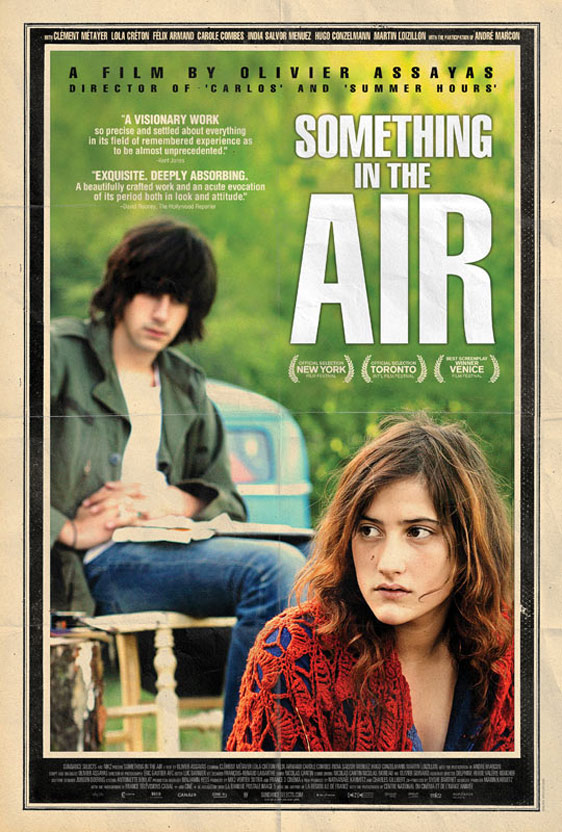
something_in_airFilmJuice have my review of Olivier Assayas’s 70s drama Something in the Air.

Much like Assayas’s near-universally acclaimed Carlos the Jackal, Something in the Air is set in the aftermath of the 1960s just as that much-overstated sense of solidarity and hopefulness was beginning to collapse into the selfishness, divisiveness and cynicism that would later herald the rise of Thatcherism and Reaganism. The film follows a group of French teenagers as they graduate from High school in 1971 and head out into Europe for a summer of self-discovery. However, despite the teenagers being incredibly passionate about their politics and the need to change the world, most of their decisions have little if anything to do with the tomes of political theory they dutifully read and quote:

Despite functioning at an incredibly high level or intellectual and political engagement, Gilles and friends drift from one doomed relationship to another whilst either embracing or rejecting the opportunities that come their way. One of them is dragged into the orbit of a bunch of aspiring terrorists while another joins a commune only to find herself doing all the washing, cleaning and shopping for a bunch of men who are anything but radical in their attitudes to women. Indeed, while some critics have made a lot of the similarities between Something in the Air and Assayas’s earlier film of ill-fated teen revolt Cold Water, a much better point of comparison would be a film like Richard Linklater’s Dazed and Confused as while Assayas’ teens may be living the revolutionary life in a series of beautiful European locations, the decisions they make are ultimately no different to those of Linklater’s suburban Texans.

This suggestion that radical politics are necessarily an affectation that do little aside from lock you into various social networks is very similar to the point Assayas makes by de-politicising the actions of Carlos the Jackal. From my review of Carlos:

By refusing to place Carlos’s actions in any kind of context, Assayas beautifully foreshortens them, reducing them from political actions to social gestures. Indeed, when Carlos and his gang storm the OPEC meeting, it is immediately clear that they have a good deal more in common with the politicians and bureaucrats than they do with ordinary people. Carlos is able to discuss his intentions quite calmly with the various politicians while their civilian underlings quake with uncontrollable terror. The politicians and police know who Carlos is. He knows who they are. Everyone knows the stakes. Everyone knows the risks. It is almost as though they are all friends.

The film is beautifully made and while it is not exactly one of Assayas’s great works, it does do a good job of raising questions about the 1960s at a time when the toxic exit strategy of that particular generation is becoming obvious to all.

REVIEW – In The Fog (2012)

InTheFogFilmJuice have my review of Sergei Loznitsa’s historical war movie In The Fog.

Based on a short story by the renowned Belarusian author Vasil’ Bykaw, In The Fog is a slow, moody and atmospheric exploration of what it was like to be alive during the Nazi invasion of Belarus. The film revolves around two childhood friends who are thrown into conflict when one is sent to execute the other on suspicion of aiding the Nazis and betraying his countrymen. While the film’s glacial pacing may initially help to introduce a note of tension, this tension soon dissipates once the film moves onto a more conventional character study… at which point it collapses into mind-boggling boredom:

While glacial pacing is quite common in European art cinema, the purpose of the long drawn-out pauses and shots of scenery is usually to draw attention to ambiguities and provide the audience with breathing space in which to reflect upon what it is that they have just seen on the screen. The problem with In The Fog is that while it may be littered with awkward pauses and shots of Belarusian forests, the film contains neither the ambiguity nor the complexity that might require these extended periods of contemplation. For example, the film’s opening sequences do a great job of establishing that the railway worker is a calm and noble man but rather than using that character’s flashback to explain or complicate his saintly demeanour, the film simply contents itself with re-iterating the same basic character beats: A man who is calm and noble in a forest is evidently just as calm and just as noble in a German prison cell. Had Loznitsa dared to introduce a note of ambiguity into either his plot or his characters then all of those (admittedly decorative) shots of Belarusian forests would have been welcome, instead they merely feel like padding. Loznitsa’s literal-mindedness is even more evident in the final act when he attempts to step back from his character studies and broaden the film’s themes out into a wider discussion of wartime morality. However, rather than introducing some fresh plot element that might have encouraged the audience to reflect upon the characters in a wider context, Loznitsa simply has his characters sit around in a forest wondering out loud about what their experiences say about the morality of war.

Readers with long memories will doubtless take this review as yet another chapter in the on-going epic known as Jonathan Complains Bitterly About the State of Arthouse film. Previous chapters can be found here, here and here. My problem with In The Fog is the same as my problem with many contemporary art house films: It is a beautiful dolt. It is easy to see that a goodly proportion of European art house directors working today have been deeply influenced by the great art house classics of the 1960s. However, rather than emulating L’Avventura‘s willingness to challenge norms and break rules, they emulate the style: The non-linear narrative, the ambiguous plot points, the extended pauses and thus what was once revolutionary is now little more than pastiche.

REVIEW – In The House (2012)

ITHFilmJuice have my review of François Ozon’s In The House.

The film is set in a devastatingly modernist French high school where a bitter failed writer grinds out a living teaching French literature to teenagers who can barely read or write. Suddenly, the teacher’s gloom is lifted when one of his students hands in an astonishingly dry and sarcastic appraisal of a middle-class home he recently visited. His interest captured, the teacher encourages the boy’s talent and soon every piece of homework becomes another wry take-down of middle-class life. What makes this film interesting is that, rather than focusing upon the emotional connection between failed writer and ambitious student (YOU’RE THE MAN NOW, DOG!), the film uses the relationship as a metaphor for the creative process as the student is effectively writing for an audience of one who gives him detailed feedback on what he wants to see in the next chapter. Brilliantly, the teacher’s requests that the student alter his plot results in the student doing things that directly impact the teacher’s life forcing the audience to suffer for their vicarious literary joy.

One way of looking at In The House is to say that it features a more restrained approach to the shaggy postmodernism of Charlie Kaufman. For example, as with Being John Malkovich, the characters in this film blur the lines between the real and the fictional. Similarly, as with Synecdoche New York, the entirety of In The House feels like an intentionally doomed attempt at capturing the entire creative process in a single unwieldy metaphor. The problem is that Kaufman realises that the cleverness of postmodernism is inherently less satisfying than the emotional payload of a sweeping narrative arc and so he builds these huge metaphorical structures in an effort to replace emotional closure with a sense of wonder. Ozon’s comparative restraint means that, unlike many of Kaufman’s projects, In The House works as a proper story right up until the end but it seems entirely reasonable to suggest that ending the film on a flight of postmodern fantasy would have been more effective than Ozon’s discontented trudge.

I’ve recently read two quite interesting books that attempt to deal with the issue of ironic detachment from the emotional manipulations of narrative. David Thomson’s typically shaggy and typically wonderful book on the history of film The Big Screen finds him deeply troubled by the way in which the rise of advertising appears to have somehow compromised the relationship between work and audience. Prior to TV and Radio, people would submit themselves to a particular narrative and stay with it till the end. Now, they find themselves jostled out of the flow by adverts… tiny self-contained stories injected into the flow of a film or TV programme but designed to sell rather than move or entertain. After combing through the history of cinema, the book ends with Thomson experimentally watching a film backwards:

You also discover what a sweet, artificial thing story is. That is not a mocking of narrative, simply a revelation that story is just a series of tricks or steps, a mechanism, not too hard to guess in advance, and as systematic and serviceable as, say, a staircase — and as logical and mathematical. A story is something made and made up; it is a disguise of life, artfully and kindly done, but not life. It is lifelike. And stories are so artful, so manufactured, that they might as easily run backwards or forward

This vision of narrative as a system of emotional control also runs through Douglas Rushkoff’s recent (and not quite wonderful) book Present Shock. Rushkoff argues that the world around us does often makes very little sense as decades of advertising have encouraged us to find ways of protecting ourselves from stories that would manipulate our emotions:

Aristotle was the first, but certainly not the last, to identify the main parts of this kind of story, and he analyzed them as if he were a hacker reverse-engineering the function of a computer program. The story mechanics he discovered are very important for us to understand, as they are still in use by governments, corporations, religions, and educators today as they attempt to teach us and influence our behaviors. They are all the more important for the way they have ceased to work on members of a society who have gained the ability to resist their spell.

While I am still in the process of digesting a lot of these ideas, I think there is a lot of meat on the bones of the idea that a lot of contemporary culture is post-postmodern in the sense that it is built with an explicit aim of overcoming the air of ironic detachment that postmodernism has encouraged us to adopt. Kaufman in particular is quite an interesting figure as all of his films begin in the real world, deconstruct the real world and end with mad flights of fantasy. I think Kaufman does this because he realises that a) neat narrative arcs are at least as ‘false’ as CGI fantasias and b) CGI fantasias are probably a more reliable way of having an impact on an audience than a happy or a tragic ending.

REVIEW – Burnt by the Sun 2 (2010)

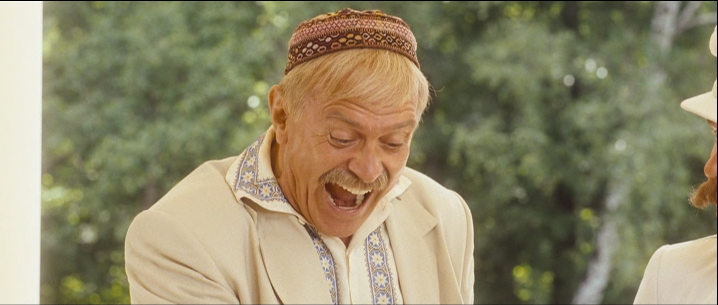
Burnt_by_the_Sun_2FilmJuice have my review of Nikita Mikhalkov’s five-hour Second World War epic Burnt by the Sun 2.

Burnt by the Sun 2 is one of the most demented films that I have ever come across. Way back in 1994, Mikhalkov co-wrote, co-produced and directed an elegant historical drama named Burnt by the Sun. Set in the run-up to World War 2, the film tells of a complex love triangle comprising an aging hero of the Russian revolution, his beautiful young wife and a concert pianist who spent the revolution on the side of the White Russian aristocracy. Coming relatively soon after the break-up of the Soviet Union, Burnt by the Sun’s nuanced vision of Russian history brought not only considerable critical and commercial success but also the rare accomplishment of winning both an Oscar and a Palme D’Or.

Twenty years later and Mikhalkov has used the international success of Burnt by the Sun to re-invent himself as both a big budget film producer and the man who reportedly leads the institutions of Russian cinema in much the same way as Putin leads the institutions of Russian government. Reportedly one of the most expensive films in the history of Russian cinema, Burnt by the Sun 2 is:

Best described as a five-hour version of Saving Private Ryan directed by a Stalinist Michael Bay. The film opens by taking the complex web of political and personal betrayals described in the original Burnt by the Sun and reducing it down to someone attempting to drown Stalin in an enormous chocolate cake.

The comparison with Bay is quite deliberate as Burnt by the Sun 2 is not only a Russian attempt at making a Big Dumb Summer Blockbuster, it is a damn sight more entertaining than most of the Big Dumb Summer Blockbusters that have graced our screens in the last couple of years.

Oh… and I wasn’t joking about someone trying to drown Stalin in an enormous chocolate cake:

StalinE

StalinD

StalinC

StalinB

StalinA