BG 41 – Last Tuesday: How to Make an Art House Video Game

Futurismic have my latest Blasphemous Geometries Column.

The column arose from the fact that, instead of playing a new game like a good columnist, I instead devoted all of my video game time over the last month to replaying Oblivion and Europa Universalis III. By the way, Oblivion is so much more fun if you play it as a warrior instead of a sneaky bloke with a bow. As the deadline loomed, I realised that I had better start looking around for a slightly shorter game to play and I stumbled across Jake Elliott’s indie game Last Tuesday, which can be downloaded for free HERE. Elliott’s game so closely adhered to the template of art house cinema that the column pretty much wrote itself:

Many of the earliest writings on film are psychological in nature because filmmakers were desperate to understand how it was that the human brain took a series of stills photographs and constructed it into not just a moving image but also an entire narrative. Indeed, it is said that when the Lumiere brothers first showed moving images of an approaching train to Parisian audiences, members of the audience fled in panic because they had not yet learned to distinguish between a large moving image of an oncoming train and an actual oncoming train. In order to ‘make sense’ of what it was they were seeing, audiences had to acquire the correct interpretative strategy.  A hundred years later and art house audiences are expected to be able to draw not only on the skills required to make sense of moving images but also upon a veritable arsenal of interpretative techniques used to shed light on narratives filled with the sorts of intentional ambiguities, inconsistencies and plot holes that would be decried as incompetence were it not for the fact that they were evidence of genius.

While I’m particularly proud of how my analysis of the art-house sensibility turned out, I’m also quite happy with my analysis of Elliott’s game. Go play it!

Some Thoughts On… The Princess of Montpensier (2010)

Based on a novel by Madame de la Fayette, Bertrand Tavernier’s The Princess of Montpensier tells a story of love, betrayal, jealousy and intrigue set against a vicious 16th Century French civil war that saw Protestants square off against Catholics.

On initial viewing, there is little to distinguish The Princess of Montpensier from the growing backlog of pleasingly cynical romances that have come to dominate French period drama over the last couple of decades. For example, if you liked the swashbuckling aspects of Philippe de Broca’s Le Bossu (1997) or the acute social commentary of Patrice Leconte’s Ridicule (1997) then you will find in Tavernier’s film elements of both. However, look beyond the masked balls and the buckled swashes and you will also find a film that is refreshingly literary in its approach to storytelling.

Many films are formulaic creations content to tell and retell the same stories that people have been telling to each other since fire met side and beer met lips.  In these ancient narratives, character only ever serves as ballast as the issue is never what a particular character will do but which of his character traits will force him down the rabbit hole of conventional narrative form: is the young hero motivated by passion or by a desire to prove himself? Is his quest for truth, for himself or for love? An approach to narrative that prizes effectiveness of plot over respect for character and complexity is a fixture of genre and there’s a genre for everything these days.  Thankfully, some works take a different approach in so far as they place the impetus not upon the plot but upon the characters.  The plot, in such forms of writing, comes from the characters and not from some procrustean notion of what constitutes a story.  This approach to plotting is particularly evident in the televisual writings of David Milch, whose Deadwood and John from Cincinatti both featured narratives that emerged organically as a result of having a bunch of well-drawn characters shoved into a confined space in which they are forced to interact.

The Princess of Montpensier is a film that is written very much in the Milchian tradition.  It begins by introducing us to a series of characters and then waits patiently as these characters’ personality traits force them into conflict with each other.  The characters in question are:

  • Marie (Melanie Thierry): The beautiful and intelligent daughter of a wealthy but guileless nobleman.
  • De Chabannes (Lambert Wilson): The accomplished scholar, courtier and warrior whose disaffection with violence has resulted in banishment from court and a job as Marie’s tutor in the courtly arts.
  • Philippe (Gregoire Leprince-Ringuet): The son of an ambitious nobleman whose character and skills never quite live up to his aspirations.
  • De Guise (Gaspard Ulliel): The impossibly skilled and glamorous scion of the wealthiest family in the realm.
  • Anjou (Raphael Personnaz): Son of the Queen and General of the Catholic armies.

For nearly two and a half hours, The Princess of Montpensier shows us what happens when some of the most accomplished, powerful and greedy men in France fall in love with the same woman. Some love her because others love her, some love her for who she is and some love her because she is theirs by right or by love.  Regardless of their motivations and Marie’s attitude towards them, these men are all willing to stake everything they have in order to get what they want. The film’s plot flows naturally from the ensuing conflicts as disagreements, jealousies and insecurities pile on top of each other as irrational desires surge and spiral out of control. This treatment of irrational passion makes the film an interesting companion piece to Patrice Chereau’s Dumas-inspired La Reine Margot (1994), which features many of the same historical characters and settings.

La Reine Margot explains the French Wars of Religion by presenting Early Modern France as a bubbling cauldron of sexual, religious and political passions, passions that inevitably bubbled over into mass hysteria resulting in the demented carnage of the St. Bartholomew’s Day Massacre.  Chereau depicts Paris as a sweltering, flea-infested place that is so overcrowded and full of drink and hatred that the massacre could just as easily have been caused by a fight over a barmaid as by the desire to control the spiritual fate of the nation. Religious violence, for Chereau, is just an expression of humanity’s inherent psychological instability.

Tavernier’s The Princess of Montpensier opts for a slightly different approach by presenting 16th Century France as an eminently reasonable place in which people go about their business without being overly worried by matters of religion or love. Indeed, given that the plot involves only Catholic nobles, the Huguenots are absent from the bulk of the film excepting one brilliant scene in which their black-clad countenances are warped and rendered monstrous and ethereal by an imperfect pane of glass. By presenting the irrational conflict over Marie as an uncharacteristic moment of madness, Tavernier is presenting Marie as a sort of thematic placeholder for the high ground of French political life, whether it is secular or religious. By showing us how a number of powerful and accomplished men can destroy themselves for the sake of a woman, Tavernier is suggesting how the Wars of Religion might have come to pass, namely that it is a small step from a life of sanity to an orgy of blood and self-destructive violence.

Grounded in some beautifully drawn and wonderfully performed characters and boasting some neat sword-fights and battle sequences, The Princess of Montpensier is a timely reminder not only of the cynical wonders of French period drama but also of the astonishing richness of French history. The French Wars of Religion saw the French body politic tear itself to shreds as the desire for compromise and peace was driven out by a murderous need for purity and blood. By setting a tragic romance against this backdrop, Tavernier is warning us that human nature is so unstable that there is no telling when such moments of madness might grip us again.

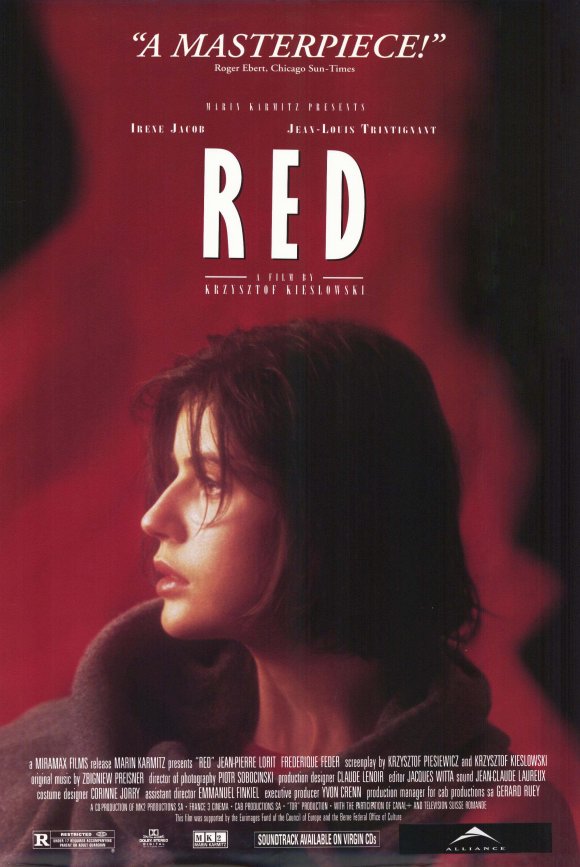
Three Colours: Red (1994) – Paths and Possibilities

As the dust settled and the cordite faded from the air, the instigators of the French revolution held aloft the severed heads of their old oppressors and proclaimed a new age of humanity; an age in which people would be governed not by the supposedly divine whim of royal genetics but by reason and the principles of the enlightenment.  Principles such as Liberty, Equality and Fraternity.  Over two hundred years later, the polish director Krzysztof Kieslowski decided to devote a trilogy of films to the question of what these hallowed values mean to the modern world.  The results are far from a glowing endorsement.

In Blue, Kieslowski renders liberty as an icy internal exile from those who would love us.  In White, he reinvents equality as a bitter and demented desire to get even. In these two films we see Kieslowski’s belief that, rather than founding a new society, the values of the enlightenment now serve to drive us apart.  Given this pessimistic assessment of the first two revolutionary values, it is surprising to discover in Three Colours: Red an exploration of the concept of Fraternity that is both upbeat in tone and resoundingly hopeful in outlook.  For Kieslowski, Liberty and Equality are virtues that drive us into the isolation of individualism while Fraternity, the sense of a common bond between all people, is the value that conspires to bring us together despite ourselves.

Continue reading →

Three Colours: White (1994) – Bitches Ain’t Shit…

There are words that yield far more easily to the lips than they do to the mind. Every day, we reach for a set of shared values and concepts which, laid down in another place and another time, no longer seem as well defined as they used to be.  Krzysztof Kieslowski’s Three Colours trilogy springs from a desire for clarification, to return to the revolutionary French values of Liberty, Equality and Fraternity and ask: What do they mean for us today?

Three Colours: White is the second film in the trilogy and its conceptual slipperiness reflects the fact that equality is one of our least understood values.  We all want to live in an equal society but do we really understand what equality entails and where in our society should the value of equality assert itself? Does a commitment to equality entail a commitment to equality of outcomes or of opportunities? Or are we talking instead about the creation of a society in which everyone is equally happy and/or equally miserable? Three Colours: White explores the dubious morality of a pursuit of emotional parity.

Continue reading →

Three Colours: Blue (1993) – Tightrope Walker

We are, according to existentialism, hopelessly free. Jean-Paul Sartre argued that, in the absence of God and the sort of meaningful meta-narratives that give life an objective meaning and purpose, we are free to define our own natures:  ‘To Do is To Be’ because ‘Existence Precedes Essence’. The problem is that freedom is a double-edged sword and while the death of God may well have done away with all limitations on our freedom, it has also served to render all of our choices meaningless.  Indeed, if all paths are open to us and equally inviting then there is no correct path to take and so every decision we do make is tainted by the knowledge that all of our choices are effectively meaningless and arbitrary.

Freedom’s double edge so concerned Sartre that he wrote a short pamphlet entitled Existentialism is a Humanism (1946) addressing the charge that existentialism is a gloomy credo.  The pamphlet ends with a barnstorming rant against Christianity:

 This is humanism, because we remind man that there is no legislator but himself; that he himself, thus abandoned, must decide for himself; also because we show that it is not by turning back upon himself, but always by seeking, beyond himself, an aim which is one of liberation or of some particular realisation, that man can realise himself as truly human (…) In this sense, existentialism is optimistic, it is a doctrine of action, and it is only by self-deception, by confusing their own despair with ours that Christians can describe us as without hope.

Barnstorming though it may be, this rant is hardly convincing as the vision of human nature that Sartre describes is one of perpetual vertigo and while ridding ourselves of the tyrannical sky-pixie is no bad thing, Sartre seems to have saddled us with another form of tyranny: The tyranny of responsibility for ourselves and the tyranny of endless choice.

This tension within the concept of freedom is beautifully demonstrated by Krzysztof Kieslowski in Three Colours: Blue, the first of a trilogy of films interrogating the values of the French Revolution (Liberte, Egalite, Fraternite).

Continue reading →

Some Thoughts On… The American (2010)

Directed by Anton Corbijn and based upon the Martin Booth novel A Very Private Gentleman (1990), The American is far too formulaic and slow of pacing for it to function as an effective thriller.  However, if approached as more of a character study, the film does suggest some insight.

The film begins with Jack (Clooney) living in a snowy wilderness with a ‘friend’.  When some assassins turn up and the ‘friend’ dies in the firefight, Jack the former spy is lured out of retirement and placed in the field by his former handler.  Right from the start, Jack is a rootless and isolated man who walks through the world acutely aware not only of that world’s hostility, but also his lack of place in it.  Like all spies, he is the resident of a demimonde of assumed identities and hidden skills.  Corbijn communicates Jacks demimondaine status by having him instantly recognise a fellow demimondaine who hires his to make a custom-built gun for her.

As Jack attempts to pull together the tools that will allow him to work on the gun, he is forced to make friends with the local priest; a man who not only knows his place in the ‘grand order’ of things but also within his local community. Much like Jack, the priest has secrets but, unlike Jack, he does not allow these secrets to isolate him from the people around him.  In fact, his secrets only serve to embed him even further in the local landscape.  He is a rock of his community, a man completely at home in the world for all of his propensity to dwell on that which lays beyond it.

As he works on the gun, Jack begins two contrasting relationships: The first is with the fellow spy.  Corbijn does an excellent job of communicating their rootless flirtation by having the pair demonstrate the extent to which they trust each other (they aim loaded guns at each other and even fire in their general direction and yet they do not shoot one another) while the traditionally trappings of seduction and romance are revealed to be nothing more than props in case the police should pass by.  The second relationship with a local prostitute resembles the first in so far as it too spurns the traditional trappings of romance and seduction but here the oddness of the flirtation is presented more as a sign of openness and complete honesty than of guile and mis-representation.

When Jack decides that he wants to get out, his handler predictably turns on him and Corbijn struggles to fill the formulaic denouement with anything approaching tension or dramatic charge.  In a way, it simply does not matter if Jack gets out… the heart of the film lies in its portrait of a man struggling to deal with his sense of alienation from community and landscape alike.

The American is one of those films that reminds me why it is I think that spies are posterboys for the postmodern condition: Isolated, deracinated and living in a world they not only do not belong to but actively fear, spies fill their days with the ritualised mundanity that is tradecraft: Check to see if anyone has been in while you were out, check to see if anyone is following you, check in with your handler, check the dead letter box, check to see if your contacts have gotten back to you and all along make sure that nothing you do makes you stand out as anything other than ‘normal’.  Spies are people alienated from society who spend all of their time trying to pass for members of the societies they live amongst.  That sense of alienation combined with paranoia and intense longing for membership and place are the constituent parts of that postmodern existential urge to belong and to know where one stands.

The fact that Jack’s flirtations are with women who exist on the margins of society is telling.  By virtue of being a spy and a prostitute, the film’s female characters are both people who, like Jack, pass as normal thanks to having learned the rules of normality from the outside, as aliens.  Jack’s stilted and technical conversation with the female spy reveals what the aliens’ language might be like while Jack’s awkward flirtations with the prostitute seem to hint at a path out of the demimonde and into the sunlight of normality.

As much as I liked the film’s capacity for capturing the postmodern condition, I was not all that convinced by Jack’s desire to return to the real world.  At the beginning of the film, he is living a ‘normal’ life in the middle of nowhere and it is not clear why it is that a life embedded in the real word should be superior to that or why Jack should require ‘the love of a good woman’ to save him.  The slow pacing of the film and the atmosphere of art house detachment and depression invites us to speculate about Jack’s inner state but with a plot this formulaic, I found myself unwilling to turn a blind eye to the lack of depth.  A few extra scenes fleshing out Jack’s existential dread beyond there merely generic would have transformed this from a perfectly watchable film into a good one.  A missed opportunity but very much part of a growing tradition of existential spy films.

Some Thoughts On… Retreat (2011)

Kate (Thandie Newton) and Martin (Cillian Murphy) are in trouble.  Married for a number of years, the couple’s relationship has been soured by the loss of a child resulting in them visiting an isolated island retreat in the hope of forcing themselves to have a proper conversation. Unfortunately, once the pair arrive on the island things go from bad to worse as instead of forcing them to communicate, the isolation offers up a myriad of displacement activities including fishing, running and the writing of incredibly bitter articles about why their marriage is doomed.

Slowly retreating into paranoia and mutual resentment, Kate and Martin are jolted out of their bitterness by the arrival of a wounded soldier.  Jack (Jamie Bell) informs the couple that a terrible pandemic is sweeping the world and that their only hope is to barricade themselves into their house and seal all the windows. Understandably sceptical, the couple play along on the grounds that even if Jack is lying, he is clearly a dangerous man who needs to be handled with care.

As he boards up the windows, Jack sets about playing on the couple’s fears and desires.  Initially, he plays upon Martin’s presumed masculine desire to protect Kate and to wear the trousers.  He then moves on to attempting to seduce Kate by suggesting that she resembles his late wife thereby tapping into both Kate’s frustration and her presumed feminine attraction to tough guys with a softer side.  While the couple remain sceptical about Jack’s claims of a pandemic, Jack’s ability to play Martin and Kate off each other does allow him to gain the upper hand, a position he begins to use quite skilfully once he finds Kate’s laptop and reads all about the couple’s marital difficulties.

Retreat is a film all about a relationship struggling with the cancer of distrust.  For a while, Jack’s ability to tap into the couple’s fears seems so uncanny that one begins to think that he might be some phantom either supernatural or psychological in nature and while the film regrettably down-plays this aspect of Jack’s character, there is a very clear evolution in the nature of the fears he uses in his attempts to manipulate the couple. For example, initially knowing nothing of the couple, Jack draws on quite widespread fears such as disease as well as a husband’s fear that he cannot protect his wife.  However, as Jack gets to know more about the couple, his lies become a whole lot more specific.  While I regret the fact that the script did not allow us more of a peak behind Jack’s thought-processes, I would still argue that Jack is the best thing about this film.  In fact, Bell’s performance is spell-binding and constitutes a timely reminder of why his name continues to carry a good deal of buzz despite its tendency to be attached to terrible films. Sadly, while Retreat offers Bell the opportunity to shine, the same cannot be said of Newton and Murphy who are forced to contend not only with a tangible lack of chemistry but also a tragically under-written script.

Retreat’s suffers for the fact that Martin and Kate’s relationship never feels unique enough to be real. This is somewhat odd given that the film takes a long time to settle into ‘thriller’ mode allowing oceans of space for the development of its central relationship. However, despite ample time and some real acting talent to draw upon, first-time director and co-writer Carl Tibbetts never quite manages to make the relationship progress beyond the merely generic. The problem is that while the idea of a couple struggling to stay together after the loss of a child is a firm grounding for a film about trust, it is not a particularly original idea.  In fact, the idea has featured in so many films that by the time Tibbetts and his co-writer Janice Hallett get round to it, it feels dated and generic.  This means that, in order to make the relationship seem real, the script and the actors needed to personalise it to the point where we feel that Martin and Kate are more than genre figures. Sadly, because neither Murphy and Newton’s performances nor the script bring that specificity to the table, Retreat’s central relationship fails to engage meaning that the film’s primary dramatic arc is as dead as Martin and Kate’s un-named child. The failure of this central relationship has a knock-on effect on the rest of the film.

The lack of emotional substance to Kate and Martin’s relationship means that Jack’s attempts to play on the couple’s mutual distrust is more interesting than it is emotionally compelling and because we are forced to engage with this unevenly paced thriller on intellectual rather than emotional terms, the film’s fundamental lack of depth becomes increasingly problematic as time goes on.

Retreat is, at root, a psychological thriller and as such it is part of a genre that thrives on the new.  Script-lead, these films typically rely for their effectiveness upon their capacity to surprise audiences through narrative innovation. This means that each new psychological thriller needs to work that little bit harder to break through to an audience raised on Basic Instinct, The Tenant and Memento. In fact, these three films demonstrate quite how much pressure there is on writers to generate something new.  Basic Instinct shocked mainstream audiences with its explicit sexuality, The Tenant shocked audiences with its inherited surrealism and Memento shocked audiences with its bizarre structure and psychological quirkiness.  One could argue that there is a screen-writing arms race raging in the psychological thriller genre and that this arms race has forced screenwriters to skew the genre away from the psychological and towards the fantastical.

As humans, we are trapped in a prison of pure subjectivity.  We know how we feel and we know how we see the world but we are forever separated from our fellow humans and we can never really know how they feel, what they see or what they think.  Because of this gap between minds, humans have developed an incredibly sophisticated of the human mind that we use to attempt to infer what it is that other people are thinking.  This model in referred to by philosophers as Folk Psychology.  The folk psychological model that we draw on as individuals is determined both by our individual experience and by our cultural history.  Indeed, one reason why the characters in classical plays frequently appear stilted and weird is because authors wrote them with radically different folk psychological models to our own.  Because our need to interact with other humans has forced us all to become amateur psychologists, we humans tend to have a pretty good nose for bullshit when it comes to characterisation.  In fact, one could argue that the challenge of characterisation is that of walking a tightrope between writing characters that we recognise as human and characters who act in individual enough ways that our folk psychological model is forced to adapt and encompass these new artistic insights into the human condition.  Unfortunately, our innate capacity to smell bad characterisation is something of a problem for writers operating within a genre that thrives on novelty and the unexpected.  Memento works as a psychological thriller because its central character feels real despite suffering from a condition that is genuinely novel from an artistic point of view but there are not that many psychological conditions that satisfy these twin demands.  As a result, many recent psychological thrillers have tended to rely upon a narrative twist grounded not in human psychology but in either fantasy or the madness of the main protagonist.

By anchoring a plot in magic and madness, a screenwriter is effectively admitting to throwing the rules of drama out the window. Once magic and madness have been invoked, audiences can never quibble about plot as all quibbles can be defused with a terse ‘of course it doesn’t make sense… it’s magic’.

Retreat attempts to double bluff its audience by raising the possibility of the fantastical only to resolve to a set of rules that are ultimately purely psychological; Jack is neither a phantom nor a delusion, he is just a desperate man with a knack for playing on people’s fears. Tibbetts and Hallett’s decision to forego madness and magic in favour of an old school Cape Fear-style psychopath is refreshing but it does show quite how sophisticated our folk psychological model has become, particularly in the light of numerous films that have set out quite explicitly to fuck with our capacity to read people.  Despite some neat ideas, Retreat never feels smart enough to scratch that genre itch.  It never surprises, it never wrong-foots, it never moves us out of our psychological or emotional comfort zones and it never for even an instant capitalises on its potential.  Perhaps if Martin and Kate had been better drawn then the film might have been more emotionally involving.  Perhaps if the script had explored Jack’s motivations a bit better then the film would have been more interesting but for a psychological thriller hoping to find an audience in this day and age, Retreat is nowhere near psychological enough.

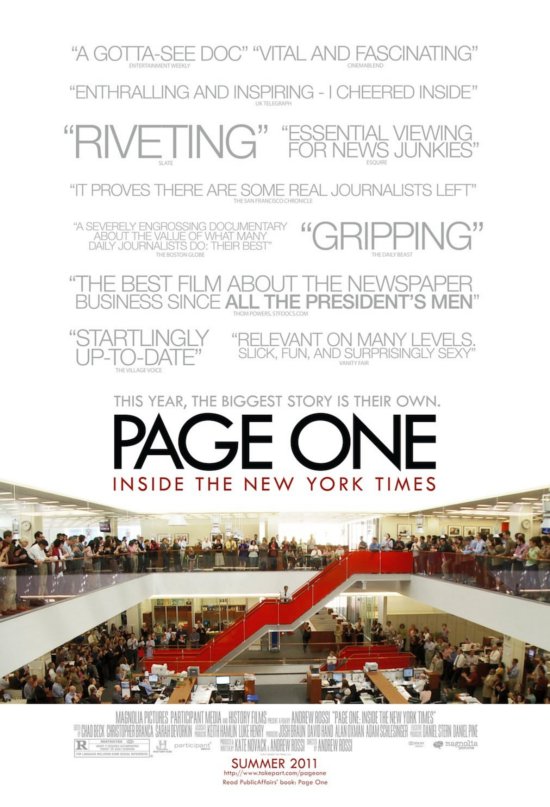
Some thoughts On… Page One: Inside the New York Times (2011)

NB: Thoughts On… is new strand for this particular blog.  As I have been watching quite a few films recently, I have realised that while many films give me reason to ponder, not all pondering necessarily results in either a coherent opinion or enough substance for a full critical response.  So instead of keeping such thought to myself, I have decided to share my thoughts on the various films I see as well as producing more developed pieces.

***

Currently on limited US release and in search of US distributors, Andrew Rossi’s Page One: Inside the New York Times primary concern is with the current economic state of the US newspaper industry and it asks whether there is still a place for an old media institution like the NYT.  Indeed, with advertising revenue drying up, classified ads moving online and more and more people getting their news online for free, the question of the Times’ continued existence needs to be asked if only so that we can work out why it is that newspapers should survive.  While Page One offers us an answer, I am not at all convinced that the answer it gives us is all that convincing.

Our guide through the issues surrounding the future of the newspaper industry is the NYT’s engaging media columnist David Carr.  The doc follows Carr about as he breaks stories, interviews new media tycoons, takes part in panel discussions and gives speeches at journalism conferences. A gruff scarecrow of a man whose odd physicality speaks to his past as a drug addict, Carr is absolutely savage in his defence of the New York Times in particular and print media in general.  In fact, Carr is so engaging a presence that it is difficult not to smile as he repeatedly swings a carefully sharpened and immaculately weighted hatchet at the reams of hyperbole generated by online mavens only too eager to dance on the grave of traditional print media. However, as engaging as Carr might be, I could not help but feel that Page One is only giving us half the story.

The problem is that Page One is a film that is utterly in love with its subject matter.  Rossi repeatedly stresses not only the NYT’s history but also its continuing role as a purveyor of truth and a guardian of natural justice.  Rather than giving equal time and equal weighting to both sides of the debate, the film portrays critics of old media as hyperbole-slinging crooks and straw men who take to the field of debate solely to provide the ferocious Carr with target practice.  So one-sided is the battle that one cannot help but begin to wonder why it is that Carr spends all his time grappling with paper tigers when the real beasts of the jungle are allowed to go about their business unmolested.  For example, in his book Flat Earth News (2008), Nick Davies points out that only 12% of the stories published in British newspapers come from actual reporters while 88% come either from recycling other papers’ stories or from cutting-and-pasting directly from press releases put out by pressure groups and business people. Once you realise that that 12% also includes stories generated through tabloid muckraking, the arguments put forward by Carr and his ilk begin to seem quite flimsy.  Indeed, there is no denying that newspapers such as the New York Times do fantastic work in breaking important stories and unveiling hidden truths, but what of the remaining 88% of the stories that grace their website?

The question of whether newspapers are a public good that are worth protecting even as their business models crumble is an important one not only for the state of our public discourse but also for the future of democracy.  By failing to answer any of the tough questions that can be asked of old media, Page One has not so much argued the NYT’s corner as sung its praises in the form of a funeral dirge.  Nobody benefits from this sort of one-sided cheerleading, least of all an industry in dire need of waking up and smelling the coffee.

Page One is arguably at its best when it is not trying to help as its most cogent and powerful arguments for the continued existence of print media are not the ones that it explicitly makes but the ones that it makes by implication simply by showing the NYT’s journalists at work.  In one brilliant sequence, the media editor and the foreign affairs editor discuss whether or not to report on a so-called ‘final patrol’ by US combat troops in Iraq only for the pair to reach the conclusion that the only people who are actually announcing the withdrawal of combat troops are the TV journalists that feature in the report and, because NBC are not actually at war in the Middle East, the story has more to do with TV reporters wanting narrative closure than it does with any real-world events of changes in policy.  As the various editors toss ideas back and forth, it is easy to see quite how much thought goes into the honing of an editorial stance.  These sequences suggest that there is far more to reporting than dumping a load of diplomatic correspondence on a website and the fact that the construction of editorial stances involve such careful deliberation and expertise is a powerful argument for the continued existence of what Clay Shirky refers to in the film as a professional media class.

The irony of Page One is that, had Rossi followed his own advice and left reportage to the reporters, this documentary would have been far more powerful an argument in favour of print media.  However, instead of allowing the NYT’s reporters to speak for themselves through their entirely admirable actions, Rossi attempts to fashion a narrative and, in so doing, weakens his own case by producing a documentary, which, though undeniably enjoyable, feels stilted to the point of hagiography.

BG 40 – Pixel-Bitching: L.A. Noire and the Art of Conversation

Futurismic have my latest Blasphemous Geometries column.

The column is about the various attempts by game-designers to emulate the cut and thrust of human social interaction.  I begin by taking and in-depth look at L.A. Noire‘s attempts to climb out of the uncanny valley before widening the aperture a touch and taking a look at some of the theoretical challenges that need to be overcome before games become capable of modelling conversation as well as they model shooting people in the face and slicing them up with great big swords:

Phelps’ capacity to be inhuman to his fellow man helps him to understand his fellow humans better… thereby raising the possibility that Phelps is in fact a sort of autistic Colonel Kurtz whose willingness to commit acts of terrible violence is a form of spiritual strength. The road to Nirvana is easy to walk when you are wearing jack-boots.

However, in the interest of full disclosure I do feel obliged to make clear the fact that I did not come up with the term ‘pixel-bitching’ all by myself. The term used to be bandied about on the RPGnet forums as a means of referring to a mode of adventure design whereby games masters will not allow the game to progress until the players have uncovered a single specific (and usually well-hidden) clue.  I’ve also heard the phenomenon referred to as a ‘plot bottleneck’ but I think that term fails to capture how irritating it can be to find yourself hunting for a single pixel in a digital landscape.

Ikigami: The Ultimate Limit… Stripp’d

Gestalt Mash have my column on Matoro Mase’s manga serial Ikigami: The Ultimate Limit.

My column draws on the first six volumes of what will be an eight volume run if Viz Media do actually translate the entire series.  Set in an alternate version of contemporary Japan, the series is about a society that has decided to force its population to make the most of life by killing one citizen in every thousand at random.  The series examines this ideas from two different perspectives; on the one hand, it examines the psychological impact of the death sentences on the victims and their families while, on the other hand, exploring what the effects of this policy are on the Japanese body politic.  The result is a series of graphic novels that paint exquisitely detailed pictures of human grief and suffering whilst also slowly creating the impression that such a society is monstrous and must be overthrown:

Death has the power not just to end lives, but also to change them. It can change them for the better by prompting people to make changes, and it can change things for the worse by fostering a crippling sense of futility and loss. Ikigami: The Ultimate Limit is an exploration of the tension between these two reactions to the revelation that we too shall someday be no more.

The series has also spawned a film adaptation, which I also wrote about a little while ago for Videovista.