I’d like to begin this entry with a word about the weather. We walked the Wall during the first week of September and we went into it knowing that the weather would be what meteorologists refer to as changeable. ‘Changeable’ is certainly an apt description of the weather we experienced though ‘unpredictable’, ‘random’ and ‘insane’ are perhaps more thematically appropriate. Day six began with what would become one of the recurring motifs of the second half of the walk: jacket switching. One minute it would be brilliant sunshine, then there would be bitter cold and howling gales. Occasionally, the sky would darken and rain would pelt us just long enough to force a stoppage and a change of clothes. These meteorological mind-games resulted in my playing chicken with the weather and refusing to put on my raincoat on the grounds that the rain simply would not last. I am happy to say that I won more games than I lost.
Having done the crags the previous day, day five’s walking felt very much like a cop-out; too few steps and too little complaining to be altogether real. The morning began with a gentle stroll along the last large-scale remnants of the Wall.
I’d like to begin this day’s entry with a few words on preparation. In the bumph we received from Hadrian’s Wall Ltd, there were frequent allusions to the need for us to be both physically and psychologically prepared for the walk. Reading this, we made fun of the idea that a few days’ walking in the countryside might require a rigorous regimen of fasting and meditation. Oh the folly of innocence!
Breakfast brought more culinary disappointments from The Keelman’s. My eggs were unseasoned and came with only minimal toast. Also, most B+Bs tend to give people a pot of coffee for the table. However, The Keelman’s serve you by the cup and so if, like me, you enjoy your coffee in the morning, you may find yourself having to pester the waitress a few times for more coffee. Given that we arrived at The Keelman’s completely knackered and starving hungry, my memories of the place may well have been etched by the twin (and not entirely disconnected) acids of bile and low blood sugar but, after two disappointing meals and a night spent on a bed that felt like a sack of flour, I was more than happy to leave Newburn behind and head out into the countryside.
The day began with the sort of breakfast you might expect from a faded seaside hotel. People sat at tables with white linen tablecloths looking out of a huge picture window at storm-ravaged British coastline. Alongside the apple and orange juice sat a pitcher of tomato juice, some Tobasco sauce and a few sticks of celery. Penance, no doubt, for a night on the Courvoisier. Breakfast was decent but no more. Neither quantity nor quality was anything other than fine.
Bags packed, boots laced, stomachs filled, we headed off on our first day’s proper walking. Gary had suggested the possibility of walking from Tynemouth to Wallsend in Newcastle but this prospect seemed to appall us both. We were there to walk the Wall. Tyneside’s cheap, clean and efficient Metro took us into town and deposited us at Wallsend, near Segedunum and the old Swan Hunter shipyards.
Our first day’s travelling was limited to getting us from London to Tynemouth via Newcastle.
As with most fields of human endeavour, there is a good deal of discussion regarding the ‘best’ and ‘correct’ way to walk Hadrian’s Wall. Some attempt to do it in three days, others argue the importance of arriving a day early in order to begin the walk first thing in the morning and others argue that the Wall should be walked from West to East on account of the prevailing winds. As this was our first walking holiday, we decided to do the Wall in seven days and we decided to walk it from East to West because walking into Newcastle’s industrial landscape might prove more depressing than triumphal. Obviously, your mileage may vary but that of the Wall does not.
The trip up to Newcastle was smooth by the standards of British railways and the hours flew by as we read, dozed and chatted to the astonishingly outgoing couple sat next to us on the train. We arrived at Newcastle and got a taxi to Tynemouth driven by an insane control-freak Geordie who drove incredibly quickly and insisted upon getting out of the cab at the lights in order to give directions to other drivers. I was too terrified to ask how he knew where the other drivers were headed.
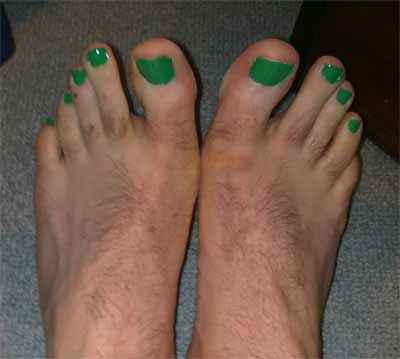
As of tomorrow I am spending seven days walking the length of Hadrian’s Wall… Eighty four miles from Tynemouth to Bowness-on-Solway. I don’t think that I will be in email contact during that time and I’m pretty damn sure that I won’t be able to write about films. So enjoy your break from my unbridled intellectual productivity and think of me marching through the Great Green Bleakness that is the British countryside. And yes… those are my feet.
I take what I do seriously. When I sit down to write reviews and longer critical pieces, I am not filling in the time before dinner, I am doing something that I am emotionally invested in. I am emotionally invested in becoming the best critic that I can possibly be, this is why I write and this is why I read books that add fresh elements to my theoretical arsenal. However, while I think that (all things considered) I am not doing too badly, I am very much aware that I am not yet Roland Barthes, David Bordwell, Nick Lowe or Adam Roberts. In fact, I am not even Kim Newman or Armond White. I know this because I know that these people write with a level of control and insight that I do not yet possess. I also know this because I have yet to be invited to write a column for the New York Times… or even the Kensington and Chelsea Times for that matter. But while I know that I am not yet quite there, I think that I could probably do a bit more cool stuff than I am currently doing. The problem is that every time that I produce something that I am particularly proud of, a hubris alert goes off in my head because I know that it is the easiest thing in the world to think that you’re brilliant when you are in fact shit. In fact, there are studies that prove it.
To say that humans are fond of self-delusion would be something of an understatement. Lacking the sort of all-encompassing social meta-narrative that delivers us a pre-packaged sense of place and identity, many of us choose to define ourselves through what we do. Some of us sing, some of us paint, some of us write and some of us have anonymous sex with multiple partners. We define ourselves not merely by doing these things but through a process of emotional investment whereby how well we are doing as individuals becomes intimately tied to how well we are doing at a particular activity. This process of emotional investment offers us some respite from the postmodern condition but it is also a minefield of self-delusion.
The more commonly travelled path to self-delusion involves becoming so emotionally invested in your undertakings that you become blind to your own inadequacies. This generally results in a hideous Catch-22 whereby people are doomed to mediocrity by their unwillingness to recognise the areas that would benefit from more work. The more areas of human undertaking I rub up against, the more I become convinced that this sort of thinking is endemic to the human condition. We all like to think of ourselves as special snowflakes and snowflakes tend not to fare too well in the baking heat of self-doubt. This, however, is not the sort of self-delusion that I want to write about today. I want to write about the need to be a good cultural citizen and to, as Dan Kois put it in a piece for the New York Times, “Eat Your Cultural Vegetables”.
Way back in the mists of time, the British mobile phone carrier Orange came up with quite a neat idea for an advertising campaign that reacted to a genuine public sentiment in a way that was not only funny but also a really intelligent piece of marketing.
In Britain, adverts for products typically appear prior to the trailers thereby forming a kind of de facto ‘buffer zone’ between the film’s advertised screening time and the point at which the film actually begins. Because nobody wants to watch adverts when they’ve just paid over £10 for the use of a chair for a couple of hours. Reacting to a sudden epidemic of texting and people talking on their phones during cinema screenings, Orange pitched a series of adverts to cinema chains that effectively allowed them to place an advert for phones in-between the trailers and the actual film, thereby reaching all of the people possessing the sense to not pay for the privilege of watching adverts.
The original idea was simple and effective: A series of actors and filmmakers approach the fictional ‘Orange Film Board’ in an effort to secure funding for their pet project. However, rather than funding the projects, the good people at Orange start to suggest ways in which adverts for phones could be crudely squeezed into the film. The moral? Don’t let mobile phones spoil your film and turn off your phone. Boasting a very funny regular cast, some decent scripts and some great cameos, the adverts were a success and they made Orange look good for being willing to make fun of themselves whilst making a point about anti-social use of mobile phones.
Fast forward a few years and the original chairman of the board drops out of the adverts only to be replaced by a markedly less funny doppelganger. Gradually, as the campaign grew longer in the tooth, the quality of the scripts started to decline as the adverts stopped being about great potential films ruined and started to be about terrible made-up films built around mobile phone gadgets. It wasn’t long before the campaign changed again and the Orange Film Board was replaced by actors from real upcoming films fighting fictional battles with Orange to protect the integrity of their films. This poses a number of problems that were not present in the original campaign:
Firstly, there is a world of difference between casting oneself as the villain who wants to spoil a potentially great fictional film and the villain who is trying to spoil a real film. Once the film actually exists, you’re not laughing at the movie business, you’re laughing with it and that makes you smug rather than satirical.
Secondly, there is a world of difference between casting oneself as the villain who wants to spoil a potentially great fictional film and the villain who has spoiled an incredibly shit real film. I care about the late Roy Scheider trying to make a black-and-white noir thriller; I don’t care about whether or not someone spoils The A-Team or Gulliver’s Travels. Those films are shit anyway.
Thirdly, there is a world of difference between casting oneself as the villain who wants to spoil a potentially great fictional film and the villain who is spoiling a real film, as, by including a real film, you are actually engaging in a form of product placement, something that actually does harm films. It is difficult to sell the message that you shouldn’t let a mobile phone ruin your film when your advert is an example of mobile phones ruining a film through crass product placement and the co-opting of characters, actors and filmmakers for commercial ends.
In conclusion? I hate the Orange film adverts and wish with all of my heart that they would fuck off and die.
Yes, this problem is exacerbated by the fact that I habitually go to the cinema two or three times a week but I never used to hate the Orange adverts and now every time I see them, part of me wants to die but only after I have stabbed the idiots who continue to laugh at the fucking things.
I understand that these adverts help Orange shovel money at films and so help films to be made and distributed but the films that Orange uses in its adverts were (by and large) never going to struggle to get distribution anyway. The A-Team is not some tiny indie film but a multi-million dollar Blockbuster that gets released on hundreds of screens and so, by featuring them in the adverts, Orange are just selling phones and helping Hollywood to line its already bulging pockets. So, again, I say that these Orange adverts need to fuck off. I hate the Orange mobile phone adverts and I wish that they would stop.
‘Ah,’ you say ‘but if Orange were to pull their campaign… how would punters get the message that they shouldn’t use their phones during the screening?’ Simple… you get your ushers to kick people out when they do and, if they complain, you do what the Alamo Drafthouse does: Take their not particularly articulate complaints and turn them into a meme.
I watch this advert and I want to give my money to the Alamo Drafthouse (who are reportedly a rather splendid chain of rep cinemas that do all kinds of seasons and interesting one-off screenings) and when I watch the Orange phone adverts, I want to firebomb their smug corporate offices. Fuck Orange, Remember the Alamo and long live the Magnited States of America!

 Ruthless Culture