REVIEW – Saint (2010)

THE ZONE has my review of Dick Maas’ Evil Santa horror movie Saint (a.k.a. Sint).

Well… I say that this is another addition to the growing sub-genre of Evil Santa movies but in truth, the film works best if you don’t see it as a deconstruction of Santa Claus.  Let me explain what I mean: Saint is an Evil Santa film but rather than deconstructing the American figure of Santa Claus, Maas focuses instead upon the North European figure of Saint Nicholas, a mythological being whose relationship with our Santa is tenuous at best.  As I explain in my review, Saint works best if, instead of seeing it as the story of an evil Santa Claus, you see it as the story of a medieval Bishop who terrorises modern-day Amsterdam. In effect, this interpretation of Saint positions it as a deconstruction of Catholicism rather than Father Christmas:

Who the fuck are these withered old bastards and where do they get off telling us what to do? The idea that the Catholic Church is now nothing more than a morally putrescent corpse imbues Saint with a strong satirical edge. Indeed, the modern Catholic Church behaves very much like the film’s Saint Nicholas, a hideous and antiquated authority figure that ‘hates everyone’ and routinely abducts children in order to force them into servitude. Indeed, the power of Maas’ surreal confrontations between myth and reality owes quite a bit to the absurdity of a medieval institution operating in the modern world. We all know that the world was not created in six days, we all know that there is nothing wrong with homosexuality, and we all know that women should have the absolute right to choose… so why do we listen to a cadre of elderly men in skirts and hats who tell us that we are not only wrong but damned?

Regardless of whether or not you buy into my anti-clerical reading of the film, Saint is one of the most entertaining high-concept horror films out there.

Cutter’s Way (1981) – The Complete Hero

When the golden age of 1970s Hollywood came to an end and the studios reasserted their control there were many unworthy casualties. The great tide of the American New Wave had surged up the beach and rolled back to a sea of spiralling budgets, slumping revenues and bottomless self-indulgence. One of these casualties was Ivan Passer’s adaptation of Newton Thornburg’s novel Cutter and Bone (1976).

Buried in a corporate shake-up and largely forgotten until its DVD re-release, Cutter’s Way is very much a product of the American New Wave. Ostensibly about a pair of misfits investigating a conspiracy to protect a wealthy industrialist, the film taps into the same cultural anxieties as Alan J. Pakula’s political paranoia trilogy comprising Klute (1971), The Parallax View (1974) and All the President’s Men (1976). However, rather than pandering to the audience’s belief that someone is out to get them, Passer’s film presents its conspiracy in a deeply ambiguous manner. Indeed, Cutter’s Way is a film that asks whether the tendency to see conspiracies everywhere might not in fact be a reflection of a deeper psychological need to be appreciated and desired. After all… if people are out to get you then that must mean that they consider you worth getting. Far more than a simple conspiracy thriller, Cutter’s Way is an exploration of the comfort that can be had in being a victim.

Continue reading →

REVIEW – The Ides of March (2011)

FilmJuice have my review of George Clooney’s much-hyped political thriller The Ides of March starring Clooney, Ryan Gosling, Philip Seymour Hoffman and Paul Giamatti.

As my review suggests, this is an entirely decent piece of filmmaking.  The story is a fundamentally interesting one, the direction is competent, the performances are entrancing and the whole thing looks and feels very much like an episode of The West Wing featuring some of the best thought-of actors in modern-day Hollywood. The problem is that, while The Ides of March is entirely decent, it is not particular exciting. Indeed, when I say that it looks and feels like an episode of The West Wing, I mean exactly that and while I liked The West Wing quite a bit at the time, I do think that a serious political film has to do a little bit more than ape a decade-old TV programme:

Whether on a visual or narrative level, Clooney and co-screenwriter Grant Heslov really do not show us anything that we have not seen before. The tale of idealism crushed beneath the boots of political expediency is an old political saw and while the themes of fear and loyalty are interesting, Clooney’s direction fails to elevate them above the level of a subtle motif. Perhaps if Clooney had been less plodding in his direction and the film’s accusation had been more concrete and impassioned then Ides of March might have been a truly memorable piece of political filmmaking. Instead, Clooney’s latest is nothing more than an entertaining and competently directed romp featuring great performances from some of Hollywood’s most potent (and promising) acting talents.  Some Friday nights, that is more than enough.

I didn’t dislike the film and I would warmly recommend it to West Wing fans but no film this derivative should have this amount of buzz surrounding it.  That’s all I’m saying…

Some Thought On… Last Screening (2011)

Reminiscent of both Michael Powell’s Peeping Tom (1960) and the genre-art house hybridisation of Nicolas Wending Refn’s Drive (2011), Laurent Achard’s Derniere Séance deconstructs the traditional horror film only to reassemble it as a dark and brooding meditation on the delights of cinephilia.

The one thing that unites all members of a cinema audience is the fact that they are members of a cinema audience. Because of this simple tautology, audiences tend to respond well to films that praise them for their decision to go to the cinema.  What do Tornatore’s Cinema Paradiso (1988) and Truffaut’s 400 Blows (1959) have in common? They both pander to their audiences by validating their love of film. Achard’s Last Screening is also about loving the cinema but rather than praising his audience for their good taste, Achard lambasts them for their toxic self-indulgence.

Sylvain (Pascal Cervo) is the manager of a repertory cinema in provincial France. Utterly devoted to the cinema, Sylvain seldom goes out except to kill women and cut off their ears. Much like Powell’s Peeping Tom, Last Screening muses on the voyeuristic nature of cinema and Achard repeatedly assails us with shots of people staring blankly at the camera setting up a similar mirroring effect to that of Kiarostami’s Shirin (2008), where the audience sat watching a cinema audience that could just as easily have been watching them. Achard also litters his film with images of darkened figures staring at illuminated performers, further extending his explicit comparison between the voyeurism of the cinema-goer and the voyeurism of the predatory serial killer. Postmodern cinematography aside, Achard’s critique of cinephilia also extends to the film’s plot as Sylvain’s crimes turn out to be motivated by a desire to recapture the film-viewing moments of his youth. For Achard, cinephilia is clearly a source of genuine joy (he obviously adores Renoir’s French Cancan) but that joy can also turn toxic as a love of old film can result in people becoming stuck in the past or shut off to new forms and experiences. With Sylvain, Achard offers us an image of twisted cinephilia.

Though marketed as a horror film, Last Screening is really more of an art house project. Seldom frightening, seldom tense and only occasionally gory, its murders are not sensationalist ends in themselves but props in Achard’s wider exploration of Sylvain’s twisted mental state.  As you might expect from an art house character study, Last Screening’s pacing in slow, deliberate and filled with languid extended takes in which nothing much happens and nothing is said. Elegantly shot and intelligently conceived, Last Screening is a combative and genuinely thought-provoking film whose absolute lack of sentiment about film itself serves as a timely antidote to a medium that can be altogether too swift to pat itself on the back.

The Rules of the Game (1939) – A Theatre of Nightmares

One of the best known rants in the history of film criticism is the one in which Andre Bazin rounds on the French film industry and lambasts it for its failure to be properly cinematic. Instead of producing properly cinematic works of art, Bazin argues, most French film directors were happy to simply film a theatrical performance. Rather than making the most of a new medium, French film was reducing the camera to the role of dumb spectator.

Jean Renoir’s La Regle Du Jeu was first released in 1939. Banned by the Vichy government for being ‘demoralising’, the film’s original negative was later destroyed in an Allied bombing raid forcing post-War cinephiles to assemble their own version of the film with advice from Renoir. This reconstructed version of the film is the one that we know today and it is dedicated to Andre Bazin.

It is tempting to link these two statements together: Renoir’s La Regle du Jeu may well be one of the great masterpieces of 1930s French cinema, but it is also an intensely theatrical film. Not only does the film contain an infamous ‘play-within-a-play’ but many of Renoir’s mis-en-scenes are explicitly and quite intentionally theatrical in both composition and reference. Reading between the lines, one can divine a response to Bazin’s famous rant.  La Regle du Jeu is full of slamming doors and romantic misunderstandings but the film’s theatrical nature is far from unthinking. In fact, in packs a powerful political punch. La Regle du Jeu uses its theatricality to present the pre-War French bourgeoisie as a frothy and insubstantial band of corrupt and self-indulgent buffoons. Wielders of a social morality so completely disconnected from the demands of the real world that they no longer seem to believe in it themselves, Renoir’s upper-classes are incapable of defending France against the rising tide of Fascism. Where were the ruling class when Vichy was on the rise? They were dressing up as bears and having delightful weekends in the country. Showing an almost post-modern awareness of media and irony, La Regle du Jeu remains one of the most powerful indictments imaginable of a society that has become lost in the maze of its own self-indulgence.

Continue reading →

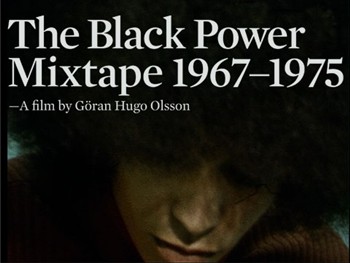
REVIEW – The Black Power Mixtape 1967-1975 (2011)

FilmJuice have my review of Goran Olsson’s archival documentary The Black Power Mixtape 1967-1975.

Back in the 60s, a group of Swedish journalists traveled to California in the hopes of understanding the American mindset. Once there, the filmmakers slowly found themselves gravitating away from ‘mainstream’ America and towards the burgeoning Black Power movement centered upon the Black Panther party. Nothing much was done with this footage at the time and so it sat in a vault for several decades until researchers uncovered it and turned it into a film. At its best, Black Power Mixtape is shining a fascinating and historically important light on a radical political movement whose reputation has long been unfairly tarnished. Unfortunately, once the film moves beyond the footage of the Black Panthers, the problems start to stack up:

Sadly, once the Black Power Mixtape shifts its emphasis from the Black Panthers to the Nation of Islam and the War on Drugs, the documentary begins to lose both its precision and its power.  An interview with Louis Farrakhan is eerie in its fantastical delusions and the documentary’s uncritical attitude towards the idea that the Nation of Islam offers a disciplined lifestyle heralds the arrival of a number of bizarre conspiracy theories including the somewhat inconsistent view that the authorities both turned a blind-eye to the drug trade in Black areas and cracked down on the drug trade in Black areas in a way that damaged the community and undermined the pursuit of civil rights.

Equally unconvincing are the documentary’s attempts to articulate the Swedish perspective on the civil rights movement.  While the amusing footage of Swedish tourists travelling round Harlem in a bus suggests that there is something vaguely inauthentic about Swedish concern for American civil rights, the documentary never manages to articulate what it is that is particularly Swedish about any of the footage or the interviews. Frankly, these could have come from the vaults of any European television station.

There’s no denying that this is an important film and I can completely understand why Sight and Sound magazine made it their film of the month. However, in an effort to expand the film to feature length and widen the scope of its observations, the film puts out a number of thematic feelers (war on drugs, Swedish opinions of 60s America) that not only fail to pay off but actually muddy the waters sufficiently that they distract from the power and importance of the film’s opening third.

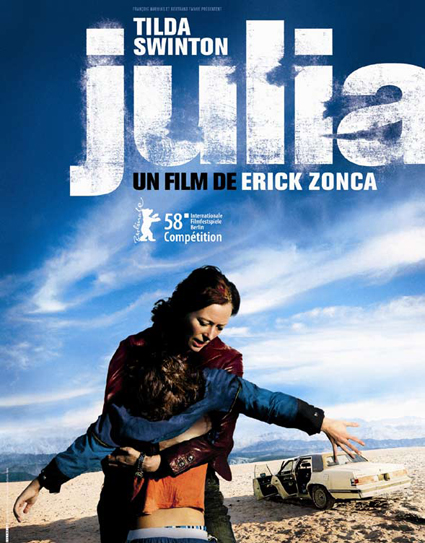
Julia (2008) – An Experiment in Unsympathetic Empathy

What can I say? I understand Lars von Trier. He did some wrong things, absolutely, but I can see him sitting there at the Cannes film festival… I sympathise with him, yes, a little bit.

When von Trier announced that he felt sympathy for Hitler, the grandees of the Cannes film festival responded by declaring him persona non grata. While much can be said of von Trier’s history of provocation, I believe that von Trier’s real mistake lay in expressing sympathy for Hitler rather than empathy. Indeed, while empathy involves understanding why someone does what they do and ‘feeling their pain’, sympathy means also seeing that person in a positive light. The slipperiness of these two concepts and their tendency to bleed into one another poses something of a challenge for writers because empathy and sympathy are quite different concepts. We should be able to understand why someone did something without seeing those actions as in any way acceptable.

Humans can be a surprisingly forgiving bunch and the more we understand another person, the more likely we are to see their actions as justified even if we do not necessarily agree with them. Because of this quirk in human nature, there is a tendency for unlikeable characters to wither beneath the glare of sustained psychological scrutiny, meaning that the more you explore a character’s back story and explain their motivations, the more likely it is that an unsympathetic bastard will turn into a big misunderstood puppy.  One could even argue that our tendency to automatically feel sympathy for the characters with whom we empathise accounts for the rise of psychopaths as anti-heroes. Indeed, by labelling a character as a psychopath, writers are making it clear that we ought not to feel much sympathy for them. Consider, for example the difference between character such as Dexter Morgan from Dexter and Vic Mackey from the Shield: Both are stone-cold killers who do not flinch from using horrific violence when it suits them. However, because Dexter has the label ‘psychopath’ attached to him, the character can never be completely sympathetic and so maintains his edge. Conversely, Vic Mackey is just a corrupt cop and, over the series, his actions take on a logic of their own that shifts the character from morally dysfunctional anti-hero to Dirty Harry-style crusader with a private sense of morality. Tellingly, when The Shield ended, Mackey’s future as an office drone was played for its pathos… we were supposed to feel sorry for a man denied access to the streets.

Based upon John Cassavetes’ Gloria (1980), Erick Zonca’s Julia can be seen as an attempt to solve this unintentional drift from empathy to sympathy. Telling the story of a selfish, unpleasant and manipulative alcoholic who kidnaps a child, the film works very hard at humanising its protagonist whilst retaining the opinion that she is a wretched human who is undeserving of either our sympathy or forgiveness. While the experiment is not entirely successful and the film does eventually collapse into something approaching sympathy for its protagonist, the move towards a more sympathetic portrayal is marked by a parallel drift away from character-based drama and towards a more genre-friendly approach to storytelling, thus begging the question as to whether we are more forgiving of genre characters than we are of real people.


Continue reading →

Red State (2011) – Nothing to Say and No Idea of How to Say it

It seems difficult to talk about a Kevin Smith film without also talking about Kevin Smith.  Since his debut Clerks (1994), Smith has excelled in the art of bundling himself up with his artistic output: When Smith made Clerks, he was making a film about himself, when Smith made Chasing Amy (1997), he was making a film about something that happened to him and when Smith made Dogma (1999), he was making a very personal statement about his own religious beliefs. Aside from a habit of making very personal and autobiographical films, Smith has also been very open about the experience of making films and the experience of… well… being Kevin Smith. When Peter Biskind wanted to write a book about the dark side of Miramax, Smith was there to provide him with quotes. When the critics sharpened their knives and leapt on Jersey Girl (2004) and Cop Out (2010), Smith made it quite clear what he thought about film critics and the industry as a whole. Smith is the logical consequence of the cult of the auteur: the director who makes every detail of his life available in the hope that this might somehow make his films seem more interesting. A habitual over-sharer, tantrum-thrower and general emotional incontinent, Smith is a wonderful figure to write about and when he announced that he would fund, make and distribute Red State alone, writers could not help but write about Smith’s latest project.  Which is somewhat odd given that this is arguably Smith’s least personal film to date. Red State finds Smith attempting to reboot his directorial career by moving into the thriller genre.

I adore thriller and horror films because, in my view, they come very close to being what Alfred Hitchcock once described as ‘pure cinema’. Thrillers are all about drawing upon plot, actors, dialogue, theme and cinematography to enclose the audience in a bubble of pure cinematic affect.  A good thriller drags you halfway out of your seat and keeps you crouching in the darkness, because of this, thrillers frequently demand a high standard of technical filmmaking. A thriller cannot hide behind lavish special effects, celebrated performances or noble themes… it has to work as a piece of art.  Despite containing some brilliantly realised elements, Red State is one of the most technically dysfunctional films that I have ever had the misfortune of seeing.

Continue reading →

REVIEW – Level Five (1997)

THE ZONE have my review of Chris Marker’s Level Five.

Level Five is an example of what I consider to be one of the most under-rated of cinematic genres: the visual essay.  Much like Patrick Keiller’s Robinson films, Adam Curtis’ documentary series, Iain Sinclair’s London Circular (2002) and Terence Davies’ Of Time and the City (2008), Level Five presents an intensely personal and formally innovative take on its subject matter.  Addressing both historical and personal forms of memory, Marker muses on the process through which we assemble and disassemble ourselves in light of both new evidence and the fading of memory. Marker attempts to link these two forms of memory together by using video games and the internet as a form of thematic connective tissue but his obvious lack of insight into either the internet or the process of games design makes the film feel both hand-wavy and almost comically dated. And don’t get me started on the human elements of the film…

Laura was intended as a character filled with both wisdom and sadness, but the weakness of Belkhodja’s performance and the artificial nature of Marker’s script combine to produce a character who is seldom more than a smug and incoherent directorial mouthpiece. By failing to ground Laura’s sections in genuine human emotion, Marker not only unbalances the film but also wastes what could have been a powerful structuring narrative: Laura is cooped up in a small, windowless room endlessly picking over discarded memories and lines of code until, eventually, the memories begin to fade and so does she. When Marker arrives at Laura’s flat to find her gone, the message is clear: Laura has reconceived herself as another person, a person free from grief and free from the memory of relationships past.

An ambitious and visually striking attempt at addressing the role of memory in personal identity, Level Five is a frustrating watch as its failures simply cannot mask the depth and breadth of Marker’s talent.  For those interested in Marker’s perspective, I’d suggest picking up the recent Optimum combined re-release of La Jetee and Sans Soleil (reviewed expertly by Max Cairnduff at Videovista)

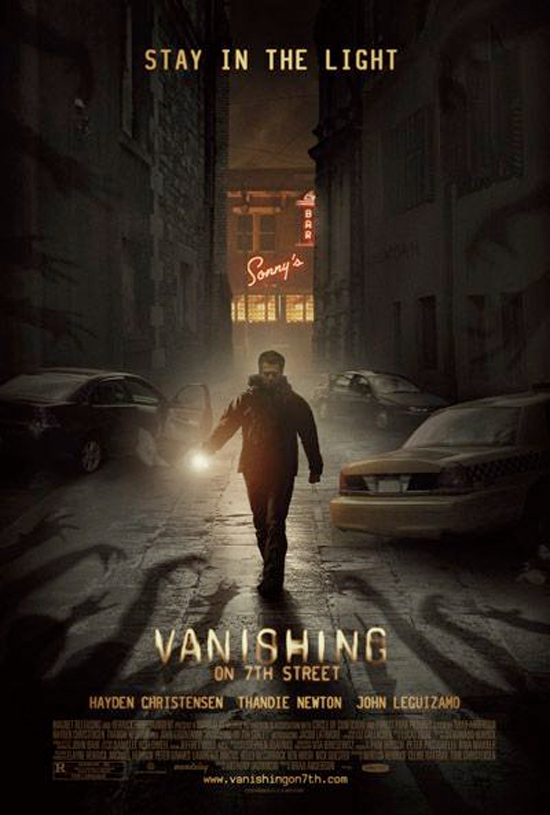
REVIEW – Vanishing on 7th Street (2010)

THE ZONE have my review of Brad Anderson’s urban horror film Vanishing on 7th Street.

I say “urban” as the film takes place in the rapidly depopulating city of Detroit but it strikes me that a more accurate description of the film might be something like ‘marshy’. Vanishing on 7th Street is about a group of people struggling to survive in the ruins of a city plunged into darkness by a powercut. What makes their existence something of a struggle is the fact that, out in the darkness, people keep disappearing meaning that, in order to stay alive, you have to keep the lights on. Unfortunately, with the main power out, the survivors are forced to rely upon mysteriously dwindling supplies of fuel and batteries.  These situation is made even worse by the tendency of the survivors to get lost in their own memories and wander off into the darkness. As you can probably tell, this is a film that is full of interesting thematic hooks but Anderson somehow manages to avoid getting caught on any of them resulting in a film that is neither scary nor dramatic and neither tense nor thought-provoking.  Vanishing on 7th Street is a marsh of ideas and Anderson made the terrible mistake of stepping off the path…

Vanishing On 7th Street could have been a brilliant horror film, an intelligent allegory for urban collapse or a thoughtful character study, but its refusal to pick a dramatic register and stick with it means that the resulting film is nothing but a series of pretty but ultimately pointless exercises in low-budget atmospheric cinematography. This is a brilliant idea waiting for a competently written script.

Whatever happened to the man who directed such brilliantly off-beat psychological thrillers as Session 9 (2001) and The Machinist (2004)? Come home Brad Anderson!  All is forgiven!