REVIEW – Jack Strong (2014)

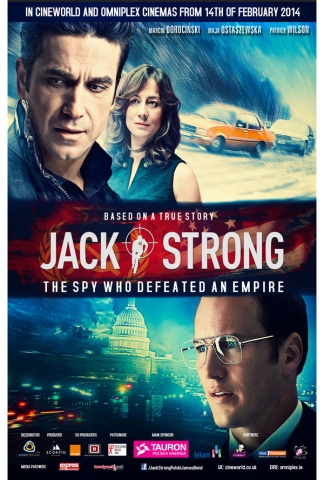
FilmJuice have my review of Wladyslaw Pasikowski’s historical espionage thriller Jack Strong, which is out in the UK on Monday. Set during the final decades of the Cold War, the film tells the story of a real-life Polish officer who came to realise that the Soviet Union would quite happily turn Poland into a radioactive wasteland if it meant protecting themselves from a Western invasion. Thus, rather than remaining loyal to his military command and working with the Soviets to defeat the West, he began sharing Polish and Soviet military secrets with the Americans in the hope of averting war. Aside from being a technically-accomplished thriller with bags of tension and some lovely set pieces, the film also goes out of its way to explore not only the historical context that informed the officer’s decision the spy for the Americans, it also spends quite a lot of time building up the characters in order to ensure that every act of betrayal has a personal edge:

The grit in the story also extends to the film’s treatment of Kuklinski’s home life as his teenaged son Bogdan comes to reject his family’s military heritage in order to embrace the kind of dissident political tendencies that would eventually result in the formation of the famous Solidarity movement. Bogdan is trapped between an intense love for his father and an intense hatred for the authoritarianism that his father’s job represents, this eventually leads him first to drink and then to drugs setting up some wonderful scenes in which Kuklinski is forced to confront his son about ideals that he secretly shares. In fact, one could easily read Bogdan as a manifestation of Kuklinski’s tortured conscience as well as the fear and self-disgust that grows within him as the film progresses.

Jack Strong reminded me of why I used to love spy films and why I no longer do. I have two main problems with the espionage genre:

Firstly, the number of spy films coming out of the English-speaking world seems to have increased exponentially since 9/11. Aside from successful franchises such as the Bond, Red and Mission Impossible films, we have ‘historical’ spy films such as Zero Dark Thirty, Fair Game and Argo as well as action-based spy films like Hanna, Haywire and Safe House.The popularity of espionage tropes is even blurring genre boundaries as TV procedurals such as Elementary and Sherlock seem to have gone out of their way to include espionage elements and that’s without mentioning the fact that superhero films and TV series make extensive use of espionage tropes in an effort to make their costumed antics seem more grounded and real. Espionage tropes are now so ubiquitous and over-exploited that their presence in a film or TV series often feels like an admission of intellectual bankruptcy.

Secondly, when espionage elements do turn up in contemporary films and TV series, they usually take the form of power fantasies.  ‘Power fantasy’ is often associated with texts in which a character is imbued with super-human powers giving them a degree of agency to which the audience could only ever aspire. A textbook example of this type of power fantasy is the scene in Sam Raimi’s Spider-Man in which the freshly-empowered Peter Parker beats and humiliates a high-school bully. However, while power fantasies are usually associated with agency-giving powers like flight or super-strength, they can also be associated with characters having the capacity to see the world in much simpler terms than people in the real world. Espionage thrillers often feature these types of knowledge fantasy in that they replace complex political issues with simple moral dichotomies in which it is relatively easy to know ‘right’ from ‘wrong’. In some cases, the knowledge fantasy even extends as far as having the evil-doers be instantly recognisable thanks to their physical characteristics and it is in this shared fantasy of recognition that the espionage and superhero genres meet.

What makes me uncomfortable about a lot of contemporary spy stories is the way that they apply these fantasies of knowledge to real-world political problems in an effort to make the film or TV series seem more ‘realistic’. The reason that real-world political problems prove intractable is that it is often almost completely impossible to determine which is the ‘right’ side of a particular issue. Taking real-world problems and reducing them down to simple moral dichotomies is not only supremely unrealistic, it is also intensely problematic as it means not only demonising the people who happen to be on the receiving end of popular fears, it also encourages the fear by suggesting that audiences are right to be terrified of particular groups. For example, one of the most egregiously right-wing TV series in recent memory is Homeland, a series that suggests Al Qaeda not only have the power to infiltrate the CIA but also to ‘turn’ American soldiers into double agents. Eager to continue feeding on popular fears, later series of Homeland appear to have switched from fantasising about an all-powerful Al Qaeda to fantasising about the supremely competent and ruthless Iranian intelligence services.

Jack Strong is just as much of a knowledge fantasy as any contemporary spy film as it not only assumes that the Soviet Union would have abandoned its satellite nations, it also glosses over the fact that America would almost certainly have proved equally reluctant to defend European cities with nuclear weapons if it meant endangering US cities. However, the fact that the film dealt with ‘historic’ issues rather than contemporary ones served to make its knowledge fantasies seem less grating and Pasikowski further attenuated the political elements of his story by stressing the human dimension not only of the character’s decision to become a traitor but also of his on-going attempts to remain hidden from people within his own government and military hierarchy. Jack Strong appealed to me because, unlike many spy films, it never forgets that complex political problems have their roots in complex political humans. Films that reduce real-world problems to simple moral dichotomies are nothing more than the latest generation of war-time propaganda.
 

The Past (2013) – No… You Can’t Have Fantasy Dad

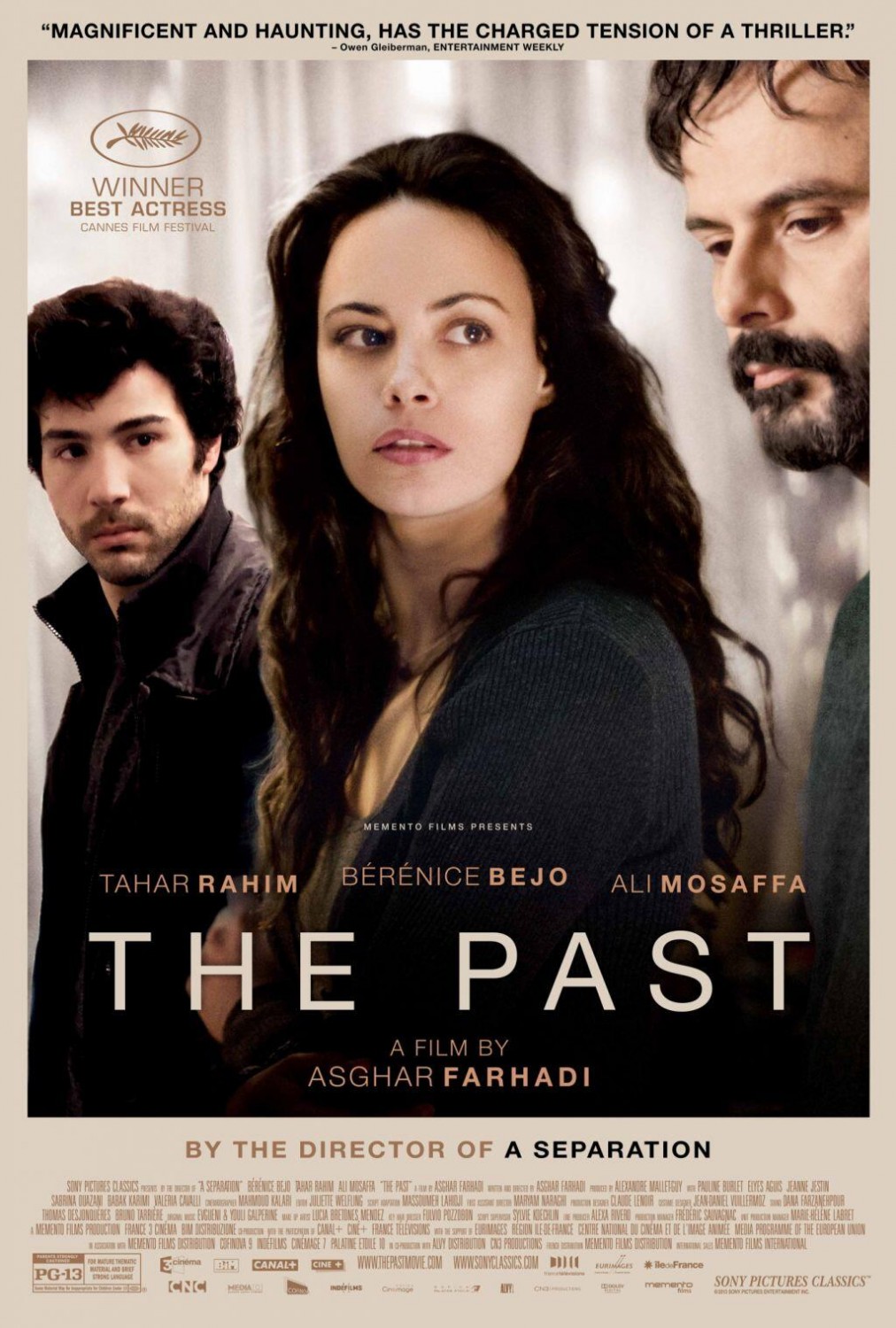
The films of Asghar Farhadi form an interesting counterpoint to the films of Joanna Hogg, which I wrote about last week. While both directors are fascinated by the way that group dynamics can impact upon our emotional lives, Hogg’s career has seen her transition from the emotional opacity of formalism to the conceptual opacity of surrealism while Farhadi’s relentless pursuit of emotional truth frequently has him brushing up against melodrama as he did with the magnificent Oscar-winning family drama A Separation.

There can be no greater validation of cinematic art than two directors approaching the same subject matter in radically different ways and yet somehow managing to produce works that feel as natural as they are satisfying. It is easy (and exciting) to imagine Joanna Hogg dancing round the question of who was responsible for the miscarriage in A Separation while Asghar Farhadi would arrive on Archipelago’s Scilly isles and refuse to let go until everyone came clean about what it was that was making them unhappy.

There’s a wonderful moment in the British situation comedy Peep Show when the emotionally constipated Mark Corrigan is confronted by a sister who wants to discuss their traumatic childhood prompting Mark to lament that the people who want to talk always seem to win. Asghar Farhadi’s latest film The Past is sympathetic to both sides of Mark’s observation: Yes… the people wanting to talk usually get their way and No… this isn’t always for the best.

Continue reading →

REVIEW – Effie Gray (2012)

FilmJuice have my review of Richard Laxton’s Effie Gray, a biopic dealing with the disastrous marriage between Euphemia ‘Effie’ Gray and the eminent Victorian art critic John Ruskin. Like many of the books, plays and films that have dealt with doomed marriage, Laxton’s film lays the blame squarely on Ruskin’s refusal to consummate the marriage while an ambitious script by the actress Emma Thompson tries to account for his reluctance in terms of Victorian society’s ambient sexism. This film has something of a troubled history as while it was completed over two years ago, two separate (and ultimately groundless) plagiarism cases prevented the film’s release. When the film did finally limp onto British cinema screens, it did so on the same weekend as Mike Leigh’s Mr. Turner (a film that also featured the couple) and without the support of Thompson who refused to do any publicity for the film despite both writing it and appearing in it. While it may be a bit gauche to speculate as to why Emma Thompson would refuse to do any publicity for a film she once considered an intensely personal project, I think it has something to do with the fact that Laxton really seems to struggle with the film’s feminist themes:

The real tragedy here is that while Thompson’s script may try to tell the story of a feminist icon, the man employed to turn that script into a film took his cues from John Ruskin and contented himself with a sexless doll.

The problem is that the script and the film are pulling in opposite directions. Things start off quite well as Thompson’s script and Laxton’s direction combine quite well to expose the everyday sexism of Victorian society. Unfortunately, when asked to turn this social analysis into a psychological explanation for Ruskin’s refusal to have sex with his wife, the film dithers and slithers and winds up not saying anything at all. The reason for this failure of characterisation is that while Laxton wanted to make a film about Ruskin, the script is actually about Gray and so it is quite content to voice a few ideas about Ruskin before moving onto the meat of the film: Effie’s experiences in a loveless marriage and how she found the agency required to take control of her own life. In fairness to Laxton, Thompson’s script really does not give Dakota Fanning a huge amount to work with but a director who was sensitive to Thompson’s aims would have realised that Effie’s character lay not so much in what she did and did not say but in how she felt while she was saying it. A sympathetic director would have encouraged Fanning to create an Effie Gray who was visibly constrained and ill-at-ease with the society she inhabited but instead we are given an Effie who is almost hypnotically passive… a beautiful china doll in need of nothing more than a good fuck and a house to keep.

As my score of 2 out of 5 would suggest, I did not enjoy Laxton’s Effie Gray but my lack of enjoyment stemmed more from my intense feelings of frustration at what an awesome film this could have been if either the script or the director had been allowed to take precedence:

  • A director sympathetic to Thompson’s script would have kept the focus on Effie and realised that the final act was actually the climax in a series of social confrontations that began on the day that Effie arrived at Ruskin’s family home. The film’s final act feels a lot like a thriller with Effie sneaking around to meet doctors and lawyers under the noses of her family and a sympathetic director might have taken this ending as a cue to turn Thompson’s script into a social thriller comparable to Wilkie Collins’ The Woman in White where an intelligent and ambitious young woman finds herself fighting for freedom against villainous men and matriarchs who are supported by a set of social attitudes that are designed to break women on the wheel and turn them into objects. All of those scenes in which Effie clashes with older women should have been tiny battles of wit rather than acts of one-sided oppression!
  • A screenwriter sympathetic to Laxton’s interest in Ruskin might have connected with the character’s humanity, taken his asexuality at face value and dealt with how it must have felt to be asexual when both your wife and your entire society expect you to be sexually active. If we do assume that Ruskin was asexual then Thompson’s suggestion that he was some kind of incestuous misogynist with a fondness for young girls is nothing short of monstrous. Even if a script didn’t assume that Ruskin was naturally asexual, it could still explore the links between his refusal to consummate his own marriage with his parents’ tendency to treat him as a child. Alternately, one could argue that Ruskin was simply an introverted and cerebral man who was far more comfortable treating love as an abstract concept than as a physical action.

So I guess what I am really saying is that while I found Ruskin and Gray’s marriage to be a really fascinating subject, I was not impressed by Thompson and Laxton’s take on it.

Exhibition (2013) – Little Boxes

Joanna Hogg is one of the most exciting film directors working in Britain today. A graduate of the National Film and Television School, Hogg spent the 1990s working in British television on series such as Casualty, London’s Burning and an Eastenders spin-off exploring the wartime exploits of a young Dot Cotton. While a decade behind the cameras of soap operas and disposable dramas does not usually herald the arrival of a major directing talent, it is worth remembering that British soap operas have a long history of social realism meaning that every year Hogg spent on Casualty and London’s Burning was a year in which she got better at observing people and the worlds they inhabit.

Hogg’s eye for social rituals and group dynamics was evident even in her debut feature Unrelated. The film revolves around a woman who joins her friends on holiday as an excuse to spend some time away from her partner. Upon arriving in Italy, the woman finds herself in a house that is already split down the middle along generational lines and decides to hang out with her friends’ hedonistic teenaged children rather than the people she came to visit. This yields a splendid holiday until a failed attempt at seduction sends the woman scurrying back to the grown-up side of the house and the grown-up life she left in Britain. While Unrelated is a recognisably British film about recognisably British characters who behave in a recognisably British way, the film’s treatment of its subject matter evokes European rather than British cinema. Aside from a southern climate and an interest in middle-aged sexuality that recalls works like Ozon’s Swimming Pool, Unrelated is defined by its emotional ambiguities and a fondness for long dialogue-free scenes and palate-cleansing landscape photography that are common in European cinema but almost entirely absent from British film.

Much like Unrelated, Hogg’s Archipelago is best understood as an attempt to explore the products of British social realism using the language of French art house drama. However, where Hogg’s first film seemed to go out of its way to retain such European topoi as sun-drenched holiday homes and illicit affairs, her second film is far more recognisably British thanks to its focus on wind-blasted landscapes and awkward family holidays. Shot on the isles of Scilly off the South-West coast of Cornwall, Archipelago features a pair of grown-up children who decide to go on holiday with their mother. The family’s unhappiness is manifest right from the start as disagreements escalate into arguments with a speed that suggests the presence of unaddressed problems. However, despite numerous elephants in the room, the family never sit down to discuss their feelings… they simply evade and deflect them by choosing to blow up over ridiculous things such as choice of bathroom and whether or not a piece of food has been properly cooked. Elegantly reserved when it comes to its characters’ actual inner lives, Archipelago is a magnificent study of the British middle-classes and how taboos surrounding direct confrontation and talking about one’s feelings have encouraged people to become emotionally self-contained. The film suggests that while this system of self-containment may be completely unreliable, it is supported by a cultural tolerance of passive-aggressive venting and the kind of extreme emotional projection that would probably be regarded as psychotic in a more emotionally-expansive culture. Like Unrelated, Archipelago explores these ideas in a quintessentially European manner by forcing the audience to observe only to then pull back and provide them with evocative imagery that will encourage them to draw their own conclusions about the things they have just been shown. This willingness to use European cinematic techniques to explore British emotional landscapes not only made for an incredibly fresh cinematic experience, it also served as a timely reminder of how staid, unadventurous and lacking in diversity European art house film can be.

Archipelago is not only a perfect fusion of British social realism and European cinematic vocabulary but also the completion of an experimental journey that began with Unrelated. This posed an interesting question: if Archipelago was everything that Unrelated wanted to be, where would their director go next?

Joanna Hogg’s third film Exhibition is also her most ambitious. Like its predecessors, the film uses a European cinematic vocabulary to explore the emotional dynamics of British middle-class life. However, whereas Unrelated and Archipelago both revolved around relatable characters who were really quite easy to understand, Exhibition concerns itself with a couple whose inner lives are so bizarre and complex that they can only be expressed artistically.

Continue reading →

Transformers: Age of Extinction (2014) – A Counter-Productive Relationship with Thought

Transformers: Age of Extinction is something of a paradox. Compared to Transformers: Dark Side of the Moon, Transformers: Revenge of the Fallen and the original Transformers, the film is better acted, better written and better made. Rather than the usual barrage of ill-connecting set-pieces, Age of Extinction’s plot has a beginning, middle and end constructed around a cast of characters who not only speak in complete sentences but also behave in a manner suggesting the presence of recognisable human emotions and comprehensible motives. The comedy (though still irritatingly broad) is somewhat less offensive and better integrated into the beats of the film while the action sequences are much easier to follow thanks to digital effects technology having now reached a point where Michael Bay can finally stage and shoot a fight between two giant robots without having to keep dipping the camera behind obstacles whenever the bit-rate sinks below the photo-realistic. Transformers: Age of Extinction is a real paradox as while it is unquestionably the best made film in the series, it is also the most excruciatingly shit.

Continue reading →

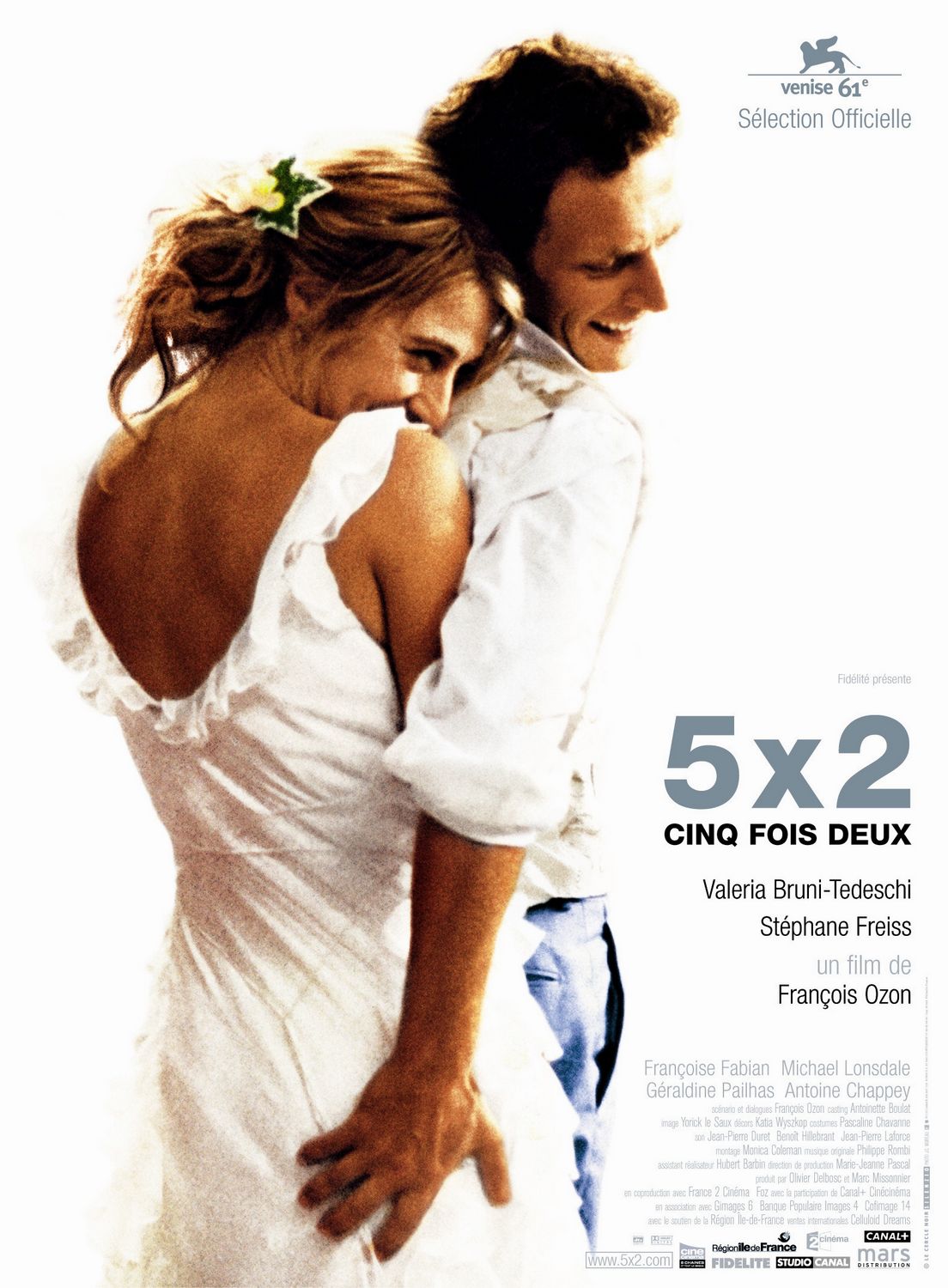
5×2 (2004) – The Space around Love

Characterisation is a funny thing. Characters obviously have no inner lives and no existence beyond the indentations they leave on a text and yet a well-drawn character can seem human enough to warrant an emotional response from the audience. Characterisation works by tapping into the various short-cuts humans use in social interaction; As humans, we can never know what another person is thinking or feeling but we can infer their emotional state by considering their behaviour and comparing it to what feelings we think might prompt us to act in a similar fashion. Characterisation can thus be thought of as the art of building an evocative human shape from a series of descriptive passages. Strike the right poses at the right moments and a character will leap off the page but fail to make a character’s poses recognisable or fail to make those poses coherent and you will be left with a character that seems lifeless and inhuman.

Different cinematic traditions have different standards of characterisation. For example, travel back to 1930s Hollywood and it was still quite common for directors to use voice-overs and have their characters tell the audience what they were thinking. Fast-forward to contemporary Hollywood blockbusters and you find directors relying quite heavily on audience-recognisable character types whose inner lives are made accessible through a combination of unambiguous musical cues and absurd theatrical gestures including sinking to their knees and bellowing ‘Nooo’ into a rain-filled sky. Thankfully, not all cinematic traditions are as heavy-handed; Cinema originating in cultures with low-levels of emotional disclosure is far more subtle in its emotional topography and so audiences are forced to pay closer attention and approach scenes in different ways in order to catch the poses that might allow them to infer the presence of an internal state or collective vibe. The subtlety of character beats in Japanese film also explains its long-standing relationship with a European art house tradition in which directors seek to deliberately attenuate their characterisation in a bid to create characters that seem more complex and ambiguous. However, despite European film’s desire to keep its characters aloof, the last fifty years have still seen the emergence of not just stock characters but stock poses that serve as short-cuts in films that should not be about the easy answers. How many times have you seen art house films in which characters stare into the middle-distance impassively? How many times have you seen art house films in which a character fails to react to some devastating event and yet winds up over-reacting to some seemingly unrelated incident? As a general rule of thumb, if you are an art house director and your characterisation techniques are showing up on Mad Men then it is time to get yourself some new techniques… which is where François Ozon’s 5×2 comes in.


Continue reading →

REVIEW – The Overnighters (2013)

FilmJuice have my review of Jesse Moss’s rather frustrating documentary The Overnighters.

The documentary is set against the backdrop of the North Dakota oil boom, which saw a massive expansion in the North Dakota oil industry at a time when many Americans were losing their jobs and their homes in the Great Recession. However, while North Dakota now has the lowest unemployment rate of any state in the Union, the job market expanded so quickly and generated so much money that the state’s rental sector simply could not keep up meaning that many Americans travelled thousands of miles to get a job in the oil industry only to realise that their new job didn’t pay enough to allow them to cover rent. The film revolves around a Lutheran pastor who set up a programme that would allow the working poor to sleep on the floor of his church.

The documentary is at its absolute best when it shows the inhumanity and indifference of American institutions:

The most striking thing about this documentary is how little support Reinke gets from… well… anyone. The oil industry in North Dakota is going through a period of historic expansion and yet despite record profits rolling in to corporate coffers, none of the oil companies seems to provide food or shelter for the thousands of people they employ. The oil boom has reportedly given the under-populated state of North Dakota a billion-dollar budget surplus and yet the state would rather shut down the church and ban people from living in caravans than find a way to house and feed the thousands of people who helped to create that surplus. Even more shocking is the way that Reinke is forced to battle his own church as parishioners file into his office and trumpet their Christian values in the same breath as they complain about poor people making the place look untidy.

However, rather than expanding this critique into something more systematic, Moss takes the disastrous decision to focus upon the human element and the experiences of the men who are running and relying on the Overnighters programme. This approach is quite traditional in American documentaries as human interest stories sell better than analytical pieces but you can only make that kind of film when the humans are interested in telling their stories and the men who feature in The Overnighters keep their emotional cards very close to their chests. As I point out in my review, Herzog’s Into the Abyss is a great example of how to use human stories to build a social critique but Herzog’s interviews help his subject to develop their own thoughts whereas Moss seemed reluctant to ask any questions whatsoever. For example, one of the subjects spends his time spouting vitriol after being asked to leave the church and Moss neither challenges his vitriolic remarks or tries to determine what actually happened. Similarly, the film seems to imply that one of the subjects might well have been sexually involved with a man staying in the church who then blackmailed him but Moss never bothers to ask questions that might have allowed him to share the real story of what happens at the end of the film. The Overnighters had the potential to be a great little documentary about the plight of America’s working poor but rather than making that film, Moss tried to make a film about people’s feelings when nobody wanted to discuss them.

Another issue the film brought to light is the role of charity in perpetuating systemic inequality. According to the film, the oil industry did not pay its workers a living wage in the sense that their salaries did not allow them to make rent and feed themselves, forcing hundreds of people to sleep in their cars. It does not seem unreasonable to suggest that, allowed to continue unchecked, these working practices would have resulted in hundreds of deaths and people fleeing the cold of North Dakota in order to return home. The resulting humanitarian disaster and shrinking of the labour pool would presumably have resulted in either the state stepping in or employers raising wages and building dormitories to arrest declining production. While charities like the Overnighters might prevent humanitarian disasters and save hundreds of lives, they do provide both the state and the public sector with an excuse for not changing their practices.  After all, why would an oil company build dormitories when a church down the road provides one at no cost to them? Watching The Overnighters, I was struck by the fact that the only way of addressing systemic inequality is at a systematic level: Workers can’t make rent? raise the minimum wage. Rents too high? Cap them. People forced to sleep in their cars because their wages are too low? raise corporate taxes and use the money to provide cheap social housing. There is something faintly obscene about the fact that the oil boom gave the state of North Dakota a seven-figure budget surplus and yet the only time we hear from the state in the film is when they are trying to shut down the church or ban people from sleeping in caravans.


REVIEW – The Killing (1956) and Killer’s Kiss (1955)

FilmJuice have my twin review of Stanley Kubrick’s second and third films Killer’s Kiss and The Killing, which are getting an all-singing and all-dancing re-release next week at the hands of Arrow Films.

It was interesting to discover these films after reviewing the Masters of Cinema release of Kubrick’s first film Fear and Desire (apologies for nerfed formatting) as, like most people, my memories of Kubrick’s work are shaped by the classics he started churning out from the late-50s onwards. Of Kubrick’s first three films, The Killing is almost certainly the most accomplished and accessible.

However, while the heist is beautifully handled and provides the film with a strong narrative spine, the film’s real beauty lies in the character beats that provide the film’s real sources of tension. Based on a novel by Lionel White but scripted by the legendary crime novelist Jim Thompson, the film benefits from a cast of old B-movie hands who slot effortlessly into their assigned character types and go to town on the dialogue:

Marie Windsor plays Sherry as this wonderfully cynical drunk with a young lover and a hunger for money. Every inch the Femme Fatale dominatrix, she showers her husband with sarcasm and distain only to show him just enough attention to secure his continued loyalty and affection.

As I point out in my review, I felt that the film’s ending failed to live up to the promise of the film’s opening act but I have since learned that the film’s leading man Sterling Hayden was not a popular choice with the film’s studio backers and I wonder if Kubrick might not have left a few of his character beats on the cutting room floor. Either way, the film makes the mistake of driving home the idea that the character is a no-nonsense hard case only to try to elicit sympathy for him in the final scene. You can see how the film might have played out as Kubrick does soften the character in the opening scene but his failure to re-visit that softening and underline that duality results in a film that feels more bleakly nihilistic than it clearly yearns to be. Having said that, I compare the film to pictures like The Big Sleep and The Maltese Falcon and I stand by that comparison as this still a really fucking good film.

As well as some awesome extras (including an interview with a bearded, shirtless and resentful Hayden), the disc also includes Kubrick’s lesser-known second film Killer’s Kiss. Seldom revived during Kubrick’s lifetime, Killer’s Kiss is just as trippy and arty as his first film Fear and Desire but rather than deploying those tricks in the context of a war movie, Kubrick decides to deploy them in the context of an hour-long film about a second-rate boxer who falls in love with a woman in trouble. The narrative isn’t that interesting and the bloke playing the boxer is not what you would call charismatic but the film looks sensational, a bit like Billy Wilder’s The Lost Weekend complete with blurring of boundary between real and imagined:

However, look beyond the simple narrative and the desperately uneven acting and you will see a young director experimenting with a wide array of cinematic techniques. For example, whereas most Hollywood films of the period shot dialogue scenes with fixed cameras, Kubrick has his cameras move in and around the actors while they deliver their lines resulting in an odd, queasy feeling that feels a lot more subjective than realistic. Also interesting is the way that Kubrick makes the walls of the boxer’s kitchen pitch black except for a window looking onto his neighbour’s apartment creating the impression that the window functions almost like a comic book thought bubble in which the boxer visualises sounds overheard through the walls.

It is also quite interesting to see these two films get a release from Arrow films. Arrow have always been a damn fine home-release outfit but I have always associated them with the cult and horror titles they release under the Arrow Video label. I’m not entirely sure how long Arrow Academy has been around as a label but releases like this one and last year’s amazing Walerian Borowczyk box set would certainly position them as the emerging power in Britain’s premium home-video market. Masters of Cinema had better watch themselves!

Nobody Knows (2004) – Left Luggage

Art house film is a really shitty cultural milieu. Back in the 1960s, when European directors began to chafe against the studio system and competition from an ever-expanding Hollywood machine, they looked to the East for legitimacy and proof that cinema didn’t need to be about three act structures and infantilising melodrama. The history of European film may be dominated by European names but those early Japanese victories in Berlin served to remind the world that Hollywood is not the default option when it comes to film. Half a century later and Japanese film is treated in the same cavalier fashion as every other piece of non-English language cinema: Invisible until someone has a breakthrough at which point the floodgates open until everyone gets bored and moves on to the next big thing. Don’t believe me? When was the last time you saw a Spanish horror film or French thriller at your local cinema? Was it after one Spanish horror film or French thriller had a breakthrough success? I thought so.

It is now a long time since a Japanese film was embraced by European audiences and so the lines of communication with the Japanese cinema scene are growing increasingly faint. Fancy watching a cartoon series about World War II battleships that are anthropomorphised as sexualised pre-pubescent girls? No problem! There’s a massive website that will sub-title that shit and stream it so that you can see it at the same time as Japanese people! Fancy watching a Japanese live-action film that peels back the surface of Japanese social problems and exposes the embattled spirit that all humans share regardless of their race, gender or sexuality? Yeah… that might appear on DVD eventually but only if it does well at Cannes. Clearly, Japanese directors are missing a trick by not having their intricately-drawn characters be semen-drinking demons that look like 10 year-old girls.

Hirokazu Koreeda is one of only a handful of Japanese directors who retain some visibility in the West. Over the past twenty years, his films have charted the emotional landscape of contemporary Japan with a degree of humanity that nearly justifies Koreeda’s reputation as heir to the cinematic tradition of Yasujiro Ozu. Released in 2004 and winner of the Best Actor award at the 2004 Cannes Film Festival, Nobody Knows finds Koreeda using one of his favoured narrative techniques: Taking inspiration from a contemporary news story and producing a film that unpacks the emotions underpinning not only the story but its relationship to Japanese society.

Continue reading →

REVIEW – Thief (1981)

FilmJuice have my review of Michael Mann’s cinematic debut Thief. Despite having seen Mann’s first feature-length film (a TV movie called Jericho Mile), I had somehow evaded seeing his first cinematic feature. This means that I have just had one of my best cinematic experiences in years as Michael Mann’s Thief is a stone cold classic!

The film revolves around a highly organised and professional thief played by James Caan in full 70s tough guy mode. Despite having his life completely squared away and stripped of all unwelcome and unnecessary emotional entanglements, the character feels a yearning for normality when a face-to-face meeting with an old mentor gives him a Ghost-of-Future-Present moment in which he imagines himself dying alone in jail. However, despite wanting to live a normal middle-class life, the character approaches his desire for normality with the same level of aggression and control-freakery that he approaches his job as a cat burglar resulting in an absolutely amazing sequence in which Caan’s character almost pulls a gun on a woman as a means of declaring his love and desire to start a family. Unfortunately, the character soon realises that his chequered past and lack of social skills mean that a proper middle-class existence is out of bounds (he cannot adopt or secure a mortgage to buy a house) and so he enters into a relationship with a crime boss who is looking to start a family.

The conventional reading of this film emphasises the humanity of Caan’s character and see a desire for emotional openness in his pursuit of a middle-class lifestyle. However, I don’t believe that Thief is a film about someone who has a middle-class life stripped away from him, this is a film about a man who was never suited to middle-class life to begin with!

Hardboiled crime thrillers love the idea of emotionally isolated men discovering reasons to live: In Nicolas Winding Refn’s Drive, Ryan Gosling’s highly-professional simpleton goes on a couple of nice dates with the woman next door and sacrifices himself for the sake of her family. In Brian Helgeland’s Payback, Mel Gibson’s highly-professional blank slate murders his way through an entire criminal syndicate for the sake of a few thousand dollars until he spends time with an old flame whose presence transforms the money from a stupid reason to risk your life into a chance for a new beginning. Directors and writers love these transformative moments as it softens one male power fantasy (the highly-professional hard case) into a slightly different male power fantasy (the highly-professional hard case who turns out to be a sensitive soul after all). Part of what makes Thief so fascinating is that while Mann literally walks Caan’s Frank up the garden path to an ordinary life, Frank abandons that life at the very first set-back. In fact, Frank doesn’t just walk away from his life… he abandons his family and burns his house to the ground because he cannot cope with the emotional entanglements that characterise a normal life.

Michael Mann’s Thief can be read as a hardboiled version of Jean Renoir’s classic Boudu Saved From Drowning except rather than being about an eccentric homeless person who is taken under the wing of a nice middle-class man only to walk away from middle-class bliss, Thief reskins Boudu as an emotionally isolated cat burglar and the lovely middle-class book salesman as a patriarchal crime boss. Both films critique the idea that everyone is suited to a normal middle-class existence and both films suggest that there is something faintly intimidating about the middle-class urge to uplift and civilise the lower orders.


Continue reading →