Some Thought On… Last Screening (2011)

Reminiscent of both Michael Powell’s Peeping Tom (1960) and the genre-art house hybridisation of Nicolas Wending Refn’s Drive (2011), Laurent Achard’s Derniere Séance deconstructs the traditional horror film only to reassemble it as a dark and brooding meditation on the delights of cinephilia.

The one thing that unites all members of a cinema audience is the fact that they are members of a cinema audience. Because of this simple tautology, audiences tend to respond well to films that praise them for their decision to go to the cinema.  What do Tornatore’s Cinema Paradiso (1988) and Truffaut’s 400 Blows (1959) have in common? They both pander to their audiences by validating their love of film. Achard’s Last Screening is also about loving the cinema but rather than praising his audience for their good taste, Achard lambasts them for their toxic self-indulgence.

Sylvain (Pascal Cervo) is the manager of a repertory cinema in provincial France. Utterly devoted to the cinema, Sylvain seldom goes out except to kill women and cut off their ears. Much like Powell’s Peeping Tom, Last Screening muses on the voyeuristic nature of cinema and Achard repeatedly assails us with shots of people staring blankly at the camera setting up a similar mirroring effect to that of Kiarostami’s Shirin (2008), where the audience sat watching a cinema audience that could just as easily have been watching them. Achard also litters his film with images of darkened figures staring at illuminated performers, further extending his explicit comparison between the voyeurism of the cinema-goer and the voyeurism of the predatory serial killer. Postmodern cinematography aside, Achard’s critique of cinephilia also extends to the film’s plot as Sylvain’s crimes turn out to be motivated by a desire to recapture the film-viewing moments of his youth. For Achard, cinephilia is clearly a source of genuine joy (he obviously adores Renoir’s French Cancan) but that joy can also turn toxic as a love of old film can result in people becoming stuck in the past or shut off to new forms and experiences. With Sylvain, Achard offers us an image of twisted cinephilia.

Though marketed as a horror film, Last Screening is really more of an art house project. Seldom frightening, seldom tense and only occasionally gory, its murders are not sensationalist ends in themselves but props in Achard’s wider exploration of Sylvain’s twisted mental state.  As you might expect from an art house character study, Last Screening’s pacing in slow, deliberate and filled with languid extended takes in which nothing much happens and nothing is said. Elegantly shot and intelligently conceived, Last Screening is a combative and genuinely thought-provoking film whose absolute lack of sentiment about film itself serves as a timely antidote to a medium that can be altogether too swift to pat itself on the back.

The Rules of the Game (1939) – A Theatre of Nightmares

One of the best known rants in the history of film criticism is the one in which Andre Bazin rounds on the French film industry and lambasts it for its failure to be properly cinematic. Instead of producing properly cinematic works of art, Bazin argues, most French film directors were happy to simply film a theatrical performance. Rather than making the most of a new medium, French film was reducing the camera to the role of dumb spectator.

Jean Renoir’s La Regle Du Jeu was first released in 1939. Banned by the Vichy government for being ‘demoralising’, the film’s original negative was later destroyed in an Allied bombing raid forcing post-War cinephiles to assemble their own version of the film with advice from Renoir. This reconstructed version of the film is the one that we know today and it is dedicated to Andre Bazin.

It is tempting to link these two statements together: Renoir’s La Regle du Jeu may well be one of the great masterpieces of 1930s French cinema, but it is also an intensely theatrical film. Not only does the film contain an infamous ‘play-within-a-play’ but many of Renoir’s mis-en-scenes are explicitly and quite intentionally theatrical in both composition and reference. Reading between the lines, one can divine a response to Bazin’s famous rant.  La Regle du Jeu is full of slamming doors and romantic misunderstandings but the film’s theatrical nature is far from unthinking. In fact, in packs a powerful political punch. La Regle du Jeu uses its theatricality to present the pre-War French bourgeoisie as a frothy and insubstantial band of corrupt and self-indulgent buffoons. Wielders of a social morality so completely disconnected from the demands of the real world that they no longer seem to believe in it themselves, Renoir’s upper-classes are incapable of defending France against the rising tide of Fascism. Where were the ruling class when Vichy was on the rise? They were dressing up as bears and having delightful weekends in the country. Showing an almost post-modern awareness of media and irony, La Regle du Jeu remains one of the most powerful indictments imaginable of a society that has become lost in the maze of its own self-indulgence.

Continue reading →

Julia (2008) – An Experiment in Unsympathetic Empathy

What can I say? I understand Lars von Trier. He did some wrong things, absolutely, but I can see him sitting there at the Cannes film festival… I sympathise with him, yes, a little bit.

When von Trier announced that he felt sympathy for Hitler, the grandees of the Cannes film festival responded by declaring him persona non grata. While much can be said of von Trier’s history of provocation, I believe that von Trier’s real mistake lay in expressing sympathy for Hitler rather than empathy. Indeed, while empathy involves understanding why someone does what they do and ‘feeling their pain’, sympathy means also seeing that person in a positive light. The slipperiness of these two concepts and their tendency to bleed into one another poses something of a challenge for writers because empathy and sympathy are quite different concepts. We should be able to understand why someone did something without seeing those actions as in any way acceptable.

Humans can be a surprisingly forgiving bunch and the more we understand another person, the more likely we are to see their actions as justified even if we do not necessarily agree with them. Because of this quirk in human nature, there is a tendency for unlikeable characters to wither beneath the glare of sustained psychological scrutiny, meaning that the more you explore a character’s back story and explain their motivations, the more likely it is that an unsympathetic bastard will turn into a big misunderstood puppy.  One could even argue that our tendency to automatically feel sympathy for the characters with whom we empathise accounts for the rise of psychopaths as anti-heroes. Indeed, by labelling a character as a psychopath, writers are making it clear that we ought not to feel much sympathy for them. Consider, for example the difference between character such as Dexter Morgan from Dexter and Vic Mackey from the Shield: Both are stone-cold killers who do not flinch from using horrific violence when it suits them. However, because Dexter has the label ‘psychopath’ attached to him, the character can never be completely sympathetic and so maintains his edge. Conversely, Vic Mackey is just a corrupt cop and, over the series, his actions take on a logic of their own that shifts the character from morally dysfunctional anti-hero to Dirty Harry-style crusader with a private sense of morality. Tellingly, when The Shield ended, Mackey’s future as an office drone was played for its pathos… we were supposed to feel sorry for a man denied access to the streets.

Based upon John Cassavetes’ Gloria (1980), Erick Zonca’s Julia can be seen as an attempt to solve this unintentional drift from empathy to sympathy. Telling the story of a selfish, unpleasant and manipulative alcoholic who kidnaps a child, the film works very hard at humanising its protagonist whilst retaining the opinion that she is a wretched human who is undeserving of either our sympathy or forgiveness. While the experiment is not entirely successful and the film does eventually collapse into something approaching sympathy for its protagonist, the move towards a more sympathetic portrayal is marked by a parallel drift away from character-based drama and towards a more genre-friendly approach to storytelling, thus begging the question as to whether we are more forgiving of genre characters than we are of real people.


Continue reading →

REVIEW – Level Five (1997)

THE ZONE have my review of Chris Marker’s Level Five.

Level Five is an example of what I consider to be one of the most under-rated of cinematic genres: the visual essay.  Much like Patrick Keiller’s Robinson films, Adam Curtis’ documentary series, Iain Sinclair’s London Circular (2002) and Terence Davies’ Of Time and the City (2008), Level Five presents an intensely personal and formally innovative take on its subject matter.  Addressing both historical and personal forms of memory, Marker muses on the process through which we assemble and disassemble ourselves in light of both new evidence and the fading of memory. Marker attempts to link these two forms of memory together by using video games and the internet as a form of thematic connective tissue but his obvious lack of insight into either the internet or the process of games design makes the film feel both hand-wavy and almost comically dated. And don’t get me started on the human elements of the film…

Laura was intended as a character filled with both wisdom and sadness, but the weakness of Belkhodja’s performance and the artificial nature of Marker’s script combine to produce a character who is seldom more than a smug and incoherent directorial mouthpiece. By failing to ground Laura’s sections in genuine human emotion, Marker not only unbalances the film but also wastes what could have been a powerful structuring narrative: Laura is cooped up in a small, windowless room endlessly picking over discarded memories and lines of code until, eventually, the memories begin to fade and so does she. When Marker arrives at Laura’s flat to find her gone, the message is clear: Laura has reconceived herself as another person, a person free from grief and free from the memory of relationships past.

An ambitious and visually striking attempt at addressing the role of memory in personal identity, Level Five is a frustrating watch as its failures simply cannot mask the depth and breadth of Marker’s talent.  For those interested in Marker’s perspective, I’d suggest picking up the recent Optimum combined re-release of La Jetee and Sans Soleil (reviewed expertly by Max Cairnduff at Videovista)

REVIEW – Night and Fog (1955)

Videovista have my review of Alain Resnais’ sublime holocaust documentary Nuit et Brouillard.

Reminiscent in both its imagery and intent to Billy Wilder’s post-War propaganda film Death Mills (1945), Night and Fog is only 32-minutes long but each and every one of those 32 minutes packs a hefty punch.  Not content with directly addressing the somewhat thorny issue of France’s involvement in the deportation of Jews, Resnais attempts to universalise the cultural significance of the Holocaust in a number of ways.  Firstly, (like many films) he suggests that Jewish people do not in any sense own the Holocaust and that the stain of the atrocity marks each and every one of us.  Secondly, (somewhat more controversially) he suggests that many of the people inside the camps were far from innocent victims:

Between this and his continued insistence upon ‘denunciations’ and ‘thievery’, Resnais suggests that concentration camp inmates were far from blameless in the construction of some of the worst living conditions imaginable to man. While the film in no way lets the Nazis off the hook, it does suggest that the capacity for inhuman violence is present in all of us and that all the Nazis really did was create an environment in which man’s inhumanity to man could express itself fully. So detailed is Resnais’ accounting of social dynamics that one could almost watch Night And Fog as a sort of time and motion study. Given the film’s almost academic tone, the horrific imagery serves as a means of grounding the film and of reminding us what it is that we are discussing.

Somewhat unsurprisingly, this review touches on many of the same issues as my recent review of Gilles Paquet-Brenner’s disappointing Sarah’s Key (2010), which is out this weekend.

Some Thoughts On… The Big Picture (2010)

Before I share my thoughts on L’Homme Qui Voulait Vivre Sa Vie, I feel under the obligation to point and laugh at the film’s British trailer. Watching the trailer, one could be forgiven for thinking that this is yet another film in the great art house/indie tradition of stories about middle-class French people who are a bit unhappy until they encounter a life-changing event that forces them to question who they are and what they do. See Romain Duris cry!  See Catherine Deneuve pout with disapproval!  See a wealthy French man fleeing responsibility in search of his true self.  Oh the terrible pathos! Mais ou est mon Cesar? While it is fair to say that this narrative is present in Eric Lartigau’s The Big Picture, the trailer completely fails to convey the fact that this bog-standard existential narrative is presented in the form of a thriller… and a deliciously odd one at that.

Paul Exben (Romain Duris) is a wealthy and successful lawyer living in the suburbs.  His wife Sarah (Marina Fois) is beautiful and his kids are charming.  His professional practice is thriving and his partner (Catherine Deneuve) has just announced that she is dying and that she is intending to sign the practice entirely over to him.  Exben has everything he needs to make him happy and yet he is miserable and he is miserable because his life is a lie.  He never wanted to become a lawyer, he never wanted to marry his wife and he never wanted to settle down in the suburbs and have kids.  He wanted to be a photographer and all the high-priced gadgets and art books in the world are not going to turn him into one.  Paul is living a lie and he hates himself for it.

Painfully aware of the deep vein of misery lurking beneath her husband’s outward shows of manic happiness, Sarah knows that Paul hates himself and so she has started an affair with a local man who did decide to pursue the dream of becoming a professional photographer.  Aware that something is wrong at home, Paul begins sniping at his wife until she leaves with the kids.  Playing a hunch, Paul visits his neighbour and winds up getting into a struggle that leaves the man dead.  Refusing to panic, Paul starts to draw up plans that will allow him to get away not only with murder but also with living the life of another person.

Lartigau treats this first act as a straightforward thriller. Full of sneaking and plotting, the scenes pop with tension as Duris uses a horrific accident as a springboard to construct a new life.  Having successfully stolen his neighbour’s identity and faked his own death, Duris flees to Hungary where he starts to build a career as a professional photographer. Once the action is transferred to Hungary, The Big Picture shifts from Highsmithian thriller to traditional art house as Duris attempts to find himself amidst the shipyards and mountain views of Eastern Europe.  Freed from the burden of his old li(f)e, Exben finds himself labouring under a somewhat different one.

As a Parisian lawyer, Exben fooled himself into thinking that he had no choice but to live the life he had. Terrified by the possibility of failure, Exben buried his dreams beneath a veneer of self-confident professionalism where they rotted into a form of self-loathing so intense that it destroyed his marriage and claimed the life of a neighbour.  As a French photographer in Hungary, Exben may well be living under an assumed identity but his real fear is that people will discover that the gifted photographer really is nothing more than a bluffer.  A chancer who bullshitted his way in the door and then used the opportunity to carve out a slice of fame and fortune. Far from being unique to Exben, these are the sorts of lies that fuel the anxieties of millions of people every day: Do we really love our partners or did we just settle? Are we really happy in our jobs? Are we deluding ourselves into thinking we can make it? When will they realise that we don’t really know what we are doing?  It is not the unique character of these lies that make The Big Picture a memorable film but rather the different ways in which Lartigau forces Exben to confront them.

When Exben first realises that he is living a lie, he reacts to a catastrophic event with astonishing calm and competence.  Masking his inner turmoil from his wife, he plans his escape and swings into action: problem solved. His escape made, he then finds himself on the receiving end of a problem that demands an entirely different approach.  While Exben can escape his first lie by becoming an action hero, his second lie cannot be solved in so straightforward a manner.  Indeed, in order to overcome the lie that he is just not good enough to work as a professional photographer, Exben has to resort to emotional exile and the slow but sure payment of dues.  As the months tick past, he slowly builds a new life for himself, a life that not only allows him to work as a professional photographer but also to look at himself in the mirror and know that he is a talented artist.

What I adore about The Big Picture is the fact that, while it shows a man overcoming self-delusion in two completely different ways, it also makes the point that self-delusion is not something that can ultimately be solved.  Not by sneaking around and not by exile and therapeutic introspection.  Indeed, having created a new life for himself as a photographer and escaped two toxic lies, Exben finds himself having to escape from a third lie, that of the assumed identity.  Again, the film shifts register.  This time from introspective art house drama to mad psychotropic Horror film.

The Big Picture’s final act finds Exben alone on an oil tanker on his way to South America.  Having fled two different li(v)es, he now finds himself poised to rebuild again.  However, one night he is locked in his room by the crew. Upon sneaking out and grabbing his camera, Exben discovers the crew about to chuck a pair of stowaways overboard in the middle of the ocean.  After snapping a few shots and deciding to challenge the captain, Exben is chucked overboard too.

The film ends with Exben having successfully faked his own death twice. No longer either a Parisian lawyer or a Parisian photographer working in Hungary, he looks across at his fellow dumpee and smiles the first unself-conscious smile of the film.  He is free… he has escaped three lives and three lies and worked his way through three separate genres… but for how long is he free?  Are lies really the sorts of thing that can be escaped or are they instead the things that make up our lives?  Exben has had more than his fair share of lives and both of them have been good ones.  Why does he think that the next one will be any better?

Given its conspicuous lack of a clear ‘take home’ message and its bewildering shifts in tone, it would have been easy for The Big Picture to come across as a muddle and a mess. While Lartigau’s direction is creditable and the film’s photography is impressive, what really holds the film together is Romain Duris’ performance.  Duris, let it be said, is not a handsome man.  He is a short man with spindly legs, a lantern jaw and hair that looks like matted pubes.  As a lawyer, he seems too young and insouciant.  As a photographer he seems overly steely and serious.  However, it is precisely because of these weird inconsistencies and tensions that Duris is perfect in this role.  As with his international breakthrough performance in Jacques Audiard’s The Beat With My Heart Skipped (2005), Duris plays a man who is at war with himself.  In both films, Duris’ character is trapped between a real life and a dream life and, in both films, there is the distinct possibility that he fits into neither.  The Big Picture raises the question that there is no single path that we ought to be walking. Lives are not things that we deny ourselves but things that we live.  Yes, life demands that we lie but so what? Duris’ brittle fragility and manic excesses make him the perfect choice for the role of a man who peels back lie after lie after lie only to realise that, deep down, there is nothing there.  Humans, it turns out, are lies all the way down.

REVIEW – Sarah’s Key (2010)

FilmJuice have my review of Gilles Paquet-Brenner’s Sarah’s Key.

Starring Kristin Scott Thomas, the film tell the twin stories of a young Jewish girl who was sent to a deportation camp as part of the French government’s infamous War-time Vel D’Hiv Roundup and an American journalist who becomes obsessed with the fact that her husband’s family may have benefited from the roundup:

As these two plot strands slowly unfurl and the connections between the two stories become more and more apparent, Sarah’s Key not only shows us the extent of French complicity in the Holocaust, it also presents us with an explanation of why it is that the events at the Vel D’Hiv were so swiftly forgotten.

While I thought that Paquet-Brenner handed the period elements of the film very well, I felt that he really struggled with the part of the film that tried to make a case for a sort of universal human guilt whereby even the children of people who indirectly benefited from the Holocaust bear a distinct burden of guilt. While this idea neither baffles nor repulses me, I think that it is something of a hard-sell and Sarah’s Key never manages to approach a convincing argument despite an increasingly melodramatic tone. Disappointing but fairly enjoyable up until the 90 minute mark.

Some Thoughts On… The Princess of Montpensier (2010)

Based on a novel by Madame de la Fayette, Bertrand Tavernier’s The Princess of Montpensier tells a story of love, betrayal, jealousy and intrigue set against a vicious 16th Century French civil war that saw Protestants square off against Catholics.

On initial viewing, there is little to distinguish The Princess of Montpensier from the growing backlog of pleasingly cynical romances that have come to dominate French period drama over the last couple of decades. For example, if you liked the swashbuckling aspects of Philippe de Broca’s Le Bossu (1997) or the acute social commentary of Patrice Leconte’s Ridicule (1997) then you will find in Tavernier’s film elements of both. However, look beyond the masked balls and the buckled swashes and you will also find a film that is refreshingly literary in its approach to storytelling.

Many films are formulaic creations content to tell and retell the same stories that people have been telling to each other since fire met side and beer met lips.  In these ancient narratives, character only ever serves as ballast as the issue is never what a particular character will do but which of his character traits will force him down the rabbit hole of conventional narrative form: is the young hero motivated by passion or by a desire to prove himself? Is his quest for truth, for himself or for love? An approach to narrative that prizes effectiveness of plot over respect for character and complexity is a fixture of genre and there’s a genre for everything these days.  Thankfully, some works take a different approach in so far as they place the impetus not upon the plot but upon the characters.  The plot, in such forms of writing, comes from the characters and not from some procrustean notion of what constitutes a story.  This approach to plotting is particularly evident in the televisual writings of David Milch, whose Deadwood and John from Cincinatti both featured narratives that emerged organically as a result of having a bunch of well-drawn characters shoved into a confined space in which they are forced to interact.

The Princess of Montpensier is a film that is written very much in the Milchian tradition.  It begins by introducing us to a series of characters and then waits patiently as these characters’ personality traits force them into conflict with each other.  The characters in question are:

  • Marie (Melanie Thierry): The beautiful and intelligent daughter of a wealthy but guileless nobleman.
  • De Chabannes (Lambert Wilson): The accomplished scholar, courtier and warrior whose disaffection with violence has resulted in banishment from court and a job as Marie’s tutor in the courtly arts.
  • Philippe (Gregoire Leprince-Ringuet): The son of an ambitious nobleman whose character and skills never quite live up to his aspirations.
  • De Guise (Gaspard Ulliel): The impossibly skilled and glamorous scion of the wealthiest family in the realm.
  • Anjou (Raphael Personnaz): Son of the Queen and General of the Catholic armies.

For nearly two and a half hours, The Princess of Montpensier shows us what happens when some of the most accomplished, powerful and greedy men in France fall in love with the same woman. Some love her because others love her, some love her for who she is and some love her because she is theirs by right or by love.  Regardless of their motivations and Marie’s attitude towards them, these men are all willing to stake everything they have in order to get what they want. The film’s plot flows naturally from the ensuing conflicts as disagreements, jealousies and insecurities pile on top of each other as irrational desires surge and spiral out of control. This treatment of irrational passion makes the film an interesting companion piece to Patrice Chereau’s Dumas-inspired La Reine Margot (1994), which features many of the same historical characters and settings.

La Reine Margot explains the French Wars of Religion by presenting Early Modern France as a bubbling cauldron of sexual, religious and political passions, passions that inevitably bubbled over into mass hysteria resulting in the demented carnage of the St. Bartholomew’s Day Massacre.  Chereau depicts Paris as a sweltering, flea-infested place that is so overcrowded and full of drink and hatred that the massacre could just as easily have been caused by a fight over a barmaid as by the desire to control the spiritual fate of the nation. Religious violence, for Chereau, is just an expression of humanity’s inherent psychological instability.

Tavernier’s The Princess of Montpensier opts for a slightly different approach by presenting 16th Century France as an eminently reasonable place in which people go about their business without being overly worried by matters of religion or love. Indeed, given that the plot involves only Catholic nobles, the Huguenots are absent from the bulk of the film excepting one brilliant scene in which their black-clad countenances are warped and rendered monstrous and ethereal by an imperfect pane of glass. By presenting the irrational conflict over Marie as an uncharacteristic moment of madness, Tavernier is presenting Marie as a sort of thematic placeholder for the high ground of French political life, whether it is secular or religious. By showing us how a number of powerful and accomplished men can destroy themselves for the sake of a woman, Tavernier is suggesting how the Wars of Religion might have come to pass, namely that it is a small step from a life of sanity to an orgy of blood and self-destructive violence.

Grounded in some beautifully drawn and wonderfully performed characters and boasting some neat sword-fights and battle sequences, The Princess of Montpensier is a timely reminder not only of the cynical wonders of French period drama but also of the astonishing richness of French history. The French Wars of Religion saw the French body politic tear itself to shreds as the desire for compromise and peace was driven out by a murderous need for purity and blood. By setting a tragic romance against this backdrop, Tavernier is warning us that human nature is so unstable that there is no telling when such moments of madness might grip us again.

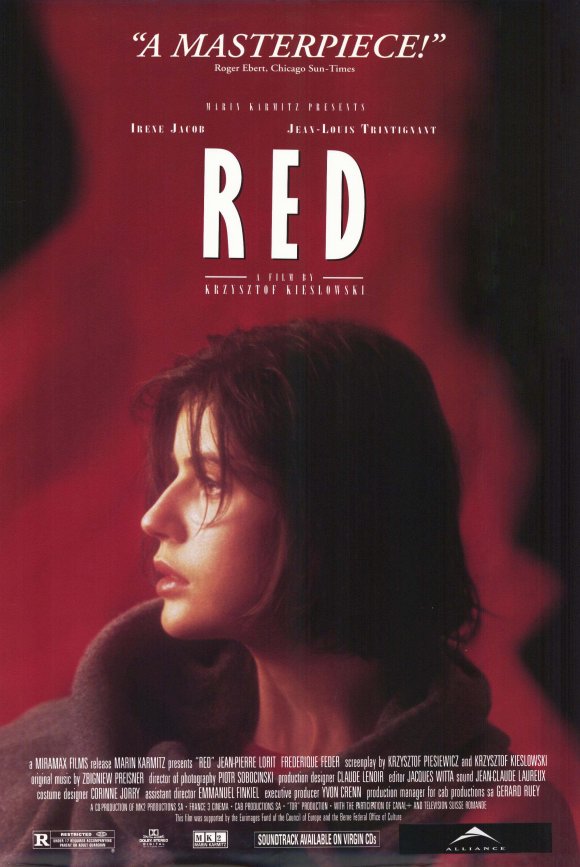
Three Colours: Red (1994) – Paths and Possibilities

As the dust settled and the cordite faded from the air, the instigators of the French revolution held aloft the severed heads of their old oppressors and proclaimed a new age of humanity; an age in which people would be governed not by the supposedly divine whim of royal genetics but by reason and the principles of the enlightenment.  Principles such as Liberty, Equality and Fraternity.  Over two hundred years later, the polish director Krzysztof Kieslowski decided to devote a trilogy of films to the question of what these hallowed values mean to the modern world.  The results are far from a glowing endorsement.

In Blue, Kieslowski renders liberty as an icy internal exile from those who would love us.  In White, he reinvents equality as a bitter and demented desire to get even. In these two films we see Kieslowski’s belief that, rather than founding a new society, the values of the enlightenment now serve to drive us apart.  Given this pessimistic assessment of the first two revolutionary values, it is surprising to discover in Three Colours: Red an exploration of the concept of Fraternity that is both upbeat in tone and resoundingly hopeful in outlook.  For Kieslowski, Liberty and Equality are virtues that drive us into the isolation of individualism while Fraternity, the sense of a common bond between all people, is the value that conspires to bring us together despite ourselves.

Continue reading →

Three Colours: White (1994) – Bitches Ain’t Shit…

There are words that yield far more easily to the lips than they do to the mind. Every day, we reach for a set of shared values and concepts which, laid down in another place and another time, no longer seem as well defined as they used to be.  Krzysztof Kieslowski’s Three Colours trilogy springs from a desire for clarification, to return to the revolutionary French values of Liberty, Equality and Fraternity and ask: What do they mean for us today?

Three Colours: White is the second film in the trilogy and its conceptual slipperiness reflects the fact that equality is one of our least understood values.  We all want to live in an equal society but do we really understand what equality entails and where in our society should the value of equality assert itself? Does a commitment to equality entail a commitment to equality of outcomes or of opportunities? Or are we talking instead about the creation of a society in which everyone is equally happy and/or equally miserable? Three Colours: White explores the dubious morality of a pursuit of emotional parity.

Continue reading →