REVIEW – Polisse (2011)

FilmJuice have my review of Maiwenn’s award-winning police drama Polisse.

The critical success of The Wire and The Sopranos has created something of a market for intelligent police procedural dramas. Incapable of keeping up with demand, British TV has begun casting its net further afield than the anglophonic sphere resulting in the explosive popularity of French series like Spiral and Braquo and Scandinavian series such as The Killing and The Bridge. Clearly designed to tap into a similar zeitgeist, Maiwenn’s Polisse is an intelligent and bleak police drama set around a Parisian child protection unit.

Maiwenn decided to make the film after seeing a documentary about child protection units. Drawing on her showbiz contacts, the director embedded herself in a working police unit and recreated everything she saw on set with actors. In other words, when a stressed single mother explains that one of her sons is better behaved than the other because she jerks him off every night, chances are that someone actually said that to a police officer in front of this film’s director.  Even more astonishing is the fact that the woman’s naïve belief that this type of behaviour is a normal part of parenting is utterly convincing and disarmingly human. Shot in a documentary style and performed by an absolutely fearless cast of adult and child actors, these little vignettes crackle with the kind of uncomfortable energy that you only get when an unpleasant truth is well and truly pinned down.

As brilliant as these interview section may be, the rest of the film suffers for Maiwenn’s misguided attempt to crowbar an entire TV series’ worth of narrative and character development into a mere two hours. What this means is that while each of the ensemble cast receives a big emotional moment, none of these moments feel in any way connected to the film’s limited space for character building and drama. The result is a film that lurches from one hysterical outburst to the next and by the time you’ve seen your third copper break down in tears and punch a wall the film’s hysteria begins to seem comical, which is really quite unfortunate for a film about child abuse.

REVIEW – Mon Oncle (1958)

FilmJuice have my review of Jacques Tati’s satirical comedy Mon Oncle.

When I recently reviewed Tati’s Jour de Fete, I was struck by how little satirical power the film actually possessed. Jour de Fete‘s satire is entirely toothless as it attempts to mock the desire for improved professionalism and efficiency by telling the story of a local postman who falls for an American propaganda film portraying American postmen as militaristic supermen who ride motorbikes through flaming hoops in an effort to deliver the mail as quickly as possible. The problem with this ‘joke’ is that exaggerates both American efficiency and the French desire to emulate American efficiency to the point where neither the subject nor the satirical instrument bear any relation to reality. Judged solely as a satirical piece, Mon Oncle is a far superior film to Jour de Fete as it not only nails the bourgeois aspirations but also the way in which these bourgeois aspirations bring nothing but ugliness and misery to the world. Set in a city of two halves, the film sends Tati’s slovenly Monsieur Hulot out of his charmingly tumble-down apartment and into the corporate suburbs where everything is clean, modern, American and monstrously ugly:

The plot of the film revolves around a battle for the soul of Arpel’s son Gerard who adores his uncle despite the fact that Hulot has no job, no ambition and no material possessions outside of his hat, raincoat and pipe. Realising quite early on that Hulot appears to be have an undue influence on his son, Arpel attempts to lure Hulot into his life of bourgeois consumerism first by fixing him up with a wealthy neighbour and then by offering him a job in his hose pipe factory. Tati chronicles these doomed attempts at embourgeoisement with a good deal of charm and inventiveness as Hulot brings chaos to dinner parties, family meals and the workplace. Hulot turns gardens into building sites, hosepipe manufacture into sausage making and expensive sofas into unfashionable beds. Like a virus with hat and pipe, Hulot spreads authenticity wherever he goes resulting not in his elevation to the bourgeoisie but the collapse of his in-laws into the same happy slum where he (and by implication most French people) live their daily lives.

I liked this film a good deal more than I liked Jour de Fete as Tati’s gentle slapstick takes a back-seat to his desire to criticise the French middle-classes.  On a technical level, the film is also a good deal more impressive as Tati attacks French society in quite complex ways but without using very dialogue. The result is an absolute masterclass in visual storytelling.

REVIEW – Jour de Fete (1949)

FilmJuice have my review of Jacques Tati’s Jour de Fete, which has just been given a dual-format re-release by the BFI.

Tati has always been something of a problematic figure for me. Having seen Les Vacances de Monsieur Hulot, I have always been aware of Tati’s skills as a performer but I have never quite grasped why it is that Tati is taken seriously as a filmmaker whilst the work of most comic directors is studiously ignored. One answer to this perplexing problem is that Tati’s work was championed by a certain group of critics at a certain point in time and that nobody has since bothered to question the assumption that he is a great film-maker. Another answer is that Tati, though a director of comedies, not only developed a coherent voice but used that voice to critique French society.

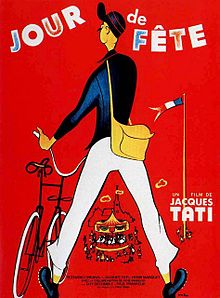
Set in a small French town in the midst of a carnival, Jour de Fete is a whimsical slapstick comedy featuring a country postman who takes it upon himself to modernise the entire French postal service, one delivery at a time. Unfortunately, while I appreciate both the uniqueness of Tati’s vision and his skill as a performer, I found the satirical elements a little too broad to be genuinely effective:

Jour de Fete is often spoken of as a treatise against American-style modernisation and while it is easy to see that Tati is attempting to satirise the ludicrous idea of an efficient French postal service, the satire is so broad that it fails to gain much traction on the world. Indeed, the best joke in the entire film is the idea that American postmen are so fast and efficient that they train for their jobs by jumping through flaming hoops on motorbikes. However, as beautiful as this idea may be, its absurdity completely overcooks the gag and boils away the film’s satirical edge leaving only a whimsical residue. The point of satire is to mock things that actually exist but surely even the most zealous of corporate reformers would allow postmen to get off their bikes when delivering letters. By presenting the desire for economic modernisation in such ludicrous terms, Tati’s satire fails to connect with anything real.

Or maybe it’s just me.

French Style – How Economics Turns World Cinema into French Film

Earlier this year I wrote a post about the lack of diversity in the films considered for the 2012 Cannes Film Festival Palme D’Or. While that post focused principally upon the demographics of the directors considered for the award, I was also concerned by the Cannes-centric feedback loop that appears to be encouraging non-French film directors to begin making films in France. I delve into this idea in a little more depth in my latest feature for FilmJuice entitled French Style – How Economics Turns World Cinema into French Film.

The thrust of my argument is that France has become so good at protecting and encouraging French film that the French film scene is beginning to suck talent from the rest of World Cinema. The most notable examples of this process are the Iranian film director Abbas Kiarostami and the Austrian director Michael Haneke:

By providing ambitious filmmakers with an oasis of financial stability, the French state may also have begun a process of cultural assimilation through which non-French directors surrender their distinct cultural identities in an effort to produce French films for the French marketplace.

Aside from the fact that non-French cinematic voices are beginning to acquire a distinctly Gallic accent, there is also the problem posed by these older established voices crowding out younger home-grown talents. France ensures that a certain number of its cinema screens must show French films but why would a cinema chain choose to show a French film by a director like Mia Hansen-Love and Katell Quillévéré when they can show a film by an award-winning star of world cinema?

REVIEW – The Woman in the Fifth (2011)

VideoVista have my review of Pawel Pawlikovski’s The Woman in the Fifth. Based on a novel by Douglas Kennedy, the film is a meditation on the costs and benefits of artistic creativity. Grounded firmly in the old trope of a sensitive and broken man who is only saved by the love of a good woman, the film presents its central character with a choice between a woman who makes him creative but also insane and a woman who makes him happy but only at the expense of his capacity to write.

I have two main problems with this film. The first is that the vision of creativity the film proposes is based entirely upon an almost ludicrously self-indulgent and melodramatic vision of the creative process. Many gifted artists produce great work without lapsing into either madness, violence or depression. Frankly, seeing these psychological problems as an inevitable by-product of the creative process is nothing more than palliative bullshit put about by people who really need to start taking responsibility for their own mental health. Being an artist does not make it okay for you to be a complete prick.  The second problem is that while Pawlikovski’s direction is entirely watchable, it is also desperately boring. Seriously… what is going on in art house filmmaking? when did it all become so fucking boring?

We are currently undergoing the greatest economic and social crisis since the Great Depression and the political decisions made today will shape the future of entire continents for generations to come. Given that the world is now continuously shifting beneath our feet and that our democratic institutions are positively crying out for an intelligent electorate that can understand and engage with the issues confronting them, do we really need another film about a novelist who is struggling with writer’s block? Do we really need another French film in which a bunch of listless Parisians tumble in and out of bed with one another? Do we really need another film in which a terminally passive and unattractive male protagonist somehow finds himself at the centre of a vortex of redemptive totty? The answer to all of these questions is a resounding ‘No!’

As I said in my piece about this year’s Cannes film festival, European art house cinema is rapidly becoming stale. A decaying boy’s club dominated by a shrinking clade of middle-aged white guys, both its ideas and its language are in desperate need of renewal and The Woman in the Fifth is yet further proof of the scene’s increasing creative sterility. Did we need another film about a novelist with writer’s block? FUCK NO! Nor do we need another polite little film directed by a middle-aged European white guy. Pawel Pawlikovski is not a bad director by any stretch of the imagination but he is a director who is part of the problem. Pawlikovski’s early works including Dostoevsky’s Travels and Tripping with Zhirinovsky were deeply personal reflections of a youth lived under Communist rule. However, as Pawlikovski freely admits in the Blu-ray’s extras, he has decided to set aside the things that made him unique as a director in order to churn out the same old derivative francophilic shit as every other art house director. Clearly… this shit needs to stop.

REVIEW – The Portuguese Nun (2009)

FilmJuice have my review of Eugene Green’s art house drama The Portuguese Nun.

Set in the backstreets of Lisbon, The Portuguese Nun tells the story of a French actress who plays the part of a Portuguese nun in a historical drama. Left mostly to her own devices by a director who prefers shooting architecture to working with his actors, she aimlessly wanders the streets of Lisbon encountering a series of male archetypes who compel her to examine the person she has become. Hounded by self-doubt and self-loathing, the actress eventually finds redemption at the hands of a local nun who helps her to realise the similarities between her life and that of the character she plays in the film.

Beautifully shot and partly redeemed by a final confrontation that positively reeks of human desperation and beauty, The Portuguese Nun is a profoundly problematic film. The main problem is that while the film does contain some ideas and some elegant photography, these moments of beauty struggle to redeem a film that is ultimately nothing more than a boring homage to art films passed:

The first thing that strikes you about The Portuguese Nun is the eye-catching beauty of its cinematography and the purity of its visual composition. As with Jose Luis Guerin’s In The City of Sylvia and Jim Jarmusch’s The Limits of Control, we spend so much time simply experiencing the city that its moods and textures come to form an integral part of the film itself. Indeed, The Portuguese Nun is probably best understood as an homage to the Portuguese director Pedro Costa whose films In Vanda’s Room and Colossal Youth attempt to capture the patina of life in a Portuguese city and reduce it down to some purified artistic essence. However, unlike Jarmusch and Guerin who use the interaction between their cities and their characters to tell a story and advance an idea, Costa and Green are quite content to treat their cities as ends in themselves resulting in excruciatingly boring but undeniably decorative cinematic experiences.

Though I absolutely adored both The Limits of Control and In The City of Sylvia, I genuinely struggle to see the point of the kind of films that are produced by the likes of Green and Costa. Beautiful photography and a steadfast refusal to indulge anything as proletarian as plot or characters are all very well but art house directors have been making variations on this particular theme for fifty fucking years! Frankly, there is only so many times that you can march your audience round a picturesque medieval city before people start questioning the artistic point of the excursion. When I reviewed Pedro Costa’s Colossal Youth I argued that these types of films are a kind of shibboleth for cinephiles in that they are so profoundly and perversely uncommercial that they seem like nature’s remedy to the Transformers and Avatars of this world.  Unfortunately, beauty and truth do not triangulate and while the likes of Transformers are undeniably dumb as posts, it does not follow that truth and beauty will emerge simply by making the opposite decision to every choice made by Michael Bay. In order to justify lengthy run times in which nothing happens, directors must have a point to make or an argument to advance and it is increasingly clear to me that the likes of Green and Costa propose neither. Self-indulgent, pompous and not particularly intellectually engaging, these films are a toxic perversion of the techniques that go into true art house filmmaking. Frankly, I worry for a critical fraternity that struggles to see the very clear differences between smart films like In The City of Sylvia and ploddingly pretentious disasters like The Portuguese Nun.

REVIEW – Le Silence de la Mer (1949)

FilmJuice have my review of Jean-Pierre Melville’s first film Le Silence de la Mer.

Given that Melville is best known for such noir crime thrillers as Bob Le Flambeur (1955) and Le Samurai (1967), it is surprising to discover that his first film is neither a thriller nor an homage to the noir classics of Hollywood’s golden age. In fact, Le Silence de la Mer is an adaptation of a novel written by a member of the French resistance. Densely atmospheric and pointedly stripped of all extraneous dialogue, the film tells the story of the relationship between a pair of French people and the Nazi officer they are ordered to provide with lodgings. Every evening, the Nazi officer comes home and trots out a few pleasantries that the French people pointedly ignore. As the months go by, the officer’s love of France and desire to talk bubbles over into a series of impassioned speeches about his hope for the future of Franco-German relations. Aside from being beautifully composed and wonderfully still, Le Silence de la Mer is also wonderfully ‘of its time’ thematically speaking:

Aside from its technical brilliance, Le Silence de la Mer also offers a fascinating snapshot of a French intellectual class that was still trying to come to terms with the implications of widespread collaboration. Indeed, between the officer’s status as a ‘Good German’ and his lengthy speeches on the greatness of French culture, it is easy to read this film as an ode to the majesty of France (the film is based on a novel written by a member of the resistance) but look beyond the foreground and you find a morally ambiguous world full of silently complicity French people, bars closed to Jews and a Nazi delivering what was effectively the Petainist line that France would become greater through collaboration. While Le Silence de la Mer may lack the slow-burning outrage of Melville’s more famous indictment of French collaboration L’Armee des Ombres (1969) this is still a heroically ambiguous film from a time when France was desperate to escape all suggestion of moral ambiguity.

As someone who owns the Mieville DVD box set, I was somewhat taken aback by how different this film feels to many of his better-known works. Indeed, contained in this still and ambiguous early film are the blueprints for an entirely different cinematic career… what if Melville had not become a maker of thrillers but a more traditionally art house experimentalist? This is a film that captures the attractions of just such a possibility.

REVIEW – L’Atalante (1934)

FilmJuice have my review of the Jean Vigo’s L’Atalante, which is being re-released in cinemas by those noble folks at the BFI.

Though not quite as subversive or as loveable as Renoir’s Boudu Saved From Drowning (with which Vigo’s film shares the incomparable Michel Simon), L’Atalante still offers a fascinating portrait of a style of life that has long since been extinguished.  Set on a French canal barge, the film explores the tension between a young woman’s desire to be with her husband and her desire to see the outside world. Evidently a man of his times, L’Atalante concludes that young women probably should stay close to their husbands but while Vigo seemingly has little affection for the life less civilised, he does an absolutely brilliant job of capturing all of its glamour and mystery:

While the film ostensibly takes its name from Jean’s ship, the ship’s name refers to the Greek mythical figure of Atalanta who refused to marry until one of her suitors could beat her in a footrace. Like many strong female mythological characters, Atalanta is something of a feminist icon but Vigo presents Juliette’s escape in decidedly ambiguous terms. Indeed, while Jean is clearly a stick-in-the-mud Vigo’s depiction of Juliette’s travails in the outside world make it clear that he thinks that the best place for her is with her husband. The only thing preventing the sexism fairy from getting to this film is the fact that Jean effectively falls apart once he realises what he has lost in Juliette. While the strength of Daste’s performance and the affective power of Vigo’s depiction of Jean’s despair prevent the film from ending on a sour note it is interesting to see that it is Father Jules and not Jean who manages to track down and ‘save’ Juliette suggesting (in accordance with the myth) that it may be the colourful Jules and not the drably professional Jean who is Juliette’s true soul-mate.

Given that our media landscape is increasingly concerned with the new and the fresh regardless of its quality, it can feel oddly contrarian to go and see an 80 year-old film at the cinema. After all, these types of film are all available of DVD so why would you bother to go and see them at the cinema when you could go and see Ghost Protocol instead? The answer is that there is still something unique about seeing old films in the way that their creators intended. To be held spell-bound by images of people long dead in a world long disappeared is a really strange but entirely rewarding experience that I simply cannot recommend highly enough. Go and see this film in the cinema and, believe me, you will be glad that you did.

REVIEW – Mademoiselle Chambon (2009)

FilmJuice have my review of Stephane Brize’s drama Mademoiselle Chambon.

Based on a plot synopsis alone, Brize’s story of a happily married man who falls in love with his child’s primary school teacher might seem stupefyingly generic. After all, how many films do the French really need to make about attractive middle class people and their complex romantic entanglements? Despite the highly generic nature of its plot and themes, Mademoiselle Chambon in nonetheless a fascinating watch because Brize tells this very conventional story in an entirely unconventional manner:

Mademoiselle Chambon is a film that lives and dies by its awkward conversational pauses. These kinds of pauses will be familiar to fans of European art house film as they are widely used in that cinematic tradition to create an impression of psychological depth, the idea being that if you have the characters do something unusual and then allow the audience the time to speculate about why they did it, the insights they gain seem more profound and intelligent than if the characters had delivered them through dialogue. However, while these kinds of pauses usually hint at such unpalatable emotions as rage, sadness and alienation, Brize uses them in order to denote the presence of deep but well-hidden passion. Mademoiselle Chambon never directly addresses the love between Jean and Veronique, instead it traces the outline of their desire in the minutiae of everyday life.

While I was not entirely convinced by the way the film ended, I was nonetheless impressed by Brize’s approach to storytelling. His grasp of emotional nuance and his ability to explore those nuances through entirely non-verbal means makes Mademoiselle Chambon a great place to start acquiring an interest in art house film.

It’s (Probably) Okay Not To Have Any Ambition

0.    Oh Shit

I recently wrote about the difficulties I have relating to groups. As a not particularly well-socialised human being who spends an inordinate amount of time in his head, I frequently see groups of humans as more trouble than they are worth. Yes, I could seek their approval and Yes, I could throw myself into one of their cultural institutions but my general feeling is that most attempts at collaboration are doomed to end in frustration and alienation. As I said, I do not relate well to groups.

One of the symptoms of my frustration with groups is an extreme sensitivity and antipathy to people who are obviously trying to “get on”. I rage at self-publicists and bristle at any attempt to win me over, coerce me or play me. This is one reason why I abhor the performative aspect of Internet life. I groan at the moral outrage of Twitter as I know that its hysteric nature has less to do with genuine expressions of anger and sorrow than it does with broadcasting the fact that you are the type of person who gets really annoyed about this type of thing. Similarly, people engaged in attempts at climbing the greasy poll immediately repulse me. I hate dishonest reviewers who swamp Google search results with jottings designed to secure them more review copies and more invitations to parties and I am horrified by the people who turn their coats and trade in careers as commentators for careers in the industry on which they are commenting. I hate all of these things because I am obsessed with the need to be authentic and I prize nothing above honesty with both oneself and the world around us. Of course, the problem with this attitude is that it is complete and utter bullshit.

Continue reading →