 Half an hour into Patrick Lussier’s uneven but ultimately likeable neo-grindhouse pseudo-exploitation film Drive Angry, there is a scene that manages to perfectly encapsulate what it is about this film that makes it both intensely silly and surprisingly interesting. In this scene, Nicolas Cage’s character John Milton is having sex with a waitress he picked up in an Oklahoma roadhouse. As the naked woman groans in pleasure and writhes around on the end of his (presumably massive) penis, Cage’s character stares impassively into space from behind a large pair of wrap-around shades. Despite being in mid coitus, Milton is fully dressed and smoking a (noticeably massive) cigar. He also has a bottle of Jack Daniels in one hand. When a bunch of Satanists come crashing through the door hoping to kill Cage’s character, Cage calmly scoops up the waitress and proceeds to shoot them all dead without either spilling his drink or pulling out of the waitress. Drive Angry is a film about humanity’s unquenchable desire for pleasure. It is not enough for these characters to have sex, they also have to smoke cigars and drink hard liquor while they are doing it. Nor is it enough for them to have exciting shoot-outs, they also have to have sex at the same time. Drive Angry is filled with characters that go to extraordinary lengths in order to satisfy their desires, but no matter how much fun, sex and excitement they have, there is always something more that needs doing.
Category / American Film
Captain America (2011) – A Star-Spangled Slave?
 0. A Capsule Review
Despite concerns about both the character and the decidedly uneven quality of Marvel’s cinematic output, Joe Johnston’s Captain America: The First Avenger reveals it to be one of the most engaging superhero films to grace the silver screen since Sam Raimi’s masterful and genre-defining Spider-Man 2 (2004). Aside from engaging central performances from Chris Evans and Hugo Weaving as Captain America and his nemesis the Red Skull and a perfectly serviceable script by Narnia alumni Stephen McFeely and Christopher Markus, the film benefits hugely from an impressive directorial turn by Johnston himself.
Johnston began his career as concept artist and special effects technician George Lucas’ Star Wars (1977) before going on to win an Oscar for his effects work on Steven Spielberg’s Raiders of the Lost Ark (1981). From there, Johnston graduated to direction but while none of his previous films stand-out as particularly worthy of praise, his work on period superhero flick The Rocketeer (1991) clearly stood him in good stead when Marvel went looking for a director to deliver Captain America from the depths of comics obscurity and into the centre of the media frenzy that will be Joss Whedon’s 2012 Avengers film.
As might be expected from a director who worked on both The Rocketeer and Raiders of the Lost Ark, Johnston delivers a film that walks an elegant line between rich period detail and fantastical anachronism. Unlike the Wagnerian belle époque of Branagh’s Thor (2011) or the muscular modernism and Gee-whizz Californian cool of Favreau’s Iron Man (2008), Johnston’s Captain America fails to break new ground but is all the more visually engaging for it. We have seen these sorts of gizmos and sets a dozen times before but Johnston does it better and more beautifully than most.
Aside from its impressive visuals, Captain America also benefits from a well-paced plot buttressed by some well-shot action sequences that help the film’s somewhat excessive 124 minutes slip by almost unnoticed. In an age where every Summer blockbuster feels the urge to edge further and further past the 120 minute-mark, Johnston delivers a film that wears its extended run-time like a well-fitted demob suit.
While all of these ingredients contributed to my enjoyment of the film, what really won me over was Captain America himself. Prior to the film, my experience of the character was limited to (a) the old animated series, (b) a few issues of Cap’s collaboration with the Falcon and (c) Ed Brubaker’s entirely over-rated run on the comic. Taken together, these created the impression of a character completely ill-suited to the modern world. Indeed, Brubaker uses Captain America’s origin story as a means of re-inventing the character as an isolated figure whose memories of the past alienate him from the people around him. However, returned to his original timeframe, Captain America’s old fashioned heroism somehow seems strikingly original and fresh.
Indeed, Captain America: The First Avenger features an origin story whose complete absence of angst is nothing short of revolutionary. Indeed, Captain America is the first cinematic Superhero to not be a slave.
REVIEW – Super 8 (2011)
 FilmJuice have my review of J.J. Abrams’ Super 8.
The film is intended as an homage to the sorts of family action adventure movies that Spielberg used to dominate the cinematic landscape in the 1980s. Think ET and Goonies. As I explain in the review, the film adopts the traditional Hollywood template of having two distinct narratives that interweave and feed off of each other. Traditionally, in these types of films, one narrative is very mundane and all about kids growing up, while the other is more fantastical. These two plot lines then intersect in such a way that the fantastical elements of the film help the kids to confront issues in their everyday life such as divorce, the death of a parent or simply growing up. Knowing a good template when he sees one, Abrams uses the same trick in Super 8 but, because this is a J.J. Abrams film, he tries to add a postmodern flourish to the film by making it all about a bunch of kids running away from aliens whilst trying to make a film:
Unfortunately, while all of these themes and narratives work superbly on their own, they never quite manage to link up and feed into each other meaning that Super 8 is never more than the sum of its parts. The failure of the film’s various subplots to connect with each other is particularly noticeable in the film’s conclusion when what should have been a moment of heart-rending reconciliation falls completely flat because all of the journeys undertaken by the characters were undertaken alone.
Though unlikely to prove as memorable as any of the films from the 80s genre boom, Super 8 is nonetheless an entertaining soufflet of a film that contains some real spectacle and some real heart.
Tree of Life (2011) – Cheese is Bad for You
 Tree of Life begins with both a question and a tentative answer. The question comes from the Book of Job:
Where were you when I laid the earth’s foundation…while the morning stars sang together and all the sons of God shouted for joy?
The context of this line is slightly peculiar but, for the moment, we can interpret it as being existential in nature: It is a demand for explanation. Where were you? Where am I? Who am I? Teasingly, Malick provides an initial answer in the form of a voice-over. There are, we are told, two paths in life: a path of Grace and a path of Nature. The path of Grace, the voice-over explains, is fearless, rewarding and free from self-doubt and self-awareness. It is a path that one walks seemingly without being aware that one is walking a path. Tellingly, Malick neither tightens his question nor the concept of Grace that he offers as a potential solution. Nor does he ever bother to explain what the path of Nature might entail. One way of reading this hand-waving is by assuming that Malick is challenging his audience: What is Grace? What is Nature? How do you walk these paths? How does walking these paths answer the fundamental existential questions of being? All will be revealed in the film that follows. However, I will argue that Malick’s evasiveness is the entire point of the film. In life, answers are fleeting and all attempts to seek clear answers are doomed to end merely in more questions. Tree of Life suggests that no matter which type of cheese (be it ‘happiness’, ‘enlightenment’, ‘Grace’ or ‘union with the Godhead’) we seek, life will always be a maze.
Some Thoughts On… Beginners (2010)
 Let me begin by saying that I went in to Beginners with an open heart. Mike Mills’ semi-autobiographical story of a man groping towards a sense of identity and a reliable source of happiness in the wake of parental death is pretty much where I have been living for the last twelve months. However, rather than seeing elements of my own experience in Mills’ gently affecting comedy-drama, I was struck only by the grinding mediocrity of his insights, the laziness of his exposition and the shameful over-reliance on art house narrative techniques to pad out a story that involves far too much hand-waving and not nearly enough heart-tugging or head-scratching.
Writer/director Mike Mills projects himself onto Oliver (Ewan McGregor), a professional illustrator who is struggling to put his life back together after the death of first his mother and then his father.
As Oliver cleans out his father’s house, he comes across a personal ad drawn up by his dad in the wake of his mother’s death, a personal ad written in hope of attracting some younger male lovers. Indeed, though Oliver’s parents Hal (Christopher Plummer) and Georgia (Mary Page Keller) were married for decades without a hint of either separation or divorce, Hal was actually gay. His wife buried, Hal comes out of the closet aged seventy-three and spends three years living the sort of life that he should have been living all along. A life filled with sex, socialising, clubbing and political activism.
Oliver’s experiences nursing his father through grief, self-realisation and terminal illness are laid bare in a narrative that is inter-cut with scenes from Oliver’s present, a present in which he has embarked upon a relationship with a French actress named Anna (Melanie Laurent). By interweaving elements from Oliver’s past and his present, the film slowly points out the similarities between Oliver’s life and that of his father:
Hal grew up at a time when being gay was treated as both a mental illness and a moral failing. In the hope of living something approaching a ‘normal’ life, Hal decided to marry a woman he could not love in the hope that happiness might come to him by osmosis. We later see Hal repeating this pattern with his younger boyfriend Andy (Goran Visnjic), whose desire to sleep with other men clearly hurts the naturally monogamous Hal. Oliver, by contrast finds himself unwilling to make any concessions to the women he dates. Easily trapped in love’s initial dizzying updraft, Oliver soon finds himself getting bored and restless with his relationships. Incapable of understanding why he should tolerate anything other than perfect happiness, Oliver sinks his relationships and winds up alone again and again. Beginners is essentially the story of Oliver’s realisation that happiness and love are born of compromise and realism rather than rare passion and emotional perfectionism. Neither of Hal’s relationships were perfect and yet he lived a happy life. Oliver is unwilling to put up with anything short of absolute happiness and is unwilling to compromise or work at being happy and so he winds up being far more miserable and alone than a man who was gay in the 1950s. In other words, Oliver is as spoiled and narcissistic as he is self-involved. This is ultimately why the film fails to convince.
Beginners’ root problem is the fact that it really does not have very much to say. The fact that Oliver is utterly self-involved is obvious in almost every beat of the film. We can see it in the fact that the film’s most insightful comments emerge during Oliver’s one-sided conversations with his dog, we can see it in the fact that he initially falls for Anna because she literally cannot speak and we see it in the fact that Hal’s story is used largely as a prop for Oliver’s generic brand of soul-searching. Indeed, it turns out that when a gay man spends fifty years living a lie only to snatch a few years of happiness in the shadow of terminal cancer, it really is all about the straight guy. By choosing to focus not upon Hal’s story but upon what Oliver learns from Hal’s story, Beginners reduces the social history of an entire generation of gay men to the status of props in the on-going indulgence of a generation of white, middle-class straight people whose dull and shallow problems already form the backbone of the indie canon. Worse still is the fact that, despite plundering the lives of a generation of gay men, Mills still struggles to come up with anything to say. Oliver begins the film as a sad, self-involved narcissist and he ends the film as a sad, self-involved narcissist without budging an inch or generating a single spark of insight in the process.
Aside from the dubious treatment of homosexuality and the general lack of insight into the human condition, what most annoys about Beginners are its rare flashes of complexity. For example, Mills occasionally transports us beyond the two interweaving narratives to Oliver’s relationship with his mother. Intriguingly, despite Hal and Georgia’s marriage coming at Georgia’s insistence, Georgia is presented as the victim of Hal’s dishonesty. Witty, wise and spunky in the best traditions of mid-century femininity, Georgia is endless lovely and this loveliness filters through into Oliver’s present in a decidedly Oedipal way. Indeed, while the foreground of the film suggests that Oliver’s unhappiness may be due to his similarity to his father, the film’s background subtly hints that Oliver’s failure to find love may be due to a lingering and yet intense sexual longing for his own mother. We see this in the way that Oliver’s seduction of Anna allows him to replay moments shared with his mother and we see it in the fact that Oliver meets Anna at a costume party where he is dressed as Sigmund Freud. The truth of Oliver’s emotional dysfunction is further hinted at in the fact that, when Oliver first meets Anna, she is dressed as a man. Sadly, while Beginners may hint at some real emotional complexity, the hints are never connected to anything in the film’s foreground and so remain nothing more than free-floating suggestions that could just as easily be the product of a starving critical brain in desperate search of insight.
Mills’ potential as a writer/director is also evident in his willingness to play tricks with the genre. For example, one of the most popular genre templates for romantic comedies is the story of a depressed man who learns to love again thanks to the life-changing ministrations of a quirky female love interest whose vivacity cuts straight through his emotional exile. These quirky female love interests are generally known as Manic Pixie Dream Girls. Initially, Beginners suggests that Anna may well be such a dream girl but, as the film progresses, it rapidly becomes clear that Anna is nothing of the sort. In fact, she is just as moody and self-involved as Oliver. In fact, if Beginners can be said to possess a Manic Pixie then the Manic Pixie in question is Andy, Hal’s Manic Pixie Dream Boy. However, while it is undeniably good news that American film has progressed to the point where it can happily transform heterosexual clichés into homosexual ones, it is frustrating to note that none of Wills’ genre-bending exertions serve any wider purpose.
Aside from being frustrating and stupid, Beginners is also a crushingly boring film. Billed as a comedy-drama, Beginners contains few laughs and little drama. What drama it does have is stretched to breaking point by the sort of long, drawn-out silences and palate-cleansing interludes that one would normally associate with art house film. Recent months have seen numerous critics rallying to the cause of cinematic boredom as a response to the on-rushing tide of cinematic spectacle that is the Hollywood blockbuster. Critics routinely cite the work of directors such as Yasujiro Ozu, Kelly Reichardt and Andrei Tarkovsky as proof that you can make beautiful films which, because of their lack of plot, are boring. However, while I agree that slow-paced films in which nothing happens can be superb, I do feel the need to point out that none of Ozu, Reichardt or Tarkovsky’s films are actually boring, they simply rely upon a suite of visual and atmospheric storytelling techniques that require lengthy pauses to allow the audience to assimilate what they have seen. Beginners is a boring film, not because it contains numerous pauses, but because it lacks the sort of visual, atmospheric and emotional complexity that requires careful assimilation and reflection. While Tarkovsky’s pauses allow us to realise the depth of his thinking, Wills’ pauses reveal only a lack of insight and a series of wasted opportunities.
Some Thoughts On… The American (2010)
 Directed by Anton Corbijn and based upon the Martin Booth novel A Very Private Gentleman (1990), The American is far too formulaic and slow of pacing for it to function as an effective thriller. However, if approached as more of a character study, the film does suggest some insight.
The film begins with Jack (Clooney) living in a snowy wilderness with a ‘friend’. When some assassins turn up and the ‘friend’ dies in the firefight, Jack the former spy is lured out of retirement and placed in the field by his former handler. Right from the start, Jack is a rootless and isolated man who walks through the world acutely aware not only of that world’s hostility, but also his lack of place in it. Like all spies, he is the resident of a demimonde of assumed identities and hidden skills. Corbijn communicates Jacks demimondaine status by having him instantly recognise a fellow demimondaine who hires his to make a custom-built gun for her.
As Jack attempts to pull together the tools that will allow him to work on the gun, he is forced to make friends with the local priest; a man who not only knows his place in the ‘grand order’ of things but also within his local community. Much like Jack, the priest has secrets but, unlike Jack, he does not allow these secrets to isolate him from the people around him. In fact, his secrets only serve to embed him even further in the local landscape. He is a rock of his community, a man completely at home in the world for all of his propensity to dwell on that which lays beyond it.
As he works on the gun, Jack begins two contrasting relationships: The first is with the fellow spy. Corbijn does an excellent job of communicating their rootless flirtation by having the pair demonstrate the extent to which they trust each other (they aim loaded guns at each other and even fire in their general direction and yet they do not shoot one another) while the traditionally trappings of seduction and romance are revealed to be nothing more than props in case the police should pass by. The second relationship with a local prostitute resembles the first in so far as it too spurns the traditional trappings of romance and seduction but here the oddness of the flirtation is presented more as a sign of openness and complete honesty than of guile and mis-representation.
When Jack decides that he wants to get out, his handler predictably turns on him and Corbijn struggles to fill the formulaic denouement with anything approaching tension or dramatic charge. In a way, it simply does not matter if Jack gets out… the heart of the film lies in its portrait of a man struggling to deal with his sense of alienation from community and landscape alike.
The American is one of those films that reminds me why it is I think that spies are posterboys for the postmodern condition: Isolated, deracinated and living in a world they not only do not belong to but actively fear, spies fill their days with the ritualised mundanity that is tradecraft: Check to see if anyone has been in while you were out, check to see if anyone is following you, check in with your handler, check the dead letter box, check to see if your contacts have gotten back to you and all along make sure that nothing you do makes you stand out as anything other than ‘normal’. Spies are people alienated from society who spend all of their time trying to pass for members of the societies they live amongst. That sense of alienation combined with paranoia and intense longing for membership and place are the constituent parts of that postmodern existential urge to belong and to know where one stands.
The fact that Jack’s flirtations are with women who exist on the margins of society is telling. By virtue of being a spy and a prostitute, the film’s female characters are both people who, like Jack, pass as normal thanks to having learned the rules of normality from the outside, as aliens. Jack’s stilted and technical conversation with the female spy reveals what the aliens’ language might be like while Jack’s awkward flirtations with the prostitute seem to hint at a path out of the demimonde and into the sunlight of normality.
As much as I liked the film’s capacity for capturing the postmodern condition, I was not all that convinced by Jack’s desire to return to the real world. At the beginning of the film, he is living a ‘normal’ life in the middle of nowhere and it is not clear why it is that a life embedded in the real word should be superior to that or why Jack should require ‘the love of a good woman’ to save him. The slow pacing of the film and the atmosphere of art house detachment and depression invites us to speculate about Jack’s inner state but with a plot this formulaic, I found myself unwilling to turn a blind eye to the lack of depth. A few extra scenes fleshing out Jack’s existential dread beyond there merely generic would have transformed this from a perfectly watchable film into a good one. A missed opportunity but very much part of a growing tradition of existential spy films.
REVIEW – The Kremlin Letter (1970)
 Videovista have my review of John Huston’s spectacularly misanthropic espionage thriller The Kremlin Letter.
Aside from its fantastically icy cinematography and its twisted multiculturalism, The Kremlin Letter is an extraordinary film in that it uses the noir idiom to call into question the utility and the morality of the Cold War cottage industry that was international espionage. Again and again, Huston returns us to the idea that while there is something heroic in fighting and dying to protect one’s country, there is absolutely nothing heroic about destroying someone’s life in order to force them to give up a few useless secrets:
It is telling that Huston neither shows us the letter at the centre of the plot, nor spells out what the letter means. The letter, like any mcguffin, exists purely in order to drive the plot but, can the same not also be said for the ‘information’ sought by real spies? How can a letter ever hope to justify the racism, misogyny, homophobia and outright savagery of the spies? In truth, the letter is but a fig leaf allowing the spies to pursue old professional rivalries and line their pockets at government expense. There is no justifying what spies do… no ‘information’ is worth such savagery, particularly when this is a war in which no shots are ever fired and where military muscle is only ever for show.
Despite the failure of the post-WWII intelligence apparatus to predict either the fall of the Berlin War or the attacks of 9/11, it is still largely unheard of for someone to call into question the need for an intelligence service. For Huston to do the same at the height of the Cold War shows not only remarkable character but also a rare amount of political and historical insight. As unpleasant as it is, The Kremlin Letter remains an astonishing film that deserves to be considered alongside Huston’s greatest cinematic achievements.
Some thoughts On… Page One: Inside the New York Times (2011)
NB: Thoughts On… is new strand for this particular blog. As I have been watching quite a few films recently, I have realised that while many films give me reason to ponder, not all pondering necessarily results in either a coherent opinion or enough substance for a full critical response. So instead of keeping such thought to myself, I have decided to share my thoughts on the various films I see as well as producing more developed pieces.
***
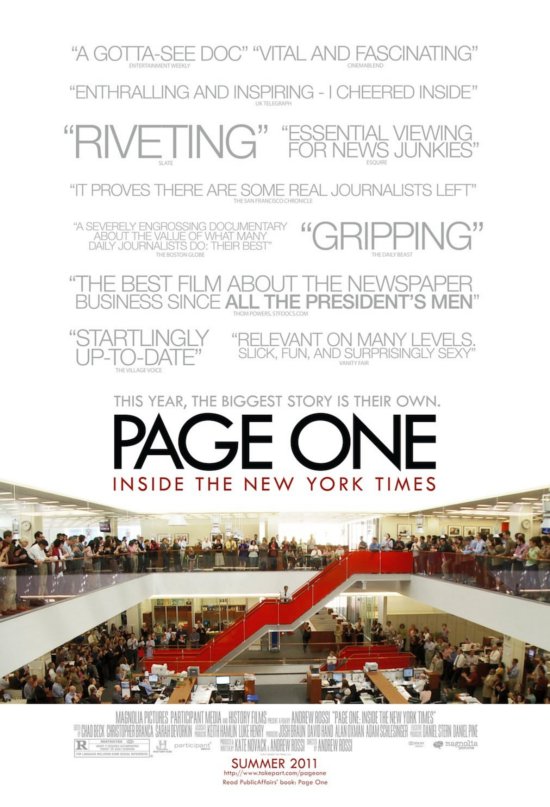 Currently on limited US release and in search of US distributors, Andrew Rossi’s Page One: Inside the New York Times primary concern is with the current economic state of the US newspaper industry and it asks whether there is still a place for an old media institution like the NYT. Indeed, with advertising revenue drying up, classified ads moving online and more and more people getting their news online for free, the question of the Times’ continued existence needs to be asked if only so that we can work out why it is that newspapers should survive. While Page One offers us an answer, I am not at all convinced that the answer it gives us is all that convincing.
Our guide through the issues surrounding the future of the newspaper industry is the NYT’s engaging media columnist David Carr. The doc follows Carr about as he breaks stories, interviews new media tycoons, takes part in panel discussions and gives speeches at journalism conferences. A gruff scarecrow of a man whose odd physicality speaks to his past as a drug addict, Carr is absolutely savage in his defence of the New York Times in particular and print media in general. In fact, Carr is so engaging a presence that it is difficult not to smile as he repeatedly swings a carefully sharpened and immaculately weighted hatchet at the reams of hyperbole generated by online mavens only too eager to dance on the grave of traditional print media. However, as engaging as Carr might be, I could not help but feel that Page One is only giving us half the story.
The problem is that Page One is a film that is utterly in love with its subject matter. Rossi repeatedly stresses not only the NYT’s history but also its continuing role as a purveyor of truth and a guardian of natural justice. Rather than giving equal time and equal weighting to both sides of the debate, the film portrays critics of old media as hyperbole-slinging crooks and straw men who take to the field of debate solely to provide the ferocious Carr with target practice. So one-sided is the battle that one cannot help but begin to wonder why it is that Carr spends all his time grappling with paper tigers when the real beasts of the jungle are allowed to go about their business unmolested. For example, in his book Flat Earth News (2008), Nick Davies points out that only 12% of the stories published in British newspapers come from actual reporters while 88% come either from recycling other papers’ stories or from cutting-and-pasting directly from press releases put out by pressure groups and business people. Once you realise that that 12% also includes stories generated through tabloid muckraking, the arguments put forward by Carr and his ilk begin to seem quite flimsy. Indeed, there is no denying that newspapers such as the New York Times do fantastic work in breaking important stories and unveiling hidden truths, but what of the remaining 88% of the stories that grace their website?
The question of whether newspapers are a public good that are worth protecting even as their business models crumble is an important one not only for the state of our public discourse but also for the future of democracy. By failing to answer any of the tough questions that can be asked of old media, Page One has not so much argued the NYT’s corner as sung its praises in the form of a funeral dirge. Nobody benefits from this sort of one-sided cheerleading, least of all an industry in dire need of waking up and smelling the coffee.
Page One is arguably at its best when it is not trying to help as its most cogent and powerful arguments for the continued existence of print media are not the ones that it explicitly makes but the ones that it makes by implication simply by showing the NYT’s journalists at work. In one brilliant sequence, the media editor and the foreign affairs editor discuss whether or not to report on a so-called ‘final patrol’ by US combat troops in Iraq only for the pair to reach the conclusion that the only people who are actually announcing the withdrawal of combat troops are the TV journalists that feature in the report and, because NBC are not actually at war in the Middle East, the story has more to do with TV reporters wanting narrative closure than it does with any real-world events of changes in policy. As the various editors toss ideas back and forth, it is easy to see quite how much thought goes into the honing of an editorial stance. These sequences suggest that there is far more to reporting than dumping a load of diplomatic correspondence on a website and the fact that the construction of editorial stances involve such careful deliberation and expertise is a powerful argument for the continued existence of what Clay Shirky refers to in the film as a professional media class.
The irony of Page One is that, had Rossi followed his own advice and left reportage to the reporters, this documentary would have been far more powerful an argument in favour of print media. However, instead of allowing the NYT’s reporters to speak for themselves through their entirely admirable actions, Rossi attempts to fashion a narrative and, in so doing, weakens his own case by producing a documentary, which, though undeniably enjoyable, feels stilted to the point of hagiography.
X-Men: First Class (2011) – Better Without The Class
 Living in the second decade of the 21st Century, it is difficult for us to cast our minds back and to recall the shocking novelty of Bryan Singer’s X-Men (2000). Up until that point, super hero films tended not to take place in the real world. Tim Burton’s Gotham City was a gothic masterpiece unlike anything on Earth while Richard Donner’s Metropolis seemed resistant to any changes in political culture that might stem from having a super-powered alien enforcing city by-laws. Prior to the release of X-Men, the politics of super hero cinema tended to follow the politics of super hero comics in so far as they existed solely at the level of sub-text. Sure, Stan Lee and Jack Kirby’s original X-Men was about racism and prejudice but those themes only emerged over time and Lee never took the risk of embarking on the sort of direct social commentary that might come from confronting his mutants with real-world events. This was, after all, the 60s…
By opening X-Men with a sequence involving a young mutant who uses his magnetic powers to bend the gates of a Nazi death camp, Singer elevated comic book politics from subtext to foreground. When American politicians planned to register all mutants, Singer was absolutely clear that this was a form of xenophobic fascism. When the parents of a mutant asked if their son had tried not being a mutant, Singer was absolutely clear that anti-mutant prejudice was akin to homophobia, racism and anti-Semitism. Bryan Singer’s X-Men films were not mere fantasies… they were stories about our broken and distorted world.
By the time Brett Ratner directed X-Men: The Last Stand (2006), much of the politics of the original film had drained away leaving only hot babes in tight outfits and dull whirlwinds of CGI presented with the same blend of hollow psychobabble and Christian imagery that pervades most super hero films. Five years later, the franchise is resurrected under the creative control of Matthew Vaughn and Jane Goldman, the pairing who brought us the somewhat uneven Kick Ass (2010). Moving from script to cinema in less than a year and with a creative partnership not known for either its creativity or its political engagement, X-Men: First Class had a steep slope to climb and while the finished product is far from flawless, the film does boast a level of intelligence and political thoughtfulness that is vanishingly rare in a genre whose recent successes include the dunderheaded Thor (2011) and the hyperactive Iron Man 2 (2010).
REVIEW – Insidious (2011)
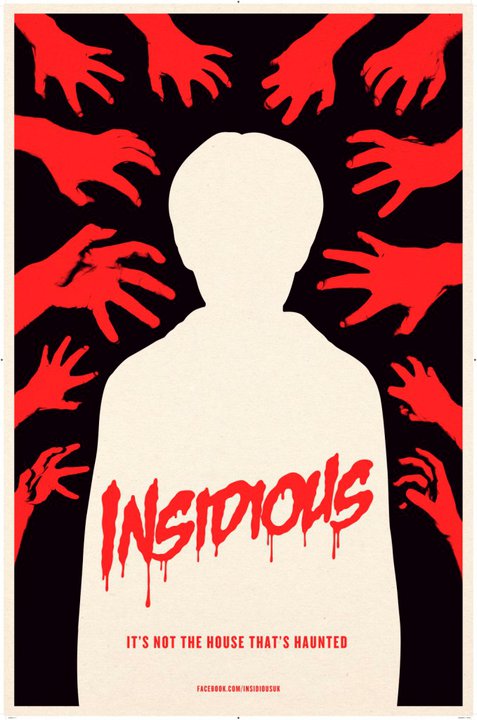 THE ZONE have my review of James Wan’s deliciously camp and thoroughly ridiculous Horror film Insidious.
Insidious is in some ways a remake of Oren Peli’s low-budget cult hit Paranormal Activity (2007) in that it is a story about a bunch of ghosts turning up and haunting an individual rather than a place. As in Paranormal Activity, the hapless victims of the haunting contact some ‘experts’ only to discover that the situation is in fact far worse than they had imagined. However, while Paranormal Activity made clever use of fixed cameras to make it look as though it had been shot by the victims themselves (an effect fatally undermined by the various special effects ‘added’ to the film for its UK cinematic release), Insidious moves right on past minimalist realism and into the realms of full bore gonzo:
Insidious is proof that Horror still has the power to entertain and to thrill without the need for 3D gimmickry, pointless nostalgia or needless deconstruction and that all you need to deliver a really effective work of cinematic Horror is a good crew and a talented director to guide them. You don’t even need a script. Or actors. Or ideas…
Warmly recommended for anyone who likes their Horror well-made but also a little bit silly. See also Jaume Collet-Serra’s Orphan a film that brings the awesome with devastating grace and efficiency.
 Ruthless Culture