REVIEW – Ghost Rider: Spirit of Vengeance (2012)

FilmJuice have my review of Mark Neveldine and Brian Taylor’s Ghost Rider: Spirit of Vengeance.

Question: Nic Cage plays a flaming skeleton on a motorbike in a film directed by the guys behind Gamer (2009) and Crank 2: High Voltage (2006), what is not to like? Answer: The script. Much like Justin Lin’s Fast Five (2011), Ghost Rider: Spirit of Vengeance is just a few jokes and few decent plot points away from being a really brilliant action film. Without a decent script, the film is simply an inordinately silly and entertaining action romp featuring some brilliant cinematography and some genuinely revolutionary use of 3D:

Most 3D techniques operate by either creating an illusion of depth, or creating the illusion that something on screen is jutting out into the cinema. 3D films create these illusions by forcing your eyes to focus on two different things at the same time, which is why watching 3D films can be a headache-inducing experience. While Neveldine/Taylor make good use of ‘traditional’ 3D effects, they also set out to push the limits of 3D by intentionally recreating those moments where the 3D techniques break down and your brain rebels, forcing you to look away from the screen in disgust. The result is a series of sequences that are both deeply unsettling and entirely appropriate given the context and subject matter. Think of the way in which Gaspar Noe’s Irreversible (2002) used brown notes and violent camera work to induce feelings of unease and you will get some idea of how visceral an experience Ghost Rider: Spirit of Vengeance can be.

Lacking decent dialogue, compelling story-telling or engaging characters, Ghost Rider 2 is almost an art house flick in that its primary pleasures are visual and cinematic rather than narrative. Fans of ground-breaking cinematography and silliness will lap this up, those seeking a more traditional comic book movie may well find themselves shifting in their seats.

REVIEW – Rampart (2011)

FilmJuice have my review of Oren Moverman’s Rampart.

Written by the crime novelist James Ellrot and set against a backdrop of police corruption and political wrangling, Rampart tells the story of a cop on the wrong side of history. Played by Woody Harrelson, Dave “Date Rape” Brown knows all the angles and all the dirty secrets meaning that even when he fucks up and gets caught, the brass can’t touch him. All Brown needs to do is claim to have received a job offer from Fox News and his problems simply melt away. However, as the film progresses and the political climate shifts further and further from yesterday’s old pals and backroom deals, Brown finds himself struggling to keep his head above water:

The idea that there is no place for a person like Dave in a civilised society provides Rampart with much of its thematic power. Dave, we are told, is the son of an old school cop and his status as the son of an old school cop gives him access to a network of contacts embodied by the nameless retired detective played by Ned Beattie. At the beginning of the film, Dave has a place in the LAPD because the department is still in thrall to the old and brutal ways of doing business. Most of Dave’s problems stem from the fact that he simply cannot adapt to the new LAPD being built by ambitious politicians like those played by Sigourney Weaver and Steve Buscemi. Thus Dave’s fall from grace is not just about his own stupidity but also about power leaching away from the brutal white men who police the city.

Though Rampart‘s wonderful cinematography, engaging characterisation and some hugely entertaining and recognisably Ellrovian dialogue are more than enough to make for an entertaining film, one cannot help but feel that there is something increasingly generic about the existential art house crime film. Back in 1967, John Boorman’s Point Blank used the tools of the art house to delve into the police house and since then a steady stream of art house directors including Abel Ferrara, Werner Herzog and Nicolas Winding Refn have happily used brilliant cinematography to tell and re-tell the same stories of crime, madness and existential alienation. Indeed, Rampart‘s real problem is that it is ultimately nothing more than a well realised genre film. Great cinematography? Check! Enigmatic protagonist? Check! Long drawn out pauses? Check? Descent into madness? Check! Ambiguous ending? Check! Though entertaining, the art house crime film really has lost its power to shock or provoke… in its own way it is just as predictable and safe as the country house mysteries of yesteryear.

REVIEW – Drive (2011)

Videovista have my review of Nicolas Winding Refn’s critically acclaimed California Noir action movie Drive.

As someone whose first instinct is invariably to distrust received opinions and critical consensuses, I was somewhat disappointed to find myself in the position of absolutely adoring Drive. I adore the way it looks, I adore the way it is paced, I adore the characters and I adore the film’s wider themes.  While there are a number of different ways of approaching the film, I see it as effectively a retelling of Pinocchio… the story of how a puppet became a real boy:

The reason the driver operates by a very simple set of rules is because he is effectively a simpleton who possesses no desires or dreams of his own. As the driver’s shambling employer and best friend Shannon explains, he suddenly appeared out of nowhere and does whatever is asked of him without complaining or asking questions. The driver’s lack of interior life is also reflected in his general demeanour as most questions asked of him result in little response beyond an impassive smile and an evasive answer. As blissful as it may seem, this state of perfect psychological simplicity is interrupted when the driver offers to help his next-door neighbour with her shopping.

Another question I explore in my review is the issue of narratives that effectively use female characters as catalysts for the emotional transformation of their male protagonists. Indeed, one of the strangest things about Drive is our willingness to accept on faith that a character such as the Driver might exist. The reason we accept the idea of an emotionally stunted driving-machine is because we are already familiar with the idea that all men are stunted children who only ever grow up (i.e. stop chronically masturbating, doing bong hits and getting into fights at sporting events) once the calming hand of a female presence is laid on their arm. In the second half of my review I explore the issue of whether this view is actually sexist:

Conrad’s Heart Of Darkness tells the story of a white man who goes mad in the jungle while the Africans quietly get on with their lives. In other words, it is the supposedly superior white man who loses his mind in the jungle and not the supposedly inferior Africans. Similarly, while it seems fair to observe that Irene is a simplistic character, her two character traits easily outdistance the subhuman imbecility of the white man at the centre of the film. Drive is the story of a character becoming human while the woman who prompts this transition remains noble, human and complete throughout. In fact, Drive could almost be read as the story of an innocent woman who becomes embroiled in a tug-of-love between the criminal she married and the handsome weirdo who lives next door.

Regardless of how you interpret it, I consider Drive to be one of the best films of 2011 and one of my ten favourite films of all time.

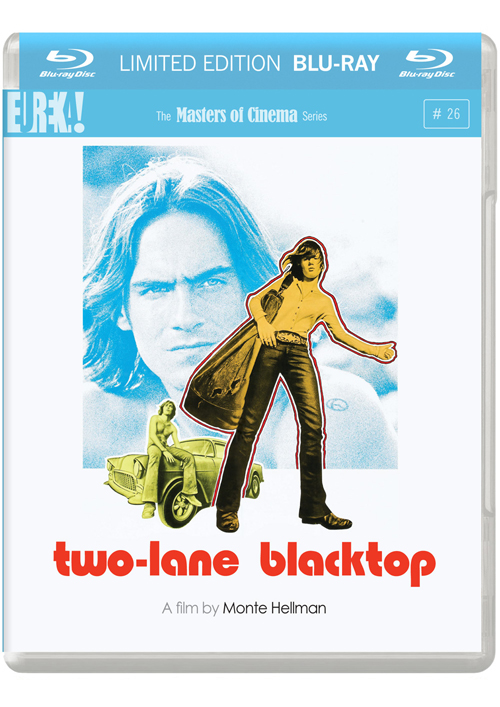
REVIEW – Two-Lane Blacktop (1971)

FilmJuice have my review of Monte Hellman’s powerfully existential road movie Two-Lane Blacktop.

Two Lane Blacktop is a film about a pair of twenty-somethings who support themselves by moving from town to town and participating in drag races. This pair are so complete adrift in the world that they possess neither home nor name, all they have is their car and the open road. In fact, the pair are so emotionally detached that it barely registers when an attractive young woman decides to join them on their aimless journey. One day, the pair run into a middle-aged fantasist and challenge him to a long distance race. Sensing some element of menace from the youngsters, the fantasist agrees but is puzzled to discover that the young people have no interest in actually winning the race:

At one point the middle-aged man is driving along and spots the youngsters having breakfast in a diner. Annoyed that they seem to be taking his challenge so lightly, the old man pulls over and confronts them, angrily asking “Are we still racing?” but no answer is forthcoming. Increasingly ill at ease with this strange relationship, the older man convinces the young girl to travel with him and he takes off while the other two are racing a local. With steel in their eyes, the pair take off after the older man but rather than confront him about cheating or stealing their girl, their annoyance seems to come from the fact that he moved the relationship from one of mutual cooperation to one of competition. As the older man drives off alone, he begins to weave lies about how he won the car from the younger men using his customised muscle car.

The middle-aged man spends the entire film telling lies because he cannot cope with the hollowness of the existence he experiences on the road. Too old and too set in his ways to come to terms with life’s lack of meaning, he spins lies to make sense of his life and that of the youngsters while the youngsters just keep on moving from town to town without ever asking for or receiving any answers.

Released by Masters of Cinema with a bevy of essays and documentaries designed to bolster its status as an overlooked classic of 1960s counterculture, Two-Lane Blacktop captures the beauty and alienation of a life lived outside of traditional culture in a way that Easy Rider never quite managed.

REVIEW – Punishment Park (1971)

FilmJuice have my review of Peter Watkins’ cruelly overlooked mock documentary Punishment Park.

Punishment Park is set in what was the near future back in 1971.  In this near future, America has descended into chaos and the American government has responded to this chaos by setting up a series of tribunals who give political prisoners the choice between a long jail term and taking part in a training exercise involving members of the police and the armed forces. These training exercises involve the prisoners being chased across a desert.  If they make it to a particular point by a particular time without being captured then they are free to go. Needless to say, nobody ever manages to escape:

On one level, Punishment Park functions as a near-future work of dystopian science fiction. If looked at in these terms, the exaggeration of the establishment’s reaction to political dissent is only a matter of degree and the exaggeration serves to highlight real problems in American political culture. Similarly, the dissidents’ futile march through a desert towards an American flag stands as a poignant metaphorical commentary on Humanity’s quest for freedom and how the value of freedom can be all too easily undermined by the very people entrusted with securing our attempts to achieve it. On another level, Punishment Park is a furious attack not only upon the politically intransigent elites that run America but also upon the biased nature of so-called reporting and the intellectually incoherent and simple-minded nature of responses to those elites.

Released in typically wonderful style by Masters of Cinema, this is a great opportunity to discover a lost classic of American cinema.

Why Hollywood Blames the HR Department for 9/11

1. Langley, we have a problem…

Last week I went to see Mission Impossible: Ghost Protocol, Brad Bird’s well-received addition to the decidedly uneven Mission Impossible franchise. While my opinion of the film is that it is really nothing more than a competently made action film, the film’s central plot conceit is absolutely fascinating for what it says about how we perceive the workings of government.  Take a look at the trailer and you will see what I mean.

Continue reading →

REVIEW: Stake Land (2010)

THE ZONE has my review of Jim Mickle’s post-apocalyptic vampire movie Stake Land.

Between Richard Matheson’s I Am Legend (1954) and Anne Rice’s Interview with the Vampire (1976) there are no shortage of works that use vampires as a means of engaging with such existentialist themes as loneliness, alienation and self-loathing. Indeed, the rather individualistic idea that people out there are somehow less alive and therefore different to us also features in zombie films like Edgar Wright’s Shaun of the Dead (2004) and Ruben Fleischer’s Zombieland (2009). Beating a critically acclaimed path to this already well-frequented watering hole is Stake Land, a film that combines the post-apocalyptic seriousness of Cormac McCarthy’s The Road (2006) with the post-apocalyptic silliness of Kevin Costner’s The Postman (1997) with all the problems this entails:

Though never all that original or overflowing with important things to say, Stake Land could have been an interesting addition to the tradition that uses elements of art house cinema to revitalise tired old horror tropes. Similarly, it could have been a harmless action movie in which a stone-cold badass leads a group of people through a vampire-infested post-apocalyptic landscape. However, by attempting to be both things at once, Stake Land succeeds at being neither. This is a slow, ponderous, underpowered and ludicrously pompous film that comes nowhere close to adding up to the sum of its parts.

Disappointing to say the least.

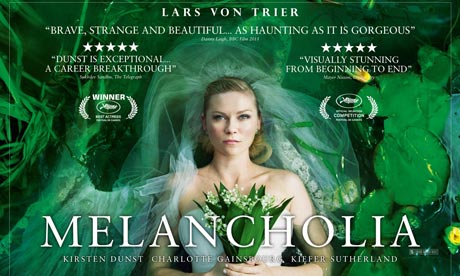
Melancholia (2011) – The Misery of Coherence vs. The Mania of Incoherence

Once upon a time, happiness was something to be avoided at all costs. The reason for this bizarre rule of thumb was that true happiness was said to be the sole preserve of the afterlife, a gift given by a loving God in return for our trust and obedience. Life was a vale of tears where our Faith and resolve were tested and tested again. If we were happy then chances were that we had taken our eye off the ball and given in to Satan as happiness-now almost invariably lead to misery-later, an eternity of misery in fact. As a result, happiness was something that happened to other folks once they died. With the Renaissance came a two-fold rejection of God’s feudalism: Not only was life driven by the pursuit of happiness, people were opting for happiness-now over Grace and Salvation-later.

When happiness became the end point of human existence, pain and suffering took on an altogether different character. Under Christianity, pain and suffering had been tangible proof of God’s promise that the meek would inherit the Earth and that worldly happiness is only fleeting when compared to the infinite joy of union with the Godhead. Under the grand ideologies of the Enlightenment’s children, pain and suffering were things to be extinguished either by revolution (surgery) or by reform (chemotherapy). Now our culture no longer sees misery as divine, it sees it as something to be eradicated and avoided at all costs. Every advert screams promises of material and sensory happiness while bookshops explode with self-help guides designed to help you kick the sadness habit. Films, food, books and even sex are commodified, packaged and sold to us as means to greater and more intense forms of happiness. Even the miseries of work become vehicles for happiness as we are encouraged to work harder for bigger rewards and grander promotions. You must have a career. You must be successful. You must be happy. And if you can’t be happy by your own means then the multi billion-dollar neuropharmacology industry stands poised to offer you deliverance. You have no choice… you must comply.

The first half of Lars von Trier’s Melancholia is a meditation on the expectation of happiness and how the insistence of others that you be happy can be a source of true and unrelenting misery. The second half of Lars von Trier’s Melancholia is about the Earth being destroyed in a collision with a rogue planet. Beautifully shot and filled with wonderful ideas and moments of real human insight, Melancholia is possibly Lars von Trier’s best film to date, but that does not mean that the film makes sense. In fact, much of the film’s greatness lies in its perverse refusal to abide by the rules of its two very different halves.

Continue reading →

REVIEW – Secret Behind The Door (1947)

THE ZONE have my review of Fritz Lang’s classic psychological thriller Secret Behind the Door starring Joan Bennett and Michael Redgrave.

Based upon Charles Perrault’s fable Bluebeard, Secret Behind the Door explores the process through which a couple get to know each other.  After a whirlwind romance, Bennett’s character marries Redgrave’s secretive and intense architect.  After a rudely interrupted honeymoon, Bennett’s character arrives at the architect’s home and finds him sharing it with two other women and a son from a previous marriage. As in the fable, Bennett’s character begins poking around in her husband’s background until she discovers something sinister.

Bluebeard is perhaps better known in its native France than it is in the Anglo-Saxon world. One reason for this is that it is one of those stories that paints women as a race of incessant and toxic meddlers whose refusal to follow simple male instructions result in the destruction of everything.  Think of Else to Lohengrin. Think of Eve to Adam. Because of the story’s misogynistic roots, generations of feminist authors have been quick to reclaim the role of interfering spouse and cast it in a more positive and transformative light such as the one that bathes Jane Eyre in Charlotte Bronte’s novel. Neither misogynistic nor feminist, Lang’s adaptation of Silvia Richards’ screenplay presents Bennett’s character as a wonderfully ambiguous figure who ‘fixes’ her husband for reasons all of her own. However, while the characters are engaging and the plot is fascinating, what really grabbed me was Lang’s decision to use a voice over as the primary means of communicating inner states:

Watching Secret Beyond The Door and noticing Lang’s tendency to simply pause the action and linger on his actor’s faces while their voiceovers are delivered, I was struck by how little has changed in the way that directors communicate interiority. Indeed, while directors of Lang’s generation paused so that voiceovers can be delivered, contemporary directors simply pause and allow audiences to fill in their own voiceovers. Doubtless many art house films could be transformed by using these little pauses and gazings into the middle distance to deliver short voiceovers in which characters speak directly to the audience. Clearly the basic grammar of cinema has not evolved that much since the days of Lang, it is just that nowadays art house directors tend to outsource exposition to audience speculation.

Secret Behind the Door is a flawed gem and its arrival on region-free DVD is long overdue. This is a must for anyone who enjoys psychological thrillers and an absolute necessity for anyone who loves Fritz Lang’s film noirs.

Cutter’s Way (1981) – The Complete Hero

When the golden age of 1970s Hollywood came to an end and the studios reasserted their control there were many unworthy casualties. The great tide of the American New Wave had surged up the beach and rolled back to a sea of spiralling budgets, slumping revenues and bottomless self-indulgence. One of these casualties was Ivan Passer’s adaptation of Newton Thornburg’s novel Cutter and Bone (1976).

Buried in a corporate shake-up and largely forgotten until its DVD re-release, Cutter’s Way is very much a product of the American New Wave. Ostensibly about a pair of misfits investigating a conspiracy to protect a wealthy industrialist, the film taps into the same cultural anxieties as Alan J. Pakula’s political paranoia trilogy comprising Klute (1971), The Parallax View (1974) and All the President’s Men (1976). However, rather than pandering to the audience’s belief that someone is out to get them, Passer’s film presents its conspiracy in a deeply ambiguous manner. Indeed, Cutter’s Way is a film that asks whether the tendency to see conspiracies everywhere might not in fact be a reflection of a deeper psychological need to be appreciated and desired. After all… if people are out to get you then that must mean that they consider you worth getting. Far more than a simple conspiracy thriller, Cutter’s Way is an exploration of the comfort that can be had in being a victim.

Continue reading →