The Organization Geek

I sometimes think that my generation got the wrong end of the stick when it came to the question of conformity. My first encounter with conformity as a theoretical concept came in my early teens when some pre-cursor to GCSE psychology mentioned Solomon Asch’s conformity experiments in which a subject was confronted with a room full of people giving the wrong answer to a simple perception test. Supposedly overwhelmed by peer pressure, over a third of Asch’s subjects chose to follow the group and give the wrong answer.

I say “supposedly” as while a lot has since been written about Asch’s experiments, most of it has been reductive, simplistic and wrong. The problem lies not in the work itself but rather in the tendency to package it up with Stanley Milgram’s experiments on obedience and Philip Zimbardo’s Stanford Prison Experiment as part of a broad cultural narrative about the hazards of conformity.

By the time I was first encountering experimental psychology in the early 1990s, conformity was being presented as a Bad, Bad Thing that caused you to speak untruths, torture people to death and generally behave like a German prison camp guard. Indeed, a lot of the research into obedience and conformity that took place in the middle decades of the 20th Century is best understood as trying to understand the rise of Nazi Germany and thereby prevent it from ever happening again. The work of Asch, Milgram and Zimbardo may have been lousy and misunderstood science but it was great propaganda as it sold us a vision of humanity as a species wired for obedience and moral cowardice.

Continue reading →

Last Night by James Salter: “Give”

A story that gave me little joy and left behind it only impertinent questions: – When was this story written relative to the others in the book? Just as composers will often re-use musical phrases and directors can often be found re-using particular motifs, “Give” is a story that seems to draw on images and themes that are also present in the other stories. Is this story’s lusty poet a dry run for that of “My Lord You” or did that image stick so firmly in Salter’s mind that he could not help but return to it? – Does Salter work better at certain lengths than others? The more space he affords himself, the more elegantly he describes to space around his moods and characters. “Give” is nearly the shortest story in the collection and while it does manage to gain some traction, the emotions and images it shuffles around are more simplistic than they are in other stories. Much like “Such Fun”, “Give” is a story with a distracting twist in the tale. I say “distracting” as the drama arising from the male narrator’s affair with another man is most definitely not the point of the story. This is not a story about lost love or a marriage strained by infidelity, it is a story about a world woven from lies and enforced with all the passive-aggression that the middle-classes can muster. Continue reading →

Last Night by James Salter: “Such Fun”

Looking back over the pieces I have written about this collection I am struck by the fact that I’ve effectively been dancing around an idea first put forward by the German poet, playwright and theatre director Bertolt Brecht.

Brecht was a life-long committed Marxist at a time when that meant something other than being an academic. As a Marxist, Brecht was concerned about the purpose of the theatre and people’s tendency to use it as a source of escapism and/or moral complacency: Turn up at a show, identify with one of the characters, experience their moral gyrations at one step removed, go back to your life without even pausing for self-reflection. Brecht’s response to this tendency was to develop a form known as ‘epic theatre’ that encouraged the audience to engage critically with his plays rather than relying on more traditional forms of engagement such as searching for strong characters with which to identify.

Brecht would pursue this end by deploying what he called Verfremdungseffekt, which is often translated as ‘distancing effect’, ‘estrangement effect’ or simply ‘the V-effekt’. The best known distancing effects are those that draw attention to the play’s status as a fictional conceit by breaking down the fourth wall, anything to prevent the audience from relaxing into a passive state and treating the text of the play as some sort of inviolable entity. Given the universality of postmodernism and the frequent use of meta-fictional conceits in popular culture, I suspect that today’s writers have to work considerably harder to force their audience onto a critical footing but the basic principle of the verfremdungseffekt remains intact: You cannot encourage your audience both to suspend their disbelief and to treat your text as an intriguing fiction. An audience that is engaging critically with a text is not surrendering to your attempts at emotional manipulation and an audience that has submitted to a series of carefully curated emotional experiences will be either unwilling or incapable of engaging with a text in a dispassionate fashion. Audiences can, of course, move from one footing to another but they can’t do both things at once.

The reason I mention the verfremdungseffekt is that I think something similar is going on in this collection. Every story thus far uses literary techniques to encourage us to identify with a character and their needs only for Salter to hide much of his real intent in little details that only become apparent when you step back from the stories and survey them not as the journeys of particular characters but as the interaction of different ideas and themes. This effect is definitely at work in “Such Fun”, one of the shorter stories included in this collection.


Continue reading →

Last Night by James Salter: “My Lord You”

Mistah Salter – He dead. The New York Times has an interesting obituary that paints Salter as a man plagued by the twin demons of ambition and bitter resentment over the failure to transmute critical acclaim into popular success. While the piece does stop well short of being a hatchet job, it is definitely in the business of burying rather than praising its subject. Having said that, it does quote a lovely line from Reynolds Price who described Salter’s work thusly:

“In its peculiar compound of lucid surface and dark interior, it’s as nearly perfect as any American fiction I know.”

Salter’s death reminded me of my need to return to this series of posts but it also reminded me of why this project began to run out of steam in the first place: I didn’t particularly enjoy “My Lord You” the first time I read through it. In fact, it was only after re-reading the story three times that I came to realise the precision and power that lies hidden behind its rather distracting use of metaphorical imagery.

Back in October 2014, I began a constellation of posts that tried to articulate the reasons for my reluctance to engage with the field of genre short fiction. While the bulk of the constellation went into describing the genre short fiction scene as an engine for acquiring and redistributing social capital rather than generating interesting stories, the root of my problem was that I simply did not like the stories that said engine was bringing to the attention of the wider genre community. As I said in my piece “Short Fiction and the Feels”:

In each of these stories, the genre elements sit somewhere between the metaphorical and the literal; aspects of a fictional world that seem to mirror the contours of real emotional lives whilst leaving the world unchanged and the metaphor unresolved and shrouded with the kind of ambiguity that renders precision anathema. As a genre reader, I am frustrated by the authors’ lack of interest in exploring how these genre elements might transform their fictional worlds. As a literary reader I am left perplexed by the decision to abandon realism in favour of a quasi-metaphorical language that makes the characters’ emotional lives seem more rather than less opaque.

Re-visiting these opinions more recently, I did begin to wonder whether my problem might not have been rooted in an aversion to fantasy literature. To me, fantasy always feels a bit like cheating because it allows the author to embed the logic of their stories in the fabric of their fictional worlds. There’s a fine line between using fiction as a means of engaging with the world from a particular viewpoint and constructing a fantasy in which all of the writer’s beliefs and prejudices are somehow magically true. Producing fiction in which the world actively rises up to meet the oncoming force of your narrative has always struck me as way too much of the latter.

Of course… traditional science fiction pulls this type of shit all the time and the boundaries between traditions have long been under pressure from a professional class with an interest in creating a single integrated marketplace for science fiction, fantasy and horror. As unpopular and deliberately narrow as it may seem, my vision of science fiction of a world-facing literary tradition in which authors are held accountable for their departures from reality, even when it is only on the level of scientific inaccuracy.

When I accused the quasi-metaphorical of falling somewhere between the demands of genre and the demands of traditional literature, I meant that many of these stories seemed completely unaccountable. Even allowing space for radical formal experimentation, literary fiction must ultimately resolve as some form of statement about the world or human nature and the same is true of the genre fiction that I want to read (although SF’s historical abrogation of the mimetic impulse allows for a considerably broader idea as to what constitutes resolution). My feeling about the quasi-metaphorical is that while many of these stories carry a very real and carefully-engineered affective payload, the artifice that goes into many of these stories also serves to distance them from the world and obscure many of the crunchier details in which the wheels of fictional conceit might be expected to meet the road of reality.

Though not a piece of genre writing, Salter’s “My Lord You” resembles the quasi-metaphorical in so far as it is a story built around a single metaphor that appears to have been designed with the intention of capturing a very specific feeling. However, unlike many of the quasi-metaphorical stories I touched on in my earlier pieces, Salter uses his metaphorical device as a means of uncovering all sorts of crunchy ideas about the nature of relationships and human sexuality.

Continue reading →

Last Night by James Salter: “Eyes of the Stars”

It is hard not to read this story as an invitation to compare-and-contrast its female characters. Like “Comet”, “Eyes of the Stars” opens with a vivisection of its primary protagonist:

She was short with short legs and her body had lost its shape. It began at her neck and continued down, and her arms were like a cook’s. In her sixties Teddy had looked the same for a decade and would probably go on looking the same, where was not that much to change. She had pouches under her eyes and a chin, slightly receding when she was a girl, that was lost now in several others, but she was dressed neatly and people liked her.

There’s a surprising amount of cruelty and laziness about this description. Teddy’s obesity is characterised as a loss of shape and begins at her neck in a way that invites us to think of her pretty face, which is always the first thing people try to compliment in fat women. Drenched in vinegar, such compliments invariably take the form “…but you have such a pretty face!” as though obesity were a body’s act of betrayal against an innocent and undeserving face. Equally uncomfortable is Salter’s decision to append the description with the rejoinder that “she was dressed neatly and people liked her” so as to assure us that Teddy is not one of those slovenly fat people who are deserving of our unreasoning hatred. The mention of the cook’s arms also gives this passage an edge of snobbery as though Teddy’s weight made her look like a member of the working class.

Uncharitably viewed, this is Salter weaving a character from raw social prejudice. Charitably viewed, this is a deliberate act of cruelty designed to make us think of Teddy as someone who has long been the victim of other people’s unkindness. When I refer to Teddy as the story’s primary protagonist, what I mean is that she is the character with whom we are meant to sympathise. She is the ‘goodie’ for want of a better word.


Continue reading →

Last Night by James Salter: “Comet”

It occurs to me that a gap has emerged between the types of film that I enjoy and the types of book that I tend to read.

As the contents of this blog suggest, I am generally drawn to small, intimate and psychological films that ask a lot of their audiences. Made with a painter’s eye and a jeweller’s hand, these films demand not just a familiarity with the language of cinema but also a capacity to sift the debris of fictional lives for traces of raw humanity. If forced to choose a film that most captured my current mood, I would happily point to Francois Ozon’s 5×2 as it strikes the major chords of a modern marriage only to then invite the audience to speculate as to nature of the tune that once united them.

Given that the books I read generally keep humanity at arm’s length, I thought it might be fun to seek out some literary short fiction that adopted a similar relationship to its readers as the works of Claude Chabrol and Francois Ozon. Hell…. Reading something a bit different might also help to improve my reading skills, which have atrophied considerably since I stopped regularly reviewing books.

I wanted a work that would present me with beautiful human puzzles and my search eventually lead me to James Salter’s Last Night. It is my intention to write a little something about each of the book’s ten stories, starting with “Comet”.

As I write, I have not yet finished Last Night but I have read a few stories ahead in an effort to familiarise myself with Salter’s techniques and spot any recurring themes. The first theme to emerge from my reading is an interest in older sexualities and the emotional lives surrounding them. “Comet” is a story that invites us to consider the differences between a freshly-married bride and groom.

Continue reading →

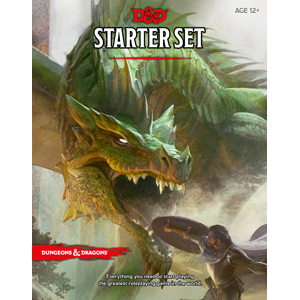
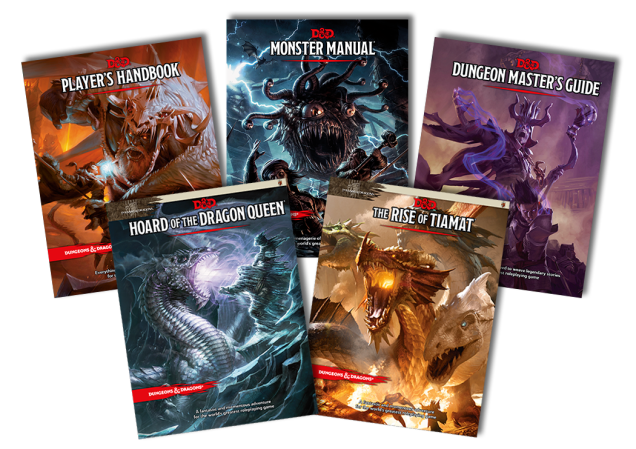
Dungeons & Dragons Starter Set – A Much Needed Fresh Start?

Seeing as a number of people have asked me for my first impressions of the new D&D Starter Set, I thought it might be fun to write up my thoughts in a little more detail than Twitter allows. In short, the Starter Set is both a brilliant introduction to a new set of rules and a fantastic opportunity to re-launch Dungeons & Dragons both as a brand and a hobby. However, while the Dungeons & Dragons Starter Set is a breath of fresh air, it is nowhere near enough to fill the lungs of someone who is already half-drowned.


The Weight of History

I first started playing tabletop RPGs not long after the release of the Second Edition of Advanced Dungeons and Dragons. AD&D2 was really nothing more than the original 1977 D&D rules with a load of extra sub-systems bolted onto them. An excellent example of the design philosophy underpinning D&D at the time was the way that different editions handled skills:

  • D&D featured no skills beyond fighting, spellcasting and a few abilities with their own discrete sets of mechanics like picking locks or noticing the gradient of a slope.
  • AD&D1 kept all of these discrete mechanics and introduced the concept of secondary skills but provided little in the way of mechanical support for those additional skills.
  • AD&D2 kept the discrete mechanics and introduced new rules that served to flesh out the secondary skill system. Despite presenting the rule changes as a more integrated system that encompassed languages, weapons and non-combat skills, the proficiencies were really nothing more than a tidy way of allowing players to choose and then keep track of their areas of expertise and the ever-expanding network of sub-systems that governed them.

If the name and design principles underpinning AD&D2 make it sound cluttered to the point of complete inaccessibility, then you would be completely right. It was nearly 25 years before someone thought to take D&D back to first principles and one can only assume that this reluctance to mess with the rules was derived from an unspoken assumption that the audience for D&D was the same as it had always been. If you assume that the only people buying AD&D2 are the people who already own AD&D1 then it doesn’t really matter that rules changes mean additional sub-systems… it’s not as though anyone has to learn all the rules from scratch! Similarly, if you assume that the only people interested in playing D&D are the people already playing it then every rule change runs the risk of alienating the people who have been playing the same campaign for 20 years. Do these designers not realise how difficult it is to port a 75th level Paladin Demigod from one edition to another?

The collapse of TSR and purchase of D&D by Wizards of the Coast inspired a long-overdue re-examination of the rules but while the game’s third edition replaced AD&D2’s warren of sub-systems with the integrated d20-based mechanics, the iteration of the d20 rules that became 3E was still an incredibly insular piece of game design. The reason for this creative introversion is that 3E was developed during a time when D&D was under intense pressure from games that tried to put RPGs on a slightly different footing.

The original D&D rules are a model of simplicity; After presenting its readers with the revolutionary notion that they could play a game entirely in their own heads, the box set provided just enough mechanical support to make those imaginary worlds seem concrete. However, because the rules were originally drawn up as the basis for a war game that focused upon individual characters rather than units and because the game wound up being marketed at boys, D&D came to be seen as a game primarily concerned with tactical combat, a myth that the publishers of D&D were only too happy to support through an endless barrage of publications pandering to the tactician’s need for more monsters, more traps, more encounters and more magical bling. As this ‘canonical’ vision of how to play D&D slowly emerged, gamers interested in other aspects of roleplaying such as playing roles and solving mysteries began to drift away towards games that emphasised their vision of what gaming was all about. As is so often the case in small sub-cultures, the desire for legitimacy and visibility inspired hyperbole that in turn provoked social schisms.

The more some gamers sought to distance themselves from traditional D&D, the more people interested in tactical play came to revel in a form of tactical fundamentalism in which non-tactical aspects of play received little or no support in published materials. It was during the years spanning the move from ADD2 to 3E that White Wolf Games reached out to fresh audiences with the promise that their games would not be about killing things. Despite this injection of new blood into the hobby and the manifest truth that hundreds of gamers had moved away from D&D, the game’s publishers listened to the tactical fundamentalists and turned their back on people less interested in tactical play.
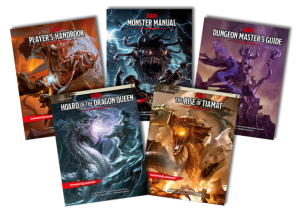
 

DD1

Despite being built around a core mechanic that could support almost any form of tabletop play, 3E featured a set of combat and movement rules that encouraged the use of miniatures as part of a highly tactical playing style. The tactical nature of in-game combat exerted a pressure on every aspect of the game as the need to make the right tactical decisions in combat encouraged players to think more strategically about their character design, which in turn created a huge market for gaming materials aimed more at players than at the Dungeon Masters who had traditionally been responsible for buying most of the books.

Nowadays, people frequently refer to the d20/3E years as something of a gold rush in which the market for RPG books expanded massively and unpredictably heralding the rise of new companies and the collapse of older ones. However, as many books as 3E managed to shift, the gold rush was not fuelled by the arrival of new players but by the more effective exploitation of existing markets. 3E saw existing players spending more and lapsed players returning to the fold either by ‘getting the band back together’ or by engaging in a weird kind of vicarious RPG experience in which they would hang out on RPG forums and buy lots of RPG materials without ever actually sitting down to play. 3E made a lot of companies a lot of money but it did almost nothing to grow a hobby that was already showing serious signs of institutional neglect.

Unlike most geeky hobbies, tabletop gaming expects you to spend time in the same room as other people. In fact, in order to get the most out of an RPG campaign, you regularly need to spend long periods of time in the same room as the same group of people who are all doing exactly the same thing as you… and who has time for that in this day and age? Nowhere is the toxic nature of capitalism more evident than in the changing face of work: A generation ago, a family could support itself with only one person working a regular 9-5 job but the waves of economic collapse that have swept around the world since the 1970s mean that everyone now works increasingly long hours with increasingly unpredictable schedules. Ever happy to exploit, the companies that helped to shatter the traditional work/life balance now peddle their wares as rewards and escapes from the demands of the unreasonable workplace that they themselves created. The upshot of this capitalist push-me-pull-you is that people now regularly return home in a state of physical and spiritual exhaustion that lends itself more readily to medicinal applications of booze and shit TV than to arguing with your friends and doing maths. Some of the main beneficiaries of our increasingly horrid work/life balances are massively multiplayer online RPGs such as Blizzard’s World of Warcraft, a game inspired by tabletop RPGs that removes the need to prepare adventures, do maths or meet up with people in real life. Given how successful MMORPGs have become, it is hardly surprising that the next iteration of D&D would use MMORPGs as a point of aesthetic departure.

Dungeons & Dragons 4th Edition remains the most radical reworking of the rules to date. While the designers drew inspiration from the 3E rules and retained a lot of the iconography of previous editions, the game is best understood as an attempt to create a board game based upon principles of MMORPG design. Unlike 3E, which provided a flexible skill system that wound up focussing on tactical engagements, 4E was built with nothing but tactical engagements in mind resulting in characters almost entirely defined by lists of powers. Despite making some gratifying inroads into the MMORPG market thanks to the widely publicised (and presumably expensive) support of Penny Arcade, interest in D&D4 plateaued when people suddenly realised that it was nothing more than a regular MMORPG with added maths and travel times.

Dungeons & Dragons has long been paralysed by the weight of its own history. Early editions simply assumed that anyone wishing to play was already playing and when that toxic attitude finally receded it was replaced by the equally problematic assumption that anyone wanting to play D&D would want to play it in the exact same manner as the brand’s core audience. This weird cultural ego-centrism will be instantly familiar to anyone who expressed an interest in science fiction only to have Robert A. Heinlein’s Rocketship Galileo thrust into their disappointed paws. Sure… the Heinlein juveniles served as a gateway drug for a lot of young readers but should we really assume that young readers today will respond to the same things as young readers in the 1940s? This is not the 1970s and not everyone is a socially inept teenaged boy, why do the owners of D&D continue to ignore thousands of potential customers? Simple: Cowardice and short sightedness.


Continue reading →
REVIEW – The Hunger Games: Catching Fire (2013)

hungame2A little while ago, the editor of Videovista approached me to review the film adaptation of Suzanne Collins’ second Hunger Games novel Catching Fire. I had read the first two books in the Hunger Games series and reviewed the first one in a mood of profound ambivalence that carried me through into the first film. In short, I liked the way the book captured Katniss’s reactions to the world but I found both the world itself and everything that happened in said world to be somewhat tedious… hence my decision to interpret the books as a sort of psychological fantasia in which the emotional touchstones of teenaged life are recreated using the language of dystopian science fiction. The problem with this interpretation is that it doesn’t really survive the decision to adapt the books but drop the internal monologues. However, rather than simply being honest and describing Francis Lawrence’s The Hunger Games: Catching Fire as a typically dull and expensive-looking Hollywood epic, I decided to work through some of my feelings about The Hunger Games, Young Adult Fiction and Hollywood Blockbusters in an essay that runs to over 4,000 words.

On psychological fantasias:

This is why President Snow is little more than a vaguely threatening beard: Collins is drawing on a particular set of cultural images to create an image of patriarchal authority that will be comprehensible to her intended audience. Though not a particularly common approach to writing, this transition from psychological realism to metaphorical fantasy is fairly common in psychological thrillers as well as T.H. White’s children’s novel The Sword And The Stone (1938), where Arthurian knights sit around drinking port and discussing Eton because even though neither of those things actually exist in the world of the novel, the words ‘port’ and ‘Eton’ serve as placeholders for a drink, and a training establishment, with a comparable set of emotional and cultural resonances.

On the incompetence of the film’s direction:

As with the opening act, a savvy director might have played up the paranoia underpinning these scenes and turned them into simmering pots of tension that occasionally explode into violence, but Lawrence follows Ross in choosing to focus on the melodrama thereby depriving the film of any sense of lingering danger or tension so that, when the angry baboons and poisonous clouds do turn up, they appear more comical than harrowing. There is one particularly wonderful scene where Katniss’ group meets up with some other tributes and decides to make peace. Noting that they appear to be covered in sticky brown liquid, Katniss asks what happened and one of the female tribute rolls her eyes and talks about blood falling from the sky in the same tone of voice that one might talk about a ruined wedding reception or barbecue; a damp squib indeed.

On adults reading books aimed at children:

The reason that people respond to works like The Hunger Games is the same reason they cower in the shadow of their parents and feel empowered by mass-market therapy sessions written for a teen demographic: we are subject to a culture that encourages us to view ourselves as creatures that are as passive and as powerless as children. Works like The Hunger Games, Harry Potter, and Twilight benefit from this cultural mood as much as they contribute to it.

An interesting corollary to some of the ideas I explore in the essay is something written by Adam “Great Sage, Equal of Heaven” Roberts who ponders the question of why Young Adult fiction has become obsessed with Victorian imagery. I think that Adam reaches some of the same conclusions that I do but expresses them in a manner that is both more erudite and sympathetic to the materials in question. Another interesting corollary is Julianne Ross’s piece in the Atlantic which asks “Must Every YA Action Heroine Be Petite?” in which she ambles down objectivisation avenue and stumbles across a far more interesting truth:

But this is the same double standard that we’ve been subjected to again and again; just as women are expected to be sexual but not slutty, pure but not prudish, heroines should be strong but not buff. Powerful, yet still delicate enough to be cradled by their male love interests. Mature enough to lead those around them, yet so small that people confuse them with innocent little girls.

I don’t think this aesthetic has as much to do with sexual objectification as it does with the fact that Young Adult fiction is partly about allowing grown-up readers to escape into worlds dominated by melodramatic treatments of banal coming-of-age stories. Indeed, as I explain in the review, The Hunger Games is all about Katniss gaining access to the rooms in which grown-ups have grown-up conversations. Her rebellion against President Snow has less to do with real-world politics than it does with standing up to Daddy. I am not a fan of escapist fiction but I have a particular contempt for escapist fiction that presents banal teenage rebellion as something worthy of book, film and song. Stories like The Hunger Games shrink the horizons of our minds to the point where the banal seems heroic and the heroic seems impossible. Give it another ten years and adults will be reading books that make them feel empowered about the fact that they are potty trained.


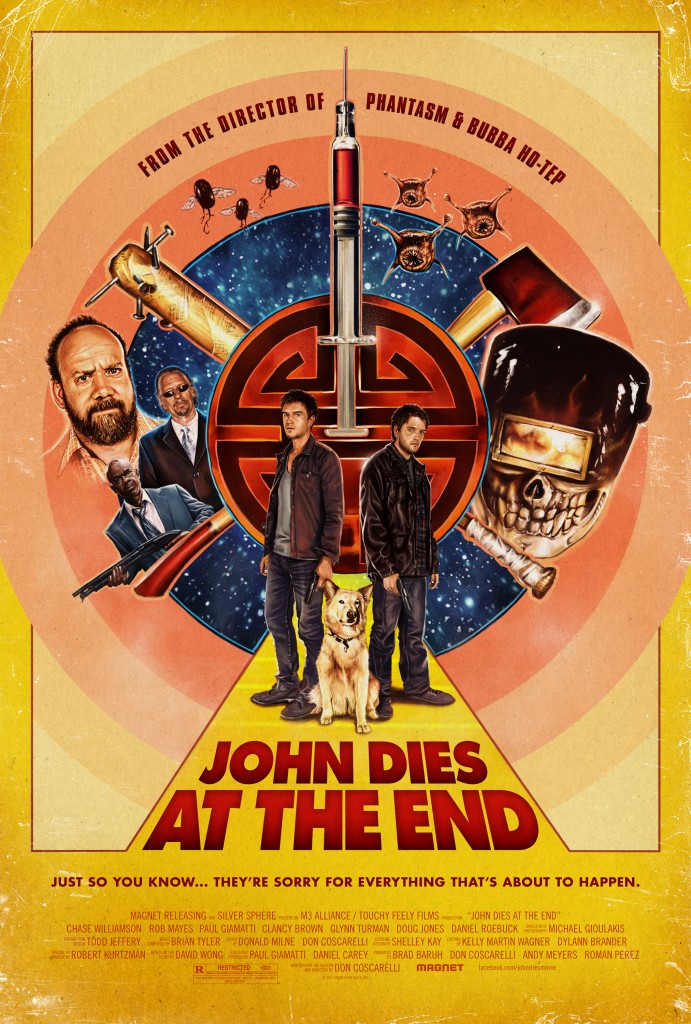
REVIEW – John Dies At The End (2012)

JDATEVideovista have my review of Don Coscarelli’s drug-addled urban fantasy John Dies at the End.

Based on a novel by Jason Pargin writing as David Wong, John Dies at the End follows a pair of generically handsome American youths (with ‘Close Boy Faces‘ naturally) as they are sucked into a weird and evocative demimonde in which they are compelled to battle ghosts, demons and genetically-engineered Cthuloid deities. The reason I go on at considerable length about JDATE being a work of urban fantasy is that the film is clearly desperate to escape that label:

Given the structural and social barriers involved in getting a work of urban fantasy made for the big screen, it is perhaps unavoidable that most marketing departments try to position works of urban fantasy as being part of more socially acceptable genres. Thus, The Matrix trilogy was successfully marketed as a work of science fiction, while the cowardly and ultimately unsuccessful adaptation of the Hellblazer comics was described as a ‘supernatural action-thriller’ lest girl-cooties alienate the intended audience. John Dies At The End continues this somewhat inglorious tradition with a PR campaign that tries to distance the project from the literary context that inspired the original novel, and reposition the film as the kind of gonzo horror/ comedy you would expect from the man responsible for both the Phantasm series and Bubba Ho-Tep.

The wikipedia entry for the film describes JDATE as “dark comedy-horror”.

The wikipedia entry for the book describes JDATE as “cosmic horror”.

Why should this be?

The answer has quite a lot to do with privilege and the ways in which we are socialised into a particular gender. The straight white men of today are like the painted French aristocrats of pre-revolutionary France: Pampered and protected by economic and social systems that are as unjust as they are unstable, straight white men live in unconscious fear of becoming declasse or reduced in status to a lower social rank like that of woman, BME or LGBT.

Once upon a time, the trappings of masculinity were so instantly recognisable that all a man needed to do in order to protect his privileged status was to grow a beard and either run off to war or get a job that required him to wear a tie. However, as society has been shaped and re-shaped by the tidal forces of global capitalism, the trappings of masculinity have been commodified to the point where cloaking yourself in the traditional trappings of masculinity no longer serve as a basis for differentiating one group from another. However, because straight white men are trained to take pride in their status, they are forever on the lookout for things that will identify them as straight white men and distinguish them from everyone else. Maybe it’s liking football, maybe it’s wearing sports gear, maybe it’s drinking pints, maybe it’s talking about how much you enjoy sex in a loud and boisterous manner. The problem is that every time straight white men find a way of broadcasting their group membership, fashions change and people from other groups begin adopting those characteristics. This has made straight white men hypersensitive to any product that might make them look like they might belong to a lesser social class, and this is where Urban Fantasy comes in.

Urban Fantasy shares about 80% of its DNA with Paranormal Romance. In fact, the only difference between Urban Fantasy and Paranormal Romance is that Urban Fantasy places ever so slightly less emphasis on the romantic sub-plots. This association is somewhat problematic as reading Romance novels is one of those characteristics that is so unquestionably feminine that it is enough to alienate most straight men. In fact, some straight white men are so uncomfortable with the connections between Urban Fantasy and Paranormal Romance that they have tried to re-write the history of Urban Fantasy to exclude as many female authors as possible. This is why JDATE is being marketed as “dark comedy-horror” rather than the work of cinematic Urban Fantasy it so obviously is.

Another result of the association between Urban Fantasy and Paranormal Romance is that Urban Fantasy is a genre with very little critical status. In fact, it’s quite telling that what I liked most about this film is the director’s valiant attempts at resisting genre narratives even though they were built into his film at script level. Some might argue that this is a reflection of my own privilege and failure to take the red pill and move beyond the gendered aesthetics fed to us by our culture but I’m not going to lose any sleep over it. Our aesthetic preferences are built into us on the same level as our personality traits and there’s a point at which getting free of the system is effectively indistinguishable from becoming an entirely different person.

Five Intelligent Science Fiction Films

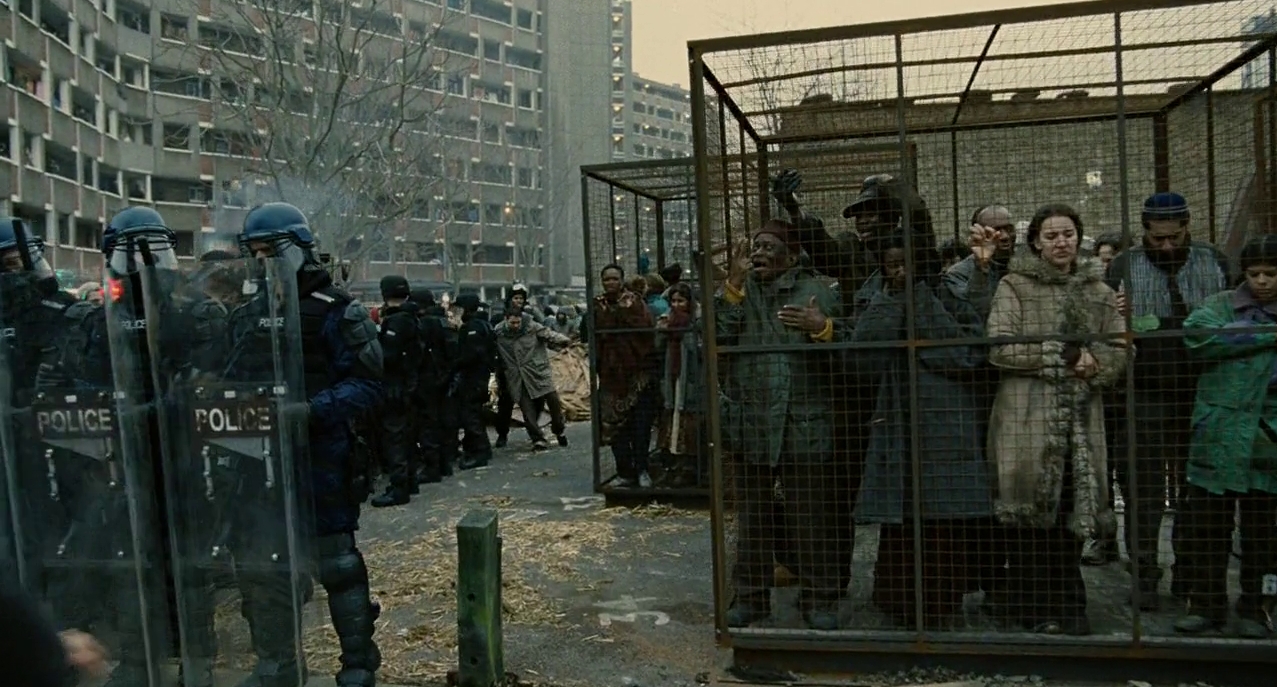
children-of-menFilmJuice have just published my latest feature. In honour of the British release of Cloud Atlas, here is my list of five literary science fiction films.

These types of feature are really quite formulaic, the list post is a staple of most major websites and I do little to subvert the format. However, while many such lists seem content to list anything that isn’t a disaster movie or an action film, I’ve attempted to select films on the basis of their vision and relevance. Somewhat unsurprisingly, I end the piece by singing hosannas to the glory of Curaon’s Children of Men:

Cuaron’s Children of Men takes place in a future Britain where the sudden and inexplicable sterility of the population has resulted in an even greater form of cultural blockage than the one we are currently experiencing. Without young people to stir things up and challenge orthodoxies, Britain has retreated into a bitter nostalgic conservatism where branded coffee shops sit beside cages full of foreign refugees and pleasant middle-class people withdraw into artfully decaying farm houses filled with relics of their long-abandoned ‘politicised’ youth. Even when The Revolution finally comes, it feels like a mass-market greatest hits album: Masked Islamic gunmen parading their martyred dead West Bank Style, under-equipped paramilitaries firing through the windows of abandoned schools Sarajevo Style, futuristic soldiers standing around impoverished suburbs Baghdad Style: Now That’s What I Call A Revolution! Volume 666.

People interested in this sense of cultural blockage might also be interested in my piece about the Cowardice, Laziness and Irony of literary science fiction and Mark Fisher’s eternally brilliant book Capitalist Realism.