REVIEW – Ghost Rider: Spirit of Vengeance (2012)

FilmJuice have my review of Mark Neveldine and Brian Taylor’s Ghost Rider: Spirit of Vengeance.

Question: Nic Cage plays a flaming skeleton on a motorbike in a film directed by the guys behind Gamer (2009) and Crank 2: High Voltage (2006), what is not to like? Answer: The script. Much like Justin Lin’s Fast Five (2011), Ghost Rider: Spirit of Vengeance is just a few jokes and few decent plot points away from being a really brilliant action film. Without a decent script, the film is simply an inordinately silly and entertaining action romp featuring some brilliant cinematography and some genuinely revolutionary use of 3D:

Most 3D techniques operate by either creating an illusion of depth, or creating the illusion that something on screen is jutting out into the cinema. 3D films create these illusions by forcing your eyes to focus on two different things at the same time, which is why watching 3D films can be a headache-inducing experience. While Neveldine/Taylor make good use of ‘traditional’ 3D effects, they also set out to push the limits of 3D by intentionally recreating those moments where the 3D techniques break down and your brain rebels, forcing you to look away from the screen in disgust. The result is a series of sequences that are both deeply unsettling and entirely appropriate given the context and subject matter. Think of the way in which Gaspar Noe’s Irreversible (2002) used brown notes and violent camera work to induce feelings of unease and you will get some idea of how visceral an experience Ghost Rider: Spirit of Vengeance can be.

Lacking decent dialogue, compelling story-telling or engaging characters, Ghost Rider 2 is almost an art house flick in that its primary pleasures are visual and cinematic rather than narrative. Fans of ground-breaking cinematography and silliness will lap this up, those seeking a more traditional comic book movie may well find themselves shifting in their seats.
REVIEW – Punishment Park (1971)

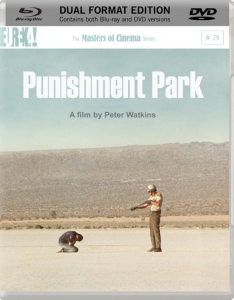
FilmJuice have my review of Peter Watkins’ cruelly overlooked mock documentary Punishment Park.

Punishment Park is set in what was the near future back in 1971.  In this near future, America has descended into chaos and the American government has responded to this chaos by setting up a series of tribunals who give political prisoners the choice between a long jail term and taking part in a training exercise involving members of the police and the armed forces. These training exercises involve the prisoners being chased across a desert.  If they make it to a particular point by a particular time without being captured then they are free to go. Needless to say, nobody ever manages to escape:

On one level, Punishment Park functions as a near-future work of dystopian science fiction. If looked at in these terms, the exaggeration of the establishment’s reaction to political dissent is only a matter of degree and the exaggeration serves to highlight real problems in American political culture. Similarly, the dissidents’ futile march through a desert towards an American flag stands as a poignant metaphorical commentary on Humanity’s quest for freedom and how the value of freedom can be all too easily undermined by the very people entrusted with securing our attempts to achieve it. On another level, Punishment Park is a furious attack not only upon the politically intransigent elites that run America but also upon the biased nature of so-called reporting and the intellectually incoherent and simple-minded nature of responses to those elites.

Released in typically wonderful style by Masters of Cinema, this is a great opportunity to discover a lost classic of American cinema.

Why Hollywood Blames the HR Department for 9/11

1. Langley, we have a problem…

Last week I went to see Mission Impossible: Ghost Protocol, Brad Bird’s well-received addition to the decidedly uneven Mission Impossible franchise. While my opinion of the film is that it is really nothing more than a competently made action film, the film’s central plot conceit is absolutely fascinating for what it says about how we perceive the workings of government.  Take a look at the trailer and you will see what I mean.

Continue reading →

REVIEW: 3-D Sex and Zen: Extreme Ecstasy (2011)

THE ZONE has my review of Christopher Sun’s erotic fantasy film 3-D Sex and Zen: Extreme Ecstasy.

Incorrectly marketed as the world’s first work of erotic 3D cinema, Sex and Zen: Extreme Ecstasy is a film that never quite manages to achieve the levels of inspired oddness that make for a decent cult following. Instead, the film has a few nice moments (including an intersexual vampire lifting cartwheels with her 8 foot-long prehensile penis) that ultimately wind up getting lost amidst a lot of puerile sniggering and some deeply unpleasant misogynistic sadism.

Right from the off, Sex And Zen 3D suffers from translation problems as British culture tends not to cope too well with attempts to combine sex with comedy. While most British people will happily acknowledge the fact that sex – as an activity – can sometimes be very funny, attempts to capture that comedy on screen generally do not fare too well, as ridicule was traditionally one of the means through which matters pertaining to sexuality was repressed. For example, while a case can be made for seeing the Carry On films as agents of social change, one could just as easily say that they helped to reinforce taboos about the human body by presenting sex as a laughing matter. 3D Sex And Zen‘s tendency to move between (rather un-stimulating) eroticism and childish humour is not only unsettling, it is also fiercely reminiscent of the jarring tonal shifts common to the kind of campy Bavarian softcore porn films that were made in the 1960s and 1970s and screened on British cable TV in the early-to-mid 1990s. Sex And Zen 3D ultimately fails as a film because its jokes are unfunny and its erotic content is nothing more than boobies and thrusting bottoms, but the constant shifting between these two registers makes for an experience which, I suspect; would translate better for people from cultures where laughter was not used to drain sex of its power.

I hate to say this but, watching 3-D Sex and Zen: Extreme Ecstasy actually made me want to read some Laurel K. Hamilton as while Hamilton writes with all the style and insight of a someone with a pick-axe embedded in their skull, she at least knows how to mine the sweet spot between titillation, repulsion and transgression.

REVIEW: Stake Land (2010)

THE ZONE has my review of Jim Mickle’s post-apocalyptic vampire movie Stake Land.

Between Richard Matheson’s I Am Legend (1954) and Anne Rice’s Interview with the Vampire (1976) there are no shortage of works that use vampires as a means of engaging with such existentialist themes as loneliness, alienation and self-loathing. Indeed, the rather individualistic idea that people out there are somehow less alive and therefore different to us also features in zombie films like Edgar Wright’s Shaun of the Dead (2004) and Ruben Fleischer’s Zombieland (2009). Beating a critically acclaimed path to this already well-frequented watering hole is Stake Land, a film that combines the post-apocalyptic seriousness of Cormac McCarthy’s The Road (2006) with the post-apocalyptic silliness of Kevin Costner’s The Postman (1997) with all the problems this entails:

Though never all that original or overflowing with important things to say, Stake Land could have been an interesting addition to the tradition that uses elements of art house cinema to revitalise tired old horror tropes. Similarly, it could have been a harmless action movie in which a stone-cold badass leads a group of people through a vampire-infested post-apocalyptic landscape. However, by attempting to be both things at once, Stake Land succeeds at being neither. This is a slow, ponderous, underpowered and ludicrously pompous film that comes nowhere close to adding up to the sum of its parts.

Disappointing to say the least.

BG46 – Skyrim and the Quest for Meaning

Futurismic have my forty-sixth Blasphemous Geometries column entitled ‘Skyrim and the Quest for Meaning’.

This column took me quite a while to write as I struggled to put my finger on precisely what it was that annoyed me about Skyrim. Initially, I thought it might be the bleak nature of the setting that reduces life to a series of to-do lists and selfish ambitions with easily quantifiable outcomes. However, while I am no Randian and tend to think that this vision of life is to be rejected rather than embraced, I simply could not fault it. I mean… life is ultimately about jumping through hoops until we die, right? Then I began to reflect upon the game’s lack of narrative and how playing it felt a lot like playing World of Warcraft without engaging with the social realities of guilds and pick-up groups. This was more promising as Skyrim is indeed a nightmare of pointless grind hidden by the tiniest narrative fig leaf imaginable. Then it occurred to me: if life really is nothing more than grind, why should we seek to immerse ourselves in fantasy realms that are similarly bleak and mechanistic? Skyrim‘s real problem is that it is an escapist fantasy that denies the possibility of escape:

While all video games ultimately reduce down to mechanical feedback loops and branching decision trees, most game designers soften the impact of their mechanical reductionism by hiding it behind a series of dramatic conceits that place the events of the game within a particular context which, though meaningless in mechanical terms, will provide the players with a context through which to understand their in-game actions, a context that will allow them to connect on an emotional level with the plots and characters of the game.

As usual, when faced with the bleakness of the world, I turned to Pinkie Pie from My Little Pony: Friendship is Magic for advice. The great sage’s advice to me was clear and unambiguous, when confronted by the horrors of existence and the feeling of bottomless dread that can only come from the realisation that we are truly and hopelessly free, the only possible solution is to laugh and launch into a nice little musical number as searching for the meaning of life is really nothing more than a quest for the most psychologically convenient form of self-delusion available.

Melancholia (2011) – The Misery of Coherence vs. The Mania of Incoherence

Once upon a time, happiness was something to be avoided at all costs. The reason for this bizarre rule of thumb was that true happiness was said to be the sole preserve of the afterlife, a gift given by a loving God in return for our trust and obedience. Life was a vale of tears where our Faith and resolve were tested and tested again. If we were happy then chances were that we had taken our eye off the ball and given in to Satan as happiness-now almost invariably lead to misery-later, an eternity of misery in fact. As a result, happiness was something that happened to other folks once they died. With the Renaissance came a two-fold rejection of God’s feudalism: Not only was life driven by the pursuit of happiness, people were opting for happiness-now over Grace and Salvation-later.

When happiness became the end point of human existence, pain and suffering took on an altogether different character. Under Christianity, pain and suffering had been tangible proof of God’s promise that the meek would inherit the Earth and that worldly happiness is only fleeting when compared to the infinite joy of union with the Godhead. Under the grand ideologies of the Enlightenment’s children, pain and suffering were things to be extinguished either by revolution (surgery) or by reform (chemotherapy). Now our culture no longer sees misery as divine, it sees it as something to be eradicated and avoided at all costs. Every advert screams promises of material and sensory happiness while bookshops explode with self-help guides designed to help you kick the sadness habit. Films, food, books and even sex are commodified, packaged and sold to us as means to greater and more intense forms of happiness. Even the miseries of work become vehicles for happiness as we are encouraged to work harder for bigger rewards and grander promotions. You must have a career. You must be successful. You must be happy. And if you can’t be happy by your own means then the multi billion-dollar neuropharmacology industry stands poised to offer you deliverance. You have no choice… you must comply.

The first half of Lars von Trier’s Melancholia is a meditation on the expectation of happiness and how the insistence of others that you be happy can be a source of true and unrelenting misery. The second half of Lars von Trier’s Melancholia is about the Earth being destroyed in a collision with a rogue planet. Beautifully shot and filled with wonderful ideas and moments of real human insight, Melancholia is possibly Lars von Trier’s best film to date, but that does not mean that the film makes sense. In fact, much of the film’s greatness lies in its perverse refusal to abide by the rules of its two very different halves.

Continue reading →

BG45 – Demon’s Souls and the Meaning and Import of Virtual Death

Futurismic have my forty-fifth Blasphemous Geometries column about From Software’s Demon’s Souls and its place in the history of video game attitudes towards death.

Following on from some of my thoughts on Deus Ex: Human Revolutions, the column argues that rather than trying to downplay virtual death by re-packaging it as with Assassin’s Creed and Prince of Persia‘s talk of death-as-flawed-memory, video game designers ought to follow From Software in embracing the cataclysmic number of deaths that feature in their games. Indeed, what makes Demon’s Souls such a fascinating game is its relentless downbeat tone and its recognition of the fact that characters will die and players will give up in disgust. Clearly, if Demon’s Souls had been a film, it would have been directed by Ingmar Bergman. The column also draws the reader’s attention to Algis Budrys’ Rogue Moon, a book all about the psychological impact of experiencing a futile death over and over again…

Nowhere is the need for unpleasantness greater than in video gaming’s attitude to death.  What was once a means of rationing the time people spent hogging a particular arcade machine has now ossified into a set of linguistic tics that are now completely disconnected from both their real-world and in-game significances. Video games ask us to die over and over again but rather than acknowledging this fact, many game designers seek to minimise the impact of these sacrifices by explaining them away as lapses in memory. By trivialising death, game designers have not only cheapened the lives of our characters, they have also deprived themselves of one of the most powerful thematic motifs in all of art and literature.

Games like Demon’s Souls recognise that they are dealing in death and this recognition is genuinely disconcerting. Like death itself, Demon’s Souls is utterly indifferent to both our presence in the game and our attempts at engaging with it. Demon’s Souls is a game of misery tempered by frustration, and its unapologetic recognition of this fact is what makes it both different and great. While I appreciate Walker’s point, I cannot help but feel that he is looking at the problem in entirely the wrong way: Let us not repackage death, but rather celebrate it as the core of the video game experience.

Having spent a good deal of time playing carefully-packaged AAA-rated titles for this column, one of the continuing joys of Demon’s Souls remains its complete indifference to my presence.  Forty hours in and I’m still not completely clear on how many basic aspects of the game actually work. One of the game’s major mechanics involves shifting between different forms and you begin to pick up magical items helping with that transition a long time before you actually realise what it means. Similarly, it took me about 20 hours to realise that the game had a magic system. In a video game culture full of shallow joys and craven player-pandering, there is something truly wonderful in From Software’s complete indifference to whether or not we ever get the hang of the game.

DC: The New Frontier… Stripp’d

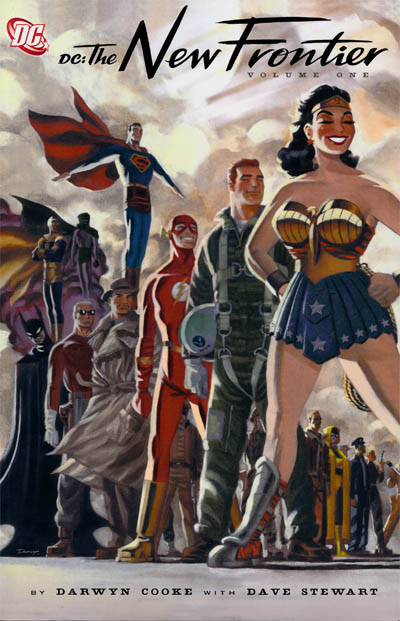
Boomtron have my latest comics column on Darwyn Cooke’s DC: The New Frontier.

New Frontier is an ‘elseworld’ that takes the superheroes of the DC Comics Universe and transposes them into the late 1940s in much the same way as Neil Gaiman transposed the Marvel Universe into Elizabethan England in 1602 (2003). However, while 1602 is really nothing more than an extended exercise in fan service that wanders around Elizabethan London going “Oooh… I wonder what Daredevil would look like if he was an Irish bard!”, DC: The New Frontier is an attempt to liberate mainstream superhero comics from the cynicism of the post-Watchmen era by finding a way of reconciling psychological depth with the values of old-fashioned Gold and Silver Age heroism. While I do not think that Cooke is ultimately successful in his endeavour, I do think that the result is one of the most fascination mainstream superhero comics ever produced.  It is fascinating because it is a comic that clearly realises the challenge that faces large generation-spanning mythological systems.  As I pointed out in my review of Dick Maas’ horror film Saint (2010), myths must reinvent themselves in order to stay alive and DC: The New Frontier is clearly designed as a mutation that might help superhero comics adapt to the culture of today:

The last thirty years has seen a drive to re-invent traditional heroes as darker and more realistic figures. Moore’s reinvention of the superhero as a vigilante mired in psychological trauma and political compromise is no different to the re-invention of King Arthur as a Roman Centurion or an Iron-age Chieftain. The world has changed and though we can no longer believe in a campy middle-aged Batman, we can believe in a tortured psychopath who acts upon his own flawed sense of justice. Humans have always and will always yearn for escape from the prison of their lives but the vehicle they choose for that escape is determined by the nature of the lives they are escaping. Because of this, stories must be retold and heroes must be reborn. Even modern day myths are subject to these evolutionary pressures, in order to survive stories must change to suit the demands of their audience.

Despite its failures, DC: The New Frontier is still a fascinating read and a great place to start if you are looking to get a handle on the tendency of superhero comics to keep re-launching and re-inventing themselves.

BG44 – The Shameful Joys of Deus Ex: Human Revolutions

Futurismic have my latest Blasphemous Geometries column devoted to Deus Ex: Human Revolutions.

A lot has been made of this game’s boss fights and the myriad niggles and irritations that conspire to make its game-play something of an uphill struggle. I will not deny, this game inspired more rage-quits than any game in recent memory. However, rather than seeing these irritations as products of genre-confusion and outdated game design, I decided to consider these problems as part of the game’s central aesthetic and sub-text. I conclude that, whereas the original Deus Ex games were all about empowering the player, Deus Ex: Human Revolutions is all about claustrophobia, prejudice and being forced into a position of willing servitude:

Taken together, these racial and economic narratives combine to create an almost intolerable atmosphere of disempowerment. Whereas Deus Ex sought to empower its players, Deus Ex: Human Revolution constantly reminds them of how worthless and incompetent they really are. Playing DXHR is like spending an afternoon with a depressed and alcoholic mother who is not only disappointed with what you have made of yourself, but also insistent on letting you know how she feels about your failure as an individual. However, as unpleasant as DXHR can be, it is an intensely enjoyable game. Indeed, the game’s real thematic power lies not in its narratives of disenfranchisement and oppression, but in the fact that it keeps us coming back for more in spite of them.

All too often, reviewers tend to assume that any mechanic that is not fun is broken. I simply could not disagree more, all mechanics tell a story… you just need to open your mind and play the story that the game wants to tell.