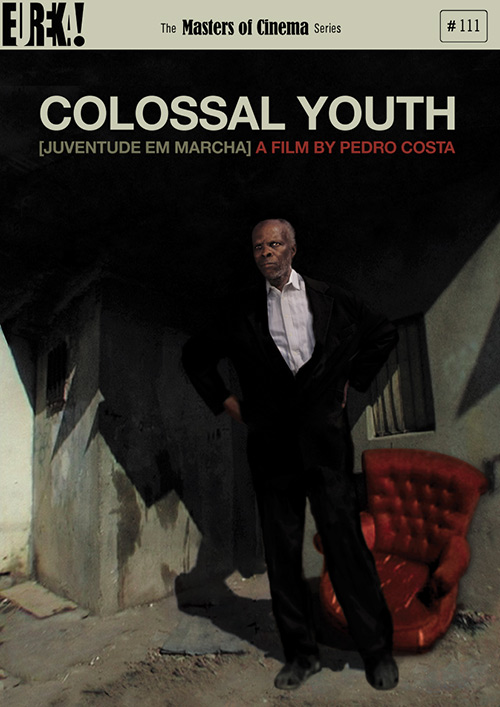
REVIEW – Colossal Youth (2006)

Videovista have my review of Pedro Costa’s Juventude em Marcha, which has been released by the always excellent boutique DVD and Blu-ray label Masters of Cinema.

While Colossal Youth is not the first Pedro Costa I have seen, my familiarity with the filmmaker’s work in no way made it either an easier or a more appealing watch.  The film is beautiful, intelligent and is inspired by the same singular vision that pervades all of Costa’s work but it is also cataclysmically boring and inaccessible. This is art house film making without compromise or concession, either you accept the film on its own terms or you don’t bother:

While Costa’s films are almost completely unwatchable, there is clearly a coherent vision behind the impenetrable boredom that dominates his films. Because this coherent vision exists, Costa has found an audience for his decidedly singular and experimental approach to filmmaking. Indeed, while I suspect that Costa has few followers outside of academic film studies and film schools, the substance that exists in his work means that his films contribute to the evolution of the cinematic form. While the films that Costa makes may be boring and unwatchable, they will be influential and it would not surprise me if Costa’s devotees can find echoes of his work in that of the filmmakers who have come after him. As boring as his work may be to me, I cannot deny that Costa is an important figure and that his films constitute a boon to the on-going evolution of the cinematic form.

Going by the recent output of Colin Marshall’s excellent podcast Marketplace of Ideas, I get the impression that certain elements of the lit-blogosphere are attempting to re-claim boredom as a position of spiritual strength and a reaction against the media-saturation and sensationalism of much of Western culture. It seems to me that Costa’s work would probably make a good case-study for people sympathetic to that position.

Robinson in Ruins (2010) – Mould on a Dystopian Corpse

Back in the 1990s, the filmmaker and architectural scholar Patrick Keiller made a pair of films about Britain. As much video essays as they were documentary films, London (1994) and Robinson in Space (1997) were concerted attempts to find the true spirit of Britain that had been buried by a decade and a half of Thatcherite rule.  Sensing that the wheels were coming off the Tory juggernaut and that a fresh start would soon be required, Keiller used the eccentric academic Robinson and a wryly-comic unnamed narrator to sift the wreckage in search of gold.  Unfortunately, despite the best efforts of Keiller’s intrepid explorers, the project was a political failure: Britain, much like its capital city, was a place devoid of any truth that could not be measured in pounds, euros, dollars or units of industrial measurement.  London and Robinson in Space are films about the defeat of the romantic spirit and the absolute victory of neoliberalism.

Over a decade later, Keiller returns with Robinson in Ruins, an unexpected addendum to the Robinson duology.  With the narrator dead and Robinson gone, the narration has fallen to an equally unnamed female public sector worker (voiced by Vanessa Redgrave) who discovers Robinson’s footage and notes in an old caravan on a site destined for re-development. Made at the height of the credit crunch, when the towers of Capitalism tottered and nearly fell, Robinson in Ruins is far less pessimistic than either London or Robinson in Space.  Eerily apocalyptic and as visually arresting as all of Keiller’s work, Robinson in Ruins suggests that humanity’s salvation may lie in communion with non-human intelligences.

Continue reading →

Some Thoughts On… Project Nim (2011)

Last year, the French documentarian Nicolas Philibert produced Nenette (2010), a film that used footage of an orang-utan and recordings taken in a zoo to demonstrate the human tendency to project human emotions onto animals. Nenette also demonstrated that human speculations about the inner lives of apes tend to tell us a lot more about the humans than they do about the apes. James Marsh’s latest documentary Project Nim ploughs much the same furrow by exploring the attempt by a group of 1970s scientists to teach a chimp to sign.

Project Nim focuses upon the story of Nim Chimpsky, a chimpanzee who was removed from his mother and brought up by humans in an attempt to see if treating a chimp like a human might encourage him to think and communicate like one.   Initially, Nim is entrusted to the care of a wealthy hippy family whose laid-back approach to parenting results in Nim effectively taking control of the house.  Concerned that the chimp is getting what he wants through social dominance rather than by acquiring language skills, the project director Herbert S. Terrace removes Nim from his surrogate family and places him in the care of a group of specialised teachers.  While these teachers manage to imbue Nim with an incredibly rich vocabulary, the older Nim becomes, the harder it is to control him. When Nim bites his teacher’s face, Terrace decides to end the project and place the chimp in a research facility where his life gets progressively worse.

The foreground of the documentary is devoted to a somewhat uneven engagement with the project’s ethical standards. Terrace is depicted as a shameless opportunist who uses both his students and Nim to build an academic career before cutting both adrift without a moment’s hesitation or regret.  While this foreground narrative produces a number of touching moments, it is fatally undermined by Marsh’s bizarre insistence upon reminding us that Nim is a wild animal who should not be thought of in human terms.  The result is a film that coaxes its audience into empathising with a chimp before slapping them down for doing precisely this.  Mercifully, the film’s background proves far more rewarding.

Stepping back from the details of Nim’s life, Project Nim does an absolutely brilliant job of conveying the weirdness of 1970s academic culture. For example, Nim’s original foster family included a woman who breast-fed Nim and then allowed the chimp to ‘explore her body’ as part of her informal personal research into the Oedipus complex. Predictably enough, once Nim is transferred to the care of a group of scientists, they follow the original foster mother in using Nim as a vehicle for their own desires and ambitions. One ambitious graduate student wrestled control of Nim’s education from the foster family as a means of acquiring Terrace’s attention, this lead to a brief affair that resulted in one dumped graduate student and one chimp deprived of a mother-figure. The more figures from Nim’s life the film introduces, the more obvious it becomes that while everyone was eager to do what was best for Nim, their assessments of what was ‘best’ usually depended upon what was convenient for them.  This is particularly obvious in the case of Terrace whose termination of the project results in Nim being sold for medical research.  His charge cast into the outer darkness, Terrace promptly produced a book in which he argues that Nim was nothing more than a hugely accomplished beggar who never really understood the language he was using. Unsurprisingly, the humans who come across as most sympathetic are the ones whose visions of Nim emphasise his human characteristics.  Particularly sympathetic is the Dead Head primate handler who treats Nim as just another pot-smoking fellow traveller.

The fact that our sympathies tend to lie with those who treat Nim like a person rather than an animal says a lot about our own empathic tendencies and the film’s capacity for inviting us to fall into the same trap as Nim’s original handlers.  However, as clever as this manipulation may be, the film’s refusal to engage with empathic projection head-on results in frustratingly lightweight fare. Yes, we extend empathy to a chimp because the chimp behaves like a human but so what? What does this say about us? What does it mean for our relationships to animals as a whole? Are we wrong to treat animals as humans or are those who treat chimps like animals unethical monsters? Project Nim tries to address some of these questions without getting bogged down in the sort of heavy philosophical speculation that might alienate audiences but by raising questions in such an oblique fashion and then failing to develop them in any meaningful way, Project Nim only manages to remind us of quite how much can be achieved with footage of an orang-utan and the sound of zoo visitors wildly projecting their own worries onto the indifferent figure of an ape.

REVIEW – Night and Fog (1955)

Videovista have my review of Alain Resnais’ sublime holocaust documentary Nuit et Brouillard.

Reminiscent in both its imagery and intent to Billy Wilder’s post-War propaganda film Death Mills (1945), Night and Fog is only 32-minutes long but each and every one of those 32 minutes packs a hefty punch.  Not content with directly addressing the somewhat thorny issue of France’s involvement in the deportation of Jews, Resnais attempts to universalise the cultural significance of the Holocaust in a number of ways.  Firstly, (like many films) he suggests that Jewish people do not in any sense own the Holocaust and that the stain of the atrocity marks each and every one of us.  Secondly, (somewhat more controversially) he suggests that many of the people inside the camps were far from innocent victims:

Between this and his continued insistence upon ‘denunciations’ and ‘thievery’, Resnais suggests that concentration camp inmates were far from blameless in the construction of some of the worst living conditions imaginable to man. While the film in no way lets the Nazis off the hook, it does suggest that the capacity for inhuman violence is present in all of us and that all the Nazis really did was create an environment in which man’s inhumanity to man could express itself fully. So detailed is Resnais’ accounting of social dynamics that one could almost watch Night And Fog as a sort of time and motion study. Given the film’s almost academic tone, the horrific imagery serves as a means of grounding the film and of reminding us what it is that we are discussing.

Somewhat unsurprisingly, this review touches on many of the same issues as my recent review of Gilles Paquet-Brenner’s disappointing Sarah’s Key (2010), which is out this weekend.

REVIEW – Arirang (2011)

The Bright Lights Film Journal have my piece on KIM Ki-duk’s Arirang, winner of the Un Certain Regard prize at this year’s Cannes film festival.

Back in the late 90s and early 00s, KIM was one of Korean cinema’s golden boys.  Hugely productive and critically acclaimed the world over, he was held up as an example by a generation of young Korean filmmakers busy taking their first steps on the international stage.  Then, in 2008, KIM suddenly stopped working and dropped out of sight.  Arirang is an autobiographical documentary made by KIM in an effort to work out why it is that he cannot make films.  Now before you dismiss this as one of those self-indulgent ‘I’m writing a song about not being able to write a song!’ stunts, you should know that Arirang is not a straight film.  In fact, it ends with an outright lie. This suggests that KIM knows that many of his ‘reasons’ for not working are fictitious and so Arirang can be seen as being about a man intent upon confronting the lies that plague his life:

Much like the suggestion that he might be acting, the use of a song as generically miserable as “Arirang” serves to question the authenticity of Kim’s self-diagnosis. “Arirang” can be sung at any time because while it articulates, it does not deconstruct. Its diagnosis is so general that it applies to all ills, and the same might well be said of Kim’s diagnoses of his own miseries. Is he really unable to work because two assistants failed to follow his example? Or because he cannot come to terms with the fact that death may well be the end of life? These seem less like insightful diagnoses than convenient tragedies that can be draped across Kim’s problems in order to allow him to vocalise his misery without actually analysing it — convenient fictions that smell of untruth.

Arirang is a delicate, moving and intensely personal film about grief, depression and creative block.  However, while it may be breathtakingly honest, I wouldn’t believe a word of it.

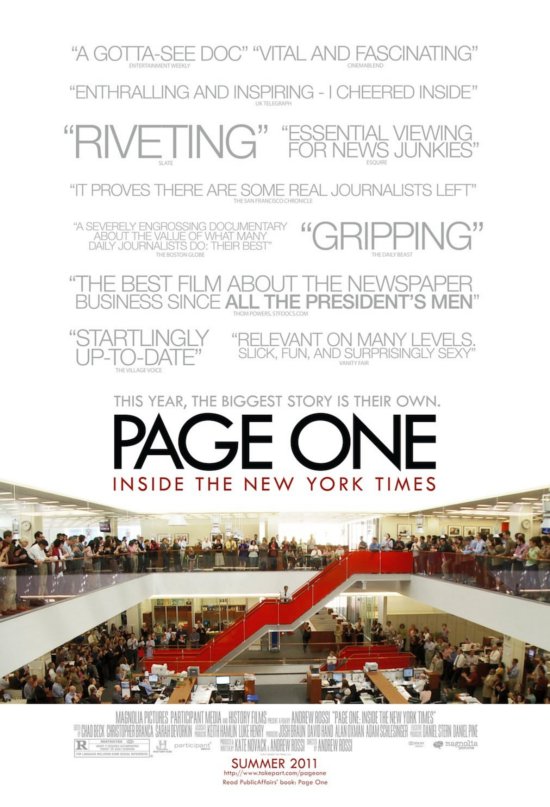
Some thoughts On… Page One: Inside the New York Times (2011)

NB: Thoughts On… is new strand for this particular blog.  As I have been watching quite a few films recently, I have realised that while many films give me reason to ponder, not all pondering necessarily results in either a coherent opinion or enough substance for a full critical response.  So instead of keeping such thought to myself, I have decided to share my thoughts on the various films I see as well as producing more developed pieces.

***

Currently on limited US release and in search of US distributors, Andrew Rossi’s Page One: Inside the New York Times primary concern is with the current economic state of the US newspaper industry and it asks whether there is still a place for an old media institution like the NYT.  Indeed, with advertising revenue drying up, classified ads moving online and more and more people getting their news online for free, the question of the Times’ continued existence needs to be asked if only so that we can work out why it is that newspapers should survive.  While Page One offers us an answer, I am not at all convinced that the answer it gives us is all that convincing.

Our guide through the issues surrounding the future of the newspaper industry is the NYT’s engaging media columnist David Carr.  The doc follows Carr about as he breaks stories, interviews new media tycoons, takes part in panel discussions and gives speeches at journalism conferences. A gruff scarecrow of a man whose odd physicality speaks to his past as a drug addict, Carr is absolutely savage in his defence of the New York Times in particular and print media in general.  In fact, Carr is so engaging a presence that it is difficult not to smile as he repeatedly swings a carefully sharpened and immaculately weighted hatchet at the reams of hyperbole generated by online mavens only too eager to dance on the grave of traditional print media. However, as engaging as Carr might be, I could not help but feel that Page One is only giving us half the story.

The problem is that Page One is a film that is utterly in love with its subject matter.  Rossi repeatedly stresses not only the NYT’s history but also its continuing role as a purveyor of truth and a guardian of natural justice.  Rather than giving equal time and equal weighting to both sides of the debate, the film portrays critics of old media as hyperbole-slinging crooks and straw men who take to the field of debate solely to provide the ferocious Carr with target practice.  So one-sided is the battle that one cannot help but begin to wonder why it is that Carr spends all his time grappling with paper tigers when the real beasts of the jungle are allowed to go about their business unmolested.  For example, in his book Flat Earth News (2008), Nick Davies points out that only 12% of the stories published in British newspapers come from actual reporters while 88% come either from recycling other papers’ stories or from cutting-and-pasting directly from press releases put out by pressure groups and business people. Once you realise that that 12% also includes stories generated through tabloid muckraking, the arguments put forward by Carr and his ilk begin to seem quite flimsy.  Indeed, there is no denying that newspapers such as the New York Times do fantastic work in breaking important stories and unveiling hidden truths, but what of the remaining 88% of the stories that grace their website?

The question of whether newspapers are a public good that are worth protecting even as their business models crumble is an important one not only for the state of our public discourse but also for the future of democracy.  By failing to answer any of the tough questions that can be asked of old media, Page One has not so much argued the NYT’s corner as sung its praises in the form of a funeral dirge.  Nobody benefits from this sort of one-sided cheerleading, least of all an industry in dire need of waking up and smelling the coffee.

Page One is arguably at its best when it is not trying to help as its most cogent and powerful arguments for the continued existence of print media are not the ones that it explicitly makes but the ones that it makes by implication simply by showing the NYT’s journalists at work.  In one brilliant sequence, the media editor and the foreign affairs editor discuss whether or not to report on a so-called ‘final patrol’ by US combat troops in Iraq only for the pair to reach the conclusion that the only people who are actually announcing the withdrawal of combat troops are the TV journalists that feature in the report and, because NBC are not actually at war in the Middle East, the story has more to do with TV reporters wanting narrative closure than it does with any real-world events of changes in policy.  As the various editors toss ideas back and forth, it is easy to see quite how much thought goes into the honing of an editorial stance.  These sequences suggest that there is far more to reporting than dumping a load of diplomatic correspondence on a website and the fact that the construction of editorial stances involve such careful deliberation and expertise is a powerful argument for the continued existence of what Clay Shirky refers to in the film as a professional media class.

The irony of Page One is that, had Rossi followed his own advice and left reportage to the reporters, this documentary would have been far more powerful an argument in favour of print media.  However, instead of allowing the NYT’s reporters to speak for themselves through their entirely admirable actions, Rossi attempts to fashion a narrative and, in so doing, weakens his own case by producing a documentary, which, though undeniably enjoyable, feels stilted to the point of hagiography.
Cyclonopedia (2008) By Reza Negarestani – Madness/Theory/Truth/Nonsense

I once attended an academic conference where a member of the audience repeated a criticism made by the author of a rather successful book. In response to this criticism, the paper-giver smiled and began his response by saying “While I think that professor X should be praised for producing such an accessible work on the subject…” before going on to explain at great length why it was that he thought that professor X was both wrong and a grotesquely ugly freak. Though I cannot remember the subject of the paper, or the criticism made of its position, or the response given to said criticism, I can still remember the audible intake of breath and the appreciative tittering from the audience when the speaker applied the word ‘accessible’ to the work of another academic. The dynamics of this withering intellectual put-down are easy enough to unpack: if a work is accessible then it means that it is written with a non-specialist audience in mind and if a work is intended to be consumed by people who are new to the subject then it cannot hope to break new-ground. However, if the aesthetics of accessibility are ‘wrong’ then what are the right aesthetics?


Continue reading →

Nenette (2010) – Behind Brown Eyes

We live the entirety of our lives entombed in our skulls.  Isolated from the world by a few inches of bone, we never experience what it is like to not be in our bodies and nor do we experience what it is like to be someone else.  Not even for a second.  Tragically detached from the world, we are forever looking out and speculating as to what it might be like out there, what might be happening inside other people’s heads.  Of course, evolution has equipped us to make these inferential leaps and studies suggest that within minutes of birth, babies have already acquired a preference for looking at human faces.  As a species of pattern-matchers, we seek out our fellow humans and we try to guess what it is that they are feeling.  We read emotions on faces and infer the emotional states that might be causing them.  As our understanding of both human psychology and ourselves expand, we build complex models that help us to make sense of other people by projecting our own emotions onto the facial expressions we see around us.  We assume that other people are like us because the alternative is unbearable.  It is one thing to be entombed in our heads, but it is quite another to be completely alone.

Our skill at pattern recognition is such that all too often we generate false positives.  We look at the weather and random happenstance and we infer a form of human agency that eventually becomes belief in a supreme divine intelligence.  We look at images beamed from the surface of Mars and we see faces in the rubble.  We look at animals and we think we recognise human emotions.  We project because that is what we do.  We project because we cannot stand the idea that we are the only people feeling what it is that we feel.  We do not want to be alone in our experiences.

Nicolas Philibert’s Nenette is a documentary film that explores this desire to project ourselves out onto the world in order to make sense of it and concludes that these acts of projection say more about the person doing the projecting than the thing being projected upon.

Continue reading →

127 Hours (2010) – Moments Exist Forever But Last No Time At All

Biographies are interestingly false.  Drawing on collections of facts about a person’s life, they attempt to present these facts as being in some way related to each other.  First one thing happens, and then another thing happens.  The audience is invited to infer either that the first thing caused the second thing or that both things are expressions of unseen psychological law.  A character trait.  An obsession.  A neurosis.  A fleeting moment of psychotic anger.  But this is to assume that the facts of our lives are connected in meaningful ways and that there are fixed patterns to our psychological states that govern our actions in a predictable and rational manner.

This is rather a large assumption to make.

The philosopher David Hume expressed a degree of scepticism about the idea of the self as a thing with fixed characteristics.  According to the traditional reading of Hume, the self is a series of perceptions that are bundled together by coherence and consistency.  One interpretation of this is that we are our own biographers and that by choosing to place discrete events and moments of our lives in a series of imagined causal relations, we are fashioning a narrative and thereby fashioning an identity for ourselves. Our continued existence is a myth.  And yet…

The philosopher Derek Parfit, himself an intellectual descendent of Hume, argues that while it does not make sense to say that we are a single person who exists through time, there is a degree of psychological connection between the different selves that make up this illusory person. The key to psychological connection, according to Parfit is memory.  The physicist David Deutsch explains the physics of behind this idea in his book The Fabric of Reality (1997):


We exist in multiples versions, in universes called ‘moments’.  Each version of us is not directly aware of the others, but has evidence of their existence because physical law links the contents of different universes.  It is tempting to suppose that the moment of which we are aware is the only real one, or is at least a little more real than the others.  But that is just solipsism.  All moments are physically real.  The whole of the multiverse is physically real.  Nothing else is. – Page 287


As a person, I remember my anterior selves and the impressions I get of my anterior selves allow me to construct an image of an enduring personality.  A personality constructed from a series of discrete but completely real selves.  A series of moments in time.

Danny Boyle’s film 127 Hours is an adaptation of Between a Rock and a Hard Place (2004) the autobiography of the outdoorsman Aron Ralston who, after being trapped beneath a boulder for five days, decided to saw his own arm off using a cheap folding knife.  Ostensibly about the realisation that even the most self-reliant of people get lonely, the film is really an exploration of the idea that we are nothing but a series of moments.

Continue reading →

The Art of Not Being Governed (2010) By James C. Scott – A Weapons-grade Meme

For providence ordained that the people with gigantic proportions and the greatest strength would wander the mountain heights like beasts with natural strength.  Then, on hearing the first thunder after the universal flood, they entered the earth in its mountain caves, and subjected themselves to the superior force which they imagined as Jupiter.  All their pride and ferocity was converted to astonishment, and they humbled themselves before this divinity.  Given the order of human institutions, divine providence could not conceivably have acted otherwise to end their bestial wandering through the earth’s forests, and to establish the order of human civil institutions – Section 1097

So says Giambattista Vico in the conclusion to his masterwork of political philosophy The Principles of a New Science of the Common Nature of Nations (1725).  Cruelly overlooked at the time of its publication, Vico’s work has since gone on to capture the imagination of thinkers and artists including Isaiah Berlin, James Joyce, Jorge Luis Borges, Northrop Frye and Samuel Beckett.  What has ensured the immortality of Vico’s vision is neither the fundamental correctness of his argument nor the soundness of his methods but the power of his central narrative.  Vico argues that all of human affairs can be accounted for in terms of a cyclical progression through three distinct ages: the divine, the heroic and the human.  As humanity moves from stage to stage its approach to language changes and as its approach to language changes, so do its attitudes to law, reason and the nature of government.  Ever upwards humanity tumbles until its thinking becomes so efficiently rational that it becomes incapable of seeing beyond its own selfish interests resulting in societal collapse amidst what Vico called “Barbarie della Reflessione” — the barbarism of reflection.  Having returned itself to an age of primitive superstition and savagery, humanity begins again its upward journey.  Forever moving upwards.  Forever passing out of the shadow of barbarism and into the light of civilisation.


Echoes of this picturesque rendering of the process of civilisation can also be found in the 14th Century Arab polymath Ibn Khaldun’s Muqaddimah (1377).  Ibn Khaldun argued that there was a fundamental currency to civilisation known as ‘Asabiyyah’.  Asabiyyah represents not just social cohesion and in-group solidarity but also group consciousness and the capacity to think and act as a single political unit. The social groups with the greatest amounts of asabiyyah were nomadic tribesmen and this great sense of social togetherness allowed them not only to accumulate wealth and power but also to assure the smooth transition of wealth and power from one generation to the next allowing the creation first of hereditary dynasties and then of civilisations.  As the generations pass and the descendants of the tribesmen become increasingly used to the trappings of civilisation, their asabiyyah slowly ebbs away.  Eventually, the dynasty’s asabiyyah levels are no longer sufficient to maintain a grip on power and the civilisation falls into decline until another group of nomadic tribesmen turn up and use their greater levels of social cohesion and political unity to make a grab for power. As Voltaire so memorably put it:


History is only the pattern of silken slippers descending the stairs to the thunder of hobnailed boots climbing upward from below.


These traditional accounts of the rise of civilisation emphasise the role of the state as agent. Growing and developing in a structure-less vacuum where life is nasty, brutish and short, the state is presented as the only institution capable of providing the sort of stable and conflict-free communal living that is necessary for human flourishing.  Under this view, people existing outside of the state system are either passive entities waiting in misery and poverty to be embraced by a nearby state or they are highly organised state-like entities poised to make the final step up to civilisation by themselves.  The circularity of this definition is obvious: only states have agency and if an institution has agency but is not a state then it must be about to become a state.


James C. Scott’s The Art of Not Being Governed takes a hammer to this neat little circle. Scott suggests that, far from being the passive victims of Hobbesian circumstance, many non-state groups actively choose to adopt such ‘uncivilised’ characteristics as illiteracy, religious extremism and reliance upon hunter-gathering modes of subsistence as part of a coordinated strategy for evading state control.  This suggestion that one can be uncivilised by choice is not only a radical departure from traditional state-based models of civilisation, it also provides us with a central narrative so powerful that it rivals that of Vico’s tumbling savages, Ibn Khaldun’s decaying nomads and Voltaire’s fleeing slippers. The Art of Not Being Governed is a book that shakes our notions of civilisation to the very core and, as a result, can only be described as a masterpiece that deserves to influence the artists and thinkers of the future in the same way as Vico’s works have influenced those of the past.


Continue reading →