 Half an hour into Patrick Lussier’s uneven but ultimately likeable neo-grindhouse pseudo-exploitation film Drive Angry, there is a scene that manages to perfectly encapsulate what it is about this film that makes it both intensely silly and surprisingly interesting. In this scene, Nicolas Cage’s character John Milton is having sex with a waitress he picked up in an Oklahoma roadhouse. As the naked woman groans in pleasure and writhes around on the end of his (presumably massive) penis, Cage’s character stares impassively into space from behind a large pair of wrap-around shades. Despite being in mid coitus, Milton is fully dressed and smoking a (noticeably massive) cigar. He also has a bottle of Jack Daniels in one hand. When a bunch of Satanists come crashing through the door hoping to kill Cage’s character, Cage calmly scoops up the waitress and proceeds to shoot them all dead without either spilling his drink or pulling out of the waitress. Drive Angry is a film about humanity’s unquenchable desire for pleasure. It is not enough for these characters to have sex, they also have to smoke cigars and drink hard liquor while they are doing it. Nor is it enough for them to have exciting shoot-outs, they also have to have sex at the same time. Drive Angry is filled with characters that go to extraordinary lengths in order to satisfy their desires, but no matter how much fun, sex and excitement they have, there is always something more that needs doing.
Category / Horror
REVIEW – 5150 Elm’s Way (2009)
 Videovista have my review of Eric Tessier’s slightly disappointing 5150, Rue des Ormes.
Based on a novel by the Canadian Horror writer Daniel Grou, 5150 tells the story of a young man who finds himself caught up in the internal struggles of a family dominated by a father who has decided to act as God’s instrument and in order to punish the unrighteous. As a series of interlocking character studies, the film works quite nicely and boasts some creepy ideas and some nice performances but step back from the melodrama of zealots interacting with psychos and you have a film that really struggles to find a point:
Lacking a clear focus or the sort of directorial discipline that might allow the visuals to cut a swathe through a dense thicket of plotlines, 5150 Elm’s Way comes very close to being genuinely interesting only to fall apart in the final stretch. Lacking both the clarity required of genuine insight and the technical flair that’s required to be genuinely thrilling, this Canadian thriller is more like a game of Hungry Hungry Hippos than it is a game of chess.
That chess comparison is there for a reason by the way… it’s not just terrible writing and an excuse to mention Hungry Hungry Hippos.
REVIEW – Battle Royale (2001)
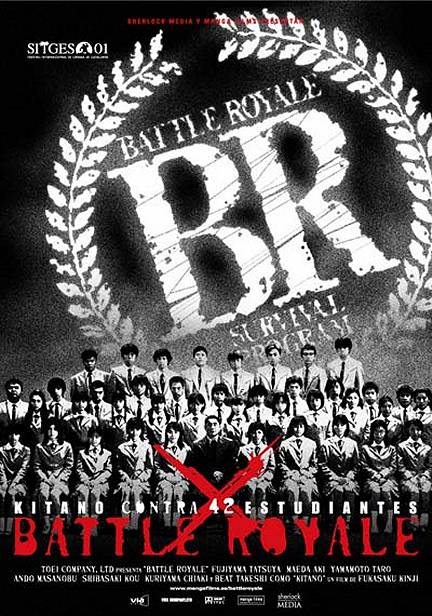 THE ZONE has my review of Kinji Fukasaku’s Battle Royale: Director’s Cut, which has recently been re-released on DVD.
My review attempts to localise Battle Royale within a dystopian tradition which, it seems to me, is peculiarly Japanese. What distinguishes Battle Royale from many dystopian fictions starring plucky teenagers is that the film uses every possible opportunity to mock and ridicule the suffering of its teenaged scapegoats. Indeed, while writers in this tradition are quick to point the finger at governments that blame the young for social problems, works in this tradition also pour scorn on the youth that allow themselves to be victimised:
Again and again, Japanese genre writers depict modern Japan as a hellish place where the old lash out against the youth in ignorance, fear and hatred but the youth refuse to organise and refuse to do anything about their treatment thereby suggesting that no matter how immoral these old people might be, they are not entirely wrong about Japan’s passive, consumerist youth.
The ways in which Fukasaku mocks and trivialises his teenaged characters feeds directly into my one serious complaint about this re-edition: Was a Director’s Cut really necessary?
Some Thoughts On… A Lonely Place To Die (2011)
 Back in 2007, Julian Gilbey co-wrote and directed a film entitled Rise of the Footsoldier. Boasting some execrable cockney dialogue, vast amounts of violence and an intent to glamorise football hooliganism that was as morally repugnant as it was artistically derivative, Rise of the Footsoldier sank rapidly, leaving behind it only a greasy slick of DVDs that clogged up the ‘3 for £10’ aisle for months on end. Four years later and Julian Gilbey returns with his co-writer Will Gilbey to offer us a film that is just as violent and unpleasant as Rise of the Footsoldier but which somehow manages to work. A Lonely Place to Die is a lean and misanthropic action thriller that warns middle-class thrill seekers to be careful what they wish for.
Dateline Scotland where Eagles soar over rocky mountainsides of almost unbearable beauty. As the camera swoops past outcrops and peaks, we suddenly see a series of coloured fleeces picked out against the barren greyness of the Scottish peaks. These fleeces belong to three friends on a climbing holiday. Well… I say friends but the tensions within the group are obvious from the get-go as Alison (Melissa George) scolds Ed (Ed Speleers) for his lack of focus while experienced climber Rob (Alec Newman) rolls his eyes at the couple’s bickering. A potentially fatal fall narrowly averted, the group trudge back to a nearby cottage where they meet up with another couple and spend the evening getting drunk. Unlike many films that attempt to stress the camaraderie of the protagonists, A Lonely Place To Die makes it abundantly clear that these people hate each other. They not only hate each other but they tease and antagonise each other to the point of nearly coming to blows. “I’d rather eat my own shit” harrumphs Ed when he is handed a fish-based sarnie after a morning’s hiking. This is a group that is tired, bored and spoiling for a bit of adventure. Needless to say, their wish is granted.
As the group make their way through a forest, a noise is carried to them on the wind. Is it an animal in pain? Is it a human voice? Spreading out to search, the group soon discover a pipe sticking out of the ground leading to a box that contains a young girl. Clearly, she has been buried alive… but by whom? Squabbling as they go, the group split up with the more experienced climbers taking the direct route to civilisation while the others move more slowly across country with the girl.
Forced out of comfort zone, the climbers are forced to climb fast and hard. Gilbey’s camera spins around and plays up the sense of vertigo as Alison and Ed hang on for dear life. However, after a nasty fall and an inexplicable rockslide, it soon becomes clear that the pair are not alone. Someone out there is after them.
In a slick move, Gilbey holds off introducing us to the villains of the piece, choosing instead to play up the sense of oppressive paranoia gripping both sets of climbers as they move across the brutal Scottish hillside. With the identities and motivations of the kidnappers still unclear, Gilbey introduces us first to a pair of hunters and then a carload of heavies who both seem to be involved in the kidnapping in some way. However, in the first of a series of reversals, Gilbey rapidly pulls the rug from beneath our understanding of the situation as people slowly reveal not only their true motivations but also their true character. People you would expect to be immoral speak of the need for trust while people that seem good and upstanding are revealed to be cold and calculating mercenaries.
By the time the group has made it back to civilisation, there are three different groups in play. All of them desperate and all of them ready to kill in order to get whatever they want. Here, the film transitions from paranoid thriller to all-out action as the three groups go to war in a small Scottish town in the midst of a spectacular street carnival populated by flame-wielding demons and strange naked figures. As flames belch into the sky and fireworks detonate above the village, the three groups go to war, filling the streets of the Scottish town with blood and bullets in a series of well-conceived and exquisitely directed gun-fights that easily rival the climbing set-pieces from earlier in the film.
In his book The Whole Equation: A History of Hollywood (2004), the film critic David Thomson speaks of the role of Californian light in helping to establish the American film industry. Indeed, by building their studios in Los Angeles, executives were able to tap into a free natural resource that would have cost them an absolute fortune to artificially replicate. Because of the climate and because of the environment, films made in Hollywood just flat out looked better than films made elsewhere. While there is previous light to be had in the Scottish Highlands, Gilbey’s film benefits hugely from the awe-inspiring natural beauty of its mountain backdrop. From the opening frames, A Lonely Place to Die is a film that looks absolutely stunning. Even when the action moves to the town, Gilbey makes brilliant use of a Scottish Winter Fire Festival to create a bizarre world of flickering firelight and sinister figures. Add to this some beautifully devised set-pieces, some neat structural tricks, some clever use of camera filters and an absolutely flawless feel for pacing and what you have is one of the best-directed action thrillers I have seen in a long time. Based upon A Lonely Place to Die, I would put Gilbey in the same bracket as the Frenchman Fred Cavaye whose Anything for Her (2008) recently received a Hollywood remake and whose Point Blank (2010) confirmed his status as one of the best thriller directors working at the moment.
For all of its technical accomplishment, A Lonely Place to Die does suffer from a regrettable lack of interiority. Gilbey introduces us to characters and plays games with our attitudes towards them but at no point does any of this game-playing really result in anything that I would call a dramatic arc; the story is that there’s a group of climbers and a kidnapped girl and people are chasing them… there is no sub-text, there is no emotional core, there are no character arcs… there’s just lots of chasing, lots of excitement, lots of people falling off of things, getting shot and being blown up but nothing really beyond that. Were A Lonely Place to Die any less technically impressive as a piece of action cinema, this lack of dramatic interiority would be a terrible problem but with pacing this good and spectacle this well constructed, I am inclined to forgive Gilbey and Gilbey their somewhat lightweight plot, particularly as the characters are well-defined and well served for dialogue despite their lack of dramatic ‘movement’. Had maybe a scene or two been devoted to giving this film some sort of ‘message’ then I would be hailing A Lonely Place to Die as one of the best films I have seen so far this year but, because of the lack of substance, I am reduced to saying that this is one of the best thrillers I have seen this year and that is still something. A Lonely Place to Die has appeared at a couple of festivals and is slated (according to IMDb) for an autumn release, this release may be theatrical or it may be on DVD but either way, it is a film that deserves to find an audience. I would be intrigued to know what Gilbey could accomplish with a really good script behind him.
Some Thoughts On… Retreat (2011)
 Kate (Thandie Newton) and Martin (Cillian Murphy) are in trouble. Married for a number of years, the couple’s relationship has been soured by the loss of a child resulting in them visiting an isolated island retreat in the hope of forcing themselves to have a proper conversation. Unfortunately, once the pair arrive on the island things go from bad to worse as instead of forcing them to communicate, the isolation offers up a myriad of displacement activities including fishing, running and the writing of incredibly bitter articles about why their marriage is doomed.
Slowly retreating into paranoia and mutual resentment, Kate and Martin are jolted out of their bitterness by the arrival of a wounded soldier. Jack (Jamie Bell) informs the couple that a terrible pandemic is sweeping the world and that their only hope is to barricade themselves into their house and seal all the windows. Understandably sceptical, the couple play along on the grounds that even if Jack is lying, he is clearly a dangerous man who needs to be handled with care.
As he boards up the windows, Jack sets about playing on the couple’s fears and desires. Initially, he plays upon Martin’s presumed masculine desire to protect Kate and to wear the trousers. He then moves on to attempting to seduce Kate by suggesting that she resembles his late wife thereby tapping into both Kate’s frustration and her presumed feminine attraction to tough guys with a softer side. While the couple remain sceptical about Jack’s claims of a pandemic, Jack’s ability to play Martin and Kate off each other does allow him to gain the upper hand, a position he begins to use quite skilfully once he finds Kate’s laptop and reads all about the couple’s marital difficulties.
Retreat is a film all about a relationship struggling with the cancer of distrust. For a while, Jack’s ability to tap into the couple’s fears seems so uncanny that one begins to think that he might be some phantom either supernatural or psychological in nature and while the film regrettably down-plays this aspect of Jack’s character, there is a very clear evolution in the nature of the fears he uses in his attempts to manipulate the couple. For example, initially knowing nothing of the couple, Jack draws on quite widespread fears such as disease as well as a husband’s fear that he cannot protect his wife. However, as Jack gets to know more about the couple, his lies become a whole lot more specific. While I regret the fact that the script did not allow us more of a peak behind Jack’s thought-processes, I would still argue that Jack is the best thing about this film. In fact, Bell’s performance is spell-binding and constitutes a timely reminder of why his name continues to carry a good deal of buzz despite its tendency to be attached to terrible films. Sadly, while Retreat offers Bell the opportunity to shine, the same cannot be said of Newton and Murphy who are forced to contend not only with a tangible lack of chemistry but also a tragically under-written script.
Retreat’s suffers for the fact that Martin and Kate’s relationship never feels unique enough to be real. This is somewhat odd given that the film takes a long time to settle into ‘thriller’ mode allowing oceans of space for the development of its central relationship. However, despite ample time and some real acting talent to draw upon, first-time director and co-writer Carl Tibbetts never quite manages to make the relationship progress beyond the merely generic. The problem is that while the idea of a couple struggling to stay together after the loss of a child is a firm grounding for a film about trust, it is not a particularly original idea. In fact, the idea has featured in so many films that by the time Tibbetts and his co-writer Janice Hallett get round to it, it feels dated and generic. This means that, in order to make the relationship seem real, the script and the actors needed to personalise it to the point where we feel that Martin and Kate are more than genre figures. Sadly, because neither Murphy and Newton’s performances nor the script bring that specificity to the table, Retreat’s central relationship fails to engage meaning that the film’s primary dramatic arc is as dead as Martin and Kate’s un-named child. The failure of this central relationship has a knock-on effect on the rest of the film.
The lack of emotional substance to Kate and Martin’s relationship means that Jack’s attempts to play on the couple’s mutual distrust is more interesting than it is emotionally compelling and because we are forced to engage with this unevenly paced thriller on intellectual rather than emotional terms, the film’s fundamental lack of depth becomes increasingly problematic as time goes on.
Retreat is, at root, a psychological thriller and as such it is part of a genre that thrives on the new. Script-lead, these films typically rely for their effectiveness upon their capacity to surprise audiences through narrative innovation. This means that each new psychological thriller needs to work that little bit harder to break through to an audience raised on Basic Instinct, The Tenant and Memento. In fact, these three films demonstrate quite how much pressure there is on writers to generate something new. Basic Instinct shocked mainstream audiences with its explicit sexuality, The Tenant shocked audiences with its inherited surrealism and Memento shocked audiences with its bizarre structure and psychological quirkiness. One could argue that there is a screen-writing arms race raging in the psychological thriller genre and that this arms race has forced screenwriters to skew the genre away from the psychological and towards the fantastical.
As humans, we are trapped in a prison of pure subjectivity. We know how we feel and we know how we see the world but we are forever separated from our fellow humans and we can never really know how they feel, what they see or what they think. Because of this gap between minds, humans have developed an incredibly sophisticated of the human mind that we use to attempt to infer what it is that other people are thinking. This model in referred to by philosophers as Folk Psychology. The folk psychological model that we draw on as individuals is determined both by our individual experience and by our cultural history. Indeed, one reason why the characters in classical plays frequently appear stilted and weird is because authors wrote them with radically different folk psychological models to our own. Because our need to interact with other humans has forced us all to become amateur psychologists, we humans tend to have a pretty good nose for bullshit when it comes to characterisation. In fact, one could argue that the challenge of characterisation is that of walking a tightrope between writing characters that we recognise as human and characters who act in individual enough ways that our folk psychological model is forced to adapt and encompass these new artistic insights into the human condition. Unfortunately, our innate capacity to smell bad characterisation is something of a problem for writers operating within a genre that thrives on novelty and the unexpected. Memento works as a psychological thriller because its central character feels real despite suffering from a condition that is genuinely novel from an artistic point of view but there are not that many psychological conditions that satisfy these twin demands. As a result, many recent psychological thrillers have tended to rely upon a narrative twist grounded not in human psychology but in either fantasy or the madness of the main protagonist.
By anchoring a plot in magic and madness, a screenwriter is effectively admitting to throwing the rules of drama out the window. Once magic and madness have been invoked, audiences can never quibble about plot as all quibbles can be defused with a terse ‘of course it doesn’t make sense… it’s magic’.
Retreat attempts to double bluff its audience by raising the possibility of the fantastical only to resolve to a set of rules that are ultimately purely psychological; Jack is neither a phantom nor a delusion, he is just a desperate man with a knack for playing on people’s fears. Tibbetts and Hallett’s decision to forego madness and magic in favour of an old school Cape Fear-style psychopath is refreshing but it does show quite how sophisticated our folk psychological model has become, particularly in the light of numerous films that have set out quite explicitly to fuck with our capacity to read people. Despite some neat ideas, Retreat never feels smart enough to scratch that genre itch. It never surprises, it never wrong-foots, it never moves us out of our psychological or emotional comfort zones and it never for even an instant capitalises on its potential. Perhaps if Martin and Kate had been better drawn then the film might have been more emotionally involving. Perhaps if the script had explored Jack’s motivations a bit better then the film would have been more interesting but for a psychological thriller hoping to find an audience in this day and age, Retreat is nowhere near psychological enough.
REVIEW – Julia’s Eyes (2010)
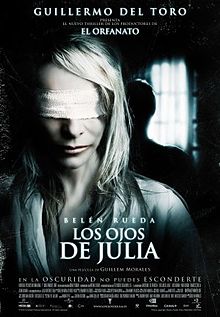 THE ZONE has my review of Guillem Morales’ disappointing Los Ojos de Julia.
The difference between the critical reaction to Julia’s Eyes and the critical reaction to James Wan’s Insidious sheds some interesting light on the extent to which our reactions to things are determined by the ways in which they are marketed and packaged. Indeed, boasting a cinematic heritage including such films as Saw and Paranormal Activity, Insidious was dismissed by many critics as stupid, childish and derivative. Or, as Nigel Floyd puts it in his review for Time Out:
From the co-creators of ‘Saw’ (James Wan and Leigh Whannell, here director and writer) and the director of ‘Paranormal Activity’ (Oren Peli, producing) comes a project featuring nothing that was original, distinctive or scary about either earlier film.
Floyd then concludes his piece with a flourish of scorn:
Not so much insidious as inexcusable.
Compare this level of dismissive hostility with many of the reviews of Julia’s Eyes and you find a very different reaction to what is, ultimately, a film operating in very much the same genre and with very much the same set of concerns and interests. Consider, for example, Nigel Floyd’s review for Time Out:
Guillem Morales’s thriller aims for intricate, Hitchcockian suspense, embellished with ornate visual flourishes that recall Dario Argento’s early giallo movies.
In fairness to Floyd, he does go on to suggest that Morales doesn’t quite manage to achieve these aims but the difference between the two reviews is quite striking. Neither film is a classic of the genre but because Julia’s Eyes reminds Floyd of Hitchcock and Argento while Insidious reminds Floyd of Saw and Paranormal Activity, Julia’s Eyes is judged with a good deal more charity. However, as I argue in my review, Julia’s Eyes fails precisely because of its direction. Morales is not only less visually imaginative than Wan but also less technically able when it comes to creating the sort of tension required to sustain a horror film and when Wan reaches for humour he connects whereas when Morales reaches for sentiment he comes away only with a handful of slush:
The chief problem with Morales’ direction is that he allows his scenes to drag on for far too long without ever really developing beyond their initial conditions. Time and again, Morales makes effective use of sound-effects and lighting cues to create an unsettling atmosphere only for this atmosphere to dissipate as audiences are allowed to grow accustomed their cinematic surroundings.
The technical failings of Julia’s Eyes are so obvious to me that I find myself wondering whether the film’s positive critical reaction might not have been due more to the way in which the film was marketed than to its inherent qualities. Indeed, while Insidious was marketed as a stupid Horror film, Julia’s Eyes was marketed as an art house thriller of precisely the sort produced by Hitchcock and Argento. While the fact that the film was in a foreign language may have hurt it at the box office, I think that its foreign language dialogue may have served to bolster its art house credentials and so helped to solicit a more positive reaction from critics.
The more I review and the more I attempt to deconstruct my own evaluative thought processes, the more it occurs to me that my reaction to films and books is determined as much by the context of discovery as by the works themselves. If a work comes to me warmly recommended by a trusted source then I am more disposed to be charitable. If a book has a cover adorned with dark imagery then I am likely to read it as Horror but if the same book comes with a cover with more neutral colours then I am more likely to see it as fantasy. The conflict between precept (my reaction as dictated by non-textual factors) and concept (my reaction to the content of the work itself) also determines the strength of my reaction. If I go into something expecting it to be awful only to discover that it is quite good then I am more likely to give it a really positive review. Similarly, if I go into something expecting it to be one of the books of the year only to discover that it is merely okay then I am less likely to be charitable in my evaluation.
Humans are such complex beasts and I suspect all of this explains why so many ‘serious’ academic critics tend to steer clear of evaluation…
REVIEW – Insidious (2011)
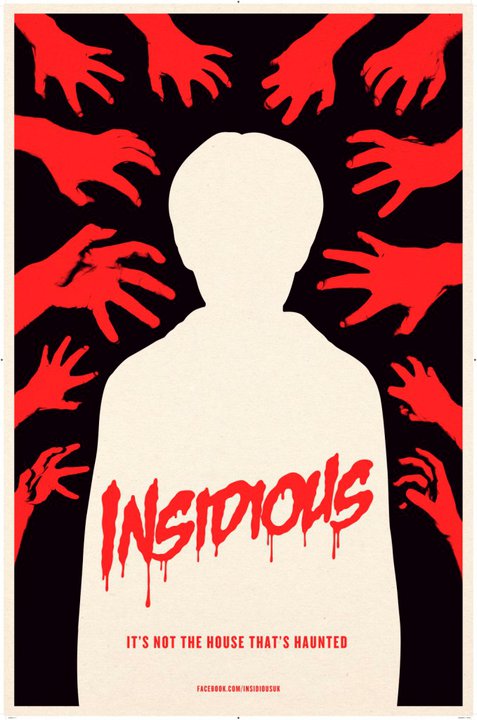 THE ZONE have my review of James Wan’s deliciously camp and thoroughly ridiculous Horror film Insidious.
Insidious is in some ways a remake of Oren Peli’s low-budget cult hit Paranormal Activity (2007) in that it is a story about a bunch of ghosts turning up and haunting an individual rather than a place. As in Paranormal Activity, the hapless victims of the haunting contact some ‘experts’ only to discover that the situation is in fact far worse than they had imagined. However, while Paranormal Activity made clever use of fixed cameras to make it look as though it had been shot by the victims themselves (an effect fatally undermined by the various special effects ‘added’ to the film for its UK cinematic release), Insidious moves right on past minimalist realism and into the realms of full bore gonzo:
Insidious is proof that Horror still has the power to entertain and to thrill without the need for 3D gimmickry, pointless nostalgia or needless deconstruction and that all you need to deliver a really effective work of cinematic Horror is a good crew and a talented director to guide them. You don’t even need a script. Or actors. Or ideas…
Warmly recommended for anyone who likes their Horror well-made but also a little bit silly. See also Jaume Collet-Serra’s Orphan a film that brings the awesome with devastating grace and efficiency.
REVIEW – Rubber (2010)
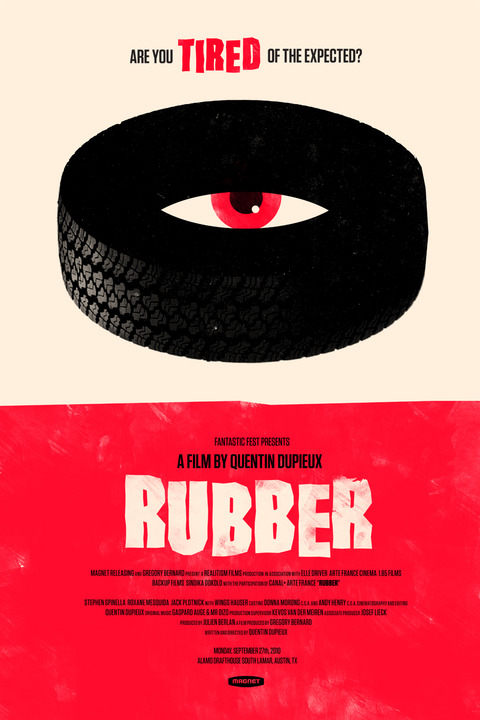 Videovista have my review of Quentin Dupieux’s postmodern exploitation film Rubber. A film that features a sentient tyre, exploding heads and a cinema audience that is force-fed poisoned turkey after spending a night alone in the desert while a tyre sits in a motel room watching TV.
While I’m not convinced that the film is entirely successful in what it sets out to do (the joke ultimately fails to sustain the film despite its short running time), this is still a hugely imaginative and ambitious piece of film-making that is unlike anything you will see in the cinema or on DVD this year:
By confronting us with the absurdity of audiences speculating about the emotional lives of apes and tires, Philibert and Dupieux are drawing our attention to the inherent absurdity of the cinematic medium: Why do we care about the characters in films? They do not exist! They are not real!
My review also points out a number of similarities between Rubber and Nicolas Philibert’s ape-based documentary Nenette (2010), which I wrote about on this very blog.
REVIEW – Savage (2010)
Videovista have my review of Brendan Muldowney’s Irish thriller Savage:
The concept of a crisis in masculinity is undeniably an interesting one but Savage seems more of a victim of this crisis than a commentary upon it. Having asked the question of what it means to be a man in the modern world, Muldowney fails to see past male complicity in patriarchal oppression and so he struggles to come up with any conceptions of masculinity that are not anchored in adolescent willy-worrying and cartoonish levels of violence.
Savage‘s problem is reflected in Jonathan Liu’s recent piece for The New York Observer:
From the back row, looking at the sea of shiny pink scalps, it was easy to chalk up the whole scene to a category error: Someone mistaking the biographical decline of a man—namely himself—for a historical Decline of Men. Yet, strange as it may sound, grown men still have influence—if only on not-grown men—and should perhaps not be cut the slack reserved for the subjugated and infantilized.
In other words, it is difficult to delve into the issue of what it means to be a man in the 21st century without such delving coming across as either a misogynistic entitlement whine, an attempt at historical revisionism or (as is the case with Savage) slavish adherence to popular prejudice and received wisdom.
REVIEW – The Dark Angel (1987)
Videovista have my review of The Dark Angel, a British TV miniseries based upon J. Sheridan Le Fanu’s Uncle Silas (1864):
If judged as a thriller then The Dark Angel suffers for the fact that Uncle Silas is very much a book that is ‘of its time’.
While the TV series is, in and of itself, perfectly watchable, I could not quite get over the extent to which a) the plot reminded me of Wilkie Collins’ The Woman in White (1859) and b) quite how superior The Woman in White is to the content of this series.
 Ruthless Culture