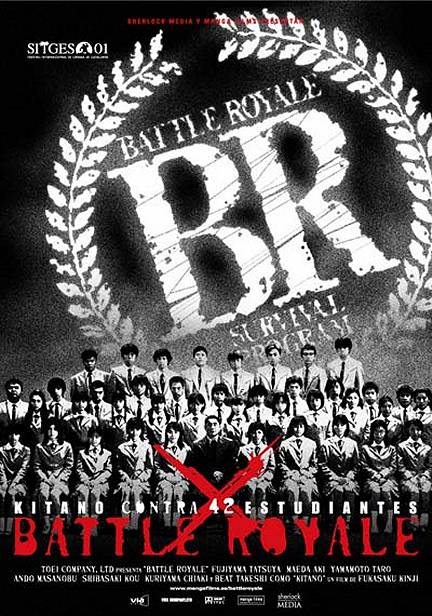
REVIEW – Battle Royale (2001)

THE ZONE has my review of  Kinji Fukasaku’s Battle Royale: Director’s Cut, which has recently been re-released on DVD.

My review attempts to localise Battle Royale within a dystopian tradition which, it seems to me, is peculiarly Japanese. What distinguishes Battle Royale from many dystopian fictions starring plucky teenagers is that the film uses every possible opportunity to mock and ridicule the suffering of its teenaged scapegoats. Indeed, while writers in this tradition are quick to point the finger at governments that blame the young for social problems, works in this tradition also pour scorn on the youth that allow themselves to be victimised:

Again and again, Japanese genre writers depict modern Japan as a hellish place where the old lash out against the youth in ignorance, fear and hatred but the youth refuse to organise and refuse to do anything about their treatment thereby suggesting that no matter how immoral these old people might be, they are not entirely wrong about Japan’s passive, consumerist youth.

The ways in which Fukasaku mocks and trivialises his teenaged characters feeds directly into my one serious complaint about this re-edition: Was a Director’s Cut really necessary?

REVIEW – Buried (2010)

Late last year, Rodrigo Cortes’s film about a man buried alive in Iraq was released to a good deal of serious critical attention.  Ostensibly an experimental work primarily concerned with trying to inject textured tension and atmosphere without ever leaving the confines of a small wooden box.  Though successful in this regard, the film’s use of the word ‘Iraq’ lead some overly eager critics to jump to the conclusion that the film is some grand allegory for American foreign policy.  It isn’t.  It’s a very silly film about a man trapped in a box which, despite glimmers of intelligence, is ultimately let-down by a decidedly lackluster script.

Videovista has my review.

In the review, I also mention Stuart Gordon’s film Stuck (2007), which I reviewed on this very site a couple of years ago.  That’s a much better film, go and watch that one instead.

REVIEW – The Lost Patrol (1934)

One of the more depressing cinematic experiences I had last year was going to see Matt Reeves’ timid remake of Tomas Alfredson’s superlative Let The Right One In.  I was lured into the cinema on the promise that the American version teased certain elements out of the original text that Alfredson’s film missed but what I got was pretty much a shot-for-shot remake.  Pointless hack-work aimed at culturally insular Americans.  Some might say that this was inevitable and that there is no point in remakes, but I do not think that this is necessarily true.  Some films positively overflow with great ideas but somehow manage to fuck up the implementation.

As my review of John Ford’s largely overlooked The Lost Patrol makes, clear, I think that it is a film that is absolutely ripe for a re-make.  Set in the Mesopotamian desert during the first world war, the film tells of a group of British soldiers who lose their officer and their way in the middle of the desert.  Under attack from unseen assailants, the soldiers hole-up in an abandoned mosque and slowly go mad.  Boasting Boris Karloff, the film is rushed and has too many characters to ever settle down into the psychological register the subject requires but there are some lovely ideas hidden in this film.  They just need someone to unleash them.

REVIEW – Gainsbourg (2010)

While I do have my preferred themes and modes of expression (abandonment, despair, existential dread), I like to think that the range of culture covered by this blog is comparatively cosmopolitan.  I do films, I do novels, I do short stories, I do non-fiction, I do games and I’m going to start doing comics too.  However, there are two forms of culture that I hate and so will never cover.  The first is French song (la chanson francaise) and the other is musicals.  I hate both of them.  With a passion.  In fact, to borrow a turn of phrase from Alexei Sayle, I hate musical theatre more than I hate fascism.

And yet here is my review of Joann Sfar’s Gainsbourg.  A musical all about French song.  And I don’t hate it.

REVIEW – Deep Red (1975)

Another month and another batch of new reviews up at Videovista.

Experience has taught me and I have learned my lessons well.  My natural film-viewing habits tend to be very director-based.  If I see a film I enjoy then my first reaction is generally to seek out that director’s other work.  Similarly, I will not go to see a film in order to see a particular actor, or to see the work of a particular writer.  But I will go out of my way to see a film by a particular director even if the subject matter does not initially speak to me.  This relationship is one of trust.  I trust certain directors to take me to certain places.

I do not trust Dario Argento.

Partly this is a reflection of the fact that he has had a very long career filled with many ups and downs but it is also due to the fact that I need to be in a quite specific frame of mind to tolerate the ostentatious silliness that characterises Argento’s style.  As my review of Profondo Rosso suggests, I was in the right frame of mind to watch a stylishly directed and fiendishly well composed whodunit.  Excellent job on the extras by Arrow too, who really are one of the best distributors out there when it comes to putting out old exploitation films.

REVIEW – Death of a Son (1989)

Do you remember the days before reality TV?  Do you remember the days before make-over shows?  Do you remember the days when British terrestrial TV used to commission one-off plays?

I bet you don’t.  Not really.

Ross Devenish’s Death of a Son is a powerful reminder of why it is that all of those British TV drama strands gradually died off.  It features one well-known actress (Lynn Redgrave) and a script that combines bone-crunching worthiness with grinding sentimentality and a complete lack of intelligence.  It is awful.

REVIEW – The Fallen Sparrow (1943)

“To shoot people, sweetheart!”

And with those words… my heart soared with joy.

Richard Wallace’s The Fallen Sparrow is very much an overlooked gem.  One of a series of novels by Dorothy B. Hughes that were adapted for the screen during the hey-day of the film noir, The Fallen Sparrow is a demented psychological thriller in which a tortured veteran of the Spanish Civil War cuts a swathe through New York high society as he attempts to solve the (possible) murder of the man who helped him escape the clutches of the Gestapo.  As the veteran moves from reconnecting with his old friends and into a world of sinister academics and crusading noblemen, the lines between reality and delusion blur and then finally disappear.  Boasting a fantastic script and some rather surprising performances, The Fallen Sparrow deserves its place in cinema history.

Videovista have my review.

REVIEW – The String (2009)

As someone who watches quite a bit of GLBT cinema – without actually being either G, L, B or T – I am often struck by the way in which gay indie film directors present coming out as a very simple moral question.  Most GLBT films frame coming out as a question of personal honesty and self-actualisation.  According to these films, people are in denial until they are not, at which point they come out and it is up to their friends and families to deal with it and by ‘deal with it’ I mean ‘accept it unconditionally’.  Indeed, GLBT cinema traditionally presents the ethics of coming out as purely a question of acceptance.  If you accept your friend/relative/former partner then you are morally good, if you do not then you are morally bad.  But what of the morality of living a lie?  what of the morality of turning people’s lives up-side down so that you can finally be honest with yourself?  Surely these are not simple questions.

Mehdi ben Attia’s film Le Fil addresses the social repercussions of coming out in a way that most Anglo-American GLBT films refuse to do.  A loving satire of upper-class Tunisian society, The String asks whether hypocrisy really is a worse option than social isolation.

Videovista have my review.

REVIEW – The Seven-Ups (1973)

Did you enjoy Steve McQueen in Bullitt?  How about Gene Hackman in The French Connection?  Well… believe it or not the producer of both of those films went on to direct a film of his own.  A film with many of the same advisors and technical assistants.  The result?  A Big Dumb Stylish 1970s Car Chase Movie but, unlike Bullitt and The French Connection, The Seven-Ups is nothing else than a Big Dumb Stylish 1970s Car Chase Movie.

Videovista have my review.

REVIEW – Sealed Cargo (1951)

Anyone who grew up in Britain in the 1980s will remember a time when TV schedules were bulked out with lesser-known black and white films.  Films which, as a kid, you would seldom find yourself watching.  There is a definite rainy-saturday-afternoon feel to Alfred L. Walker’s Sealed Cargo.  A war-time drama dealing with U-boats and the paranoia surrounding Nazi infiltration of the Danish merchant navy, Sealed Cargo features both some sublimely atmospheric moments of tension and some frankly demented action sequences.

Videovista have my review.