REVIEW – Blood Simple: Director’s Cut (1998)

BloodSimpleFilmJuice have my review of Joel and Ethan Coen’s first film Blood Simple. Or rather, the slightly shorter director’s cut that was released about fifteen years after the original film.

I found this review quite difficult to write as while I have seen and enjoyed most of the Coen Brothers’ films, I’m also acutely aware that their work invariably seems less substantial the more you think about it. Though some of their films are easily dismissed as more-or-less enjoyable tosh, some of their films feel like substantial dramas. Indeed, both A Simple Man and The Man Who Wasn’t There seemed intellectually robust when I first saw them but I am now hard pressed to remember anything about them aside from a couple of throwaway gags. Blood Simple felt very similar in that it is a film that does a great job of looking smart even though it is really little more than a pastiche:

Clearly inspired by such hardboiled crime novels as Dashiell Hammett’s Red Harvest and James M. Cain’s Double Indemnity, Blood Simple takes a collection of film noir clichés, drives them out of the city and deposits them in a crummy bar at the tail end of Texas. Stripped of their tilted fedoras and artfully crumpled raincoats, the clichés valiantly attempt to start new lives but eventually find themselves sliding back into old familiar habits.

Watching Blood Simple, I couldn’t help but reflect upon the fact that the dividing line between a ‘smart’ film and a ‘dumb’ film is often a question of viewer charity as a charitable viewer is more likely to detect meaning and symbolism than someone who is bored out of their tiny mind. Indeed, skilled directors know that it is possible to make a film seem smarter by using some of the visual and stylistic cues that people associate with smartness. For example, even though Jon Favreau’s Iron Man and Christopher Nolan’s The Dark Knight Rises do not actually say anything substantial about either the War against Terror or the Occupy movement, visual references to both of those real world events goaded critics into assuming both films had elaborate political messages. Similarly, art house films such as Eugene Green’s The Portuguese Nun and Carlos Reygadas’ Silent Light are so good at looking like serious intellectual films (long takes, lots of silence, beautiful photography, impressions of interiority) that many critics simply assume that they were in fact serious art house films filled with deep and meaningful truths.

Blood Simple is very much like a Batman comic in so far as it looks really dark, twisted and psychological but that look is ultimately all it has to offer. Watching Blood Simple I began to think about whether No Country For Old Men is a smart film or merely a film that looks smart… is there any difference? Does ‘smartness’ actually exist outside of the audience’s heads?

REVIEW – Les Cousins (1959)

LesCousinsFilmJuice have my review of Claude Chabrol’s second film Les Cousins, which has just been re-released by the ever-excellent Masters of Cinema.

Les Cousins tells of a young man who moves to the city in order to study law. Sharing his uncle’s place with his far more sophisticated and extroverted cousin, the young man finds himself being sucked into his cousin’s glamorous lifestyle filled with parties, girls and dubious European noblemen. Initially, this relationship works quite well as the cousin likes to be the centre of attention and the young man’s inexperience makes him feel like an older brother and a community leader. However, when the young man attempts to become romantically involved with a young lady in his cousin’s entourage, the cousin takes umbrage and decides to assert his supremacy. Disgusted both with his cousin’s behaviour and his own loss of focus, the young man throws himself into his studies but this only provokes his cousin into more frequent and louder parties:

Things come to ahead when Charles is trying to study for his finals but Paul keeps having loud parties. Charles pleads with his cousin to do some revision but Paul’s confidence is absolute… he knows what he is doing and revision is an absolute waste of time. As with Le Beau Serge, Chabrol presents the tension between the two boys as being social and psychological in nature but in truth their disagreement is a moral one: Charles writes endless letters home to his mother promising that he will succeed in his studies and suggesting that his desire to work is born of a sense of duty to do right by his parents. By not only refusing to study but also making it harder for Charles to study, Paul is challenging the moral order of Charles’s universe. In Charles’s mind, Paul is doomed to failure because the universe does not reward provocative layabouts. This means that when Paul does pass his exams with flying colours, Charles is forced to examine not only his faith in the moral nature of the universe but also his conviction that his duty to his parents obliged him to study: What if the best way to succeed really was to wear a smart suit and hang-out with dubious Italian aristocrats?

I mention Le Beau Serge as Les Cousins can be read as a response to that earlier film. Where Le Beau Serge is rural, Les Cousins is urban. Where Le Beau Serge is about a town-mouse visiting a familiar countryside, Les Cousins is about a country-mouse visiting an alien city. Where Le Beau Serge is about taking responsibility for the actions of another, Les Cousins is about remaining true to yourself.

Somewhat handily, Masters of Cinema have decided to time their re-release of Les Cousins with a parallel re-release of Le Beau Serge (that I also reviewed for FilmJuice). While both films work beautifully on their own, many of their subtleties only become apparent when viewed one after the other.

REVIEW – Le Beau Serge (1958)

LeBeauSergeFilmJuice have my review of Claude Chabrol’s first film Le Beau Serge, which has just been re-released by Masters of Cinema.

Le Beau Serge tells of a young man who returns to his home town in order to recuperate from an extended period of illness. Upon arriving, he becomes obsessed with a childhood friend who, despite showing real signs of intelligence and potential as a child, has now fallen into drink and bitterness. Puzzled by this unexpected fall from grace, the young man sets about trying to solve the riddle of what happened to the handsome Serge of his youth:

While much of the initial narrative energy comes from François’s attempts to solve the mystery of le beau Serge, the second half of the film increasingly comes to focus upon why it is that François is so obsessed with saving first Serge, then Marie and then the entire village. Though Chabrol offers us no easy answers, the depth of François’s guilt is such that his attempts to protect Serge and his family eventually come to seem insane and messianic. Why doesn’t François leave? Why didn’t Serge leave? Why doesn’t anyone leave a life that is manifestly killing them?

Chabrol is a director with a somewhat misleading reputation for producing thrillers. Though many of his most famous films (including Le Boucher, This Beast Must Die and La Ceremonie) include a bloody murder and a good deal of psychological tension, the truth of the matter is that Chabrol is and always was a moralist. Not in the sense of lecturing people about right and wrong but rather exploring why it is that people make certain decisions and how they come by certain strange beliefs. Unlike Chabrol’s later films, which dressed the morality up in murder and tension, Le Beau Serge strips the core of the Chabrol experience right back to the very core and asks two very salient questions: Why did Serge turn to drink? Why is Francois obsessed with saving him? A truly wonderful film by a truly wonderful director.

Interestingly, Masters of Cinema have chosen to re-release Le Beau Serge on the same day as they re-release his second film Les Cousins. As I explain in my review of that film over at FilmJuice, the two films function as a pair: Complementing each other through their many differences and juxtapositions.

REVIEW – Amour (2012)

amour-2FilmJuice have my review of Michael Haneke’s Palme D’Or and Oscar-winning drama Amour.

Set almost entirely within the walls of a well-appointed Parisian apartment, Amour tells the story of a retired couple named Anne and Georges who are forced to adapt to entirely new ways of being and relating when one of the couple suffers a massive stroke. Unlike many of Haneke’s films, which present themselves as being of a certain genre only to then deconstruct the genre and mock audiences for wanting generic plot resolutions, Amour is a film that is almost entirely free of postmodern cleverness. In fact, the only thing distinguishing Amour from an old-fashioned weepy is its thematic content. This thematic content sat very close to my personal metal as I spent a number of years as my mother’s primary carer and so immediately identified with the changes taking place in Georges’ character:

Much of the film’s drama and tension comes from Georges’ troubled attempts to reinvent himself and his relationships in a way that protects both Anne’s dignity and his own humanity. Sometimes the negative emotions prompt Georges to over-react to relatively minor problems because it is much easier to fire and humiliate a nurse than it is to deal with the feeling that your life is now nothing more than medication, nappy changes and the grim inevitability of death. As Anne’s condition continues to deteriorate, we see Georges attempting to cling to any island of psychological stability he can find. For example, when the couple’s children turn up and express concern over Anne’s condition, Georges seems cold and inflexible to the point of outright insanity but in truth this attitude is entirely self-protective. As Georges points out, the tears and concerns of his children are of no practical use to him because, at the end of the say, he is the one who will be left alone to care for Anne. Better that the children keep their mouths shut than for them to offer the type of false hope that would make it so much harder for Georges to go back to his life as a solitary carer. It is in Georges’ interactions with these islands of stability that we see Haneke’s vision imposing itself upon what would otherwise be quite a traditional weepy.

Usually, one finds oneself praising Haneke for his savagery and visual brilliance but Amour is a surprisingly humane and visually simplistic film. At times, the only difference between this and a TV movie is the lack of melodramatic scoring and even this is present if you allow for the fact that the film continues Haneke’s obsession with the emotional lives of neurotic pianists. Rather than praising Haneke for his ability to be Haneke, I find myself praising him for his compassion and attention to detail as many of the details of this film could have been lifted directly from my own life.

Five Intelligent Science Fiction Films

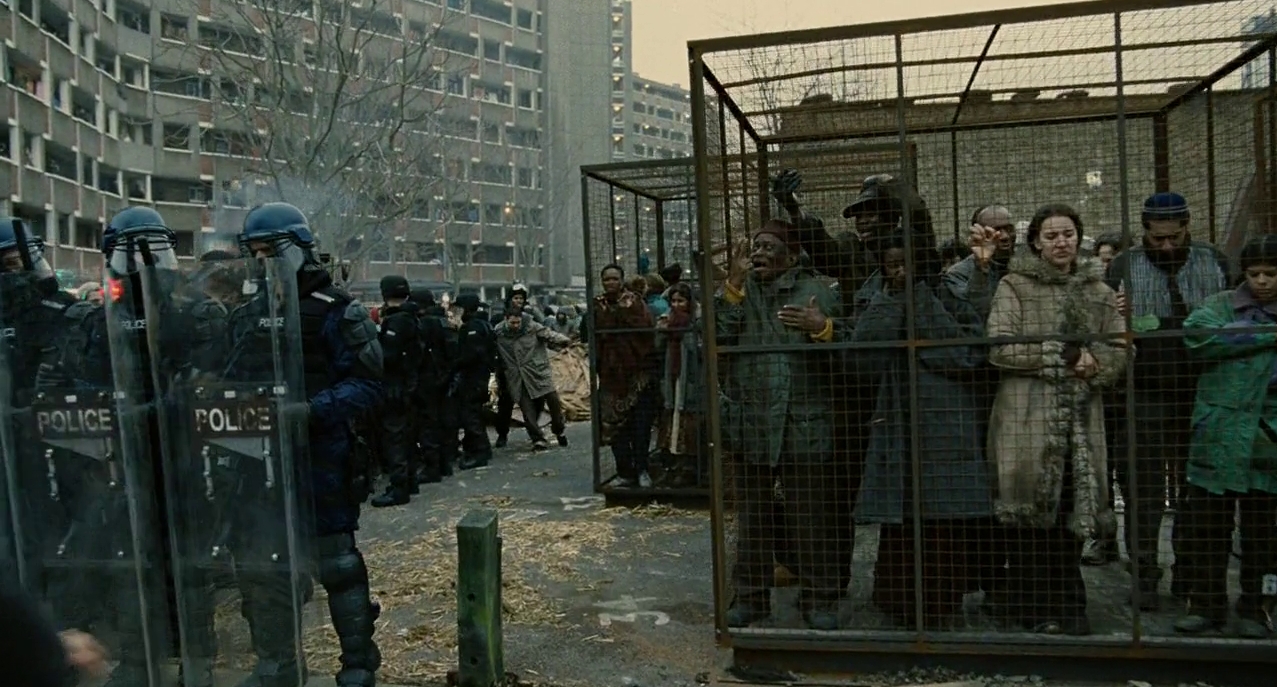
children-of-menFilmJuice have just published my latest feature. In honour of the British release of Cloud Atlas, here is my list of five literary science fiction films.

These types of feature are really quite formulaic, the list post is a staple of most major websites and I do little to subvert the format. However, while many such lists seem content to list anything that isn’t a disaster movie or an action film, I’ve attempted to select films on the basis of their vision and relevance. Somewhat unsurprisingly, I end the piece by singing hosannas to the glory of Curaon’s Children of Men:

Cuaron’s Children of Men takes place in a future Britain where the sudden and inexplicable sterility of the population has resulted in an even greater form of cultural blockage than the one we are currently experiencing. Without young people to stir things up and challenge orthodoxies, Britain has retreated into a bitter nostalgic conservatism where branded coffee shops sit beside cages full of foreign refugees and pleasant middle-class people withdraw into artfully decaying farm houses filled with relics of their long-abandoned ‘politicised’ youth. Even when The Revolution finally comes, it feels like a mass-market greatest hits album: Masked Islamic gunmen parading their martyred dead West Bank Style, under-equipped paramilitaries firing through the windows of abandoned schools Sarajevo Style, futuristic soldiers standing around impoverished suburbs Baghdad Style: Now That’s What I Call A Revolution! Volume 666.

People interested in this sense of cultural blockage might also be interested in my piece about the Cowardice, Laziness and Irony of literary science fiction and Mark Fisher’s eternally brilliant book Capitalist Realism.

REVIEW – Black Sunday (1960)

BlackSundayFilmJuice have my review of the Arrow Films re-release of Mario Bava’s wonderful Black Sunday (a.k.a. The Mask of Satan) which is out in shops today and well worth picking up.

Very loosely based upon Nikolai Gogol’s short story “Viy”, Black Sunday is an unabashedly Gothic vampire story about a pair of aristocratic doctors who accidentally re-awaken a long-buried evil. Shot in luxuriant black and white that looks absolutely sensational on Blu-ray, Black Sunday shows how effective Gothic imagery can be when used by a director who knows what he is doing. As I point out in the review, many people have come to associate Gothic horror with campy Hammer Horror films but those films undermined the effectiveness of their own Gothic tropes by shooting on Technicolor film:

Many period horror films such as Hammer’s Curse of Frankenstein attempted to improve upon traditional Hollywood gothic by shooting in colour and making use of the Technicolor reds made famous by Powell and Pressburger’s The Red Shoes. The problem is that while these vibrant reds looked amazing when spilling from someone’s throat, they looked absolutely nothing like the colour of real blood. Combine this cartoonish hyper-realism with the fact that the aggressive lighting required by Technicolor cameras made it almost impossible to shoot a dark film and it is easy to see why the movement into colour collapsed 1930s Hollywood gothic into the camp silliness of Hammer horror.

My point is best illustrated by a scene in which one of the doctors drips blood on the witch’s corpse causing it to knit itself back together. Had Bava shot this scene in colour then the writhing blood would have just looked disgusting. However, because the scene was shot in black and white and blood appears black on black and white film, the writhing flesh looks more like a seething blackness than a bloody rice pudding.

Two Films You Should See – Stalker and Perfect Blue

PerfectBluestalker-film-poster-tarkovsky

This year, FilmJuice have decided to compile a list of a hundred films that everyone should see. I was lucky enough to kick-off the series this week with my two selections: Andrei Tarkovsky’s Stalker and Satoshi Kon’s Perfect Blue.

Unlike Western science fiction films that use spectacular action sequences and fast-paced narratives to excite and entertain their audiences, Stalker uses a combination of extraordinary visual richness and extreme narrative simplicity to coax its audience into a mood of thoughtful curiosity. To call Stalker a ‘boring’ film is both technically correct and completely misleading as the lack of complex plot and distracting characters is a deliberate move designed to force the audience to reflect upon what it is they are actually seeing. Having placed the audience in a state of engaged curiosity, Tarkovsky engineers the cinematic equivalent of a spiritual experience.

My reading of Stalker is somewhat different to the one I put forward back in 2009 but I think the two are broadly compatible.

The brilliance of Perfect Blue lies not just in its ability to handle the dovetailing realities of a disturbed mind in a manner that is both poised and extremely rigorous, it also uses these fragmented realities to critique a cultural environment that is extremely resistant to re-invention and experimentation. This is a film about how society dehumanises and destabilises those women who refuse to stay in the box allotted them by the men who would control their lives.

I have not written about Perfect Blue before but it remains one of my very favourite films.  The rape scene I discuss is triggery as fuck for obvious reasons but I think it remains one of the most brutally ambivalent cinematic sequences every produced. Horrific, self-aware and even more horrific because of its self-awareness.

REVIEW – Floating Weeds (1959)

FWFilmJuice have my review of Yasujiro Ozu’s wonderful Floating Weeds.

A colour remake of Ozu’s 1934 film A Story of Floating Weeds, the film tells of a group of actors who arrive in a sea-side town.Initially, the actors present themselves as being in a different world from the residents and so work together to seduce local women. However, as the story unfolds, we soon learn that the head of the company has a pre-existing relationship with a local woman and that this relationship resulted in the birth of a child who has now grown-up.

This is a film all about the boundaries between worlds. The most obvious boundary is the one between the people on the stage and the people in the audience but a more important one is that between the world of the professional actor and the world of the respectable citizen. This perceived boundary serves both to draw the actors together and distance them from the world around them.

The plot revolves around a series of characters who struggle to keep these two worlds separate.  Some consider moving from one world to another, others are repulsed by a world and want to keep it separate from their world of choice and others choose one world only to change their minds and lose themselves in another.  The more the boundaries between worlds are tested, the less substantial the boundaries become and the less substantial the boundaries become, the more the characters come to realise the impact said boundaries have had on their lives.

There are always questions to ask when a widely respected and well-established director suddenly decides to remake one of his best known films (*ahem*). One particularly interesting question is the one posed by the fact that A Story of Floating Weeds was also remade one year earlier by Ozu’s one-time assistant director Shohei Imamura. As I said when I reviewed Stolen Desires back in 2011:

Imamura cut his cinematic teeth as Ozu’s assistant and, when the time came for him to make his own film, it was only natural that he should try to step out of Ozu’s shadow by making it clear how different his sensibilities were to those of his master and how better to make that difference apparent than by directing a vicious attack on one of Ozu’s best-loved films?

If we assume that Imamura’s chaotic and slovenly Stolen Desires was intended as an attempt at subverting the dignity and calm of Ozu’s films, might we also assume that the re-make was intended as something of a response to an uppity former underling? as I say in my review of Floating Weeds, there are moments of violence and melodrama in Floating Weeds that are quite unlike anything you usually find in a film by Yasukiro Ozu. Did Ozu film those scenes with Imamura in mind? Was Floating Weeds perhaps intended as proof that the old man still had it in him to make important films (as with Clouzot’s attempt tomake L’Enfer as a reply to the nouvelle vague directors)? That’s a question for scholars but looking at Floating Weeds and Stolen Desires, it is hard not to speculate about why this remake was made so soon after Stolen Desires.

REVIEW – Gate of Hell (1953)

GateofHellFilmJuice have my review of Teinosuke Kinugasa’s historically significant samurai drama Gate of Hell. I use the term ‘historical significance’ somewhat guardedly as it is one of those pieces of critical terminology which, though apparently quite bland and benign, actually contains a number of harsh judgements.

When people describe a film as being ‘historically significant’, what they generally mean is that watching it allows one to gain a better understanding of the evolution of a particular art form. For example, Jaws has enormous historical significance as Spielberg’s combination of accessibility and technical brilliance provided a blueprint for populist American cinema that continues to shape the films we see in cinemas today. To put it even more crude and reductive terms: You need to see Jaws in order to understand the transition from 1960s Hollywood to 1980s Hollywood.

While Jaws remains a great film, its greatness actually has very little to do with its historical significance. In fact, saying that a film is historically significant in no guarantees that it will make for enjoyable viewing now. Some works enchant with their timeless technical brilliance, others enchant by being of a particular cultural moment and while those cultural moments may linger in our cultural consciousness, it is often hard to experience a historically significant work in the way that made it historically significant to begin with.

Kinugasa’s Gate of Hell is a historically significant film in so far as it is not only a Palme D’Or winner and the first Japanese colour film to be seen outside of Japan, but also one of the first generation of Japanese films to find a European audience. In fact, Gate of Hell was considerably better received in Europe than it was in Japan for reasons that seem pretty obvious to me in hindsight. The main problem is that while the film opens as a visually striking ode to the chaos of war it soon changes into a rather underwhelming (and in some ways quite sexist) costume drama about the constraints of honour. As I put it in my review, this latter section is:

Underwritten, under-directed and spoiled by the concussive brilliance of its opening section, the film fizzles and fades when it should ring the bells and light the fires.

One for scholars and historians rather than modern film fans but the chaos and colour of the opening section does go a surprising way to redeeming it.

REVIEW – The Passion of Joan of Arc (1928)

FilmJuice have my review of Carl Theodor Dreyer’s immortal The Passion of Joan or Arc, which is being released on the 26th of this month by Masters of Cinema.

Set after the capture of Joan of Arc by the English, the film chronicles the authorities’ attempts to try and convict Joan as either a fraud, a witch, a heretic or all three at once. Shot very simply and all the more powerful for this simplicity, the film distinguishes between the ethereal world inhabited by the peasant Joan and the corrupt and venal world inhabited by the supposedly holy churchmen. Dreyer establishes this distinction simply by point his camera at the actors’ faces and allowing the simple authenticity of Joan’s tears stand in stark contrast to the weathered faces and knowing smiles of her inquisitors:

Like many of the silent films released by Masters of Cinema in recent months, Carl Theodor Dreyer’s The Passion of Joan of Arc is a powerful reminder of how much can be accomplished with limited technological resources.  While Hollywood spends billions producing films that struggle to make you feel anything other than boredom, Dreyer invokes the full weight of human sympathy by showing a tear roll down an actress’s cheek.

Since hooking up with FilmJuice earlier this year, I’ve been fortunate enough to review a goodly number of Masters of Cinema’s recent releases.  I really feel as though this process has been something of an education for me as visiting brilliant but sometimes under appreciated films from earlier eras has allowed me to get a really good feel for which filmmakers have proved influential and which important lessons have somehow been lost. For example, when I reviewed a number of films by Pier Paolo Passolini, I realised that many of his experiments had failed to catch-on in the way that those of his contemporary Antonioni clearly did. Watching Pasolini, I was struck by the idea that film history could have been radically different had it gone down the avenue of intensely personal metaphor rather than emotional evocation. I got the same feeling watching The Passion of Joan or Arc as filming a human face in emotional distress is surely a far more effective manner of eliciting sympathy than the sophisticated emotional manipulation you get in most Hollywood films. People talk about art house film being difficult compared to Hollywood blockbusters but it strikes me that blockbusters are a good deal more artistically sophisticated and difficult than Dreyer’s use of a tear rolling down a cheek… the difference is that we have grown so accustomed to the artifice and complexity of Hollywood filmmaking that we now see the simple and the pure as pretentious and fake.