REVIEW – Nowhere (1997)

NowhereFilmJuice have my review of Gregg Araki’s psychotronic teen soap opera Nowhere.

Final installment of Araki’s wonderful Teenage Apocalypse series (along with Totally Fucked Up and The Doom Generation), Nowhere follows a group of American teenagers as they work to find themselves in a swamp of sex and drugs. Melancholy and often seen as more reactionary than the earlier films in the series, Nowhere focuses less on the joys of transgressive sex and drug-taking than on the psychological consequences of immersing yourself in one particular culture. The film’s main protagonist is dating a beautiful girl who turns out to be naturally bi but while the main protagonist is also naturally bi, he struggles with the idea that he must share his girlfriend with a woman. In fact, the thought so bothers him that he ends the film by fleeing his transgressive subculture in pursuit of a far more traditional and romantic belief that there is one person out there who will suit his needs perfectly.

While you could, if you were that way inclined, read this narrative as an indictment of youth culture and an Assayas-style mutterings about everyone needing to grow up and settle down, I think a more interesting approach is to view the film as a 90s equivalent to that speech in Fear and Loathing in Las Vegas where Hunter S. Thompson remembers the end of the 60s. The one that ends with:

So now, less than five years later, you can go up on a steep hill in Las Vegas and look West, and with the right kind of eyes you can almost see the high-water mark — that place where the wave finally broke and rolled back.

Gregg Araki’s Nowhere is not about the wave rolling back but about that moment when the wave slows and you think maybe it’s not going to make it all the way up the beach after all. Maybe it’s going to stop. Maybe it was never going to make it after all.

Imbued with a touch more humanity than many of his peers, Dark begins to notice strange things happening on the edges of his culture; alien lizards are disintegrating vacuous teens while a televangelist makes big promises on late-night TV. Filled with dread and alienated from the air of fashionably empty transgression surrounding him, Dark abandons the values of his peers in favour of a traditional fantasy of finding one person with whom he can spend the rest of his life. Aware that something is slipping away from him, Dark makes an uncharacteristically articulate speech about reaching the end of an era as his lover explodes leaving only an alien insect that promptly climbs out the window taking all youthful weirdness with it.
REVIEW – Something in the Air (2013)

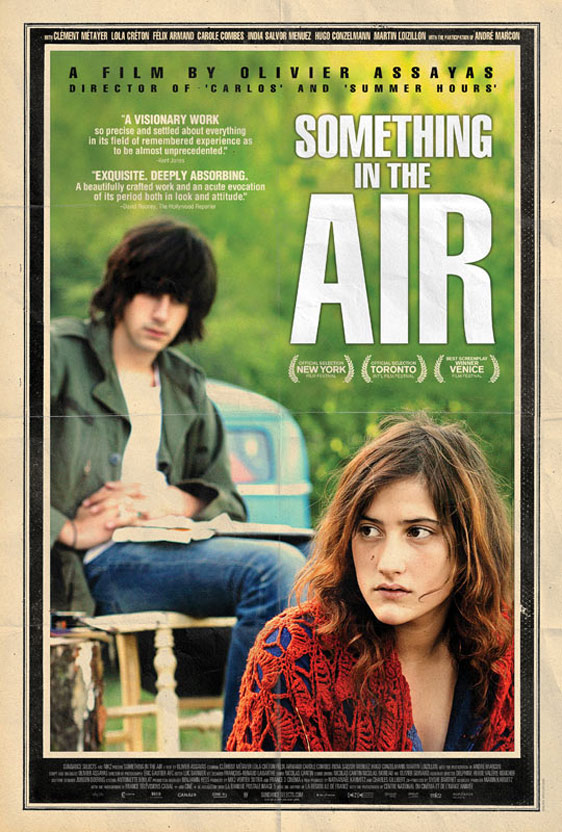
something_in_airFilmJuice have my review of Olivier Assayas’s 70s drama Something in the Air.

Much like Assayas’s near-universally acclaimed Carlos the Jackal, Something in the Air is set in the aftermath of the 1960s just as that much-overstated sense of solidarity and hopefulness was beginning to collapse into the selfishness, divisiveness and cynicism that would later herald the rise of Thatcherism and Reaganism. The film follows a group of French teenagers as they graduate from High school in 1971 and head out into Europe for a summer of self-discovery. However, despite the teenagers being incredibly passionate about their politics and the need to change the world, most of their decisions have little if anything to do with the tomes of political theory they dutifully read and quote:

Despite functioning at an incredibly high level or intellectual and political engagement, Gilles and friends drift from one doomed relationship to another whilst either embracing or rejecting the opportunities that come their way. One of them is dragged into the orbit of a bunch of aspiring terrorists while another joins a commune only to find herself doing all the washing, cleaning and shopping for a bunch of men who are anything but radical in their attitudes to women. Indeed, while some critics have made a lot of the similarities between Something in the Air and Assayas’s earlier film of ill-fated teen revolt Cold Water, a much better point of comparison would be a film like Richard Linklater’s Dazed and Confused as while Assayas’ teens may be living the revolutionary life in a series of beautiful European locations, the decisions they make are ultimately no different to those of Linklater’s suburban Texans.

This suggestion that radical politics are necessarily an affectation that do little aside from lock you into various social networks is very similar to the point Assayas makes by de-politicising the actions of Carlos the Jackal. From my review of Carlos:

By refusing to place Carlos’s actions in any kind of context, Assayas beautifully foreshortens them, reducing them from political actions to social gestures. Indeed, when Carlos and his gang storm the OPEC meeting, it is immediately clear that they have a good deal more in common with the politicians and bureaucrats than they do with ordinary people. Carlos is able to discuss his intentions quite calmly with the various politicians while their civilian underlings quake with uncontrollable terror. The politicians and police know who Carlos is. He knows who they are. Everyone knows the stakes. Everyone knows the risks. It is almost as though they are all friends.

The film is beautifully made and while it is not exactly one of Assayas’s great works, it does do a good job of raising questions about the 1960s at a time when the toxic exit strategy of that particular generation is becoming obvious to all.

REVIEW – In The Fog (2012)

InTheFogFilmJuice have my review of Sergei Loznitsa’s historical war movie In The Fog.

Based on a short story by the renowned Belarusian author Vasil’ Bykaw, In The Fog is a slow, moody and atmospheric exploration of what it was like to be alive during the Nazi invasion of Belarus. The film revolves around two childhood friends who are thrown into conflict when one is sent to execute the other on suspicion of aiding the Nazis and betraying his countrymen. While the film’s glacial pacing may initially help to introduce a note of tension, this tension soon dissipates once the film moves onto a more conventional character study… at which point it collapses into mind-boggling boredom:

While glacial pacing is quite common in European art cinema, the purpose of the long drawn-out pauses and shots of scenery is usually to draw attention to ambiguities and provide the audience with breathing space in which to reflect upon what it is that they have just seen on the screen. The problem with In The Fog is that while it may be littered with awkward pauses and shots of Belarusian forests, the film contains neither the ambiguity nor the complexity that might require these extended periods of contemplation. For example, the film’s opening sequences do a great job of establishing that the railway worker is a calm and noble man but rather than using that character’s flashback to explain or complicate his saintly demeanour, the film simply contents itself with re-iterating the same basic character beats: A man who is calm and noble in a forest is evidently just as calm and just as noble in a German prison cell. Had Loznitsa dared to introduce a note of ambiguity into either his plot or his characters then all of those (admittedly decorative) shots of Belarusian forests would have been welcome, instead they merely feel like padding. Loznitsa’s literal-mindedness is even more evident in the final act when he attempts to step back from his character studies and broaden the film’s themes out into a wider discussion of wartime morality. However, rather than introducing some fresh plot element that might have encouraged the audience to reflect upon the characters in a wider context, Loznitsa simply has his characters sit around in a forest wondering out loud about what their experiences say about the morality of war.

Readers with long memories will doubtless take this review as yet another chapter in the on-going epic known as Jonathan Complains Bitterly About the State of Arthouse film. Previous chapters can be found here, here and here. My problem with In The Fog is the same as my problem with many contemporary art house films: It is a beautiful dolt. It is easy to see that a goodly proportion of European art house directors working today have been deeply influenced by the great art house classics of the 1960s. However, rather than emulating L’Avventura‘s willingness to challenge norms and break rules, they emulate the style: The non-linear narrative, the ambiguous plot points, the extended pauses and thus what was once revolutionary is now little more than pastiche.

REVIEW – In The House (2012)

ITHFilmJuice have my review of François Ozon’s In The House.

The film is set in a devastatingly modernist French high school where a bitter failed writer grinds out a living teaching French literature to teenagers who can barely read or write. Suddenly, the teacher’s gloom is lifted when one of his students hands in an astonishingly dry and sarcastic appraisal of a middle-class home he recently visited. His interest captured, the teacher encourages the boy’s talent and soon every piece of homework becomes another wry take-down of middle-class life. What makes this film interesting is that, rather than focusing upon the emotional connection between failed writer and ambitious student (YOU’RE THE MAN NOW, DOG!), the film uses the relationship as a metaphor for the creative process as the student is effectively writing for an audience of one who gives him detailed feedback on what he wants to see in the next chapter. Brilliantly, the teacher’s requests that the student alter his plot results in the student doing things that directly impact the teacher’s life forcing the audience to suffer for their vicarious literary joy.

One way of looking at In The House is to say that it features a more restrained approach to the shaggy postmodernism of Charlie Kaufman. For example, as with Being John Malkovich, the characters in this film blur the lines between the real and the fictional. Similarly, as with Synecdoche New York, the entirety of In The House feels like an intentionally doomed attempt at capturing the entire creative process in a single unwieldy metaphor. The problem is that Kaufman realises that the cleverness of postmodernism is inherently less satisfying than the emotional payload of a sweeping narrative arc and so he builds these huge metaphorical structures in an effort to replace emotional closure with a sense of wonder. Ozon’s comparative restraint means that, unlike many of Kaufman’s projects, In The House works as a proper story right up until the end but it seems entirely reasonable to suggest that ending the film on a flight of postmodern fantasy would have been more effective than Ozon’s discontented trudge.

I’ve recently read two quite interesting books that attempt to deal with the issue of ironic detachment from the emotional manipulations of narrative. David Thomson’s typically shaggy and typically wonderful book on the history of film The Big Screen finds him deeply troubled by the way in which the rise of advertising appears to have somehow compromised the relationship between work and audience. Prior to TV and Radio, people would submit themselves to a particular narrative and stay with it till the end. Now, they find themselves jostled out of the flow by adverts… tiny self-contained stories injected into the flow of a film or TV programme but designed to sell rather than move or entertain. After combing through the history of cinema, the book ends with Thomson experimentally watching a film backwards:

You also discover what a sweet, artificial thing story is. That is not a mocking of narrative, simply a revelation that story is just a series of tricks or steps, a mechanism, not too hard to guess in advance, and as systematic and serviceable as, say, a staircase — and as logical and mathematical. A story is something made and made up; it is a disguise of life, artfully and kindly done, but not life. It is lifelike. And stories are so artful, so manufactured, that they might as easily run backwards or forward

This vision of narrative as a system of emotional control also runs through Douglas Rushkoff’s recent (and not quite wonderful) book Present Shock. Rushkoff argues that the world around us does often makes very little sense as decades of advertising have encouraged us to find ways of protecting ourselves from stories that would manipulate our emotions:

Aristotle was the first, but certainly not the last, to identify the main parts of this kind of story, and he analyzed them as if he were a hacker reverse-engineering the function of a computer program. The story mechanics he discovered are very important for us to understand, as they are still in use by governments, corporations, religions, and educators today as they attempt to teach us and influence our behaviors. They are all the more important for the way they have ceased to work on members of a society who have gained the ability to resist their spell.

While I am still in the process of digesting a lot of these ideas, I think there is a lot of meat on the bones of the idea that a lot of contemporary culture is post-postmodern in the sense that it is built with an explicit aim of overcoming the air of ironic detachment that postmodernism has encouraged us to adopt. Kaufman in particular is quite an interesting figure as all of his films begin in the real world, deconstruct the real world and end with mad flights of fantasy. I think Kaufman does this because he realises that a) neat narrative arcs are at least as ‘false’ as CGI fantasias and b) CGI fantasias are probably a more reliable way of having an impact on an audience than a happy or a tragic ending.

REVIEW – Burnt by the Sun 2 (2010)

Burnt_by_the_Sun_2FilmJuice have my review of Nikita Mikhalkov’s five-hour Second World War epic Burnt by the Sun 2.

Burnt by the Sun 2 is one of the most demented films that I have ever come across. Way back in 1994, Mikhalkov co-wrote, co-produced and directed an elegant historical drama named Burnt by the Sun. Set in the run-up to World War 2, the film tells of a complex love triangle comprising an aging hero of the Russian revolution, his beautiful young wife and a concert pianist who spent the revolution on the side of the White Russian aristocracy. Coming relatively soon after the break-up of the Soviet Union, Burnt by the Sun’s nuanced vision of Russian history brought not only considerable critical and commercial success but also the rare accomplishment of winning both an Oscar and a Palme D’Or.

Twenty years later and Mikhalkov has used the international success of Burnt by the Sun to re-invent himself as both a big budget film producer and the man who reportedly leads the institutions of Russian cinema in much the same way as Putin leads the institutions of Russian government. Reportedly one of the most expensive films in the history of Russian cinema, Burnt by the Sun 2 is:

Best described as a five-hour version of Saving Private Ryan directed by a Stalinist Michael Bay. The film opens by taking the complex web of political and personal betrayals described in the original Burnt by the Sun and reducing it down to someone attempting to drown Stalin in an enormous chocolate cake.

The comparison with Bay is quite deliberate as Burnt by the Sun 2 is not only a Russian attempt at making a Big Dumb Summer Blockbuster, it is a damn sight more entertaining than most of the Big Dumb Summer Blockbusters that have graced our screens in the last couple of years.

Oh… and I wasn’t joking about someone trying to drown Stalin in an enormous chocolate cake:

StalinE

StalinD

StalinC

StalinB

StalinA

REVIEW – Mea Maxima Culpa: Silence in the House of God (2012)

MeaMaximaCulpa1FilmJuice have my review of Alex Gibney’s documentary Mea Maxima Culpa: Silence in the House of God.

One of the most fascinating battlefronts in contemporary culture is the question of how the baby boomers will be remembered once they are gone. Raised amidst talk of their parents having been the greatest of all generations, the boomers have always been intensely aware of their own place in history and the need to impose some sort of narrative on their predictably chaotic lives. For a long time now, the baby boomers have been telling us that theirs was the most liberal and radical of generations: Neither empire-builders nor war-mongers, they came out against the Vietnam War, spawned the summer of love and demanded the right to live life entirely upon their own terms. That generation did it all and when the time came for them to ‘grow up’ they took their longhaired rebel logic with them into the boardroom and created one of the longest periods of sustained economic growth in the history of humanity. Nowhere is the desire to ‘fashion’ the generational narrative more evident than in Hollywood where B-movie Shitlord Roger Corman has been re-imagined as a visionary producer simply because Hollywood boomers need to believe that they rose to the top in a period of unrivalled openness and experimentation.

While inter-generational power differences mean that relatively few people are directly calling out the boomers on their relentless selfishness and toxic self-involvement, we are beginning to see some pushback in the form of prominent institutions falling into scandal and crisis. Indeed, the UK’s Operation Yewtree seems to be quietly re-inventing the swinging 60s as a time when men with jobs in the British media got to rape as many young women as they wanted while police and employers looked the other way. Turns out that ‘free love’ only ever applied to powerful white dudes. Alex Gibney’s documentary Mea Maxima Culpa: Silence in the House of God is very much a part of this cultural battlefield as it is one of many recent documentaries to suggest that the 60s and 70s were a time when Catholic priests were effectively above the law when it came to the sexual abuse of children. Much like Kirby Dick’s Twist of Faith and Amy J. Berg’s Deliver Us From Evil, Mea Maxima Culpa suggests that child abuse was almost systemic as was the Church’s desire to protect the abuser at the expense of the abused.

The science fiction writer William Gibson once stated that while the future is here, it has not been evenly distributed and I think the same can be said of the liberal individualism of the baby boomers: Much like the revelations of Operation Yewtree, films like Mea Maxima Culpa suggest that while some people had a load of fun in the 60s and 70s, this fun came exclusively at the expense of people who have been denied the right to give their own impressions of what life was like at that particular time. Though Mea Maxima Culpa may lack the anger and analytic depth of films like Twist of Faith and Deliver us from Evil, it does do a singularly fantastic job of letting the voiceless speak for themselves, something that is particularly important given that the abused, in this case, were all deaf:

Gibney films his interviews with the survivors using an elegantly subdued form of lighting that beautifully emphasises the expressiveness of their faces. Also important is the fact that, rather than systematically cutting away from the survivors and having their words translated by non-deaf actors, Gibney keeps the audience’s attention firmly on the survivors allowing them to communicate their own feelings in their own words and in their own language. This choice of interview technique is important because Mea Maxima Culpa is not just about the Catholic Church’s attempts to cover-up decades of sexual abuse, it is also about giving a voice to people who had theirs taken away by a Church that claimed to have their best interests at heart.

As someone whose familiarity with sign language is limited to on-screen sign translation of TV programmes, it really was fascinating to see native signers using their own language to deliver incredibly personal and intimate truths. Sign translators are professional translators rather than actors and so they tend to translate what they are hearing in a way that communicates their personal detachment from the material (their facial expressions and body language tend to say ‘this is a sad bit’ rather than ‘I am sad’) and so seeing sign language being used in an emotive manner was really quite the revelation. Even if you are not all that interested in another story about the moral bankruptcy of the Catholic Church I think that Gibney’s interviews with the abuse survivors alone make this a film worth seeking out.

REVIEW – Diaz: Don’t Clean Up This Blood (2012)

diaz-2012FilmJuice have my review of Daniele Vicari’s topical ensemble drama Diaz: Don’t Clean Up This Blood.

Set during the 2001 G8 protests in the Italian city of Genoa, the film tells the real-life story of one of the most outrageous abuses of police power in European history. The action focuses upon a pair of buildings that served as both a media center and a dormitory for people who happened to be in Genoa during the protests. Believing the buildings to be full of black bloc anarchists, the Italian police stormed in, beat everyone to a pulp and then dragged a number of people away to jail where they were humiliated, assaulted and tortured by not just police but also police doctors.

The structure of this film is faintly reminiscent of such ensemble dramas as Steven Soderbergh’s Contagion and Fernando Meirelles’ 360 (Which I recently reviewed for Videovista). However, while these Hollywood productions are very similar to anthology pictures in so far as they are collections of more-or-less self-contained narratives, Diaz: Don’t Clean Up This Blood departs from this model by using the different strands of the the narrative to explore the same event from different perspectives. Rather than resorting to anything as clunking as a time-stamp, Vicari allows history to unfold up to a single moment — someone throwing a bottle — and signals our return to the past by having the bottle re-assemble itself and return to the hand of the person who threw it. Aside from being incredibly elegant, this narrative technique works brilliantly in context as it allows Vicari to explore the extent to which the shared spaces of the protest mean different things to different people: For an elderly man trapped in Genoa overnight, the buildings are a safe place to sleep. For the journalists covering the protests, they are somewhere to file copy and conduct interviews. For the Black Bloc, they are a place to hide and draw up plans. This plurality of experience and perception is both brilliantly handled and intensely refreshing in a medium that all too often either avoids ambiguity like the plague or confuses it with evasiveness. Diaz Don’t Clean Up This Blood is a wonderfully ambiguous film because it presents you with several incompatible and yet entirely consistent viewpoints on the same series of events. Then the ambiguity goes away:

The final third of the film is spent exploring the mistreatment and torture meted out to the victims of the raid by police and police doctors and it is here that the film ultimately stumbles. The problem is that, while the bulk of the film is intensely humanistic and diverse in its exploration of different perspectives on the same events, Vicari’s coverage of the aftermath of the raid abandons nuance in favour of stark moralism: These are not the over-emotional and ill-informed police officers of the opening scene, these are cold and calculating psychopaths who humiliate and torture people because they know that they can do so with complete impunity. While there is no reason to doubt the brutality of the Italian police or the veracity of their victims’ claims, it is jarring when a film about understanding suddenly transforms into a film about condemnation.

One of the interesting things about Diaz that I did not have space to touch on in my review is the fact that while Vicari feels quite comfortable portraying the police as psychopathic Nazis, he is almost flawlessly even-handed when it comes to portraying the actions of the Black Bloc. In Diaz, the Black Bloc are a bunch of kids from all over Europe who descend on protest areas, stir shit up and then promptly retreat before the inevitable government response. Indeed, while the Black Bloc did indeed use the buildings that the police raid, Vicari goes out of his way to show them hiding in a nearby cafe while innocent by-standers get beaten to a pulp.

Why are we allowed to sympathise with the Black Bloc’s cowardice but not with the anger of the police?

One to this question is that while the Black Bloc’s actions contain enough moral ambiguity for there to be differences of opinion about them, nobody in their right mind would consider it acceptable for a police doctor to sexually assault a left-wing activist while the police singing fascist battle anthems. Indeed, one of the problems with liberalism and tolerance is that it’s very difficult to make any kind of moral judgement once you allow for the fact that all humans are fallible products of their environment and most people do what they do because they think it’s the right thing at the time. Diaz is an intensely humane and liberal film and yet its problematic final act shows that there must be limits to even the most pluralistic and tolerant of personal philosophies. I’m not convinced that Vicari handles the movement between ambiguity and certainty all that well but it is nice to see a film that attempts to address those types of moral problems.

REVIEW – Zaytoun (2012)

ZaytounVideovista have my review of Eran Riklis’s Zaytoun, an almost impossibly idealistic film about Arab-Israeli relations.

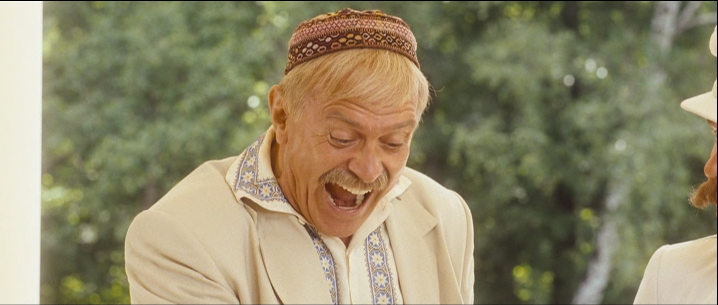
Set during the 1982 Lebanon war, Zaytoun tells of an Israeli fighter pilot who is shot down over a refugee camp. Locked up in a cell, the fighter pilot only frees himself by agreeing to help a Palestinian teenager to return to his family’s land in what is now Israel. Essentially a road movie, the two travelers make their way through a number of tricky encounters growing closer and closer to each other with each new mile. More symbolic vehicles than actual characters, the boy and the fighter pilot seem to represent the two sides of the conflict suggesting that if two fictional characters can make friends then surely the Israeli and Palestinian leaderships should also be able to make friends… yeah.

The real problem with Zaytoun is that while Riklis clearly made a deliberate choice to sacrifice depth of character in return for increased depth of symbolic representation, the fable he weaves around his generic archetypes is so trite and simple-minded that the audience is left with neither a decent set of characters nor a particularly good idea about the Arab-Israeli conflict. Indeed, strip away the pretty landscape photography, and the broadly comic secondary characters, and you are left with a film that suggests the Palestinian question could be solved if only both sides could be a little bit nicer to each other.

Another issue I raise in my review is the fact that recent years have seen a number of Israeli films that attempt to deal with the current state of Arab-Israeli relations by projecting the writer and director’s ideas back onto a vision of the 1982 Lebanon war. Aside from the obvious questions of historical accuracy and political cowardice raised by this trend, I am also struck by the fact that films like Zaytoun, Waltz with Bashir and Lebanon all treat the Palestinian and Lebanese as symbolic representations of Israel’s moral character: In Waltz with Bashir, the war of 1982 is treated as a sort of psychotic episode, in Lebanon the war was treated as a crucible of psychological hardship and, in Zaytoun, bopth the Palestinian people and the road to Palestine are treated as psychological stepping stones for an Israeli protagonist. The interesting thing about all of these films is that none of them treat the Palestinians as real people with an existence outside of their presence in the minds of Israeli characters. In fact, one is reminded of Chinua Achebe’s incendiary comments about the depiction of African people in Joseph Conrad’s Heart of Darkness:

Africa as setting and backdrop which eliminates the African as human factor. Africa as a metaphysical battlefield devoid of all recognizable humanity, into which the wandering European enters at his peril. Can nobody see the preposterous and perverse arrogance in thus reducing Africa to the role of props for the break-up of one petty European mind?

The most worrying thing about films like Zaytoun is that they suggest that contemporary middle-class Israelis are falling into the same trap as White Victorian novelists. Rather than treating Palestine as a complex place filled with real and complex people, they reduce it to the state of Universal Other… a place that wandering Israeli soldiers enter at their peril. Zaytoun is clearly an idealistic film but I think it is, in the words of Achebe, ‘bloody racist’.

REVIEW – West of Memphis (2012)

west-of-memphis-posterEvidently, I am passing through a documentary phase as FilmJuice have my review of Amy J. Berg’s West of Memphis.

I first became aware of Amy J. Berg through her film about the clerical abuse scandal Deliver Us From Evil. While the subject matter may now be reaching the point of saturation, Berg grabbed my attention by daring to place paedophile priests in the wider social context of a Catholic Church that hates homosexuality almost as much as it hates women. However, while Deliver Us From Evil was nominated for an Oscar, it also saw Berg drop off the map for a number of years and so I was very pleased to see her return to the director’s chair for this high-budget documentary about the West Memphis Three.

Given how impressed I was by Berg’s debut feature, it is slightly dispiriting to find her turning her hand to a film that is unadventurous both in terms of its form and its analysis. Indeed, much of West of Memphis‘s substantial running time is devoted to an extended recap of the ground already covered in the Paradise Lost trilogy of documentaries that have already been made about this particular topic. So while I’m sympathetic to the film’s aims and acknowledge that it’s a perfectly well-made and entertaining piece of documentary filmmaking, I do question the wisdom of making yet another film about this case. Are there really no other injustices in the world? If you are going to make a film about a topic that has already been covered by an entire trilogy of documentaries, I think it is important to do something new with the material and West of Memphis never quite manages to innovate:

There is no denying that West of Memphis is a worthy film and that this worthiness is utterly undiminished by the fact that three very good documentaries have already been made about this case. Nor is there any denying that Peter Jackson, Fran Walsh and all the other people working to free the West Memphis Three did a profoundly good thing by using their money and celebrity to help three unloved and unjustly convicted men from Arkansas. There is no denying any of these things and yet these things cannot entirely compensate for the fact that West of Memphis fails to offer us anything that we have not seen before. Hollywood has a fondness for documentaries designed to overturn miscarriages of justice and though certainly entertaining and occasionally compelling, this film never quite compares to either the exquisite ambiguity of Andrew Jarecki’s Capturing the Friedmans or the campaigning psychological complexity of Errol MorrisThe Thin Blue Line.

It’s hard to be unimpressed about this type of documentary without also seeming unimpressed with the subject matter but I was unimpressed, it felt like a step backwards by a promising director.

REVIEW – L’Assassin Habite au 21(1942)

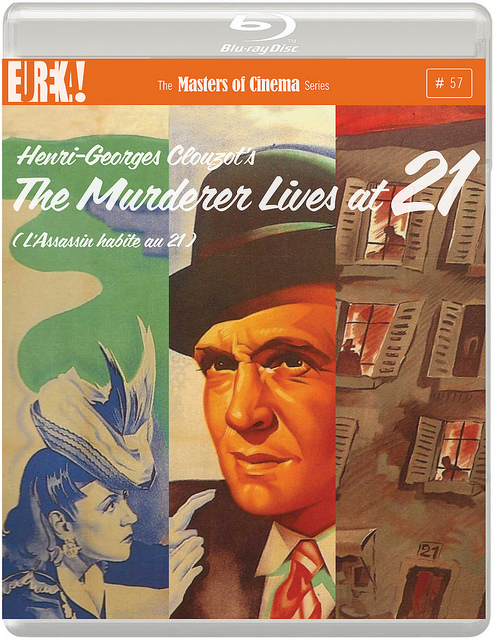
21FilmJuice have my review of Henri-Georges Clouzot’s zesty whodunit L’Assassin Habite au 21 (a.k.a. The Murder Lives at 21)

Best known for his misanthropic thrillers Le Corbeau, Les Diaboliques and The Wages of Fear, Clouzot’s first film tells of a dapper and sarcastic detective who is charged with tracking down a mysterious serial killer known only as ‘Monsieur Durand’. Unfortunately for the detective, he is involved with a flighty and foul-mouthed opera singer who insists on going undercover with him in the hope that the ensuing publicity will help her faltering career:

Much like Ernst Lubitsch’s magnificent Trouble in Paradise, Clouzot’s film features a couple whose relationship has nothing to do with love or devotion and everything to do with sex and cynical self-advancement. This misanthropic vision of human relationships pervades every aspect of the film from the way people talk to each other in the boarding house to the way things get done at police headquarters.

L’Assassin Habite au 21 looks and feels like an adaptation of Dashiell Hammett’s The Thin Man filmed by Fritz Lang but aside from being brilliantly written, brilliantly shot and brilliantly acted, the film also reminds us that there was a point in cinematic history when films were not afraid to depict grown-up and unusual relationships in all of their complex glory. Indeed, one of the things that most struck me about J.J. Abram’s recently-released (and incredibly tedious) Star Trek into Darkness is that while all of the characters may technically be adults their concerns are those of much much younger men.

Today’s Hollywood blockbusters are locked in what can only be called a financial death spiral. Lured into competing with each other to produce more and more expensive films, the studios have now reached a point where they have spent the last decade actively alienating anyone who is not a teenaged American boy. Painfully aware that films like Star Trek into Darkness need to make about $1 Billion before they start making money, the studios are now making more of an effort to reach out to foreign markets and they are doing this by making their themes and narratives as broad and accessible as possible. A Hollywood blockbuster needs to be comprehensible to everyone in America but it also needs to be comprehensible to people who grew up in rural China or India. As a result, films like Star Trek into Darkness are about grown men confronting the generic problems of teenaged boys such as getting the right girl to like them and overcoming their love-hate relationship with Daddy. This infantilisation of Hollywood’s primary protagonists is particularly amusing in the case of Star Trek as there’s a scene where Zachary Quinto’s Spock contacts Leonard Nimoy’s Spock in order to get advice. 21st Century heroes are evidently not afraid to call their parents and have them come and pick them up from the party. There’s your crisis of masculinity right there!

The Murderer Lives at 21 is released on Monday by Masters of Cinema and it is worth every penny.