REVIEW — The Fallen Idol (1948)

This week, circumstances have allowed me to offer you something of a cultural dyad. For years now, British film critics have fetishised British film to the point where the term has become almost meaningless. For some, it means simply British accents and British names on the credits of Hollywood Blockbusters. For others, it means a truly national cinema that speaks to the concerns of the British people in terms that are uniquely theirs. As someone who has grown increasingly pessimistic about the Hollywood machine’s capacity to generate decent films, I favour the latter solution but even I wonder what a mature and deep-rooted British cinema might look like. Would it be Hollywood-lite in the same way as BBC dramas have come to feel like childish and over-eager attempts to appeal to American audiences? Or would it be something much darker and unpleasant? An expression of the fascistic desires and xenophobic tendencies that coarse through the British political bloodstream?

French cinema might be a good form to emulate but French cinema has very noticeably struggled with the urge to be Hollywood-lite and the urge to continue producing respectable grown-up films about middle-class people experiencing some sort of crisis. Don’t get me wrong… I love French populist cinema almost as much as I love films about middle-class French people experiencing crises but I also realise that neither of these models represents the realities of modern France. Another alternative would be to look back to a time when Britain actually had a film industry that was both mature and authentic, which is where this week’s offerings come in.

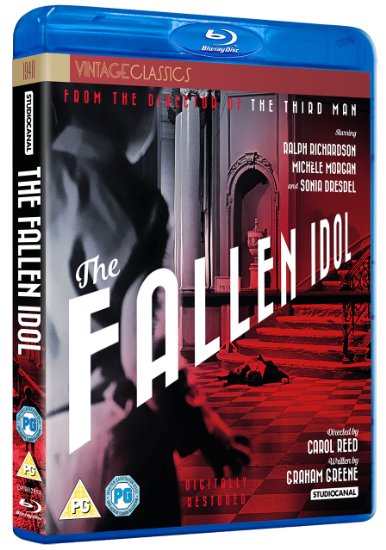
This week’s first review demonstrates quite how sophisticated post-War British cinema could be. As my review for FilmJuice argues, Carol Reed’s The Fallen Idol is an attempt to engage with how children see the world and how their vision of the world is liable to be distorted by grown-ups with vested interests in particular truths. Set amidst the marble palaces of Knightsbridge, the film is about a diplomat’s son who has been left alone with his father’s butler and house-keeper:

At first, Reed forces us to see this reluctant family unit through the eyes of the child meaning that Mrs. Baines comes across as an evil step-mother while Mr. Baines seems like an ideal father. However, as the film progresses and we are allowed to learn a little more about the secondary characters, it becomes clear that the couple’s behaviour towards the child is being driven in part by grown-up problems that Philippe is not equipped to understand. In reality, Mrs. Baines is not so much an ogre as a desperately unhappy woman who is trapped in a loveless marriage to a man who cannot stop lying.

As the narrative unfolds, Philippe’s attempts to protect the interests of his surrogate father are undermined by his own failure to understand either the adult world or what it is that he is actually seeing. The tension between what Philippe believes, what he wants others to believe and what is actually true blossoms into full-grown horror when Philippe mistakenly comes to believe that Mr. Baines has murdered his wife. Interrogated by the police and still desperate to defend his hero, the little boy spins lie after lie and winds up making things a lot worse than they ever needed to be.


FI2


The Fallen Idol took me completely be surprise as it seems to be engaged in a very similar exercise to that pursued by Charles Laughton in his classic The Night of The Hunter. However, while Laughton re-constructed the children’s vision of ‘reality’ as filtered through fairy tales, Reed allows the various interpretations of reality to co-exist and sit atop a ‘reality’ that is accessible to the audience but not the characters. This idea of conflicting ‘realities’ battling for dominance is also picked up in the form of characters speaking either figuratively or literally in different languages meaning that even relatively coherent conversations can be engines of disagreement and confusion. The Fallen Idol is a film in which people are forever talking despite being unable to understand each other.


Suffragette (2015) – Britain’s Radical Soul

It is often said that Britain’s revolution happened too early to make much of a difference. Rather than waiting for the emergence of liberalism (like France and America) or socialism (like Russia and China), Britain deposed an absolute monarch and handed the country to a bourgeois tyrant who opposed universal suffrage on the grounds that it posed a threat to private property. Though somewhat more democratic today than under Cromwell, British political progress has always been constrained by the understanding that radical politics are somehow profoundly un-British. Sure… people take to the streets from time to time but ask the wrong question or allow injustice to anger you for even a second and that very human emotional response will be used against you like a cudgel, or indeed a truncheon.

The British establishment has never been squeamish about using violence to subdue domestic radicals, but it does recognise that some groups are harder to put down than others. Race and religion are still used as a justification for violent repression (as they were in Ireland and in the aftermath of 9/11) but when the radicals start looking a little bit too white and middle-class, the tactics generally shift to smears and mockery. Central to this undertaking has been the re-invention of the British radical as stock comic character.


The vision of British radicals as comically inept hypocrites informed the 1970s sitcom Citizen Smith. Written by the same man who created Only Fools and Horses, Citizen Smith’s Walter ‘Wolfie’ Smith uses Marxist posturing to conceal the fact that he is little more than an oafish petty criminal content to sponge off of his girlfriend’s family.


A similar set of ideas is evident in Disney’s Mary Poppins, in which the Character of Mrs. Banks returns home from a Suffragette rally singing about being a soldier. The scene is played for laughs and the implication is that Mrs. Banks is not only an inattentive mother who can’t be bothered to raise her own children but also an upper middle-class hypocrite who plays the radical before returning home to an army of maids, cooks, and nannies paid for by a wealthy husband.

It bothers me that Mrs. Banks is one of the most enduring depictions of a Suffragette in popular culture.

It bothers me that the fight for women’s suffrage was ever deemed a subject worthy of mockery.

It bothers me that Britain’s radical tendencies have been systematically scorned and buried by self-serving cultural elites.

It bothers me that the history of Britain has been re-written but I am delighted that some films are beginning to challenge the idea that Britain lacks a radical spark. Poised somewhere between the transcendentalism of Steve McQueen’s Hunger and the humanism of Chris Morris’ Four Lions, Sarah Gavron’s Suffragette is an exploration of what it would take to turn a normal working-class mum into a revolutionary. Suffragette is a film marked by the stirring of Britain’s radical soul.


Continue reading →

Catch Me Daddy (2014) — #NotYourChumChum

I have long suspected that there is a great book to be written about the spread of existentialism throughout European film and literature. Born of middle-class alienation from 19th Century spirituality, existentialism was a requiem for lost faith and a roar of disgust at the less-than-flattering lighting conditions left by the departure of the divine light. God is Dead, O God… This Sucks.

As time passed, the post-religiosity of existentialism was shuffled into the background as the movement came to focus upon the psychological hardships of a life without meaning. Existentialism’s obsession with the grim futility of everyday life caught the imagination of people returning from war and so Raskolnikov trying to make sense of his own actions in Crime and Punishment and Meursault refusing to defend himself at trial in The Stranger came to seem like beautiful expressions of what it meant to be human.

Having long enjoyed a close relationship with mainstream literature, existentialism spread to film and when critics from the Cahiers du Cinema transitioned from seeing existential themes in the work of others to replicating those themes in their own work, they went straight to feelings of anger and despair at a world that refused to abide by human expectations.

Cruelty and nihilism are everywhere in the films of the French New Wave and when art house cinema began to become its own thing, the canon was formed of films like Au Hazard Balthazar, Mouchette and Le Beau Serge… films in which women suffer while men brood.

Looking back at the post-War years, I cannot help but wonder whether existentialism’s appeal might not have had something to do with either its flight from responsibility or its lack of psychological precision. Think about it… existentialism is a philosophy that takes in the cruelty, pointlessness and arbitrariness of life and proscribes only directionless and unresolvable angst. Do not examine your role in making the world a worse place or consider why you feel the way you do, just shrug your shoulders and light up another cigarette as your actions count for nothing in a world that was born plain bad. Existentialism is a philosophy designed by emotionally stunted men and its popular success owes a lot to the fact that an entire generation of men came home from World War II and pointedly refused to deal with the trauma of what they had seen and done. Existentialism legitimises the refusal to deal with your own shit and that dead-eyed passivity was decanted into countless noir thrillers and stories in which lovely young women are destroyed by the world while men stand around looking glum.

Very much a part of the European art house tradition, Daniel Wolfe’s debut film Catch Me Daddy is a beautifully shot and relentlessly nihilistic film in which yet another young woman is destroyed by the cruelty of the world. Filled with dead-eyed tough guys muttering into mobile phones whilst staring into the middle-distance, it trots through every post-existential cliché in the European art house canon before arriving at a climax that shows just enough self-awareness to highlight the thoughtlessness of the preceding 90 minutes.


Continue reading →

REVIEW — The Immortal Story (1968)

FilmJuice have my review of Orson Welles’ wonderfully lugubrious The Immortal Story, a low-budget adaptation of a Karen Blixen story.

Set in Macao, the film tells of a Scrooge-like figure who attempts to turn fantasy into reality by paying a soldier to sleep with an attractive woman in the hope of producing a child to whom he could leave his immeasurable wealth. Shot in and around Welles’ real-world home near Madrid, the film’s world is composed entirely of decaying buildings, empty streets and elaborately decorated rooms that look more like tombs than luxury apartments. Little over an hour long, the film cuts out virtually all exposition resulting in a plot that is almost completely impenetrable. However, given the sense of spiritual desolation that hangs over the entire film, I suspect The Immortal Story is about the creation of a fantasy that only serves to make people miserable by presenting them with their heart’s desire as well as the distance that separates them from that desire:

What Welles refuses to do is to spell out the point of the story which is that every one of these characters is just one step away from happiness: Clay is terribly alone and yet his house is suddenly full of people, Virginie has spent her life wanting to return to her childhood home and now she’s there, Paul spent a year dreaming of girls and now he has one, and Levinsky’s desire to be completely alone is what all of the others seem to detest the most about their own lives.

There’s a wonderfully geometrical precision about the unhappiness that flows through this film… everyone seems to want what makes everyone else miserable but rather than getting what they want, they get money. Just not enough money to get what they really want.


Love is All (2014) – Misty Windows

Art isn’t so much a window on the world as the condensation that forms on said window whenever we stand too close. As creative beings we inhale ideology and exhale art… metabolising the myths, assumptions and taboos comprising our cultures and turning them into a mist that hangs somewhere between us and the world. Neither entirely of the world, nor entirely of us… Art is made up of elements from both domains meaning that any attempt to construct the history of an art-form will necessarily tell us a little about our history and a little about the history of the world.

Kim Longinotto” is not the first name that comes to mind when you think of historical analysis as most of her films appear to have been assembled with nothing more abstract than a hand-held camera and the truth. Whether exploring the social pressures perpetuating the practice of female circumcision in The Day I Will Never Forget (2002) or following social workers as they try to help women leave the sex trade in Dreamcatcher (2015), Longinotto is a filmmaker who has earned an international reputation for absolute documentary realism… which is precisely what makes Love is All such an exciting project.

Commissioned by the British Film Institute and originally broadcast as part of the BBC’s Storyville documentary strand, Love is All is an experimental documentary that takes a load of cinematic archive materials, combines them with a specially-written soundtrack, and tells a story about the evolution of love and courtship over the course of the 20th Century.


Continue reading →

Colin Barrett’s Young Skins: “Stand Your Skin”

I alighted on this book after reading a few reviews but none of them went so far as to mention a context for the book’s creation. Interviews with Barrett focus on his process and the fact that he evidently achieved publication after receiving a post-graduate degree means that he tends to view his own process through a lens of theoretical jargon. As a result, I was rather pleased to notice Colin Barrett being touted as one of the more striking voices of post-crash Irish literature. Evidently I’m not the only person who thinks that Barrett is on to something…

Looking back, I notice an edge to my last piece about Young Skins as I was starting to get very frustrated with the narrowness of Barrett’s subject matter: Yes, rural Ireland is a psychic sinkhole… Yes, Irish women are terrifyingly fierce… Yes, Irish men are hapless and broken figures… Is that all you have to say for yourself? Thankfully, the next story in the collection has gone some way towards renewing my faith in both Barrett and my decision to write at length about his collection of short stories.

“Stand Your Skin” may be another story of broken men, unattainable women and depressing local pubs but the slightly higher page count has allowed Barrett to move beyond his initial terms of engagement and provide us with a bit more of a character study. “Stand Your Skin” is all about how one of the broken men of Glanbeigh came to be broken in the first place.


Continue reading →

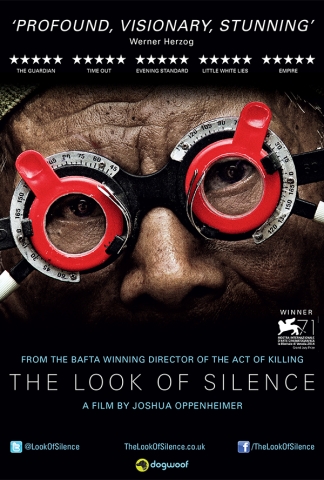
The Look of Silence (2014) – A Mortal Stillness

Back in 2013, the Danish-based filmmaker Joshua Oppenheimer stunned the world with The Act of Killing, a documentary about Indonesia’s blood-soaked past and how political institutions had conspired to turn murderous gangsters into national heroes.

Whereas most serious-minded documentarians approach difficult subject matter through the performance of journalistic objectivity, Oppenheimer’s film about mass-murder took its stylistic cues from the people who did the killings. Secure in the knowledge that they continued to enjoy the support and gratitude of Indonesian political elites, the killers chose to celebrate their past using a combination of surreal dream-sequences and colourful dance routines resulting in a documentary that looked and felt like a beautiful fever dream.

According to Oppenheimer, his intention was always to make two films about the anti-communist purges and how contemporary Indonesia manages to function with a million deaths on its collective conscience. The Act of Killing is a film about the transformation of gangsters into heroes, its brash visual style a reflection of its subjects’ surreal arrogance. The Look of Silence, on the other hand, is a devastatingly quiet film filled with awkward silences, which is precisely what you would expect from a film inspired by people who have spent decades trying to keep their feelings under control.


Continue reading →

The Decline of Western Civilization (1981-1998) – Ancestor Worship

I grew up within gobbing distance of the Kings Road and can still remember teenaged punks charging tourists for photos and shitting in doorways opposite what is now an enormous McDonalds. I remember when postcards of London still featured punks and I remember when rising property prices finally rid Chelsea of its art school pretensions and replaced them with the cosmopolitan brutality of a first class airport lounge. I remember the aftermath of the British punk scene but I was too young to appreciate it… all I have to go on is what history has taught me.

Anyone who grew up in Britain during the 1990s will be familiar with the broad narrative beats of British punk history as laid down by the Sex Pistol–Media–Industrial-Complex: From the poorly attended gig at the Manchester Lesser Free Trade Hall to their expletive-laden appearance on the Bill Grundy Show and on to mocking the Queen’s silver jubilee from the top of a chartered boat. We are familiar with these narratives because they are the origin stories of people who would later become very popular and very successful. The truth about the British punk scene might have endured the deliberate revisionism of Julien Temple’s The Great Rock n’ Roll Swindle but it was never going to survive Alan fucking Partridge:


Narratives are easy to steal, history is easy to re-write and the truth will always be closer to the unformed opinions of people who were there than the polished anecdotes of those exact same people twenty years down the line. The truth about British punk may lie buried in interviews and half-forgotten fanzines but part of the truth about one corner of the LA music scene recently returned to DVD in the form of a swanky box set.

Continue reading →

REVIEW — The Connection (2014)

FilmJuice have my review of Cedric Jimenez’s The Connection (a.k.a. La French), a stylish crime thriller that could be described as the French side of The French Connection.

Setting aside the fact that this is a really well-made cat-and-mouse thriller set in an impeccably realised and beautifully shot vision of 1970s Marseilles, there are two really interesting things going on in this film that elevate it above your standard crime drama and into the intellectual stratosphere occupied by the likes of David Simon’s The Wire and Jacques Audiard’s A Prophet.


First, the film is grounded in the character study of a local magistrate who is lured into an ineffectual War on Drugs by a combination of excitement and fame. Cleverly, the film portrays the magistrate’s early ‘successes’ as fantastic nights out in which everyone drinks champagne and gets laid. This is then related back to the fact that the magistrate in question (Jean Dujardin’s Pierre Michel) has a gambling problem, thereby raising the possibility that his commitment to the job might have less to do with results and more to do with addiction:

The film suggests that Michel’s pursuit of Zampa and the insane risks he takes as part of that pursuit are just an expression of his addictive personality: Where once Michel risked everything on a turn of the card, now he risks everything by playing hunches and violating civil rights. What is the War on Drugs if not an institutionalised addiction to headlines and excitement? Maybe the reason we continue to treat addicts like criminals is that you don’t build careers in law enforcement and politics by tending to the sick.

What I really liked about this film is that while it may start off as yet another right-wing law-enforcement fantasy about a rogue magistrate trying to take down a gang by cracking balls and bending laws, the film gradually segues into a brutal critique of the assumptions underpinning this very myth. Do car-chases and fist-fights actually keep the streets clean or do they merely serve as a distraction from the intractability of major social problems and the combination of corruption and neglect that feeds them?

Second, while the film is a fictionalised account of the real-world French Connection that supplied the American drugs trade with most of its illegal heroin throughout the 1960s and ’70s, the writer and director use these fictional elements as a springboard for naming names and pointing fingers at a French establishment that allowed organised crime to flourish in the hope that it would keep French ports free from communist elements:

Jimenez’s desire to confront France’s recent political past is reminiscent of Matthieu Kassovitz’s thoroughly excellent Rebellion, a film about how Jacques Chirac allowed police to massacre protesters in an effort to win over hard-right voters in a tightly-run election. Both films are powerful, necessary and a reminder that no comparable tradition exists in British film.

When British films critique British governments, it’s usually as part of a broader social realist tradition that shows the consequences of government action rather than the combination of incompetence and indifference that informed those decisions in the first place. I also wonder whether British film’s reluctance to go after the British establishment might not be a function of the fact that many British films are made with American audiences in mind using money handed out by British institutions.

I also wonder whether British directors might not see these types of stories as more televisual than cinematic based upon the fact that Britain used to have a tradition of producing one-off dramas and plays that criticised both British society and its government.The problem is that while British TV used to have a tradition of producing politicised plays and one-off dramas, the amount of drama on British TV has now declined to the point where there’s really not much room for unpopular opinions. Of course, the excellent Red Riding trilogy was produced for TV but that came out in 2009 and I struggle to think of anything even remotely like it that has appeared since.

Colin Barrett’s Young Skins: “The Moon”

Short story Short: This is yet another story about the impossibly fierce, beautiful and unapproachable women living in the fictional Irish town of Glanbeigh.

Short story Long: This follows the example set by “Bait” in so far as it takes the basic gender dynamics explored in “The Clancy Kid” and deepens the analysis by exporting it to a slightly different relationship. The result is a surprisingly humane short story about the crisis of masculinity and how young women react to the collapse of male identities. It also touches on the idea of change and how making positive changes in one’s life often requires levels of energy that are drained by the very things that would make you want to make those changes in the first place.

When change is impossible one can only settle and “The Moon” is as much a story about a woman’s refusal to settle as it is about a man finding comfort and stability in the misery that surrounds him.

Continue reading →