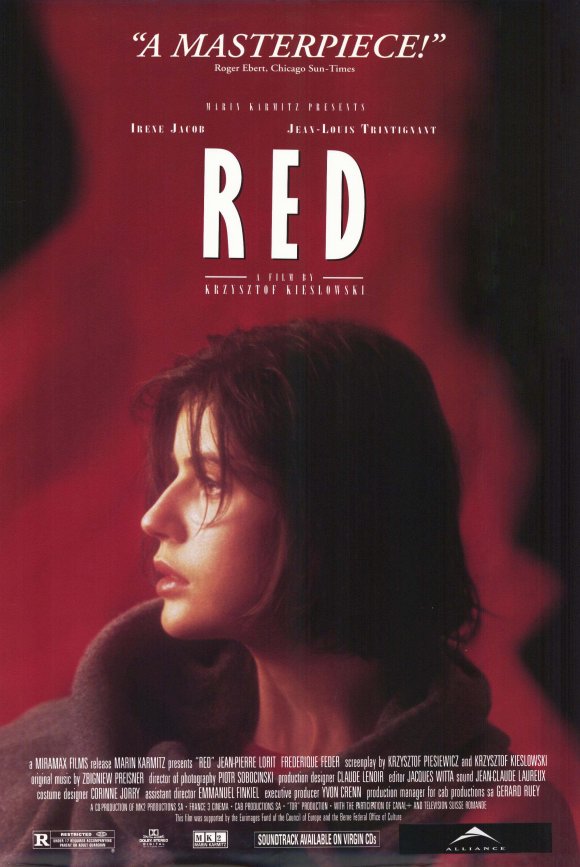
Three Colours: Red (1994) – Paths and Possibilities

As the dust settled and the cordite faded from the air, the instigators of the French revolution held aloft the severed heads of their old oppressors and proclaimed a new age of humanity; an age in which people would be governed not by the supposedly divine whim of royal genetics but by reason and the principles of the enlightenment.  Principles such as Liberty, Equality and Fraternity.  Over two hundred years later, the polish director Krzysztof Kieslowski decided to devote a trilogy of films to the question of what these hallowed values mean to the modern world.  The results are far from a glowing endorsement.

In Blue, Kieslowski renders liberty as an icy internal exile from those who would love us.  In White, he reinvents equality as a bitter and demented desire to get even. In these two films we see Kieslowski’s belief that, rather than founding a new society, the values of the enlightenment now serve to drive us apart.  Given this pessimistic assessment of the first two revolutionary values, it is surprising to discover in Three Colours: Red an exploration of the concept of Fraternity that is both upbeat in tone and resoundingly hopeful in outlook.  For Kieslowski, Liberty and Equality are virtues that drive us into the isolation of individualism while Fraternity, the sense of a common bond between all people, is the value that conspires to bring us together despite ourselves.

Continue reading →

Aesthetic Authenticity and Not Being a Good Cultural Citizen

To say that humans are fond of self-delusion would be something of an understatement. Lacking the sort of all-encompassing social meta-narrative that delivers us a pre-packaged sense of place and identity, many of us choose to define ourselves through what we do. Some of us sing, some of us paint, some of us write and some of us have anonymous sex with multiple partners. We define ourselves not merely by doing these things but through a process of emotional investment whereby how well we are doing as individuals becomes intimately tied to how well we are doing at a particular activity.  This process of emotional investment offers us some respite from the postmodern condition but it is also a minefield of self-delusion.

The more commonly travelled path to self-delusion involves becoming so emotionally invested in your undertakings that you become blind to your own inadequacies. This generally results in a hideous Catch-22 whereby people are doomed to mediocrity by their unwillingness to recognise the areas that would benefit from more work. The more areas of human undertaking I rub up against, the more I become convinced that this sort of thinking is endemic to the human condition. We all like to think of ourselves as special snowflakes and snowflakes tend not to fare too well in the baking heat of self-doubt. This, however, is not the sort of self-delusion that I want to write about today.  I want to write about the need to be a good cultural citizen and to, as Dan Kois put it in a piece for the New York Times, “Eat Your Cultural Vegetables”.

Continue reading →

Three Colours: White (1994) – Bitches Ain’t Shit…

There are words that yield far more easily to the lips than they do to the mind. Every day, we reach for a set of shared values and concepts which, laid down in another place and another time, no longer seem as well defined as they used to be.  Krzysztof Kieslowski’s Three Colours trilogy springs from a desire for clarification, to return to the revolutionary French values of Liberty, Equality and Fraternity and ask: What do they mean for us today?

Three Colours: White is the second film in the trilogy and its conceptual slipperiness reflects the fact that equality is one of our least understood values.  We all want to live in an equal society but do we really understand what equality entails and where in our society should the value of equality assert itself? Does a commitment to equality entail a commitment to equality of outcomes or of opportunities? Or are we talking instead about the creation of a society in which everyone is equally happy and/or equally miserable? Three Colours: White explores the dubious morality of a pursuit of emotional parity.

Continue reading →

Three Colours: Blue (1993) – Tightrope Walker

We are, according to existentialism, hopelessly free. Jean-Paul Sartre argued that, in the absence of God and the sort of meaningful meta-narratives that give life an objective meaning and purpose, we are free to define our own natures:  ‘To Do is To Be’ because ‘Existence Precedes Essence’. The problem is that freedom is a double-edged sword and while the death of God may well have done away with all limitations on our freedom, it has also served to render all of our choices meaningless.  Indeed, if all paths are open to us and equally inviting then there is no correct path to take and so every decision we do make is tainted by the knowledge that all of our choices are effectively meaningless and arbitrary.

Freedom’s double edge so concerned Sartre that he wrote a short pamphlet entitled Existentialism is a Humanism (1946) addressing the charge that existentialism is a gloomy credo.  The pamphlet ends with a barnstorming rant against Christianity:

 This is humanism, because we remind man that there is no legislator but himself; that he himself, thus abandoned, must decide for himself; also because we show that it is not by turning back upon himself, but always by seeking, beyond himself, an aim which is one of liberation or of some particular realisation, that man can realise himself as truly human (…) In this sense, existentialism is optimistic, it is a doctrine of action, and it is only by self-deception, by confusing their own despair with ours that Christians can describe us as without hope.

Barnstorming though it may be, this rant is hardly convincing as the vision of human nature that Sartre describes is one of perpetual vertigo and while ridding ourselves of the tyrannical sky-pixie is no bad thing, Sartre seems to have saddled us with another form of tyranny: The tyranny of responsibility for ourselves and the tyranny of endless choice.

This tension within the concept of freedom is beautifully demonstrated by Krzysztof Kieslowski in Three Colours: Blue, the first of a trilogy of films interrogating the values of the French Revolution (Liberte, Egalite, Fraternite).

Continue reading →

Some Thoughts On… The American (2010)

Directed by Anton Corbijn and based upon the Martin Booth novel A Very Private Gentleman (1990), The American is far too formulaic and slow of pacing for it to function as an effective thriller.  However, if approached as more of a character study, the film does suggest some insight.

The film begins with Jack (Clooney) living in a snowy wilderness with a ‘friend’.  When some assassins turn up and the ‘friend’ dies in the firefight, Jack the former spy is lured out of retirement and placed in the field by his former handler.  Right from the start, Jack is a rootless and isolated man who walks through the world acutely aware not only of that world’s hostility, but also his lack of place in it.  Like all spies, he is the resident of a demimonde of assumed identities and hidden skills.  Corbijn communicates Jacks demimondaine status by having him instantly recognise a fellow demimondaine who hires his to make a custom-built gun for her.

As Jack attempts to pull together the tools that will allow him to work on the gun, he is forced to make friends with the local priest; a man who not only knows his place in the ‘grand order’ of things but also within his local community. Much like Jack, the priest has secrets but, unlike Jack, he does not allow these secrets to isolate him from the people around him.  In fact, his secrets only serve to embed him even further in the local landscape.  He is a rock of his community, a man completely at home in the world for all of his propensity to dwell on that which lays beyond it.

As he works on the gun, Jack begins two contrasting relationships: The first is with the fellow spy.  Corbijn does an excellent job of communicating their rootless flirtation by having the pair demonstrate the extent to which they trust each other (they aim loaded guns at each other and even fire in their general direction and yet they do not shoot one another) while the traditionally trappings of seduction and romance are revealed to be nothing more than props in case the police should pass by.  The second relationship with a local prostitute resembles the first in so far as it too spurns the traditional trappings of romance and seduction but here the oddness of the flirtation is presented more as a sign of openness and complete honesty than of guile and mis-representation.

When Jack decides that he wants to get out, his handler predictably turns on him and Corbijn struggles to fill the formulaic denouement with anything approaching tension or dramatic charge.  In a way, it simply does not matter if Jack gets out… the heart of the film lies in its portrait of a man struggling to deal with his sense of alienation from community and landscape alike.

The American is one of those films that reminds me why it is I think that spies are posterboys for the postmodern condition: Isolated, deracinated and living in a world they not only do not belong to but actively fear, spies fill their days with the ritualised mundanity that is tradecraft: Check to see if anyone has been in while you were out, check to see if anyone is following you, check in with your handler, check the dead letter box, check to see if your contacts have gotten back to you and all along make sure that nothing you do makes you stand out as anything other than ‘normal’.  Spies are people alienated from society who spend all of their time trying to pass for members of the societies they live amongst.  That sense of alienation combined with paranoia and intense longing for membership and place are the constituent parts of that postmodern existential urge to belong and to know where one stands.

The fact that Jack’s flirtations are with women who exist on the margins of society is telling.  By virtue of being a spy and a prostitute, the film’s female characters are both people who, like Jack, pass as normal thanks to having learned the rules of normality from the outside, as aliens.  Jack’s stilted and technical conversation with the female spy reveals what the aliens’ language might be like while Jack’s awkward flirtations with the prostitute seem to hint at a path out of the demimonde and into the sunlight of normality.

As much as I liked the film’s capacity for capturing the postmodern condition, I was not all that convinced by Jack’s desire to return to the real world.  At the beginning of the film, he is living a ‘normal’ life in the middle of nowhere and it is not clear why it is that a life embedded in the real word should be superior to that or why Jack should require ‘the love of a good woman’ to save him.  The slow pacing of the film and the atmosphere of art house detachment and depression invites us to speculate about Jack’s inner state but with a plot this formulaic, I found myself unwilling to turn a blind eye to the lack of depth.  A few extra scenes fleshing out Jack’s existential dread beyond there merely generic would have transformed this from a perfectly watchable film into a good one.  A missed opportunity but very much part of a growing tradition of existential spy films.
We Need To Talk About Kevin (2011) – Fear and Loathing in Thebes

Back in 2003, Lionel Shriver published the Orange award-winning novel We Need to Talk About Kevin. Taking the form of a series of letters, the book chronicles a mother’s attempt to come to terms with the extent of her responsibility in the creation of a monster. The novel’s epistolary structure means that adapting it for the cinema was always going to horrify the book’s ever-growing legion of fans but a ripple of excitement passed through cinephilia when the news began to spread that a film had been produced and that it marked the long-overdue return of Scotland’s Lynne Ramsay, a director whose earlier films Morvern Callar (2002) and Ratcatcher (1998) demonstrated a real gift for tackling darker themes with a decidedly poetic sensibility. We Need to Talk About Kevin is not only a successful adaptation of a great novel, it also heralds the return of a director who has been absent from our screens for far too long.  We Need to Talk About Kevin is nothing short of breath taking.


Continue reading →

REVIEW – The Kremlin Letter (1970)

Videovista have my review of John Huston’s spectacularly misanthropic espionage thriller The Kremlin Letter.

Aside from its fantastically icy cinematography and its twisted multiculturalism, The Kremlin Letter is an extraordinary film in that it uses the noir idiom to call into question the utility and the morality of the Cold War cottage industry that was international espionage.  Again and again, Huston returns us to the idea that while there is something heroic in fighting and dying to protect one’s country, there is absolutely nothing heroic about destroying someone’s life in order to force them to give up a few useless secrets:

It is telling that Huston neither shows us the letter at the centre of the plot, nor spells out what the letter means. The letter, like any mcguffin, exists purely in order to drive the plot but, can the same not also be said for the ‘information’ sought by real spies? How can a letter ever hope to justify the racism, misogyny, homophobia and outright savagery of the spies? In truth, the letter is but a fig leaf allowing the spies to pursue old professional rivalries and line their pockets at government expense. There is no justifying what spies do… no ‘information’ is worth such savagery, particularly when this is a war in which no shots are ever fired and where military muscle is only ever for show.

Despite the failure of the post-WWII intelligence apparatus to predict either the fall of the Berlin War or the attacks of 9/11, it is still largely unheard of for someone to call into question the need for an intelligence service.  For Huston to do the same at the height of the Cold War shows not only remarkable character but also a rare amount of political and historical insight.  As unpleasant as it is, The Kremlin Letter remains an astonishing film that deserves to be considered alongside Huston’s greatest cinematic achievements.

REVIEW – Stranger on the 3rd Floor (1940)

Videovista have my review of Boris Ingster’s Stranger on the 3rd Floor, which was co-written by Nathanael West of Day of the Locust fame.

Another slice of film noir goodness, Stranger on the 3rd Floor is one of a number of films from that era that flirted ideas of madness and surrealism before eventually surrendering to the strictures of the genre. The root of the madness, in this case, is guilt.  Guilt for participating in an unjust system and guilt over feelings of hatred so intense that it is easy to imagine why someone would stoop to murder:

Mike’s guilt is so intense that it seems to take on a physical form as Mike stumbles across a strange man leaving the neighbour’s apartment. Was the man there? Is the neighbour actually dead? Did Mike murder the old man while drunk? Mike’s guilt and self-doubt are so intense that, without actually checking to see whether the old man is dead, Mike is already dreaming about the possibility of being rightly executed for being a murderer.

Part of what makes this surprisingly short film so satisfying is the fact that despite the film ending in such a way as to dispel the possibility of projection, the resolution is ambiguous and strange enough that we are left with more than enough critical space in which to dream.

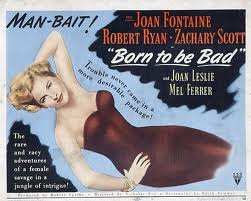
REVIEW – Born to be Bad (1950)

Videovista have my review of Nicholas Ray’s sensationally subversive film noir Born to be Bad starring Joan Fontaine.

The film revolves around a young woman who preys on a couple’s insecurities in order to manipulate her way into landing a wealthy husband.  So far, so femme fatale.  However, what makes this film so strangely compelling is Ray’s abject refusal to turn his femme fatale into a misogynistic punching bag.  Instead, Ray continuously stresses the woman’s basic humanity and her yearning to be loved and understood for what she really is:

The double-standard behind the femme fatale trope is made clear by virtue of the fact that both disreputable Nick and cynical Gobby use their charms to get what they want but nobody seems to think any less of them for it. Indeed, when Christabel encourages Curtis to think of Donna as a gold-digger, she is not summoning this belief from out of this air, she is tapping into Curtis’ quite legitimate concerns about his fellow humans: is anyone ever completely honest, or do we all bend the truth in order to make our lives a little bit easier?

Ray is perhaps best known for Rebel Without a Cause (1955) and the history of that film sheds an interesting light on Ray’s methods as a filmmaker.  The title for the James Dean classic is actually drawn from a book by the psychiatrist Robert M. Linder entitled Rebel Without A Cause: The Hypnoanalysis of a Criminal Psychopath (1944), a book that reportedly inspired Ray to write the story that would become Rebel Without a Cause. James Dean’s character in that film is still considered to be one of the great manifestations of misunderstood youth, but if the character was based upon a case study of a criminal psychopath, what does that say about the character? Both Rebel Without a Cause and Born to be Bad take characters with negative traits and humanise them through a leap of empathy and understanding leaving me wondering whether Born to be Bad should not, in fact, be seen as a companion-piece to Rebel Without A Cause.

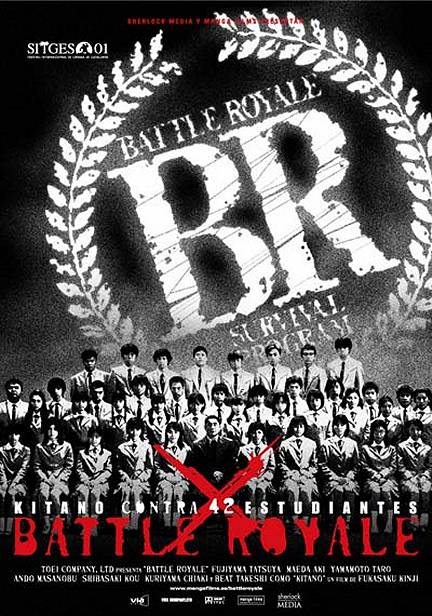
REVIEW – Battle Royale (2001)

THE ZONE has my review of  Kinji Fukasaku’s Battle Royale: Director’s Cut, which has recently been re-released on DVD.

My review attempts to localise Battle Royale within a dystopian tradition which, it seems to me, is peculiarly Japanese. What distinguishes Battle Royale from many dystopian fictions starring plucky teenagers is that the film uses every possible opportunity to mock and ridicule the suffering of its teenaged scapegoats. Indeed, while writers in this tradition are quick to point the finger at governments that blame the young for social problems, works in this tradition also pour scorn on the youth that allow themselves to be victimised:

Again and again, Japanese genre writers depict modern Japan as a hellish place where the old lash out against the youth in ignorance, fear and hatred but the youth refuse to organise and refuse to do anything about their treatment thereby suggesting that no matter how immoral these old people might be, they are not entirely wrong about Japan’s passive, consumerist youth.

The ways in which Fukasaku mocks and trivialises his teenaged characters feeds directly into my one serious complaint about this re-edition: Was a Director’s Cut really necessary?