The Act of Killing (2013) – The Things We Choose To Live With

The colonial period of Indonesian history ended with Japanese occupation. Aside from a reported 4 Million deaths, Japan’s wartime occupation of the Indonesian archipelago also saw the growth of a national independence movement that was only too happy to take leadership of the country when Japan surrendered to allied forces in August 1945.

Two days after Japan’s surrender, a nationalist leader and one-time Japanese collaborator by the name of Sukarno declared Indonesian independence only to be made president the following day. However, this independence turned out to be short-lived as the Dutch were quick to reassert their colonial rights and to press them with the aid of the British military. Sukarno would go on to steer Indonesia in and out of independence as European colonial influence collapsed and various administrative structures were unsuccessfully tried. By the 1960s, Sukarno was seen as something of a puppet master, a politician who clung to power by playing the army and political Islam off against each other with the help of his allies in the air force and his true powerbase, a vast democratic communist party known as the PKI.

In 1965, Sukarno’s grip on power was beginning to fade. The country’s economy was in free fall and while the president’s anti-Western rhetoric had made him friends in Russia and China, an unnecessary military confrontation with Malaysia along with almost complete domination of the government by PKI members meant that those out of power had increasingly little to gain by remaining loyal. In fact, the CIA was fully aware of this fact and was happily providing support and encouragement to what would eventually emerge as the opposition to the so called 30 September Movement.

The official history of the 30 September Movement (or G30S) is that it was an abortive coup launched by members of the PKI in an effort to topple the Sukarno regime. While declassified documents suggest that this might well have been an invention of Western intelligence, the abortive coup provided the army with an opportunity and an excuse to seize power. In the years that followed the abortive coup, the Indonesian army along with allied paramilitary and Islamic groups undertook what can only be described as a wholesale purge of the Indonesian body-politic. While records from this period are understandably patchy, experts suggest that over 1.5 Million people wound up in prison as a result of their supposed communist sympathies. Even though countless thousands would wind up being held in prison for decades without trial, these political prisoners can almost count themselves lucky as experts suggest that the purges also included somewhere between 500,000 and 3 Million extra-judicial killings. Though history records these killings as being part of an anti-PKI purge, the reality is that the army and their allies also went after intellectuals, trade unionists, women’s rights advocates and the ethnic Chinese: Anyone who posed a potential threat, anyone who saw the world in a different way. By the time the killings ended, Sukarno’s leftist regime had been replaced by a pro-Western government headed by Suharto and backed by paramilitary organisations that continue to play an important role in Indonesian public life.

Most documentaries are content to remain small films that tackle small issues in small ways. The larger the issue, the smaller the film generally becomes as documentarians abandon the complexities of the real world in favour of simple moral fables that are easily packaged and easily sold to an audience trained to confuse complexity with confusion and ambiguity with dissemblance. Joshua Oppenheimer’s twelfth film The Act of Killing is something different… it is a big film that takes on a huge issue and provides answers so big and so complex that watching it means forcing oneself to see the world in an entirely new way.

Continue reading →

REVIEW – If… (1968)

FilmJuice have my review of Lindsay Anderson’s story of public school rebellion If…

One of the things I most remember from my time attending press screenings is the extent to which a clever PR might ensure the good will of the critical community. At the lower end of the scale, a PR might turn up early and lay on the booze, thereby ensuring that critics went into the screening feeling appropriately jolly. Further up the scale, a PR with a bit of a budget might book a more upscale screening room and lay on proper food and drink. Once you get into the bigger budget films it is not unheard of for PRs to lay on entire meals and special events, particularly if they are trying to ensure that a film is well-reviewed by non-specialised but widely-read press such as women’s magazines. When the last James Bond film Skyfall was released to rapturous applause, I couldn’t help but imagine film critics being dosed up with vodka martinis and champagne. This type of shit shouldn’t impact on how well a film is received but it really, really does.

Another way of ensuring a warm reception by critics is to speak directly to the concerns and lived experience of the kind of people who tend to become critics. Why else would so many critically-praised novels involve middle-age intellectuals feeling a bit sad and having affairs with sexually generous young women? At its worst, this phenomenon can even lead to critics suggesting that the only books worth reading and films worth watching are the ones that speak directly to them; Isn’t it funny how inward looking films about middle-aged men tend to be seen as more serious and worthwhile than romantic comedies? Isn’t it funny that romantic comedies began to lose prestige and standing the instant they began to be marketed at women rather than men? Anderson’s If… is an undoubted beneficiary of this phenomenon as it is a film about intellectuals rebelling against their public school that was released at a time when practically every film critic in the country would have been a public school-educated intellectual.

I have a good deal of affection for If… and I can totally see why it proved so influential but, as someone who didn’t go to public school, I must say that this film simply does not speak to me. In fact, I think this is less a film about revolution than it is about the upper class finally getting fed up of pretending not to be selfish pricks:

It is easy to imagine Travis growing up to be a Richard Branson-type figure, a ruthless businessman who considers himself a rebel and an individualist because he wears his hair long and doesn’t even pretend to take an interest in the welfare of the poor. Far from being a politically progressive film, If… is a reminder that Capital has always been far more revolutionary than the left-wingers and trade unionists who sought to oppose it.

Maybe if Travis had shown some self-awareness about his position and privilege… Maybe if his rejection of the system had been on moral grounds… Maybe if Travis had wanted something more out of life than the ability to get drunk, wear his hair long and seduce women. Maybe then I might have been sympathetic to his rebellion. Maybe then I might have seen him as a revolutionary rather than a spoiled brat.


REVIEW – The Armstrong Lie (2013)

FilmJuice have my review of Alex Gibney’s sports documentary The Armstrong Lie.

I went into this film with quite a good impression of Gibney as a filmmaker. I loved his award-winning Taxi to the Dark Side about the use of torture in the Iraq war and his Enron: The Smartest Guys in the Room about the myriad ways in which elements of American government, business and media made the collapse of Enron possible. I love those films because Gibney takes a couple of big, explosive news stories and proceeds to do precisely the kind of stuff that the media reporting the stories refused to do: Explain events by embedding them in a broader cultural and sociopolitical context. When The Armstrong Lie applies this methodology to the world of professional cycling, the film is fascinating… the problem is that Gibney keeps allowing Armstrong himself to get in the way:

The problem with this film is that Armstrong’s story is not interesting enough to sustain an entire film. At the end of the day, Armstrong was an ambitious and aggressive man who did everything in his power to win, including cheat. His history of testicular cancer along with his deprived childhood may well account for his will to victory but anyone who looks at the amount of money he made and the level of fame he reached should be able to work out why he cheated and why he continued lying about it until he was eventually caught. Like most sportsmen, Armstrong does not appear to be imbued with a profound inner life and so any attempt to tell his personal story will inevitably come across as being rather dull and predictable

Lance Armstrong’s story should by now be familiar to anyone who is not living in a cave on Mars with their fingers crammed in their ears. Gibney originally set out to make a film about Armstrong’s return to the sport in 2009 and his claims to be running the race ‘clean’ for the first time since his return after testicular cancer. Mercifully, this film collapsed when it became obvious that Armstrong was still cheating and planning on using Gibney to help repair his reputation. The collapse of this earlier project forced Gibney to make a more interesting film as his desire to understand Armstrong’s motivations forced him to look into the culture of a sport that had effectively been sanctioning secret doping for decades. At its best, The Armstrong Lie really connects with the idea that Armstrong succeeded simply because he was a more talented and organised cheat than anyone else in cycling at the time. The problem is that, rather than focusing upon what made Armstrong such an effective cheat, Gibney keeps getting distracted by questions about Armstrong’s motivations and mental state. This proves incredibly frustrating as the whole point of the film is that Armstrong was always a wheel in a much bigger machine who managed to protect the machine by attracting all the attention to a single cog.

The film is filled with footage of journalists and sporting officials trying to hold Armstrong to account but they never get close to him. Every time someone asks about doping, Armstrong puts on a sad face, mentions his cancer as well as the work he did for cancer charities and moves the debate away from whether or not he cheated to the more tricky question of whether or not a journalist or a sporting official have the right to persecute a cancer survivor who raises millions of dollars for other cancer survivors. Indeed, Gibney completely misses the fact that Armstrong’s 2009 Tour de France saw him refusing to answer questions from anyone other than a  disgrace former team-mate who had reinvented himself as a sports presenter. Even if such a man did manage to hold Armstrong to account with an awkward question, Armstrong could simply paint the journalist as a bitter hypocrite and thereby shift the discussion away from whether or not he cheated and towards the far more comfortable question of whether or not it was appropriate to even discuss that possibility.

Armstrong was a brilliant cheat because he managed to protect not only himself but his entire sport from serious scrutiny. He did this by magically transforming all questions about drugs in cycling into questions about whether or not it was appropriate to question the honesty of a cancer survivor and charity worker.

The question of how Armstrong managed this trick is actually very similar to the question of how a vicious paedophile like Jimmy Saville could not only escape prosecution but also enjoy a successful career in show-business. The trick that both Saville and Armstrong pulled is that they managed to position themselves so close to a series of institutions that it effectively became impossible to challenge the individual without also challenging the institutions they stood next to. If this wasn’t bad enough, the relationship between the criminals and the institutions was so close that the institutions wound up with a vested interest in defending the criminal who was using them as cover. How could the BBC, the Royal Family or the various charities he supported distance themselves from Jimmy Saville without admitting their close ties to a paedophile? How could the Tour de France distance itself from Lance Armstrong without admitting that it was their culture of rules-bending that allowed him to rise to prominence in the first place?


Top of the Lake (2014) – #NoDads #NoMums #NoDrama

Funded by the BBC and directed by the only woman to win a Cannes Palme D’Or in the modern era, Jane Campion’s miniseries Top of the Lake is a complete dramatic failure. Beautiful to look at thanks to its New Zealand location, the series follows a detective’s attempts to locate a 12-year-old girl who goes missing after it is discovered that she is five months pregnant.

What makes this series a failure is foreground stuff like plot and character; things which we are encouraged to see as being the entire point of film and TV dramas. The plot does not work as it is poorly written and poorly paced. Having introduced us to the figure of a young girl who has manifestly been raped, the series forgets her existence for two or three episodes before suddenly remembering that finding the girl and revealing the identity of her rapist is the over-arching narrative that is supposed to provide this baggy and ill-disciplined mess with the illusion of structure. Having placed their main plot on the back burner, the writers set about weighting down the characters with an overabundance of backstory that serves only to let the writers off the hook when they decide to write themselves out of trouble by having one of their characters behave in an entirely irrational and uncharacteristic fashion: Need a ruthless patriarch and criminal mastermind to get outwitted by a terrified child? Well… it turns out that he has mummy issues and family-related plot point X caused him to have a convenient mental breakdown. Need an incredibly professional police officer to randomly shoot someone? Well… it turns out that she’s not only a rape survivor but also someone dealing with the aftermath of grief and other incest-related problems.

The novelist E.M. Forster distinguished between flat and rounded characters on the basis that rounded characters are intrinsically knowable. They seem real to us because the author shows how one event triggers an internal change that results in different behaviour patterns. According to Forster, we cannot ever really understand real people but we can understand a rounded character and see not only the different aspects of their personality but also how those different aspects interact and propel the character along a particular course of action. The characters in Top of the Lake are like planets in that they are so painstakingly rounded that they appear completely flat. Campion and her co-writer Gerard Lee provide their characters with so much traumatic backstory that they become unknowable; their melodramatic irrationality so pronounced that they are just as likely to save the day, as they are to put guns in their mouths. Unknowable and unaccountable, they are pools of unreasoning expediency that flow wherever the plot demands. Even with the best will in the world, it is impossible to relate to such creations… they are too convenient to be real.

While the main plotline of Top of the Lake may be dull and its main characters completely devoid of interest, the series does take place in an absolutely fascinating world, one that highlights the problematic aspects of gender and our perpetual need for some notional adult to come along and sort out our problems. Though Top of the Lake may not work as a police procedural, it does stumble across some fascinating ideas.

Continue reading →

REVIEW – Boomerang! (1947)

FilmJuice have my review of Elia Kazan’s impressively crunchy but politically ambivalent legal drama Boomerang!

Set in what the film goes out of its way to refer to as a typical town from the American mid-west, Boomerang! begins exploring the political landscape of a small town on the move. We are introduced to the well-meaning reformers who kicked out the ‘machine politicians’ in order to make their home town a better place and how these patrician figures relate to the wider community through institutions such as the local church. There’s even a nice scene where a planning committee is shown and despite the committee having a woman for a chairperson, it’s pretty clear that the real person in charge is the local priest. Given the extent to which the various power-groups rely on each other to stay in power, it is hardly surprising that when the local priest is inexplicably gunned down, the political scene undergoes a crisis with politicians demanding results while newspapers and rival political parties sharpen their knives. The pressure is so great that the police wind up taking shortcuts, arresting everyone in sight and effectively torturing someone into signing a confession.All of this social realism is beautifully realised but unlike similar endeavours such as David Simon’s The Wire, the film does not end with a call for revolution or the liberal conclusion that everything is fucked. Instead, the film seems to conclude that the system is okay because a single corrupt politicians wound up doing the right thing whilst angling to be made governor. This makes for a denouement that is as dramatically unsatisfying as it is confounding of genre expectations:

There is a tendency in American popular culture to treat the legal process as a moral crucible. Well-meaning bourgeois films like My Cousin Vinny and 12 Angry Men suggest that all of humanity’s moral impurities can be boiled away by the system while more politically radical films such as JFK and Amistad draw attention to the failings of the legal system as a way of demonstrating an urgent need for reform.

Having thought about it a bit more, I am struck by the suspicion that treating courtrooms as moral crucibles is a singularly American affectation. America is a country founded by lawyers as well as run by a political class mostly comprising lawyers and so it is hardly surprising that American popular culture has come to believe that court is the place where justice and truth are imposed upon the world. Even comparatively cynical legal dramas such as The Good Wife and Damages present corruption and inequality as incidental rather than systemic problems meaning that they can be defeated by a lawyer who is both talented and righteous. Compare this to a drama such as the French series Engrenages where the French legal system is presented as universally corrupt or the venerable Rumpole of the Bailey, which depicted the British legal system as little more than a playground for ambitious scions of the establishment.

Another interesting question is the extent to which these legal programmes have shaped the minds of the people who viewed them. Children subjected to endless police dramas might be likely to see justice as something meted out by the police just as children trained to see the world through the eyes of the Good Wife would doubtless come to see lawyers as being in the business of keeping the system in line and ensuring that it continues to deliver justice. One of the reasons why a flawed and frankly preposterous programme like The West Wing is well remembered is that it suggested that it was the job of the state to impose justice on the world, which is rather unfashionable in an age where most politicians see their jobs as being all about waging war, locking up prisoners and outsourcing everything to the private sector. An interesting tangent to this issue is the way that American superhero comics explain their protagonists’ capacity to do good.

It used to be that superheroes were frequently patrician figures who used their personal fortunes to fund both their crime-fighting activities and a variety of different charitable works. Thus, Bruce Wayne funded Batman as well as the Wayne Foundation just as Professor Charles Xavier funded both the X-Men and Xavier’s School for Gifted Youngsters. While these characters endure, the nature of their financial backing has significantly changed. For example, there was no talk in the 1960s Batman TV series of Bruce Wayne being an industrialist but now it is impossible to think of Batman without thinking of Wayne Enterprises and the incorporation of Batman that took place during Grant Morrison’s extended run on the comic. That’s a pretty substantial message to send to kids: Not only will justice come at the hands of a masked vigilante but that vigilante will be a franchised brand that is owned by a multinational corporation. This idea that only corporations can deliver justice has also leached into the X-Men as more recent X-Men comics cast Charles Xavier as founder of the X-Corporation which funds the X-Men in much the same way as Tony Stark’s Stark Industries funds the Avengers and many of the lower-level supers that inhabit the Marvel Universe.

An interesting counter-point to this drive to incorporation is the group known as Stormwatch. Created as part of the Wildstorm universe, Stormwatch were funded and controlled by the United Nations. However, as time progressed (as Wildstorm comics were purchased by DC) these links to publicly-minded NGOs were put under dramatic pressure as writer after writer chose to depict the UN as a bureaucracy that was as incompetent as it was corrupt. One of the first things to happen in The Authority is that the heroes severed all ties with Stormwatch and took it upon themselves to impose their own ideas of justice on a series of corrupt and incompetent human governments. Somewhat tellingly, the cinematic Avengers began life under the control of the government agency known as SHIELD but Captain America: Winter Soldier revealed SHIELD to be corrupt, thereby setting the stage for Stark Enterprises to step in and provide the group with funding.

On the one hand, this is clearly nothing more than aggressive right-wing propaganda as corporations are effectively using corporate-owned intellectual property to train children to believe that all governments are corrupt and only Capital can save them. However, on the other hand, this is an excellent example of the narrowing of the imagination associated with late capitalism: We are so wedded to the capitalist system that even escapist fluff struggles to portray a world in which only people with corporate backing can hope to make a difference.

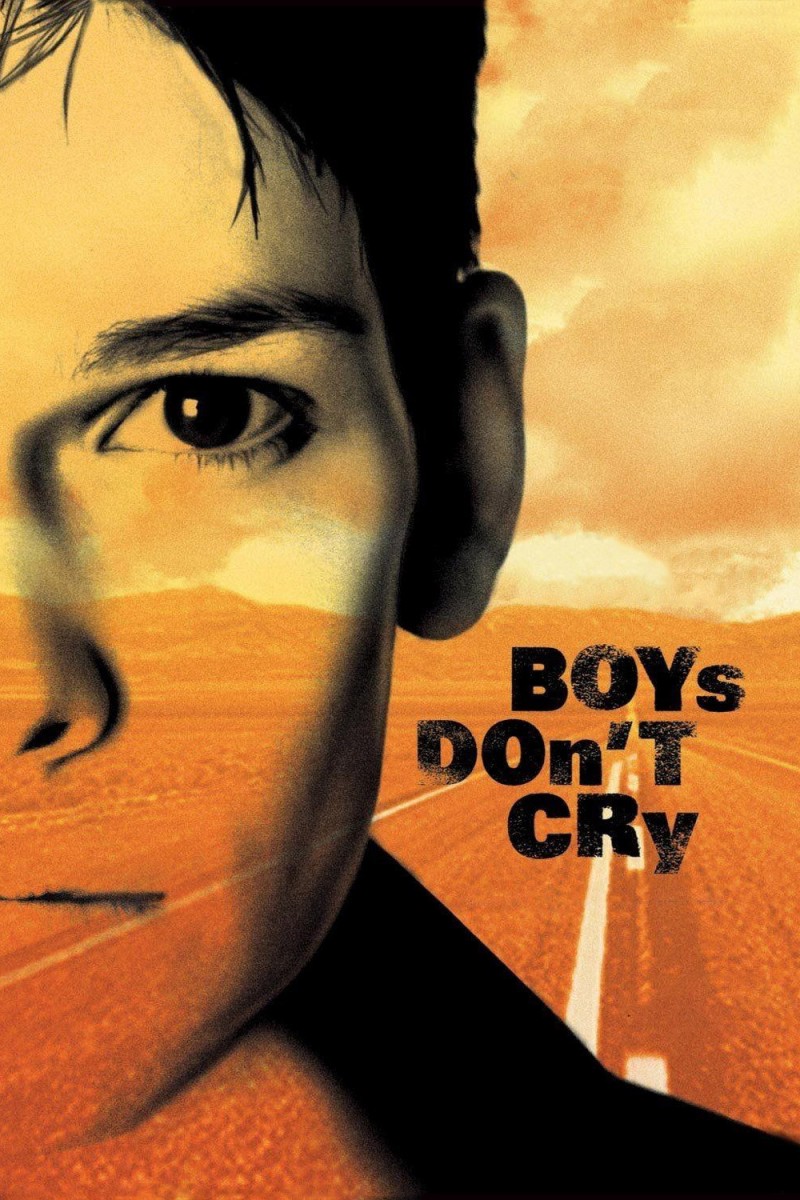
Boys Don’t Cry (1999) – On the Inhumanity of Sexual Categorisation

When people talk about gender and sexuality, they usually do so from within the context of a broad social narrative. Arguably the most popular gender narrative of the day is that we (in the West particularly) are in the process of weaning ourselves off of a particularly toxic and reductive understanding of human sexuality. According to this narrative, we have progressed from what was essentially a tri-partite model of human sexuality (straight male, straight female, and Other) to an N-partite model that allows not only for differences in sexual preference but variations in relationship models, different sexual practices and conceptions of gender that rely upon variables other than genital shape and chromosomal configuration. Under the logic of this narrative, a three-box understanding of human sexuality is repressive and so the more boxes we add to our model, the closer we come to a theory that reflects the enormous complexity of human sexual identity. In an ideal world, everyone would fit into their own universally recognised pigeonhole with nobody left puzzling as to how they fit in or who they are. Though giddily utopian, this narrative is not without its critics.

Back in the 1970s, the French philosopher Michel Foucault began to examine the different ways in which humanity has conceived of sexuality. He concluded that, far from being a historical reality, the above narrative was a construct of the 1960s and that, much like previous models of human sexuality, it contained the embryo of an intensely problematic political programme. Foucault argued that the urge to determine the ‘truth’ about a particular phenomenon and break it down into distinct categories tends to go hand-in-hand with a desire to control the phenomenon. For example, while most people do have a conception of race, their conception tends to be a lot less exacting that the systems created by governments intent upon dehumanising particular groups of humans. Thus, while most Westerners are now content to use the term ‘mixed race’ to describe people of mixed racial heritage, previous generations have used terms like ‘mulatto’ and ‘quadroon’ to determine not only which races were mixed but also in what proportions. Though pointless in the West today, these linguistic categories would have proved extraordinarily useful for societies that practiced apartheid, slavery or any other systematic abuse of different racial groups. Indeed, the first step towards the Final Solution was the creation of a legal framework allowing Nazi officials to ‘objectively’ distinguish between Jews and non-Jews on the basis of their parentage.

Though Foucault stops well short of drawing a parallel between how people used systems of racial classification and how people use systems of sexual classification, he does express profound concern over our assumption that more precise systems of top-down classification are somehow a sign of progress. After all, ‘Octaroon’ is a more precise term than ‘Black person’ but nobody in their right mind would consider it progressive to begin pigeon-holing people on the basis of their having one Afro-Caribbean grandparent. Systems of top-down classification require measurement and basing someone’s identity upon their ability to satisfy objective scientific criteria is intensely dehumanising… we see this not only in the Victorian and Nazi obsession with skull sizes but also in the grotesquely gynaecological language applied to the Trans* community when the need to fit people into pre-existing categories invariably devolves into discussions of genital shape and chromosomal configuration.

Kimberley Peirce’s Boys Don’t Cry won awards and captured hearts by drawing the world’s attention to the real-life story of Brandon Teena, who was betrayed, raped and murdered by a group of friends who believed that Brandon had misrepresented his gender. When the film was first released in 1999, many people described it as the story of a woman who ‘passed herself off’ as a man in an effort to reconcile her desire to sleep with women with the universal homophobia of 1990s Nebraska. Since then, awareness has expanded and so most people now think of the film as a tragic story about how an intolerant culture treats transgender people. However, while both sets of readings say quite a lot about our need to impose clear boundaries on ambiguous phenomena, a better reading of the film is to take it as an attack on the process of classification itself.

Continue reading →

Swimming Pool (2003) – Touched by The Gods of Indecision

One of the enduring concerns of human culture is how to deal with thoughts and feelings that are not recognisably our own.

Much like the ancients, who associated odd feelings and passing moods with particular deities, Saint Augustine viewed unwelcome thoughts as something external to the self. According to Augustine, our urge to transgress God’s laws stems from a wound inflicted by Original Sin and passed down through the generations by sexual contact. Later churchmen would describe the concept of Original Sin as:

“Privation of the righteousness which every man ought to possess”

Inspired by the Augustinian concept of Concupiscence but intent upon creating a materialistic account of human nature, Sigmund Freud divided the self into different parts and invoked the concept of the unconscious as a place where unspeakable thoughts and desires boil and occasionally rise up, hammering at the walls of the conscious self. Though no longer central to scientific accounts of human nature, Freud’s account of the self remains incredibly influential. Artists and mental health professionals conspire to present the mind as a city under constant pressure from a vast and barely manageable neurochemical hinterland where entire streets pass in and out of the surrounding jungle. The question of how we navigate such a city, where we draw the line between town and country, ours and not-ours not only endures to this day but also accounts for many of the most striking literary and philosophical innovations of the 20th Century.

Like many psychological thrillers, Francois Ozon’s Swimming Pool follows a character’s attempt to repress, confront and ultimately claim ownership of a series of unwelcome and unrecognisable thoughts, but as sophisticated as the film’s distinctions may be, it is never entirely clear where the film’s main protagonist begins and ends.

Continue reading →

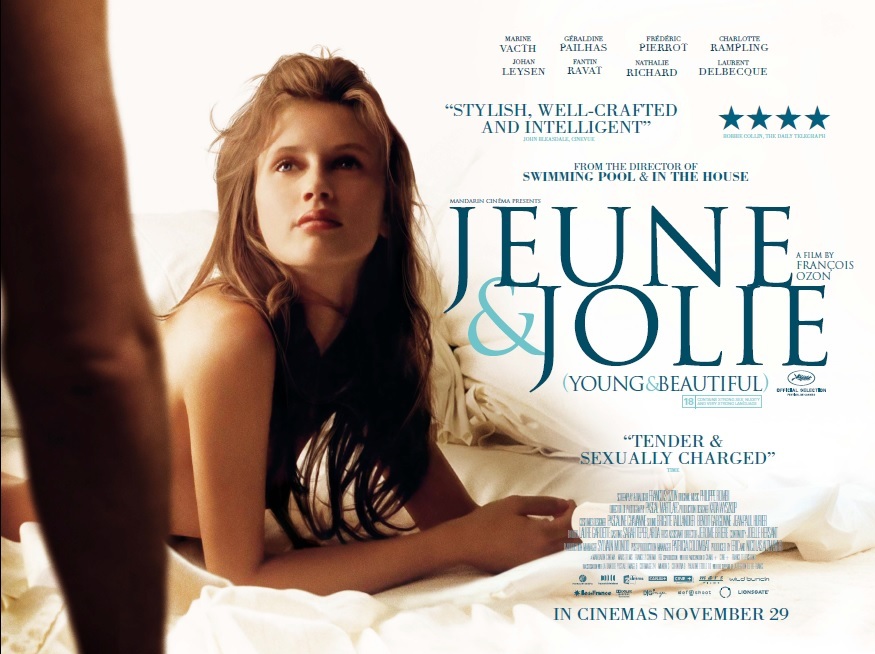
Jeune et Jolie (2013) – Taking Your Sexuality Off-Grid

JJ1Art house film has always had a problematic relationship with female sexuality. Though art house directors are far more likely to construct their films around strong female characters than their Hollywood counterparts, their engagement with these characters’ sexualities is often limited to stripping an actress naked and posing her in a series of titillating tableaux such as those found in Abdellatif Kechiche’s Palme D’Or winning film Blue is the Warmest Colour. The further a female character ventures from the realms of male fantasy, the more likely it is that her sexuality will be turned against her and used as a sign of encroaching madness, alienation or spiritual collapse. In art house film, sad men may become murderers but sad women will always become prostitutes.

The tragedy of problematic narratives is that they frequently outlive the social attitudes that first informed them. For example, while the films of Luis Bunuel may have been informed by the remnants of his Jesuitical education, the phrases and characters he helped to develop in films like Belle de Jour passed into common usage and came to form part of the basic vocabulary of art house film. Used and revisited for decade after decade, the character of the fallen woman is now so familiar to art house audiences that directors no longer feel the need to spell out why promiscuous women are sad women… they just show us a female character having loads of sex and allow us to fill in the blanks. We have been trained through repetition and this training followed us out of the cinema and into our daily lives meaning that, without ever having been subjected to an argument about the evils of promiscuity, our first reaction to promiscuous women is to assume that there is something terribly wrong with them.

The alternative to allowing our culture to train us is to question the values embedded in stock cinematic phrases and champion works that set out to subvert stock phrases and use them to draw our attention to the sexism and racism that is perpetuated by our own intellectual laziness. Thankfully, while the 2013 Cannes jury was content to give the biggest prize in art house film to a work that presented sexually empowered women as hollow vessels and childlike victims, another director in competition set out to pick a fight with the myth of the fallen woman. The director in question is Francois Ozon and his film is Jeune et Jolie.


Continue reading →

REVIEW – Wish You Were Here (2012)

wishyouwerehereFilmJuice has my review of Kieran Darcy-Smith’s Wish You Were Here, an Australian mystery/drama that is not to be confused with David Leland’s oddball British tragedy of the same name.

Set between Australia and Cambodia, Wish You Were Here is a great-looking film that is hamstrung by its director’s self-indulgence and borderline racism. The plot revolves around a pair of Australian couples who visit Cambodia and have a great old time until one of the group disappears. Understandably distraught, the remaining holiday makers limp back home and begin worrying about the disappearance of their friend and the fact that reporting his disappearance to the authorities might shine a light not only on their illegal activities but also their dysfunctional relationships. I say that the film is borderline racist as it falls into the familiar trap of using a non-white culture as backdrop for the breakdown of white middle-class lives. Colourful marketplaces, yay! Maimed beggars and brown dudes with machine guns, boo!

However, more interesting than Darcy-Smith’s use of lazy racist stereotypes is his failure to fuse the mystery and kitchen sink drama genres:

Darcy-Smith’s mistake lies in a fundamental misunderstanding of the differences between mysteries and dramas: The focus of a mystery is on leading the audience through a particular narrative while the focus of a drama is on unravelling the complexities of character. While psychological mysteries can sustain a hybridisation of the two genres, Wish You Were Here is ultimately a story about a missing tourist and not an exploration of why the characters are the way that they are. As you would expect from a plot structured around a missing person narrative, the characters only have as much depth as that central mystery requires meaning that while Darcy-Smith gives his actors vast amounts of time in which to explore their characters, the characters they are exploring are neither particularly deep nor particularly interesting. If Darcy-Smith wanted to direct a character-based drama then he should have written a script about character and not about an extraneous mystery. In a way, it’s a bit like turning up at the cinema to watch Avengers 2 only to discover that the director has decided to focus on the inner life of the bloke who drives the aircraft carrier. There’s nothing wrong with making a film about the bloke who drives the aircraft carrier but if you do then at least go to the trouble of working from a script that explores the character’s background and how they got recruited into SHIELD. Don’t just turn on the camera, leave them emote and expect the audience to be as fascinated by the results as the people doing the acting! That would make for a dull Avengers 2 and it certainly makes for a dull Wish You Were Here.

It is interesting that positive reviews of this film tend to point to the central performances of Joel Edgerton and Felicity Price as while both do well and are accorded a good deal of time and space, neither character is particularly complex or engaging. They’re just vaguely unhappy middle-class people who can’t talk about their problems. In truth, I’m not convinced that either performance was really all that worthy of commentary, though I do think that Darcy-Smith made their performances the focus of the film.

Blue is the Warmest Colour (2013) – Orgasms and Spaghetti Bolognese

BWC1The world of art house film has become a tediously reverential place. Raised on auteur theory and acutely aware that it lacks both the cash and cachet of commercial cinema, the people who write about art film are prone to treating its institutions as temples and its practitioners as living saints. Once filled with experimentation, transgression, provocation and very human failures, the cultural spaces of art house film are now given over to callow hagiography and propping up the careers of once great talents. As one might expect of a milieu that looks upon dissent as an act of economic sabotage, there is a tendency to treat the recipients of major festival awards as worthy regardless of whether their films are any good. Thus, to say that Abdellatif Kechiche’s Blue is the Warmest Colour is the most controversial winner of the Palme D’Or in decades is actually a good thing… turns out that there might be some life in the old dog yet.

While the controversy has many heads, the one with the longest teeth erupted prior to the announcement of the Palme D’Or when the New York Times’ senior film critic Manohla Dargis wrote about the film in what she would later describe as “399 words dissenting words”:

It’s disappointing that Mr. Kechiche, whose movies include “The Secret of the Grain” and “Black Venus” (another voyeuristic exercise), seems so unaware or maybe just uninterested in the tough questions about the representation of the female body that feminists have engaged for decades. However sympathetic are the characters and Ms. Exarchopoulos, who produces prodigious amounts of tears and phlegm along with some poignant moments, Mr. Kechiche registers as oblivious to real women. He’s as bad as the male character who prattles on about “mystical” female orgasms and art without evident awareness of the barriers female artists faced or why those barriers might help explain the kind of art, including centuries of writhing female nudes, that was produced.

“Men look at women,” the art critic John Berger observed in 1972. “Women watch themselves being looked at.” Plus ça change….

When people voiced their disagreement, Dargis took the bait and expanded her ideas in an essay that draws on a blog post made by the creator of the graphic novel that inspired the film. Writing in French but translated for Anglophonic consumption, Julie Marot praised the style and vision of the film whilst not only distancing it from her book but also from the real-life experiences of actual LGBT women:

I don’t know the sources of information for the director and the actresses (who are all straight, unless proven otherwise) and I was never consulted upstream. Maybe there was someone there to awkwardly imitate the possible positions with their hands, and/or to show them some porn of so-called “lesbians” (unfortunately it’s hardly ever actually for a lesbian audience). Because — except for a few passages — this is all that it brings to my mind: a brutal and surgical display, exuberant and cold, of so-called lesbian sex, which turned into porn, and me feel very ill at ease. Especially when, in the middle of a movie theater, everyone was giggling. The heteronormative laughed because they don’t understand it and find the scene ridiculous. The gay and queer people laughed because it’s not convincing, and found it ridiculous. And among the only people we didn’t hear giggling were the potential guys too busy feasting their eyes on an incarnation of their fantasies on screen.

In other words, the 2013 Cannes Film Festival jury gave the most prestigious award in world cinema to a piece of grotesque cultural appropriation; a film that took an original graphic novel by a gay woman and filtered it through the beliefs and proclivities of a straight man resulting in a series of needlessly explicit and exploitative sex scenes that owe a good deal more to the tropes and techniques of pornography than to the emotional contours of LGBT life.

Though in and of itself disappointing, the jury’s decision is made infinitely worse by the fact that Cannes Film Festival has an absolutely terrible track record when it comes to the representation of women in general and LGBT women in particular: Since the Palme D’Or assumed its current form in 1975, the award has had only one female winner (Jane Campion). In the year that Blue is the Warmest Colour won the Palme D’Or, there was only one female director in competition and the previous year saw none at all. While the slightly more edgy Un Certain Regard prize has a much better track record of allowing women to compete, men still dominate the list of winners. The problem is not just that the Cannes jury gave its most prestigious award to a straight man’s vision of a lesbian relationship, it’s that it chose to give that film an award despite having completely ignored all the films made by actual LGBT women including Chantal Akerman, Andrea Weiss, Ulrike Ottinger, Barbara Hammer, Lana Wachowski, Monika Treut and Lisa Cholodenko. It is almost as though the Cannes Film Festival only discovered the concept of a non-straight woman when a straight man decided to film a couple of straight women pretending to go down on each other. Given that art house film likes to present itself as being interested in different ways of seeing the world, this addiction to the straight male gaze is complacent, corrosive, wasteful and so completely unacceptable that every passing year brings nothing but shame to an institution already in urgent need of reform.

Continue reading →