REVIEW – Beyond the Valley of the Dolls (1970)

FilmJuice have my review of Arrow’s re-release of Russ Meyer’s Beyond the Valley of the Dolls. The film revolves around a group of female rock musicians who decide to leave home and try their luck on the LA music scene. What they find is a scene replete with sex and drugs where fame is just as likely an outcome as death. Initially wowed by the glamour and raw sexuality of their new friends and hangers on, the band lose sight of the music and each other before re-discovering themselves and asserting their basic moral character. In other words… it’s the cinematic version of Josie and the Pussycats only without the tunes and satirical edge:

The problem with Russ Meyer’s Beyond the Valley of the Dolls is that while Meyer had been working in Hollywood for a few years, neither he nor his screen-writer the film critic Roger Ebert had any idea as to what LA’s sinister underbelly was actually like. Meyer was 48 when Beyond the Valley of the Dolls was released and so the image of Hollywood he wound up ‘satirising’ was one with little or no basis in reality. Beyond the Valley of the Dolls is not so much humorous as embarrassing in that characters wander around spouting 60s-inspired gibberish like “don’t bogart that joint” and “I’d love to strap you on”. It’s funny enough the first few times but the well is shallow and Ebert’s script keeps digging long after the audience is being served refreshing glasses of dirt. Moving beyond the thin attempts at satire are juvenile attempts at transgression that usually boil down to footage of enormous bouncing breasts and moments of gay panic.

Some critics describe Beyond the Valley of the Dolls as a satire of the LA scene but the satire rarely rises above the level achieved by Rowan and Martin’s Laugh In, which I assume provided the bulk of Ebert and Meyer’s ‘research’ into 60s counter-culture.

Meyer is a director who reminds me a lot of Roger Corman in so far as his fame seems to be a reflection of financial realities rather than genuine authorial vision. Both directors arrived on the scene after the collapse of the studio system and TV’s wholesale annexation of cinema audiences. Corman and Meyer made money and brought in younger audiences by filling cinema screens with sex and violence and so have come to be hailed as pioneers but the directors of the American New Wave did much the same and yet produced art rather than the grubby, stupid and lacklustre nonsense that we have come to associate with Corman and Meyer. As I say in my review, Meyer deserves credit for developing a vision that was uniquely his own but there really are much better Meyer films than Beyond the Valley of the Dolls. This film is unfunny, unsexy, unexciting and egregiously reactionary. Ugh.


REVIEW — The Angry Silence (1960)

I often wonder how much attention I should play to politics in the evaluative elements of my reviewing. As someone who is normally quite cynically detached from the culture that surrounds me, I am –to borrow a turn of phrase from Peter Mandelson and thereby prove a point — intensely relaxed about the consumption of right-wing culture.

I can watch Triumph of the Will and The Birth of a Nation just as easily as I watch Saturday Night and Sunday Morning. I can watch and appreciate these films because I take them all  to be well-realised expressions of particular world-views. The fact that I have more personal sympathy for the politics of Saturday Night and Sunday Morning might encourage me to return to that film slightly more often and hold it in slightly higher regard but ugly politics are no impediment to the creation of beautiful films. At least in principle…

There are times when right-wing culture annoys me and those times are usually when the film is quite obviously tapping into existing trends in right-wing propaganda in order to connect with an audience. My go-to example for this type of thing is Ciaran Foy’s The Citadel, a low-budget horror film that draws on a variety of racist and classist stereotypes in its efforts to depict modern-day council estates as madness-flecked sink holes filled with feral dog-children who would just as soon rape you as smear faeces on your front door. This type of shit bothers me because these are notions that are still ‘live’ and still doing damage to the people who live and work on those council estates. Fascism and racism are still very real social problems but I feel that cultural politics have shifted far enough that it is easy to gain some distance from films about Nazis and Klansmen. This may be a reflection of my white privilege, but it is also how culture works… time and distance make it a lot easier to be objective.

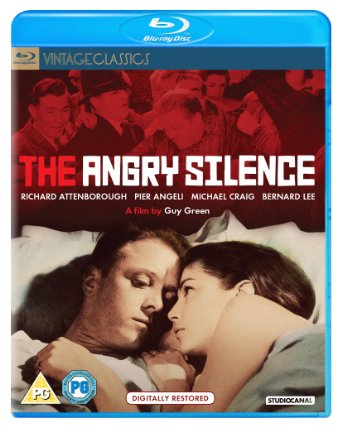
An excellent example of this process at work is my review of Guy Green’s workplace drama The Angry Silence, which has now gone live on FilmJuice.

The film is set in a period of British history where capitalism had not yet been completely unbound. The story revolves around a factory-worker who is forced to choose between financial security and group loyalty when a communist agitator manipulates his local union into a series of wildcat strikes:

It is at this point that the film’s right-wing politics begin to manifest themselves as Curtis is positioned as a righteous individual standing up to both the inhuman collectivism of the working class and the selfishness of ruling elites who inexplicably single him out as a ‘lone wolf’ and general trouble maker. What makes the film right-wing is the way that it paints the working class as a collection of cowards, sheep and thugs. Easily manipulated by what would appear to be Soviet spies, they strike out of vanity and blind conformity rather than as a means of securing fairer wages or safer working conditions. The Angry Silence is not set in our world but in a parallel universe where capitalists increase wages, workers remove their own safety rails and still people turn out on strike. The situation explored in The Angry Silence is as much of a paranoid right-wing fantasy as the ticking terrorist time bomb that invariably serves to justify the use of torture… no wonder this film was universally praised by the right-wing press.

The Angry Silence is a piece of right-wing propaganda that aped the kitchen sink realism and working-class focus of the British New Wave at a time when those themes, methods and politics still had an audience. It’s not just that the film’s politics are wrong and harmful, it’s that the producers Richard Attenborough, Bryan Forbes, and Jack Rix took a set of tools devised to help set people free and used them to construct an argument in favour of the blasted neoliberal hellscape in which we are now collectively entombed. The Angry Silence is a well-made film in the same way as Triumph of the Will and The Birth of a Nation are well-made films in that it articulates its right-wing worldview with real panache in a film that is well-constructed, well-written and very well-performed.

The Angry Silence is a well-made piece of right-wing propaganda and the only reason I am able to enjoy it is because the argument the film participates in about the merits of collective action and group solidarity have now been lost. I can understand why the right-wing press praised this film and I can understand why the (then) predominantly left-wing film culture absolutely hated it. I hate what this film represents and yet I have enough distance from the argument that I am able to appreciate the skill with which its clauses and conclusions are laid out. Yet another good film in service of an ugly argument.

REVIEW — The Raging Moon (1971)

Some films fail at the level of script, others fail at the level of pacing or subject matter. Bryan Forbes’ The Raging Moon is interesting in so far as it fails at the level of casting.

Based on a novel by Peter Marshall and manifestly inspired by the author’s life, the film tells of an unpleasant but vital young man who inexplicably loses the use of his legs. Abandoned by a family who simply cannot cope with the idea of a disabled son, the character plunges into depression just as he begins life in a Church-run home for disabled people. This protagonist’s depression lingers until he becomes friends with an attractive middle-class girl who effectively gives him something to live for. No longer depressed and now capable of imagining a future without the use of his legs, the young man emerges as a fully-formed adult with a promising literary career.

As I explain in my review for FilmJuice, the problem with Forbes’ adaptation of The Raging Moon is that while the story was originally designed to be a bildungsroman in which a young man has to lose the use of his legs before gaining the use of his mind, the film focuses not upon the protagonist’s journey but upon the under-written romance that marks the point at which the character comes properly of age:

Simply stated, the romance between Bruce and Jill feels under-written, poorly paced and completely unbelievable. Having spent a quarter of an hour establishing that Bruce is depressed and alienated from the people around him, the film transforms him into a love-struck puppy within fifteen seconds of noticing Jill across a crowded room. Given that Jill simply did not exist as a character prior to that scene, Bruce’s attraction and mood change seem completely out of character. Shockingly under-written given the detail lavished upon both Bruce’s relationship with his brother and Jill’s relationship with her former fiancé, the bond between Jill and Bruce feels more like a cynical contrivance than something genuinely character driven. Indeed, a romance featuring Malcolm McDowell and Nanette Newman was always going to be an easier sell than a film about a horrible young man who loses the use of his legs but gains the ability to think and feel like a normal human being.

Rather than casting someone who could play a petulant boy as he turns into a man, Forbes cast Malcolm McDowell… postboy for adolescent angst and justified rebellion. This casting decision alone practically forces us to mis-read McDowell’s character and view him as a rebel rather than the immature and lonely figure that Peter Marshall quite obviously intended.

Also problematic was the decision to cast Nanette Newman in the role of Jill. In 1971, Nanette Newman was not only a proper film star but also Bryan Forbes wife meaning that the character of Jill could not help but expand beyond the limited role accorded it in both the script and the novel. Had Marshall and Forbes decided to rework the story to provide Jill with more back-story and interiority then the romance between the two characters might have worked. Instead, we have a romance that rests on an underdeveloped and unengaging relationship.

It took me a while to work out quite how negative I wanted to be in this review. The problem is that while the film was s0ld as a romance and fails according to that particular yardstick, there’s a really interesting (if somewhat prosaic) drama trying to get out from beneath the director’s terrible casting and adaptation decisions.

Rather than viewing The Raging Moon as an under-cooked romance, we would be better off viewing it as a social drama looking at the lives of disabled people in the late 1960s. For example, the film does an excellent job of noting how families would distance themselves from disabled children in an effort to remain untainted by the stigma of disability. The film also suggests that this stigma informed the policy of locking disabled people away in homes and resulted in people experiencing real horror and disgust at the idea of disabled people having relationships with each other.

Raging Moon deserves full credit for daring to show a tender love affair between two people in wheelchairs but that type of romance is poorly served by a script set up to support a completely different type of story.


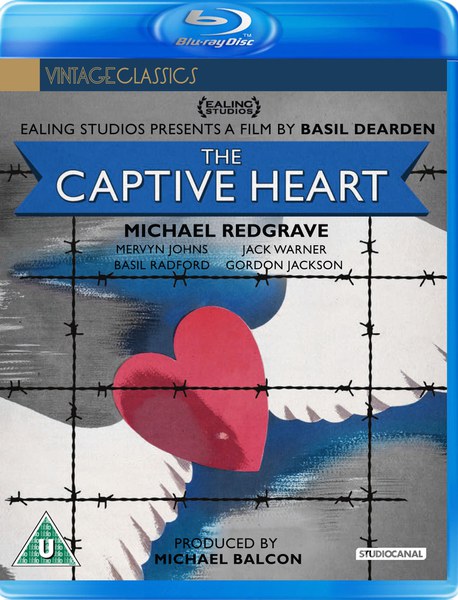
REVIEW — The Captive Heart (1946)

Earlier this week, I wondered what a fully mature and authentic British film industry might actually look like. For inspiration, I looked to the British cinema of the 1940s and found both good and evil.

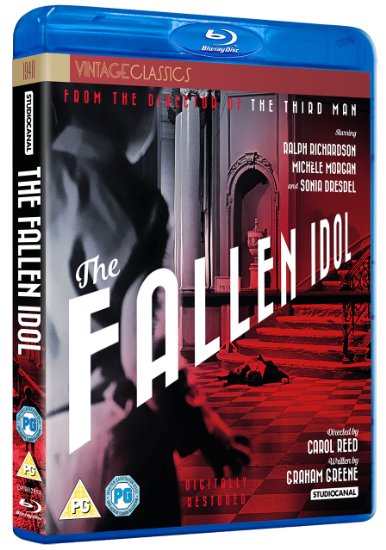
One side of the dyad is represented by Carol Reed’s The Fallen Idol, an immensely thought-provoking film about how children see the world and how that vision is subject to distortion by more-or-less well-intentioned adults.However, while the mature and authentic British film industry of the 1940s was capable of producing complex and challenging films like The Fallen Idol, it was also capable of producing films so wedded to the political establishment that hindsight reveals them to be almost indistinguishable from propaganda.

However, while it may be comforting to believe that a mature British film industry would happily churn out films of similar quality to The Fallen Idol, an authentic British film industry would almost certainly give voice to conservative and reactionary feelings that are just as much a part of the British cultural landscape as the desire to ask awkward questions and consider the perspectives of the powerless. While The Fallen Idol may embody everything I’d like to see from a mature British cinema, the opposite side of the dyad would be represented by  Basil Dearden’s The Captive Heart, an elegantly-structured and intelligently scripted film that just so happens to feel like the clarion call of a new British imperialism.

The film opens with footage of injured British soldiers marching through the French and German countrysides. These are the remnants of the British Expeditionary Force and they are destined to spend the rest of the War in a German POW camp. The film introduces us to a variety of different characters, provides them with back stories and then allows us to watch as the men come to terms with both their new situation and the demands placed upon them by their connections back home. As I say in my review, the effect is very reminiscent of the so-called Cosy Catastrophes that dominated British science-fiction in the aftermath of World War II:

Back in 1973, the British author and critic Brian Aldiss argued that British writers like John Wyndham had a nasty habit of depicting the end of the world as a cosy catastrophe in which survival demanded little in the way of hardship, sacrifice or philosophical re-orientation. The classic example of this style of science fiction story is Wyndham’s The Day of the Triffids in that, after escaping a London full of man-eating plants, the protagonists settle into a Sussex mansion where tea is drunk, cake is made, and the class system endures. Though somewhat unfair to Wyndham, it is easy to see how the generation that survived World War II might have come to imagine the end of the world in terms of rose gardens turned into veg patches rather than rape, cannibalism and disease. To this day, popular British representations of World War II are far more likely to dwell on ration books and period kitchens than the experiences of men who spent their formative years dodging bullets and climbing over corpses.

The idea that ‘Englishness’ will endure the collapse of civilisation is absolutely central to The Captive Heart. Aside from the fact that all of the various sub-plots involve British people doing British things in a POW camp until they can get back to Britain and continue being British, the film’s primary plot-line involves a man falling in love with Englishness as he falls in love with an English woman:

(Michael) Redgrave’s Czech officer is something of an interstitial figure as his growing love for Mitchell’s widow is skilfully interwoven with a growing love for the English born of their many kindnesses. There’s even a montage of people playing cricket as a voice-over talks about fruit trees coming into bloom in the back garden. The reason The Captive Heart was released so soon after the end of World War II is that Ealing Studios began making it before the war had even ended. This means not only that the film was made without being touched by the realities of war but also that it was made with very little idea as to how England (or indeed Britain) might fit into a post-War Europe. Unsurprisingly, the film resonates with a distinctly imperial mind-set in that English values are shown to be not only eternal and immutable but also exportable to Eastern Europe where tales of English decency and sacrifice would doubtless fill the squares with people desperate to try their hand at cricket. Seen in this light, Michael Redgrave isn’t so much seduced into English as colonised by it.

If I am blurring the line between Englishness and Britishness then it is because the film makes exactly this mistake. Much like Laurence Olivier’s wartime Henry V, Englishness is parlayed into Britishness through the use of loyal Welsh and Scottish subalterns who hint at a broader conception of Britishness only to doff their caps to the English upper-classes.

The Captive Heart is a deeply conservative film and that conservatism is manifest in its abject failure to imagine a future that was not identical to the twenty-years between World War I and World War II. The Captive Heart cannot imagine a world in which Britain isn’t a global player or where Englishness is neither admired nor emulated. Nowadays, people often use the acronym “TINA” to refer to our failure to imagine a world other than that provided by neoliberalism but I think works like The Captive Heart and Day of the Triffids are examples of an older version of TINA whereby people simply could not imagine a world without cricket, empire and an all-encompassing class-system.

 

REVIEW — The Fallen Idol (1948)

This week, circumstances have allowed me to offer you something of a cultural dyad. For years now, British film critics have fetishised British film to the point where the term has become almost meaningless. For some, it means simply British accents and British names on the credits of Hollywood Blockbusters. For others, it means a truly national cinema that speaks to the concerns of the British people in terms that are uniquely theirs. As someone who has grown increasingly pessimistic about the Hollywood machine’s capacity to generate decent films, I favour the latter solution but even I wonder what a mature and deep-rooted British cinema might look like. Would it be Hollywood-lite in the same way as BBC dramas have come to feel like childish and over-eager attempts to appeal to American audiences? Or would it be something much darker and unpleasant? An expression of the fascistic desires and xenophobic tendencies that coarse through the British political bloodstream?

French cinema might be a good form to emulate but French cinema has very noticeably struggled with the urge to be Hollywood-lite and the urge to continue producing respectable grown-up films about middle-class people experiencing some sort of crisis. Don’t get me wrong… I love French populist cinema almost as much as I love films about middle-class French people experiencing crises but I also realise that neither of these models represents the realities of modern France. Another alternative would be to look back to a time when Britain actually had a film industry that was both mature and authentic, which is where this week’s offerings come in.

This week’s first review demonstrates quite how sophisticated post-War British cinema could be. As my review for FilmJuice argues, Carol Reed’s The Fallen Idol is an attempt to engage with how children see the world and how their vision of the world is liable to be distorted by grown-ups with vested interests in particular truths. Set amidst the marble palaces of Knightsbridge, the film is about a diplomat’s son who has been left alone with his father’s butler and house-keeper:

At first, Reed forces us to see this reluctant family unit through the eyes of the child meaning that Mrs. Baines comes across as an evil step-mother while Mr. Baines seems like an ideal father. However, as the film progresses and we are allowed to learn a little more about the secondary characters, it becomes clear that the couple’s behaviour towards the child is being driven in part by grown-up problems that Philippe is not equipped to understand. In reality, Mrs. Baines is not so much an ogre as a desperately unhappy woman who is trapped in a loveless marriage to a man who cannot stop lying.

As the narrative unfolds, Philippe’s attempts to protect the interests of his surrogate father are undermined by his own failure to understand either the adult world or what it is that he is actually seeing. The tension between what Philippe believes, what he wants others to believe and what is actually true blossoms into full-grown horror when Philippe mistakenly comes to believe that Mr. Baines has murdered his wife. Interrogated by the police and still desperate to defend his hero, the little boy spins lie after lie and winds up making things a lot worse than they ever needed to be.


FI2


The Fallen Idol took me completely be surprise as it seems to be engaged in a very similar exercise to that pursued by Charles Laughton in his classic The Night of The Hunter. However, while Laughton re-constructed the children’s vision of ‘reality’ as filtered through fairy tales, Reed allows the various interpretations of reality to co-exist and sit atop a ‘reality’ that is accessible to the audience but not the characters. This idea of conflicting ‘realities’ battling for dominance is also picked up in the form of characters speaking either figuratively or literally in different languages meaning that even relatively coherent conversations can be engines of disagreement and confusion. The Fallen Idol is a film in which people are forever talking despite being unable to understand each other.


Suffragette (2015) – Britain’s Radical Soul

It is often said that Britain’s revolution happened too early to make much of a difference. Rather than waiting for the emergence of liberalism (like France and America) or socialism (like Russia and China), Britain deposed an absolute monarch and handed the country to a bourgeois tyrant who opposed universal suffrage on the grounds that it posed a threat to private property. Though somewhat more democratic today than under Cromwell, British political progress has always been constrained by the understanding that radical politics are somehow profoundly un-British. Sure… people take to the streets from time to time but ask the wrong question or allow injustice to anger you for even a second and that very human emotional response will be used against you like a cudgel, or indeed a truncheon.

The British establishment has never been squeamish about using violence to subdue domestic radicals, but it does recognise that some groups are harder to put down than others. Race and religion are still used as a justification for violent repression (as they were in Ireland and in the aftermath of 9/11) but when the radicals start looking a little bit too white and middle-class, the tactics generally shift to smears and mockery. Central to this undertaking has been the re-invention of the British radical as stock comic character.


The vision of British radicals as comically inept hypocrites informed the 1970s sitcom Citizen Smith. Written by the same man who created Only Fools and Horses, Citizen Smith’s Walter ‘Wolfie’ Smith uses Marxist posturing to conceal the fact that he is little more than an oafish petty criminal content to sponge off of his girlfriend’s family.


A similar set of ideas is evident in Disney’s Mary Poppins, in which the Character of Mrs. Banks returns home from a Suffragette rally singing about being a soldier. The scene is played for laughs and the implication is that Mrs. Banks is not only an inattentive mother who can’t be bothered to raise her own children but also an upper middle-class hypocrite who plays the radical before returning home to an army of maids, cooks, and nannies paid for by a wealthy husband.

It bothers me that Mrs. Banks is one of the most enduring depictions of a Suffragette in popular culture.

It bothers me that the fight for women’s suffrage was ever deemed a subject worthy of mockery.

It bothers me that Britain’s radical tendencies have been systematically scorned and buried by self-serving cultural elites.

It bothers me that the history of Britain has been re-written but I am delighted that some films are beginning to challenge the idea that Britain lacks a radical spark. Poised somewhere between the transcendentalism of Steve McQueen’s Hunger and the humanism of Chris Morris’ Four Lions, Sarah Gavron’s Suffragette is an exploration of what it would take to turn a normal working-class mum into a revolutionary. Suffragette is a film marked by the stirring of Britain’s radical soul.


Continue reading →

Catch Me Daddy (2014) — #NotYourChumChum

I have long suspected that there is a great book to be written about the spread of existentialism throughout European film and literature. Born of middle-class alienation from 19th Century spirituality, existentialism was a requiem for lost faith and a roar of disgust at the less-than-flattering lighting conditions left by the departure of the divine light. God is Dead, O God… This Sucks.

As time passed, the post-religiosity of existentialism was shuffled into the background as the movement came to focus upon the psychological hardships of a life without meaning. Existentialism’s obsession with the grim futility of everyday life caught the imagination of people returning from war and so Raskolnikov trying to make sense of his own actions in Crime and Punishment and Meursault refusing to defend himself at trial in The Stranger came to seem like beautiful expressions of what it meant to be human.

Having long enjoyed a close relationship with mainstream literature, existentialism spread to film and when critics from the Cahiers du Cinema transitioned from seeing existential themes in the work of others to replicating those themes in their own work, they went straight to feelings of anger and despair at a world that refused to abide by human expectations.

Cruelty and nihilism are everywhere in the films of the French New Wave and when art house cinema began to become its own thing, the canon was formed of films like Au Hazard Balthazar, Mouchette and Le Beau Serge… films in which women suffer while men brood.

Looking back at the post-War years, I cannot help but wonder whether existentialism’s appeal might not have had something to do with either its flight from responsibility or its lack of psychological precision. Think about it… existentialism is a philosophy that takes in the cruelty, pointlessness and arbitrariness of life and proscribes only directionless and unresolvable angst. Do not examine your role in making the world a worse place or consider why you feel the way you do, just shrug your shoulders and light up another cigarette as your actions count for nothing in a world that was born plain bad. Existentialism is a philosophy designed by emotionally stunted men and its popular success owes a lot to the fact that an entire generation of men came home from World War II and pointedly refused to deal with the trauma of what they had seen and done. Existentialism legitimises the refusal to deal with your own shit and that dead-eyed passivity was decanted into countless noir thrillers and stories in which lovely young women are destroyed by the world while men stand around looking glum.

Very much a part of the European art house tradition, Daniel Wolfe’s debut film Catch Me Daddy is a beautifully shot and relentlessly nihilistic film in which yet another young woman is destroyed by the cruelty of the world. Filled with dead-eyed tough guys muttering into mobile phones whilst staring into the middle-distance, it trots through every post-existential cliché in the European art house canon before arriving at a climax that shows just enough self-awareness to highlight the thoughtlessness of the preceding 90 minutes.


Continue reading →

REVIEW — The Immortal Story (1968)

FilmJuice have my review of Orson Welles’ wonderfully lugubrious The Immortal Story, a low-budget adaptation of a Karen Blixen story.

Set in Macao, the film tells of a Scrooge-like figure who attempts to turn fantasy into reality by paying a soldier to sleep with an attractive woman in the hope of producing a child to whom he could leave his immeasurable wealth. Shot in and around Welles’ real-world home near Madrid, the film’s world is composed entirely of decaying buildings, empty streets and elaborately decorated rooms that look more like tombs than luxury apartments. Little over an hour long, the film cuts out virtually all exposition resulting in a plot that is almost completely impenetrable. However, given the sense of spiritual desolation that hangs over the entire film, I suspect The Immortal Story is about the creation of a fantasy that only serves to make people miserable by presenting them with their heart’s desire as well as the distance that separates them from that desire:

What Welles refuses to do is to spell out the point of the story which is that every one of these characters is just one step away from happiness: Clay is terribly alone and yet his house is suddenly full of people, Virginie has spent her life wanting to return to her childhood home and now she’s there, Paul spent a year dreaming of girls and now he has one, and Levinsky’s desire to be completely alone is what all of the others seem to detest the most about their own lives.

There’s a wonderfully geometrical precision about the unhappiness that flows through this film… everyone seems to want what makes everyone else miserable but rather than getting what they want, they get money. Just not enough money to get what they really want.


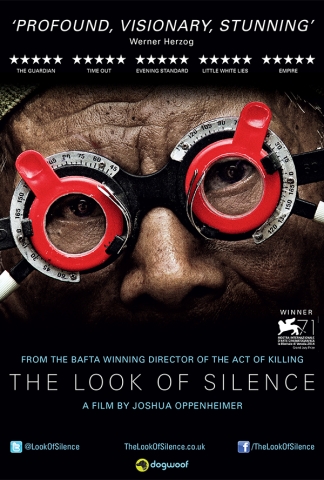
The Look of Silence (2014) – A Mortal Stillness

Back in 2013, the Danish-based filmmaker Joshua Oppenheimer stunned the world with The Act of Killing, a documentary about Indonesia’s blood-soaked past and how political institutions had conspired to turn murderous gangsters into national heroes.

Whereas most serious-minded documentarians approach difficult subject matter through the performance of journalistic objectivity, Oppenheimer’s film about mass-murder took its stylistic cues from the people who did the killings. Secure in the knowledge that they continued to enjoy the support and gratitude of Indonesian political elites, the killers chose to celebrate their past using a combination of surreal dream-sequences and colourful dance routines resulting in a documentary that looked and felt like a beautiful fever dream.

According to Oppenheimer, his intention was always to make two films about the anti-communist purges and how contemporary Indonesia manages to function with a million deaths on its collective conscience. The Act of Killing is a film about the transformation of gangsters into heroes, its brash visual style a reflection of its subjects’ surreal arrogance. The Look of Silence, on the other hand, is a devastatingly quiet film filled with awkward silences, which is precisely what you would expect from a film inspired by people who have spent decades trying to keep their feelings under control.


Continue reading →

The Decline of Western Civilization (1981-1998) – Ancestor Worship

I grew up within gobbing distance of the Kings Road and can still remember teenaged punks charging tourists for photos and shitting in doorways opposite what is now an enormous McDonalds. I remember when postcards of London still featured punks and I remember when rising property prices finally rid Chelsea of its art school pretensions and replaced them with the cosmopolitan brutality of a first class airport lounge. I remember the aftermath of the British punk scene but I was too young to appreciate it… all I have to go on is what history has taught me.

Anyone who grew up in Britain during the 1990s will be familiar with the broad narrative beats of British punk history as laid down by the Sex Pistol–Media–Industrial-Complex: From the poorly attended gig at the Manchester Lesser Free Trade Hall to their expletive-laden appearance on the Bill Grundy Show and on to mocking the Queen’s silver jubilee from the top of a chartered boat. We are familiar with these narratives because they are the origin stories of people who would later become very popular and very successful. The truth about the British punk scene might have endured the deliberate revisionism of Julien Temple’s The Great Rock n’ Roll Swindle but it was never going to survive Alan fucking Partridge:


Narratives are easy to steal, history is easy to re-write and the truth will always be closer to the unformed opinions of people who were there than the polished anecdotes of those exact same people twenty years down the line. The truth about British punk may lie buried in interviews and half-forgotten fanzines but part of the truth about one corner of the LA music scene recently returned to DVD in the form of a swanky box set.

Continue reading →