The Sight of the Hunted: German Expressionism and Night of the Hunter

night of the hunter poster

FilmJuice have published a lengthy piece written in celebration of the recent re-release of Charles Laughton’s legendary Night of the Hunter.

This piece was a real joy as it gave me an excuse to not only rewatch the film for the first time in a while, but also to do some research into Laughton’s life and refamiliarise myself with some of the better works of German Expressionist cinema. I wrote quite a lengthy piece about German Expressionism for Videovista a few years but my understanding of that particular cinematic milieu has solidified somewhat and hooked up with some much larger thoughts I’ve been having about the relationship between psychological realism and fantasy in the psychological thriller genre. In my original Videovista article, I spoke about Expressionism in terms of:

Expressionism emerged as a reaction to impressionism. Impressionism, as practised by the artists Claude Monet and Pierre-Auguste Renoir attempted to break down the boundaries between subject and background in order to produce paintings that were almost like snapshots: images that were exacting reflections of the world itself. Expressionism reacted against impressionism by rejecting the call to represent the world ‘as it is’. Instead, expressionists favoured representations of the world that ‘expressed’ the artists’ attitudes towards the subject matter. They did not reflect the world, they abstracted from it. A key work in the development of expressionism is Edvard Munch’s painting The Scream (1893), in which the insane flowing colours of the background, the pale featureless visage of the screamer and the dark figures in the background express not merely a person screaming but rather a state of inner turmoil, paranoia, alienation and insanity.

Now I say far more straightforwardly:

The most influential work of German Expressionist cinema is undoubtedly The Cabinet of Dr. Caligari. Told entirely in flashback by a man who turns out to be an inmate in an insane asylum, Robert Wiene’s film is a hypnotic mess of light, shadow and unsettling angles. Too fantastical to be real and yet too raw to be fictitious, Caligari’s story of love, murder and sinister sleepwalkers is best understood as an emotional landscape, a realistic portrayal of what the real world feels like to the person telling the story. The light and darkness of Caligari’s world are absolute because they are absolute in the mind of the madman just as they might be in the mind of a child. This is the exact same idea that lurks behind the myriad eccentricities of Laughton’s Night of the Hunter.

Rather than seeing the film through the gauze of southern gothic, I view it as a quite explicitly psychological piece: The fantastical nature of many sequences and effects are not reflections of a world that is in itself fantastical but rather a reflection of how that world feels to the children and how children (and everyone else for that matter) use the culture they have consumed in order to make sense of the world around them. It is only natural that the world should resemble a fairy tale when the only time you have heard of evil priests and murderous ogres is in the pages of just such a children’s story. Far from being limited to the children’s worldview, Night of the Hunter occasionally switches to other worldviews such as those of the mother, a friendly drunk and a horny teenaged girl. This is a film that not only reaches back to a cinematic vocabulary that was largely unknown to 1950s American audiences, it also takes those Expressionistic techniques and takes them to the next level. Night of the Hunter is a film that is literally decades ahead of its time.


Mother

REVIEW – Winter of Discontent (2012)

Winter of DiscontentFilmJuice have my review of Ibrahim El Batout’s film about the Egyptian revolution Winter of Discontent.

Made in the immediate aftermath of the 2011 overthrow of Mubarak regime, Winter of Discontent follows a group of Egyptians as revolution changes their relationship with their government. Thus, one of the strands follows a TV presenter on a government network who is effectively forced out of her job for daring to ask awkward questions of politicians. Initially, this makes her incredibly fearful for her life but as events in Tahrir square unfold, we see her becoming increasingly bold and defiant before eventually switching sides and using Youtube to denounce the corrupt government. This story is beautifully juxtaposed with that of a secret policeman who moves from a position of absolute certainty in which he feels free to threaten and torture respectable citizens to a position where he owes his family’s safety to the forgiving nature of brutes with sticks.

Let me be clear, despite its shortcomings, I very much enjoyed Winter of Discontent and part of what made the film enjoyable was the fact that it was an incredibly middle-class film made by middle-class Egyptians about their experience of political upheaval. According to the filmmakers, this was a decidedly quiet revolution and that is something of a cinematic rarity:

Sergei Eisenstein’s immortal Battleship Potemkin begins with sailors eating maggoty food and ends with many of those exact same sailors cheering the revolution as their fellows decide to join them in open revolt against the Tsarist regime. Ken Loach’s magnificent ode to the Spanish Civil War Land and Freedom contains oodles of dead fascists and Spanish peasants finally getting a say in how to work their own fields but it ends with the granddaughter of a dead veteran giving a sad but defiant raised fist salute. These cinematic accounts of real-world revolutions may be brilliant, maudlin, triumphalist and manipulative but one thing they are not is quiet. By this measure alone, Ibrahim El Batout’s Winter of Discontent is something entirely unique: a quiet film about revolution.

Watching this film made me reflect on Western attitudes to revolution as I feel most people’s aversion to the idea of overthrowing their government stems from the fact that they are afraid of what might happen to them. This fear is perfectly captured in Marjane Sattrapi and Vincent’s Paronnaud’s Persepolis where a liberal middle-class family wind up being judged and mistreated by uneducated working class people who have been placed in positions of authority by the new regime. One of the fascinating things about Winter of Discontent is that it is entirely free from this sort of class-bound paranoia… the characters sense that something is wrong and face down brutal oppression in order to speak out but while one of the characters is a bit mistrustful of his uneducated upstairs neighbours, his feelings of solidarity quickly overwhelm any misgivings he might have had about the great unwashed. A more romantic and — dare I say it? — politically engaged director might have made a good deal more of that moment of solidarity but El Batout handles it with a quiet restraint that is actually quite refreshing.

REVIEW – Upstream Color (2013)

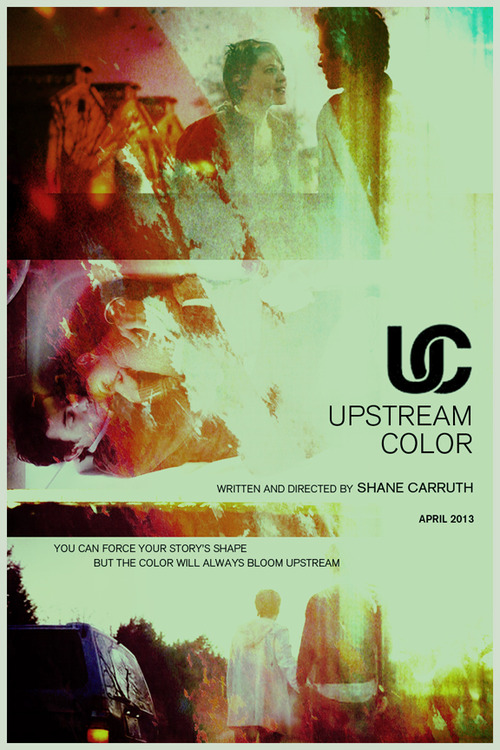
Upstream-Color-PosterFilmJuice have my review of Seth Carruth’s art house SF film Upstream Color, which came out this week on DVD and Blu-ray. I loved the film but it also made me intensely aware of the limitations of certain styles of cinematic storytelling.

At the heart of Upstream Color is a very conventional relationship movie: Two fragile people struggling to overcome life-threatening traumas meet on public transport and immediately recognise themselves in each other. Initially quite tentative, the two fragile people orbit around each other; feeling the attraction but afraid of getting too close lest they get sucked in. When the pair do eventually commit to each other they connect on such a profound level that the lines where one person stops and another person begins begin to blur. Whose memories are these? Whose emotions are these? Am I me? Are you me? Told in a way that emphasises visual storytelling over verbal exposition, Upstream Color looks and feels very much like the type of film that European art house cinema has been churning out for the last fifty years. World cinema is a very different cinematic tradition to that of Hollywood but the techniques and themes favoured by that tradition mean that Carruth can quite easily pick up their tools and tell yet another story about alienated people undergoing the ambivalent process of change associated with love and the construction of a couple’s subjectivity. This cinematic vocabulary is a mature system and Carruth is a talented-enough director to use those tools to tell a really effective if ultimately unchallenging relationship story. However, Upstream Color is a lot more besides…

Halfway through watching the film, I pointed out on Twitter that Upstream Color felt a lot like someone using an iPad to make scrambled eggs. What I meant by this was that while the core story was really quite mundane and unadventurous, Carruth tells his story using one of the richest and most complex metaphorical infrastructures in recent cinematic history. Yes, this film is all about empathy and Carruth uses an explicitly Science Fictional device to explore how empathy can open us up to good as well as bad experiences, Carruth’s device is actually a lot more complex than a traditional relationship drama would require. Indeed, while Buffy the Vampire Slayer trod similar ground by making Buffy temporarily telepathic, Carruth cracks the egg of human relationships with the genre equivalent of a sledgehammer. A worm that, when consumed, puts people in state of such psychological vulnerability that someone can effectively clean out their bank account, destroy their life and order them to forget the whole thing. Even more conceptually lavish, Carruth explores the life-cycle of these worms and how, once removed from a human host, they allow people who understand the technology to ‘check in’ and watch the people that were once infected. Frankly, there are enough ideas and story-hooks in these worms to support and entire film festival but Carruth only really begins to exploit the thematic potential of his device at the end of the film:

Aware that his genre tropes can probably handle a lot more than a simple relationship story, Carruth devotes the final act to pushing the limits of his metaphorical infrastructure and so we are treated to an absolutely beautiful sequence in which the life-cycle of the worms is revealed and a further sequence in which Jeff and Kris confront their shared trauma and tentatively begin edging towards a less isolated way of living. Carruth handles both of these expansions quite well but the combination of oblique storytelling techniques and limited space means that much of their thematic and dramatic potential must remain untapped. Indeed, Terrence Malick’s The Tree of Life spends over two hours wrestling with ideas far less substantial than the ones that Carruth rushes through in less than ten minutes!

In an age when both art house and mainstream directors are making films based on tired and insubstantial ideas, it is both refreshing and slightly overwhelming to encounter a film that could easily have been a trilogy or a series. Upstream Color is not just an incredibly beautiful and well-told story, it is a film so full of ideas and thematic resonances that it is almost too frustrating to watch. Sitting through Upstream Color I was struck by the extent to which art house cinematic techniques struggle to convey new types of information. Watch enough art house films about alienated people trying to get their lives back on track and those techniques are incredibly effective at conveying mood and theme but ask those techniques to explore the psychic fallout of discovering that you are only one of hundreds of people who have been secretly observed by shadowy figures and those techniques begin to struggle. Upstream Color could have been about the NSA and Google dismantling privacy, it could have been about post-traumatic stress or it could have been about the psychic fallout from being involved in a mass event like a terrorist atrocity or a religious cult. It could have been about any of these things and yet the film ended too soon.

REVIEW – Blancanieves (2012)

BlancanievesVideoVista has my review of Pablo Berger’s Blancanieves, a silent black and white re-invention of Snow White.

Set in 1920s Spain, the film opens on a young couple who are about to have their first child. He is a successful bullfighter, She is a famed flamenco dancer. Unfortunately, tragedy strikes when He is injured in the ring and She goes into premature labour and dies in the process of giving birth to her daughter. For reasons that are not even remotely addressed, the bullfighter’s daughter grows up in the care of her grandmother and is never allowed to meet her father who immediately marries his demonic and controlling nurse. When the young girl’s grandmother dies, for reasons that are not even remotely addressed, the bullfighter agrees to assume his responsibilities as a father but he refuses to meet with his daughter and so the young girl is forced to work as a scullery maid. Eventually the father and daughter meet and so the evil step-mother throws the young woman out onto the street forcing her to befriend a band of dwarven bullfighters who help her achieve fame as a successful bullfighter in her own right.

The fascinating thing about this film is that while Berger sets out to make a proper silent film, it is clear that Berger struggles to tell a story using only images and musical cues. Thus, rather than images that tell a story and musical cues that provide an emotional context for these images, Berger presents us with a series of incredibly well-composed but dramatically empty images backed up with an entirely inappropriate musical score. Indeed, Blancanieves is less a work of cinematic art than it is a fashion shoot inspired by a combination of 1920s Spain and film noir. As I say in the review:

Having failed to marshal both his visual and his musical resources in an effective manner, Berger is forced onto the decidedly contemporary footing of relying upon scripting and actors to tell the story, and this is where silent film’s lack of bandwidth really bites as the actors seem to take their cues from the inter-titles and the inter-titles are all featureless snippets of dialogue meaning that none of the actors ever transcends the childish and stereotypical origins of their characters: evil stepmother is evil, warm-hearted child is warm-hearted, broken patriarch is broken, and dwarves provide a deeply questionable combination of comedy and pathos.

Ideally, the history of film should tell a story of growing complexity and accomplishment; Each new technical innovation unlocking entire arenas of artistic potential that is broken, harnessed and added to the ever-growing toolbox of a mature art form. However, as Berger’s failure to tell a convincing story suggests, many of the techniques pioneered by silent filmmakers have dropped out of mainstream use meaning that many contemporary directors trained to make ‘talkies’ are effectively incapable of making a silent film as they lack the technical skills required to convey narrative without the use of expositionary dialogue. However, as I explain in my review, many of the skills pioneered by silent filmmakers live on in the work of art house directors:

In 1963, the Swedish filmmaker Ingmar Bergman produced a film with no dialogue at all. The Silence is a genuinely extraordinary exercise in technical self-control as while Bergman does make use of sound effects and incomprehensible mumbling, he effectively manages to tell a complex psychological story without a single line of dialogue or even an inter-title. This desire to demand more from your audience and keep them making imaginative leaps is now firmly embedded in the DNA of the art house tradition but it is particularly noticeable in such recent dialogue-free triumphs as Jose Luis Guerin’s In The City Of Sylvia, Mao Mao’s Here, Then, and Amer by Helene Cattet and Bruno Forzani. Watching these films reminds us of how crude, lazy and wasteful Hollywood filmmaking has become. It also shows us quite how much the likes of Pablo Berger need to learn before they can tell a compelling story without the use of dialogue.

For those interested, I include links to reviews of the films I mention:

Re-reading my review of Bergman’s The Silence, I am struck by how little I actually engaged with the film as a piece of silent cinema: I talk about character, I talk about mythology and I talk about the purpose of criticism precisely because at the time of writing that review (2008) I lacked the critical tools required to make sense of what it was that I was seeing on screen. In order for audiences to be able to make sense of a work of art, they must first possess the tools that will allow them to decode them. Much of what we mean when we talk about ‘education’, ‘learning’ and ‘being cultured’ is acquiring skills that allow us to make sense of particular works of art and it is in this process of acquisition that we see the true biases of our own society: Because I grew up in an era when films had dialogue, I never needed to acquire the skills required to make sense of a dialogue-free film. Because I am a straight, white man and I grew up in a culture that uses that perspective as a universal cultural default, I find films that embody different perspectives to be both a challenge and a release but I think many people view films made from non-white, non-straight and non-male perspectives in a manner comparable to the way I used to see silent film: Sure… a lot of effort went into this, but I can’t make any fucking sense of it!

REVIEW – Alan Partridge: Alpha Papa (2013)

Alan Partridge Alpha Papa posterFilmJuice have my review of Declan Lowney’s Alan Partridge: Alpha Papa, easily one of the most disappointing films I have seen this year.

Despite his familiarity to and broad popularity with British audiences, the character of Alan Partridge is something of a cult figure; A comedy grotesque born not only from the self-conscious egotism of Steve Coogan but also the subtle brilliance of Armando Ianucci and Chris Morris, two of the most respected and influential writers in contemporary British comedy. Over the years, Partridge has undergone a slow process of evolution from little more than a means of mocking sports journalism to a a more rounded critique of low-end British celebrity and eventually middle-aged masculinity in general. That which began as Motson continued as Wogan and Titchmarsh before concluding as your dad. Given that each turn of the creative handle has injected more history and depth into the character, it is strange to find the beautifully nuanced Partridge of Welcome to the Places of My Life turn up in a knockabout cinematic comedy. Indeed, many of the problems with Alan Partridge: Alpha Papa stem from the fact that the film’s writers keep wanting to produce character comedy in a film set up to deliver broad and accessible jokes. Little surprise that this film seems to have encountered significant problems during the production process:

Most DVD releases contain making-of documentaries that are really little more than advertising designed to convince everyone that actors and crew all had an amazing time making the film. Alan Partridge: Alpha Papa breaks violently with that tradition by inadvertently laying bare the film’s tortured production history. The first warning sign appears when Steve Coogan apologises to his fellow actors for the lack of a finished script. From there we move on to talk about on-camera improvisation and some absolutely extraordinary footage in which Colm Meaney appears to be working out his character’s motivations on set while other actors mention the fact that they were frequently given their lines on the morning on which they were due to film the scene. This lack of a clear vision going into the project is evident not only in the sloppy narrative but also the comparative weakness of many of the jokes. Compared to your average cinematic comedy or TV sitcom, this film’s gag-rate is surprisingly low and when the jokes do come they invariably feel as though they could have been improved by a couple of re-writes. In fact, aside from a few good lines and a genuinely funny dream sequence, Alan Partridge: Alpha Papa is not a particularly funny film. It is not only less funny and less well made than such recent comedies as Bridesmaids, it is significantly less funny than Michael Lehmann’s 1994 comedy Airheads, whose plot is almost identical to that of Alpha Papa.

This is one of those films where you wish you could be a fly on the wall during production meetings as almost every aspect of the film seems to have gone wrong from the choice of locations to the choice of plot right through to the way in which the actors worked on set.

How actors work on set is actually a fascinating question as the rise of Judd Apatow seems to have ushered in an entirely new approach to the production of cinematic comedy. The reason why the trailers for films like Bridesmaids and Get Him to The Greek (both produced by Apatow) feature different iterations of the jokes that appear in the final films is that many contemporary comedies work by shooting numerous variations on the same basic gags. Sometimes these differences will be comedic in nature (different pace, different props, different lines), sometimes they will be technical (different angles, different lightings) and sometimes they will bring out different aspects of the plot or characters, but what all of these differences do is shift the act of creating the film from something that happens in the writers’ heads before production starts to something that happens in the heads of the editors and directors after production has completed.

Given the information contained in the astonishingly candid making-of featurette included on the DVD, it is tempting to conclude that Alan Partridge: Alpha Papa tried to use both approaches at the same time and wound up locating the creative act in the minds of writers and actors as they were sitting on set. Indeed, we see that Coogan and Meaney had a good deal of freedom in creating their parts on set and yet supporting actors were given their parts on the morning in which they were expected to shoot. This suggests that the film went through a continuous process of re-writing in which spontaneous acts of creativity would shape and reshape the characters who were supposed to serve as basis for much of the comedy. This also explains why so many of the gags felt under-written: The writers simply did not have time to finesse them. An experienced director could have imposed order on this process but the producers of Alan Partridge: Alpha Papa went with Declan Lowney, whose directorial experience lies mostly in TV comedies like Father Ted. Again, the making-of featurette reveals quite a lot about Lowney’s role as it is full of images of Coogan either directly undermining Lowney or assuming the type of leadership position that you would normally associate with a director.


REVIEW – Silence (2012)

SilenceFilmJuice have my review of Pat Collins’ art house travelogue Silence. The plot (such as it is) revolves around a sound-recordist who is dumped by his German partner. Depressed and more than a little lost, the sound-recordist reacts to his personal tragedy by returning to the Donegal coast in Ireland in order to make recordings of places completely devoid of human presence. However, whilst engaging in this anti-social dalliance, the sound-recordist realises that the sound of silence might yield something more than an absence of arsehole humans… something deeper and more spiritual. As I explain in my review, Silence is essentially a cinematic reconstruction of the experience of watching an art house film. In an art house film, the director presents you with a collection of beautiful images and invites you to reflect upon the thoughts, feelings and memories these images bring forth. In the case of the sound-recordist, the sound of silence summons memories of a childhood spent in an isolated fishing village on a tiny island off the Irish coast. A little while ago, I wrote something about Andrei Tarkovsky’s Stalker (apologies for the fucked-up formatting) in which I argued that the film was an attempt to use cinematic techniques to induce a sort of spiritual experience in the audience:

While there are many films that use evocative imagery to explore the belief that there is something out there that is bigger than ourselves, Stalker moves beyond the purely representative in order to fundamentally alter the relationship between film and audience. Yes… the hidden systems of the Zone neatly mirror the type of magical thinking that underpins most religions, and yes… the perversely benign Room serves as an elegant symbol for any spiritual end-point you care to name, but the film does not simply represent a spiritual experience, it actually compels the audience to have one by encouraging them to seek meaning in the film in much the same way as the Stalker seeks meaning in the Zone and the spiritual seek meaning in the world. This state of forced sympathy with a man who is either deeply disturbed or deeply religious pays off in an absolutely mesmerising final scene in which the Stalker’s daughter appears to move a glass with her mind as a train roars past in the background: Did the Zone actually exist or was it all a fantasy? Did the daughter move the glass or was it the train? Was the daughter gaining magical powers the Stalker’s reward for reaching the Room in the correct state of mind? Did the Stalker’s visits to the Zone alter the DNA he passed on to his daughter? Tarkovsky’s film is so rich and complex that these questions can be answered in any number of ways but which interpretation you happen to choose invariably comes down to a leap of faith no different to that of the Stalker or that of the spiritually minded.

Silence is clearly an attempt to reproduce this same trick by inviting the audience to identify with the sound-recordist and open themselves up to the possibility of a deeper silence. Unfortunately, Silence is let down by Collins’ failure to follow through and show us what this process of reflection and silent-listening might produce. In Stalker, we have the appearance of a dog and the possibility of the stalker’s daughter Monkey acquiring supernatural powers. In Silence we simply have the possibility that the entire thing might well have been a waste of time:

While Tarkovsky perfectly captures the combination of profound understanding and acute alienation that accompanies life-changing experiences, Collins is rather unclear on what it is that his protagonist actually finds at the end of his journey: Is it a sense of community? Is it the understanding that he should never have left his home? All we see is a wind-swept derelict.

It may seem a little unfair to unfavorably compare Silence to one of the greatest films of all time but I see the comparison as a compliment. Many directors reach for the art house tool kit and produce nothing more than a series of pretty images that signify nothing more than the compositional skill of the cinematographer. Silence is not an entirely successful film but it is an attempt to reconnect with an approach to filmmaking that has lain dormant for far too long. Great cinema should not merely entertain or move, it should transform and films like Stalker and Silence should be celebrated for pursuing that transformative potential, even if it is ultimately unsuccessful.

TranSylvania (2006) – Post-Sedentary

Identity is an ambiguous thing: Some are born without an obvious place in the world and so wander the Earth in search of an identity they might call their own. Others are born with a very clear identity that is imposed upon them at birth and while these people may know precisely where they are, their location frequently turns out to be under someone else’s boot. The dull ache of ambiguity throbs not only in the identities we receive from society at large, but also from the identities we choose to impose upon ourselves. This is a film about identity and how assuming an identity may very well wind up harming those who have that identity forced upon them.

Continue reading →

REVIEW – Creepshow (1982)

creepshowFilmJuice have my review of George A. Romero’s infamous horror/comedy Creepshow. Infamous… not because it’s particularly funny or scary, but rather because it features the film’s writer Stephen King playing a dungaree-clad redneck simpleton who slowly turns into a hedge. Creepshow is something of an odd cultural artifact as, despite having an incredibly famous writer and an incredibly famous director, the film is actually quite shit. Indeed, re-watching the film and scowling my way through its terrible gags and ineffectual scares, I was struck by the fact that this film’s fame owes less to the film itself than it does to its impeccable geek heritage. As I put it in my review:

Nostalgia only ever functions within the confines of a single generation and expecting contemporary audiences to feel nostalgic for comics produced in the 1950s is a fool’s errand.  Creepshow may well have struck a nerve with audiences when it first appeared but uneven writing and questionable direction mean that this film is now of little more than historical interest.

The nostalgia I speak of is nostalgia for a range of oddball horror comics published in the 1950s by a company called EC. As I explain in my review, before being wound down into a rump publishing little more than Mad Magazine, EC acquired a huge following by pioneering the combination of comedy and horror at a time when comics were being broken on the rack of public opinion for their supposed role in creating juvenile delinquents. Despite being something of a flash in the pan, the sensibility pioneered by EC was immensely influential on American babyboomers and traces of EC heritage can be found not only in the work of George A. Romero and Stephen King but also people like Stephen Spielberg, Sam Raimi and anyone from that generation who took it upon themselves to direct a horror/comedy. The problem is that, while the ‘boomers clearly loved their EC comics, they drank so deeply from the wellspring and returned to it so often that the idea explored by the EC comics themselves now seem incredibly dated and dull. We’ve seen it before and we’ve seen it better because everyone who ever read an EC comic decided to borrow the idea and make a film about it.

At the time, Creepshow must have seemed like a great idea and given how many 1980s film critics must have read EC comics as children, I’m sure the sense of shared love and nostalgia was universal. However, while nostalgia is an incredibly potent force that excuses many great cultural ills, it doesn’t transfer between generations meaning that while EC comics might have meant a lot to ‘boomers, they don’t mean anything to people like me. In fact, I’m more like to be nostalgic for the work of Romero and King than I am for the work that inspired them. Stripped of its shield of nostalgic good will, Creepshow reveals itself as poorly conceived, poorly written and poorly made.

I got into this question when I reviewed Sam Raimi’s Drag Me To Hell back in 2009:

What most struck me as I sat watching Drag Me To Hell is its quite overt racism.  The film’s depiction of the Roma people is straight out of the darkest dreams of the Daily Mail and a tradition of racial prejudice, fear and scape-goating that stretches back at least as far as the Dark Ages.  Mrs. Ganush is physically disgusting, replete with disease and foul habits.  A vindictive and dishonest creature who needs little provocation before lashing out at honest white middle class people using her sinister gypsy powers.  Her family are presented in a similar tone as a pack of ugly, sinister and unsympathetic people playing weird violin music in the basement of a tumbledown old house.  I would have some sympathy for the idea that the Raimi brothers – as Americans – have little awareness of the spectre of genocide that still hangs over the European treatment and depiction of gypsies except that, even accepting that this kind of gross ignorance is acceptable, it does not explain why the same kind of racially-inspired, type-based characterisation also applies to other non-White characters.

At which point, Patrick Hudson appeared in the comments and mentioned not only Creepshow, but also nostalgia for EC comics. At the time, I was unimpressed by the suggestion that nostalgia somehow made Sam Raimi’s antitziganism acceptable but since then, my position has hardened even further: Nostalgia does not travel between generations and any attempt to force the issue (as in the case of Olivier Assayas’ recent love letter to the 1960s) is likely to result in a film that makes its creator look either sentimental, simple-minded or politically reactionary.

Keeper of the Clockwork Heart: The Late Films of Kenji Mizoguchi

Late-MizoguchiIn a career spanning thirty three years, the Japanese film director Kenji Mizoguchi produced a total of eighty three feature films. While many of those films have now been lost and only a few have ever been made available to Western audiences, recent years have seen an attempt to reclaim the legacy of Mizoguchi and introduce his work to a new generation of film-lovers. So far, the most visible element of this campaign has been the very visible release of Mizoguchi’s later films by Criterion in America and Masters of Cinema in the UK. Next week, Masters of Cinema are releasing a blu-ray box set entitled Late Mizoguchi: Eight Films 1951-1956. The set includes:

  • Ugetsu Monogatari (1951)
  • Oyu Sama (1951)
  • Gion Bayashi (1953)
  • Sansho Dayu (1954)
  • Chikamatsu Monogatari (1954)
  • Uwasa No Onna (1954)
  • Yokihi (1955)
  • Akasen Chitai (1956)

My review of the complete box set is now available on FilmJuice. As you might expect for a review of an eight-film box set, the review is kind of long but I think the length was necessary in order to explore not only Mizoguchi’s approach to narrative but also his attitudes to women and how these attitudes to women transitioned over time from bewailing their fate to celebrating their courage and finally to railing at the capitalist system that dehumanises and immiserates them. I personally consider Akasen Chitai to be one of the greatest films of all time as no other film so perfectly captures the ways in which the system bullies and coerces us into betraying each other for personal advancement.

I was actually lucky enough to review some of these films when they were first released on DVD back in 2007:

Re-reading these reviews just now, it’s interesting to see that while my dim opinions of Yokihi and Chikamatsu Monogatari have not massively changed, my feelings on both Uwasa No Onna and Akasen Chitai have improved immeasurably with time. Akasen Chitai may have impressed me at the time but it also stayed with me and had a real impact on how I thought about both the world and film. Since then, I’ve seen quite a few works that have been celebrated for their politics and their devotion to social realism but nothing in either British or Italian Social Realism come even close to the focus and power of Akasen Chitai.

Here, Then (2012) – So Much Less To Me Than Meets the Eye

here_thenIt is impossible to overstate the enduring influence of existentialism on art house film. Since disentangling themselves from the mainstream of popular cinema back in the 1960s, art house filmmakers have worked hard to create a set of narrative techniques that perfectly capture what it’s like to feel lost and a little bit sad in a world rippling with beauty and potential. This tension between the world’s extraordinary potential and our own failure to make the most of it is what lies at the heart of all existential thought and most art house film. Indeed, these techniques and the moods associated with them are now so common in European and World cinema that their deployment has started to feel more like a professional rite-of-passage than an expression of manifest truth.

Winner of the Best International Film award at the 2012 Edinburgh International Film Festival, Chinese director Mao Mao’s first film Here, Then (Ci Chu Yu Bi Chu) is an excellent example of how to launch a directorial career: As technically brilliant and thematically rich as any conventional art house film produced in the last five years, Mao Mao’s debut proves that he can use conventional art house techniques to tell a conventional art house story about alienation, isolation and the yawning chasm at the heart of middle-class life.

Continue reading →