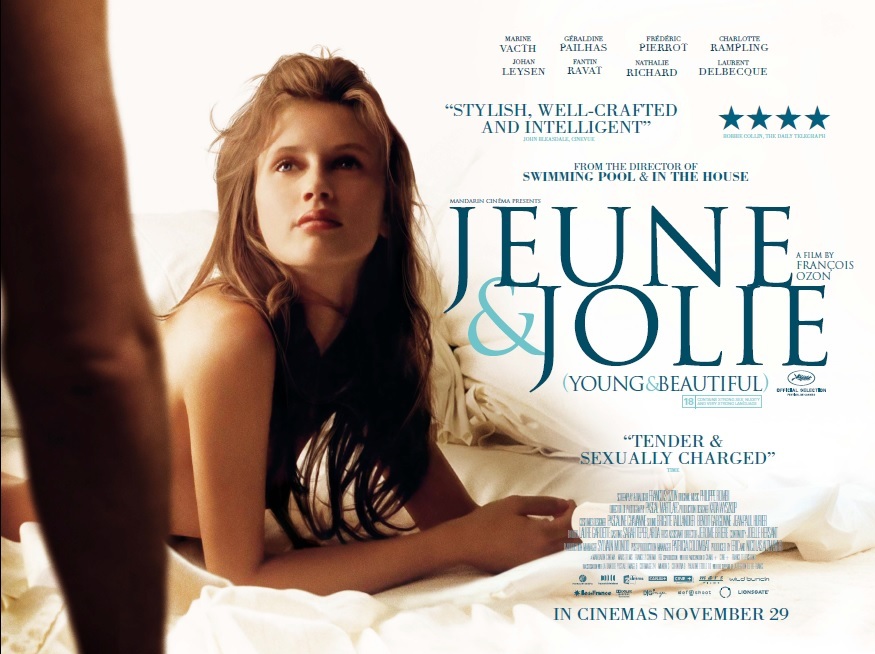
Jeune et Jolie (2013) – Taking Your Sexuality Off-Grid

JJ1Art house film has always had a problematic relationship with female sexuality. Though art house directors are far more likely to construct their films around strong female characters than their Hollywood counterparts, their engagement with these characters’ sexualities is often limited to stripping an actress naked and posing her in a series of titillating tableaux such as those found in Abdellatif Kechiche’s Palme D’Or winning film Blue is the Warmest Colour. The further a female character ventures from the realms of male fantasy, the more likely it is that her sexuality will be turned against her and used as a sign of encroaching madness, alienation or spiritual collapse. In art house film, sad men may become murderers but sad women will always become prostitutes.

The tragedy of problematic narratives is that they frequently outlive the social attitudes that first informed them. For example, while the films of Luis Bunuel may have been informed by the remnants of his Jesuitical education, the phrases and characters he helped to develop in films like Belle de Jour passed into common usage and came to form part of the basic vocabulary of art house film. Used and revisited for decade after decade, the character of the fallen woman is now so familiar to art house audiences that directors no longer feel the need to spell out why promiscuous women are sad women… they just show us a female character having loads of sex and allow us to fill in the blanks. We have been trained through repetition and this training followed us out of the cinema and into our daily lives meaning that, without ever having been subjected to an argument about the evils of promiscuity, our first reaction to promiscuous women is to assume that there is something terribly wrong with them.

The alternative to allowing our culture to train us is to question the values embedded in stock cinematic phrases and champion works that set out to subvert stock phrases and use them to draw our attention to the sexism and racism that is perpetuated by our own intellectual laziness. Thankfully, while the 2013 Cannes jury was content to give the biggest prize in art house film to a work that presented sexually empowered women as hollow vessels and childlike victims, another director in competition set out to pick a fight with the myth of the fallen woman. The director in question is Francois Ozon and his film is Jeune et Jolie.


Continue reading →

REVIEW – Wish You Were Here (2012)

wishyouwerehereFilmJuice has my review of Kieran Darcy-Smith’s Wish You Were Here, an Australian mystery/drama that is not to be confused with David Leland’s oddball British tragedy of the same name.

Set between Australia and Cambodia, Wish You Were Here is a great-looking film that is hamstrung by its director’s self-indulgence and borderline racism. The plot revolves around a pair of Australian couples who visit Cambodia and have a great old time until one of the group disappears. Understandably distraught, the remaining holiday makers limp back home and begin worrying about the disappearance of their friend and the fact that reporting his disappearance to the authorities might shine a light not only on their illegal activities but also their dysfunctional relationships. I say that the film is borderline racist as it falls into the familiar trap of using a non-white culture as backdrop for the breakdown of white middle-class lives. Colourful marketplaces, yay! Maimed beggars and brown dudes with machine guns, boo!

However, more interesting than Darcy-Smith’s use of lazy racist stereotypes is his failure to fuse the mystery and kitchen sink drama genres:

Darcy-Smith’s mistake lies in a fundamental misunderstanding of the differences between mysteries and dramas: The focus of a mystery is on leading the audience through a particular narrative while the focus of a drama is on unravelling the complexities of character. While psychological mysteries can sustain a hybridisation of the two genres, Wish You Were Here is ultimately a story about a missing tourist and not an exploration of why the characters are the way that they are. As you would expect from a plot structured around a missing person narrative, the characters only have as much depth as that central mystery requires meaning that while Darcy-Smith gives his actors vast amounts of time in which to explore their characters, the characters they are exploring are neither particularly deep nor particularly interesting. If Darcy-Smith wanted to direct a character-based drama then he should have written a script about character and not about an extraneous mystery. In a way, it’s a bit like turning up at the cinema to watch Avengers 2 only to discover that the director has decided to focus on the inner life of the bloke who drives the aircraft carrier. There’s nothing wrong with making a film about the bloke who drives the aircraft carrier but if you do then at least go to the trouble of working from a script that explores the character’s background and how they got recruited into SHIELD. Don’t just turn on the camera, leave them emote and expect the audience to be as fascinated by the results as the people doing the acting! That would make for a dull Avengers 2 and it certainly makes for a dull Wish You Were Here.

It is interesting that positive reviews of this film tend to point to the central performances of Joel Edgerton and Felicity Price as while both do well and are accorded a good deal of time and space, neither character is particularly complex or engaging. They’re just vaguely unhappy middle-class people who can’t talk about their problems. In truth, I’m not convinced that either performance was really all that worthy of commentary, though I do think that Darcy-Smith made their performances the focus of the film.

Blue is the Warmest Colour (2013) – Orgasms and Spaghetti Bolognese

BWC1The world of art house film has become a tediously reverential place. Raised on auteur theory and acutely aware that it lacks both the cash and cachet of commercial cinema, the people who write about art film are prone to treating its institutions as temples and its practitioners as living saints. Once filled with experimentation, transgression, provocation and very human failures, the cultural spaces of art house film are now given over to callow hagiography and propping up the careers of once great talents. As one might expect of a milieu that looks upon dissent as an act of economic sabotage, there is a tendency to treat the recipients of major festival awards as worthy regardless of whether their films are any good. Thus, to say that Abdellatif Kechiche’s Blue is the Warmest Colour is the most controversial winner of the Palme D’Or in decades is actually a good thing… turns out that there might be some life in the old dog yet.

While the controversy has many heads, the one with the longest teeth erupted prior to the announcement of the Palme D’Or when the New York Times’ senior film critic Manohla Dargis wrote about the film in what she would later describe as “399 words dissenting words”:

It’s disappointing that Mr. Kechiche, whose movies include “The Secret of the Grain” and “Black Venus” (another voyeuristic exercise), seems so unaware or maybe just uninterested in the tough questions about the representation of the female body that feminists have engaged for decades. However sympathetic are the characters and Ms. Exarchopoulos, who produces prodigious amounts of tears and phlegm along with some poignant moments, Mr. Kechiche registers as oblivious to real women. He’s as bad as the male character who prattles on about “mystical” female orgasms and art without evident awareness of the barriers female artists faced or why those barriers might help explain the kind of art, including centuries of writhing female nudes, that was produced.

“Men look at women,” the art critic John Berger observed in 1972. “Women watch themselves being looked at.” Plus ça change….

When people voiced their disagreement, Dargis took the bait and expanded her ideas in an essay that draws on a blog post made by the creator of the graphic novel that inspired the film. Writing in French but translated for Anglophonic consumption, Julie Marot praised the style and vision of the film whilst not only distancing it from her book but also from the real-life experiences of actual LGBT women:

I don’t know the sources of information for the director and the actresses (who are all straight, unless proven otherwise) and I was never consulted upstream. Maybe there was someone there to awkwardly imitate the possible positions with their hands, and/or to show them some porn of so-called “lesbians” (unfortunately it’s hardly ever actually for a lesbian audience). Because — except for a few passages — this is all that it brings to my mind: a brutal and surgical display, exuberant and cold, of so-called lesbian sex, which turned into porn, and me feel very ill at ease. Especially when, in the middle of a movie theater, everyone was giggling. The heteronormative laughed because they don’t understand it and find the scene ridiculous. The gay and queer people laughed because it’s not convincing, and found it ridiculous. And among the only people we didn’t hear giggling were the potential guys too busy feasting their eyes on an incarnation of their fantasies on screen.

In other words, the 2013 Cannes Film Festival jury gave the most prestigious award in world cinema to a piece of grotesque cultural appropriation; a film that took an original graphic novel by a gay woman and filtered it through the beliefs and proclivities of a straight man resulting in a series of needlessly explicit and exploitative sex scenes that owe a good deal more to the tropes and techniques of pornography than to the emotional contours of LGBT life.

Though in and of itself disappointing, the jury’s decision is made infinitely worse by the fact that Cannes Film Festival has an absolutely terrible track record when it comes to the representation of women in general and LGBT women in particular: Since the Palme D’Or assumed its current form in 1975, the award has had only one female winner (Jane Campion). In the year that Blue is the Warmest Colour won the Palme D’Or, there was only one female director in competition and the previous year saw none at all. While the slightly more edgy Un Certain Regard prize has a much better track record of allowing women to compete, men still dominate the list of winners. The problem is not just that the Cannes jury gave its most prestigious award to a straight man’s vision of a lesbian relationship, it’s that it chose to give that film an award despite having completely ignored all the films made by actual LGBT women including Chantal Akerman, Andrea Weiss, Ulrike Ottinger, Barbara Hammer, Lana Wachowski, Monika Treut and Lisa Cholodenko. It is almost as though the Cannes Film Festival only discovered the concept of a non-straight woman when a straight man decided to film a couple of straight women pretending to go down on each other. Given that art house film likes to present itself as being interested in different ways of seeing the world, this addiction to the straight male gaze is complacent, corrosive, wasteful and so completely unacceptable that every passing year brings nothing but shame to an institution already in urgent need of reform.

Continue reading →
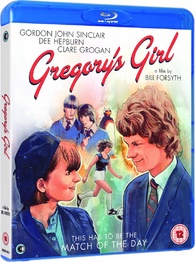
REVIEW – Gregory’s Girl (1981)

GGFilmJuice have my review of Bill Forsyth’s unimpeachably wonderful Romantic Comedy Gregory’s Girl.

I have seen Gregory’s Girl a number of times and each time I return to it, I am struck by another wonderful little moment. Set in urban Scotland in the early 1980s, the film takes place in a surprisingly well-mannered state school peopled with a variety of wonderful and colourful characters including the passionate chef, the diminutive football coach, the furtively light hearted head master and, of course, the charmingly naive Gregory. Tall and somewhat gangly, Gregory loses his place on the football team to a particularly athletic young woman:

One of the most striking things about Gregory’s Girl is the thoroughly progressive manner in which Forsyth handles Gregory’s growing obsession with Dorothy. These days, even relatively benign high school movies such as Easy A and Mean Girls go out of their way to sexualise their young female characters in a way that not only turns the audience into voyeurs but also speaks to Hollywood’s lack of confidence in an audience’s ability to empathise with female characters. A remade Gregory’s Girl would linger on Dorothy’s shorts and marvel at her thighs but Forsyth uses Dorothy’s athletic prowess as little more than the distinguishing characteristic that brings her to Gregory’s attention. Before Dorothy, Gregory viewed women as fantasy objects but losing his place on the football team to a girl means that he is suddenly able to relate to that girl as a real person and so falls hopelessly in love with her.

The reason I stress the important of the supporting characters is that Forsyth makes wonderful use of them as a means of providing a sense of emotional scale to what Gregory is undergoing. For example, the film opens with Gregory and his mates peeping at a nurse getting undressed but while Gregory’s realisation that girls can play football allows him to realise that women are people rather than sex objects, two of Gregory’s friends remain stuck in a state of adolescent sexuality and so spend the entire film talking about Caracas where the women reportedly outnumber the men. Also wonderful is the way that the film’s female characters usher Gregory into adulthood by urging him first to look after himself and then to realise that there are plenty of women in the world who are people despite the fact that they do not play football. Without the people around him, Gregory would not be anywhere near as memorable a character. Without the people around him, Gregory would have struggled to grow up.

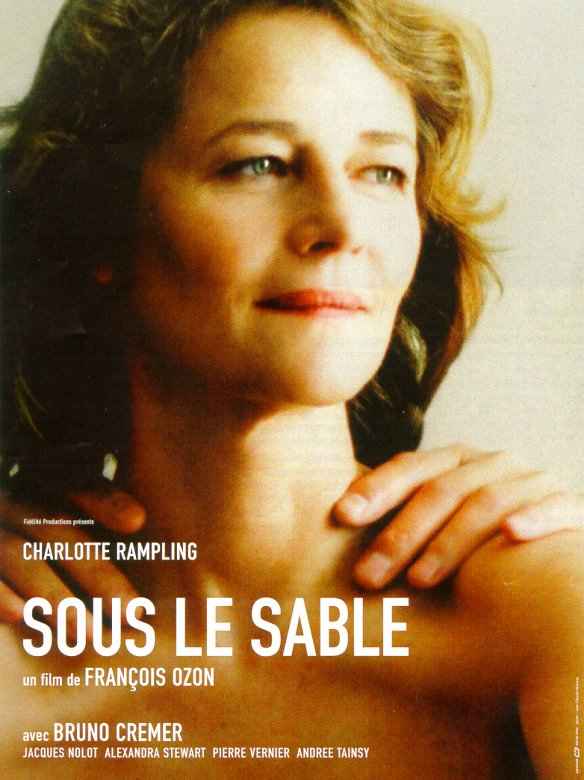
Sous Le Sable (2000) – Everyone Needs a Little Cup of Stars

SLS1There are few situations to which the opening lines of Shirley Jackson’s The Haunting of Hill House are not pressingly germane:

No live organism can continue for long to exist sanely under conditions of absolute reality.

Often spoken of as a ghost story, The Haunting of Hill House is more rewardingly read as a portrait of a fragile mind under intense pressure. Scarred by decades of servitude to a sick and deranged mother, Eleanor Vance is a woman who carries her reality with her like a snail carries its shell. While the novel’s melody is dominated by Hugh Crain’s house and the miseries that befell his family, the harmony is all about the way that Eleanor picks things up and uses them to fashion a world more comforting and endurable than absolute reality. Everyone needs a little cup of stars.

One of the great joys of Jackson’s novel is the way that she manages to blur the boundaries of the real, the supernatural and the outright hallucinatory without ever bothering to draw attention to the lack of subjective difference between these different categories. For Jackson, this uncertainty is so universal that it simply does not merit commentary… it’s all one big sordid mess. Many films and books have been drawn to this ambiguity but while great works such Henry James’ The Turn of the Screw or Caitlin R. Kiernan’s The Red Tree and The Drowning Girl add their own ingredients to the ambiguous brew, most works that use these tropes yearn for clear dividing lines between the metaphorical and the concrete, the material and the fantastical, the sane and the insane, the true and the false. This is why you are more likely to encounter the carefully nested realities of films like Inception and Jacob’s Ladder than you are the happy ambiguities of a film like Total Recall or The Descent. Though definitely a film with a clear dividing line between reality and fantasy, Francois Ozon’s Sous le Sableis a film that is intensely relaxed about the ambiguities of madness.

Continue reading →

The Yellow Sea (2010) – A Rising Tide of Gonzo

TYSWhile people are prone to getting sentimental about the power of story, the truth is that narrative is nothing more than a means of providing structure to a series of disconnected things. Thus, rather than delivering their ideas in the form of bullet points, artists use stories as a means of linking different ideas and providing an emotional context that will shape how a particular work makes you feel about those ideas. On the crudest possible level, having all the bad guys smoke while all the good guys drink Pepsi is a pretty good way of encouraging your audience to gain a good impression of Pepsi and a bad impression of smokers. However, while narrative is one of humanity’s most enduring and effective methods of structuring information, it is far from the only means at our disposal.

Literary culture has long resented the cultural primacy of narrative and so many literary types are prone to treating the ability to read for style and subtext rather than plot as a sign of intellectual sophistication. One way of approaching the history of art house film is to date its creation to the point in the 1960s when European directors stopped trying to tell mere stories and began making art. In fact, one could push this analysis even further and suggest that European art house film was born amidst the boos that echoed round the cinema during the first screening of Michelangelo Antonioni’s L’Avventura, a film that begins as a missing person story only to rapidly lose interest and set about trying to recreate the emotional texture of feckless upper-class Italian lives.

Just as literature has experimented with alternate means of ordering information, film has developed techniques that allow directors to structure their ideas around such abstract principles as character, theme or mood. An excellent example of this type of filmmaking is Terrence Malick’s The Tree of Life where a series of incredibly disparate vistas including family drama and warring dinosaurs are held together by the concept of ‘grace’ or (as I argued in my review) the pointlessness of seeking to impose narrative order on disparate lives. For those people not used to using principles other than narrative to make sense of a film, Tree of Life was a mess of incoherent and portentous ideas. For those people well versed in the techniques that Malick chose to deploy, Tree of Life was as beautiful as it was transparent. There is nothing inherently better about building a work around a theme rather than a story but our culture does a pretty good job of teaching us how to make sense of stories and so works built around moods and themes have acquired a touch of exclusivity. If you can make sense of The Tree of Life then it’s a sign that you’ve put in the effort of watching difficult films rather than just filling your headspace with Doctor Who and rolling news.

The problem with experimental techniques is that the good ones inspire imitation and the more a technique is imitated, the more likely it is that it will enter the mainstream and lose that hint of exclusivity. What many people now think of as the Golden Age of TV is really just a rather grandiose way of talking about the fact that art house techniques have escaped the cinema and begun turning up in TV dramas. Indeed, people who have watched more than a single season of Mad Men will find themselves perfectly capable of making sense of a film like L’Avventura as both works put a lot of effort into emotional texture whilst refusing to provide narrative closure and stressing the existential void that lurks at the heart of every character. Aside from depriving art house film of its much-valued hint of exclusivity, the democratisation of post-narrative techniques also speaks to a growing conservatism and intellectual exhaustion at the heart of art house film. If Millions of people tune in to watch Don Draper wander around an existential wasteland of mild-depression and meaningless sex, then how experimental is a film that makes use of precisely those techniques and subjects? Clearly, art house film is getting old and it’s time for something new… something like Na Hong-jin’s The Yellow Sea.

Continue reading →

The Hunt (2012) – This is my Rifle, This is my Gun… Both Make Me Superior to Women.

TH1Despite a small budget and funding secured from about half a dozen Scandinavian film funds, The Hunt premiered at the 2012 Cannes Film Festival where it was the first Danish film to make it into the competition for about 14 years. Well-received by judges and critics alike, the film landed a prize for its leading man and then went on to secure Best Foreign Language Film nominations at both the Oscars and Golden Globes. The reason for this warm reception is that the man responsible for directing it has pointedly refused to claim responsibility for his best-known film. The man in question is Thomas Vinterberg and the film in question is Festen, the first film created under the strictures of the radical Dogme 95 filmmaking manifesto that also launched the career of Lars von Trier.

Shot entirely on location with hand-held cameras and without props, sets or lighting, Festen told of a disastrous birthday celebration at which a family patriarch is accused of having molested two of his own children. Far from shutting the matter down, the family’s inevitable denial of the patriarch’s guilt only serves to fan the flames of anger and resentment until years of distrust explode in a fireball of violence and madness that consumes what is left of the family’s loyalty and trust. I mention Festen not only because it is easily Vinterberg’s best-known film, but also because it shares a good number of themes and ideas with The Hunt. However, while Festen is an unashamedly youthful film that draws on feelings of betrayal and confusion and hurls them into the face of a complacent older generation, The Hunt draws on a decidedly more traditional emotional palette including smug moral certitude and emotional restraint. The difference between to the two films is so stark that it is tempting to view The Hunt as the result of an aging Vinterberg having chosen to shift his sympathies from angry accuser to vilified accused but a more straightforward reading of this film would be to view The Hunt as a celebration of patriarchal values and women who know when to keep their cunt mouths shut.


Continue reading →

Classe Tous Riques (1960) – Ten Paces Behind

I have often thought that there was a great book to be written about why it is that particular genres catch on in particular places and times. What is it about post-War America and Victorian Britain that made Science Fiction so vibrant? What is it about 1980s Japan that so perfectly fit the mood of Cyberpunk? How was it that post-War France seemed capable of producing one classic piece of hardboiled crime fiction after another? An answer to this final question can be glimpsed in the life of one Jose Giovanni.

Giovanni was an educated man who spent the War as a rural guerrilla. When France was liberated, Giovanni decided to put his Maquisard skills to use in the Parisian underworld where his presence at the scene of a murder lead to him being sentenced to death. While in prison awaiting Madame La Guillotine, Giovanni made the acquaintance of a man named Abel Davos, a gangster and collaborator who went on the run with kids in tow. In 1947, Giovanni attempted to escape from prison but while the escape ultimately proved unsuccessful, it did not prevent either the lifting of Giovanni’s death sentence or his eventual pardon and successful retrial. Upon release from prison, Giovanni began writing and rapidly produced books that would go on to be adapted for the screen as:

  •  Jacques Becker’s Le Trou (1960)
  • Claude Sautet’s Classe Tous Risques (1960)
  • Jean-Pierre Melville’s Le Deuxieme Souffle (1966)

All three films draw directly from Giovanni’s life story and all three films are classics of cinematic noir. While I have a good deal of affection for both Le Trou and Le Deuxieme Souffle, the most puzzling and least generic of all three films is the long-forgotten and recently-rereleased Classe Tous Risques directed by Claude Sautet and starring Lino Ventura as a man on the run with kids in tow.

Continue reading →

REVIEW – The Hobbit: The Desolation of Smaug (2013)

TDoSFilmJuice have my review of Peter Jackson’s The Hobbit: The Desolation of Smaug, a film that rivals Iron Man 2 and Man of Steel for the title of Worst Film Ever Made.

Peter Jackson is a terrible loss to the special effects profession and a terrible addition to that of professional film direction. Right from the start, his films have been filled with technical excellence and entirely devoid of artistic merit. The flaw in Jackson’s approach to direction is most evident when you consider his adaptations of existing works:Regardless of whether we are talking about Lord of the Rings, King Kong or The Lovely Bones, the involvement of Peter Jackson means that the resulting film will invariably be worse than the source material.

  • King Kong took a very simple and elegant story and expanded it into a 187 minute-long monstrosity in which the elegance and drama of the original were entirely lost.
  • Lord of the Rings bent over backwards to put as much of the books on screen as possible but whenever Jackson was called upon to make an interpretative leap, his interpretations were invariably less interesting and more prosaic than those of conventional understanding.
  • The Lovely Bones made the most of Jackson’s mastery of visual effects to create an impressive vision of the afterlife but Jackson’s interpretation of the book mislaid the original horror and settled instead for a jarring combination of brutal violence and horrific sentimentality.

Jackson’s interpretation of The Hobbit is plagued by these exact same mistakes:

  • A short children’s book has been expanded into three over-long films thanks to tedious CGI action sequences that unbalance the plot and submerge the original drama.
  • Every time that Jackson is called upon to make an interpretative leap, his interpretations tend to be less interesting, more prosaic and prone to moving the film into the realm of fantasy cliche.
  • Having decided to transform a whimsical children’s story into a portentous epic, Jackson struggles with tone and so veers between horrific violence, grinding sentimentality and childish comedy.

My review of The Hobbit: The Desolation of Smaug focuses on two particular areas: The paucity of the writing and the intense ugliness of the visuals.

Of the writing I say:

Given that The Desolation of Smaug contains much less of The Hobbit than its predecessor, the joins between source and additional materials are far less noticeable. However, while this frees us from the first film’s bizarre tone changes, it does mean that the film comes to be dominated by an array of characters and sub-plots who owe a good deal less to Tolkien’s brilliance than they do to Peter Jackson’s fondness for fantasy clichés. The additional plotlines are not only thin and crippled with incredibly cheesy dialogue, they also feature a grand total of three lank-haired white dudes with soulful eyes, tragic backgrounds and a need for redemption when even one would have been too many. With so many unconnected characters and plotlines to follow, the film haemorrhages thematic focus and dramatic energy and so keeps relying on orc attacks to jump-start the plot and keep things moving.

Of the look of the film I say:

The root of the problem lies in the first film’s revelation that traditional sets, effects and make-up tend to look absolutely terrible when shot at 48 frames-per-second. In an effort to stop his film from looking like something shot between takes with an old-fashioned camcorder, Jackson has taken to replacing sets and actors with CGI backgrounds and figures. When a scene cannot be done entirely in CGI, Jackson limits himself to superimposing CGI over the sets and actors in an effort to make them look less real and so provide a more even distribution of unreality. What this means in practice is that all the actors wind up with enormous bulbous noses but at least it doesn’t look like they’re being interviewed on the set. The real problem occurs when Jackson switches entirely to CGI and creates the kinds of figures and landscapes that only exist in videogames. Lacking the weight and reality of actors and practical effects, the CGI character bounce around the screen in a manner all to reminiscent of the Legolas sequences in the original trilogy and the monster fights in Jackson’s laughable remake of King Kong. Taken on their own and in small doses, these digital inserts are technically impressive and reasonably well choreographed but, taken in the context of an extremely long film where they are allowed to continue for upwards of twenty minutes, their cartoonish lack of realism rapidly devolves from unintentionally funny to downright excruciating.

The reason why I consider The Desolation of Smaug to be one of the worst films ever made is that I believe in grading on a curve: Whenever people talking about the WORST. FILM. EVAH. their minds turn to Ed Wood and Uwe Boll despite the fact that both men were operating with comparatively small budgets and incredibly tiny pools of talent. How many great technicians and actors would answer the call if Uwe Boll approached them about working on his latest adaptation of a shitty video game? Now how many actors and technicians would answer the call if Peter Jackson asked them to fly to New Zealand and work on an incredibly expensive production of much-beloved and hugely successful books? Works like The Desolation of Smaug, Iron Man 2 and The Man of Steel operate with virtually unlimited budgets, unlimited good will and immediate access to the best writers, actors and technicians operating in contemporary cinema. To take all of those resources and turn them into a tedious mess like Desolation of Smaug is not only an obscene waste of money, it is also a sign of true directorial incompetence.

REVIEW – Wake in Fright (1971)

wake-in-frightFilmJuice have my review of Ted Kotcheff’s sensational Australian film Wake in Fright.

Released this week by Masters of Cinema, Wake in Fright is one of those films that stays with you forever. Set in the middle of the Australian outback, the film is structured around a descent into madness after a middle class school teacher gets stuck in a working class mining town called The Yabba. Initially smug and contemptuous of the working class culture that surrounds him, the teacher is forced to make friends and make do and so finds himself drinking, gambling, hunting and fighting… his life one bender after another without room to think or breathe. However, rather than being a simple critique of working class habits from a middle class perspective, the film broadens its critique to all of Australian society:

Kotcheff uses John’s journey through The Yabba as a means of exposing the violent alcoholic nihilism that lurks beneath the surface of the Australian national image. John’s reactions are obviously quite bourgeois and, presented on their own, might have resulted in a film that spends over 100 minutes sneering at working-class Australians. However, the film’s use of John as an emotional touchstone is intriguingly refracted through the impressions of two other characters, a middle-class drunk (Al Thomas) whose wit and discernment become less and less obvious the drunker be becomes and an educated nihilist (Donald Pleasence) who has chosen to embrace the Yabba-lifestyle because he sees all forms of social, moral or spiritual advancement as a sign of vanity. The result is a film that manages to walk a fine line between demonising elements of working-class Australian culture and expressing real empathy as to why these people have come to think and act the way they do. There’s a wonderful scene late in the film where John hitches a lift with a trucker who invites him in to have a drink, terrified that another drink might send him back into the Yabba’s downward spiral, John refuses the drink only to be insulted and described as mad. How could anyone avoid descending into alcoholism when refusing to have a drink with a complete stranger is treated as a mortal insult?

As I point out in my review, the film functions almost like a non-genre revisionist western in so far as it sets out to debunk and deconstruct the national icon that is the Australian bushman. Interestingly, while the Australian film industry has produced a number of revisionist westerns (including the excellent Red Hill, which I wrote about a couple of years ago) almost all of them are devoted to addressing the various ways in which white Australians mistreated  Indigenous Australians. One of the ways in which white Australians mistreated indigenous Australians is by making them invisible and perpetuating the myth that Australia was an uninhabited landscape before the arrival of the white man. As I point out in my Red Hill piece, this tendency to make indigenous Australians disappear is actually being perpetuated by the fact that all of these films about terrible white people are themselves directed by white people! As a result, Wake in Fright‘s decision to pick a fight with the predominantly white bushman and give his culture both barrels is far less problematic than most of the real Australian revisionist westerns.

There’s also a lovely bit in one of the interviews included on the DVD where someone describes how the first Australian screenings went quite badly with one person standing up and shouting “this ain’t us!” to which a member of the cast responded, gloriously, “Sit down mate, this is us!”.

This film is really something special.