REVIEW – Cannibal Holocaust (1980)

THE ZONE have my review of Ruggero Deodato’s hugely influential found footage horror film Cannibal Holocaust.

Watching the film for the first time since my teens, I was struck both by how poorly it worked as a horror film and how brilliantly it worked as a piece of postmodern cinema. The most shocking thing about Cannibal Holocaust is not the casual use of rape, the deliberate cruelty to animals or the shameless pandering to ignorant prejudices regarding the developing world, it is the way in which Deodato uses the format of the film to point an accusatory directly at his audience. In fact, the film’s nested narration reminded me of Conrad’s Heart of Darkness and its similarly mephitic critique of colonialism:

The point of Marlow’s tale is thus not his encounter with Kurtz but the context of his observations about the journey. By providing us with an extra layer of narration that draws us even further back from the events in the Congo, Conrad is inviting us to reflect upon the comparison between the Thames and the Congo itself. For while Conrad is clear that the heart of darkness resides in deepest Africa, the suggestion is that even the well-groomed hillsides of the Thames valley were once a place of impossible savagery. By providing us with an extra layer of narration, Deodato is not only drawing quite a clear comparison between the peerless Kurtz and the peerless documentary filmmakers, he is also inviting us to reflect upon the context in which their story is told. Indeed, the meat of Cannibal Holocaust lies not in the story of the filmmakers or even the academic’s encounters with the TV producers, but in our own willingness to look at the bigger picture and realise the similarities between the fictional events of the film and the real-world practices of filmmakers and journalists.

Arguably a classic, but for all the wrong reasons.
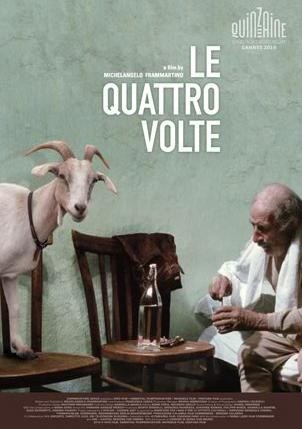
Le Quattro Volte (2010) – Pay No Attention To The Goat Behind The Ocean

Film critics sometimes talk about films having a ‘Malick Aesthetic’.  What they generally mean by this is that the film features lots of nature photography such as the fields of long grass rippling in the wind from The Thin Red Line (1998), the sunlight in the trees from The New World (2005) or the desert sunsets from Badlands (1973). The ‘Malick Aesthetic’ is created by inserting this sort of footage in between more eventful scenes both as a way of allowing the audience to reflect upon what they have just seen and as a way of creating an impression of the numinous that both surrounds and consumes the characters. Michelangelo Frammartino’s Le Quattro Volte is a film that makes extensive use of this technique to create a film that is both free of dialogue and positively overflowing with the same sense of grace that infuses many of Malick’s most enduring films. However, unlike films such as Carlos Reygadas’ Silent Light (2007), Frammartino is not content with presenting us a world imbued with the divine. Instead, much like Malick himself, Frammartino interrogates the divine resulting in a film filled with wit, warmth and wonder, but also profound scepticism about the divine spark that supposedly surrounds us.

Continue reading →

REVIEW – La Signora Senza Carmelie

Videovista have my review of Michelangelo Antonioni’s La Signora Senza Camelie:

However, look beyond such technical considerations and you will find not only a fascinating glimpse into the state of female emancipation in 1950s’ Italy but also an absolutely vicious indictment of the Italian studio system at the time.

Looking back at the review (I actually wrote it for the April issue of Videovista), I think I was a trifle harsh in giving the film only 7 out of 10 but my rather subdued marking does reflect a problem I have with Antonioni.

One of the accusations leveledat the postmodern novel by more traditionally-minded readers is that these works are nothing more than ‘clever tricks for grad students’. What this means is that the people who write postmodern novels imbue the work with so much front-loaded theoretical complexity that their novels can only ever be appreciated by people who share their understanding of postmodern theory. While I would never argue that Antonioni made films with film students in mind, I do think that his worth has been inflated by people who have studied his work in an academic setting.

As with L’Avventura (1960), I can watch La Donna Senza Camelie and marvel at its technical sophistication, its intellectual politics and the ways in which it moves the medium of film onwards and upwards. I understand both why and how he made the film, I understand how he was trying to attack the mythical status of Cinecitta. I can understand and appreciate all of these things about the film and still it bores me. La Donna Senza Camelie imparts information but it does not speak to me.

REVIEW – Deep Red (1975)

Another month and another batch of new reviews up at Videovista.

Experience has taught me and I have learned my lessons well.  My natural film-viewing habits tend to be very director-based.  If I see a film I enjoy then my first reaction is generally to seek out that director’s other work.  Similarly, I will not go to see a film in order to see a particular actor, or to see the work of a particular writer.  But I will go out of my way to see a film by a particular director even if the subject matter does not initially speak to me.  This relationship is one of trust.  I trust certain directors to take me to certain places.

I do not trust Dario Argento.

Partly this is a reflection of the fact that he has had a very long career filled with many ups and downs but it is also due to the fact that I need to be in a quite specific frame of mind to tolerate the ostentatious silliness that characterises Argento’s style.  As my review of Profondo Rosso suggests, I was in the right frame of mind to watch a stylishly directed and fiendishly well composed whodunit.  Excellent job on the extras by Arrow too, who really are one of the best distributors out there when it comes to putting out old exploitation films.

Certified Copy (2010) – Truth through Fakery

“The secret power of novels: they look like mirrors held up to the world, but what they are is machines that secrete spurious meaning into the world and so muddy the waters of genuine understanding of the human condition”

So says Gabriel Josipovici on page 70 of his book Whatever Happened to Modernism? (2010).  Josipovici tries to isolate the spirit of Modernism not in any formal development or stylistic quirk, but in a particular philosophical stance with regards not only to the world but also to the act of producing art.  This stance finds its origins in what Weber and Schiller called the Disenchantment of the World, an event — associated either with the Renaissance or the French Revolution — that saw the dismantling of the certainties of the old medieval conceptual order and their replacement with a more sceptical, tentative and detached worldview born of the scientific revolution and a humanist tradition stretching back to antiquity.  The word became disenchanted not because old comforting falsehoods were replaced by harsh new truths but because it suddenly became clear that the world was a place free of certainties and that absolutely everything was open to questioning.  This sense of disenchantment provoked what the philosopher Kierkegaard called ‘the dizziness of freedom’, a feeling that everything could be said but because there were no longer any fixed rules or structures to press against that nothing that could be said would have any meaning.  The essence of Modernism, according to Josipovici, is art that embraces this lack of certainty and manages to press forward because of it.

Abbas Kiarostami’s previous film Shirin (2008) seemed to embody this artistic self-awareness perfectly.  Set in an Iranian cinema, the film is composed of nothing but a series of close-ups on the faces of Iranian women as they watch a film based upon a work of epic Persian romantic poetry.  We never see the film itself, but in reading about the making of Shirin we learn anecdotes about the poem, the production process and the somewhat jarring presence of the actress Juliette Binoche amongst a sea of unrecognisable faces.  Shirin is a film that invites us to think not about the images upon the screen but upon the selection of those images and the relationship between those images and the (unseen) story that is producing them.  In short, Shirin is very much a work of Modernist cinema as Josipovici would understand the term… it is a film about the author’s lack of authority and the lack of authenticity inherent in any artistic text regardless of how ‘realistic’ the images on screen purport to be.

However…

While Shirin is undeniably a beautiful and powerful film, it is also a film that smacks of cleverness more than authenticity.  There is do doubting the reality of the women’s responses to the unseen film but the framing of these images is so philosophically complex and ontologically ‘clever’ that Shirin seems less like a work of art and more like a critical essay on the impossibility of creating authentic art.  To borrow a phrase from Roland Barthes, it lacks the trembling of existence.  It lacks that smack of the real.  It does not feel like an authentic slice of reality, let alone a reliable reproduction of the world.  Copie Conforme, Kiarostami’s follow-up film, can be seen as an attempt to correct the mistakes made by Shirin.  It is a film that engages and struggles with the unsurmountable difficulty of achieving artistic authenticity, but it does so from within the context of a story that feels both horribly and beautifully real.

Continue reading →

REVIEW – Eagles Over London (1961)

VideoVista have my review of Enzo G. Castellari’s Eagles Over London.

Castellari is probably best known to wider audiences as the guy who directed the original Inglorious Bastards (1978).  Much like that film, Eagles Over London is a part of the Euro War or Macaroni Combat sub-genre of Second World War action movies made in the 1970s.  What most fascinated me about Eagles Over London was the extent to which its low budgets and Italian sets and actors ensured that the film effectively reinvents Wartime London as 1960s Rome.  A Strange but entertaining film.

REVIEW – Two Evil Eyes (1990)

THE ZONE has my piece on the Dario Argento and George A. Romero Poe anthology film Due Occhi Diabolici.

I have written about Poe anthologies before… once for Strange Horizons and another time as a part of a longer piece about great French Horror films.

The DVD made for an interesting review as it opens with a film that left no doubt in my mind that George Romero is one of the most over-rated and talentless directors ever to pick up a camera but closes with a film that really brought home to me how much I adore the work of Dario Argento and how much I need to see more of his films.  So a mixed bag really…

REVIEW – The Stendhal Syndrome (1996)

Videovista have my review of Dario Argento’s rather splendidly weird The Stendhal Syndrome.

Oddly enough, despite being a fan of Horror and a fan of world cinema, I had never really encountered the films of Dario Argento before seeing this film.  I have seen films inspired by his works and gialli that tried to copy it but I had never actually experienced proper Argento before.  Needless to say, I loved it: A psychological thriller about a descent into madness that brilliantly doubles as a scathing critique of Italian attitudes to women.  Great stuff.

REVIEW – The New Barbarians (1982)

Videovista have my review of Enzo G. Castellari’s The New Barbarians, a post-apocalyptic exploitation film made around the same time as his better known and arguably more entertaining Bronx Warriors.

Watching the film I was hit by a wave of raw nostalgia as most of my childhood summers were spent sitting in darkened rooms watching precisely these kinds of films.  If it had mutants, a tricked out car and loads of violence in it then chances are that pre-teen Jona would have hunted it down and happily watched it.  For all the recent talk of films like Avatar dumbing down cinema, watching The New Barbarians really brought home to me the fact that there was a time when science fiction cinema had teeth.  It was weird, surreal, violent and thoroughly disreputable.  I can’t help but feel that the mainstreaming of science fiction might well have cost us these kinds of films.  Even attempts to recapture the magic such as Neil Marshall’s Doomsday (2008) seem somehow more respectable and tame in comparison.

Also interesting is the film’s blatant homophobia.  You simply could not make a film nowadays in which the bad guys are a load of gay men.  Indeed, it occurred to me after writing the review that the film suggests that should the extinction of the human race ever become a genuine risk then homosexuality would not simply be a lifestyle, a preference, a predisposition or even a perversion.  It would be an act of outright nihilism.  But then, is humanity really worth saving?  The film’s baddies – the Templars – are effectively an armed wing of the Voluntary Human Extinction Movement except rather than seeking to justify themselves using the language of ecology, the Templars speak of vengeance and a need to exact retribution for humanity’s crimes against itself.  Which makes little sense but there you go…

REVIEW – The House by the Cemetery (1981)

Videovista has my review of Lucio Fulci’s Quella Villa accanto al Cimitero.

What surprised me most about this film was how genuinely weird it was.  By the early 1980s, the Italian film industry was doing a pretty god job of milking the ideas from successful genre films.  In some cases, they even released unofficial sequels to American films such as Night of the Living Dead (1968) and even Terminator (1984) – more about which can be found in the interesting if rather bizarre videologs put out by The Cinema Snob – Fulci was very much a part of this tradition and The House by the Cemetery was a part of a series of zombie films he made.  However, with little money and much repetition of subject matter, these Italian exploitation films had to find someway of getting themselves noticed and this seems to have spawned a culture of genre-bending where ideas were crammed together in interesting ways regardless of whether or not they made sense.

This hot house of creativity stands in stark contrast with the stagnant and moribund culture of gay indie cinema.  As proof, Videovista has my review of Chip Hale’s Mulligans (2008).  A review which marks round 273 in my on-going battle with TLA Releasing.