REVIEW – L’Assassin Habite au 21(1942)

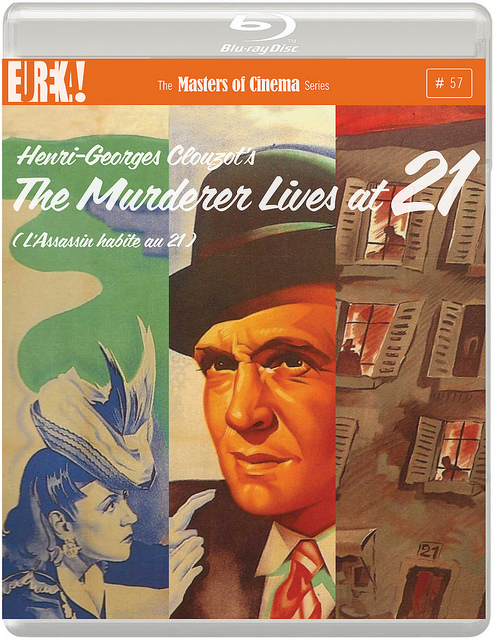
21FilmJuice have my review of Henri-Georges Clouzot’s zesty whodunit L’Assassin Habite au 21 (a.k.a. The Murder Lives at 21)

Best known for his misanthropic thrillers Le Corbeau, Les Diaboliques and The Wages of Fear, Clouzot’s first film tells of a dapper and sarcastic detective who is charged with tracking down a mysterious serial killer known only as ‘Monsieur Durand’. Unfortunately for the detective, he is involved with a flighty and foul-mouthed opera singer who insists on going undercover with him in the hope that the ensuing publicity will help her faltering career:

Much like Ernst Lubitsch’s magnificent Trouble in Paradise, Clouzot’s film features a couple whose relationship has nothing to do with love or devotion and everything to do with sex and cynical self-advancement. This misanthropic vision of human relationships pervades every aspect of the film from the way people talk to each other in the boarding house to the way things get done at police headquarters.

L’Assassin Habite au 21 looks and feels like an adaptation of Dashiell Hammett’s The Thin Man filmed by Fritz Lang but aside from being brilliantly written, brilliantly shot and brilliantly acted, the film also reminds us that there was a point in cinematic history when films were not afraid to depict grown-up and unusual relationships in all of their complex glory. Indeed, one of the things that most struck me about J.J. Abram’s recently-released (and incredibly tedious) Star Trek into Darkness is that while all of the characters may technically be adults their concerns are those of much much younger men.

Today’s Hollywood blockbusters are locked in what can only be called a financial death spiral. Lured into competing with each other to produce more and more expensive films, the studios have now reached a point where they have spent the last decade actively alienating anyone who is not a teenaged American boy. Painfully aware that films like Star Trek into Darkness need to make about $1 Billion before they start making money, the studios are now making more of an effort to reach out to foreign markets and they are doing this by making their themes and narratives as broad and accessible as possible. A Hollywood blockbuster needs to be comprehensible to everyone in America but it also needs to be comprehensible to people who grew up in rural China or India. As a result, films like Star Trek into Darkness are about grown men confronting the generic problems of teenaged boys such as getting the right girl to like them and overcoming their love-hate relationship with Daddy. This infantilisation of Hollywood’s primary protagonists is particularly amusing in the case of Star Trek as there’s a scene where Zachary Quinto’s Spock contacts Leonard Nimoy’s Spock in order to get advice. 21st Century heroes are evidently not afraid to call their parents and have them come and pick them up from the party. There’s your crisis of masculinity right there!

The Murderer Lives at 21 is released on Monday by Masters of Cinema and it is worth every penny.
REVIEW – Mouchette (1967)

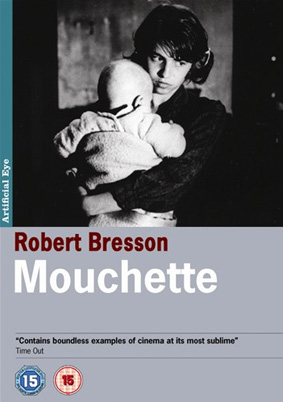
mouchtteFilmJuice have my review of Robert Bresson’s Art House classic Mouchette.

Set in a part of the French countryside that is so poor that modern technology like cars and mopeds seem entirely out of place, Mouchette tells of an impoverished young girl who is born to an alcoholic father and a terminally ill mother. Expected to not only fend for herself but also for her parents, the young girl puts up with an almost impossible amount of teasing and brutality until she eventually snaps, wanders off into a nearby forest and winds up being raped by a local poacher. Trained to accept all the hardship that life has to give and never offer a word of complaint, the girl refuses to press charges against her assailant and instead throws herself into a river.

Bresson made Mouchette in the immediate aftermath of the much better known and more widely admired Au Hasard Balthazar, which I also reviewed. As with Claude Chabrol’s Le Beau Serge and Les Cousins, the extreme proximity of the two films means that Mouchette can be seen almost as a response to au Hasard Balthazar. As I explain in my review, the big difference between Bresson’s two films is that while both films feature a young woman who is beaten down and destroyed by the world, Au Hasard Balthazar seems a lot more human and emotionally vibrant because the donkey serves as a sort of emotional lightening rod allowing us to connect to the suffering of the main character.  Unfortunately, because Mouchette lacks a comparable lightening rod, the film seems bleak to the point of outright nihilism:

It is here that a comparison with Au Hasard Balthazar becomes really useful: Both films are about young women who are born into worlds of unrelenting cruelty that crush their spirits and drive them to suicide. However, while Au Hasard Balthazar uses a combination of donkey and Christian symbolism to make this suffering seem meaningful, the lack of wider context for Mouchette’s suffering makes her travails seem not just pointless but downright exploitative too.  Was there really no other way for Bresson to explore the corruption of the world than to make yet another film in which a young girl is raped by a local thug? And if you are going to make a film in which a fourteen year-old girl covers up her own rape, is it really acceptable to present these events with no social or psychological context whatsoever?

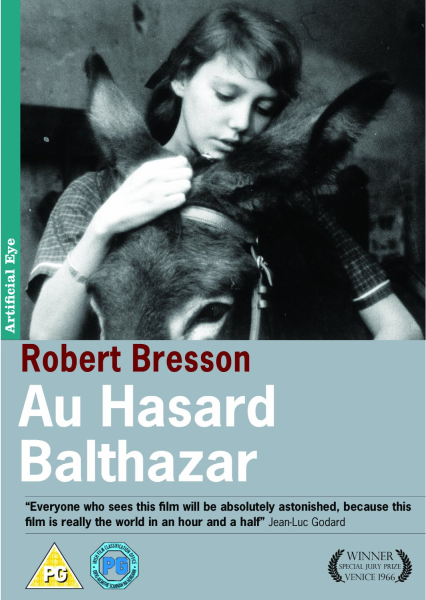
Another useful thing about re-visiting classic films is that it allows you to re-examine their value in light of contemporary values. Indeed, when Bresson made Mouchette and Au Hasard Balthazar, the predominance of male critics and male filmmakers was such that nobody really called into question the idea that rape was simply a part of everyday life and that making two back-to-back films that conclude with the rape of an under-aged protagonist might be considered a little bit creepy. The cover for Au Hasard Balthazar features a quote from Jean-Luc Goddard in which he states that:

This film really is the world in an hour and a half.

Cute line, but I am starting to find it deeply problematic that an entire generation of male filmmakers evidently thought it was okay to use rape as a sort of signifier for the horrible nature of the world. Aside from being deeply exploitative, this effectively serves to reinforce the view that rape is just a normal feature of life rather than a grotesque and intolerable moral transgression. Feminist thinkers even have a name for the vision of the world contained in Mouchette and Au Hasard Balthazar: Rape Culture. It’s one thing to make a film that casually reduces rape to the status of genre trope… it’s quite another to make two films in a row that use precisely this device. Au Hasard Balthazar‘s humanity and experimental use of symbolism are so striking that I believe it will remain a part of the European Art House canon for years to come. Mouchette, on the other hand, is a film that needs to be removed from its pedestal as a matter of urgency.

REVIEW – Au Hasard Balthazar (1966)

BalthazarFilmJuice have my review of Robert Bresson’s art house classic Au Hasard Balthazar.

Over the last year or so, I’ve been lucky enough to review some of the great classics of European Art House film as they’ve been re-issued on DVD and Blu-ray. Aside from introducing me to some genuinely great films and directors, this process has also motivated me to fill some of the gaps in my cinematic expertise and Au Hasard Balthazar was definitely one of those gaps. The reason I never got round to watching it is that, while I had heard great things about the film, I knew it was basically an extended religious metaphor based on a donkey and this struck me as so totally ridiculous that I decided not to bother checking it out. Having now finally gotten round to watching the bloody thing, my view remains that Au Hasard Balthazar is an entirely ridiculous film but the ridiculousness sort of works…

Set in the French countryside, the film tells the story of a sickly young girl who grows up into a confused young woman. Trapped between a distant father and an abusive quasi-boyfriend, the young woman is ground down beneath the heels of the patriarchy until she eventually just gives up and dies. The fascinating thing about this plot is that while neither Bresson’s script nor the amateur actors offer any real insight into why anyone does anything, the presence of a donkey who suffers just as the young woman suffers somehow makes the film incredibly moving. Even more fascinating is the fact that while the donkey effectively suffers ‘for’ the young woman in the same way as Jesus died ‘for’ our sins, the peculiar metaphysics of this relationship seems designed to flush out people’s attitudes towards God:

While the link between Marie and Balthazar works astonishingly well, the link between Balthazar and Christ seems like a metaphor too far. Indeed, while the donkey helps us sympathise with the impassive and often incomprehensibly self-destructive Marie, the religious symbolism only serves to lend this suffering some sort of dignified legitimacy, as though the donkey somehow died for our sins. The beautiful thing about this failure is that a case could be made for seeing it as intentional. After all, what is the point of religious belief if not a palliative sense that all the world’s suffering serves some greater purpose? And what greater signifier of atheism than the feeling that such ontological apologism serves only to distract us from the sufferings of real people?

A few weeks ago, I was lucky enough to review Claude Chabrol’s Le Beau Serge and Les Cousins. These films were originally made almost on top of each other and used not only many of the same actors but also many of the same themes, by reviewing the two films at the same time, I was able to tease out the connections between those two films and see how a director approached a similar question from two very different perspective.  My review of Au Hasard Balthazar is similar to my review of Le Beau Serge in that, as well as reviewing Au Hasard Balthazar, I reviewed Mouchette… which explored many of the same themes as Au Hasard Balthazar but from a rather different perspective.

REVIEW – Les Cousins (1959)

LesCousinsFilmJuice have my review of Claude Chabrol’s second film Les Cousins, which has just been re-released by the ever-excellent Masters of Cinema.

Les Cousins tells of a young man who moves to the city in order to study law. Sharing his uncle’s place with his far more sophisticated and extroverted cousin, the young man finds himself being sucked into his cousin’s glamorous lifestyle filled with parties, girls and dubious European noblemen. Initially, this relationship works quite well as the cousin likes to be the centre of attention and the young man’s inexperience makes him feel like an older brother and a community leader. However, when the young man attempts to become romantically involved with a young lady in his cousin’s entourage, the cousin takes umbrage and decides to assert his supremacy. Disgusted both with his cousin’s behaviour and his own loss of focus, the young man throws himself into his studies but this only provokes his cousin into more frequent and louder parties:

Things come to ahead when Charles is trying to study for his finals but Paul keeps having loud parties. Charles pleads with his cousin to do some revision but Paul’s confidence is absolute… he knows what he is doing and revision is an absolute waste of time. As with Le Beau Serge, Chabrol presents the tension between the two boys as being social and psychological in nature but in truth their disagreement is a moral one: Charles writes endless letters home to his mother promising that he will succeed in his studies and suggesting that his desire to work is born of a sense of duty to do right by his parents. By not only refusing to study but also making it harder for Charles to study, Paul is challenging the moral order of Charles’s universe. In Charles’s mind, Paul is doomed to failure because the universe does not reward provocative layabouts. This means that when Paul does pass his exams with flying colours, Charles is forced to examine not only his faith in the moral nature of the universe but also his conviction that his duty to his parents obliged him to study: What if the best way to succeed really was to wear a smart suit and hang-out with dubious Italian aristocrats?

I mention Le Beau Serge as Les Cousins can be read as a response to that earlier film. Where Le Beau Serge is rural, Les Cousins is urban. Where Le Beau Serge is about a town-mouse visiting a familiar countryside, Les Cousins is about a country-mouse visiting an alien city. Where Le Beau Serge is about taking responsibility for the actions of another, Les Cousins is about remaining true to yourself.

Somewhat handily, Masters of Cinema have decided to time their re-release of Les Cousins with a parallel re-release of Le Beau Serge (that I also reviewed for FilmJuice). While both films work beautifully on their own, many of their subtleties only become apparent when viewed one after the other.

REVIEW – Le Beau Serge (1958)

LeBeauSergeFilmJuice have my review of Claude Chabrol’s first film Le Beau Serge, which has just been re-released by Masters of Cinema.

Le Beau Serge tells of a young man who returns to his home town in order to recuperate from an extended period of illness. Upon arriving, he becomes obsessed with a childhood friend who, despite showing real signs of intelligence and potential as a child, has now fallen into drink and bitterness. Puzzled by this unexpected fall from grace, the young man sets about trying to solve the riddle of what happened to the handsome Serge of his youth:

While much of the initial narrative energy comes from François’s attempts to solve the mystery of le beau Serge, the second half of the film increasingly comes to focus upon why it is that François is so obsessed with saving first Serge, then Marie and then the entire village. Though Chabrol offers us no easy answers, the depth of François’s guilt is such that his attempts to protect Serge and his family eventually come to seem insane and messianic. Why doesn’t François leave? Why didn’t Serge leave? Why doesn’t anyone leave a life that is manifestly killing them?

Chabrol is a director with a somewhat misleading reputation for producing thrillers. Though many of his most famous films (including Le Boucher, This Beast Must Die and La Ceremonie) include a bloody murder and a good deal of psychological tension, the truth of the matter is that Chabrol is and always was a moralist. Not in the sense of lecturing people about right and wrong but rather exploring why it is that people make certain decisions and how they come by certain strange beliefs. Unlike Chabrol’s later films, which dressed the morality up in murder and tension, Le Beau Serge strips the core of the Chabrol experience right back to the very core and asks two very salient questions: Why did Serge turn to drink? Why is Francois obsessed with saving him? A truly wonderful film by a truly wonderful director.

Interestingly, Masters of Cinema have chosen to re-release Le Beau Serge on the same day as they re-release his second film Les Cousins. As I explain in my review of that film over at FilmJuice, the two films function as a pair: Complementing each other through their many differences and juxtapositions.

REVIEW – Amour (2012)

amour-2FilmJuice have my review of Michael Haneke’s Palme D’Or and Oscar-winning drama Amour.

Set almost entirely within the walls of a well-appointed Parisian apartment, Amour tells the story of a retired couple named Anne and Georges who are forced to adapt to entirely new ways of being and relating when one of the couple suffers a massive stroke. Unlike many of Haneke’s films, which present themselves as being of a certain genre only to then deconstruct the genre and mock audiences for wanting generic plot resolutions, Amour is a film that is almost entirely free of postmodern cleverness. In fact, the only thing distinguishing Amour from an old-fashioned weepy is its thematic content. This thematic content sat very close to my personal metal as I spent a number of years as my mother’s primary carer and so immediately identified with the changes taking place in Georges’ character:

Much of the film’s drama and tension comes from Georges’ troubled attempts to reinvent himself and his relationships in a way that protects both Anne’s dignity and his own humanity. Sometimes the negative emotions prompt Georges to over-react to relatively minor problems because it is much easier to fire and humiliate a nurse than it is to deal with the feeling that your life is now nothing more than medication, nappy changes and the grim inevitability of death. As Anne’s condition continues to deteriorate, we see Georges attempting to cling to any island of psychological stability he can find. For example, when the couple’s children turn up and express concern over Anne’s condition, Georges seems cold and inflexible to the point of outright insanity but in truth this attitude is entirely self-protective. As Georges points out, the tears and concerns of his children are of no practical use to him because, at the end of the say, he is the one who will be left alone to care for Anne. Better that the children keep their mouths shut than for them to offer the type of false hope that would make it so much harder for Georges to go back to his life as a solitary carer. It is in Georges’ interactions with these islands of stability that we see Haneke’s vision imposing itself upon what would otherwise be quite a traditional weepy.

Usually, one finds oneself praising Haneke for his savagery and visual brilliance but Amour is a surprisingly humane and visually simplistic film. At times, the only difference between this and a TV movie is the lack of melodramatic scoring and even this is present if you allow for the fact that the film continues Haneke’s obsession with the emotional lives of neurotic pianists. Rather than praising Haneke for his ability to be Haneke, I find myself praising him for his compassion and attention to detail as many of the details of this film could have been lifted directly from my own life.

REVIEW – Holy Motors (2012)

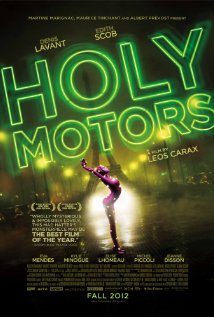
HolyMotorsVideovista have my review of Leos Carax’s beautifully weird Holy Motors.

Holy Motors is a film that took me almost completely by surprise. Going into it, I had seen the widely-circulated ‘Trois! Douze! Merde!’ video in which an intense bald man wanders round a church with an orchestra of accordion players but beyond that I had heard nothing other than the fact that this was a festival of pretty but ultimately insubstantial whimsy. I could not have been more wrong. Holy Motors is a film about the contemporary self and our tendency to not only play different roles at different points in our lives but also our willingness to effectively ‘pull up the ladder’ behind these roles and reinvent ourselves periodically whenever we hit upon a persona we find particularly useful or enjoyable:

20th century counter-culture was obsessed with the idea that, instead of allowing people to ‘be themselves’, society bullied people into conforming to a narrow set of social expectations. However, after 50 years of relentless subversion and deconstruction, the mainstream of our culture is now almost impossible to pin down. Cultures are first and foremost collections of signs and symbols that bind and inform the people who partake of them, identities have meaning and status because people partaking of a particular culture recognise and respond to a particular set of signs, but our culture has replaced a single set of cultural signifiers with a collage of more-or-less overlapping cultures that many people struggle to navigate. What is the backlash against political correctness and multiculturalism if not a demand that old cultural privileges be reinstated? As our cultural spaces become more diffuse and intractable, we begin to yearn for that which horrified the 20th century existentialists.

For Jean-Paul Sartre, to be defined by others was to be confined to hell. His 1944 play No Exit was a howl of protest and repugnance at the idea that our identities might somehow rely upon the judgement of others. However, fast-forward 70 years and we demand the attention and judgement of others! We photograph our lunches and live-tweet our social interactions because we know that our identities exist only as long as they are recognised by the people who matter to us. Holy Motors is not about the tyranny of others but the fear of their absence… if nobody is observing Oscar then why does he play the dying uncle, the punk rock accordion player or the husband to a chimpanzee? Why do anything if nobody is paying attention? And if nobody is out there defining us then how do we even begin to define ourselves?

What makes Holy Motors a brilliant film is that Carax not only engages with these ideas, he does so using a cinematic language that is entirely new and entirely of the moment. This is cinema built with Youtube in mind. Cinema that uses spectacle not as a blunt instrument but as a scalpel that cuts away the conventions of traditional storytelling till nothing but the raw pulsating nerve of The Moment is left. Quite possibly the best and most under-appreciated film of 2012.

Secret Defense (1998) by Jacques Rivette

secret-defenseDirected by Jacques Rivette (one of the big beasts of the French Nouvelle Vague) Secret Defense is best understood as a sort of inside-out psychological thriller. What I mean by this is that while most psychological thrillers use the language of film to convey what it feels like to be in a particular psychological state, Rivette’s film looks beyond what the characters are feeling and focuses instead upon the insane realities of what it is they are doing.

The film opens as research scientist Sylvie (Sandrine Bonnaire) is approached by her younger brother Paul (Gregoire Colin). Obviously troubled, Paul presents Sylvie with photographic evidence suggesting that the charismatic and ambitious Walser (Jerzy Radziwilowicz) might have been involved in the death of their powerful father. Initially dismissive of her brother’s conspiracy theories, Sylvie soon becomes worried that Paul might be planning to do something stupid and so decides to ‘save’ her brother by travelling across the country in order to kill Walser herself.

At this, point, most directors would have used either the relationship between the siblings or their historic links to Walser as a means of exploring Sylvie’s character and explaining her decision to seek revenge on her brother’s behalf. However, rather than following this well-trodden path, Rivette devotes twenty minutes of the film to a largely dialogue-free train journey during which Sylvie sleeps, tries on sunglasses, changes trains and gets drunk. The sheer crushing boredom of this section beautifully demonstrates the depths of Sylvie’s madness and obsession whilst keeping her actual emotional state firmly at arm’s length. Indeed, the reason Secret Defense runs to a colossal 170 minutes is that each of the film’s revelations comes only after a succession of missed phone-calls, awkwardly silent breakfasts, gloomy afternoons spent sitting around, and seductions embarked upon solely to give the characters an excuse to not talk to each other. In fact, this cycle of avoidance, confrontation and acceptance repeats itself endlessly throughout the film but without much insight ever being gained.

The point of the film is that it takes considerable time and energy to both keep and reveal family secrets. Much like the intelligence services alluded to by the film’s title, Sylvie works hard to break through a wall of silence and once that wall is finally breached she pointedly refuses to reveal the family’s secret to her troubled younger brother. There’s simply too much at stake and he wouldn’t understand anyway.

By focussing upon the characters’ actions rather than their exact motivations, Rivette emphasises not only the irrationality of the characters’ actions but also the social nature of many psychological states. When Walser finally lets Sylvie in on the family secret, Sylvie lashes out at her mother and then immediately forgives her; it is as though she has passed through a veil from one world into another where secrecy and even murder make perfect sense. Thus, the decision to keep the characters at arms’ length results in a truly devastating psychological truth: all human behaviour seems irrational and insane when deprived of its cultural and psychological context.

REVIEW – The Passion of Joan of Arc (1928)

FilmJuice have my review of Carl Theodor Dreyer’s immortal The Passion of Joan or Arc, which is being released on the 26th of this month by Masters of Cinema.

Set after the capture of Joan of Arc by the English, the film chronicles the authorities’ attempts to try and convict Joan as either a fraud, a witch, a heretic or all three at once. Shot very simply and all the more powerful for this simplicity, the film distinguishes between the ethereal world inhabited by the peasant Joan and the corrupt and venal world inhabited by the supposedly holy churchmen. Dreyer establishes this distinction simply by point his camera at the actors’ faces and allowing the simple authenticity of Joan’s tears stand in stark contrast to the weathered faces and knowing smiles of her inquisitors:

Like many of the silent films released by Masters of Cinema in recent months, Carl Theodor Dreyer’s The Passion of Joan of Arc is a powerful reminder of how much can be accomplished with limited technological resources.  While Hollywood spends billions producing films that struggle to make you feel anything other than boredom, Dreyer invokes the full weight of human sympathy by showing a tear roll down an actress’s cheek.

Since hooking up with FilmJuice earlier this year, I’ve been fortunate enough to review a goodly number of Masters of Cinema’s recent releases.  I really feel as though this process has been something of an education for me as visiting brilliant but sometimes under appreciated films from earlier eras has allowed me to get a really good feel for which filmmakers have proved influential and which important lessons have somehow been lost. For example, when I reviewed a number of films by Pier Paolo Passolini, I realised that many of his experiments had failed to catch-on in the way that those of his contemporary Antonioni clearly did. Watching Pasolini, I was struck by the idea that film history could have been radically different had it gone down the avenue of intensely personal metaphor rather than emotional evocation. I got the same feeling watching The Passion of Joan or Arc as filming a human face in emotional distress is surely a far more effective manner of eliciting sympathy than the sophisticated emotional manipulation you get in most Hollywood films. People talk about art house film being difficult compared to Hollywood blockbusters but it strikes me that blockbusters are a good deal more artistically sophisticated and difficult than Dreyer’s use of a tear rolling down a cheek… the difference is that we have grown so accustomed to the artifice and complexity of Hollywood filmmaking that we now see the simple and the pure as pretentious and fake.

REVIEW – In Your Hands (2010)

Videovista has my review of Lola Doillon’s In Your Hands, a French drama starring Kristin Scott Thomas.

I think that In Your Hands is trying to be about quite an interesting question, namely whether loneliness creates a sense of desperation that blinds people to the human failings of the people who lift them out of loneliness. The film seems to explore this idea by having a socially isolated surgeon (Scott Thomas) be kidnapped by the husband (Pio Marmai) of a woman who died on her operating table. Initially, the dynamic is pretty generic as the surgeon reveals herself to be uninterested in human suffering to the point of being completely unwilling to recognise her role in the woman’s death, let alone apologise for it. However, as the film progresses and we learn more about the character, it transpires that the husband is also socially isolated and his relationship with the surgeon is actually the only one he has.  Sounds interesting, right? The problem is that the text of the film does almost nothing to support this reading:

The problem with the film’s central theme of alienation is that it is impossible to determine whether it is something that exists in the text of the film or whether it is something that I have made up out sheer boredom. Are we supposed to attend to the fact that neither of the characters have any friends or is their lack of social connection simply the product of weak characterisation and sloppy world building? Despite being only 80 minutes long, the film contains no context for the events surrounding the kidnapping, meaning that the characters begin and end the film as impenetrable cyphers. To make matters worse, having teased the audience with the idea that kidnapper and victim might have fallen for each other because that relationship was the only one they had, Doillon refuses to either acknowledge this interpretation of events or develop the insight in any meaningful way.

As I explain in the review, post-War art house cinema has developed a style of storytelling that presents us with an ambiguous set of events and then steps back and allows us the space to make sense of these events for ourselves.  This is why art house film is so slow: those moments of people peering off into the distance are there to give you some space in which to think. The problem with this approach is that many directors have come to rely upon audience participation to the point where they no longer both to present you with any well-drawn ambiguities… they simply show you some stuff happening and then retreat into beautiful cinematography in the hope that you will invent some thematic context that makes sense of the images on the screen. An excellent example of this type of filmmaking is Eugene Green’s The Portuguese Nun, a film so boring and pretentious that it left me wanting to wring the director’s neck when I reviewed it for FilmJuice:

If one were being particularly charitable one might attempt to argue that the film constitutes some kind of meditation on the affected and staged nature of film as a medium but if Green is indeed trying to present an argument then his ideas are either insufficiently clear or insufficiently substantial to support a 127-minute film.

Much like The Portuguese Nun, In Your Hands does contain some ideas but these ideas are so insubstantial and evasively presented that they barely constitute ideas at all. This is homeopathic cinema: while an idea may once have been near the production process, that idea has now been so thoroughly diluted that its presence in the film is now largely the product of the audience’s imagination.