Swimming Pool (2003) – Touched by The Gods of Indecision

One of the enduring concerns of human culture is how to deal with thoughts and feelings that are not recognisably our own.

Much like the ancients, who associated odd feelings and passing moods with particular deities, Saint Augustine viewed unwelcome thoughts as something external to the self. According to Augustine, our urge to transgress God’s laws stems from a wound inflicted by Original Sin and passed down through the generations by sexual contact. Later churchmen would describe the concept of Original Sin as:

“Privation of the righteousness which every man ought to possess”

Inspired by the Augustinian concept of Concupiscence but intent upon creating a materialistic account of human nature, Sigmund Freud divided the self into different parts and invoked the concept of the unconscious as a place where unspeakable thoughts and desires boil and occasionally rise up, hammering at the walls of the conscious self. Though no longer central to scientific accounts of human nature, Freud’s account of the self remains incredibly influential. Artists and mental health professionals conspire to present the mind as a city under constant pressure from a vast and barely manageable neurochemical hinterland where entire streets pass in and out of the surrounding jungle. The question of how we navigate such a city, where we draw the line between town and country, ours and not-ours not only endures to this day but also accounts for many of the most striking literary and philosophical innovations of the 20th Century.

Like many psychological thrillers, Francois Ozon’s Swimming Pool follows a character’s attempt to repress, confront and ultimately claim ownership of a series of unwelcome and unrecognisable thoughts, but as sophisticated as the film’s distinctions may be, it is never entirely clear where the film’s main protagonist begins and ends.

Continue reading →

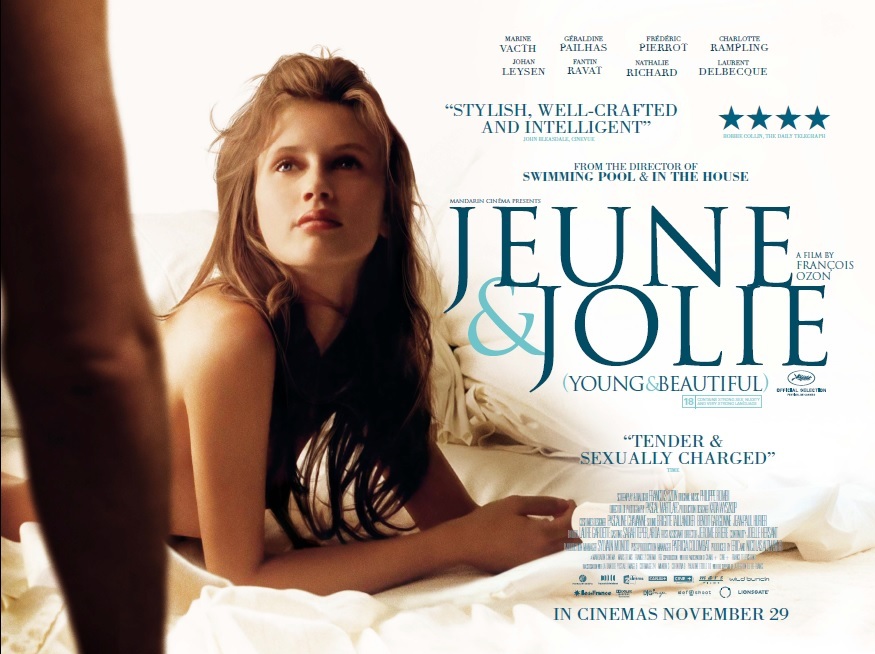
Jeune et Jolie (2013) – Taking Your Sexuality Off-Grid

JJ1Art house film has always had a problematic relationship with female sexuality. Though art house directors are far more likely to construct their films around strong female characters than their Hollywood counterparts, their engagement with these characters’ sexualities is often limited to stripping an actress naked and posing her in a series of titillating tableaux such as those found in Abdellatif Kechiche’s Palme D’Or winning film Blue is the Warmest Colour. The further a female character ventures from the realms of male fantasy, the more likely it is that her sexuality will be turned against her and used as a sign of encroaching madness, alienation or spiritual collapse. In art house film, sad men may become murderers but sad women will always become prostitutes.

The tragedy of problematic narratives is that they frequently outlive the social attitudes that first informed them. For example, while the films of Luis Bunuel may have been informed by the remnants of his Jesuitical education, the phrases and characters he helped to develop in films like Belle de Jour passed into common usage and came to form part of the basic vocabulary of art house film. Used and revisited for decade after decade, the character of the fallen woman is now so familiar to art house audiences that directors no longer feel the need to spell out why promiscuous women are sad women… they just show us a female character having loads of sex and allow us to fill in the blanks. We have been trained through repetition and this training followed us out of the cinema and into our daily lives meaning that, without ever having been subjected to an argument about the evils of promiscuity, our first reaction to promiscuous women is to assume that there is something terribly wrong with them.

The alternative to allowing our culture to train us is to question the values embedded in stock cinematic phrases and champion works that set out to subvert stock phrases and use them to draw our attention to the sexism and racism that is perpetuated by our own intellectual laziness. Thankfully, while the 2013 Cannes jury was content to give the biggest prize in art house film to a work that presented sexually empowered women as hollow vessels and childlike victims, another director in competition set out to pick a fight with the myth of the fallen woman. The director in question is Francois Ozon and his film is Jeune et Jolie.


Continue reading →

Blue is the Warmest Colour (2013) – Orgasms and Spaghetti Bolognese

BWC1The world of art house film has become a tediously reverential place. Raised on auteur theory and acutely aware that it lacks both the cash and cachet of commercial cinema, the people who write about art film are prone to treating its institutions as temples and its practitioners as living saints. Once filled with experimentation, transgression, provocation and very human failures, the cultural spaces of art house film are now given over to callow hagiography and propping up the careers of once great talents. As one might expect of a milieu that looks upon dissent as an act of economic sabotage, there is a tendency to treat the recipients of major festival awards as worthy regardless of whether their films are any good. Thus, to say that Abdellatif Kechiche’s Blue is the Warmest Colour is the most controversial winner of the Palme D’Or in decades is actually a good thing… turns out that there might be some life in the old dog yet.

While the controversy has many heads, the one with the longest teeth erupted prior to the announcement of the Palme D’Or when the New York Times’ senior film critic Manohla Dargis wrote about the film in what she would later describe as “399 words dissenting words”:

It’s disappointing that Mr. Kechiche, whose movies include “The Secret of the Grain” and “Black Venus” (another voyeuristic exercise), seems so unaware or maybe just uninterested in the tough questions about the representation of the female body that feminists have engaged for decades. However sympathetic are the characters and Ms. Exarchopoulos, who produces prodigious amounts of tears and phlegm along with some poignant moments, Mr. Kechiche registers as oblivious to real women. He’s as bad as the male character who prattles on about “mystical” female orgasms and art without evident awareness of the barriers female artists faced or why those barriers might help explain the kind of art, including centuries of writhing female nudes, that was produced.

“Men look at women,” the art critic John Berger observed in 1972. “Women watch themselves being looked at.” Plus ça change….

When people voiced their disagreement, Dargis took the bait and expanded her ideas in an essay that draws on a blog post made by the creator of the graphic novel that inspired the film. Writing in French but translated for Anglophonic consumption, Julie Marot praised the style and vision of the film whilst not only distancing it from her book but also from the real-life experiences of actual LGBT women:

I don’t know the sources of information for the director and the actresses (who are all straight, unless proven otherwise) and I was never consulted upstream. Maybe there was someone there to awkwardly imitate the possible positions with their hands, and/or to show them some porn of so-called “lesbians” (unfortunately it’s hardly ever actually for a lesbian audience). Because — except for a few passages — this is all that it brings to my mind: a brutal and surgical display, exuberant and cold, of so-called lesbian sex, which turned into porn, and me feel very ill at ease. Especially when, in the middle of a movie theater, everyone was giggling. The heteronormative laughed because they don’t understand it and find the scene ridiculous. The gay and queer people laughed because it’s not convincing, and found it ridiculous. And among the only people we didn’t hear giggling were the potential guys too busy feasting their eyes on an incarnation of their fantasies on screen.

In other words, the 2013 Cannes Film Festival jury gave the most prestigious award in world cinema to a piece of grotesque cultural appropriation; a film that took an original graphic novel by a gay woman and filtered it through the beliefs and proclivities of a straight man resulting in a series of needlessly explicit and exploitative sex scenes that owe a good deal more to the tropes and techniques of pornography than to the emotional contours of LGBT life.

Though in and of itself disappointing, the jury’s decision is made infinitely worse by the fact that Cannes Film Festival has an absolutely terrible track record when it comes to the representation of women in general and LGBT women in particular: Since the Palme D’Or assumed its current form in 1975, the award has had only one female winner (Jane Campion). In the year that Blue is the Warmest Colour won the Palme D’Or, there was only one female director in competition and the previous year saw none at all. While the slightly more edgy Un Certain Regard prize has a much better track record of allowing women to compete, men still dominate the list of winners. The problem is not just that the Cannes jury gave its most prestigious award to a straight man’s vision of a lesbian relationship, it’s that it chose to give that film an award despite having completely ignored all the films made by actual LGBT women including Chantal Akerman, Andrea Weiss, Ulrike Ottinger, Barbara Hammer, Lana Wachowski, Monika Treut and Lisa Cholodenko. It is almost as though the Cannes Film Festival only discovered the concept of a non-straight woman when a straight man decided to film a couple of straight women pretending to go down on each other. Given that art house film likes to present itself as being interested in different ways of seeing the world, this addiction to the straight male gaze is complacent, corrosive, wasteful and so completely unacceptable that every passing year brings nothing but shame to an institution already in urgent need of reform.

Continue reading →

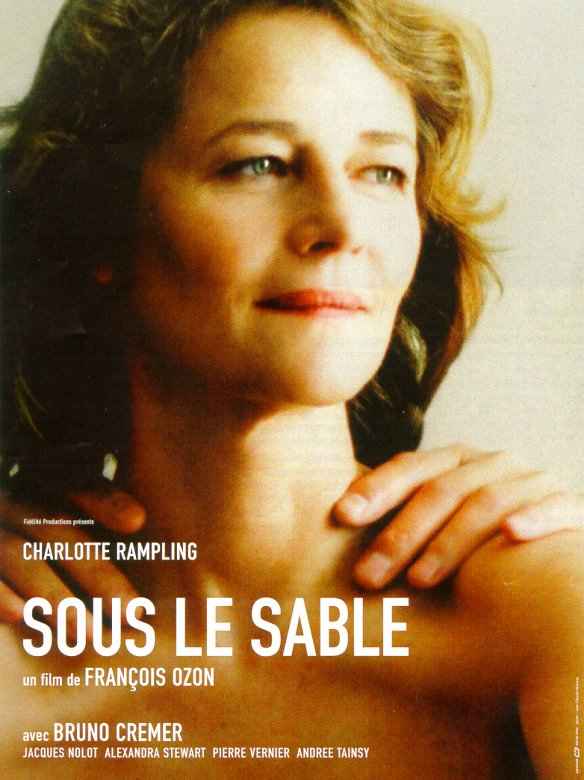
Sous Le Sable (2000) – Everyone Needs a Little Cup of Stars

SLS1There are few situations to which the opening lines of Shirley Jackson’s The Haunting of Hill House are not pressingly germane:

No live organism can continue for long to exist sanely under conditions of absolute reality.

Often spoken of as a ghost story, The Haunting of Hill House is more rewardingly read as a portrait of a fragile mind under intense pressure. Scarred by decades of servitude to a sick and deranged mother, Eleanor Vance is a woman who carries her reality with her like a snail carries its shell. While the novel’s melody is dominated by Hugh Crain’s house and the miseries that befell his family, the harmony is all about the way that Eleanor picks things up and uses them to fashion a world more comforting and endurable than absolute reality. Everyone needs a little cup of stars.

One of the great joys of Jackson’s novel is the way that she manages to blur the boundaries of the real, the supernatural and the outright hallucinatory without ever bothering to draw attention to the lack of subjective difference between these different categories. For Jackson, this uncertainty is so universal that it simply does not merit commentary… it’s all one big sordid mess. Many films and books have been drawn to this ambiguity but while great works such Henry James’ The Turn of the Screw or Caitlin R. Kiernan’s The Red Tree and The Drowning Girl add their own ingredients to the ambiguous brew, most works that use these tropes yearn for clear dividing lines between the metaphorical and the concrete, the material and the fantastical, the sane and the insane, the true and the false. This is why you are more likely to encounter the carefully nested realities of films like Inception and Jacob’s Ladder than you are the happy ambiguities of a film like Total Recall or The Descent. Though definitely a film with a clear dividing line between reality and fantasy, Francois Ozon’s Sous le Sableis a film that is intensely relaxed about the ambiguities of madness.

Continue reading →

Classe Tous Riques (1960) – Ten Paces Behind

I have often thought that there was a great book to be written about why it is that particular genres catch on in particular places and times. What is it about post-War America and Victorian Britain that made Science Fiction so vibrant? What is it about 1980s Japan that so perfectly fit the mood of Cyberpunk? How was it that post-War France seemed capable of producing one classic piece of hardboiled crime fiction after another? An answer to this final question can be glimpsed in the life of one Jose Giovanni.

Giovanni was an educated man who spent the War as a rural guerrilla. When France was liberated, Giovanni decided to put his Maquisard skills to use in the Parisian underworld where his presence at the scene of a murder lead to him being sentenced to death. While in prison awaiting Madame La Guillotine, Giovanni made the acquaintance of a man named Abel Davos, a gangster and collaborator who went on the run with kids in tow. In 1947, Giovanni attempted to escape from prison but while the escape ultimately proved unsuccessful, it did not prevent either the lifting of Giovanni’s death sentence or his eventual pardon and successful retrial. Upon release from prison, Giovanni began writing and rapidly produced books that would go on to be adapted for the screen as:

  •  Jacques Becker’s Le Trou (1960)
  • Claude Sautet’s Classe Tous Risques (1960)
  • Jean-Pierre Melville’s Le Deuxieme Souffle (1966)

All three films draw directly from Giovanni’s life story and all three films are classics of cinematic noir. While I have a good deal of affection for both Le Trou and Le Deuxieme Souffle, the most puzzling and least generic of all three films is the long-forgotten and recently-rereleased Classe Tous Risques directed by Claude Sautet and starring Lino Ventura as a man on the run with kids in tow.

Continue reading →

TranSylvania (2006) – Post-Sedentary

Identity is an ambiguous thing: Some are born without an obvious place in the world and so wander the Earth in search of an identity they might call their own. Others are born with a very clear identity that is imposed upon them at birth and while these people may know precisely where they are, their location frequently turns out to be under someone else’s boot. The dull ache of ambiguity throbs not only in the identities we receive from society at large, but also from the identities we choose to impose upon ourselves. This is a film about identity and how assuming an identity may very well wind up harming those who have that identity forced upon them.

Continue reading →

REVIEW – Plein Soleil (1960)

pleinsoleil10A little while ago, I was planning on writing a book about psychological thrillers. I thought it might have been a good idea because I wanted to read a book about psychological thrillers but nobody appeared to have written one. While the project was eventually dissolved by the dawning realisation that nobody would publish a book about psychological thrillers written by me, my attempt to pull together a list of great psychological thrillers brought me into contact with Rene Clement’s Plein Soleil. Based on Patricia Highsmith’s classic existential novel The Talented Mr Ripley, Plein Soleil struck me as a fascinating misprision… a failure to comprehend the original intent of a work that nonetheless produced something of considerable beauty. FilmJuice have my review of Plein Soleil, which is now available in the UK for the first time in altogether too long.

Set in the strange demimonde created by wealthy American socialites slumming it in Italian hotels, Plein Soleil tells of a penniless young man who attaches himself to a much wealthier man with a far more forceful personality. In Highsmith’s original text, the relationship between Ripley and his prey is a sort of existential magnetism, a void that attempts to fill itself by consuming a much more substantial person. Intriguingly, Clement and Delon present Ripley not as an existential void but as a sort of unquenchable hunger… a man with nothing who wants everything and who will stop at nothing in order to get it. Indeed, even Anthony Minghella’s stylistically dull adaptation of the book presented Ripley as a sexless figure whereas Delon’s Ripley is all about Marie Laforet’s fragrant Marge:

Delon’s Ripley is an absolute masterpiece, a creature of malign and yet unfettered grace, the male libido chiselled into marble and made socially acceptable by the strategic use of smart haircuts and tailor-made suits. Think Bond unhitched from Queen and Country.

Another thing that struck me since filing the review is that Plein Soleil has a very similar setting and cast of characters to Antonioni’s now burdensomely-canonical L’Avventura; both are about beautiful people in a beautiful place and both films use that beauty to highlight the beautiful people’s complete lack of interiority. In L’Avventura, the mediterranean is a dull grey slate dotted with jet black protuberances while that of Clement is a washed-out nightmare where only the most brutal and beautiful fear to tread.

Re-visiting Plein Soleil was a real treat that only continues to confirm my feeling that Anthony Minghella’s Oscar-nominated and BAFTA-winning Talented Mr Ripley is actually the weakest of all the Ripley films while Clement’s adaptation and Liliana Cavani’s take on Ripley’s Game remain sadly under-rated.

REVIEW – Rebellion (2011)

rebellion-quadFilmJuice have my review of Mathieu Kassovitz’s political thriller Rebellion (a.k.a. L’Ordre et La Morale – which is a much better title).

Based not only on historical events but historical events involving French politicians who have only recently left the stage, the film tells of how a group of political activists protested the continued French political control of New Caledonia. Hoping to catch the attention of the media by occupying a French gendarmerie in the run-up to the 1988 French general election, the Kanak protesters accidentally killed a policeman resulting in the French army being sent to reassert ‘order and morality’ on what is still considered French soil. Kassovitz himself plays a French gendarme who is sent to negotiate a settlement only to discover that both the French military and their political masters are dead set on violence resulting in what has become known as the Ouvea cave massacre.

As with La Haine, Kassovitz jumps into the political elements of his narrative with real zeal and understanding. Using Legorjus as a viewpoint, Kassovitz crawls around inside the Ouvea massacre and shows not only the cowardice of the separatist politicians who failed to support their own activists but the complete moral bankruptcy of a French political class who used a real-life hostage situation as an opportunity to grandstand on the eve of a national election. However, unlike many political films that are content to bewail the system and blame impersonal forces for the ills of the world, Rebellion goes out of its way to name real-life politicians and speculate about their motives. Why did Jacques Chirac close the door on negotiations? Because he wanted to attract the votes of the French National Front and he knew that brown bodies meant votes. Why did the separatist politicians fail to support their own activists? Because they were afraid of being associated with dead police even though the plan to occupy police stations was theirs to begin with. Rebellion is a blisteringly angry film and watching it will make you angry too; if Western governments behaved this badly in 1988, what do you think it says about the people in power today?

As I say in my review, I think that Rebellion is a real return to form for Kassovitz. While I’ve enjoyed almost all the films he has directed, I remain of the opinion that La Haine will be the film for which he is remembered and Rebellion shows a real desire to return to the same levels of anger and political engagement. Possibly one of the best-made and more courageous political thrillers of recent times, this film really puts all of those terrible Iraq War films in perspective. All too often, political stories stress the cultural dimensions of their analyses resulting in a snapshot of a particular moment in time that blames nobody by exaggerating the inevitability of it all. This type of analysis that focuses on systemic forces rather than individual personalities is alarmingly common in American politics where perpetual warfare, the brutalisation of the poor and the rich getting richer are all seen as just shit that happens. By naming names and placing the blame not just on ‘the political class’ but on particular people within that political class, Kassovitz is reminding us that politicians are responsible for the offices they are elected to fill and who is in office at a particular time really does matter. Had Jacques Chirac not been eager to secure the votes of Jean-Marie Le Pen’s followers then chances are that the hostage takers would have walked away unharmed and ready to face justice.

REVIEW – Something in the Air (2013)

something_in_airFilmJuice have my review of Olivier Assayas’s 70s drama Something in the Air.

Much like Assayas’s near-universally acclaimed Carlos the Jackal, Something in the Air is set in the aftermath of the 1960s just as that much-overstated sense of solidarity and hopefulness was beginning to collapse into the selfishness, divisiveness and cynicism that would later herald the rise of Thatcherism and Reaganism. The film follows a group of French teenagers as they graduate from High school in 1971 and head out into Europe for a summer of self-discovery. However, despite the teenagers being incredibly passionate about their politics and the need to change the world, most of their decisions have little if anything to do with the tomes of political theory they dutifully read and quote:

Despite functioning at an incredibly high level or intellectual and political engagement, Gilles and friends drift from one doomed relationship to another whilst either embracing or rejecting the opportunities that come their way. One of them is dragged into the orbit of a bunch of aspiring terrorists while another joins a commune only to find herself doing all the washing, cleaning and shopping for a bunch of men who are anything but radical in their attitudes to women. Indeed, while some critics have made a lot of the similarities between Something in the Air and Assayas’s earlier film of ill-fated teen revolt Cold Water, a much better point of comparison would be a film like Richard Linklater’s Dazed and Confused as while Assayas’ teens may be living the revolutionary life in a series of beautiful European locations, the decisions they make are ultimately no different to those of Linklater’s suburban Texans.

This suggestion that radical politics are necessarily an affectation that do little aside from lock you into various social networks is very similar to the point Assayas makes by de-politicising the actions of Carlos the Jackal. From my review of Carlos:

By refusing to place Carlos’s actions in any kind of context, Assayas beautifully foreshortens them, reducing them from political actions to social gestures. Indeed, when Carlos and his gang storm the OPEC meeting, it is immediately clear that they have a good deal more in common with the politicians and bureaucrats than they do with ordinary people. Carlos is able to discuss his intentions quite calmly with the various politicians while their civilian underlings quake with uncontrollable terror. The politicians and police know who Carlos is. He knows who they are. Everyone knows the stakes. Everyone knows the risks. It is almost as though they are all friends.

The film is beautifully made and while it is not exactly one of Assayas’s great works, it does do a good job of raising questions about the 1960s at a time when the toxic exit strategy of that particular generation is becoming obvious to all.

REVIEW – In The House (2012)

ITHFilmJuice have my review of François Ozon’s In The House.

The film is set in a devastatingly modernist French high school where a bitter failed writer grinds out a living teaching French literature to teenagers who can barely read or write. Suddenly, the teacher’s gloom is lifted when one of his students hands in an astonishingly dry and sarcastic appraisal of a middle-class home he recently visited. His interest captured, the teacher encourages the boy’s talent and soon every piece of homework becomes another wry take-down of middle-class life. What makes this film interesting is that, rather than focusing upon the emotional connection between failed writer and ambitious student (YOU’RE THE MAN NOW, DOG!), the film uses the relationship as a metaphor for the creative process as the student is effectively writing for an audience of one who gives him detailed feedback on what he wants to see in the next chapter. Brilliantly, the teacher’s requests that the student alter his plot results in the student doing things that directly impact the teacher’s life forcing the audience to suffer for their vicarious literary joy.

One way of looking at In The House is to say that it features a more restrained approach to the shaggy postmodernism of Charlie Kaufman. For example, as with Being John Malkovich, the characters in this film blur the lines between the real and the fictional. Similarly, as with Synecdoche New York, the entirety of In The House feels like an intentionally doomed attempt at capturing the entire creative process in a single unwieldy metaphor. The problem is that Kaufman realises that the cleverness of postmodernism is inherently less satisfying than the emotional payload of a sweeping narrative arc and so he builds these huge metaphorical structures in an effort to replace emotional closure with a sense of wonder. Ozon’s comparative restraint means that, unlike many of Kaufman’s projects, In The House works as a proper story right up until the end but it seems entirely reasonable to suggest that ending the film on a flight of postmodern fantasy would have been more effective than Ozon’s discontented trudge.

I’ve recently read two quite interesting books that attempt to deal with the issue of ironic detachment from the emotional manipulations of narrative. David Thomson’s typically shaggy and typically wonderful book on the history of film The Big Screen finds him deeply troubled by the way in which the rise of advertising appears to have somehow compromised the relationship between work and audience. Prior to TV and Radio, people would submit themselves to a particular narrative and stay with it till the end. Now, they find themselves jostled out of the flow by adverts… tiny self-contained stories injected into the flow of a film or TV programme but designed to sell rather than move or entertain. After combing through the history of cinema, the book ends with Thomson experimentally watching a film backwards:

You also discover what a sweet, artificial thing story is. That is not a mocking of narrative, simply a revelation that story is just a series of tricks or steps, a mechanism, not too hard to guess in advance, and as systematic and serviceable as, say, a staircase — and as logical and mathematical. A story is something made and made up; it is a disguise of life, artfully and kindly done, but not life. It is lifelike. And stories are so artful, so manufactured, that they might as easily run backwards or forward

This vision of narrative as a system of emotional control also runs through Douglas Rushkoff’s recent (and not quite wonderful) book Present Shock. Rushkoff argues that the world around us does often makes very little sense as decades of advertising have encouraged us to find ways of protecting ourselves from stories that would manipulate our emotions:

Aristotle was the first, but certainly not the last, to identify the main parts of this kind of story, and he analyzed them as if he were a hacker reverse-engineering the function of a computer program. The story mechanics he discovered are very important for us to understand, as they are still in use by governments, corporations, religions, and educators today as they attempt to teach us and influence our behaviors. They are all the more important for the way they have ceased to work on members of a society who have gained the ability to resist their spell.

While I am still in the process of digesting a lot of these ideas, I think there is a lot of meat on the bones of the idea that a lot of contemporary culture is post-postmodern in the sense that it is built with an explicit aim of overcoming the air of ironic detachment that postmodernism has encouraged us to adopt. Kaufman in particular is quite an interesting figure as all of his films begin in the real world, deconstruct the real world and end with mad flights of fantasy. I think Kaufman does this because he realises that a) neat narrative arcs are at least as ‘false’ as CGI fantasias and b) CGI fantasias are probably a more reliable way of having an impact on an audience than a happy or a tragic ending.