Top of the Lake (2014) – #NoDads #NoMums #NoDrama

Funded by the BBC and directed by the only woman to win a Cannes Palme D’Or in the modern era, Jane Campion’s miniseries Top of the Lake is a complete dramatic failure. Beautiful to look at thanks to its New Zealand location, the series follows a detective’s attempts to locate a 12-year-old girl who goes missing after it is discovered that she is five months pregnant.

What makes this series a failure is foreground stuff like plot and character; things which we are encouraged to see as being the entire point of film and TV dramas. The plot does not work as it is poorly written and poorly paced. Having introduced us to the figure of a young girl who has manifestly been raped, the series forgets her existence for two or three episodes before suddenly remembering that finding the girl and revealing the identity of her rapist is the over-arching narrative that is supposed to provide this baggy and ill-disciplined mess with the illusion of structure. Having placed their main plot on the back burner, the writers set about weighting down the characters with an overabundance of backstory that serves only to let the writers off the hook when they decide to write themselves out of trouble by having one of their characters behave in an entirely irrational and uncharacteristic fashion: Need a ruthless patriarch and criminal mastermind to get outwitted by a terrified child? Well… it turns out that he has mummy issues and family-related plot point X caused him to have a convenient mental breakdown. Need an incredibly professional police officer to randomly shoot someone? Well… it turns out that she’s not only a rape survivor but also someone dealing with the aftermath of grief and other incest-related problems.

The novelist E.M. Forster distinguished between flat and rounded characters on the basis that rounded characters are intrinsically knowable. They seem real to us because the author shows how one event triggers an internal change that results in different behaviour patterns. According to Forster, we cannot ever really understand real people but we can understand a rounded character and see not only the different aspects of their personality but also how those different aspects interact and propel the character along a particular course of action. The characters in Top of the Lake are like planets in that they are so painstakingly rounded that they appear completely flat. Campion and her co-writer Gerard Lee provide their characters with so much traumatic backstory that they become unknowable; their melodramatic irrationality so pronounced that they are just as likely to save the day, as they are to put guns in their mouths. Unknowable and unaccountable, they are pools of unreasoning expediency that flow wherever the plot demands. Even with the best will in the world, it is impossible to relate to such creations… they are too convenient to be real.

While the main plotline of Top of the Lake may be dull and its main characters completely devoid of interest, the series does take place in an absolutely fascinating world, one that highlights the problematic aspects of gender and our perpetual need for some notional adult to come along and sort out our problems. Though Top of the Lake may not work as a police procedural, it does stumble across some fascinating ideas.

Continue reading →

Swimming Pool (2003) – Touched by The Gods of Indecision

One of the enduring concerns of human culture is how to deal with thoughts and feelings that are not recognisably our own.

Much like the ancients, who associated odd feelings and passing moods with particular deities, Saint Augustine viewed unwelcome thoughts as something external to the self. According to Augustine, our urge to transgress God’s laws stems from a wound inflicted by Original Sin and passed down through the generations by sexual contact. Later churchmen would describe the concept of Original Sin as:

“Privation of the righteousness which every man ought to possess”

Inspired by the Augustinian concept of Concupiscence but intent upon creating a materialistic account of human nature, Sigmund Freud divided the self into different parts and invoked the concept of the unconscious as a place where unspeakable thoughts and desires boil and occasionally rise up, hammering at the walls of the conscious self. Though no longer central to scientific accounts of human nature, Freud’s account of the self remains incredibly influential. Artists and mental health professionals conspire to present the mind as a city under constant pressure from a vast and barely manageable neurochemical hinterland where entire streets pass in and out of the surrounding jungle. The question of how we navigate such a city, where we draw the line between town and country, ours and not-ours not only endures to this day but also accounts for many of the most striking literary and philosophical innovations of the 20th Century.

Like many psychological thrillers, Francois Ozon’s Swimming Pool follows a character’s attempt to repress, confront and ultimately claim ownership of a series of unwelcome and unrecognisable thoughts, but as sophisticated as the film’s distinctions may be, it is never entirely clear where the film’s main protagonist begins and ends.

Continue reading →

REVIEW – Gregory’s Girl (1981)

GGFilmJuice have my review of Bill Forsyth’s unimpeachably wonderful Romantic Comedy Gregory’s Girl.

I have seen Gregory’s Girl a number of times and each time I return to it, I am struck by another wonderful little moment. Set in urban Scotland in the early 1980s, the film takes place in a surprisingly well-mannered state school peopled with a variety of wonderful and colourful characters including the passionate chef, the diminutive football coach, the furtively light hearted head master and, of course, the charmingly naive Gregory. Tall and somewhat gangly, Gregory loses his place on the football team to a particularly athletic young woman:

One of the most striking things about Gregory’s Girl is the thoroughly progressive manner in which Forsyth handles Gregory’s growing obsession with Dorothy. These days, even relatively benign high school movies such as Easy A and Mean Girls go out of their way to sexualise their young female characters in a way that not only turns the audience into voyeurs but also speaks to Hollywood’s lack of confidence in an audience’s ability to empathise with female characters. A remade Gregory’s Girl would linger on Dorothy’s shorts and marvel at her thighs but Forsyth uses Dorothy’s athletic prowess as little more than the distinguishing characteristic that brings her to Gregory’s attention. Before Dorothy, Gregory viewed women as fantasy objects but losing his place on the football team to a girl means that he is suddenly able to relate to that girl as a real person and so falls hopelessly in love with her.

The reason I stress the important of the supporting characters is that Forsyth makes wonderful use of them as a means of providing a sense of emotional scale to what Gregory is undergoing. For example, the film opens with Gregory and his mates peeping at a nurse getting undressed but while Gregory’s realisation that girls can play football allows him to realise that women are people rather than sex objects, two of Gregory’s friends remain stuck in a state of adolescent sexuality and so spend the entire film talking about Caracas where the women reportedly outnumber the men. Also wonderful is the way that the film’s female characters usher Gregory into adulthood by urging him first to look after himself and then to realise that there are plenty of women in the world who are people despite the fact that they do not play football. Without the people around him, Gregory would not be anywhere near as memorable a character. Without the people around him, Gregory would have struggled to grow up.

REVIEW – White of the Eye (1987)

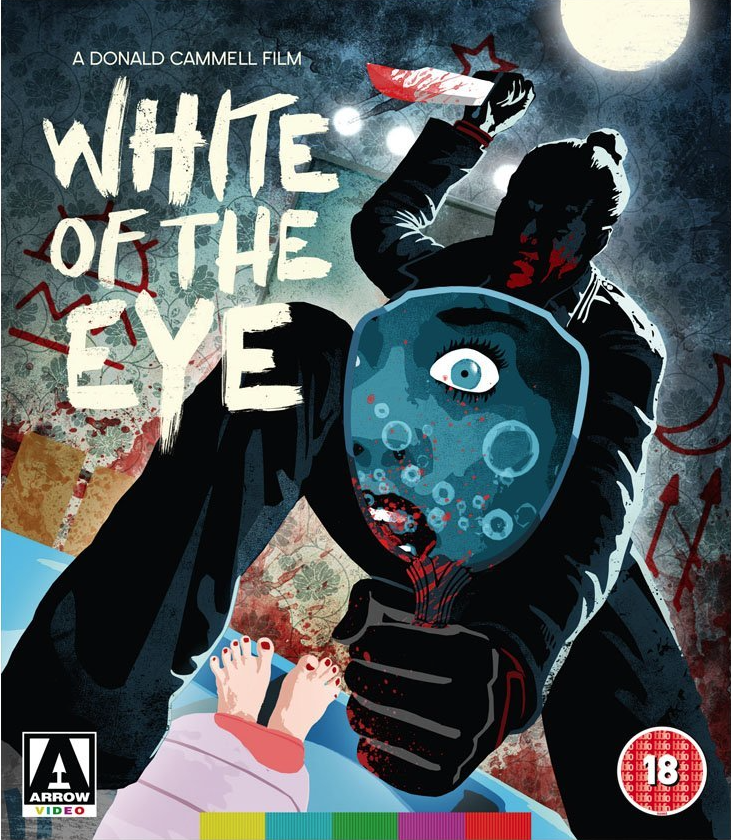
WhiteoftheEyeFilmJuice have my review of Donald Cammell’s thriller White of the Eye.

Donald Cammell is arguably best known for his first film Performance in which an east end geezer moves in with a jaded rock star and loses his values and identity in a world of sex, drugs and faded Edwardian interiors. Set in small town Arizona, White of the Eye could not be more different in so far as it conceals its artistic intentions beneath a thick genre glaze. The glaze in question is that a serial killer is moving from house to house murdering wealthy attractive women. Hired by the husbands of wealthy attractive women to install expensive sound systems, the film’s protagonist is sucked into the investigation despite his claims of innocent. Rather than following this narrative line in a conventional manner, Cammell slows things down to a crawl and begins to explore the protagonist’s history and relationships in exquisitely stylised detail:

Cammell’s film opens on a montage that feels like a dozen 1980s music videos crammed into a pot and reduced down to an inky sludge. Hints of ZZ Top collide with notes of Duran Duran as red wine splashes across tiles, blood arcs through the air and eyes are drawn to stocking-clad legs, pastel interiors and improbably geometric patterns. If, as Marianne Faithful once said, Performance took 1960s Chelsea and placed it under glass, White of the Eye takes the surface gloss of 1980s MTV and turns it into a living, breathing, bleeding world.

While the film itself is pretty damn fine, I was amused by the fact that the documentary included on the disc about Cammell made him seem like a complete and utter cock as it spends well over an hour talking about how much he enjoyed hanging about with aristocrats having loads of sex and taking loads of drugs. I appreciate that this might well have seemed incredibly transgressive and important to people in the 1960s but nowadays it just sounds like the Bullingdon club on spring break.

REVIEW – Alan Partridge: Alpha Papa (2013)

Alan Partridge Alpha Papa posterFilmJuice have my review of Declan Lowney’s Alan Partridge: Alpha Papa, easily one of the most disappointing films I have seen this year.

Despite his familiarity to and broad popularity with British audiences, the character of Alan Partridge is something of a cult figure; A comedy grotesque born not only from the self-conscious egotism of Steve Coogan but also the subtle brilliance of Armando Ianucci and Chris Morris, two of the most respected and influential writers in contemporary British comedy. Over the years, Partridge has undergone a slow process of evolution from little more than a means of mocking sports journalism to a a more rounded critique of low-end British celebrity and eventually middle-aged masculinity in general. That which began as Motson continued as Wogan and Titchmarsh before concluding as your dad. Given that each turn of the creative handle has injected more history and depth into the character, it is strange to find the beautifully nuanced Partridge of Welcome to the Places of My Life turn up in a knockabout cinematic comedy. Indeed, many of the problems with Alan Partridge: Alpha Papa stem from the fact that the film’s writers keep wanting to produce character comedy in a film set up to deliver broad and accessible jokes. Little surprise that this film seems to have encountered significant problems during the production process:

Most DVD releases contain making-of documentaries that are really little more than advertising designed to convince everyone that actors and crew all had an amazing time making the film. Alan Partridge: Alpha Papa breaks violently with that tradition by inadvertently laying bare the film’s tortured production history. The first warning sign appears when Steve Coogan apologises to his fellow actors for the lack of a finished script. From there we move on to talk about on-camera improvisation and some absolutely extraordinary footage in which Colm Meaney appears to be working out his character’s motivations on set while other actors mention the fact that they were frequently given their lines on the morning on which they were due to film the scene. This lack of a clear vision going into the project is evident not only in the sloppy narrative but also the comparative weakness of many of the jokes. Compared to your average cinematic comedy or TV sitcom, this film’s gag-rate is surprisingly low and when the jokes do come they invariably feel as though they could have been improved by a couple of re-writes. In fact, aside from a few good lines and a genuinely funny dream sequence, Alan Partridge: Alpha Papa is not a particularly funny film. It is not only less funny and less well made than such recent comedies as Bridesmaids, it is significantly less funny than Michael Lehmann’s 1994 comedy Airheads, whose plot is almost identical to that of Alpha Papa.

This is one of those films where you wish you could be a fly on the wall during production meetings as almost every aspect of the film seems to have gone wrong from the choice of locations to the choice of plot right through to the way in which the actors worked on set.

How actors work on set is actually a fascinating question as the rise of Judd Apatow seems to have ushered in an entirely new approach to the production of cinematic comedy. The reason why the trailers for films like Bridesmaids and Get Him to The Greek (both produced by Apatow) feature different iterations of the jokes that appear in the final films is that many contemporary comedies work by shooting numerous variations on the same basic gags. Sometimes these differences will be comedic in nature (different pace, different props, different lines), sometimes they will be technical (different angles, different lightings) and sometimes they will bring out different aspects of the plot or characters, but what all of these differences do is shift the act of creating the film from something that happens in the writers’ heads before production starts to something that happens in the heads of the editors and directors after production has completed.

Given the information contained in the astonishingly candid making-of featurette included on the DVD, it is tempting to conclude that Alan Partridge: Alpha Papa tried to use both approaches at the same time and wound up locating the creative act in the minds of writers and actors as they were sitting on set. Indeed, we see that Coogan and Meaney had a good deal of freedom in creating their parts on set and yet supporting actors were given their parts on the morning in which they were expected to shoot. This suggests that the film went through a continuous process of re-writing in which spontaneous acts of creativity would shape and reshape the characters who were supposed to serve as basis for much of the comedy. This also explains why so many of the gags felt under-written: The writers simply did not have time to finesse them. An experienced director could have imposed order on this process but the producers of Alan Partridge: Alpha Papa went with Declan Lowney, whose directorial experience lies mostly in TV comedies like Father Ted. Again, the making-of featurette reveals quite a lot about Lowney’s role as it is full of images of Coogan either directly undermining Lowney or assuming the type of leadership position that you would normally associate with a director.


REVIEW – The Pervert’s Guide to Ideology (2013)

PGTI_home2FilmJuice have my review of Sophie Fiennes and Slavoj Žižek’s lecture/documentary film The Pervert’s Guide to Ideology.

This film was a real disappointment for me. I remember discovering The Pervert’s Guide to Cinema when it screened on BBC4 and buying the DVD directly from the production company as it hadn’t quite managed to land a mainstream distribution deal. I love the visual style, I loved the choice of films it discussed and I loved the way in which Žižek took incredibly complex readings and compressed them down into diamonds of insight. I didn’t necessarily buy all of Žižek’s interpretations but criticism is a creative endeavour in which being boring is a far greater crime than being wrong. In that series, Žižek was never boring and so the series remains a fantastic piece of TV. Unfortunately The Pervert’s Guide to Ideology is a far less attractive prospect for a number of reasons.

The first major problem with this film is that Fiennes has failed to reign in Žižek. Pervert’s Guide to Cinema worked by providing its resident critic with a very clear framework: He could talk about whatever the fuck it was that sprang to mind but each of his flights of fancy had to begin and end with the text of a particular film. This not only forced Žižek to be concise in his opinions, it also meant that if the audience ever fell of the train of thought, they could re-orient themselves by using their knowledge of a particular cinematic text. Sadly, The Pervert’s Guide to Ideology suffers from the same problem that many of Žižek’s lectures (and now books) suffer from: a complete lack of intellectual discipline and a woeful tendency towards self-indulgence. As I explain in my review:

it is never entirely clear how Žižek’s opinions about the 2011 London riots relate to his opinions about Stalin’s efforts to position himself at the centre of not just Russian politics but Russian private lives as well. The more Fiennes indulges Žižek’s wandering attention span, the more insubstantial and hollow his ideas come to seem, something that is particularly evident in the slightly embarrassing attempt to conclude the film with something resembling a plan of action or a unified worldview.

In other words, this film is full of entertaining ideas… but none of those ideas ever amount to anything like a sustained intellectual critique. By failing to impose any limits on what Žižek couldn’t say, Fiennes has insured that he says nothing at all. In addition to these structural problems, the film also suffers from the decision to chase a cinematic release rather than the much longer TV-friendly running time enjoyed by the original series. The result is a lecture that tackles a much larger topic in much less time and with much less intellectual coherence. To paraphase Woody Allen: So much intellectual incoherence… and in such a small portion too!

REVIEW – Trevor Howard: Collection (2013)

trevor-howard-collectionFilmJuice have my review of a recently released collection of films starring the late great Trevor Howard.

The collection includes David Lean’s Brief Encounter, Herbert Wilcox’s Odette, George More O’Ferrall’s Heart of the Matter and a Carol Reed double-bill comprising The Third Man and Outcast of the Islands. While it is somewhat unfortunate that the collection doesn’t include Sons and Lovers (the film that netted Howard his only Oscar nomination), I feel that the films included here do an excellent job of showcasing precisely why it was that the odd-looking Howard rose to prominence as a leading man in post-War British cinema. The answer, in a word, is fallibility:

Instantly recognisable to anyone who grew up in the days when terrestrial TV channels still padded out their schedule with classic black and white films, Trevor Howard is one of the great screen presences of British post-War cinema. No matinee idol, Howard’s awkward looks and brittle manner made him the perfect choice for directors seeking a wounded British patriarch; a man of action who is forever tired, a romantic figure with just a hint of threat, a spy who gives away all his secrets and listens to no one. In fact, Howard was so effective in these sorts of roles that the end of his career saw him typecast as an impotent and dysfunctional authority figure: a symbol of broken imperial hubris to be mocked in Superman and denounced in Gandhi.

Howard is, in many ways, the antithesis to the unflappable patriarch played by Noel Coward in In Which We Serve, a fragile and selfish man who tries to assume the role expected of him by his society only to fail and fail again. Interestingly, Howard’s film career was boosted by his reputation for being something of a war hero who did ‘good work’ in the royal corps of signals during the Second World War. However, as Terence Pettigrew revealed Trevor Howard: A Personal Biography, Howard was actually kicked out of the army for having a “psychopathic personality”. I can think of no more fitting a life story for a man who would spend his career playing flawed patriarchs.

In terms of the films included in the collection, Brief Encounter, Odette and The Third Man are unimpeachable classics of post-War British cinema which more than justify picking up the collection. However, the other two films are somewhat less than brilliant.  I bounced quite hard off the hysterical racism of Outcast of the Islands but warmed to the odd narrative structures and atmospheric cinematography of O’Ferrall’s Heart of the Matter. However, I can completely understand people having the opposite reaction as in the case of Viv Wilby’s excellent write-up of the collection over at Mostly Film:

In his New Biographical Dictionary of Film, the critic David Thomson blames Trevor Howard’s second-league career on bad role choices and a reluctance to move to Hollywood. Maybe. Or maybe he was hidebound by a British film industry that struggled to see him in anything other than upper-middle class officer roles. Or perhaps he was just born too early. Were he in his prime in the 60s rather than the early 50s perhaps he would have had more interesting choices to make. One of his favourite roles was apparently the eccentric aristocrat in Vivian Stanshall’s 1980 film Sir Henry at Rawlinson End. That would have been a more interesting addition to a Trevor Howard boxset than, say. Odette. But even in this rather narrow selection of movies, Howard shows himself to be an actor of great versatility and sensitivity and there’s much to admire and enjoy.

While I can see the case for excluding Odette, I think it would be foolish to do so. Odette casts Howard as a deluded and privileged foil to Anna Neagle’s quietly heroic female spy who undergoes terrible hardship without breaking whilst Howard’s character enjoys a much softer treatment by virtue of his family connections to Churchill. Aside from being the originator of the immortal “we have ways of making you talk” line and the inspiration for the way that Allo Allo handled British people speaking in different languages by varying their accents, Odette can actually be classed as a feminist film. At a time when most big releases struggle to pass the Bechdel test, it is hard to imagine a lavishly produced studio picture about the quiet heroism of a middle-aged woman.

REVIEW – Citadel (2012)

Citadel_2FilmJuice have my review of Ciaran Foy’s debut horror movie Citadel.

Set on a council estate that might be in Ireland or possibly Scotland, Citadel revolves around a single father attempting to escape from a decaying council estate that is over-run with faceless hoodies. When the hoodies break into his council house in a bid to abduct his daughter, the young man turns to a psychotic Catholic priest who urges him to abandon all fear and compassion. Turns out the feral underclass are the inbred “dog children” of a pair of junkies and the only way to ‘save’ them is to murder them in an enormous gas explosion that will not only wipe the streets clear of impoverished scum but also allow the young man to become a real father.

The problem with Citadel is that, rather than seeking to examine middle class fears of a feral underclass, Foy treats these fears as entirely rational thanks to a backstory that deploys not only the language of class warfare as found in the pages of the Daily Mail but also fears of miscegenation, violence and unreasoning carnality that are common to pretty much every racial panic in recorded history. Much like Velt Harlan’s Jew Süss and D. W. Griffith’s The Birth of a Nation, Ciaran Foy’s Citadel uses crude stereotypes to dehumanise and degrade whilst equating personal fulfilment and moral clarity with an act of grotesque violence against the dehumanised group. This makes Citadel not just ugly and reactionary, but downright fascistic in both its imagery and argument. To produce a film like this at a time when poor people are disproportionately subject to government funding cuts is nothing short of reprehensible.

As distasteful as it may be to make a film that dehumanises the poor at a time when they are being disproportionately targeted by government cuts, Citadel somehow manages to be even more offensive by virtue of receiving funding from government bodies such as the Irish Film Board and Creative Scotland. What this means is that while the Scottish and Irish governments may well have cut back on the amount of money they use to help poor people, they still found money to help produce a film that demonises the poor and advocates killing them all in an enormous gas explosion. How’s that for a slice of class warfare?

REVIEW – Shame (2011)

Back in 2008, I struggled with the religious imagery of Steve McQueen’s debut feature Hunger (2008). I struggled with it because it seemed too obvious and because the troubles had been cast in that particular light altogether too many times.  I have since rewatched Hunger and I now realise that I was wrong. I was wrong to read the film as being Catholic in sentiment and I was wrong to argue that it was simply retreading old ground. When I said that Hunger “cannot get out from under the weight of cinematic history”, I might as well have been writing about my own review. Given that my fondness for Hunger has grown over the years, I was somewhat reluctant to go and see his second feature Shame at the cinema. Aware of my history of not ‘getting’ McQueen’s films and concerned that the film’s subject matter struck me as over-exposed and boring, I waited for the DVD release… and then waited some more. In truth, I was happy to let this film slip away from me until I was offered a review copy. Just When I Thought I Was Out… As a result, Videovista have my review of Steve McQueen’s Shame and it is full of ambivalence.

Set in an economically prosperous but emotionally barren New York City, Shame tells of a successful man who devotes his life to the pursuit of orgasms. Orgasms by hand, orgasms by mouth, orgasms by any means necessary and to the exclusion of all other avenues of pleasure and fulfillment. Moving from one nameless sexual partner to the next, the character leads an admirably simple life and appears to experience none of the downsides traditionally associated with a hedonistic lifestyle. However, this simple existence is thrown out of balance when the character’s emotionally incontinent sister comes to stay. Suddenly plagued by feelings of shame, the character attempts to re-invent himself as a normal person only to fall at pretty much the first hurdle. While much has been made of the film’s interest in the question of sex addiction, my view is that the film is attempting to do what it says on the tin, namely examine the role of shame in making us do the things we do:

 What distinguishes Shame from the likes of Lost In Translation and Up In The Air is that it pointedly refuses to use the same psychological model as most films and TV dramas. Most film and TV writers create their characters using a somewhat simplified version of Freudian psychodynamics. In particular, they tend to be very fond of the Freudian concept of displacement whereby an irrational over-reaction to one thing is actually the product of a rational but socially unacceptable reaction to something else. For example, in Up In The Air, George Clooney’s character comes across as excessively hostile to a co-worker who is attempting to force him off the road and into an office job. Initially, this reaction seems perfectly understandable but as the movie progresses and Clooney’s character becomes more and more unreasonable; we learn that the true source of his unease is the fact that he has no social bonds and hates the hugely successful career that he has built for himself. Some critics have sought to interpret Brendon’s sexual escapades in light of an unmentioned childhood trauma, but McQueen pointedly makes no reference at all either to Brendon’s inner life or to the emotional life of his childhood. The reason for this is that McQueen wants us to focus only upon that which we can see and what we see is a man who is forced out of his comfort zone because he feels ashamed.

While I think that McQueen’s attempt to break new psychological ground is nothing short of heroic, I am not convinced that the film ever gains any traction on the concept of shame. Add to this the lack of visual firepower and what you’re left with is a quite traditional arty drama held together by two decent performances. Which is a recipe for Oscar-bait, not thought-provoking cinematic art.

The Glorious Indiscipline of Michael Powell and Emeric Pressburger

The good people at FilmJuice have just updated their site and the latest update includes my article on the films of Michael Powell and Emeric Pressburger.

Prior to agreeing to write this article, my experience of the Archers was (like many people) limited to some of their bigger and better-known films including The Red Shoes, Black Narcissus and The Life and Death of Colonel Blimp. However, after dusting off the excellent ITV box set and delving into Powell and Pressburger’s back catalogue, I quickly realised that posterity has done the Archers a grave disservice by choosing to pool its affections on so few of their films. Indeed, one of the things that distinguishes The Red Shoes, Black Narcissus and The Life and Death of Colonel Blimp from films like The Battle of The River Plate or A Canterbury Tale is that they are a good deal more disciplined and thematically focused than many of the Archers’ less celebrated films. For example, The Battle of The River Plate begins by laying the foundations for what we expect to be a traditional World War II naval movie in the grand tradition of Noel Coward and David Lean’s In Which We Serve. However, halfway through the film the battle itself takes place and the action immediately moves away from the war ships on onto the journalists and diplomats reacting to the battle. From there, the film explodes into what can only be referred to as a ‘naval procedural’ in which people debate shipping laws and propaganda. However, rather than celebrating the cleverness of men in suits, the film concludes with an enigmatic but nonetheless moving scene in which a bluff British naval officer pays tribute to the aristocratic German captain who held him prisoner. This refusal to expand upon the relationship between the two men or relate it back to the core themes of the film may initially seem quite slapdash but it ultimately manages to capture something of the complexity of modern warfare. War, the Archers seem to suggest, is not about ships or spies or even victory… it is about people and people often get squeezed out when nations go looking for stories to tell their people. A similar thematic largesse features in A Canterbury Tale:

Set in an idyllic English village, the film follows a group of conscripts as they try to uncover the identity of the man who is terrorising the local women by pouring glue in their hair. Initially quite genteel and grounded in social realism, the film soon spirals out into a demented meditation on the wartime emancipation of women and the ambiguous nature of social change. Filled with lovely cinematic moments and a central figure that would not be out of place in a J.G. Ballard novel, A Canterbury Tale never quite manages to present a coherent argument or viewpoint and so comes across as the product of adoring foreign eyes surveying a dying civilisation. Think of a Miss Marple film directed by Yasujiro Ozu and you will get a good idea of the film’s tone and focus.

In writing this article I realised that part of what makes the films of Powell and Pressburger so special is their refusal to pin themselves down to a single idea or a single theme. Filled with dangling threads and thematic bombast, the films of Powell and Pressburger are a mess. A glorious and undisciplined mess just like this sequence from their adaptation of The Tales of Hoffman: