REVIEW – The Banshee Chapter (2012)

the-banshee-chapterFilmJuice have my review of Blair Erickson’s bizarrely incompetent horror movie The Banshee Chapter.

When I say “bizarrely incompetent”, I mean that while some of the set-pieces are incredibly effective and the opening vignette is incredibly eye-catching, the film has one of the most poorly-constructed narratives that I have ever encountered. People spit a lot of bile at the likes of Uwe Boll but despite making cheap, shoddy and astonishingly boring films, Boll is at least able to construct a cinematic world that makes some sort of sense.

Every style of storytelling has rules. Though some would argue that these rules are hard-wired into the human brain, a less Darwinian theory is that we are socialised into expecting certain kinds of story from certain kinds of work. Consider, for example, the way that Ruggero Deodata’s Cannibal Holocaust borrows techniques from documentary filmmaking and uses them to make his otherwise quite conventional horror film seem more terrifying. Another fine example of a work that transgresses the boundaries between genres is Stephen Volk’s Ghostwatch, which terrified Britain by using the tropes and faces of British TV to tell a fictional ghost story. Blair Erickson’s film also moves between a number of different genres and borrows from different cinematic traditions but rather than blurring the boundaries to create a particular effect, Erickson muddles the boundaries in a way that suggests he was incapable of telling the difference between them:

This is particularly glaring when Erickson continues to use found footage techniques despite the fact that the journalist is no longer keeping a video diary. It is one thing for the picture to go fuzzy and the camera to dart around in a panicky fashion when a terrified character is holding it, but why would there be interference and panicky camera movements when none of the characters are holding a camera? What is that interference supposed to represent? Erickson’s confusion of first-person and third-person perspectives on his cinematic world results in a world so broken and incoherent that it comes dangerously close to collapsing in a puddle of beautifully-edited gibberish.

Frequent visitors to this here site will doubtless have noticed that one of my most common complaints is that while a film may be beautifully made, it has absolutely nothing to say. This is undoubtedly a result of the fact that people can now go to film school, learn how to be a competent director, acquire the funds to make their own film and then realise that they have no particular message to convey or story to tell. While Auteur theory stresses the importance of vision and of having the freedom to fully realise that vision, it struggles when forced to content with neophyte directors who are still trying to find their feet. Undoubtedly a talented editor and a filmmaker with some potential, Erickson should have been reigned in by both a working script and a producer willing to ask uncomfortable questions but instead he seems to have been given free reign resulting in a film so stylistically incoherent that it is frequently impossible to tell what it is that we are supposed to be seeing.

Banshee Chapter could have been an atmospheric return to paths already well-trodden by the X-Files but instead it is an incoherent mess. While my review blames Erickson for his inability to tell a story, a more likely set of culprits are the producers who either failed to spot a foundering director or refused to throw him a life raft. Hollywood is now quite fond of marketing films on the basis of who produced them and the PR bullshit for this particular film listed Zachary Quinto’s involvement no less than three times. Based on Banshee Chapter alone, I’d say that ‘…from the dude who plays Spock in those terrible Star Trek movies’ is more of a bug than a feature.

The Sight of the Hunted: German Expressionism and Night of the Hunter

night of the hunter poster

FilmJuice have published a lengthy piece written in celebration of the recent re-release of Charles Laughton’s legendary Night of the Hunter.

This piece was a real joy as it gave me an excuse to not only rewatch the film for the first time in a while, but also to do some research into Laughton’s life and refamiliarise myself with some of the better works of German Expressionist cinema. I wrote quite a lengthy piece about German Expressionism for Videovista a few years but my understanding of that particular cinematic milieu has solidified somewhat and hooked up with some much larger thoughts I’ve been having about the relationship between psychological realism and fantasy in the psychological thriller genre. In my original Videovista article, I spoke about Expressionism in terms of:

Expressionism emerged as a reaction to impressionism. Impressionism, as practised by the artists Claude Monet and Pierre-Auguste Renoir attempted to break down the boundaries between subject and background in order to produce paintings that were almost like snapshots: images that were exacting reflections of the world itself. Expressionism reacted against impressionism by rejecting the call to represent the world ‘as it is’. Instead, expressionists favoured representations of the world that ‘expressed’ the artists’ attitudes towards the subject matter. They did not reflect the world, they abstracted from it. A key work in the development of expressionism is Edvard Munch’s painting The Scream (1893), in which the insane flowing colours of the background, the pale featureless visage of the screamer and the dark figures in the background express not merely a person screaming but rather a state of inner turmoil, paranoia, alienation and insanity.

Now I say far more straightforwardly:

The most influential work of German Expressionist cinema is undoubtedly The Cabinet of Dr. Caligari. Told entirely in flashback by a man who turns out to be an inmate in an insane asylum, Robert Wiene’s film is a hypnotic mess of light, shadow and unsettling angles. Too fantastical to be real and yet too raw to be fictitious, Caligari’s story of love, murder and sinister sleepwalkers is best understood as an emotional landscape, a realistic portrayal of what the real world feels like to the person telling the story. The light and darkness of Caligari’s world are absolute because they are absolute in the mind of the madman just as they might be in the mind of a child. This is the exact same idea that lurks behind the myriad eccentricities of Laughton’s Night of the Hunter.

Rather than seeing the film through the gauze of southern gothic, I view it as a quite explicitly psychological piece: The fantastical nature of many sequences and effects are not reflections of a world that is in itself fantastical but rather a reflection of how that world feels to the children and how children (and everyone else for that matter) use the culture they have consumed in order to make sense of the world around them. It is only natural that the world should resemble a fairy tale when the only time you have heard of evil priests and murderous ogres is in the pages of just such a children’s story. Far from being limited to the children’s worldview, Night of the Hunter occasionally switches to other worldviews such as those of the mother, a friendly drunk and a horny teenaged girl. This is a film that not only reaches back to a cinematic vocabulary that was largely unknown to 1950s American audiences, it also takes those Expressionistic techniques and takes them to the next level. Night of the Hunter is a film that is literally decades ahead of its time.

Mother

REVIEW – Upstream Color (2013)

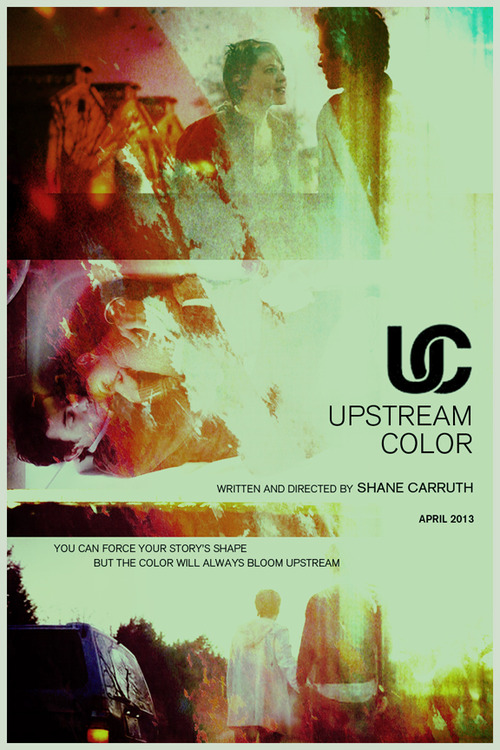
Upstream-Color-PosterFilmJuice have my review of Seth Carruth’s art house SF film Upstream Color, which came out this week on DVD and Blu-ray. I loved the film but it also made me intensely aware of the limitations of certain styles of cinematic storytelling.

At the heart of Upstream Color is a very conventional relationship movie: Two fragile people struggling to overcome life-threatening traumas meet on public transport and immediately recognise themselves in each other. Initially quite tentative, the two fragile people orbit around each other; feeling the attraction but afraid of getting too close lest they get sucked in. When the pair do eventually commit to each other they connect on such a profound level that the lines where one person stops and another person begins begin to blur. Whose memories are these? Whose emotions are these? Am I me? Are you me? Told in a way that emphasises visual storytelling over verbal exposition, Upstream Color looks and feels very much like the type of film that European art house cinema has been churning out for the last fifty years. World cinema is a very different cinematic tradition to that of Hollywood but the techniques and themes favoured by that tradition mean that Carruth can quite easily pick up their tools and tell yet another story about alienated people undergoing the ambivalent process of change associated with love and the construction of a couple’s subjectivity. This cinematic vocabulary is a mature system and Carruth is a talented-enough director to use those tools to tell a really effective if ultimately unchallenging relationship story. However, Upstream Color is a lot more besides…

Halfway through watching the film, I pointed out on Twitter that Upstream Color felt a lot like someone using an iPad to make scrambled eggs. What I meant by this was that while the core story was really quite mundane and unadventurous, Carruth tells his story using one of the richest and most complex metaphorical infrastructures in recent cinematic history. Yes, this film is all about empathy and Carruth uses an explicitly Science Fictional device to explore how empathy can open us up to good as well as bad experiences, Carruth’s device is actually a lot more complex than a traditional relationship drama would require. Indeed, while Buffy the Vampire Slayer trod similar ground by making Buffy temporarily telepathic, Carruth cracks the egg of human relationships with the genre equivalent of a sledgehammer. A worm that, when consumed, puts people in state of such psychological vulnerability that someone can effectively clean out their bank account, destroy their life and order them to forget the whole thing. Even more conceptually lavish, Carruth explores the life-cycle of these worms and how, once removed from a human host, they allow people who understand the technology to ‘check in’ and watch the people that were once infected. Frankly, there are enough ideas and story-hooks in these worms to support and entire film festival but Carruth only really begins to exploit the thematic potential of his device at the end of the film:

Aware that his genre tropes can probably handle a lot more than a simple relationship story, Carruth devotes the final act to pushing the limits of his metaphorical infrastructure and so we are treated to an absolutely beautiful sequence in which the life-cycle of the worms is revealed and a further sequence in which Jeff and Kris confront their shared trauma and tentatively begin edging towards a less isolated way of living. Carruth handles both of these expansions quite well but the combination of oblique storytelling techniques and limited space means that much of their thematic and dramatic potential must remain untapped. Indeed, Terrence Malick’s The Tree of Life spends over two hours wrestling with ideas far less substantial than the ones that Carruth rushes through in less than ten minutes!

In an age when both art house and mainstream directors are making films based on tired and insubstantial ideas, it is both refreshing and slightly overwhelming to encounter a film that could easily have been a trilogy or a series. Upstream Color is not just an incredibly beautiful and well-told story, it is a film so full of ideas and thematic resonances that it is almost too frustrating to watch. Sitting through Upstream Color I was struck by the extent to which art house cinematic techniques struggle to convey new types of information. Watch enough art house films about alienated people trying to get their lives back on track and those techniques are incredibly effective at conveying mood and theme but ask those techniques to explore the psychic fallout of discovering that you are only one of hundreds of people who have been secretly observed by shadowy figures and those techniques begin to struggle. Upstream Color could have been about the NSA and Google dismantling privacy, it could have been about post-traumatic stress or it could have been about the psychic fallout from being involved in a mass event like a terrorist atrocity or a religious cult. It could have been about any of these things and yet the film ended too soon.

REVIEW – Creepshow (1982)

creepshowFilmJuice have my review of George A. Romero’s infamous horror/comedy Creepshow. Infamous… not because it’s particularly funny or scary, but rather because it features the film’s writer Stephen King playing a dungaree-clad redneck simpleton who slowly turns into a hedge. Creepshow is something of an odd cultural artifact as, despite having an incredibly famous writer and an incredibly famous director, the film is actually quite shit. Indeed, re-watching the film and scowling my way through its terrible gags and ineffectual scares, I was struck by the fact that this film’s fame owes less to the film itself than it does to its impeccable geek heritage. As I put it in my review:

Nostalgia only ever functions within the confines of a single generation and expecting contemporary audiences to feel nostalgic for comics produced in the 1950s is a fool’s errand.  Creepshow may well have struck a nerve with audiences when it first appeared but uneven writing and questionable direction mean that this film is now of little more than historical interest.

The nostalgia I speak of is nostalgia for a range of oddball horror comics published in the 1950s by a company called EC. As I explain in my review, before being wound down into a rump publishing little more than Mad Magazine, EC acquired a huge following by pioneering the combination of comedy and horror at a time when comics were being broken on the rack of public opinion for their supposed role in creating juvenile delinquents. Despite being something of a flash in the pan, the sensibility pioneered by EC was immensely influential on American babyboomers and traces of EC heritage can be found not only in the work of George A. Romero and Stephen King but also people like Stephen Spielberg, Sam Raimi and anyone from that generation who took it upon themselves to direct a horror/comedy. The problem is that, while the ‘boomers clearly loved their EC comics, they drank so deeply from the wellspring and returned to it so often that the idea explored by the EC comics themselves now seem incredibly dated and dull. We’ve seen it before and we’ve seen it better because everyone who ever read an EC comic decided to borrow the idea and make a film about it.

At the time, Creepshow must have seemed like a great idea and given how many 1980s film critics must have read EC comics as children, I’m sure the sense of shared love and nostalgia was universal. However, while nostalgia is an incredibly potent force that excuses many great cultural ills, it doesn’t transfer between generations meaning that while EC comics might have meant a lot to ‘boomers, they don’t mean anything to people like me. In fact, I’m more like to be nostalgic for the work of Romero and King than I am for the work that inspired them. Stripped of its shield of nostalgic good will, Creepshow reveals itself as poorly conceived, poorly written and poorly made.

I got into this question when I reviewed Sam Raimi’s Drag Me To Hell back in 2009:

What most struck me as I sat watching Drag Me To Hell is its quite overt racism.  The film’s depiction of the Roma people is straight out of the darkest dreams of the Daily Mail and a tradition of racial prejudice, fear and scape-goating that stretches back at least as far as the Dark Ages.  Mrs. Ganush is physically disgusting, replete with disease and foul habits.  A vindictive and dishonest creature who needs little provocation before lashing out at honest white middle class people using her sinister gypsy powers.  Her family are presented in a similar tone as a pack of ugly, sinister and unsympathetic people playing weird violin music in the basement of a tumbledown old house.  I would have some sympathy for the idea that the Raimi brothers – as Americans – have little awareness of the spectre of genocide that still hangs over the European treatment and depiction of gypsies except that, even accepting that this kind of gross ignorance is acceptable, it does not explain why the same kind of racially-inspired, type-based characterisation also applies to other non-White characters.

At which point, Patrick Hudson appeared in the comments and mentioned not only Creepshow, but also nostalgia for EC comics. At the time, I was unimpressed by the suggestion that nostalgia somehow made Sam Raimi’s antitziganism acceptable but since then, my position has hardened even further: Nostalgia does not travel between generations and any attempt to force the issue (as in the case of Olivier Assayas’ recent love letter to the 1960s) is likely to result in a film that makes its creator look either sentimental, simple-minded or politically reactionary.

Spring Breakers (2012) by Harmony Korine

SB1People fond of European and World cinema often accuse Hollywood of churning out safe, derivative crap whilst turning a blind eye to the fact that the vocabulary of art house film has remained largely unchanged since the 1960s. Indeed, if you have seen Michelangelo Antonioni’s L’Avventura and Alain Renais’s Last Year at Marienbad then you are unlikely to be surprised by anything that appears in your local art house cinema. The truth of the matter is that cinema is an expensive medium and the conservative forces that compel American filmmakers to produce violently misogynistic popcorn movies are the same as the ones compelling ambitious non-American directors to produce beautifully shot stories of middle-class alienation filled with extended silences and psychological ambiguities. Given how many promising talents are crushed by the gears of these mature economic systems, it is always something of a delight when a director manages to follow their own path and find their own means of expression. Harmony Korine is just that kind of director.

Korine’s latest and most widely marketed work opens with a montage that is both completely out of character and utterly in keeping with the director’s favoured themes. The scene is one of oppressive revelry as American students drink, dance and grind up against each other in the Florida sunshine. Shot through a slightly greenish filter, the scene is gorgeously bright and yet oddly murky, as though someone had decided to open the Arc of the Covenant at the bottom of a garden pond. Korine is best known for such quirky portraits of impoverished dysfunction as Gummo and Trash Humpers but he was also the writer behind Larry Clark’s Kids and Ken Park. The sensibility that unites all of these films is that contentment (and even transcendence) is most likely not going to be found in all the usual places; churches, stable relationships, middle-aged men walking through fields of grass whilst talking in voices filled with hushed awe. Happiness is where you find it and chances are that the place you eventually find it is going to seem incredibly ugly and bleak to anyone who isn’t you. We see this in the squalid threesome at the end of Ken Park, we see this in the psychotic performance art of the Trash Humpers and we see it in the dub-step, boobies and beer bongs of Spring Breakers’ opening montage, which is best described as Ibiza Uncovered with better dentistry.

Continue reading →

REVIEW – Nowhere (1997)

NowhereFilmJuice have my review of Gregg Araki’s psychotronic teen soap opera Nowhere.

Final installment of Araki’s wonderful Teenage Apocalypse series (along with Totally Fucked Up and The Doom Generation), Nowhere follows a group of American teenagers as they work to find themselves in a swamp of sex and drugs. Melancholy and often seen as more reactionary than the earlier films in the series, Nowhere focuses less on the joys of transgressive sex and drug-taking than on the psychological consequences of immersing yourself in one particular culture. The film’s main protagonist is dating a beautiful girl who turns out to be naturally bi but while the main protagonist is also naturally bi, he struggles with the idea that he must share his girlfriend with a woman. In fact, the thought so bothers him that he ends the film by fleeing his transgressive subculture in pursuit of a far more traditional and romantic belief that there is one person out there who will suit his needs perfectly.

While you could, if you were that way inclined, read this narrative as an indictment of youth culture and an Assayas-style mutterings about everyone needing to grow up and settle down, I think a more interesting approach is to view the film as a 90s equivalent to that speech in Fear and Loathing in Las Vegas where Hunter S. Thompson remembers the end of the 60s. The one that ends with:

So now, less than five years later, you can go up on a steep hill in Las Vegas and look West, and with the right kind of eyes you can almost see the high-water mark — that place where the wave finally broke and rolled back.

Gregg Araki’s Nowhere is not about the wave rolling back but about that moment when the wave slows and you think maybe it’s not going to make it all the way up the beach after all. Maybe it’s going to stop. Maybe it was never going to make it after all.

Imbued with a touch more humanity than many of his peers, Dark begins to notice strange things happening on the edges of his culture; alien lizards are disintegrating vacuous teens while a televangelist makes big promises on late-night TV. Filled with dread and alienated from the air of fashionably empty transgression surrounding him, Dark abandons the values of his peers in favour of a traditional fantasy of finding one person with whom he can spend the rest of his life. Aware that something is slipping away from him, Dark makes an uncharacteristically articulate speech about reaching the end of an era as his lover explodes leaving only an alien insect that promptly climbs out the window taking all youthful weirdness with it.

REVIEW – Mea Maxima Culpa: Silence in the House of God (2012)

MeaMaximaCulpa1FilmJuice have my review of Alex Gibney’s documentary Mea Maxima Culpa: Silence in the House of God.

One of the most fascinating battlefronts in contemporary culture is the question of how the baby boomers will be remembered once they are gone. Raised amidst talk of their parents having been the greatest of all generations, the boomers have always been intensely aware of their own place in history and the need to impose some sort of narrative on their predictably chaotic lives. For a long time now, the baby boomers have been telling us that theirs was the most liberal and radical of generations: Neither empire-builders nor war-mongers, they came out against the Vietnam War, spawned the summer of love and demanded the right to live life entirely upon their own terms. That generation did it all and when the time came for them to ‘grow up’ they took their longhaired rebel logic with them into the boardroom and created one of the longest periods of sustained economic growth in the history of humanity. Nowhere is the desire to ‘fashion’ the generational narrative more evident than in Hollywood where B-movie Shitlord Roger Corman has been re-imagined as a visionary producer simply because Hollywood boomers need to believe that they rose to the top in a period of unrivalled openness and experimentation.

While inter-generational power differences mean that relatively few people are directly calling out the boomers on their relentless selfishness and toxic self-involvement, we are beginning to see some pushback in the form of prominent institutions falling into scandal and crisis. Indeed, the UK’s Operation Yewtree seems to be quietly re-inventing the swinging 60s as a time when men with jobs in the British media got to rape as many young women as they wanted while police and employers looked the other way. Turns out that ‘free love’ only ever applied to powerful white dudes. Alex Gibney’s documentary Mea Maxima Culpa: Silence in the House of God is very much a part of this cultural battlefield as it is one of many recent documentaries to suggest that the 60s and 70s were a time when Catholic priests were effectively above the law when it came to the sexual abuse of children. Much like Kirby Dick’s Twist of Faith and Amy J. Berg’s Deliver Us From Evil, Mea Maxima Culpa suggests that child abuse was almost systemic as was the Church’s desire to protect the abuser at the expense of the abused.

The science fiction writer William Gibson once stated that while the future is here, it has not been evenly distributed and I think the same can be said of the liberal individualism of the baby boomers: Much like the revelations of Operation Yewtree, films like Mea Maxima Culpa suggest that while some people had a load of fun in the 60s and 70s, this fun came exclusively at the expense of people who have been denied the right to give their own impressions of what life was like at that particular time. Though Mea Maxima Culpa may lack the anger and analytic depth of films like Twist of Faith and Deliver us from Evil, it does do a singularly fantastic job of letting the voiceless speak for themselves, something that is particularly important given that the abused, in this case, were all deaf:

Gibney films his interviews with the survivors using an elegantly subdued form of lighting that beautifully emphasises the expressiveness of their faces. Also important is the fact that, rather than systematically cutting away from the survivors and having their words translated by non-deaf actors, Gibney keeps the audience’s attention firmly on the survivors allowing them to communicate their own feelings in their own words and in their own language. This choice of interview technique is important because Mea Maxima Culpa is not just about the Catholic Church’s attempts to cover-up decades of sexual abuse, it is also about giving a voice to people who had theirs taken away by a Church that claimed to have their best interests at heart.

As someone whose familiarity with sign language is limited to on-screen sign translation of TV programmes, it really was fascinating to see native signers using their own language to deliver incredibly personal and intimate truths. Sign translators are professional translators rather than actors and so they tend to translate what they are hearing in a way that communicates their personal detachment from the material (their facial expressions and body language tend to say ‘this is a sad bit’ rather than ‘I am sad’) and so seeing sign language being used in an emotive manner was really quite the revelation. Even if you are not all that interested in another story about the moral bankruptcy of the Catholic Church I think that Gibney’s interviews with the abuse survivors alone make this a film worth seeking out.

REVIEW – West of Memphis (2012)

west-of-memphis-posterEvidently, I am passing through a documentary phase as FilmJuice have my review of Amy J. Berg’s West of Memphis.

I first became aware of Amy J. Berg through her film about the clerical abuse scandal Deliver Us From Evil. While the subject matter may now be reaching the point of saturation, Berg grabbed my attention by daring to place paedophile priests in the wider social context of a Catholic Church that hates homosexuality almost as much as it hates women. However, while Deliver Us From Evil was nominated for an Oscar, it also saw Berg drop off the map for a number of years and so I was very pleased to see her return to the director’s chair for this high-budget documentary about the West Memphis Three.

Given how impressed I was by Berg’s debut feature, it is slightly dispiriting to find her turning her hand to a film that is unadventurous both in terms of its form and its analysis. Indeed, much of West of Memphis‘s substantial running time is devoted to an extended recap of the ground already covered in the Paradise Lost trilogy of documentaries that have already been made about this particular topic. So while I’m sympathetic to the film’s aims and acknowledge that it’s a perfectly well-made and entertaining piece of documentary filmmaking, I do question the wisdom of making yet another film about this case. Are there really no other injustices in the world? If you are going to make a film about a topic that has already been covered by an entire trilogy of documentaries, I think it is important to do something new with the material and West of Memphis never quite manages to innovate:

There is no denying that West of Memphis is a worthy film and that this worthiness is utterly undiminished by the fact that three very good documentaries have already been made about this case. Nor is there any denying that Peter Jackson, Fran Walsh and all the other people working to free the West Memphis Three did a profoundly good thing by using their money and celebrity to help three unloved and unjustly convicted men from Arkansas. There is no denying any of these things and yet these things cannot entirely compensate for the fact that West of Memphis fails to offer us anything that we have not seen before. Hollywood has a fondness for documentaries designed to overturn miscarriages of justice and though certainly entertaining and occasionally compelling, this film never quite compares to either the exquisite ambiguity of Andrew Jarecki’s Capturing the Friedmans or the campaigning psychological complexity of Errol MorrisThe Thin Blue Line.

It’s hard to be unimpressed about this type of documentary without also seeming unimpressed with the subject matter but I was unimpressed, it felt like a step backwards by a promising director.

REVIEW – Blood Simple: Director’s Cut (1998)

BloodSimpleFilmJuice have my review of Joel and Ethan Coen’s first film Blood Simple. Or rather, the slightly shorter director’s cut that was released about fifteen years after the original film.

I found this review quite difficult to write as while I have seen and enjoyed most of the Coen Brothers’ films, I’m also acutely aware that their work invariably seems less substantial the more you think about it. Though some of their films are easily dismissed as more-or-less enjoyable tosh, some of their films feel like substantial dramas. Indeed, both A Simple Man and The Man Who Wasn’t There seemed intellectually robust when I first saw them but I am now hard pressed to remember anything about them aside from a couple of throwaway gags. Blood Simple felt very similar in that it is a film that does a great job of looking smart even though it is really little more than a pastiche:

Clearly inspired by such hardboiled crime novels as Dashiell Hammett’s Red Harvest and James M. Cain’s Double Indemnity, Blood Simple takes a collection of film noir clichés, drives them out of the city and deposits them in a crummy bar at the tail end of Texas. Stripped of their tilted fedoras and artfully crumpled raincoats, the clichés valiantly attempt to start new lives but eventually find themselves sliding back into old familiar habits.

Watching Blood Simple, I couldn’t help but reflect upon the fact that the dividing line between a ‘smart’ film and a ‘dumb’ film is often a question of viewer charity as a charitable viewer is more likely to detect meaning and symbolism than someone who is bored out of their tiny mind. Indeed, skilled directors know that it is possible to make a film seem smarter by using some of the visual and stylistic cues that people associate with smartness. For example, even though Jon Favreau’s Iron Man and Christopher Nolan’s The Dark Knight Rises do not actually say anything substantial about either the War against Terror or the Occupy movement, visual references to both of those real world events goaded critics into assuming both films had elaborate political messages. Similarly, art house films such as Eugene Green’s The Portuguese Nun and Carlos Reygadas’ Silent Light are so good at looking like serious intellectual films (long takes, lots of silence, beautiful photography, impressions of interiority) that many critics simply assume that they were in fact serious art house films filled with deep and meaningful truths.

Blood Simple is very much like a Batman comic in so far as it looks really dark, twisted and psychological but that look is ultimately all it has to offer. Watching Blood Simple I began to think about whether No Country For Old Men is a smart film or merely a film that looks smart… is there any difference? Does ‘smartness’ actually exist outside of the audience’s heads?

Detachment (2011) by Tony Kaye

detachmentBack in the 1990s, Tony Kaye seemed destined for great things. After cutting his teeth on a series of award-winning music videos including “Runaway Train” by Soul Asylum, Kaye took the step up to the big leagues and signed on to direct American History X, a film that humanised a pair of skinheads and blamed American middle-class culture for their descent into violent racism. However, while the film’s power and insight have become only more evident with the passage of time, American History X very nearly ended Kaye’s career as the studio’s indifference to his first cut lead to a very public PR battle in which Kaye bemoaned his treatment in a series of full-page adverts in the Hollywood press. His reputation effectively ruined, Kaye returned to music videos until his 2006 abortion documentary Lake of Fire paved the way for another shot at feature-length cinematic narratives. Like American History X and Kaye himself, Detachment is an unsettling and ambiguous film that assaults contemporary morals with a fury so intense, grandiose and ill-disciplined that it feels less like an argument for or against something than it does a howl of rage at the universe itself.

Much of the critical indifference to Detachment can be explained by its initial similarity to both John N. Smith’s Dangerous Minds and Ramon Menendez’s Stand and Deliver. However, despite telling of a new teacher arriving in a failing inner city school, Detachment is neither a critique of the American school system nor a heart-warming tale of academic triumph over economic adversity. Instead, Detachment picks a fight with the human condition itself.

Continue reading →