Some Thoughts On… The Big Picture (2010)

Before I share my thoughts on L’Homme Qui Voulait Vivre Sa Vie, I feel under the obligation to point and laugh at the film’s British trailer. Watching the trailer, one could be forgiven for thinking that this is yet another film in the great art house/indie tradition of stories about middle-class French people who are a bit unhappy until they encounter a life-changing event that forces them to question who they are and what they do. See Romain Duris cry!  See Catherine Deneuve pout with disapproval!  See a wealthy French man fleeing responsibility in search of his true self.  Oh the terrible pathos! Mais ou est mon Cesar? While it is fair to say that this narrative is present in Eric Lartigau’s The Big Picture, the trailer completely fails to convey the fact that this bog-standard existential narrative is presented in the form of a thriller… and a deliciously odd one at that.

Paul Exben (Romain Duris) is a wealthy and successful lawyer living in the suburbs.  His wife Sarah (Marina Fois) is beautiful and his kids are charming.  His professional practice is thriving and his partner (Catherine Deneuve) has just announced that she is dying and that she is intending to sign the practice entirely over to him.  Exben has everything he needs to make him happy and yet he is miserable and he is miserable because his life is a lie.  He never wanted to become a lawyer, he never wanted to marry his wife and he never wanted to settle down in the suburbs and have kids.  He wanted to be a photographer and all the high-priced gadgets and art books in the world are not going to turn him into one.  Paul is living a lie and he hates himself for it.

Painfully aware of the deep vein of misery lurking beneath her husband’s outward shows of manic happiness, Sarah knows that Paul hates himself and so she has started an affair with a local man who did decide to pursue the dream of becoming a professional photographer.  Aware that something is wrong at home, Paul begins sniping at his wife until she leaves with the kids.  Playing a hunch, Paul visits his neighbour and winds up getting into a struggle that leaves the man dead.  Refusing to panic, Paul starts to draw up plans that will allow him to get away not only with murder but also with living the life of another person.

Lartigau treats this first act as a straightforward thriller. Full of sneaking and plotting, the scenes pop with tension as Duris uses a horrific accident as a springboard to construct a new life.  Having successfully stolen his neighbour’s identity and faked his own death, Duris flees to Hungary where he starts to build a career as a professional photographer. Once the action is transferred to Hungary, The Big Picture shifts from Highsmithian thriller to traditional art house as Duris attempts to find himself amidst the shipyards and mountain views of Eastern Europe.  Freed from the burden of his old li(f)e, Exben finds himself labouring under a somewhat different one.

As a Parisian lawyer, Exben fooled himself into thinking that he had no choice but to live the life he had. Terrified by the possibility of failure, Exben buried his dreams beneath a veneer of self-confident professionalism where they rotted into a form of self-loathing so intense that it destroyed his marriage and claimed the life of a neighbour.  As a French photographer in Hungary, Exben may well be living under an assumed identity but his real fear is that people will discover that the gifted photographer really is nothing more than a bluffer.  A chancer who bullshitted his way in the door and then used the opportunity to carve out a slice of fame and fortune. Far from being unique to Exben, these are the sorts of lies that fuel the anxieties of millions of people every day: Do we really love our partners or did we just settle? Are we really happy in our jobs? Are we deluding ourselves into thinking we can make it? When will they realise that we don’t really know what we are doing?  It is not the unique character of these lies that make The Big Picture a memorable film but rather the different ways in which Lartigau forces Exben to confront them.

When Exben first realises that he is living a lie, he reacts to a catastrophic event with astonishing calm and competence.  Masking his inner turmoil from his wife, he plans his escape and swings into action: problem solved. His escape made, he then finds himself on the receiving end of a problem that demands an entirely different approach.  While Exben can escape his first lie by becoming an action hero, his second lie cannot be solved in so straightforward a manner.  Indeed, in order to overcome the lie that he is just not good enough to work as a professional photographer, Exben has to resort to emotional exile and the slow but sure payment of dues.  As the months tick past, he slowly builds a new life for himself, a life that not only allows him to work as a professional photographer but also to look at himself in the mirror and know that he is a talented artist.

What I adore about The Big Picture is the fact that, while it shows a man overcoming self-delusion in two completely different ways, it also makes the point that self-delusion is not something that can ultimately be solved.  Not by sneaking around and not by exile and therapeutic introspection.  Indeed, having created a new life for himself as a photographer and escaped two toxic lies, Exben finds himself having to escape from a third lie, that of the assumed identity.  Again, the film shifts register.  This time from introspective art house drama to mad psychotropic Horror film.

The Big Picture’s final act finds Exben alone on an oil tanker on his way to South America.  Having fled two different li(v)es, he now finds himself poised to rebuild again.  However, one night he is locked in his room by the crew. Upon sneaking out and grabbing his camera, Exben discovers the crew about to chuck a pair of stowaways overboard in the middle of the ocean.  After snapping a few shots and deciding to challenge the captain, Exben is chucked overboard too.

The film ends with Exben having successfully faked his own death twice. No longer either a Parisian lawyer or a Parisian photographer working in Hungary, he looks across at his fellow dumpee and smiles the first unself-conscious smile of the film.  He is free… he has escaped three lives and three lies and worked his way through three separate genres… but for how long is he free?  Are lies really the sorts of thing that can be escaped or are they instead the things that make up our lives?  Exben has had more than his fair share of lives and both of them have been good ones.  Why does he think that the next one will be any better?

Given its conspicuous lack of a clear ‘take home’ message and its bewildering shifts in tone, it would have been easy for The Big Picture to come across as a muddle and a mess. While Lartigau’s direction is creditable and the film’s photography is impressive, what really holds the film together is Romain Duris’ performance.  Duris, let it be said, is not a handsome man.  He is a short man with spindly legs, a lantern jaw and hair that looks like matted pubes.  As a lawyer, he seems too young and insouciant.  As a photographer he seems overly steely and serious.  However, it is precisely because of these weird inconsistencies and tensions that Duris is perfect in this role.  As with his international breakthrough performance in Jacques Audiard’s The Beat With My Heart Skipped (2005), Duris plays a man who is at war with himself.  In both films, Duris’ character is trapped between a real life and a dream life and, in both films, there is the distinct possibility that he fits into neither.  The Big Picture raises the question that there is no single path that we ought to be walking. Lives are not things that we deny ourselves but things that we live.  Yes, life demands that we lie but so what? Duris’ brittle fragility and manic excesses make him the perfect choice for the role of a man who peels back lie after lie after lie only to realise that, deep down, there is nothing there.  Humans, it turns out, are lies all the way down.

Some Thoughts On… The American (2010)

Directed by Anton Corbijn and based upon the Martin Booth novel A Very Private Gentleman (1990), The American is far too formulaic and slow of pacing for it to function as an effective thriller.  However, if approached as more of a character study, the film does suggest some insight.

The film begins with Jack (Clooney) living in a snowy wilderness with a ‘friend’.  When some assassins turn up and the ‘friend’ dies in the firefight, Jack the former spy is lured out of retirement and placed in the field by his former handler.  Right from the start, Jack is a rootless and isolated man who walks through the world acutely aware not only of that world’s hostility, but also his lack of place in it.  Like all spies, he is the resident of a demimonde of assumed identities and hidden skills.  Corbijn communicates Jacks demimondaine status by having him instantly recognise a fellow demimondaine who hires his to make a custom-built gun for her.

As Jack attempts to pull together the tools that will allow him to work on the gun, he is forced to make friends with the local priest; a man who not only knows his place in the ‘grand order’ of things but also within his local community. Much like Jack, the priest has secrets but, unlike Jack, he does not allow these secrets to isolate him from the people around him.  In fact, his secrets only serve to embed him even further in the local landscape.  He is a rock of his community, a man completely at home in the world for all of his propensity to dwell on that which lays beyond it.

As he works on the gun, Jack begins two contrasting relationships: The first is with the fellow spy.  Corbijn does an excellent job of communicating their rootless flirtation by having the pair demonstrate the extent to which they trust each other (they aim loaded guns at each other and even fire in their general direction and yet they do not shoot one another) while the traditionally trappings of seduction and romance are revealed to be nothing more than props in case the police should pass by.  The second relationship with a local prostitute resembles the first in so far as it too spurns the traditional trappings of romance and seduction but here the oddness of the flirtation is presented more as a sign of openness and complete honesty than of guile and mis-representation.

When Jack decides that he wants to get out, his handler predictably turns on him and Corbijn struggles to fill the formulaic denouement with anything approaching tension or dramatic charge.  In a way, it simply does not matter if Jack gets out… the heart of the film lies in its portrait of a man struggling to deal with his sense of alienation from community and landscape alike.

The American is one of those films that reminds me why it is I think that spies are posterboys for the postmodern condition: Isolated, deracinated and living in a world they not only do not belong to but actively fear, spies fill their days with the ritualised mundanity that is tradecraft: Check to see if anyone has been in while you were out, check to see if anyone is following you, check in with your handler, check the dead letter box, check to see if your contacts have gotten back to you and all along make sure that nothing you do makes you stand out as anything other than ‘normal’.  Spies are people alienated from society who spend all of their time trying to pass for members of the societies they live amongst.  That sense of alienation combined with paranoia and intense longing for membership and place are the constituent parts of that postmodern existential urge to belong and to know where one stands.

The fact that Jack’s flirtations are with women who exist on the margins of society is telling.  By virtue of being a spy and a prostitute, the film’s female characters are both people who, like Jack, pass as normal thanks to having learned the rules of normality from the outside, as aliens.  Jack’s stilted and technical conversation with the female spy reveals what the aliens’ language might be like while Jack’s awkward flirtations with the prostitute seem to hint at a path out of the demimonde and into the sunlight of normality.

As much as I liked the film’s capacity for capturing the postmodern condition, I was not all that convinced by Jack’s desire to return to the real world.  At the beginning of the film, he is living a ‘normal’ life in the middle of nowhere and it is not clear why it is that a life embedded in the real word should be superior to that or why Jack should require ‘the love of a good woman’ to save him.  The slow pacing of the film and the atmosphere of art house detachment and depression invites us to speculate about Jack’s inner state but with a plot this formulaic, I found myself unwilling to turn a blind eye to the lack of depth.  A few extra scenes fleshing out Jack’s existential dread beyond there merely generic would have transformed this from a perfectly watchable film into a good one.  A missed opportunity but very much part of a growing tradition of existential spy films.

We Need To Talk About Kevin (2011) – Fear and Loathing in Thebes

Back in 2003, Lionel Shriver published the Orange award-winning novel We Need to Talk About Kevin. Taking the form of a series of letters, the book chronicles a mother’s attempt to come to terms with the extent of her responsibility in the creation of a monster. The novel’s epistolary structure means that adapting it for the cinema was always going to horrify the book’s ever-growing legion of fans but a ripple of excitement passed through cinephilia when the news began to spread that a film had been produced and that it marked the long-overdue return of Scotland’s Lynne Ramsay, a director whose earlier films Morvern Callar (2002) and Ratcatcher (1998) demonstrated a real gift for tackling darker themes with a decidedly poetic sensibility. We Need to Talk About Kevin is not only a successful adaptation of a great novel, it also heralds the return of a director who has been absent from our screens for far too long.  We Need to Talk About Kevin is nothing short of breath taking.


Continue reading →

REVIEW – The Kremlin Letter (1970)

Videovista have my review of John Huston’s spectacularly misanthropic espionage thriller The Kremlin Letter.

Aside from its fantastically icy cinematography and its twisted multiculturalism, The Kremlin Letter is an extraordinary film in that it uses the noir idiom to call into question the utility and the morality of the Cold War cottage industry that was international espionage.  Again and again, Huston returns us to the idea that while there is something heroic in fighting and dying to protect one’s country, there is absolutely nothing heroic about destroying someone’s life in order to force them to give up a few useless secrets:

It is telling that Huston neither shows us the letter at the centre of the plot, nor spells out what the letter means. The letter, like any mcguffin, exists purely in order to drive the plot but, can the same not also be said for the ‘information’ sought by real spies? How can a letter ever hope to justify the racism, misogyny, homophobia and outright savagery of the spies? In truth, the letter is but a fig leaf allowing the spies to pursue old professional rivalries and line their pockets at government expense. There is no justifying what spies do… no ‘information’ is worth such savagery, particularly when this is a war in which no shots are ever fired and where military muscle is only ever for show.

Despite the failure of the post-WWII intelligence apparatus to predict either the fall of the Berlin War or the attacks of 9/11, it is still largely unheard of for someone to call into question the need for an intelligence service.  For Huston to do the same at the height of the Cold War shows not only remarkable character but also a rare amount of political and historical insight.  As unpleasant as it is, The Kremlin Letter remains an astonishing film that deserves to be considered alongside Huston’s greatest cinematic achievements.

REVIEW – Stranger on the 3rd Floor (1940)

Videovista have my review of Boris Ingster’s Stranger on the 3rd Floor, which was co-written by Nathanael West of Day of the Locust fame.

Another slice of film noir goodness, Stranger on the 3rd Floor is one of a number of films from that era that flirted ideas of madness and surrealism before eventually surrendering to the strictures of the genre. The root of the madness, in this case, is guilt.  Guilt for participating in an unjust system and guilt over feelings of hatred so intense that it is easy to imagine why someone would stoop to murder:

Mike’s guilt is so intense that it seems to take on a physical form as Mike stumbles across a strange man leaving the neighbour’s apartment. Was the man there? Is the neighbour actually dead? Did Mike murder the old man while drunk? Mike’s guilt and self-doubt are so intense that, without actually checking to see whether the old man is dead, Mike is already dreaming about the possibility of being rightly executed for being a murderer.

Part of what makes this surprisingly short film so satisfying is the fact that despite the film ending in such a way as to dispel the possibility of projection, the resolution is ambiguous and strange enough that we are left with more than enough critical space in which to dream.

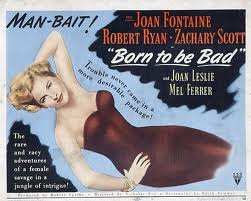
REVIEW – Born to be Bad (1950)

Videovista have my review of Nicholas Ray’s sensationally subversive film noir Born to be Bad starring Joan Fontaine.

The film revolves around a young woman who preys on a couple’s insecurities in order to manipulate her way into landing a wealthy husband.  So far, so femme fatale.  However, what makes this film so strangely compelling is Ray’s abject refusal to turn his femme fatale into a misogynistic punching bag.  Instead, Ray continuously stresses the woman’s basic humanity and her yearning to be loved and understood for what she really is:

The double-standard behind the femme fatale trope is made clear by virtue of the fact that both disreputable Nick and cynical Gobby use their charms to get what they want but nobody seems to think any less of them for it. Indeed, when Christabel encourages Curtis to think of Donna as a gold-digger, she is not summoning this belief from out of this air, she is tapping into Curtis’ quite legitimate concerns about his fellow humans: is anyone ever completely honest, or do we all bend the truth in order to make our lives a little bit easier?

Ray is perhaps best known for Rebel Without a Cause (1955) and the history of that film sheds an interesting light on Ray’s methods as a filmmaker.  The title for the James Dean classic is actually drawn from a book by the psychiatrist Robert M. Linder entitled Rebel Without A Cause: The Hypnoanalysis of a Criminal Psychopath (1944), a book that reportedly inspired Ray to write the story that would become Rebel Without a Cause. James Dean’s character in that film is still considered to be one of the great manifestations of misunderstood youth, but if the character was based upon a case study of a criminal psychopath, what does that say about the character? Both Rebel Without a Cause and Born to be Bad take characters with negative traits and humanise them through a leap of empathy and understanding leaving me wondering whether Born to be Bad should not, in fact, be seen as a companion-piece to Rebel Without A Cause.

BG 40 – Pixel-Bitching: L.A. Noire and the Art of Conversation

Futurismic have my latest Blasphemous Geometries column.

The column is about the various attempts by game-designers to emulate the cut and thrust of human social interaction.  I begin by taking and in-depth look at L.A. Noire‘s attempts to climb out of the uncanny valley before widening the aperture a touch and taking a look at some of the theoretical challenges that need to be overcome before games become capable of modelling conversation as well as they model shooting people in the face and slicing them up with great big swords:

Phelps’ capacity to be inhuman to his fellow man helps him to understand his fellow humans better… thereby raising the possibility that Phelps is in fact a sort of autistic Colonel Kurtz whose willingness to commit acts of terrible violence is a form of spiritual strength. The road to Nirvana is easy to walk when you are wearing jack-boots.

However, in the interest of full disclosure I do feel obliged to make clear the fact that I did not come up with the term ‘pixel-bitching’ all by myself. The term used to be bandied about on the RPGnet forums as a means of referring to a mode of adventure design whereby games masters will not allow the game to progress until the players have uncovered a single specific (and usually well-hidden) clue.  I’ve also heard the phenomenon referred to as a ‘plot bottleneck’ but I think that term fails to capture how irritating it can be to find yourself hunting for a single pixel in a digital landscape.

Point Blank (2010) – The Love… The Love…

From Plato to Robert Louis Stevenson and Joseph Conrad to William Golding, one of the most enduring leitmotifs in the history of Western Culture has been the duality of man and how, beneath a civilised and housebroken exterior, lurks a creature with a truly terrifying capacity for debasement, savagery and chaos. One of the reasons for the popularity of this dualistic conception of human nature is that the idea of humanity being suspended between two points allows different cultures to position the points wherever they choose. For example, for the Platonists, these points were positioned in intellectual real of the Forms and the sensual world of the flesh allowing Platonists to talk about the need for humanity to aspire to the examined life of the mind. This denigration of the body proved convenient when Plato entered the Christian bloodstream through thr works of Plotinus and Augustine allowing the life of the mind to be replaced with the life of the spirit and the pursuit of Salvation. One of the peculiarities of dualism as a cultural trope is the tendency for people to present man’s duality as an essentially moral problem with one pole representing moral rectitude and the other pole representing all that is base and horrid about human nature.  It is telling that, when Golding’s schoolboys are freed from the fetters of civilisation, they immediately turn to killing each other and not to making great art, thinking great thoughts or just fucking the living shit out of each other.  The tension between the fundamental amorality of the dualist conception of human nature and our tendency to see this duality in strictly moral terms is one that is present in many adaptations of Robert Louis Stevenson’s Strange Case of Dr. Jekyll and Mr. Hyde (1886) as for every adaptation that has presented Hyde as an evil psychopath there is an adaptation that presents him as a free spirit to whom the laws of society (for good or ill) simply do not apply. This notion that man’s inner savage need not necessarily be evil is one that is emerging as absolutely central to the films of Fred Cavaye.

Cavaye’s First film Anything for Her (2008) (a.k.a. Tout Pour Elle) tells the story of a man whose wife is sent to prison for a crime she did not commit.  Rendered incapable of functioning by the loss of his wife, the film’s mild-mannered protagonist sets about reinventing a new identity for himself that will allow him to break his wife out of prison. Events rip away the character’s veneer of bourgeois rectitude, but while the inner savage allows the character to do some genuinely terrible things, the film never passes judgement on him because what he does he does out of love and because he is ultimately in the right.

Cavaye’s second film as writer/director Point Blank (a.k.a. A Bout Portant) sees him return to this same moral hypothesis: Men and women are born divided. On the one hand, we are civilised beings who love each other, hate violence and generally follow the rules.  On the other hand, we are uncivilised beings who will stop at nothing in order to defend what we have and get what we want. Because we live in a society that protects us and enforces ‘civilised’ values, we tend to keep our uncivilised natures in check: We do not murder, we do not steal and we do not fuck the living shit out of each other at the drop of a hat. However, should civilisation fail us then our animalistic character will come to the fore.  What makes animalistic actions morally reprehensible is not their violence, their destructiveness or their anti-social character but their motivation.  In Point Blank as in Anything for Her, Cavaye believes that there is nothing that is not permissible as long as it is done out of love.

Continue reading →

REVIEW – Monk: Season 7

  Videovista have my review of season seven on Monk.

Given that Monk (in the UK at least) is a daytime TV detective series that appeals mostly to old people, I think it is fair enough to say that it is somewhat off the beaten path in terms of stuff I normally think and write about.  Hell… it’s not the type of thing I normally watch let alone review!  However, despite it being quite formulaic, quite repetitive and really not particularly intelligent, I rapidly found myself warming to the way in which the writers were able to take a small number of ideas and themes and keep returning to them again and again without those ideas ever coming across as in anyway tired.  Given that most of my genre-related reading and watching tends to focus upon works that transcend and question genre boundaries, I found it fascinating to watch a TV series that is quite content to play within the boundaries of the genre:

While Murder, She Wrote, The Father Dowling Mysteries and Diagnosis Murder may all feature crime-fighting pensioners; only Monk tells the story of a character whose life genuinely resembles that of an older person. Weighed down by fears, doubts and a variety of weird mental compulsions that make it difficult for him to deal with the realities of 21st Century life, Monk lives the sort of awkward and fragile existence common to older people.  He even has a carer and struggles with ‘new-fangled’ technology such as the Internet. While Monk may ultimately be little more than lightweight fluff that shamelessly panders to a demographic of which I am not a part, I cannot deny that I enjoyed watching it.  You simply have to marvel at a series that does so much with so little!

REVIEW – Confessions (2010)

  Videovista have my review of Tetsuya Nakashima’s Confessions.

Based on a novel by Kanae Minato Confessions (a.k.a. Kokuhaku) is a brilliantly conceived psychological thriller involving an elaborate scheme to take revenge for the murder of a child. Powerful and astonishingly mean, the film is sadly let down by some over-cooked but nonetheless well executed music video-style visual flourishes:

As the ghastly constellation of neuroses that lead to the murder is carefully illuminated, Confessions flirts with forgiveness, bats its eyelashes at reconciliation but ultimately ends in an act of vengeance so beautifully composed and ambiguous in its meaning that it rivals anything found in the work of such divinities of the form as Claude Chabrol, Alfred Hitchcock, Ruth Rendell or Patricia Highsmith.

My review also contains an extended complaint about the difference between material shot in order to encourage people to buy a film and material shot in order to help people make the most of a film they have already bought.  The second category makes for excellent DVD extras.  The first… not so much.