FilmJuice have my review of Claude Chabrol’s first film Le Beau Serge, which has just been re-released by Masters of Cinema.
Le Beau Serge tells of a young man who returns to his home town in order to recuperate from an extended period of illness. Upon arriving, he becomes obsessed with a childhood friend who, despite showing real signs of intelligence and potential as a child, has now fallen into drink and bitterness. Puzzled by this unexpected fall from grace, the young man sets about trying to solve the riddle of what happened to the handsome Serge of his youth:
While much of the initial narrative energy comes from François’s attempts to solve the mystery of le beau Serge, the second half of the film increasingly comes to focus upon why it is that François is so obsessed with saving first Serge, then Marie and then the entire village. Though Chabrol offers us no easy answers, the depth of François’s guilt is such that his attempts to protect Serge and his family eventually come to seem insane and messianic. Why doesn’t François leave? Why didn’t Serge leave? Why doesn’t anyone leave a life that is manifestly killing them?
Chabrol is a director with a somewhat misleading reputation for producing thrillers. Though many of his most famous films (including Le Boucher, This Beast Must Die and La Ceremonie) include a bloody murder and a good deal of psychological tension, the truth of the matter is that Chabrol is and always was a moralist. Not in the sense of lecturing people about right and wrong but rather exploring why it is that people make certain decisions and how they come by certain strange beliefs. Unlike Chabrol’s later films, which dressed the morality up in murder and tension, Le Beau Serge strips the core of the Chabrol experience right back to the very core and asks two very salient questions: Why did Serge turn to drink? Why is Francois obsessed with saving him? A truly wonderful film by a truly wonderful director.
Interestingly, Masters of Cinema have chosen to re-release Le Beau Serge on the same day as they re-release his second film Les Cousins. As I explain in my review of that film over at FilmJuice, the two films function as a pair: Complementing each other through their many differences and juxtapositions.
FilmJuice have my review of Michael Haneke’s Palme D’Or and Oscar-winning drama Amour.
Set almost entirely within the walls of a well-appointed Parisian apartment, Amour tells the story of a retired couple named Anne and Georges who are forced to adapt to entirely new ways of being and relating when one of the couple suffers a massive stroke. Unlike many of Haneke’s films, which present themselves as being of a certain genre only to then deconstruct the genre and mock audiences for wanting generic plot resolutions, Amour is a film that is almost entirely free of postmodern cleverness. In fact, the only thing distinguishing Amour from an old-fashioned weepy is its thematic content. This thematic content sat very close to my personal metal as I spent a number of years as my mother’s primary carer and so immediately identified with the changes taking place in Georges’ character:
Much of the film’s drama and tension comes from Georges’ troubled attempts to reinvent himself and his relationships in a way that protects both Anne’s dignity and his own humanity. Sometimes the negative emotions prompt Georges to over-react to relatively minor problems because it is much easier to fire and humiliate a nurse than it is to deal with the feeling that your life is now nothing more than medication, nappy changes and the grim inevitability of death. As Anne’s condition continues to deteriorate, we see Georges attempting to cling to any island of psychological stability he can find. For example, when the couple’s children turn up and express concern over Anne’s condition, Georges seems cold and inflexible to the point of outright insanity but in truth this attitude is entirely self-protective. As Georges points out, the tears and concerns of his children are of no practical use to him because, at the end of the say, he is the one who will be left alone to care for Anne. Better that the children keep their mouths shut than for them to offer the type of false hope that would make it so much harder for Georges to go back to his life as a solitary carer. It is in Georges’ interactions with these islands of stability that we see Haneke’s vision imposing itself upon what would otherwise be quite a traditional weepy.
Usually, one finds oneself praising Haneke for his savagery and visual brilliance but Amour is a surprisingly humane and visually simplistic film. At times, the only difference between this and a TV movie is the lack of melodramatic scoring and even this is present if you allow for the fact that the film continues Haneke’s obsession with the emotional lives of neurotic pianists. Rather than praising Haneke for his ability to be Haneke, I find myself praising him for his compassion and attention to detail as many of the details of this film could have been lifted directly from my own life.
FilmJuice have my review of Yasujiro Ozu’s wonderful Floating Weeds.
A colour remake of Ozu’s 1934 film A Story of Floating Weeds, the film tells of a group of actors who arrive in a sea-side town.Initially, the actors present themselves as being in a different world from the residents and so work together to seduce local women. However, as the story unfolds, we soon learn that the head of the company has a pre-existing relationship with a local woman and that this relationship resulted in the birth of a child who has now grown-up.
This is a film all about the boundaries between worlds. The most obvious boundary is the one between the people on the stage and the people in the audience but a more important one is that between the world of the professional actor and the world of the respectable citizen. This perceived boundary serves both to draw the actors together and distance them from the world around them.
The plot revolves around a series of characters who struggle to keep these two worlds separate. Some consider moving from one world to another, others are repulsed by a world and want to keep it separate from their world of choice and others choose one world only to change their minds and lose themselves in another. The more the boundaries between worlds are tested, the less substantial the boundaries become and the less substantial the boundaries become, the more the characters come to realise the impact said boundaries have had on their lives.
There are always questions to ask when a widely respected and well-established director suddenly decides to remake one of his best known films (*ahem*). One particularly interesting question is the one posed by the fact that A Story of Floating Weeds was also remade one year earlier by Ozu’s one-time assistant director Shohei Imamura. As I said when I reviewedStolen Desires back in 2011:
Imamura cut his cinematic teeth as Ozu’s assistant and, when the time came for him to make his own film, it was only natural that he should try to step out of Ozu’s shadow by making it clear how different his sensibilities were to those of his master and how better to make that difference apparent than by directing a vicious attack on one of Ozu’s best-loved films?
If we assume that Imamura’s chaotic and slovenly Stolen Desires was intended as an attempt at subverting the dignity and calm of Ozu’s films, might we also assume that the re-make was intended as something of a response to an uppity former underling? as I say in my review of Floating Weeds, there are moments of violence and melodrama in Floating Weeds that are quite unlike anything you usually find in a film by Yasukiro Ozu. Did Ozu film those scenes with Imamura in mind? Was Floating Weeds perhaps intended as proof that the old man still had it in him to make important films (as with Clouzot’s attempt tomake L’Enfer as a reply to the nouvelle vague directors)? That’s a question for scholars but looking at Floating Weeds and Stolen Desires, it is hard not to speculate about why this remake was made so soon after Stolen Desires.
Earlier this year I wrote a post about the lack of diversity in the films considered for the 2012 Cannes Film Festival Palme D’Or. While that post focused principally upon the demographics of the directors considered for the award, I was also concerned by the Cannes-centric feedback loop that appears to be encouraging non-French film directors to begin making films in France. I delve into this idea in a little more depth in my latest feature for FilmJuice entitled French Style – How Economics Turns World Cinema into French Film.
The thrust of my argument is that France has become so good at protecting and encouraging French film that the French film scene is beginning to suck talent from the rest of World Cinema. The most notable examples of this process are the Iranian film director Abbas Kiarostami and the Austrian director Michael Haneke:
By providing ambitious filmmakers with an oasis of financial stability, the French state may also have begun a process of cultural assimilation through which non-French directors surrender their distinct cultural identities in an effort to produce French films for the French marketplace.
Aside from the fact that non-French cinematic voices are beginning to acquire a distinctly Gallic accent, there is also the problem posed by these older established voices crowding out younger home-grown talents. France ensures that a certain number of its cinema screens must show French films but why would a cinema chain choose to show a French film by a director like Mia Hansen-Love and Katell Quillévéré when they can show a film by an award-winning star of world cinema?
FilmJuice have my review of Alexander Sokurov’s Faust.
Like many people, my first contact with the work of Alexander Sokurov was his 2002 film Russian Ark. Filmed in the Winter Palace and shot in one long continuous take, Russian Ark presents itself as a journey through Russian history. Visually striking and technically flawless, the film is a brilliant exercise in cinematic logistics as Sokurov does not just produce an entire film in a single shot, he also stage-manages hundreds of extras in real time with absolutely no room for error.
Much like Russian Ark, Faust is both visually and technically impressive:
Shot amidst narrow streets using a very narrow aspect ratio, Sokurov fills the screen with extras to the point where the film’s main characters struggle to be seen and heard. Hemmed in on all sides by people and buildings, Sokurov’s Faust withdraws into a world of ideas only to be shocked and horrified by his resulting distance from human concerns. The self-destructive nature of Faust’s psychological exile is made all the more clear through a series of allusions to great works of art which, despite their considerable beauty, are entirely lost on the self-absorbed Faust.
Based on the well-known and often-revisited story of a Renaissance scholar who sells his soul to the devil only to discover his soul’s true worth, Sokurov’s Faust presents the character as a bored intellectual who is so detached from the world that he literally would not know what to do with unlimited power were he to receive it. Much like Christopher Marlowe’s Dr Faustus, Sokurov’s creation acquires neither wisdom nor morality alongside his satanic powers.
Much like Russian Ark, Faust is the product of a man with amazing technical skill and very little to say. As I said in my review of Russian Ark, his films are lifeless collages of beautifully rendered images. Affectless to the point of absolute sterility, Sokurov is a gifted cinematographer needlessly elevated to the role of director.
FilmJuice have my review of Pier Paolo Pasolini’s wonderful adaptation of Oedipus Rex.
While I am a huge fan of Pasolini’s work, his films always leave me feeling as though I have had to fight Pasolini tooth and nail in order to extract a coherent message from an enormous pile of idiosyncratically juxtaposed signs and portents. Indeed, if you read my review of Pasolini’s contribution to the short film collection RoGoPaG you will have noticed that I genuinely have no idea what it was that he was trying to say with his weird Christ/Cheese metaphor. As a result, it was somewhat refreshing to encounter an example of what Pasolini could achieve when working with a text that is already quite well understood.
Based on the classical play by Sophocles, Pasolini’s Oedipus Rex offers a moving commentary on the fact that even the most concerted rebels and outcasts are doomed to assume the roles vacated by their parents. Re-issued by Master of Cinema alongside a series of other Pasolini titles, Oedipus Rex is a useful point of entry into one of the 20th Century’s most challenging and unusual filmmakers. Indeed, having now seen Oedipus Rex, Pasolini’s Pigsty makes a good deal more sense.
Oedipus Rex is one of the most beautiful films ever made. Its opening sequences of people running around a field are fiercely reminiscent of the whispered awe that flows throughout the films of Terrence Malick. Pasolini captures the North African landscape with the eye of a painter, the deep red of the sand constantly at war with the brilliant blue of the sky while the film’s outlandish costumes seem to shriek defiance at the heavens themselves. We are here! We are human! We exist! Staggeringly beautiful, the film’s production design is reminiscent of what might have happened had the surrealist master Alejandro Jodorowsky been recruited to direct films like 300 and Immortals.
If you are looking for an intelligent and staggeringly beautiful art house film then please look no further than the BD edition of Oedipus Rex. This is staggeringly good cinema.
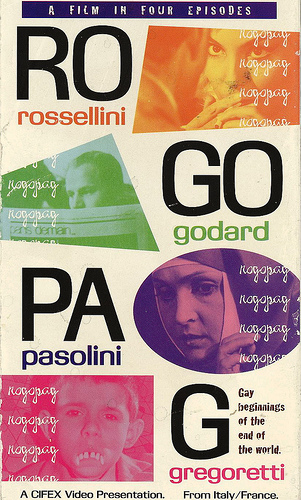
FilmJuice have my review of the really rather wonderful 1960s Italian anthology film RoGoPaG. Comprising three short films directed by Roberto Rossellini, Jean-Luc Godard, Pier Paolo Pasolini and Ugo Gregoretti, RoGoPaG is funny, satirical, gnomic and misogynistic in equal parts but the satire and humour of Passolini and Goretti more than make up for the pretentiousness and misogyny of Godard and Rossellini.
The film begins poorly with a well made but ultimately insipid morality tale by Roberto Rossellini in which an innocent and matronly airhostess (Rosanna Schiaffino) reinvents herself as a ‘whore’ in order to escape the attentions of a horny businessman. Schiaffino is undoubtedly charismatic but her charms simply cannot make up for the grinding misogyny of the film’s themes and plot.
Much like Pigsty and Hawks and Sparrows, Pasolini’s short film “La Ricotta” is a joyous avalanche of images and symbols that communicate mood far more effectively than they communicate ideas. The film revolves around an attempt to make a film about the Crucifixion that ends with one of the bit players dying on the cross as a result of eating too much cheese. Pasolini was evidently sent to prison for making the film and, to be honest, I can see why as the anger and hostility to organised religion are clear even though the exact nature of that anger is much harder to discern. The best short film in the collection is also the product of the least well-known director. Ugo Gregoretti’s “Il Polo Ruspante” is a well-observed and viciously delivered critique of Italian post-War consumerism in which a small family travel across the country while being fleeced by everyone they enter into contact with.
FilmJuice have my review of Pier Paolo Pasolini’s postmodern/religious fable Hawks and Sparrows (a.k.a. Uccellacci e Uccellini).
Much like Pasolini’s Pigsty, Hawks and Sparrows comes across as an intensely weird and inaccessible piece of film making. Filled with portentous images as well as characters and narratives that make very little in the way of sense, both films are products of a time when the fundamental grammar of film was in the process of revision/ The works of Pier Paolo Pasolini feel far stranger than contemporary works such as Alain Resnais’s Last Year at Marienbad or Michelangelo Antonioni’s L’Avventura because Pasolini has proved to be a far less influential filmmaker than either Resnais or Antonioni. Contemporary audiences can easily decode L’Avventura because L’Avventura contains a number of techniques which, though radical at the time, have since entered the mainstream of film and TV. Conversely, the works of Pasolini contain ideas and techniques that are seldom used in contemporary art house film and so they seem as radically odd now as they did when they first appeared in the 1960s. As I put it in the actual review:
Once you accept that Hawks and Sparrows is little more than a cavalcade of images and references, the film becomes a good deal more enjoyable. Freed from the need to present an argument or tell a coherent story, Pasolini plays with the fabric of our dreams to present a succession of memorable cinematic images including dark-eyed girls with angelic wings, rampaging monks and an aging clown who is suddenly gripped by a lust for life in all its pulchritudinous glory. Hawks and Sparrows is neither particularly entertaining, nor particularly profound. However, despite the film’s decidedly experimental and disposable feel, it remains a timely reminder of quite how brave and innovative art house filmmaking can be when it decides to start rattling cages. At a time when every art house cinema seems filled with beautifully hollow dramas about beautifully hollow upper-class people, Masters of Cinema have allowed us the opportunity to (re) discover the work of a legitimately artistic and legitimately challenging filmmaker.
FilmJuice have my review of the recent Masters of Cinema release of Pier Paolo Pasolini’s uncanny masterpiece Pigsty.
Comprising two narrative strands, the film explores the way in which cultural elites undermine dissenting opinions by subsuming traditional vocabularies of dissent. In one strand, a young man wanders wordlessly around a volcanic landscape until he comes across a dead body which he promptly consumes. This act of consumption classifies the young man as an outcast and this outcast status allows him to acquire a following that eventually forces the local authorities to intervene. When the young man is finally given the opportunity to express himself in words, all he has to say for himself is:
I killed my father, I have eaten human flesh, and I quiver with joy.
The film’s second strand is set in the 1960s where another young man finds himself crushed between the capitalistic radicalism of his father and the logorrheic gibberrish of his leftist fiancee. Denied the means with which to express himself as an individual, the boy retreats into a comatose state before finding some form of fulfillment in the act of fucking a pig.
Pigsty is an attempt to address the relationship between the generations and how difficult it can be for the young to express themselves when they are not the ones in control of society. Particularly striking is the way that Pasolini presents post-War German prosperity as little more than a repackaged version of the pre-War economic boom engineered by the Nazi government of the 1930s. With all of culture safely commoditised and filed away, what are today’s rebels to do but seek sanctuary in the most heinous acts imaginable? Windy, difficult and decidedly ‘of its time’ Pigsty remains a ceaseless beautiful and thought-provoking film by one of the great provocateurs and stylists of the European art house tradition.
The idea that cultural elites pull the ladder up behind them to ensure that nobody can rebel against them in the same way that they rebelled against previous generations will be familiar to those of you who have read Thomas Frank’s wonderful essay “Why Johnny Can’t Dissent”.
Long-time visitors to the site will know that I have something of a love-hate relationship with the films of Nicolas Winding Refn.The relationship began in 2008 when I went to see his singular and yet problematic biopic Bronson. Soon after that, I was completely blown away by the viciously gritty realism of Winding Refn’s Pusher trilogy. A few years later, I was going through something of a ‘viking’ phase during which I read several books about the period. Upon hearing that Winding Refn’s next film Valhalla Rising was a Conradian take on vikings, I immediately dragged my partner to a film festival where it was screening. The result was something of a disappointment. Winding Refn had won my devotion by crushing the bones of modern life and sucking the marrow from them without using the increasingly hide-bound techniques of european art house film. Indeed, you are more likely to see someone get shot to death in a Winding Refn film than you are to see them staring meaningfully into the distance. When the time came for me to review the film, I voiced my extreme ambivalence and disappointment in a post over at Videovista:
This is art with the creative impulse kept in chains and passed back and forth between worn-out chieftains. This is the kind of film that makes you strain to remember the last time you were genuinely shocked or surprised at the cinema. This is art that leaves you yearning for a gust of fresh air that will blow away the cobwebs. This is the revolutionary corrupted into the familiar. The transgressive repackaged as the formulaic. This is what creative stagnation looks like and I find that almost unbearably depressing. As someone who is not only a huge fan of Conrad but also of Malick, existentialism and Vikings, Valhalla Rising should have been my ideal film but instead it left me feeling that I had seen it all before just one too many times.
This is basically the art house intellectual equivalent of nerd rage. My annoyance at the film was such that I even felt obliged to unpack my feelings even further in a piece inspired by James Woods’ extended critical essay How Fiction Works and Thomas Clay’s Soi Cowboy. Valhalla Rising left a deep wound in my appreciation of film, it marked the point where I stopped celebrating art house film and began questioning its methods and its metrics of success. Valhalla Rising is not the work of a free spirit, it is the work of someone who is reaching out to the art house establishment in search of recognition and legitimacy. Valhalla Rising is the work of an outsider who wants to come in from the cold and the exact same thing can be said of Thomas Clay’s Soi Cowboy, Andrea Arnold’s Wuthering Heights and Steve McQueen’s Shame. All of these films bend the knee to the European art house establishment and so come off looking like genre pieces. The problem is that the techniques that once revolutionised European filmmaking in the 1960s have become ossified and so European art house film is now little more than a genre that talented directors attempt to move beyond. As Woods puts it:
When a style decomposes, flattens itself down into a genre, then indeed it does become a set of mannerisms and often pretty lifeless techniques
Winding Refn’s willingness to bend the knee was amply rewarded when his next film Drive became one of the most widely celebrated films of 2011. Full of violence and exploitation film tropes, Drive seemed built for the US market and yet it managed to convince art house fans as well as critics. Had Winding Refn not made a film as conventionally arty as Valhalla Rising, I suspect that Drive would never have won over art house critics. It is too American… too violent… too exciting… too plot driven. The Imp of the Perverse that sits on my shoulder decided that I should hate Drive on general principle and yet I did not. In fact, as I said when I reviewed the film, I consider it to be one of the greatest films of all time… if only for this scene:
I could watch it all day: The dimming of the light, the way he starts to pull away before she does and the way he steps back before exploding into action in a way that pleads ‘just give me one more second of this feeling… one more second before I have to do something horrible’. There is genius in that scene and there is genius in Drive as a work of cinematic art. It is a thousand miles from the sterile art house nonsense of Eugene Green’s Portuguese Nun and Carlos Reygadas’ Stellet Licht.
Given that I adore the work of Nicolas Winding Refn, I was delighted to discover a documentary about his work. Filmed as Winding Refn scouts out locations in Bancock, Laurent Duroche’s NWR is a wonderfully candid piece that reveals a lot about how Winding Refn works and how he thinks his way through particular projects. Particularly interesting is the fact that Winding Refn actually turned down the chance to go to a prominent Danish film school and chose instead to use the money to make Pusher. The film, and many other fantastic films like it, are made available for free online and are collected at the absolutely awesome Cinephilia&Beyond Archive.
I am particularly enamored with the film as it opens with some fantastic comments in French by the great surrealist filmmaker Alejandro Jodorowsky. This opening section, sadly devoid of English subtitles, translates as:
You have to understand one thing. Cinema has arrived at a disappointing stage: Complete industial degeneration. With this pulp… this cancer that is American cinema has infected the entire planet. It has political power… it has economic power… it is a pile of spiritual excrement. Then, when we had lost absolutely all hope, when we saw that all films were lit in exactly the same way… with that degenerate Spielberg… When we find ONE artist who can survive (despite having to earn a living) and who BREATHES… it is a moment of supreme joy. The boy Nicolas saved me from my cinematic depression
 FilmJuice have my review of Claude Chabrol’s first film Le Beau Serge, which has just been re-released by Masters of Cinema.





 Ruthless Culture