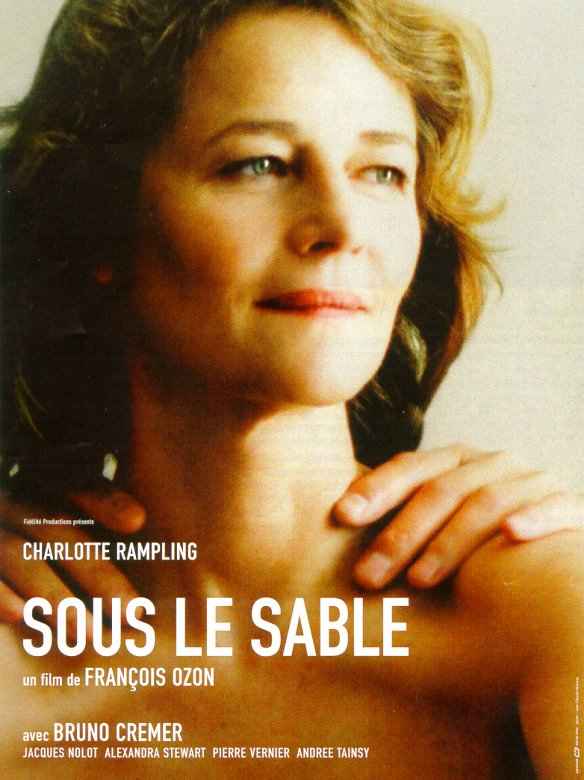
Sous Le Sable (2000) – Everyone Needs a Little Cup of Stars

SLS1There are few situations to which the opening lines of Shirley Jackson’s The Haunting of Hill House are not pressingly germane:

No live organism can continue for long to exist sanely under conditions of absolute reality.

Often spoken of as a ghost story, The Haunting of Hill House is more rewardingly read as a portrait of a fragile mind under intense pressure. Scarred by decades of servitude to a sick and deranged mother, Eleanor Vance is a woman who carries her reality with her like a snail carries its shell. While the novel’s melody is dominated by Hugh Crain’s house and the miseries that befell his family, the harmony is all about the way that Eleanor picks things up and uses them to fashion a world more comforting and endurable than absolute reality. Everyone needs a little cup of stars.

One of the great joys of Jackson’s novel is the way that she manages to blur the boundaries of the real, the supernatural and the outright hallucinatory without ever bothering to draw attention to the lack of subjective difference between these different categories. For Jackson, this uncertainty is so universal that it simply does not merit commentary… it’s all one big sordid mess. Many films and books have been drawn to this ambiguity but while great works such Henry James’ The Turn of the Screw or Caitlin R. Kiernan’s The Red Tree and The Drowning Girl add their own ingredients to the ambiguous brew, most works that use these tropes yearn for clear dividing lines between the metaphorical and the concrete, the material and the fantastical, the sane and the insane, the true and the false. This is why you are more likely to encounter the carefully nested realities of films like Inception and Jacob’s Ladder than you are the happy ambiguities of a film like Total Recall or The Descent. Though definitely a film with a clear dividing line between reality and fantasy, Francois Ozon’s Sous le Sableis a film that is intensely relaxed about the ambiguities of madness.

Continue reading →

REVIEW – White Dog (1982)

WhiteDogFilmJuice have my review of the recent Masters of Cinema release of Samuel Fuller’s racially-themed horror film White Dog.

Cutting to the chase, I really enjoyed this film. Set on the margins of Hollywood, the film tells of an actress who happens to run over a beautiful white Alsatian dog. Forced to take responsibility to the animal after taking it to the vet, the actress nurses it back to health and has all of her care and attention redeemed when the animal protects her from a rapist who breaks into her home. Fuller shoots the dog at night using spotlights that reflect against the whiteness of the fur but not the background meaning that the dog appears to glow in an almost spectral fashion. The otherwordliness of the dog is put to brilliant use when it escapes the actress’s yard and begins attacking black people: The pure white dog devouring black people and covering itself in blood is as striking and troubling an image of racism as you could possibly imagine. Part of what makes these images so troubling is the fact that they could just as easily have been inserted into a film about a heroic white dog that eats evil black people. However, to look upon these scenes as racist or problematic is to ignore the wider context of the film and how the film is really about trying to cure racism:

Fuller intends the dog (tellingly referred to as ‘Mr Hyde’) to serve as a metaphorical representation of human racism and, to a certain extent, he does: One point the film repeatedly makes is that there is nothing ‘natural’ about the dog’s hatred of black people; his fear and hatred were deliberately engineered by people who wanted to use his savagery as a tool of racial segregation and oppression. Another point the film makes is that the techniques required to train a racist dog were pioneered in the days of slavery when plantation owners had a vested interest in keeping vicious attack dogs that would happily kill a black person but never think to harm a white person. These two ideas certainly mesh with contemporary thoughts on social justice and they make a very interesting point about how the racist attitudes that continue to be perpetuated today originated in a time when extreme and dehumanising patterns of racist thought underpinned an entire economic system. Fuller’s metaphorical racist dog also represents how difficult it can be to wean oneself away from racist thought and how some attitudes can be so deeply engrained that unravelling them is tantamount to unravelling an entire personality. However, Fuller’s metaphor only goes so far.

While I think that Fuller’s position is somewhat outdated (one of the first things you learn about social justice is that it’s a white person’s duty to educate themselves and not to be ‘saved’ by black and minority ethnic people) I don’t think it’s racist. In fact, I think that White Dog is a thoughtful and intellectually intense film that tries to grapple with a huge and incredibly different problem. What I don’t understand is the logic of using an intensely problematic piece of fiction as a springboard for that engagement.

White Dog is based on a book by the French novelist Romain Gary which tells the semi-autobiographical story of a dog who has been trained to attack black people on sight. As in the film, a black animal trainer steps in and tries to cure the animal but rather than getting rid of the animal’s murderous urges entirely, the trainer simply reprograms the animal to attack white people instead. As I explain in the review, Gary intended this as a critique of civil rights activists who, in his opinion, were training people to be ‘intolerant of intolerance’. From J. Hoberman’s interesting piece about the film:

Gary and his then wife, actress Jean Seberg, find a stray German shepherd that, they soon discover, has been raised to attack black people on sight. Although told that the dog is too old to be deconditioned, they turn him over to an animal trainer who turns out to be a Black Muslim and vengefully reprograms the creature to maul whites—including, at the book’s climax, Gary himself. (Some of the vengeance in this “found” allegory belongs to the author: Gary disapproved of his wife’s public support of the Black Panther Party, a political stance that put her under FBI investigation.)

This attempt to set up an equivalence between systemic white racism and angry reaction to that racist system will be familiar to anyone who remembers the much-lamented Derailing For Dummies site as the ‘You’re As Bad as They Are!’ defence:

Because they’re angry about the treatment they undergo and because they are aggressive and persistent in wanting to see change happen, you can target this behaviour (remembering that it is unseemly for Marginalised People™ – they’re supposed to set an example at all times by being humble and long suffering) by suggesting it puts them on a par with the people and system that stigmatise, ostracise and target them every second of every day of their lives. This also suggests that reacting to such discrimination is totally unreasonable and out of proportion (they should just take their knocks!) and that has the benefit of indicating your ignorance to just how pervasive and constant this discrimination truly is.

Thankfully, Fuller does not follow Gary down that particular political rabbit hole but it I can’t imagine anyone wanting to base a contemporary critique of racism on a book that suggests black civil rights activists are morally equivalent to people who train their animals to attack black people on sight.


Keeper of the Clockwork Heart: The Late Films of Kenji Mizoguchi

Late-MizoguchiIn a career spanning thirty three years, the Japanese film director Kenji Mizoguchi produced a total of eighty three feature films. While many of those films have now been lost and only a few have ever been made available to Western audiences, recent years have seen an attempt to reclaim the legacy of Mizoguchi and introduce his work to a new generation of film-lovers. So far, the most visible element of this campaign has been the very visible release of Mizoguchi’s later films by Criterion in America and Masters of Cinema in the UK. Next week, Masters of Cinema are releasing a blu-ray box set entitled Late Mizoguchi: Eight Films 1951-1956. The set includes:

  • Ugetsu Monogatari (1951)
  • Oyu Sama (1951)
  • Gion Bayashi (1953)
  • Sansho Dayu (1954)
  • Chikamatsu Monogatari (1954)
  • Uwasa No Onna (1954)
  • Yokihi (1955)
  • Akasen Chitai (1956)

My review of the complete box set is now available on FilmJuice. As you might expect for a review of an eight-film box set, the review is kind of long but I think the length was necessary in order to explore not only Mizoguchi’s approach to narrative but also his attitudes to women and how these attitudes to women transitioned over time from bewailing their fate to celebrating their courage and finally to railing at the capitalist system that dehumanises and immiserates them. I personally consider Akasen Chitai to be one of the greatest films of all time as no other film so perfectly captures the ways in which the system bullies and coerces us into betraying each other for personal advancement.

I was actually lucky enough to review some of these films when they were first released on DVD back in 2007:

Re-reading these reviews just now, it’s interesting to see that while my dim opinions of Yokihi and Chikamatsu Monogatari have not massively changed, my feelings on both Uwasa No Onna and Akasen Chitai have improved immeasurably with time. Akasen Chitai may have impressed me at the time but it also stayed with me and had a real impact on how I thought about both the world and film. Since then, I’ve seen quite a few works that have been celebrated for their politics and their devotion to social realism but nothing in either British or Italian Social Realism come even close to the focus and power of Akasen Chitai.

REVIEW – Nowhere (1997)

NowhereFilmJuice have my review of Gregg Araki’s psychotronic teen soap opera Nowhere.

Final installment of Araki’s wonderful Teenage Apocalypse series (along with Totally Fucked Up and The Doom Generation), Nowhere follows a group of American teenagers as they work to find themselves in a swamp of sex and drugs. Melancholy and often seen as more reactionary than the earlier films in the series, Nowhere focuses less on the joys of transgressive sex and drug-taking than on the psychological consequences of immersing yourself in one particular culture. The film’s main protagonist is dating a beautiful girl who turns out to be naturally bi but while the main protagonist is also naturally bi, he struggles with the idea that he must share his girlfriend with a woman. In fact, the thought so bothers him that he ends the film by fleeing his transgressive subculture in pursuit of a far more traditional and romantic belief that there is one person out there who will suit his needs perfectly.

While you could, if you were that way inclined, read this narrative as an indictment of youth culture and an Assayas-style mutterings about everyone needing to grow up and settle down, I think a more interesting approach is to view the film as a 90s equivalent to that speech in Fear and Loathing in Las Vegas where Hunter S. Thompson remembers the end of the 60s. The one that ends with:

So now, less than five years later, you can go up on a steep hill in Las Vegas and look West, and with the right kind of eyes you can almost see the high-water mark — that place where the wave finally broke and rolled back.

Gregg Araki’s Nowhere is not about the wave rolling back but about that moment when the wave slows and you think maybe it’s not going to make it all the way up the beach after all. Maybe it’s going to stop. Maybe it was never going to make it after all.

Imbued with a touch more humanity than many of his peers, Dark begins to notice strange things happening on the edges of his culture; alien lizards are disintegrating vacuous teens while a televangelist makes big promises on late-night TV. Filled with dread and alienated from the air of fashionably empty transgression surrounding him, Dark abandons the values of his peers in favour of a traditional fantasy of finding one person with whom he can spend the rest of his life. Aware that something is slipping away from him, Dark makes an uncharacteristically articulate speech about reaching the end of an era as his lover explodes leaving only an alien insect that promptly climbs out the window taking all youthful weirdness with it.

REVIEW – Something in the Air (2013)

something_in_airFilmJuice have my review of Olivier Assayas’s 70s drama Something in the Air.

Much like Assayas’s near-universally acclaimed Carlos the Jackal, Something in the Air is set in the aftermath of the 1960s just as that much-overstated sense of solidarity and hopefulness was beginning to collapse into the selfishness, divisiveness and cynicism that would later herald the rise of Thatcherism and Reaganism. The film follows a group of French teenagers as they graduate from High school in 1971 and head out into Europe for a summer of self-discovery. However, despite the teenagers being incredibly passionate about their politics and the need to change the world, most of their decisions have little if anything to do with the tomes of political theory they dutifully read and quote:

Despite functioning at an incredibly high level or intellectual and political engagement, Gilles and friends drift from one doomed relationship to another whilst either embracing or rejecting the opportunities that come their way. One of them is dragged into the orbit of a bunch of aspiring terrorists while another joins a commune only to find herself doing all the washing, cleaning and shopping for a bunch of men who are anything but radical in their attitudes to women. Indeed, while some critics have made a lot of the similarities between Something in the Air and Assayas’s earlier film of ill-fated teen revolt Cold Water, a much better point of comparison would be a film like Richard Linklater’s Dazed and Confused as while Assayas’ teens may be living the revolutionary life in a series of beautiful European locations, the decisions they make are ultimately no different to those of Linklater’s suburban Texans.

This suggestion that radical politics are necessarily an affectation that do little aside from lock you into various social networks is very similar to the point Assayas makes by de-politicising the actions of Carlos the Jackal. From my review of Carlos:

By refusing to place Carlos’s actions in any kind of context, Assayas beautifully foreshortens them, reducing them from political actions to social gestures. Indeed, when Carlos and his gang storm the OPEC meeting, it is immediately clear that they have a good deal more in common with the politicians and bureaucrats than they do with ordinary people. Carlos is able to discuss his intentions quite calmly with the various politicians while their civilian underlings quake with uncontrollable terror. The politicians and police know who Carlos is. He knows who they are. Everyone knows the stakes. Everyone knows the risks. It is almost as though they are all friends.

The film is beautifully made and while it is not exactly one of Assayas’s great works, it does do a good job of raising questions about the 1960s at a time when the toxic exit strategy of that particular generation is becoming obvious to all.

REVIEW – In The House (2012)

ITHFilmJuice have my review of François Ozon’s In The House.

The film is set in a devastatingly modernist French high school where a bitter failed writer grinds out a living teaching French literature to teenagers who can barely read or write. Suddenly, the teacher’s gloom is lifted when one of his students hands in an astonishingly dry and sarcastic appraisal of a middle-class home he recently visited. His interest captured, the teacher encourages the boy’s talent and soon every piece of homework becomes another wry take-down of middle-class life. What makes this film interesting is that, rather than focusing upon the emotional connection between failed writer and ambitious student (YOU’RE THE MAN NOW, DOG!), the film uses the relationship as a metaphor for the creative process as the student is effectively writing for an audience of one who gives him detailed feedback on what he wants to see in the next chapter. Brilliantly, the teacher’s requests that the student alter his plot results in the student doing things that directly impact the teacher’s life forcing the audience to suffer for their vicarious literary joy.

One way of looking at In The House is to say that it features a more restrained approach to the shaggy postmodernism of Charlie Kaufman. For example, as with Being John Malkovich, the characters in this film blur the lines between the real and the fictional. Similarly, as with Synecdoche New York, the entirety of In The House feels like an intentionally doomed attempt at capturing the entire creative process in a single unwieldy metaphor. The problem is that Kaufman realises that the cleverness of postmodernism is inherently less satisfying than the emotional payload of a sweeping narrative arc and so he builds these huge metaphorical structures in an effort to replace emotional closure with a sense of wonder. Ozon’s comparative restraint means that, unlike many of Kaufman’s projects, In The House works as a proper story right up until the end but it seems entirely reasonable to suggest that ending the film on a flight of postmodern fantasy would have been more effective than Ozon’s discontented trudge.

I’ve recently read two quite interesting books that attempt to deal with the issue of ironic detachment from the emotional manipulations of narrative. David Thomson’s typically shaggy and typically wonderful book on the history of film The Big Screen finds him deeply troubled by the way in which the rise of advertising appears to have somehow compromised the relationship between work and audience. Prior to TV and Radio, people would submit themselves to a particular narrative and stay with it till the end. Now, they find themselves jostled out of the flow by adverts… tiny self-contained stories injected into the flow of a film or TV programme but designed to sell rather than move or entertain. After combing through the history of cinema, the book ends with Thomson experimentally watching a film backwards:

You also discover what a sweet, artificial thing story is. That is not a mocking of narrative, simply a revelation that story is just a series of tricks or steps, a mechanism, not too hard to guess in advance, and as systematic and serviceable as, say, a staircase — and as logical and mathematical. A story is something made and made up; it is a disguise of life, artfully and kindly done, but not life. It is lifelike. And stories are so artful, so manufactured, that they might as easily run backwards or forward

This vision of narrative as a system of emotional control also runs through Douglas Rushkoff’s recent (and not quite wonderful) book Present Shock. Rushkoff argues that the world around us does often makes very little sense as decades of advertising have encouraged us to find ways of protecting ourselves from stories that would manipulate our emotions:

Aristotle was the first, but certainly not the last, to identify the main parts of this kind of story, and he analyzed them as if he were a hacker reverse-engineering the function of a computer program. The story mechanics he discovered are very important for us to understand, as they are still in use by governments, corporations, religions, and educators today as they attempt to teach us and influence our behaviors. They are all the more important for the way they have ceased to work on members of a society who have gained the ability to resist their spell.

While I am still in the process of digesting a lot of these ideas, I think there is a lot of meat on the bones of the idea that a lot of contemporary culture is post-postmodern in the sense that it is built with an explicit aim of overcoming the air of ironic detachment that postmodernism has encouraged us to adopt. Kaufman in particular is quite an interesting figure as all of his films begin in the real world, deconstruct the real world and end with mad flights of fantasy. I think Kaufman does this because he realises that a) neat narrative arcs are at least as ‘false’ as CGI fantasias and b) CGI fantasias are probably a more reliable way of having an impact on an audience than a happy or a tragic ending.
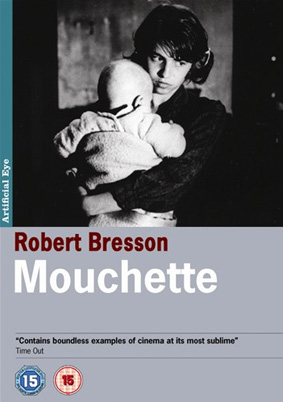
REVIEW – Mouchette (1967)

mouchtteFilmJuice have my review of Robert Bresson’s Art House classic Mouchette.

Set in a part of the French countryside that is so poor that modern technology like cars and mopeds seem entirely out of place, Mouchette tells of an impoverished young girl who is born to an alcoholic father and a terminally ill mother. Expected to not only fend for herself but also for her parents, the young girl puts up with an almost impossible amount of teasing and brutality until she eventually snaps, wanders off into a nearby forest and winds up being raped by a local poacher. Trained to accept all the hardship that life has to give and never offer a word of complaint, the girl refuses to press charges against her assailant and instead throws herself into a river.

Bresson made Mouchette in the immediate aftermath of the much better known and more widely admired Au Hasard Balthazar, which I also reviewed. As with Claude Chabrol’s Le Beau Serge and Les Cousins, the extreme proximity of the two films means that Mouchette can be seen almost as a response to au Hasard Balthazar. As I explain in my review, the big difference between Bresson’s two films is that while both films feature a young woman who is beaten down and destroyed by the world, Au Hasard Balthazar seems a lot more human and emotionally vibrant because the donkey serves as a sort of emotional lightening rod allowing us to connect to the suffering of the main character.  Unfortunately, because Mouchette lacks a comparable lightening rod, the film seems bleak to the point of outright nihilism:

It is here that a comparison with Au Hasard Balthazar becomes really useful: Both films are about young women who are born into worlds of unrelenting cruelty that crush their spirits and drive them to suicide. However, while Au Hasard Balthazar uses a combination of donkey and Christian symbolism to make this suffering seem meaningful, the lack of wider context for Mouchette’s suffering makes her travails seem not just pointless but downright exploitative too.  Was there really no other way for Bresson to explore the corruption of the world than to make yet another film in which a young girl is raped by a local thug? And if you are going to make a film in which a fourteen year-old girl covers up her own rape, is it really acceptable to present these events with no social or psychological context whatsoever?

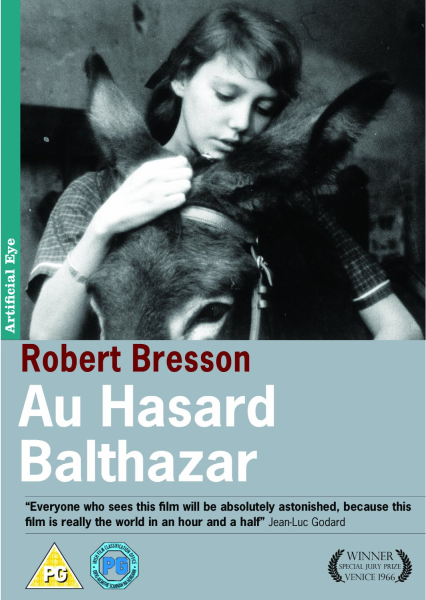
Another useful thing about re-visiting classic films is that it allows you to re-examine their value in light of contemporary values. Indeed, when Bresson made Mouchette and Au Hasard Balthazar, the predominance of male critics and male filmmakers was such that nobody really called into question the idea that rape was simply a part of everyday life and that making two back-to-back films that conclude with the rape of an under-aged protagonist might be considered a little bit creepy. The cover for Au Hasard Balthazar features a quote from Jean-Luc Goddard in which he states that:

This film really is the world in an hour and a half.

Cute line, but I am starting to find it deeply problematic that an entire generation of male filmmakers evidently thought it was okay to use rape as a sort of signifier for the horrible nature of the world. Aside from being deeply exploitative, this effectively serves to reinforce the view that rape is just a normal feature of life rather than a grotesque and intolerable moral transgression. Feminist thinkers even have a name for the vision of the world contained in Mouchette and Au Hasard Balthazar: Rape Culture. It’s one thing to make a film that casually reduces rape to the status of genre trope… it’s quite another to make two films in a row that use precisely this device. Au Hasard Balthazar‘s humanity and experimental use of symbolism are so striking that I believe it will remain a part of the European Art House canon for years to come. Mouchette, on the other hand, is a film that needs to be removed from its pedestal as a matter of urgency.

REVIEW – Au Hasard Balthazar (1966)

BalthazarFilmJuice have my review of Robert Bresson’s art house classic Au Hasard Balthazar.

Over the last year or so, I’ve been lucky enough to review some of the great classics of European Art House film as they’ve been re-issued on DVD and Blu-ray. Aside from introducing me to some genuinely great films and directors, this process has also motivated me to fill some of the gaps in my cinematic expertise and Au Hasard Balthazar was definitely one of those gaps. The reason I never got round to watching it is that, while I had heard great things about the film, I knew it was basically an extended religious metaphor based on a donkey and this struck me as so totally ridiculous that I decided not to bother checking it out. Having now finally gotten round to watching the bloody thing, my view remains that Au Hasard Balthazar is an entirely ridiculous film but the ridiculousness sort of works…

Set in the French countryside, the film tells the story of a sickly young girl who grows up into a confused young woman. Trapped between a distant father and an abusive quasi-boyfriend, the young woman is ground down beneath the heels of the patriarchy until she eventually just gives up and dies. The fascinating thing about this plot is that while neither Bresson’s script nor the amateur actors offer any real insight into why anyone does anything, the presence of a donkey who suffers just as the young woman suffers somehow makes the film incredibly moving. Even more fascinating is the fact that while the donkey effectively suffers ‘for’ the young woman in the same way as Jesus died ‘for’ our sins, the peculiar metaphysics of this relationship seems designed to flush out people’s attitudes towards God:

While the link between Marie and Balthazar works astonishingly well, the link between Balthazar and Christ seems like a metaphor too far. Indeed, while the donkey helps us sympathise with the impassive and often incomprehensibly self-destructive Marie, the religious symbolism only serves to lend this suffering some sort of dignified legitimacy, as though the donkey somehow died for our sins. The beautiful thing about this failure is that a case could be made for seeing it as intentional. After all, what is the point of religious belief if not a palliative sense that all the world’s suffering serves some greater purpose? And what greater signifier of atheism than the feeling that such ontological apologism serves only to distract us from the sufferings of real people?

A few weeks ago, I was lucky enough to review Claude Chabrol’s Le Beau Serge and Les Cousins. These films were originally made almost on top of each other and used not only many of the same actors but also many of the same themes, by reviewing the two films at the same time, I was able to tease out the connections between those two films and see how a director approached a similar question from two very different perspective.  My review of Au Hasard Balthazar is similar to my review of Le Beau Serge in that, as well as reviewing Au Hasard Balthazar, I reviewed Mouchette… which explored many of the same themes as Au Hasard Balthazar but from a rather different perspective.

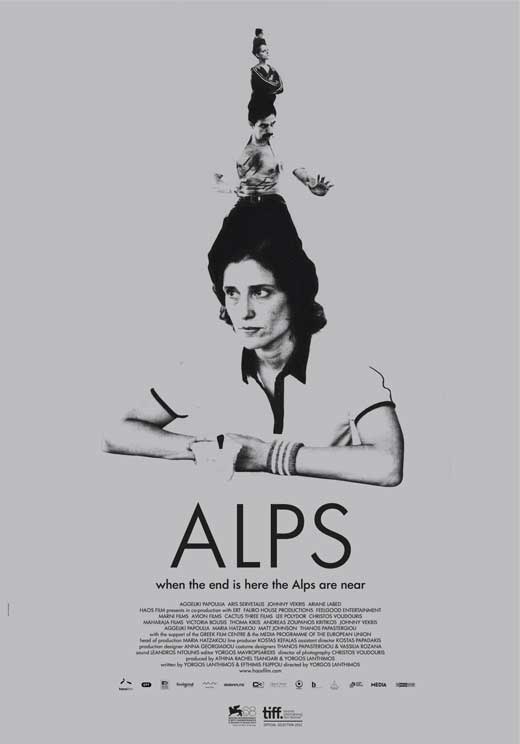
REVIEW – Alps (2011)

alpsVideoVista have my review of Giorgos Lanthimos’s third films Alps.

Alps is part of a suite of films that began in 2009 when Lanthimos’s second film Dogtooth won the Un Certain Regard prize at the Cannes film festival. Surreal, funny and utterly unlike anything else in contemporary art house film, Dogtooth tells of a pair of siblings who have been raised to believe that the world outside of their family home is a sort of dystopian nightmare. Much like Rolf de Heer’s incandescently brilliant Bad Boy Bubby, Lanthimos uses this set-up to explore not only the weird second-hand beliefs that parents pass onto their children, but also the oddness of contemporary life and how arbitrary our social conventions must feel to people not raised to accept them. This critique of contemporary morality and generational differences then stepped up a gear in Attenberg, a film by Athina Rachel Tsangari who also serves as Lanthimos’ producer on Dogtooth and Alps. Much like Dogtooth, Attenberg uses surrealism to draw our attention to the arbitrary nature of social mores but in a way that suggests considerably more anger towards the older generation. How are young people supposed to cope with a complex world when all their parents ever did was fill their heads with be-bop and David Attenborough documentaries. Alps is very much a part of the Dogtooth cycle but, unlike Dogtooth and Attenberg, it does away with the surreal imagery that made those earlier films so intensely eye-catching and different.

The film tells of a group of people who make a living impersonating the recently deceased. Initially, we are encouraged to look upon the gang as either crooks or amateur grief therapists, but as the film unfolds and we learn more about the characters, the reasons for the impersonations become increasingly strange and difficult to discern:

The root of the problem lies in Lanthimos’ decision to abandon the surrealism of Dogtooth and Attenberg in favour of a more realistic footing. In Dogtooth and Attenberg, the surrealism served not only to exaggerate the foibles of everyday life but also to locate the film within a context that was more symbolic and fantastical than strictly representational. This means that the audience is left stranded in a sort of philosophical ‘uncanny valley’ as the film is both too real to be metaphorical and too weird to be a representation of the real world. Neither a fable nor a drama, Alps is a hugely evocative mess of impenetrable feelings and oblique social observations that could have been a whole lot more.

Clearly, this is a film that is overflowing with ideas and I continue to think that Lanthimos and Tsangari are two of the most important filmmakers working today. However, I question the decision to shift to a more realistic register as I’m not convinced that the cinematic vocabulary of social and psychological realism can cope with the complex and frequently metaphorical nature of Lanthimos’ ideas. Still… a director whose ideas outstrip the visual elements of his film is a refreshing change to the current vogue for incredibly beautiful and well-made films that are completely devoid of new ideas.

REVIEW – Les Cousins (1959)

LesCousinsFilmJuice have my review of Claude Chabrol’s second film Les Cousins, which has just been re-released by the ever-excellent Masters of Cinema.

Les Cousins tells of a young man who moves to the city in order to study law. Sharing his uncle’s place with his far more sophisticated and extroverted cousin, the young man finds himself being sucked into his cousin’s glamorous lifestyle filled with parties, girls and dubious European noblemen. Initially, this relationship works quite well as the cousin likes to be the centre of attention and the young man’s inexperience makes him feel like an older brother and a community leader. However, when the young man attempts to become romantically involved with a young lady in his cousin’s entourage, the cousin takes umbrage and decides to assert his supremacy. Disgusted both with his cousin’s behaviour and his own loss of focus, the young man throws himself into his studies but this only provokes his cousin into more frequent and louder parties:

Things come to ahead when Charles is trying to study for his finals but Paul keeps having loud parties. Charles pleads with his cousin to do some revision but Paul’s confidence is absolute… he knows what he is doing and revision is an absolute waste of time. As with Le Beau Serge, Chabrol presents the tension between the two boys as being social and psychological in nature but in truth their disagreement is a moral one: Charles writes endless letters home to his mother promising that he will succeed in his studies and suggesting that his desire to work is born of a sense of duty to do right by his parents. By not only refusing to study but also making it harder for Charles to study, Paul is challenging the moral order of Charles’s universe. In Charles’s mind, Paul is doomed to failure because the universe does not reward provocative layabouts. This means that when Paul does pass his exams with flying colours, Charles is forced to examine not only his faith in the moral nature of the universe but also his conviction that his duty to his parents obliged him to study: What if the best way to succeed really was to wear a smart suit and hang-out with dubious Italian aristocrats?

I mention Le Beau Serge as Les Cousins can be read as a response to that earlier film. Where Le Beau Serge is rural, Les Cousins is urban. Where Le Beau Serge is about a town-mouse visiting a familiar countryside, Les Cousins is about a country-mouse visiting an alien city. Where Le Beau Serge is about taking responsibility for the actions of another, Les Cousins is about remaining true to yourself.

Somewhat handily, Masters of Cinema have decided to time their re-release of Les Cousins with a parallel re-release of Le Beau Serge (that I also reviewed for FilmJuice). While both films work beautifully on their own, many of their subtleties only become apparent when viewed one after the other.