REVIEW – 5150 Elm’s Way (2009)

Videovista have my review of Eric Tessier’s slightly disappointing 5150, Rue des Ormes.

Based on a novel by the Canadian Horror writer Daniel Grou, 5150 tells the story of a young man who finds himself caught up in the internal struggles of a family dominated by a father who has decided to act as God’s instrument and in order to punish the unrighteous.  As a series of interlocking character studies, the film works quite nicely and boasts some creepy ideas and some nice performances but step back from the melodrama of zealots interacting with psychos and you have a film that really struggles to find a point:

Lacking a clear focus or the sort of directorial discipline that might allow the visuals to cut a swathe through a dense thicket of plotlines, 5150 Elm’s Way comes very close to being genuinely interesting only to fall apart in the final stretch. Lacking both the clarity required of genuine insight and the technical flair that’s required to be genuinely thrilling, this Canadian thriller is more like a game of Hungry Hungry Hippos than it is a game of chess.

That chess comparison is there for a reason by the way… it’s not just terrible writing and an excuse to mention Hungry Hungry Hippos.

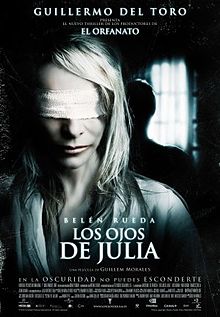
REVIEW – Julia’s Eyes (2010)

THE ZONE has my review of Guillem Morales’ disappointing Los Ojos de Julia.

The difference between the critical reaction to Julia’s Eyes and the critical reaction to James Wan’s Insidious sheds some interesting light on the extent to which our reactions to things are determined by the ways in which they are marketed and packaged. Indeed, boasting a cinematic heritage including such films as Saw and Paranormal Activity, Insidious was dismissed by many critics as stupid, childish and derivative.  Or, as Nigel Floyd puts it in his review for Time Out:

From the co-creators of ‘Saw’ (James Wan and Leigh Whannell, here director and writer) and the director of ‘Paranormal Activity’ (Oren Peli, producing) comes a project featuring nothing that was original, distinctive or scary about either earlier film.

Floyd then concludes his piece with a flourish of scorn:

Not so much insidious as inexcusable.

Compare this level of dismissive hostility with many of the reviews of Julia’s Eyes and you find a very different reaction to what is, ultimately, a film operating in very much the same genre and with very much the same set of concerns and interests.  Consider, for example, Nigel Floyd’s review for Time Out:

Guillem Morales’s thriller aims for intricate, Hitchcockian suspense, embellished with ornate visual flourishes that recall Dario Argento’s early giallo movies.

In fairness to Floyd, he does go on to suggest that Morales doesn’t quite manage to achieve these aims but the difference between the two reviews is quite striking.  Neither film is a classic of the genre but because Julia’s Eyes reminds Floyd of Hitchcock and Argento while Insidious reminds Floyd of Saw and Paranormal Activity, Julia’s Eyes is judged with a good deal more charity.  However, as I argue in my review, Julia’s Eyes fails precisely because of its direction. Morales is not only less visually imaginative than Wan but also less technically able when it comes to creating the sort of tension required to sustain a horror film and when Wan reaches for humour he connects whereas when Morales reaches for sentiment he comes away only with a handful of slush:

The chief problem with Morales’ direction is that he allows his scenes to drag on for far too long without ever really developing beyond their initial conditions. Time and again, Morales makes effective use of sound-effects and lighting cues to create an unsettling atmosphere only for this atmosphere to dissipate as audiences are allowed to grow accustomed their cinematic surroundings.

The technical failings of Julia’s Eyes are so obvious to me that I find myself wondering whether the film’s positive critical reaction might not have been due more to the way in which the film was marketed than to its inherent qualities.  Indeed, while Insidious was marketed as a stupid Horror film, Julia’s Eyes was marketed as an art house thriller of precisely the sort produced by Hitchcock and Argento. While the fact that the film was in a foreign language may have hurt it at the box office, I think that its foreign language dialogue may have served to bolster its art house credentials and so helped to solicit a more positive reaction from critics.

The more I review and the more I attempt to deconstruct my own evaluative thought processes, the more it occurs to me that my reaction to films and books is determined as much by the context of discovery as by the works themselves.  If a work comes to me warmly recommended by a trusted source then I am more disposed to be charitable.  If a book has a cover adorned with dark imagery then I am likely to read it as Horror but if the same book comes with a cover with more neutral colours then I am more likely to see it as fantasy.  The conflict between precept (my reaction as dictated by non-textual factors) and concept (my reaction to the content of the work itself) also determines the strength of my reaction.  If I go into something expecting it to be awful only to discover that it is quite good then I am more likely to give it a really positive review.  Similarly, if I go into something expecting it to be one of the books of the year only to discover that it is merely okay then I am less likely to be charitable in my evaluation.

Humans are such complex beasts and I suspect all of this explains why so many ‘serious’ academic critics tend to steer clear of evaluation…

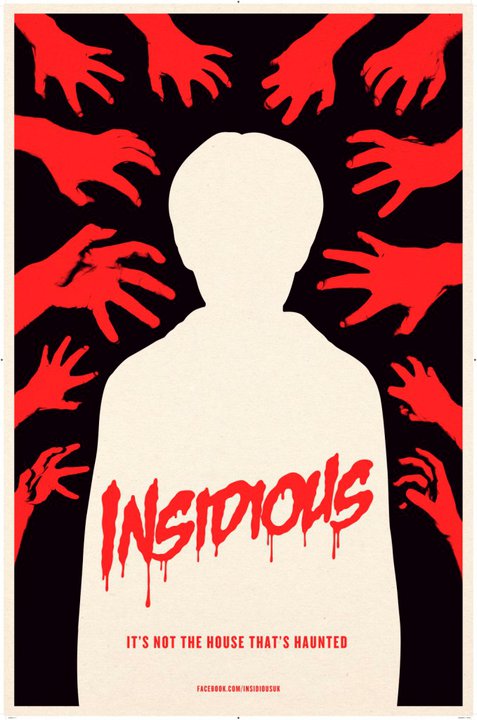
REVIEW – Insidious (2011)

THE ZONE have my review of James Wan’s deliciously camp and thoroughly ridiculous Horror film Insidious.

Insidious is in some ways a remake of Oren Peli’s low-budget cult hit Paranormal Activity (2007) in that it is a story about a bunch of ghosts turning up and haunting an individual rather than a place.  As in Paranormal Activity, the hapless victims of the haunting contact some ‘experts’ only to discover that the situation is in fact far worse than they had imagined.  However, while Paranormal Activity made clever use of fixed cameras to make it look as though it had been shot by the victims themselves (an effect fatally undermined by the various special effects ‘added’ to the film for its UK cinematic release), Insidious moves right on past minimalist realism and into the realms of full bore gonzo:

Insidious is proof that Horror still has the power to entertain and to thrill without the need for 3D gimmickry, pointless nostalgia or needless deconstruction and that all you need to deliver a really effective work of cinematic Horror is a good crew and a talented director to guide them. You don’t even need a script. Or actors. Or ideas…

Warmly recommended for anyone who likes their Horror well-made but also a little bit silly. See also Jaume Collet-Serra’s Orphan a film that brings the awesome with devastating grace and efficiency.

REVIEW – Savage (2010)

Videovista have my review of Brendan Muldowney’s Irish thriller Savage:

The concept of a crisis in masculinity is undeniably an interesting one but Savage seems more of a victim of this crisis than a commentary upon it. Having asked the question of what it means to be a man in the modern world, Muldowney fails to see past male complicity in patriarchal oppression and so he struggles to come up with any conceptions of masculinity that are not anchored in adolescent willy-worrying and cartoonish levels of violence.

Savage‘s problem is reflected in Jonathan Liu’s recent piece for The New York Observer:

From the back row, looking at the sea of shiny pink scalps, it was easy to chalk up the whole scene to a category error: Someone mistaking the biographical decline of a man—namely himself—for a historical Decline of Men. Yet, strange as it may sound, grown men still have influence—if only on not-grown men—and should perhaps not be cut the slack reserved for the subjugated and infantilized.

In other words, it is difficult to delve into the issue of what it means to be a man in the 21st century without such delving coming across as either a misogynistic entitlement whine, an attempt at historical revisionism or (as is the case with Savage) slavish adherence to popular prejudice and received wisdom.

Cyclonopedia (2008) By Reza Negarestani – Madness/Theory/Truth/Nonsense

I once attended an academic conference where a member of the audience repeated a criticism made by the author of a rather successful book. In response to this criticism, the paper-giver smiled and began his response by saying “While I think that professor X should be praised for producing such an accessible work on the subject…” before going on to explain at great length why it was that he thought that professor X was both wrong and a grotesquely ugly freak. Though I cannot remember the subject of the paper, or the criticism made of its position, or the response given to said criticism, I can still remember the audible intake of breath and the appreciative tittering from the audience when the speaker applied the word ‘accessible’ to the work of another academic. The dynamics of this withering intellectual put-down are easy enough to unpack: if a work is accessible then it means that it is written with a non-specialist audience in mind and if a work is intended to be consumed by people who are new to the subject then it cannot hope to break new-ground. However, if the aesthetics of accessibility are ‘wrong’ then what are the right aesthetics?


Continue reading →

REVIEW – We Are What We Are (2010)

THE ZONE have my review of Jorge Michel Grau’s recent art house cannibal film We Are What We Are (a.k.a. Somos Lo Que Hay).

Though undeniably atmospheric and full of potential, the film never quite manages to get its ducks in a row.  Instead of developing a coherent line of thought, the film flirts with various ideas.  Cannibalism as a relationship with one’s family.  Cannibalism as living a GLBT lifestyle.  Cannibalism as living in a state with a corrupt police force.  All of these ideas drift through the script and the film’s imagery but none of them are ever fleshed out or pursued.

Watching the film I was reminded of the post-’68 vendetta waged by the Cahiers du Cinema against Costa-Gavras’ film Z (1969).  In her flawed but punchy history of the Cahiers, A Short History of Cahiers du Cinema(2010), Emilie Bickerton characterises the Cahiers reaction to the Serie-Z as :

With Z you had a film-maker who was addressing politics on the surface, but simultaneously banalizing it.  Costa-Gavras was thus perfectly attuned to the changes in public demand: he offered a film that was shot with panache, a lively score, a hint of experimentation (…) it was intelligent and committed but never revolutionary, in either narrative content or aesthetic form. — pp. 65

I think a similar failing can be identified in We Are What We Are.  It is a film that relies quite heavily upon an audience’s familiarity with genre tropes.  To make sense of the film, you have to be aware of serial killer narratives, zombie narratives and crime narratives.  It presents itself as a film that has taken on the ideas and imagery of genre only to project them forward into a more ‘grown up’ cinematic milieu and so it appeals to people who, though familiar with genre tropes, are wanting more from their cinematic experiences than explosions and special effects.  However, despite promising a deeper level of intellectual engagement than your average genre piece, We Are What We Are is empty and insubstantial.

This is a growing problem.

REVIEW – 7 Days (2009)

Videovista have my review of Daniel Grou’s Quebecois Thriller Les 7 Jours du Talion.

The film was written by the same person who wrote the novel upon which it is based.  However, somewhat unusually, the film adaptation manages to completely miss the point of the novel.  The original book is all about a man who kidnaps his daughter’s murderer and announces to the media that he will torture the killer to death and then turn himself in to the police.  When the torture begins it is clear that the man is not psychologically equipped for the task and that in order to exact revenge the man must change.  He must effectively kill the person he once was and become someone much closer to his daughter’s killer, someone who can torture and murder another human being.  What makes the novel so interesting is the fact that the arguments for and against the man carrying out his threat are played out in real time through the media.  So, in effect, the man externalises his conscience.

Bizarrely, the film downplays this act of externalisation leaving only a somewhat dull and repetitive series of torture set-pieces.

REVIEW – The Dinner Party (2009)

Videovista have my review of Scott Murden’s The Dinner Party, an Australian psychological thriller.

Though rather unyielding in tone (it contains no changes in tempo or plot twists that might vary the mood or allow the degree of tension to vary), the film contains a really insightful commentary on the potential of friendship, love and politeness to enable the worst kinds of transgressive behaviour.  In essence, the film is an assault on the glaze of consent and agreement that we apply to all of our social interactions.

Nice to see an Australian film filtering through to UK release too.

REVIEW – Two Evil Eyes (1990)

THE ZONE has my piece on the Dario Argento and George A. Romero Poe anthology film Due Occhi Diabolici.

I have written about Poe anthologies before… once for Strange Horizons and another time as a part of a longer piece about great French Horror films.

The DVD made for an interesting review as it opens with a film that left no doubt in my mind that George Romero is one of the most over-rated and talentless directors ever to pick up a camera but closes with a film that really brought home to me how much I adore the work of Dario Argento and how much I need to see more of his films.  So a mixed bag really…

REVIEW – Left Bank (2008)

Videovista have my review of Van Hees’ wonderfully unpleasant Horror film Left Bank.

Left Bank is reminiscent of films like Irreversible and Cruising in so far as it manages to engage with a set of unpalatable attitudes in a critical way despite embodying those attitudes in the cinematography of the film.  In Cruising, the attitude in question was homophobia, in Left Bank it is misogyny.