The Films of Paul Verhoeven

FilmJuice have just uploaded a piece I wrote for them about the films of Paul Verhoeven, director of Robocop, Total Recall, Showgirls and Basic Instinct.

Regular readers of this site will know that I have a marked fondness for unpopular blockbuster directors like Neveldine/Taylor, Michael Bay and Zac Snyder. Part of what drives my fondness for these directors is their willingness to set aside human values in pursuit of absolute spectacle. All of these directors use violence and action to entertain their audiences but they also use sexuality and fascistic imagery in a way that many directors are reluctant to do. My view on these directors is that one cannot defend Big Dumb Blockbusters like Avengers or Spiderman whilst turning one’s nose up at films like Transformers 3. Summer blockbusters are in the business of pushing buttons and to have your buttons pushed is an inherently dehumanising process. The difference between directors like Bay and directors like Spielberg is that Bay is completely unapologetic about what it is that he does. He makes films for the sweaty masturbating homunculus in all of us:

When people talk about blockbuster action movies, their minds naturally gravitate to the works of sexless man-children such as Peter Jackson, Stephen Spielberg and George Lucas. The reason for this strange cognitive bias is that most people feel ashamed about watching big dumb action movies and so they need their violence to be not only bloodless but also presented in terms of absolute moral simplicity. Spielberg always cuts to the heroic working-class dad because cinema audiences need to know that their yearning for cinematic carnage does not make them a bad person. Similarly, George Lucas can neither shoot nor write a love scene because you can’t have people falling in love and then shooting each other in the face. That simply would not do.

My take on Paul Verhoeven is that he is a transitional figure in the history of blockbuster filmmaking as he spent the late 80s and early 90s building up mainstream audiences’ tolerance for sex. Without Verhoeven, people would never have gone to see Snyder’s Watchmen or Bay’s Transformers.

REVIEW – Howl’s Moving Castle (2004)

FilmJuice have my review of Hayao Miyazaki’s adaptation of Diana Wynne Jones’s Howl’s Moving Castle. Re-watching the film for the first time since it first appeared in a UK cinema, I was struck by the extent to which it is a microcosm for all the strengths and weaknesses of Miyazaki’s direction:  On the plus side, the animation is spectacular, the mood is uplifting without ever seeming false and the design is a profound expression of nostalgia for a sophisticated, metropolitan Europe that may never have existed in the first place. On the down side, the plotting is frequently nonsensical and the characters have so little depth that they struggle to command our interest, let alone our sympathies. As I put it in the review:

If you are one of those upper middle-class parents that have latched onto Miyazaki as a reliable source of non-violent and morally uplifting children’s entertainment then Howl’s Moving Castle is definitely the film for you. The animation, artwork and pacing are more than enough to keep the little ones amused while their parents sit in open-plan kitchens drawing up plans to take over a Tuscan bean farm or a gite in the Dordogne. However, if you are a grown-up looking for grown-up ideas and characters then Howl’s Moving Castle is a touch more problematic.

A couple of years ago, I wrote a piece about Miyazaki’s Ponyo (2008) in which I suggested that Miyazaki’s attitudes towards humanity moved back and forth between flesh-rending misanthropy and warm-hearted sentimentality. In that piece, I concluded that Miyazaki tended to ‘do’ warm-hearted sentimentality a lot better than he did complex adult morality. Having recently re-watched both Ponyo and Howl’s Moving Castle, I now realise that my earlier diagnosis was entirely off base. The problem is not that Miyazaki struggles with adult morality, it is that he struggles with human psychology but that these struggles are less evident when they are presented as part of a film aimed directly at children. Indeed, both Ponyo and Howl’s Moving Castle suffer from the fact that they are films that revolve around entirely unconvincing love stories but because Ponyo presents itself as child-friendly, we are more inclined to forgive its lack of psychological foundation while Howl’s Moving Castle seems much more grown-up and so the lack of real characterisation is both obvious and grating.

Prometheus (2012) – Calvinball Mythology and the Void of Meaning

0. We Crave Mythologies, Not Stories

Humanity has always told and listened to stories. Given that these stories sometimes provide the backbone for an entire culture or mode of being, it is only natural that stories should evolve to suit the needs of the cultures that tell them. Western culture has changed a lot over the last fifty years and one of the ways in which our culture has changed is that we have acquired a taste for longer and longer stories. Once upon a time, we watched films, read novels and enjoyed TV shows that could be watched in almost any order. Now, we read series of novels, watch trilogies of films and feel cheated if our TV series do not end by paying off storylines that span multiple seasons and dozens of episodes. As a culture, Westerners no longer crave stories… they crave mythologies.

While explanations for this trend towards narrative expansiveness may lie beyond the scope of a single blog post, I would suggest that we crave fictional mythologies because the religious mythologies we inherited have lost all credibility and the market has stepped in to fill the gap. Though we may not believe in the mythologies of Marvel comics in the same way that our parents believed in God, the experience of engaging with escapist literature is very similar to that of engaging with religious text.  As J.R.R. Tolkien once put it:

It is the mark of a good fairy-story, of the higher or more complete kind, that however wild its events, however fantastic or terrible the adventures, it can give to child or man that hears it, when the ‘turn’ comes, a catch of the breath, a beat and lifting of the heart, near to (or indeed accompanied by) tears, as keen as that given by any form of literary art, and having peculiar quality.

This ‘turn’ comes in the form of the moment when we suddenly lose ourselves in a fictional world and cheer inwardly when the narrative logic of that world asserts itself upon the events of the plot. When a hero finally wins the day or the tragic queen finally dies, we feel a sense of consolation that is entirely lacking from the ‘real world’ we inhabit for much of our waking lives. This desire to feel that the world abides by the rules of a story and that everything in the world happens for a reason is central to the religious impulse. Even a staunch Catholic like Tolkien recognised that the sense of fulfilment we gain from a good piece of escapist literature offers a faint echo of the sense of fulfilment that can be gained from having Faith in the Christian story.

As Westerners have come to demand more and more from their escapist media, creators have responded by not only satisfying those desires but by encouraging them whenever possible. These days, one cannot have a successful film without a franchise and one cannot have a franchise without a suite of media tie-ins including novels, games, TV series and comics. Each of these spin-offs adds complexity to the franchise and allows for the creation of yet more products whose worlds intersect that of the core franchise. The talent, manpower and money poured into the construction of these trans-media megatexts would be horrifying were it not so historically familiar… The truth is that our culture builds media franchises for the same reason that the Ancient Egyptians built pyramids and Medieval Christians built cathedrals: We are taking the fantastical and making it concrete so as to make the fantasy feel more like reality.

Continue reading →

REVIEW – Shame (2011)

Back in 2008, I struggled with the religious imagery of Steve McQueen’s debut feature Hunger (2008). I struggled with it because it seemed too obvious and because the troubles had been cast in that particular light altogether too many times.  I have since rewatched Hunger and I now realise that I was wrong. I was wrong to read the film as being Catholic in sentiment and I was wrong to argue that it was simply retreading old ground. When I said that Hunger “cannot get out from under the weight of cinematic history”, I might as well have been writing about my own review. Given that my fondness for Hunger has grown over the years, I was somewhat reluctant to go and see his second feature Shame at the cinema. Aware of my history of not ‘getting’ McQueen’s films and concerned that the film’s subject matter struck me as over-exposed and boring, I waited for the DVD release… and then waited some more. In truth, I was happy to let this film slip away from me until I was offered a review copy. Just When I Thought I Was Out… As a result, Videovista have my review of Steve McQueen’s Shame and it is full of ambivalence.

Set in an economically prosperous but emotionally barren New York City, Shame tells of a successful man who devotes his life to the pursuit of orgasms. Orgasms by hand, orgasms by mouth, orgasms by any means necessary and to the exclusion of all other avenues of pleasure and fulfillment. Moving from one nameless sexual partner to the next, the character leads an admirably simple life and appears to experience none of the downsides traditionally associated with a hedonistic lifestyle. However, this simple existence is thrown out of balance when the character’s emotionally incontinent sister comes to stay. Suddenly plagued by feelings of shame, the character attempts to re-invent himself as a normal person only to fall at pretty much the first hurdle. While much has been made of the film’s interest in the question of sex addiction, my view is that the film is attempting to do what it says on the tin, namely examine the role of shame in making us do the things we do:

 What distinguishes Shame from the likes of Lost In Translation and Up In The Air is that it pointedly refuses to use the same psychological model as most films and TV dramas. Most film and TV writers create their characters using a somewhat simplified version of Freudian psychodynamics. In particular, they tend to be very fond of the Freudian concept of displacement whereby an irrational over-reaction to one thing is actually the product of a rational but socially unacceptable reaction to something else. For example, in Up In The Air, George Clooney’s character comes across as excessively hostile to a co-worker who is attempting to force him off the road and into an office job. Initially, this reaction seems perfectly understandable but as the movie progresses and Clooney’s character becomes more and more unreasonable; we learn that the true source of his unease is the fact that he has no social bonds and hates the hugely successful career that he has built for himself. Some critics have sought to interpret Brendon’s sexual escapades in light of an unmentioned childhood trauma, but McQueen pointedly makes no reference at all either to Brendon’s inner life or to the emotional life of his childhood. The reason for this is that McQueen wants us to focus only upon that which we can see and what we see is a man who is forced out of his comfort zone because he feels ashamed.

While I think that McQueen’s attempt to break new psychological ground is nothing short of heroic, I am not convinced that the film ever gains any traction on the concept of shame. Add to this the lack of visual firepower and what you’re left with is a quite traditional arty drama held together by two decent performances. Which is a recipe for Oscar-bait, not thought-provoking cinematic art.

I Saw the Devil and His Name Was Kim Jong-un – Vengeance and South Korean Cinema

Kim Ji-woon’s I Saw the Devil tells of a South Korean intelligence agent who responds to the death of his wife by tracking down the man who murdered her. However, instead of simply killing the man, the agent decides to install surveillance equipment that will allow him to continue punishing the murderer over an extended period of time. Initially, the killer is taken aback by the agent’s hatred but he soon comes to enjoy the confrontations and so lures the agent into an increasingly brutal contest of wills. Hideously violent, unflinchingly brutal and yet beguiling to watch, Kim’s film offers a traditionally Nietzschean warning to those who would consider embarking on a quest for revenge:

Battle not with monsters, lest ye become a monster, and if you gaze into the abyss, the abyss gazes also into you.

While Kim’s film is beautifully made and eminently entertaining, I cannot help but wonder why it is that he felt inspired to make a film with this particular message. Back in 2005, Kim directed the wonderful A Bittersweet Life in which the protagonist exacts a bloody revenge on his employers for the way in which they deprived him of a personal life and yet responded with furious anger the second he stepped out of line in an effort to grab some happiness for himself. Given that A Bittersweet Life convincingly communicates the idea that revenge is a necessary but ultimately self-defeating course of action, it is strange to see Kim making yet another film with this precise message. Especially when the message in question is so blindingly obvious that it scarcely merits a passing thought at all let alone enough thought to fill two entire films. Even more puzzling is the fact that Kim is not alone in his desire to brood over the morality of vengeance. In fact, South Korean cinema has produced so many revenge films in recent years that one can comfortably talk about them constituting a sub-genre in their own right.

Continue reading →

REVIEW – The Rafi Pitts Collection (2012)

Back in April 2011, I reviewed Rafi Pitts’ The Hunter, a superb insertion of 1970s American paranoid cinema tropes into a depiction of contemporary Iranian society. Evidently quite successful, the cinematic release of The Hunter has prompted the good folks at Artificial Eye to put out a box set of Pitts’ films including The Hunter but also the exquisitely moving It’s Winter (2006) and Pitts’ far more conventional early feature Sanam (2000). FilmJuice have my review of The Rafi Pitts Collection.

One of the pleasures of this box sex is that it allows you to survey the development of a creative talent. Though beautiful to look at and entirely decent, Pitts’ Sanam is a highly generic exercise in wrangling world cinema tropes. Indeed, the colourful photography and plot featuring a young boy struggling to get over the death of his father could have been made by any world cinema director in any country in the world. Having mastered the world cinema genre, Pitts then begins to process of developing his own sensibility. Intensely poetic and filled with chilly urban alienation, It’s Winter is demonstrably a far better film than Sanam and a far better film than we have come to expect from most world cinema directors who seem mostly content with toeing the line and giving western art house audiences exactly what they expect of a particular country. This cold and urban sensibility finds its ultimate fruition in the paranoia and repressed violence of The Hunter, which is easily Pitts’ best film to date:

The Hunter tells of a reformed criminal struggling to find salvation in the role of husband and father. The problem is that, while the film’s protagonist is quite content to go straight as long as he can spend time with his family, his employers use his criminal past as an excuse to make him work nights thereby ensuring that he rarely gets to see his family. When something terrible happens and the man’s family disappears, the man understandably goes nuts and begins hunting Iranian policemen. At this point, the film transitions from being an account of social injustice to being a tense paranoid thriller in the style of Taxi Driver and The Parallax View. Just as beautifully shot as Pitts’ earlier films, The Hunter juxtaposes the cold urban landscapes of It’s Winter with the warm naturalism of Sanam only to find that the Iranian police will chase you down through both sets of landscapes. Intriguingly, the film’s ending obliquely hints at the possibility of future uprisings. How much mistreatment will the Iranian people endure before, much like the hunter, they snap?

Also fantastic is the interview with Pitts that is included on the second disk in the collection. Many creatives, though clearly intelligent, lack either the self-awareness or the personal openness required to shed much light on their working processes, Pitts is clearly not one of those types of creatives. Witty, insightful and astonishingly candid about the choices he made during the shooting of It’s Winter, the interview is a timely reminder of quite how much a good DVD extra can add to the experience of watching a film.

Five Great Films by Billy Wilder

After years of somewhat patchy DVD coverage, the films of Billy Wilder are finally getting the DVD releases they deserve. In celebration of this fact, I have written a piece for FilmJuice listing my five favourite Wilder movies. The list includes — in no particular order — The Lost Weekend, Sunset Boulevard, Double Indemnity, Some Like it Hot and Murder Mills.

My take on Wilder is that many of his films feature a tension between brutal cynicism and crowd-pleasing optimism that sometimes cuts very close to the winds of mushy sentiment. Had Wilder been anything less than a great director, this tension would most likely have resulted in some spectacularly dishonest filmmaking. However, each of the films I explore in the article work because they are all heart-felt journeys out of cynicism and into the light. In each case, you can follow the path and see Wilder talking himself down off the edge:

Billy Wilder is the most sentimental filmmaker to ever acquire a reputation for cynicism.

As I worked my way back through Wilder’s films (including some of the decidedly less interesting works produced late in his career) I couldn’t help but wonder about the tension between cynicism and romanticism. Indeed, if Wilder’s films are to be understood as the product of a mind endlessly seeking reasons to be cheerful, what does this say about the wider relationship between cynicism and romanticism? Are all cynics disappointed romantics? Are all romantics naive cynics? Wilder’s films certainly suggest some form of connection between the two dispositions.

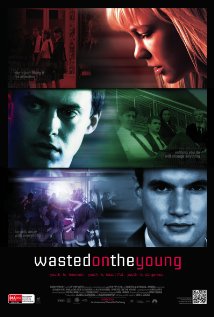
REVIEW – Wasted on the Young (2010)

THE ZONE has my review of an interesting Australian film by first-time director Ben C. Lucas. Wasted on the Young is stylishly shot high school mystery in very much the same tradition as Rian Johnson’s Brick. Aside from the intriguing plot and the deliciously chilly cinematography, what really grabbed me about this film was its attempt to get inside the head of contemporary teenagers whose every move is recorded by CCTV cameras and whose every thought is captured by social media:

 As William Gibson’s recent writings have suggested, there was a point when society changed and certain ideas ceased to be science fictional. Yesterday’s cyberpunk futurism is today’s kitchen sink realism. Similarly, many old realist touchstones appear to be little more than genre affectations tainted by reactionary nostalgia. We no longer live in a world where women can afford to be bored doctor’s wives. Virginia Wolfe once described George Elliott’s Middlemarch as one of the few British novels written for adults but when read today, the book appears about as realistic as a quest to destroy a magical ring. By borrowing elements from the hard-boiled and cyberpunk genres while simultaneously downplaying the fictional character of these elements, Lucas is attempting to capture what it feels like to grow up in a world with its own set of realist touchstones and its own set of worries and concerns.

Watching it I was reminded not only of the more recent works by William Gibson but also the short stories of Tim Maughan (some of which I reviewed a little while back). What unites these works is a realisation that, rather than simply adding to an already existing world, the internet and social media are changing the world by sculpting how young people learn to see and react to the world. Literary theorists have spent the last 100 years bemoaning the fact that we are now modern and as such have severed our ties to the gods of our forefathers. Similarly, transhumanists spend much of their time banging a drum for the change that will come with the arrival of the Singularity. The more I read and the more I think about today’s youth, the more I realise that there is no great Death of Pan or Birth of the Singularity… there’s just some old fucks dying and some young fucks taking their place. Society is in constant evolution and social media is one particular area of genetic drift. In 10 years (let alone 100), people will wander what it was like to live without the internet and so any work of art that does not engage with the social changes created by the internet must be seen as little more than a side-show.

Gibson’s decision to re-position himself as a mainstream writer rather than a genre writer is the product of two forms of change: Firstly, society has changed to the point where science-fictional ideas are now realistic ideas. Secondly, Gibson needed to leave genre because genre has no interest in writing about the world that we are currently making for ourselves. Wasted on the Young is yet more evidence that science fiction has run its course as both a literary tradition and a sub-culture as it is easily as cyberpunky as any of Gibson’s recent novels and yet it presents these scientific and social ideas as nothing more than grindingly mundane realism.

REVIEW – Crows Zero (2007)

In a recent review over at FilmJuice, I moaned about the tendency of Western distributors to only pick up the films that chimed with Takashi Miike’s reputation for producing horrifically violent cinema. However, Miike’s recent acquisition of mainstream respectability thanks to Thirteen Assassins (2010) and Hara-kiri: Death of a Samurai (2011) means that more and more of his lesser films are finding their way to US distribution. Yatterman (2009) is one example of this, Crows Zero (2007) is another.  THE ZONE has my review of the latter.

What I liked about the film is that it takes quite a traditional hero’s journey plot structure and neatly dovetails it with quite a melodramatic approach to characterisation meaning that despite being nothing more than a series of confrontations leading to a final battle, the film never feels overly episodic:

While the foreground of Crows Zero is dominated by the need to conquer the school, the subplots all revolve around the tensions between what the individual wants and what people expect of them. Thus, Ginji struggles with both the expectations of his father and the expectations of his followers while Serizawa tries to cope with the fact that his gang expects him to deal with Ginji despite the fact that he thinks the pair could probably be quite good friends. In true yakuza picture style, these tensions are explored in a highly stylised and melodramatic manner that owes more to opera than it does to gritty crime fiction. In fact, one subplot resolves itself by having someone bellowing their devotion into a rain-soaked sky while another subplot resolves itself through an epic all-day battle sequence. As the film progresses, this movement between genres proves itself to be remarkably effective as the melodrama distracts from the episodic structure of the plot while the humour and violence prevent the film from getting bogged down in self-indulgent teenaged angst. However, while Crows Zero neatly sidesteps the problems associated with both of its parent genres, the film does possess its own set of problems.

These problems are derived from the fact that, rather than constructing the series as one would a traditional cinematic trilogy, Miike directly imports the narrative conventions of shounen manga. Shounen manga narratives frequently span dozens and dozens of books and in order to support these astoundingly lengthy narratives, manga writers have developed their own set of techniques that are very different to those of cinematic series. While the techniques required to sustain lengthy cinematic series are evolving in light of franchises such as The Avengers, Miike’s use of narrative techniques derived from manga feels like too much change far too quickly resulting in some astonishingly awkward plotting. As I say in the review, I can imagine how these techniques might work in the context of an entire series, they are really quite distracting in the context of an individual film (indeed, given that the sequel exists and is now three years old, I think it was a major mistake not to release both films as a box set).

REVIEW – The Island of Lost Souls (1932)

FilmJuice have my review of Erle C. Kenton’s much under-loved The Island of Lost Souls starring Charles Laughton and Bela Lugosi.

The film is a product of the 1930s Golden Age in American horror that produced many of the great American movie monsters. Based on H.G. Wells’ The Island of Doctor Moreau, The Island of Lost Souls was banned in the UK because of its tendency to deny God and play with the idea of inter-racial and inter-species sex. Indeed, to say that this film is racist would be something of an understatement as it represents an almost flawless articulation of White America’s fear that non-whites will someday rise-up and, in the immortal words of Hunter S. Thompson, savagely penetrate every orifice in their bodies with their throbbing, uncircumcised members:

The film’s use of the word ‘native’ to denote the man-beasts is hardly accidental as it panders to double-edged racist fantasies about non-white people being more animalistic than American Christians. I use the word ‘fantasies’ advisedly as this belief in the passionate nature of non-white people extends not just to their perceived capacity for violence but also to their atavistic sexualities. Thus, when Parker kisses Lota and recoils in disgust, his disgust is born not only of inter-racial and inter-species revulsion but also from the realisation that he enjoyed kissing the savage far more than he did his immaculate groomed white fiancée.

Interestingly, the film is currently considered to be out of copyright meaning that you can watch it for free on Youtube. However, the good folks at Eureka have done a fantastic job of packaging the film up with a series of interviews and essays and the print used for their release is fantastically clear so I definitely recommend picking up their edition rather than watching it for free on the internet.