REVIEW – Ghost Rider: Spirit of Vengeance (2012)

FilmJuice have my review of Mark Neveldine and Brian Taylor’s Ghost Rider: Spirit of Vengeance.

Question: Nic Cage plays a flaming skeleton on a motorbike in a film directed by the guys behind Gamer (2009) and Crank 2: High Voltage (2006), what is not to like? Answer: The script. Much like Justin Lin’s Fast Five (2011), Ghost Rider: Spirit of Vengeance is just a few jokes and few decent plot points away from being a really brilliant action film. Without a decent script, the film is simply an inordinately silly and entertaining action romp featuring some brilliant cinematography and some genuinely revolutionary use of 3D:

Most 3D techniques operate by either creating an illusion of depth, or creating the illusion that something on screen is jutting out into the cinema. 3D films create these illusions by forcing your eyes to focus on two different things at the same time, which is why watching 3D films can be a headache-inducing experience. While Neveldine/Taylor make good use of ‘traditional’ 3D effects, they also set out to push the limits of 3D by intentionally recreating those moments where the 3D techniques break down and your brain rebels, forcing you to look away from the screen in disgust. The result is a series of sequences that are both deeply unsettling and entirely appropriate given the context and subject matter. Think of the way in which Gaspar Noe’s Irreversible (2002) used brown notes and violent camera work to induce feelings of unease and you will get some idea of how visceral an experience Ghost Rider: Spirit of Vengeance can be.

Lacking decent dialogue, compelling story-telling or engaging characters, Ghost Rider 2 is almost an art house flick in that its primary pleasures are visual and cinematic rather than narrative. Fans of ground-breaking cinematography and silliness will lap this up, those seeking a more traditional comic book movie may well find themselves shifting in their seats.

REVIEW – Rampart (2011)

FilmJuice have my review of Oren Moverman’s Rampart.

Written by the crime novelist James Ellrot and set against a backdrop of police corruption and political wrangling, Rampart tells the story of a cop on the wrong side of history. Played by Woody Harrelson, Dave “Date Rape” Brown knows all the angles and all the dirty secrets meaning that even when he fucks up and gets caught, the brass can’t touch him. All Brown needs to do is claim to have received a job offer from Fox News and his problems simply melt away. However, as the film progresses and the political climate shifts further and further from yesterday’s old pals and backroom deals, Brown finds himself struggling to keep his head above water:

The idea that there is no place for a person like Dave in a civilised society provides Rampart with much of its thematic power. Dave, we are told, is the son of an old school cop and his status as the son of an old school cop gives him access to a network of contacts embodied by the nameless retired detective played by Ned Beattie. At the beginning of the film, Dave has a place in the LAPD because the department is still in thrall to the old and brutal ways of doing business. Most of Dave’s problems stem from the fact that he simply cannot adapt to the new LAPD being built by ambitious politicians like those played by Sigourney Weaver and Steve Buscemi. Thus Dave’s fall from grace is not just about his own stupidity but also about power leaching away from the brutal white men who police the city.

Though Rampart‘s wonderful cinematography, engaging characterisation and some hugely entertaining and recognisably Ellrovian dialogue are more than enough to make for an entertaining film, one cannot help but feel that there is something increasingly generic about the existential art house crime film. Back in 1967, John Boorman’s Point Blank used the tools of the art house to delve into the police house and since then a steady stream of art house directors including Abel Ferrara, Werner Herzog and Nicolas Winding Refn have happily used brilliant cinematography to tell and re-tell the same stories of crime, madness and existential alienation. Indeed, Rampart‘s real problem is that it is ultimately nothing more than a well realised genre film. Great cinematography? Check! Enigmatic protagonist? Check! Long drawn out pauses? Check? Descent into madness? Check! Ambiguous ending? Check! Though entertaining, the art house crime film really has lost its power to shock or provoke… in its own way it is just as predictable and safe as the country house mysteries of yesteryear.

Zona (2012) By Geoff Dyer – Then, after about 15 minutes, you’re spit out into a ditch on the side of the New Jersey Turnpike!

Geoff Dyer is a man who knows the value of an unconventional job title. Rather than sauntering through life as a simple novelist, critic, travel writer, historian or essayist, Dyer has tried his hand at many different forms and somehow evaded becoming particularly associated with any of them. Geoff Dyer is not a novelist who writes criticism or a travel writer who produces novels, he is all of these things and yet none of them. Like a Renaissance princeling or Imperial Khan, his name is habitually appended with an ever-growing succession of baroque and idiosyncratic job titles ranging from the mundane (writer) and the old fashioned (intellectual) to the endearingly preposterous (intellectual gate-crasher). Frankly, if Dyer began describing himself as a servant of the Secret Fire and wielder of the Flame of Anor I doubt that anyone would be particularly surprised. Dyer evades encapsulation in the same way as Pynchon evades publicity… his elusiveness is central to his charm.

In a typically warm, insightful and engaging interview conducted by Colin Marshall, Dyer explains the reasoning behind his steadfast refusal to either commit to any particular form or abide by the rules of any of the forms he operates in.  Dyer’s end game is to create a body of work whose allure bears no relation to its actual subject matter. For example, you may have no interest in the life and work of D.H. Lawrence but this should not prevent you from being entertained by Dyer’s Out of Sheer Rage (1997), a book about trying to write a book about D.H. Lawrence. Similarly, you might prefer the idea of burying your face in an ants nest to reading another novel about spiritually disaffected upper-middle class people but this should in no way prevent you from enjoying Dyer’s Jeff in Venice, Death in Varanasi (2009).

With no apparent form or subject matter to call his own, the seat of Dyer’s charm is… well… Dyer himself. As Michael Silverblatt put it when he interviewed Dyer, there is something decidedly likeable about a man who travels the world only to obsess over finding the correct local iteration of his preferred breakfast. There is something instantly recognisable about a man who loves books and films but never the ones that he is supposed to be reading at any given moment. As in the works of J.G. Ballard, this persona may change slightly from book to book and from article to article but that voice and that character are present in everything that Dyer writes. Chances are that if you like the persona that Dyer presents in all of his writings then you will happily read anything that Dyer has to say as the true subject of Dyer’s books and articles is invariably himself.

Those immune to Dyer’s charms may well view Dyer’s methodology as supremely egocentric and dishonest. Indeed, how many people have purchased Out of Sheer Rage expecting an award-winning biography of Lawrence only to discover that the book is actually the amusing tale of a hapless writer who scoffs almond croissants goes on holiday and crashes his moped? These un-named and potentially fictitious critics may well be completely right about Dyer but they are also missing the point.

There are many reasons for deciding to read a particular book (plot, characterisation, social commentary, prose style) but one of the most compelling is that the process of reading someone else’s thoughts allows you to gain access to that person’s headspace for extended periods of time. To read a book is to experience something – a time, a place, a film, a relationship – through the eyes of an author and when that author has a set of sensibilities as distinct and engaging as those of Geoff Dyer then sharing that author’s headspace can become an end in itself. If the point of Dyer’s writing is to allow us to hear the world described by his voice then his latest work Zona (2012) is his most successful to date.

Continue reading →

Red Hill (2010) – The Old West, The Outback and the Awesome Power of Whitey

History is one of the key battlegrounds in the war for social progress. When used correctly, history confers not just a sense of tradition and legitimacy but also a sense of inevitability: Why bother fighting to change society when things have always been the way they are? Why bother fighting to overthrow the status quo when history tells us that there are no viable alternatives to the existing model? To control history is to control the narratives that govern society and to control the narratives that govern society is to govern society’s moral compass.

Once a group controls all the narratives and sets the moral tone of the discussion, all they need to do in order to win an argument is to present themselves as being history’s natural endpoint. Indeed, it is one thing to criticise the morals of the ruling elite and the moral righteousness of the status quo but it is quite another to pick a fight with the implacable Darwinian logic of human history. By staking out the historical high ground and claiming to be the culmination of long-standing historical processes, defenders of the status quo can make their critics appear not merely wrong but ignorant and downright delusional. One spectacular example of this type of thing is Francis Fukuyama’s infamous decision to celebrate the end of the Cold War by asking whether America’s victory over the Soviet Union marked the end of history. By attempting to claim American liberal democracy as history’s logical end point, Fukuyama was making a bold political claim namely that in the grand scheme of things, All Paths Lead to Us. Thus, the Soviets were not merely wrong; they were fighting against history’s oceanic tide. Another example of the battle to control a society’s historical narratives can be found in the evolution of the cinematic Western.

Continue reading →

REVIEW – Drive (2011)

Videovista have my review of Nicolas Winding Refn’s critically acclaimed California Noir action movie Drive.

As someone whose first instinct is invariably to distrust received opinions and critical consensuses, I was somewhat disappointed to find myself in the position of absolutely adoring Drive. I adore the way it looks, I adore the way it is paced, I adore the characters and I adore the film’s wider themes.  While there are a number of different ways of approaching the film, I see it as effectively a retelling of Pinocchio… the story of how a puppet became a real boy:

The reason the driver operates by a very simple set of rules is because he is effectively a simpleton who possesses no desires or dreams of his own. As the driver’s shambling employer and best friend Shannon explains, he suddenly appeared out of nowhere and does whatever is asked of him without complaining or asking questions. The driver’s lack of interior life is also reflected in his general demeanour as most questions asked of him result in little response beyond an impassive smile and an evasive answer. As blissful as it may seem, this state of perfect psychological simplicity is interrupted when the driver offers to help his next-door neighbour with her shopping.

Another question I explore in my review is the issue of narratives that effectively use female characters as catalysts for the emotional transformation of their male protagonists. Indeed, one of the strangest things about Drive is our willingness to accept on faith that a character such as the Driver might exist. The reason we accept the idea of an emotionally stunted driving-machine is because we are already familiar with the idea that all men are stunted children who only ever grow up (i.e. stop chronically masturbating, doing bong hits and getting into fights at sporting events) once the calming hand of a female presence is laid on their arm. In the second half of my review I explore the issue of whether this view is actually sexist:

Conrad’s Heart Of Darkness tells the story of a white man who goes mad in the jungle while the Africans quietly get on with their lives. In other words, it is the supposedly superior white man who loses his mind in the jungle and not the supposedly inferior Africans. Similarly, while it seems fair to observe that Irene is a simplistic character, her two character traits easily outdistance the subhuman imbecility of the white man at the centre of the film. Drive is the story of a character becoming human while the woman who prompts this transition remains noble, human and complete throughout. In fact, Drive could almost be read as the story of an innocent woman who becomes embroiled in a tug-of-love between the criminal she married and the handsome weirdo who lives next door.

Regardless of how you interpret it, I consider Drive to be one of the best films of 2011 and one of my ten favourite films of all time.

Why Do People Buy Books They Don’t Read?

0. TBR! TBR!

Regardless of whether your passion is for books, films, games or comics, the chances are that your home contains a large stockpile of unconsumed culture. Depending upon the exact nature of your passion, this stockpile can take a number of different forms including:

  • A pile of books marked ‘To Be Read’
  • An array of downloaded or recorded TV series you need to ‘Catch Up On’
  • A Steam account containing games boasting zero hours of play
  • A shelf groaning under the weight of shrink-wrapped DVD box sets

As perverse as this kind of cultural opulence might seem, it is as nothing when compared to the mind-boggling absurdity of our tendency to buy new books and films when we have dozens of perfectly wonderful titles sitting at home on a shelf. Why do we do it? Why do we buy books we don’t read? The answer lies in our postmodern condition, the economics of human attention and the ever-changing nature of the self.

Continue reading →

REVIEW – Le Silence de la Mer (1949)

FilmJuice have my review of Jean-Pierre Melville’s first film Le Silence de la Mer.

Given that Melville is best known for such noir crime thrillers as Bob Le Flambeur (1955) and Le Samurai (1967), it is surprising to discover that his first film is neither a thriller nor an homage to the noir classics of Hollywood’s golden age. In fact, Le Silence de la Mer is an adaptation of a novel written by a member of the French resistance. Densely atmospheric and pointedly stripped of all extraneous dialogue, the film tells the story of the relationship between a pair of French people and the Nazi officer they are ordered to provide with lodgings. Every evening, the Nazi officer comes home and trots out a few pleasantries that the French people pointedly ignore. As the months go by, the officer’s love of France and desire to talk bubbles over into a series of impassioned speeches about his hope for the future of Franco-German relations. Aside from being beautifully composed and wonderfully still, Le Silence de la Mer is also wonderfully ‘of its time’ thematically speaking:

Aside from its technical brilliance, Le Silence de la Mer also offers a fascinating snapshot of a French intellectual class that was still trying to come to terms with the implications of widespread collaboration. Indeed, between the officer’s status as a ‘Good German’ and his lengthy speeches on the greatness of French culture, it is easy to read this film as an ode to the majesty of France (the film is based on a novel written by a member of the resistance) but look beyond the foreground and you find a morally ambiguous world full of silently complicity French people, bars closed to Jews and a Nazi delivering what was effectively the Petainist line that France would become greater through collaboration. While Le Silence de la Mer may lack the slow-burning outrage of Melville’s more famous indictment of French collaboration L’Armee des Ombres (1969) this is still a heroically ambiguous film from a time when France was desperate to escape all suggestion of moral ambiguity.

As someone who owns the Mieville DVD box set, I was somewhat taken aback by how different this film feels to many of his better-known works. Indeed, contained in this still and ambiguous early film are the blueprints for an entirely different cinematic career… what if Melville had not become a maker of thrillers but a more traditionally art house experimentalist? This is a film that captures the attractions of just such a possibility.

REVIEW – Two-Lane Blacktop (1971)

FilmJuice have my review of Monte Hellman’s powerfully existential road movie Two-Lane Blacktop.

Two Lane Blacktop is a film about a pair of twenty-somethings who support themselves by moving from town to town and participating in drag races. This pair are so complete adrift in the world that they possess neither home nor name, all they have is their car and the open road. In fact, the pair are so emotionally detached that it barely registers when an attractive young woman decides to join them on their aimless journey. One day, the pair run into a middle-aged fantasist and challenge him to a long distance race. Sensing some element of menace from the youngsters, the fantasist agrees but is puzzled to discover that the young people have no interest in actually winning the race:

At one point the middle-aged man is driving along and spots the youngsters having breakfast in a diner. Annoyed that they seem to be taking his challenge so lightly, the old man pulls over and confronts them, angrily asking “Are we still racing?” but no answer is forthcoming. Increasingly ill at ease with this strange relationship, the older man convinces the young girl to travel with him and he takes off while the other two are racing a local. With steel in their eyes, the pair take off after the older man but rather than confront him about cheating or stealing their girl, their annoyance seems to come from the fact that he moved the relationship from one of mutual cooperation to one of competition. As the older man drives off alone, he begins to weave lies about how he won the car from the younger men using his customised muscle car.

The middle-aged man spends the entire film telling lies because he cannot cope with the hollowness of the existence he experiences on the road. Too old and too set in his ways to come to terms with life’s lack of meaning, he spins lies to make sense of his life and that of the youngsters while the youngsters just keep on moving from town to town without ever asking for or receiving any answers.

Released by Masters of Cinema with a bevy of essays and documentaries designed to bolster its status as an overlooked classic of 1960s counterculture, Two-Lane Blacktop captures the beauty and alienation of a life lived outside of traditional culture in a way that Easy Rider never quite managed.

BG47 – Hang All The Critics

Futurismic have just published my forty-seventh Blasphemous Geometries column entitled ‘Hang all the Critics: Towards Useful Video Game Writing’.

I originally wrote the column about ten days ago but last weekend I became aware of two significant blogospheric shit-storms that seem to provide an interesting context for the column.  The first shit-storm involves a bunch of people being upset by an article about yoga and the second shit-storm involves a bunch of people being upset by a review of an epic fantasy novel. Though ostensibly very different in their origins and subject matters, both shit-storms involve a community reacting very angrily to negative coverage from a perceived outsider. In the case of the ‘yoga community’, the outsider is the New York Times senior science writer William Broad and, in the case of the ‘epic fantasy community’, the outsider is the Strange Horizons reviewer and post-graduate student Liz Bourke.

The link between these blogstorms and my most recent video games column is that ‘Hang All the Critics’ is an attempt to confront the fact that the age of the critic has now passed. Criticism and its less well-heeled cousin reviewing rely upon the assumption that a person of reasonable insight and creative flair can consume a cultural product and issue an opinion or reaction to that will be of use to other people despite the fact that these other people might have very different tastes and interests.

It is no accident that the role of the critic has its roots in the cafe culture of the 17th Century as the coffee shops frequented by the likes of Samuel Johnson tended to be cramped places where all kinds of bourgeois intellectuals were forced to rub shoulders. One of the unfortunate side-effects of the Internet’s infinite potential for space is that people from a particular class and with a particular set of interests are no longer forced to rub shoulders with people with ever-so-slightly different sets of tastes. These days, if you are interested in steam locomotives but not other forms of train then you are in no way obliged to encounter the opinions of people who consider steam trains to be a quaint but outmoded form of technology. The more the Internet matures, the more interest groups fragment and the more interest groups fragment, the more isolated and tribal these communities become. There is no place for criticism in a world dominated by tribal conflicts and persecution complexes, this is why Liz Bourke and William Broad got it in the neck and this is why Rotten Tomatoes is filled with people reacting angrily to the idea that a film they haven’t seen might not be as good as they expect. The age of the critic is at an end and it is time to change the way we do business.

Needless to say, I am not the first person to notice the collapse of our culture’s public spaces. Indeed, many reviewers and critics have attempted to respond to the increasingly commercial and tribal nature of the public sphere either by retreating into the walled-garden of academia or by creating a tribal space of their own. While I can entirely understand this desire for retrenchment, I think that it is ultimately an act of cowardice:

As someone who has never once tried to review a game for a major site, I am not in the least bit opposed to the fracturing of public space in order to create environments in which inaccessible forms of writing are protected from the vagaries of commerce and popular tastes. A recent comment on one of my pieces described my style as “masturbatory” and I find myself absolutely powerless to disagree. There is something decidedly self-indulgent about sharing one’s opinions online — particularly when one makes little or no effort to reach out to the majority of people interested in a particular topic — and this kind of self-indulgence is not about subjecting games to serious intellectual scrutiny or ‘consolidating a continuous counterbalance’; is a cowardly retreat from the public sphere, driven by the recognition that my opinions are of use to nobody but myself. There is absolutely nothing brave or revolutionary about taking your ball and going home.

My problem with the critics of Bourke and Broad is not that they are wrong to feel the way they feel. Life in the 21st Century is frequently lonely and it is easy to begin thinking of one’s sub-culture as a kind of family that provides us with both an identity and a set of values. When you invest yourself that heavily in a particular sub-culture then it makes perfect sense that you should bristle when that elements of that sub-culture come under fire from outsiders. Even if you don’t like a particular novel or have your own concerns about the way that yoga is taught, it is one thing to hear those feelings from someone you trust and quite another to hear them from someone you don’t know. Ever bitched about a sibling to a member of your family? ever defended that same sibling when they came under fire from someone else? Some truths can only be spoken inside the family.

My problem with the critics of Bourke and Broad (or the people who complained about Uncharted 3 only getting 8 out of 10) is not that they are wrong, it is that they are being insular. As I said elsewhere, the most wonderful thing in the world is to have someone care enough to listen to you and tell you that you are completely full of shit. By wanting to protect epic fantasy from outsiders like Bourke, the defenders of epic fantasy (and those of yoga) are closing themselves off to a potential source of cultural renewal.

I would like to believe that there is a place for people like Bourke and Broad because I would like to believe that there is a place for cultural generalists and for people who take the ideas and values of one culture and carry them into those of another.  This blog is very much devoted to the idea that a single person can look at radically different forms and subject matters and say something of value about them. Unfortunately, while I would like to believe that there is a place for that form of cultural generalism, I think that the Internet is growing increasingly hostile to it. After all, why listen to random strangers when you can only listen to fellow academics, fantasy fans, yoga enthusiasts, republicans or furries? Why listen to anyone other than yourself?

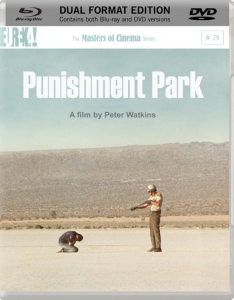
REVIEW – Punishment Park (1971)

FilmJuice have my review of Peter Watkins’ cruelly overlooked mock documentary Punishment Park.

Punishment Park is set in what was the near future back in 1971.  In this near future, America has descended into chaos and the American government has responded to this chaos by setting up a series of tribunals who give political prisoners the choice between a long jail term and taking part in a training exercise involving members of the police and the armed forces. These training exercises involve the prisoners being chased across a desert.  If they make it to a particular point by a particular time without being captured then they are free to go. Needless to say, nobody ever manages to escape:

On one level, Punishment Park functions as a near-future work of dystopian science fiction. If looked at in these terms, the exaggeration of the establishment’s reaction to political dissent is only a matter of degree and the exaggeration serves to highlight real problems in American political culture. Similarly, the dissidents’ futile march through a desert towards an American flag stands as a poignant metaphorical commentary on Humanity’s quest for freedom and how the value of freedom can be all too easily undermined by the very people entrusted with securing our attempts to achieve it. On another level, Punishment Park is a furious attack not only upon the politically intransigent elites that run America but also upon the biased nature of so-called reporting and the intellectually incoherent and simple-minded nature of responses to those elites.

Released in typically wonderful style by Masters of Cinema, this is a great opportunity to discover a lost classic of American cinema.