REVIEW – In Your Hands (2010)

Videovista has my review of Lola Doillon’s In Your Hands, a French drama starring Kristin Scott Thomas.

I think that In Your Hands is trying to be about quite an interesting question, namely whether loneliness creates a sense of desperation that blinds people to the human failings of the people who lift them out of loneliness. The film seems to explore this idea by having a socially isolated surgeon (Scott Thomas) be kidnapped by the husband (Pio Marmai) of a woman who died on her operating table. Initially, the dynamic is pretty generic as the surgeon reveals herself to be uninterested in human suffering to the point of being completely unwilling to recognise her role in the woman’s death, let alone apologise for it. However, as the film progresses and we learn more about the character, it transpires that the husband is also socially isolated and his relationship with the surgeon is actually the only one he has.  Sounds interesting, right? The problem is that the text of the film does almost nothing to support this reading:

The problem with the film’s central theme of alienation is that it is impossible to determine whether it is something that exists in the text of the film or whether it is something that I have made up out sheer boredom. Are we supposed to attend to the fact that neither of the characters have any friends or is their lack of social connection simply the product of weak characterisation and sloppy world building? Despite being only 80 minutes long, the film contains no context for the events surrounding the kidnapping, meaning that the characters begin and end the film as impenetrable cyphers. To make matters worse, having teased the audience with the idea that kidnapper and victim might have fallen for each other because that relationship was the only one they had, Doillon refuses to either acknowledge this interpretation of events or develop the insight in any meaningful way.

As I explain in the review, post-War art house cinema has developed a style of storytelling that presents us with an ambiguous set of events and then steps back and allows us the space to make sense of these events for ourselves.  This is why art house film is so slow: those moments of people peering off into the distance are there to give you some space in which to think. The problem with this approach is that many directors have come to rely upon audience participation to the point where they no longer both to present you with any well-drawn ambiguities… they simply show you some stuff happening and then retreat into beautiful cinematography in the hope that you will invent some thematic context that makes sense of the images on the screen. An excellent example of this type of filmmaking is Eugene Green’s The Portuguese Nun, a film so boring and pretentious that it left me wanting to wring the director’s neck when I reviewed it for FilmJuice:

If one were being particularly charitable one might attempt to argue that the film constitutes some kind of meditation on the affected and staged nature of film as a medium but if Green is indeed trying to present an argument then his ideas are either insufficiently clear or insufficiently substantial to support a 127-minute film.

Much like The Portuguese Nun, In Your Hands does contain some ideas but these ideas are so insubstantial and evasively presented that they barely constitute ideas at all. This is homeopathic cinema: while an idea may once have been near the production process, that idea has now been so thoroughly diluted that its presence in the film is now largely the product of the audience’s imagination.

Don’t Let Pop Culture Tell You Who You Are

Frequent visitors to this blog will by now have realised that both the form and frequency of my posting is subject to a good deal of fluctuation. Sometimes I crank out sizeable pieces on a regular basis, sometimes I provide only links and other times I post links to short reviews and publish larger essays. The reason for these variations is that my motivations sometimes change and when my motivations change, so to does the nature of my output.  These changes in motivation were particularly obvious when, earlier this year, I ceased to write very much at all.

At the time, I found this sudden lack of motivation rather distressing as I have always been able to re-motivate myself by shaking things up and writing about different things in different ways. In fact, this lack of motivation was so traumatic that I soon came to believe that my time as a critic might have come to an end. Needless to say, this did not actually happen but the reasons for this creative impasse strike me as interesting enough to warrant a proper post, if only for the sake of other people who may be experiencing similar motivational problems.

The problem was that I was going through the process of selling my childhood home and moving to an entirely new town. On a purely practical level, this made sitting down to write rather difficult. On a psychological level, this made it almost impossible to think about anything that was not directly related to the move. Unclear as to why I was finding it so difficult to sit down and write, I managed to convince myself that my motivation for writing has been completely destroyed by the realisation that there was really no point in sharing my views with anyone about anything. The reason I reached this particular creative impasse was that I encountered a number of works that encouraged me to think of myself purely as an introverted outsider and introverted outsiders tend not to be all that interested in sharing their opinions with other people. This is a post about the dangers of labelling oneself and then coming to believe that those labels exhaust your entire identity.

Continue reading →

REVIEW – Trouble in Paradise (1932)

FilmJuice have my review of Ernst Lubitsch’s classic 1930s romantic comedy Trouble in Paradise.

Set in 1930s Paris, the film tells of a pair of confidence tricksters who fall in love and decide to fleece the heiress to a large perfume fortune. However, as the male crook worms his way into the heiress’s affections as head of her household, he soon comes to realise that he actually prefers the identity he has assumed to the identity he was born with. Trapped between his growing love for the heiress and his standing relationship with a female crook, the confidence trickster is forced to contend with issues of class and ask himself what it is that he really wants from a relationship.

I must admit, I approached this film with some degree of trepidation as my experience of Lubitsch has always been tainted by Nora Ephron’s slushily sentimental You’ve Got Mail, a remake of Lubitsch’s immeasurably more elegant The Shop Around the Corner. Well… that and the wider problem that:

Most romantic comedies are rubbish. The reason for this is that the people who make romantic comedies want as broad an audience as possible and assume that the only way to reach this broad audience is to keep the subject matter simple-minded in order to make it accessible. This terror of alienating audiences has resulted in a cinematic culture in which romantic comedies tend to either be about actual teenagers (e.g. Juno and 10 Things I Hate About You) or about emotionally stunted adults who behave like teenagers (e.g. High Fidelity and Amelie). The reason why genre classics such as Annie Hall, His Girl Friday and The Apartment have endured while the likes of My Big Fat Greek Wedding and What Women Want have faded from view is because these classic romantic comedies speak of grown-up relationships in a way that ensures their continued relevance to generations of grown-up film lovers. Indeed, if the measure of a romantic comedy’s greatness is its level of emotional sophistication then few romantic comedies come anywhere close to rivaling the magnificence of Ernst Lubitsch’s Trouble in Paradise.

Aside from being beautifully acted, wonderfully made and occasionally very funny indeed, the film also contains some real insight into the ambiguities and challenges of managing an adult relationship. Are you with the right person? Are you with the right person for the wrong reason? What kind of person would you be if you were to spend your life with a different person than the one you have? These are not the types of questions that appear in most romantic comedies as most romantic comedies are focused upon the adolescent adrenaline rush of first love. However, as anyone who has been in a long-term relationship will tell you, those early months are really very different to the emotional and intellectual landscape of genuinely long-term relationships. Trouble in Paradise is a real joy to watch as it speaks directly to the nature of adult relationships in a way that adults can understand.

REVIEW – Polisse (2011)

FilmJuice have my review of Maiwenn’s award-winning police drama Polisse.

The critical success of The Wire and The Sopranos has created something of a market for intelligent police procedural dramas. Incapable of keeping up with demand, British TV has begun casting its net further afield than the anglophonic sphere resulting in the explosive popularity of French series like Spiral and Braquo and Scandinavian series such as The Killing and The Bridge. Clearly designed to tap into a similar zeitgeist, Maiwenn’s Polisse is an intelligent and bleak police drama set around a Parisian child protection unit.

Maiwenn decided to make the film after seeing a documentary about child protection units. Drawing on her showbiz contacts, the director embedded herself in a working police unit and recreated everything she saw on set with actors. In other words, when a stressed single mother explains that one of her sons is better behaved than the other because she jerks him off every night, chances are that someone actually said that to a police officer in front of this film’s director.  Even more astonishing is the fact that the woman’s naïve belief that this type of behaviour is a normal part of parenting is utterly convincing and disarmingly human. Shot in a documentary style and performed by an absolutely fearless cast of adult and child actors, these little vignettes crackle with the kind of uncomfortable energy that you only get when an unpleasant truth is well and truly pinned down.

As brilliant as these interview section may be, the rest of the film suffers for Maiwenn’s misguided attempt to crowbar an entire TV series’ worth of narrative and character development into a mere two hours. What this means is that while each of the ensemble cast receives a big emotional moment, none of these moments feel in any way connected to the film’s limited space for character building and drama. The result is a film that lurches from one hysterical outburst to the next and by the time you’ve seen your third copper break down in tears and punch a wall the film’s hysteria begins to seem comical, which is really quite unfortunate for a film about child abuse.

REVIEW – Mon Oncle (1958)

FilmJuice have my review of Jacques Tati’s satirical comedy Mon Oncle.

When I recently reviewed Tati’s Jour de Fete, I was struck by how little satirical power the film actually possessed. Jour de Fete‘s satire is entirely toothless as it attempts to mock the desire for improved professionalism and efficiency by telling the story of a local postman who falls for an American propaganda film portraying American postmen as militaristic supermen who ride motorbikes through flaming hoops in an effort to deliver the mail as quickly as possible. The problem with this ‘joke’ is that exaggerates both American efficiency and the French desire to emulate American efficiency to the point where neither the subject nor the satirical instrument bear any relation to reality. Judged solely as a satirical piece, Mon Oncle is a far superior film to Jour de Fete as it not only nails the bourgeois aspirations but also the way in which these bourgeois aspirations bring nothing but ugliness and misery to the world. Set in a city of two halves, the film sends Tati’s slovenly Monsieur Hulot out of his charmingly tumble-down apartment and into the corporate suburbs where everything is clean, modern, American and monstrously ugly:

The plot of the film revolves around a battle for the soul of Arpel’s son Gerard who adores his uncle despite the fact that Hulot has no job, no ambition and no material possessions outside of his hat, raincoat and pipe. Realising quite early on that Hulot appears to be have an undue influence on his son, Arpel attempts to lure Hulot into his life of bourgeois consumerism first by fixing him up with a wealthy neighbour and then by offering him a job in his hose pipe factory. Tati chronicles these doomed attempts at embourgeoisement with a good deal of charm and inventiveness as Hulot brings chaos to dinner parties, family meals and the workplace. Hulot turns gardens into building sites, hosepipe manufacture into sausage making and expensive sofas into unfashionable beds. Like a virus with hat and pipe, Hulot spreads authenticity wherever he goes resulting not in his elevation to the bourgeoisie but the collapse of his in-laws into the same happy slum where he (and by implication most French people) live their daily lives.

I liked this film a good deal more than I liked Jour de Fete as Tati’s gentle slapstick takes a back-seat to his desire to criticise the French middle-classes.  On a technical level, the film is also a good deal more impressive as Tati attacks French society in quite complex ways but without using very dialogue. The result is an absolute masterclass in visual storytelling.

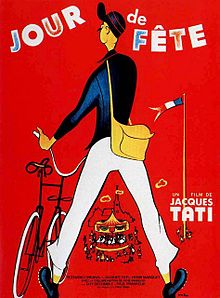
REVIEW – Jour de Fete (1949)

FilmJuice have my review of Jacques Tati’s Jour de Fete, which has just been given a dual-format re-release by the BFI.

Tati has always been something of a problematic figure for me. Having seen Les Vacances de Monsieur Hulot, I have always been aware of Tati’s skills as a performer but I have never quite grasped why it is that Tati is taken seriously as a filmmaker whilst the work of most comic directors is studiously ignored. One answer to this perplexing problem is that Tati’s work was championed by a certain group of critics at a certain point in time and that nobody has since bothered to question the assumption that he is a great film-maker. Another answer is that Tati, though a director of comedies, not only developed a coherent voice but used that voice to critique French society.

Set in a small French town in the midst of a carnival, Jour de Fete is a whimsical slapstick comedy featuring a country postman who takes it upon himself to modernise the entire French postal service, one delivery at a time. Unfortunately, while I appreciate both the uniqueness of Tati’s vision and his skill as a performer, I found the satirical elements a little too broad to be genuinely effective:

Jour de Fete is often spoken of as a treatise against American-style modernisation and while it is easy to see that Tati is attempting to satirise the ludicrous idea of an efficient French postal service, the satire is so broad that it fails to gain much traction on the world. Indeed, the best joke in the entire film is the idea that American postmen are so fast and efficient that they train for their jobs by jumping through flaming hoops on motorbikes. However, as beautiful as this idea may be, its absurdity completely overcooks the gag and boils away the film’s satirical edge leaving only a whimsical residue. The point of satire is to mock things that actually exist but surely even the most zealous of corporate reformers would allow postmen to get off their bikes when delivering letters. By presenting the desire for economic modernisation in such ludicrous terms, Tati’s satire fails to connect with anything real.

Or maybe it’s just me.

REVIEW – Die Nibelungen (1924)

FilmJuice have my review of Masters of Cinema’s re-release of Fritz Lang’s fantasy epic Die Nibelungen.

Originally released in two halves as Die Nibelungen: Siegfried and Die Nibelungen: Kriemhilde’s Rache, the film spend five hours exploring the tension between the passions that drive society onwards and the rules developed to govern that society’s violent impulses and channel them into more productive pursuits such as the construction of a modern state governed by enlightened individuals. The film begins with a great hero making his way to what he assumes to be a shining city on a hill… a beacon of medieval civilisation in an ocean of blackness and savagery.  Upon arriving at the legendary city of Burgundy, the hero falls in love with the king’s sister but in order to gain the permission to marry Kriemhild, Siegfried must trick the hero Brunhild into marrying cowardly king Gunther. Brunhild eventually discovers the ploy and demands that Gunther redeem herself by killing Siegfried. Weak and afraid, Gunther convinces his chief knight to murder Sigfried prompting his sister Kriemhild to present him with an ultimatum: Either Gunther betrays his chief knight and does justice to Kriemhild or he remains loyal to his knight and ignores the injustice that keeps him on the throne.

Die Nibelungen is essentially the story of an immoral oyster pearl.  Though Gunther is the king of a great country his desire for the hero Brunhild prompts him into doing something immoral. Trapped in a lie, Gunther then adds to his woes by first murdering his friend and then turning his back on his beautiful sister who promptly runs off and marries the lord of the Huns in an effort to force her brother to do her justice. The more Gunther denies wrong-doing, the greater the injustice grows and the greater the injustice grows, the more transparently immoral the world becomes:

It is easy to see why both Adolf Hitler and Joseph Goebels claimed Die Nibelungen as one of their favourite films. Aside from the Germanic origins of the Nibelungen stories, Lang also draws heavily upon the idea that a group of blond-haired heroes might emerge from the common muck of humanity and, through sheer force of character, build a shining civilisation on a hill. Marinated in the same myths of national exceptionalism that informed the iconography of the Third Reich, Lang’s film presents the king of the Dwarves as a treacherous Jew and the emotional energies unleashed by Kriemhild at the end of the film as a tide of dark-skinned savages from the East. This is not just a film that is of its time, this is a film that perfectly captures a time when a society’s capacity to regulate its own behaviour can no longer cope with the violent forces at work in the culture at large. By refusing to constrain his feelings of lust for Brunhild, Gunther is forced to trick her into marriage, by refusing to discuss or atone for his dishonest seduction of Brunhild, Gunther is forced to murder his friend, by refusing to acknowledge that he had his friend murdered, Gunther is forced to go to war with his sister and by attempting to justify his actions through an appeal to loyalty, Gunther undermines the entire moral infrastructure of his society… there are no rules, there are no principles, there are no cities on the hill… there is only violence, lust, madness and death.

Lang’s Burgundian society reflects a German political culture that was finding it increasingly difficult to deal with intense feelings of anger and desire. Pickled in war resentment and drunk on a growing sense of historical self-importance, German culture burst its banks and drowned Europe in blood while German political elites either worked the crowd or went with the flow. Die Nibelungen‘s political elites use words like ‘honour’ and ‘loyalty’ but these words become increasingly meaningless as the film progresses.  Just as American political elites use words like ‘freedom’ and ‘patriotism’ to justify violence and repression, King Gunther uses the word ‘loyalty’ to justify the betrayal and murder of his brother-in-law. By distorting shared values in an effort to justify their own selfish desires, the royals of Die Nibelungen paint themselves into a political corner: fully aware that their war will lead to nothing but destruction, they can neither compromise nor make peace as the words required to broker a cease-fire have been rendered completely meaningless.

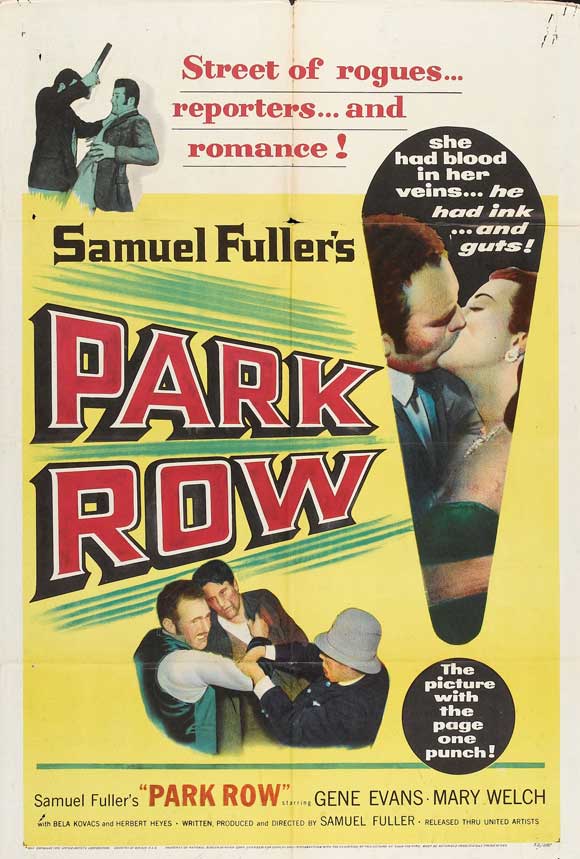
REVIEW – Park Row (1952)

FilmJuice have my review of Samuel Fuller’s classic film Park Row.

Set in 19th Century New York where dozens of newspapers are competing for dominance, Park Row tells the story of Phineas Mitchell… a reporter whose nose for a story and willingness to rattle cages results in him being sacked from one paper only to be given the editorship of another. The scene in which this professional transition takes place is telling as Mitchell is appointed as editor not because of his politics or his experience but because of the manifest greatness of his journalistic talent.  What makes this film so interesting is that while most films about journalism invoke the concept of journalistic greatness, many choose to define that concept in strictly moral terms: Did this journalist speak the truth? Did they change the world? Park Row, on the other hand, defines journalistic greatness in terms that are entirely amoral:

Unlike many odes to journalistic greatness, Fuller eschews both sentiment and morality in order to celebrate Mitchell’s ability to strike a chord and continue to play a tune regardless of how many people get crushed on the dance floor. Drawing freely from the press room cynicism of Citizen Kane’s opening act and pre-empting the vision of 19th Century New York as a bubbling cauldron of tribal violence in Martin Scorsese’s Gangs of New York, Fuller praises a form of journalistic greatness that the newspaper business is now only too eager to forget. Mitchell’s greatness is not that of Bernstein and Woodward in Alan J. Pakula’s All the President’s Men or that of Edward R. Murrow in George Clooney’s Good Night, and Good Luck, this is the greatness of Orson Welles’s Kane, Rupert Murdoch and Robert Maxwell. A form of greatness measured not in moral victories but in blood and gold… the type of greatness that builds industries and nations at the expense of individuals… the type of greatness that built America.

Made entirely with Fuller’s own money, Park Row is not just a love letter to journalism, it is a love letter to a sharp-edged and chaotic form of life that has now been excluded from the middle-class existential vocabulary.  Mitchell is neither a sharp-elbowed careerist or a shabby paladin, he is a brutal and energetic man who prowls through life with all the malignant pugnacity of a tiger with tooth-ache. This is a man who demands ‘Truth’ and ‘Liberty’ in much the same way as he might turn on you in order to demand ‘Did you just spill my pint?’. When Mitchell feels professionally marginalised, he starts his own newspaper. When Mitchell needs a story, he throws someone in jail in order to mount a campaign to secure their liberation. When Mitchell feels hard-done by, he takes to the streets and begins rioting. It is hardly surprising that many people have pointed out that Phineas Mitchell bears a striking resemblance to the cigar-chewing Fuller himself.

French Style – How Economics Turns World Cinema into French Film

Earlier this year I wrote a post about the lack of diversity in the films considered for the 2012 Cannes Film Festival Palme D’Or. While that post focused principally upon the demographics of the directors considered for the award, I was also concerned by the Cannes-centric feedback loop that appears to be encouraging non-French film directors to begin making films in France. I delve into this idea in a little more depth in my latest feature for FilmJuice entitled French Style – How Economics Turns World Cinema into French Film.

The thrust of my argument is that France has become so good at protecting and encouraging French film that the French film scene is beginning to suck talent from the rest of World Cinema. The most notable examples of this process are the Iranian film director Abbas Kiarostami and the Austrian director Michael Haneke:

By providing ambitious filmmakers with an oasis of financial stability, the French state may also have begun a process of cultural assimilation through which non-French directors surrender their distinct cultural identities in an effort to produce French films for the French marketplace.

Aside from the fact that non-French cinematic voices are beginning to acquire a distinctly Gallic accent, there is also the problem posed by these older established voices crowding out younger home-grown talents. France ensures that a certain number of its cinema screens must show French films but why would a cinema chain choose to show a French film by a director like Mia Hansen-Love and Katell Quillévéré when they can show a film by an award-winning star of world cinema?

REVIEW – Jeff, Who Lives at Home (2011)

FilmJuice have my review of Jay and Mark Duplass’s indie dramedy Jeff, Who Lives at Home.

A little while ago, I wrote a piece giving full vent to my growing feelings of frustration with US ‘independent’ film. Once a home to quirky and insightful comedy-drama hybrids, US independent film is now a highly formulaic cultural space where directors make and re-make the same films over and over again while Hollywood A-listers grub for awards by pretending to be normal people with normal problems. However, as much as I felt that Reitman’s Young Adult was a retread of an already overly-familiar path, Jeff, Who Lives at Home is possibly the most generic film of all time:

Packed with stock characters wandering through the kind of character arcs that grace dozens of other films, the Duplass brothers deliver the achingly familiar in a style that is as safe as it is forgettable. In fact, this film’s characters are so recognisable that one cannot help but feel deprived of the actors that are usually typecast in these particular roles. For example, Segel is as likeable here as he was in Forgetting Sarah Marshall but his turn as a rudderless geek with a heart of gold lacks the satisfying bedrock of anger and self-loathing that the likes of Seth Rogen and Jonah Hill usually bring to this character type. Similarly, Helms’ Pat is a gruff pepper pot of squabbling neuroses but his charmless irritability does nothing but remind us of the profound humanity that allowed Paul Giamatti to effectively monopolise this type of part.

The worst thing about this film is that on the margins of the plot, partly obscured by white middle-class males ‘learning’ and ‘growing’, is a beautiful sub-plot featuring Susan Sarandon as a woman who, in late middle-age, comes to realise that what she really needs to make her happy is a sexless love affair without another straight woman. Both a much needed response to the growth in bromance movies and an amusing nod to the sexless love of Thelma and Louise, this sub-plot really does merit its own film. Fuck generic white guys, give me non-heteronormative middle-aged women!